
A complete issue · 16 pages · 1883
Life — August 9, 1883
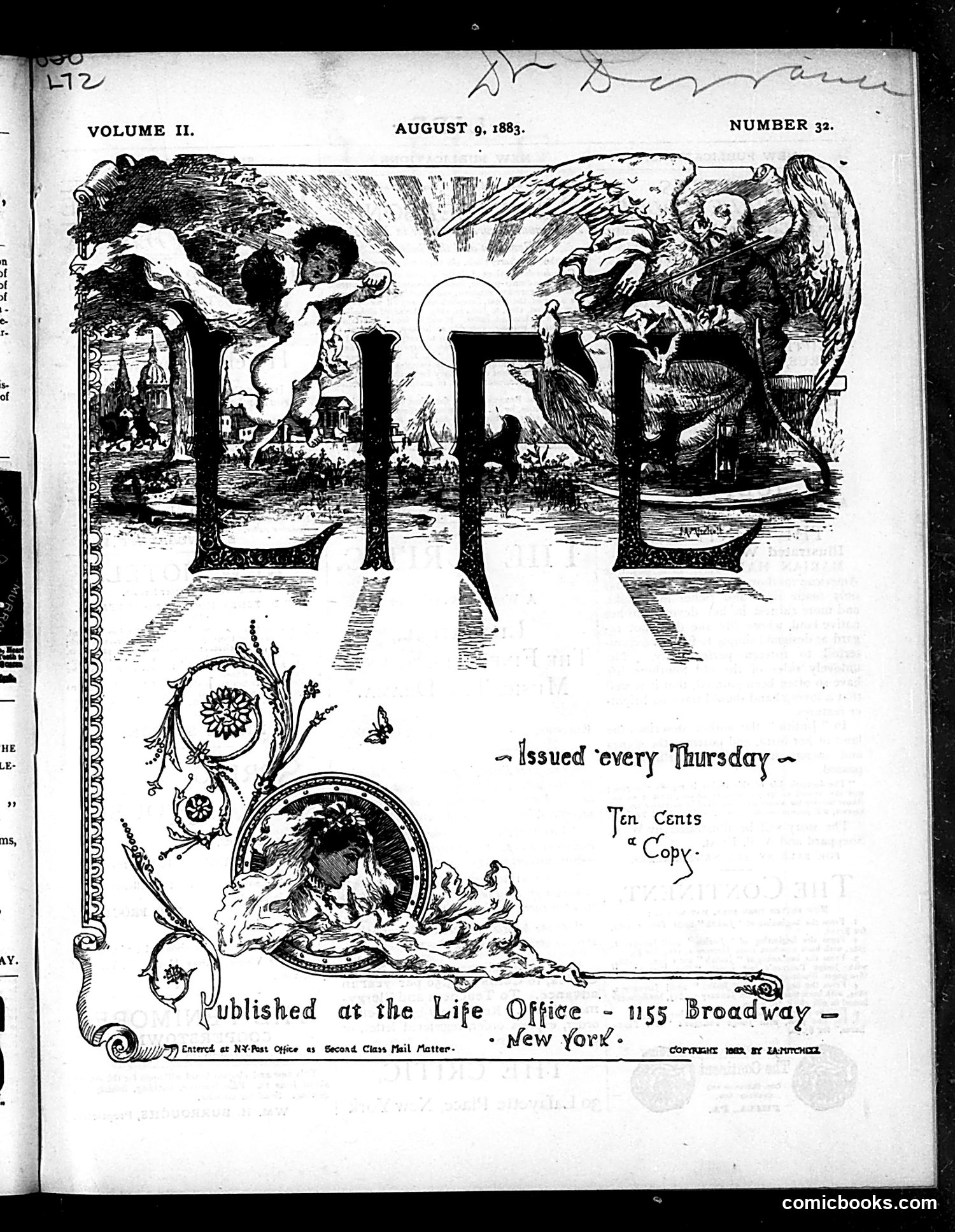
This is the cover of *Life* magazine, a satirical weekly published in New York. The elaborate illustration depicts a fantastical scene with elaborate decorative framing. Large letters spelling "LIFE" dominate the center, with theatrical figures and architectural elements surrounding them—including what appears to be classical or mythological imagery with cherubs and dramatic landscapes visible through the letter-forms. The ornate border and allegorical imagery suggest this is primarily a *cover design* rather than commentary on specific current events. Without additional context or readable text identifying particular political figures or situations, the exact satirical target remains unclear. The artistic style and decorative approach were characteristic of *Life's* aesthetic during this period, emphasizing artistic presentation over topical political commentary.
This page is **primarily advertising and announcements**, not satirical content. It contains advertisements for new publications, including: - **Richter's Invisible Lodge** (German translation) - **Marian Harland's new story** in *The Continent* illustrated magazine - **The Critic**, a weekly literary review journal The right column advertises summer resorts and hotels in New York and surrounding areas (Parker House, Hotel Netherwood, The Dutcher House, Spring House, The Fenimore). The page header identifies this as "LIFE" magazine, and the content reflects the publication's dual nature as both satirical magazine and venue for literary/commercial announcements. **No political cartoons or satirical commentary appear visible on this particular page.**
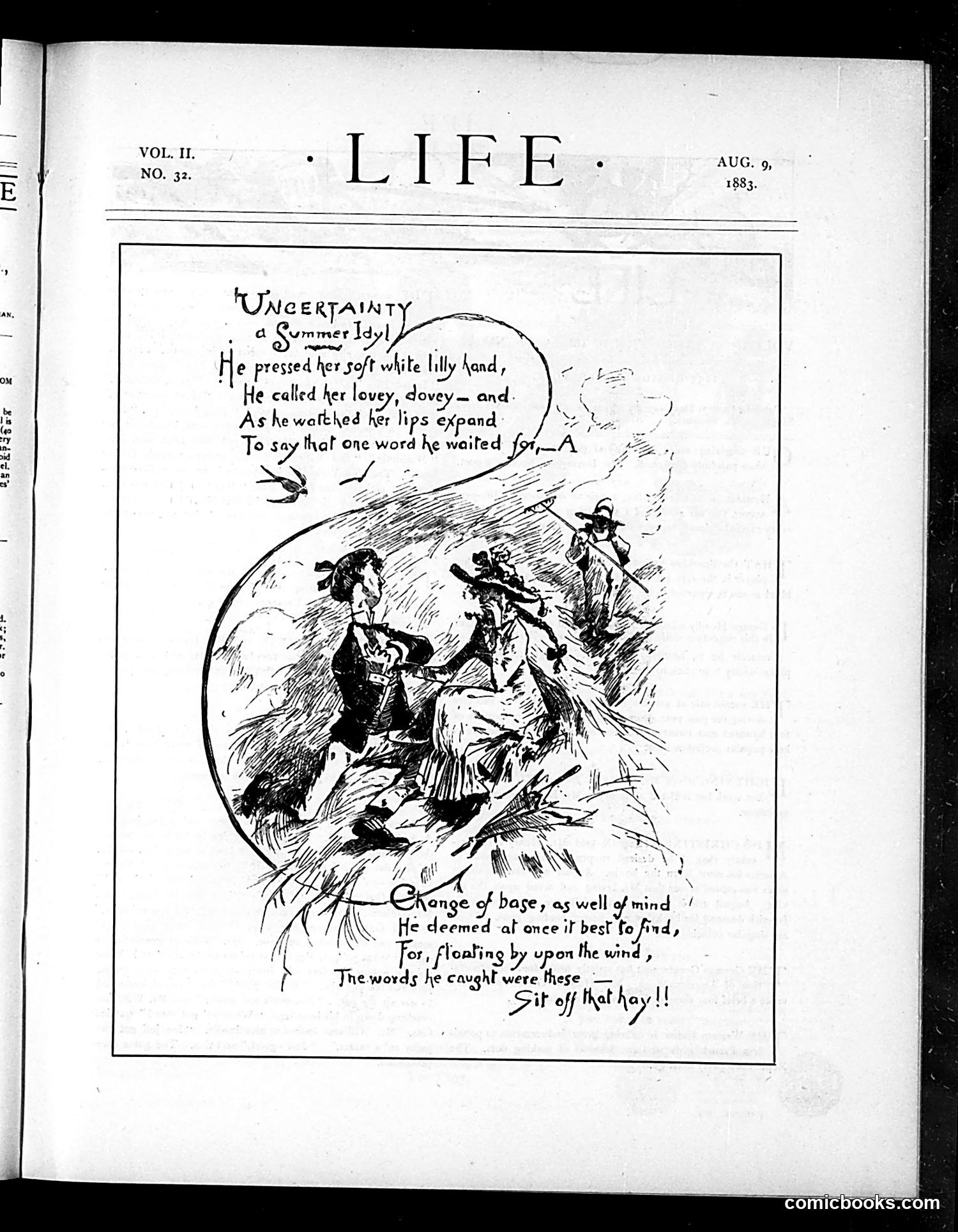
This 1883 *Life* cartoon satirizes romantic indecision. It depicts a couple in an intimate moment—he presses her hand softly while calling her endearments ("lovey, dovey")—yet he waits anxiously for one crucial word: her answer to an implied marriage proposal. The humor plays on the uncertainty of courtship conventions of the era, where men bore the responsibility of proposing but faced agonizing suspense awaiting acceptance. The punchline—"Sit off that hay!!"—suggests the woman's response is not romantic acceptance but practical annoyance at their uncomfortable location, deflating the romantic tension entirely. The satire gently mocks both romantic melodrama and the gap between male expectations and female concerns.
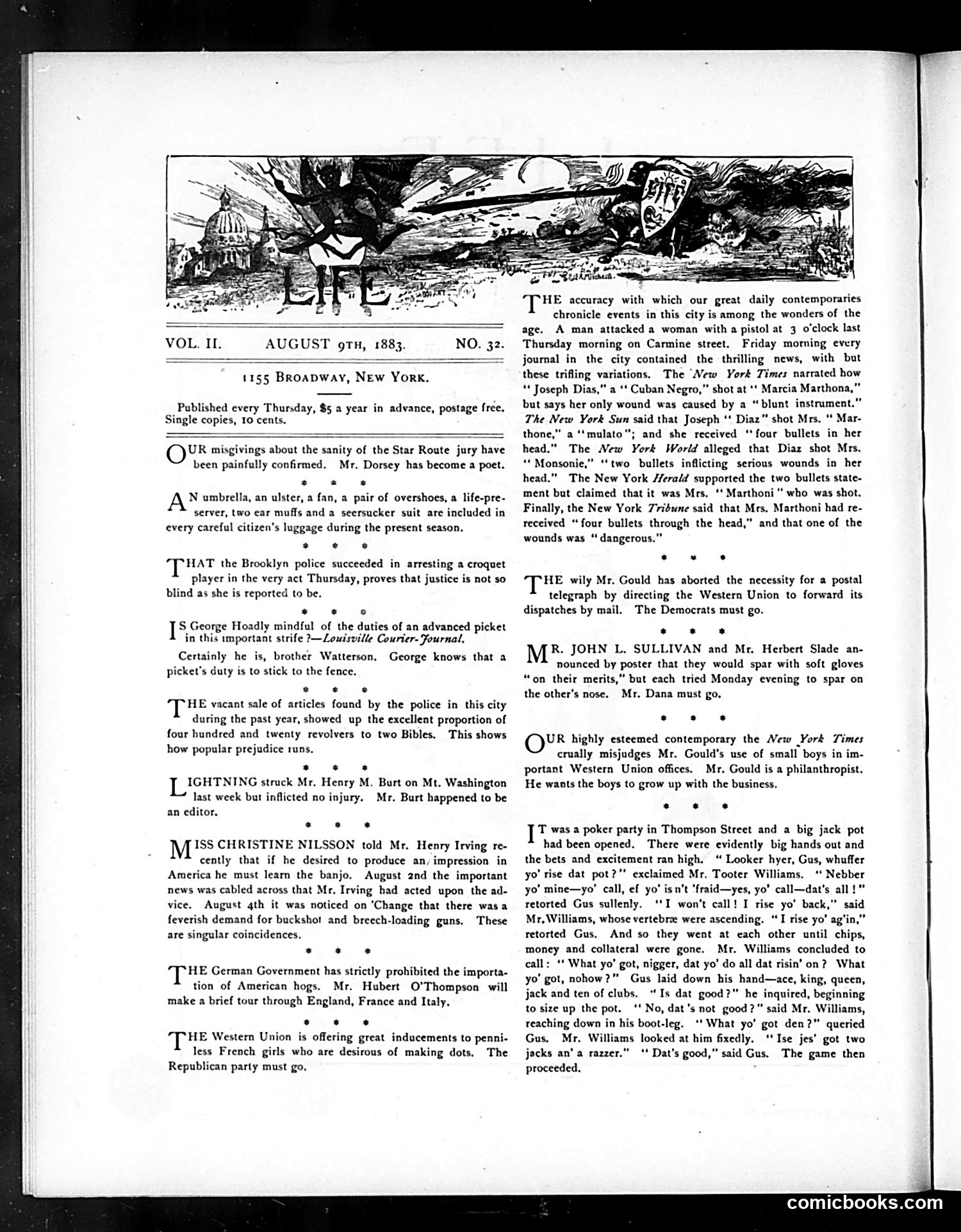
The header illustration depicts a skeletal Death figure sitting in a chair beneath a crescent moon and bare tree—a memento mori image typical of 19th-century satirical publications. The text below consists of brief satirical "items" mocking contemporary news and personalities, rather than political cartoons. These include jabs at: - The Star Route jury's sanity - Police procedures and judicial blindness - Western Union's telegraph monopoly and Mr. Gould's business practices - The New York Times's misuse of child laborers - German restrictions on American hog imports - Various minor social observations The page functions as editorial commentary on current events, scandals, and absurdities rather than featuring illustrated political cartoons. It's representative of Life's satirical house-organ style from this period.
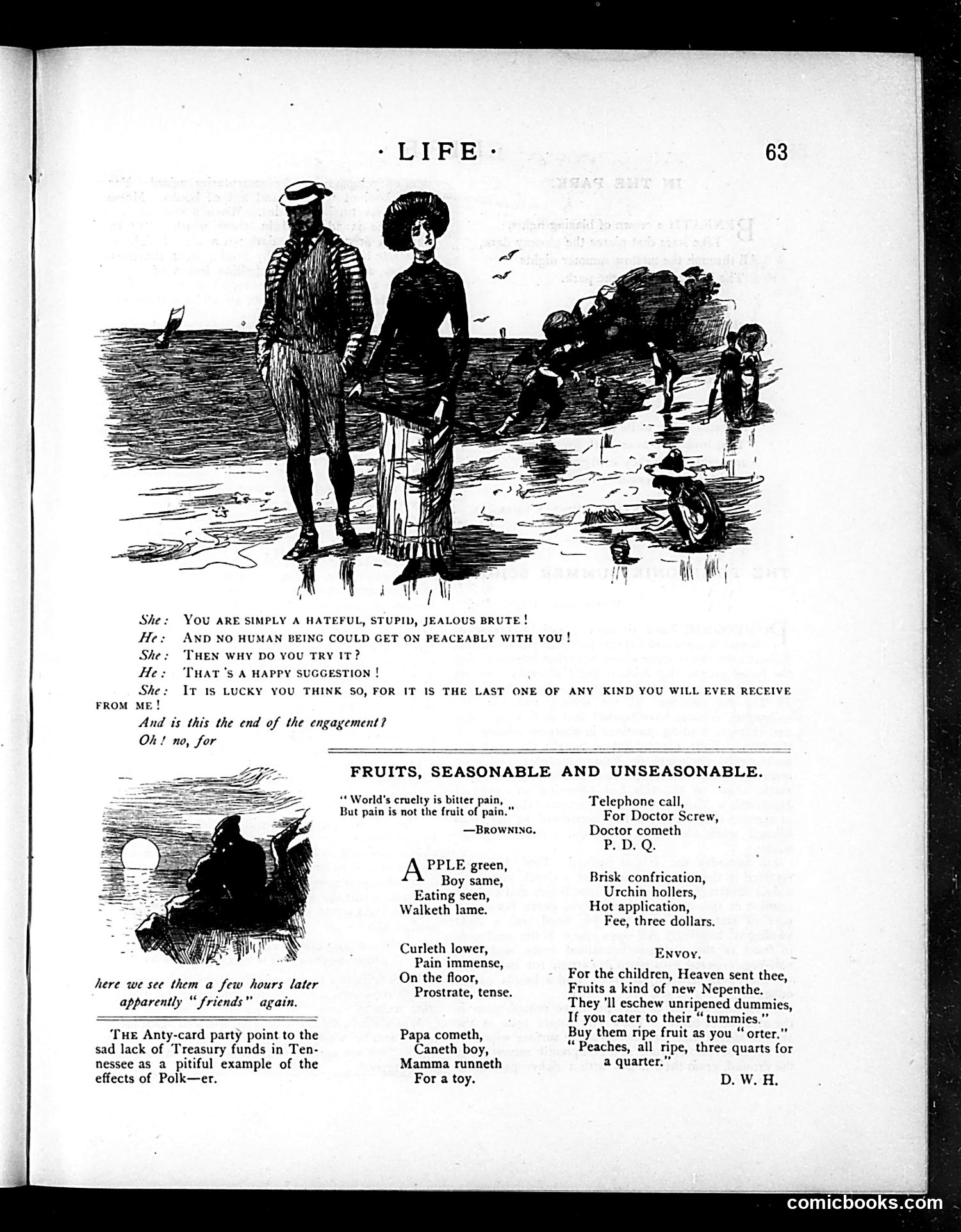
The top cartoon depicts a seaside quarrel between a well-dressed couple. The woman accuses the man of being "hateful, stupid, jealous" while he responds that "no human being could get on peaceably with you." She sarcastically suggests they should try to get along; he agrees it's a "happy suggestion," but she has the final word: this will be the last kindness he'll receive from her. The illustration shows children playing in the background, indifferent to the adult drama. Below is a separate humorous poem titled "Fruits, Seasonable and Seasonable" mocking various ailments and remedies, likely social commentary on contemporary medical quackery or human folly. The satirical verse employs wordplay about apples, papa cometh, and other produce as metaphorical or literal treatments.
This page contains a romantic poem by Frank Dempster Sherman about lovers in a moonlit park, followed by a satirical article about Pompoonik's summer school (July 1883). The satire targets academic pretension. The school, described as teaching "Transcendental Science and Ethical and Æsthetical Culture," is mocked for its complete absence of books and absurdly abstract debates—including whether spiders use telegraphy via invisible batteries in their abdomens. Professor Izikslumis is ridiculed for arguing that "ideas" themselves are unknowable, while colleagues sleep during lectures. The piece satirizes late-19th-century transcendentalist philosophy and pseudo-intellectual institutions that prioritized vague theorizing over practical learning. The rustic setting and elaborate nonsense highlight the gap between lofty educational ambitions and actual substance.
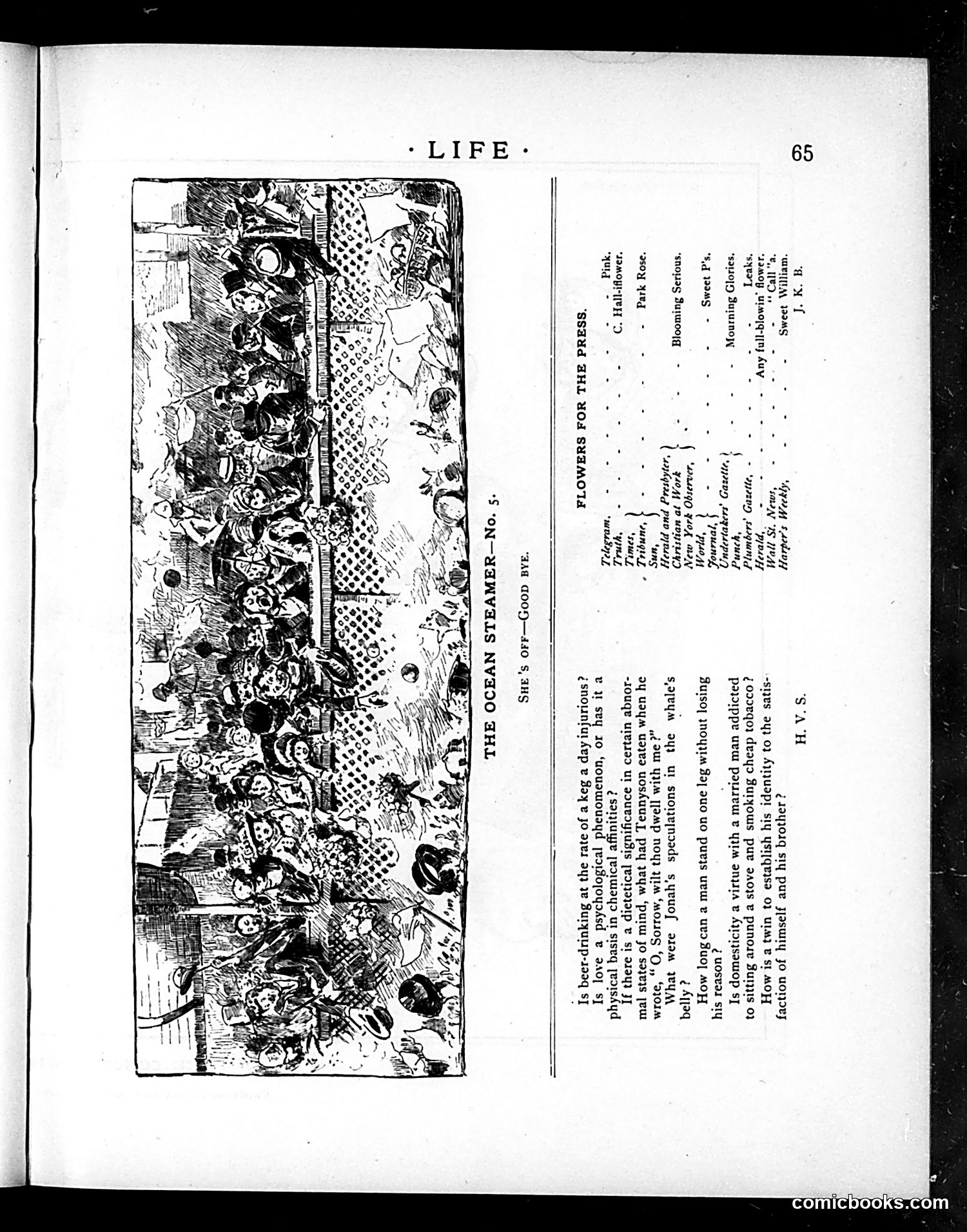
This appears to be a satirical illustration of crowded conditions aboard an ocean steamship. The densely packed scene shows numerous passengers in what seems to be a below-deck area or steerage section, with elaborate period dress and chaotic activity. The accompanying text discusses psychological observation, noting how a "leg dangling" creates a "difficulty in me?" and references measuring "small about 2 inches" with mention of "O. Sorry, it must being without being." The satire likely critiques overcrowding and poor conditions in ship travel, possibly steerage accommodations common in the late 19th/early 20th century. However, the OCR text is largely illegible, making the specific satirical target unclear. The illustration's exaggerated detail suggests criticism of either the shipping industry's practices or passenger behavior during travel.
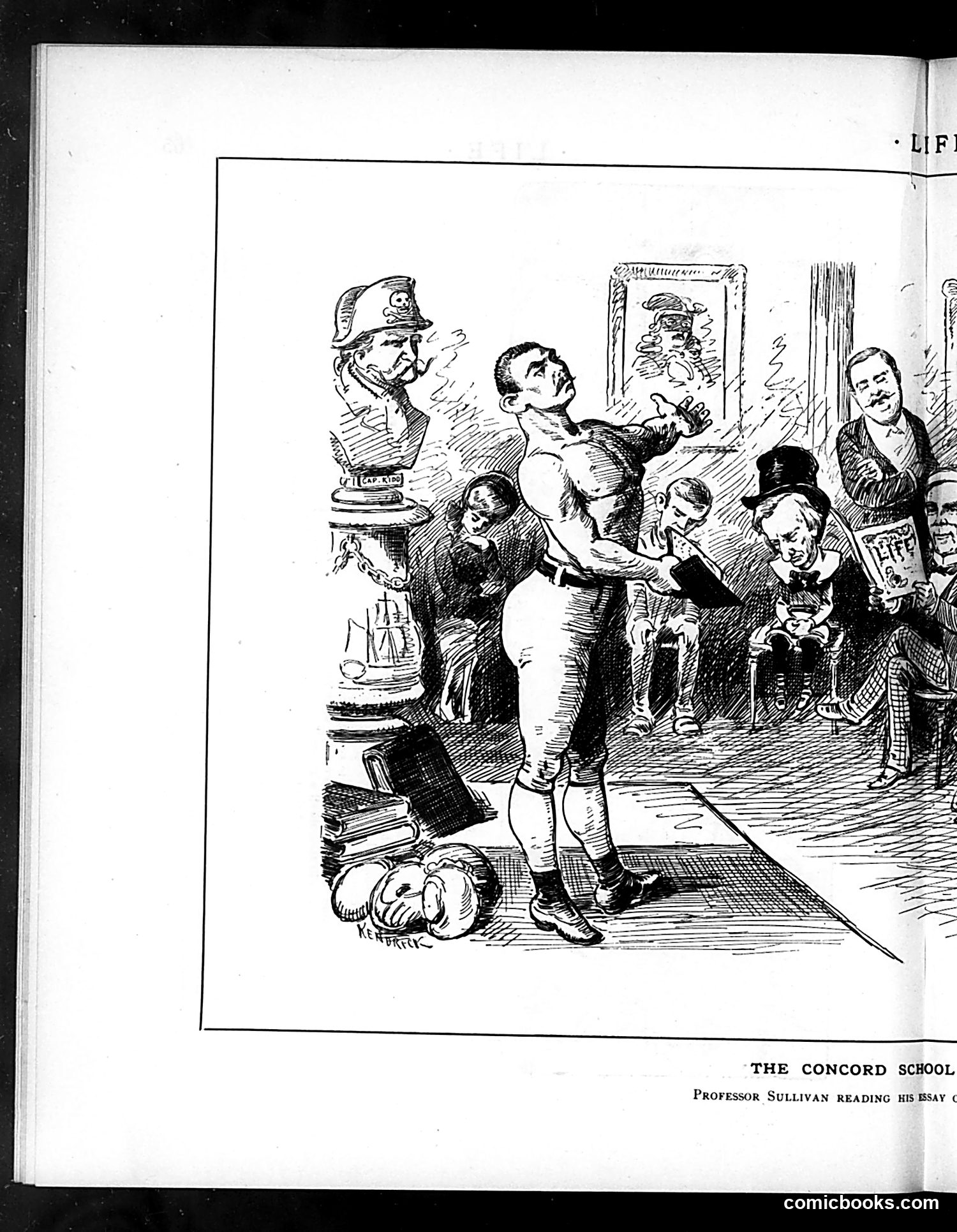
This satirical cartoon depicts "Professor Sullivan" presenting an essay to an audience at what appears to be the Concord School of Philosophy. The central figure is a portly man in undergarments, gesturing dramatically while addressing an assembled crowd of well-dressed observers. A bust (likely of a famous philosopher) sits prominently on a pedestal to the left, alongside books. The satire appears to mock both the pretentiousness of the Concord School—a real 19th-century institution in Massachusetts associated with transcendentalist philosophy—and the figure's undignified appearance while delivering supposedly serious intellectual work. The contrast between the scholarly setting and the professor's state of undress creates the cartoon's humor, suggesting absurdity in academic pomposity.
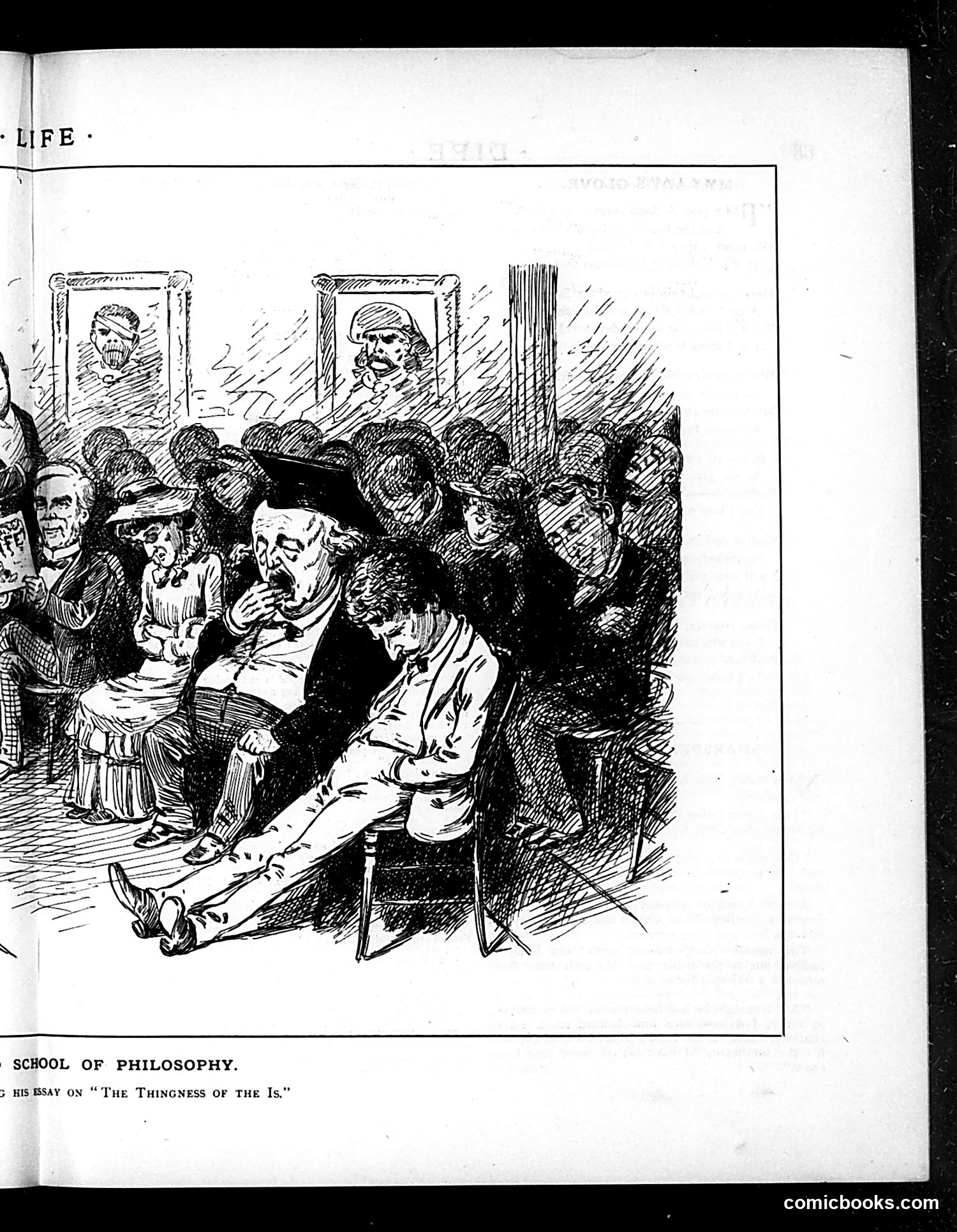
This satirical cartoon depicts a crowded, informal lecture scene titled "School of Philosophy," with a caption referencing "His Essay on 'The Thingness of the Is.'" The cartoon mocks pretentious philosophical discourse. A central figure sits prominently, appearing to hold forth to an assembled crowd of listeners in what seems a cramped, working-class setting. The dense crosshatching and crowded composition suggest chaos rather than dignified intellectual pursuit. The satire appears to target either a specific philosopher's obscure essay or more broadly ridicules abstract philosophy that prioritizes incomprehensible wordplay ("thingness of the is") over practical sense. The ragged, ordinary appearance of the "students" suggests Life magazine is mocking both the pretension of philosophical lecturing and perhaps the gullibility of audiences drawn to such incomprehensible intellectual posturing.
This humorous sketch mocks a rustic newcomer, Josh Hornblower from Niagara Falls, who boards a steamship without understanding maritime protocol. When asked to "settle" (pay for his ticket at the captain's office), the thick-accented rural character repeatedly misinterprets the instruction as a casual suggestion to relax or sit down. The satire targets backwoods ignorance—Hornblower's dialect and confusion suggest he's unfamiliar with city conventions. His eventual violation of social boundaries (removing shoes and lounging in the captain's private quarters) underscores the joke: a country rube fundamentally misunderstands how civilized society operates, treating formal nautical procedures as hospitality. The piece reflects late 19th-century American humor's reliance on ethnic/regional dialect comedy and class-based ridicule of "outsiders" to urban, sophisticated settings.
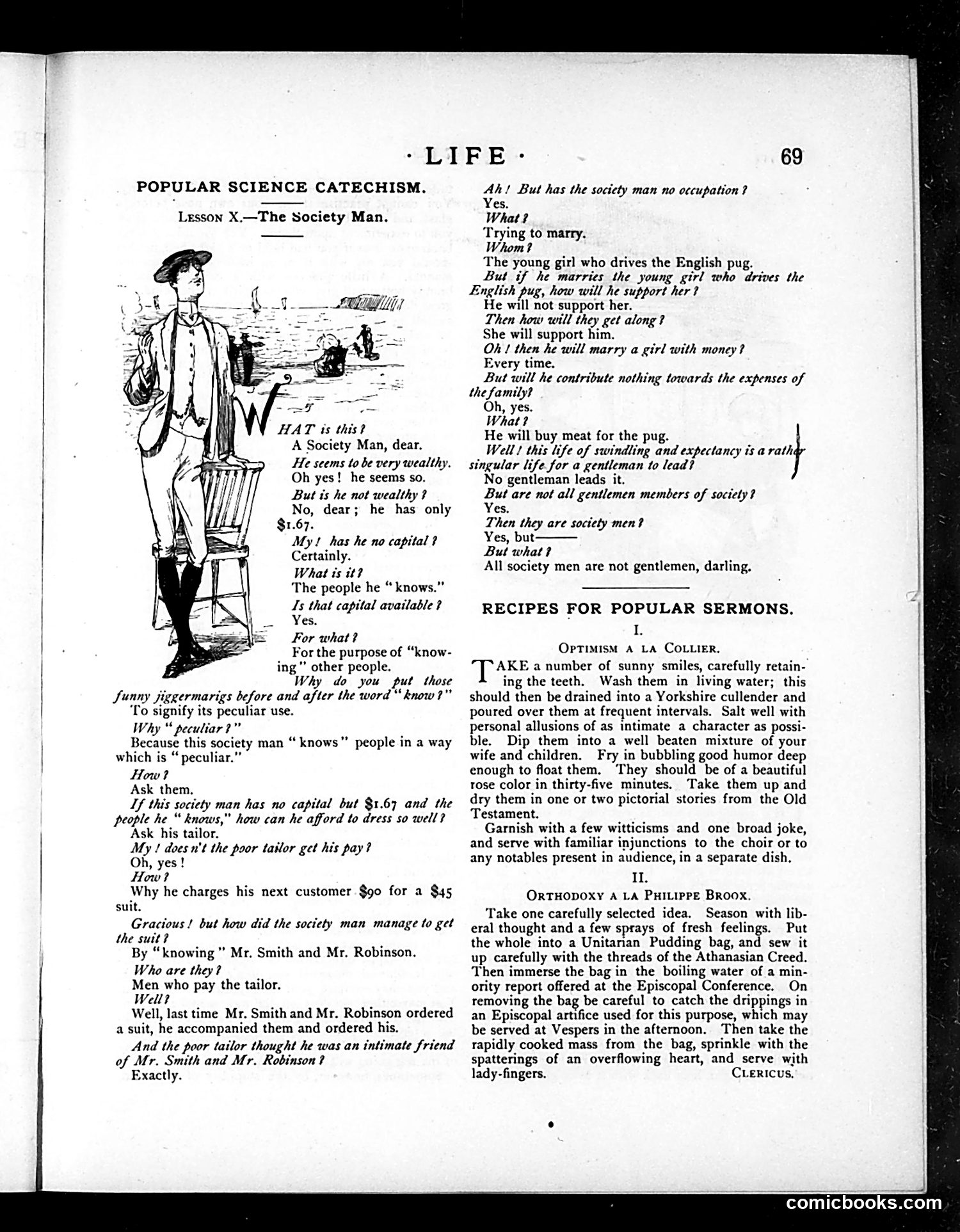
This two-part page satirizes the American upper-class social climber circa early 1900s. **The Main Cartoon** (left) mocks the "society man"—a wealthy-*appearing* gentleman who actually possesses only $1.67 in actual capital. His real "wealth" is social connections he exploits through quotation-marked "knowing" of rich people. The joke: he dresses fashionably by befriending wealthy men like Mr. Smith and Mr. Robinson, then ordering suits alongside them so tailors assume he can pay. The tailor recoupes losses by overcharging subsequent customers. The man's marital prospects are equally parasitic: he'll marry a wealthy girl (humorously described as one "who drives the English pug") and contribute nothing but buying dog meat—she'll support *him*. **The Sermon Recipes** (right) parody popular preachers of the era (Collier and Philippe Brooks appear to be references), reducing their sermons to absurd recipes mixing platitudes, sentiment, and denominational politics into easily digestible packages for audiences. Together, the page critiques both social pretense and superficial morality in Gilded Age America.
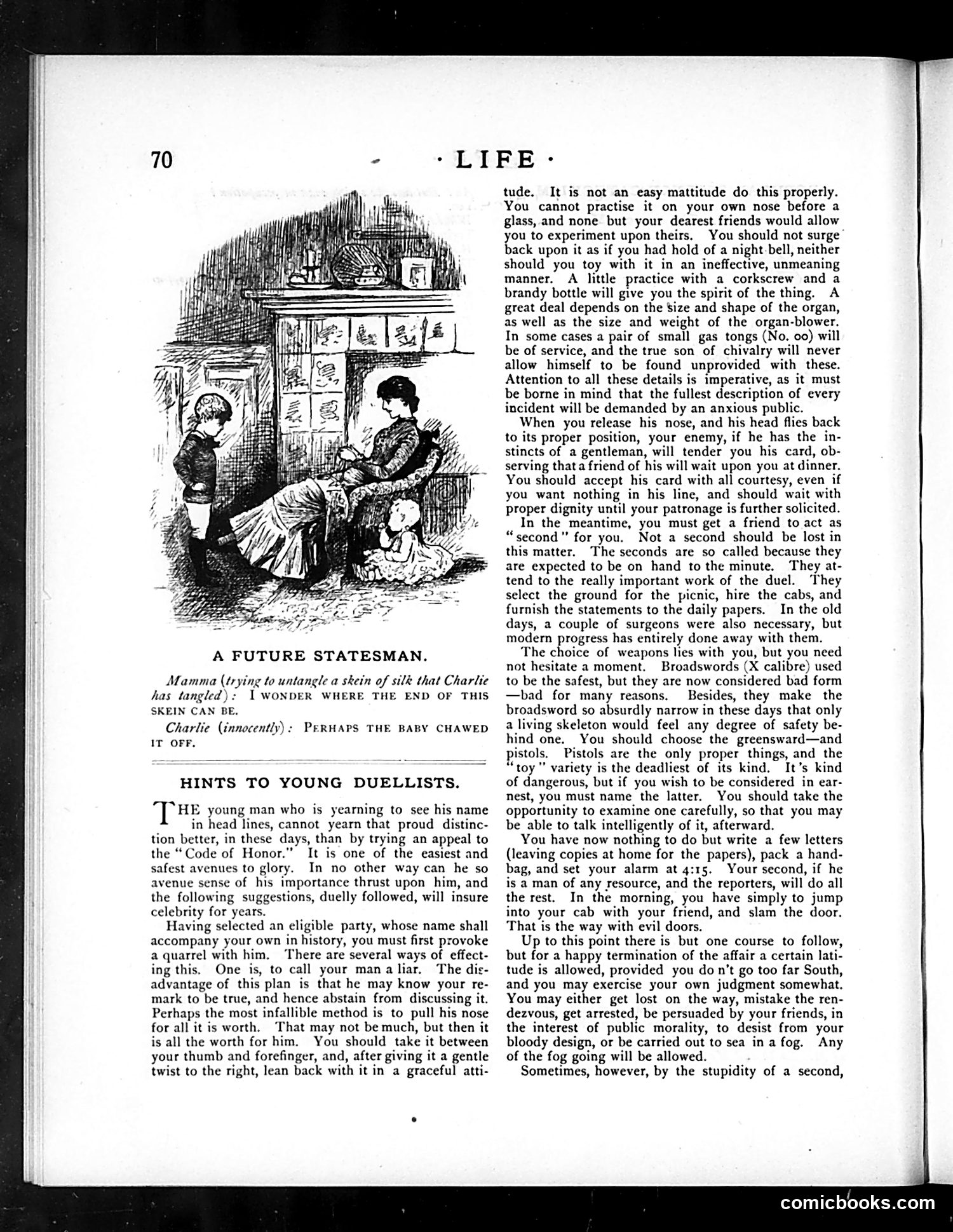
This page contains two satirical pieces: **"A Future Statesman"** (top cartoon): A brief joke where a mother tries untangling silk while her young son Charlie suggests "the baby chawed it off"—mocking children's tendency to blame others and deny responsibility, presented as training for future political leadership. **"Hints to Young Duelists"** (main article): Viciously satirizes the "Code of Honor" dueling culture that still persisted in 19th-century America. The writer mockingly details how to provoke duels (pulling someone's nose, calling them a liar) and manage the absurd logistics—hiring cabs, briefing newspapers, choosing "toy" pistols. The satire's point: dueling is a ridiculous, dangerous path to fame pursued by men seeking headlines. The detailed, matter-of-fact tone emphasizes how absurd these "honorable" traditions are. The repeated emphasis on "the fullest description of every incident will be demanded by an anxious public" mocks how duels became public spectacles feeding newspapers and vanity rather than genuine honor. This reflects Life's role critiquing outdated aristocratic customs.
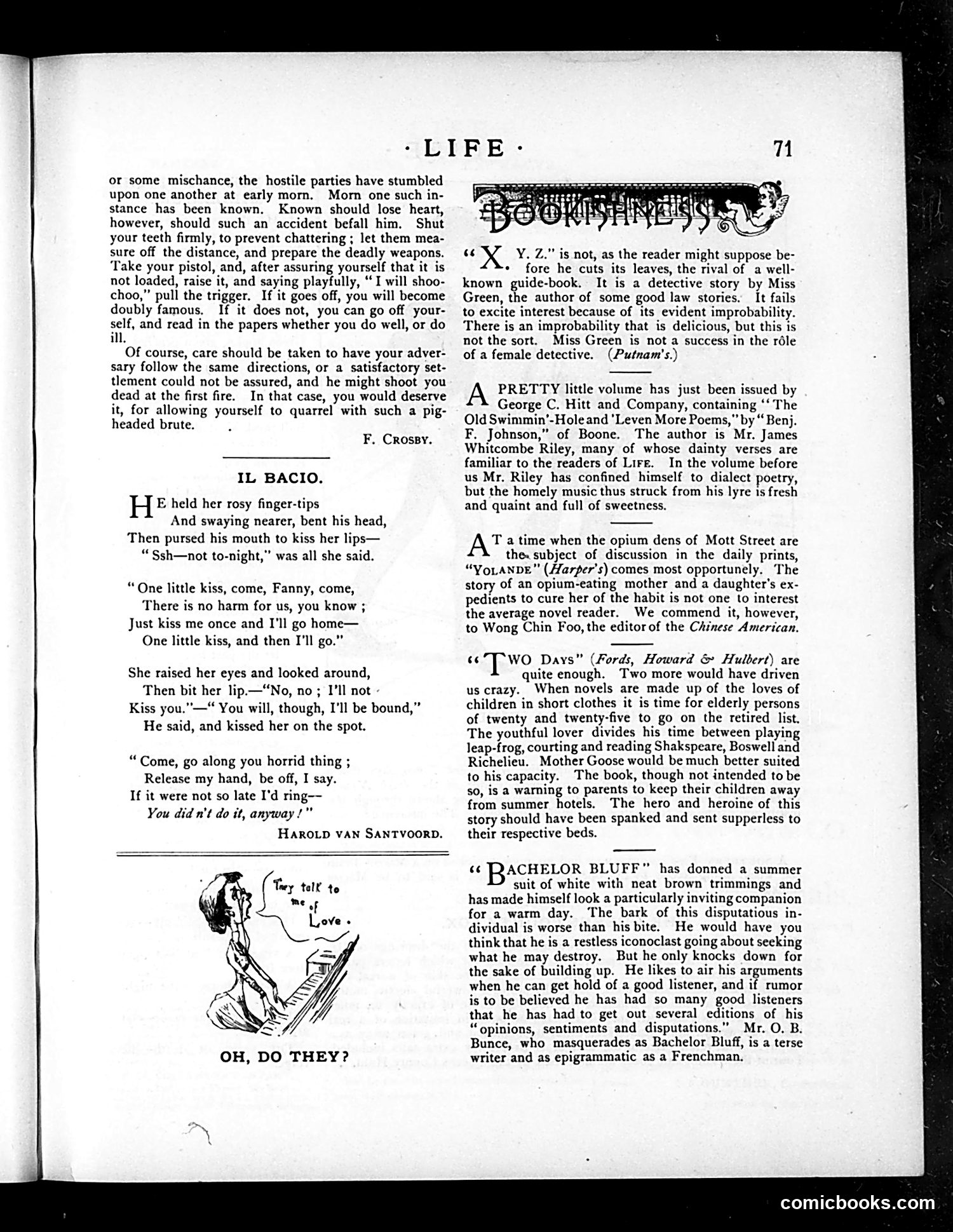
This page contains literary reviews and satirical poetry rather than political cartoons. The main content includes: **"IL BACIO"** (The Kiss) — A poem by Harold Van Santvoord depicting a flirtatious courtship where a man persuades a reluctant woman into kissing him despite her protests ("You will, though, I'll be bound"). The accompanying illustration shows a couple embracing, with text reading "they tell' to me of Love" and "OH, DO THEY?" — suggesting satirical commentary on romantic conventions or the gap between romantic ideals and reality. **Book Reviews** — Critical assessments of period publications, including detective fiction by "Miss Green," James Whitcombe Riley's dialect poetry, and novels about children's love stories, which the reviewer dismisses as trivial and warns parents against. The satire targets sentimental Victorian literature and courtship conventions, mocking both overwrought romantic narratives and poorly-written novels aimed at young readers.
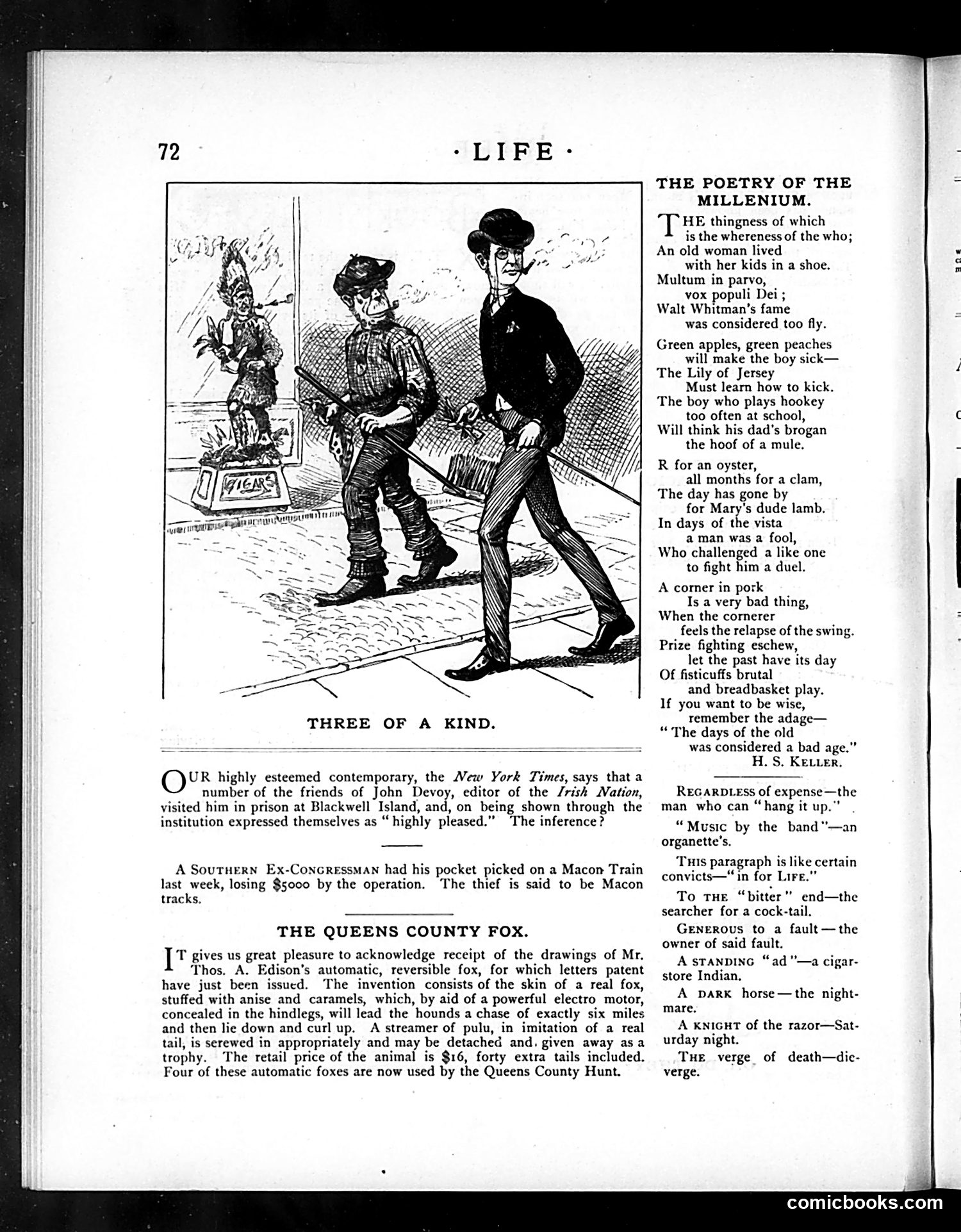
This Life magazine page contains three satirical items: **"Three of a Kind"** (cartoon + text): Mocks three types of people—Irish nationalist John Devoy (imprisoned at Blackwell Island), a Southern congressman robbed of $5,000, and an unnamed Macon thief. The "inference" joke suggests these groups are morally equivalent or similarly disreputable. **"The Queens County Fox"**: Parodies Thomas Edison's supposed invention—a mechanical fox made from real fox skin stuffed with anise and caramels, powered by electro-motor in its legs. It would lead hounds on a six-mile chase then curl up. This satirizes both Edison's prolific patent claims and wealthy hunters' elaborate pursuits. **"The Poetry of the Millenium"**: Nonsensical verse by H.S. Keller mixing nursery rhymes, pretentious phrases ("Multum in parvo"), and absurdist definitions. It mocks contemporary avant-garde or experimental poetry as meaningless wordplay—alongside other humorous definitions (like "music by the band" = an organette). The page's humor relies on recognizing topical figures and lampooning intellectual pretension.
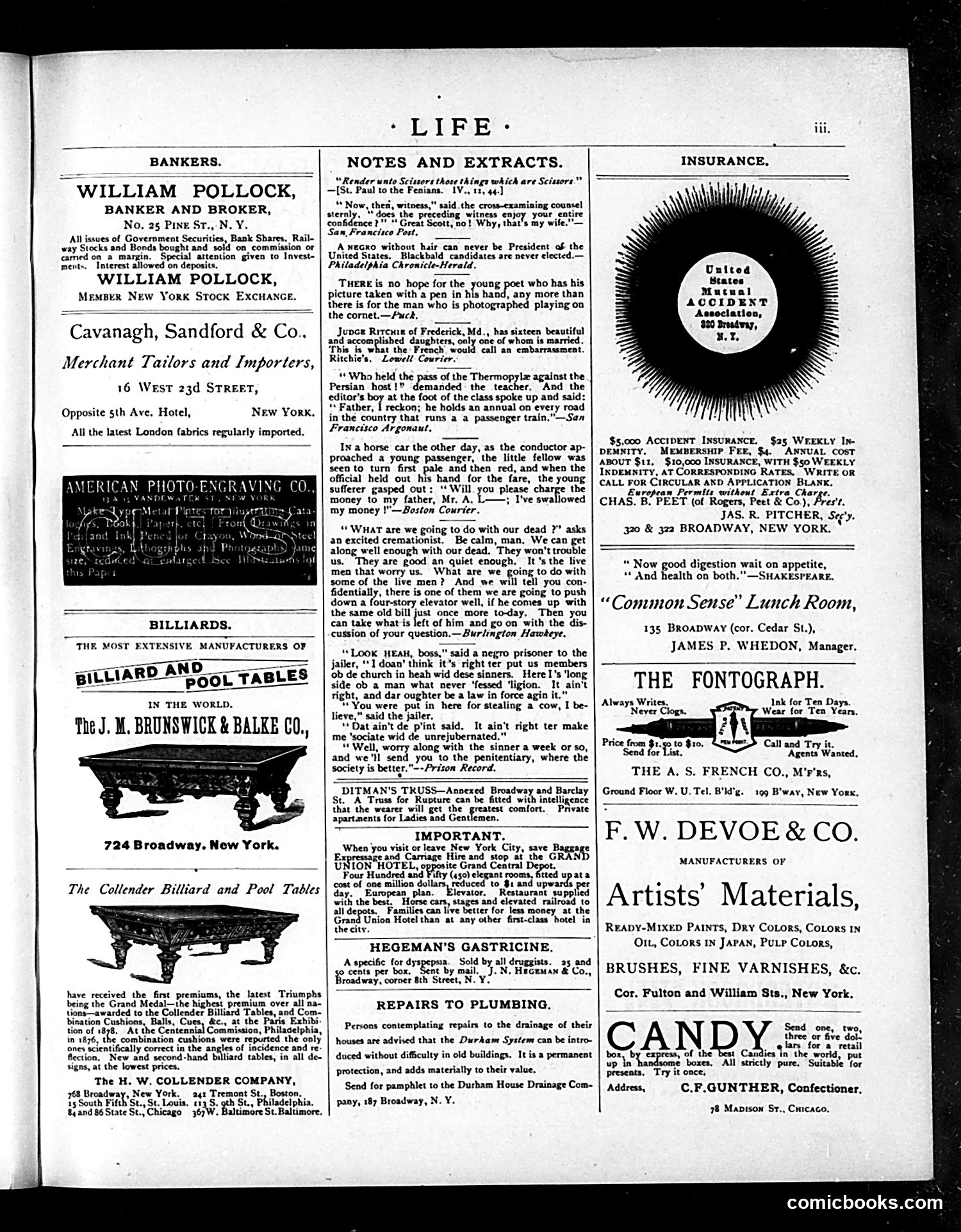
This page is primarily **advertising and directory listings** for a satirical magazine called *Life*. The content includes: - Banker and broker services (William Pollock) - Merchant tailors and importers (Cavanagh, Sandford & Co.) - Billiard and pool table manufacturers (J.M. Brunswick & Balke Co.) - Insurance services - Various restaurants and commercial establishments The center section contains **brief satirical "Notes and Extracts,"** including humorous anecdotes about classroom etiquette, church behavior, and social situations—typical of *Life* magazine's light humor. There are **no political cartoons visible** on this page. The layout is characteristic of late 19th/early 20th-century magazine advertising pages, where editorial content is minimal and commercial listings dominate. The satire here is confined to short, witty prose observations rather than visual caricature or commentary.
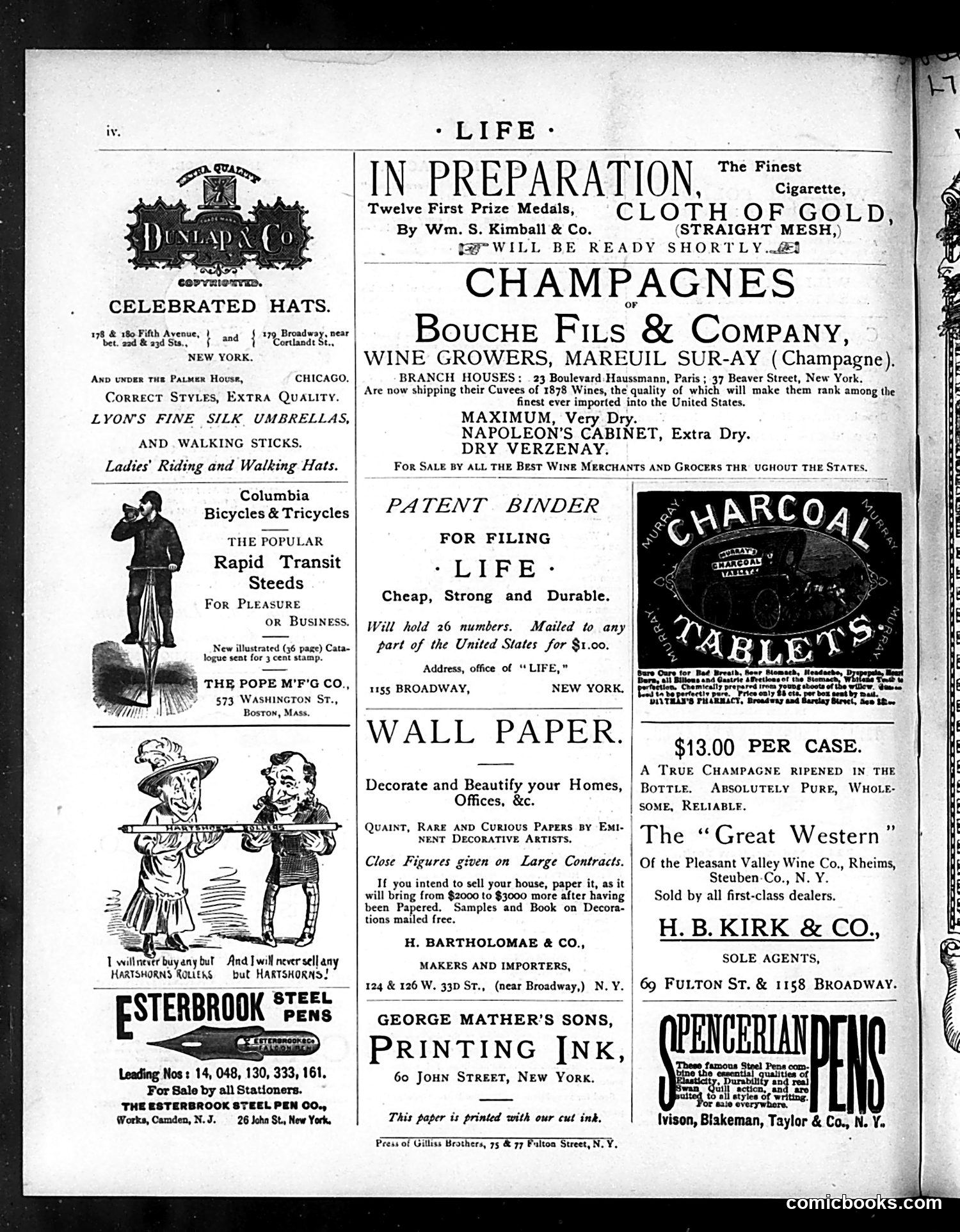
This page is primarily **advertising**, not political satire. It's a collection of late-19th-century product advertisements for goods like hats, bicycles, champagne, wall paper, and office supplies. The only **cartoon element** appears in the lower left: two figures in a brief visual joke about **Hartshorne's Salts** (a consumer product). One figure declares "I will never buy any but Hartshorne's Salts!" while the other says "And I will never sell any but Hartshorne's!" The humor lies in their absolute loyalty to the brand—likely satirizing exaggerated product endorsements and consumer culture's obsession with brand loyalty. The cartoon carries no deeper political meaning; it's simple consumer-focused humor typical of 19th-century magazine advertising. Most of the page consists of straightforward product promotion rather than editorial satire.