
Life, 1883-08-09 · page 13 of 16
Life — August 9, 1883 — page 13: what you’re looking at
What you’re looking at
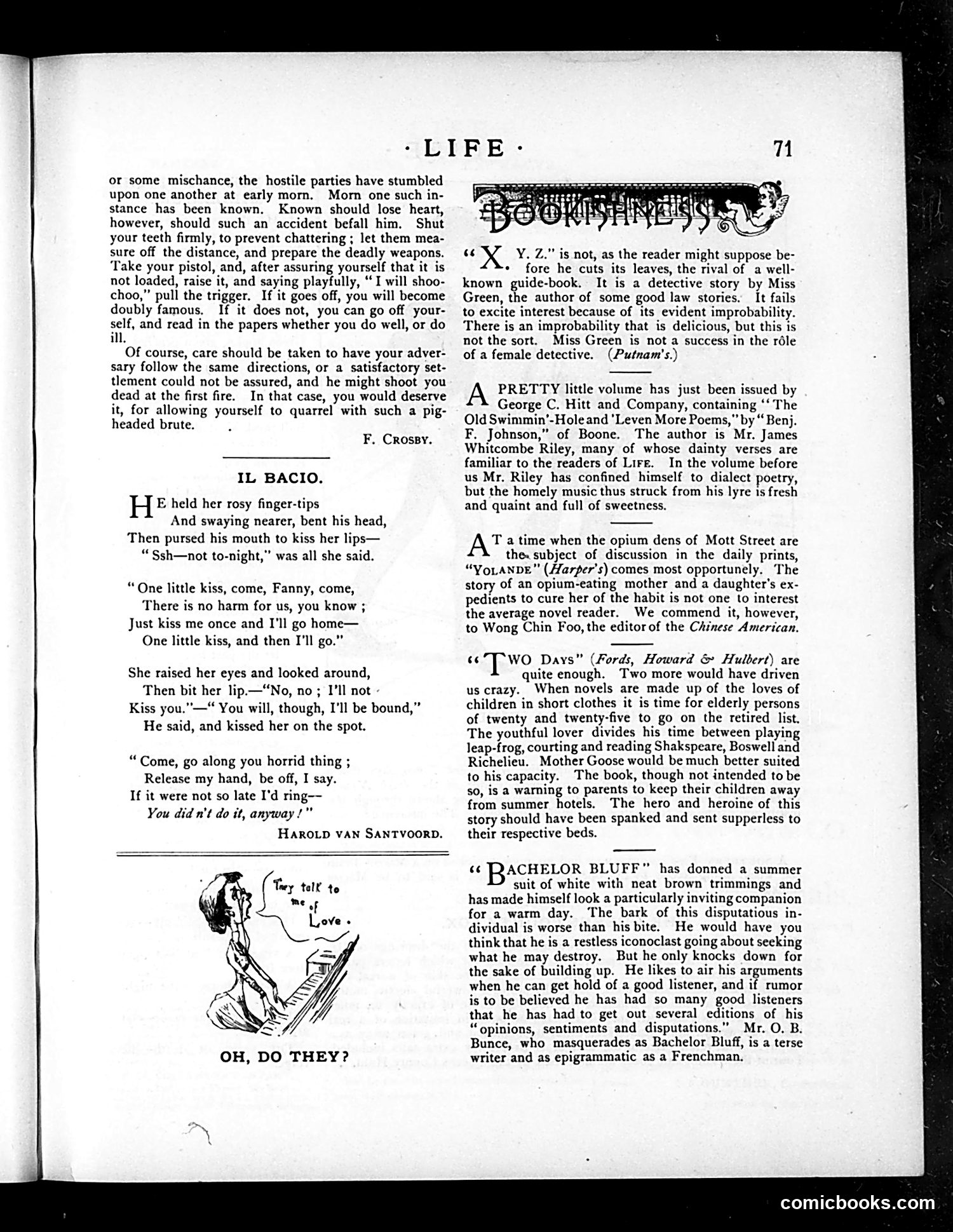
This page contains literary reviews and satirical poetry rather than political cartoons. The main content includes: **"IL BACIO"** (The Kiss) — A poem by Harold Van Santvoord depicting a flirtatious courtship where a man persuades a reluctant woman into kissing him despite her protests ("You will, though, I'll be bound"). The accompanying illustration shows a couple embracing, with text reading "they tell' to me of Love" and "OH, DO THEY?" — suggesting satirical commentary on romantic conventions or the gap between romantic ideals and reality. **Book Reviews** — Critical assessments of period publications, including detective fiction by "Miss Green," James Whitcombe Riley's dialect poetry, and novels about children's love stories, which the reviewer dismisses as trivial and warns parents against. The satire targets sentimental Victorian literature and courtship conventions, mocking both overwrought romantic narratives and poorly-written novels aimed at young readers.
📄 Transcribed text from this page (OCR, searchable)
Machine-transcribed from the original scan — historical spelling and the odd misread are preserved.
-LIFE-: or some mischance, the hostile parties have stumbled upon one another at early morn. Morn one such in- stance has been known. Known should lose heart, however, should such an accident befall him. Shut your teeth firmly, to prevent chattering ; let them mea- sure off the distance, and prepare the deadly weapons. Take your pistol, and, after assuring yourself that it is not loaded, raise it, and saying playfully, “I will shoo- choo,” pull the trigger. If it goes off, you will become doubly famous. If it does not, you can go off your- self, and read in the papers whether you do well, or do ill, Of course, care should be taken to have your adver- sary follow the same directions, or a satisfactory set- tlement could not be assured, and he might shoot you dead at the first fire. In that case, you would deserve it, for allowing yourself to quarrel with such a pig- headed brute. F. Crossy. IL BACIO. E held her rosy finger-tips And swaying nearer, bent his head, Then pursed his mouth to kiss her lips— “Ssh—not to-night,” was all she said. “One little kiss, come, Fanny, come, There is no harm for us, you know ; Just kiss me once and I'll go home— One little kiss, and then I'll go.” She raised her eyes and looked around, Then bit her lip.—“No, no ; I'll not Kiss you.”—“ You will, though, I'll be bound,” He said, and kissed her on the spot. “Come, go along you horrid thing ; Release my hand, be off, I say. If it were not so late I'd ring—- You did n't do it, anyway!" HAROLD VAN SANTVOORD. Trey toll’ to ™me of Love - a OH, DO THEY? 3 Y. Z.” is not, as the reader might suppose be- * fore he cuts its leaves, the rival of a well- known guide-book. It is a detective story by Miss Green, the author of some good law stories. It fails to excite interest because of its evident improbability. There is an improbability that is delicious, but this is not the sort. Miss Green is not a success in the réle of a female detective. (Putnam's.) PRETTY little volume has just been issued by George C. Hitt and Company, containing ‘‘ The Old Swimmin’-Hole and ‘Leven More Poems,” by “Benj. F. Johnson,” of Boone. The author is Mr. James Whitcombe Riley, many of whose dainty verses are familiar to the readers of Lire. In the volume before us Mr. Riley has confined himself to dialect poetry, but the homely music thus struck from his lyre is fresh and quaint and full of sweetness. A’ a time when the opium dens of Mott Street are the. subject of discussion in the daily prints, “YoLANDE” (Harper's) comes most opportunely. The story of an opium-eating mother and a daughter's ex- pedients to cure her of the habit is not one to interest the average novel reader. We commend it, however, to Wong Chin Foo, the editor of the Chinese American. 3 WO Days” (Fords, Howard & Hulbert) are quite enough. Two more would have driven us crazy. When novels are made up of the loves of children in short clothes it is time for elderly persons of twenty and twenty-five to go on the retired list. The youthful lover divides his time between playing leap-frog, courting and reading Shakspeare, Boswell and Richelieu. Mother Goose would be much better suited to his capacity. The book, though not intended to be so, is a warning to parents to keep their children away from summer hotels. The hero and heroine of this story should have been spanked and sent supperless to their respective beds. 6¢ PRACHELOR BLUFF” has donned a summer suit of white with neat brown trimmings and has made himself look a particularly inviting companion for a warm day. The bark of this disputatious in- dividual is worse than his bite. He would have you think that he is a restless iconoclast going about seeking what he may destroy. But he only knocks down for the sake of building up. He likes to air his arguments when he can get hold of a good listener, and if rumor is to be believed he has had so many good listeners that he has had to get out several editions of his “opinions, sentiments and disputations.” Mr. O, B. Bunce, who masquerades as Bachelor Bluff, is a terse writer and as epigrammatic as a Frenchman. comicbooks.com