
Life, 1883-08-09 · page 6 of 16
Life — August 9, 1883 — page 6: what you’re looking at
What you’re looking at
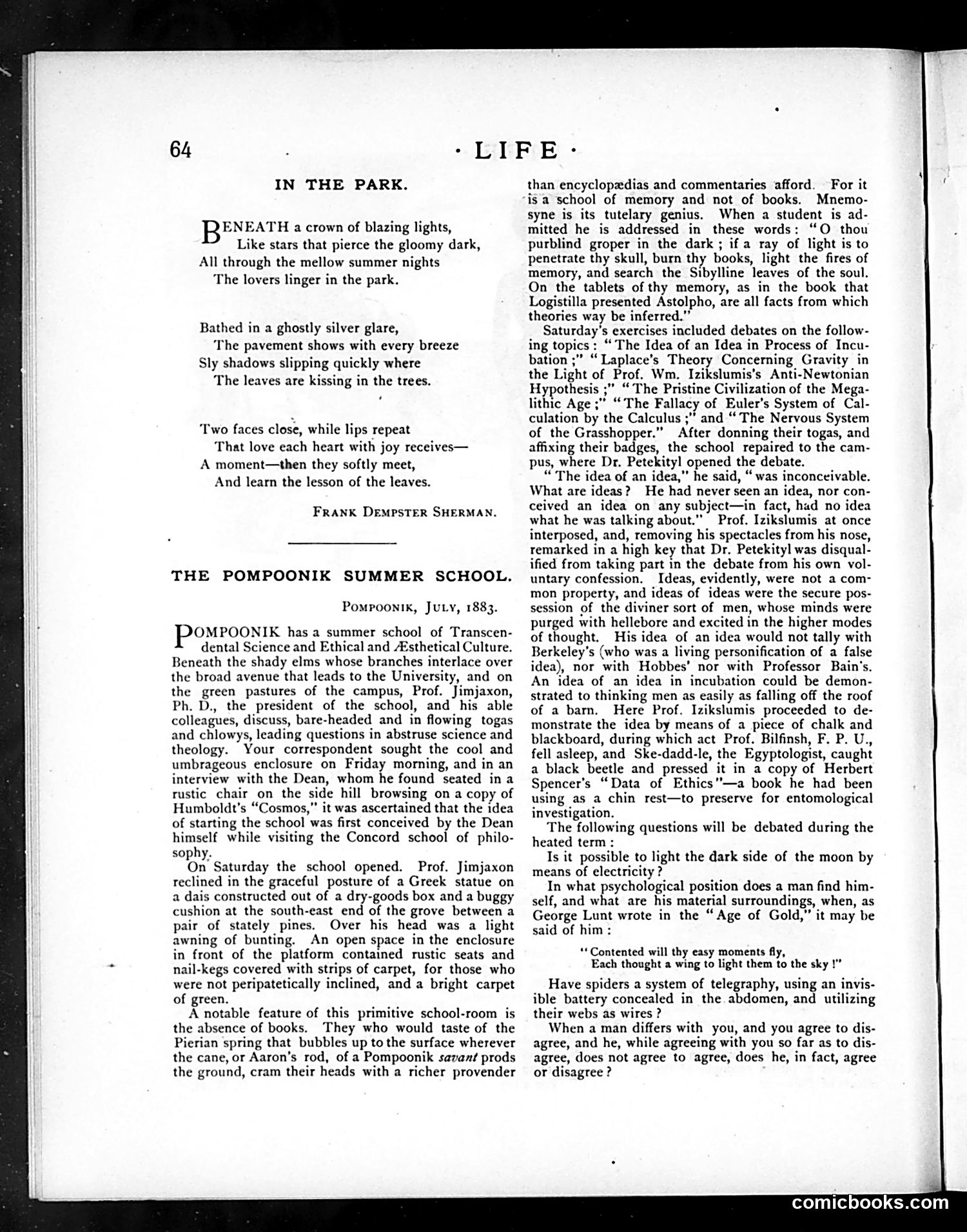
This page contains a romantic poem by Frank Dempster Sherman about lovers in a moonlit park, followed by a satirical article about Pompoonik's summer school (July 1883). The satire targets academic pretension. The school, described as teaching "Transcendental Science and Ethical and Æsthetical Culture," is mocked for its complete absence of books and absurdly abstract debates—including whether spiders use telegraphy via invisible batteries in their abdomens. Professor Izikslumis is ridiculed for arguing that "ideas" themselves are unknowable, while colleagues sleep during lectures. The piece satirizes late-19th-century transcendentalist philosophy and pseudo-intellectual institutions that prioritized vague theorizing over practical learning. The rustic setting and elaborate nonsense highlight the gap between lofty educational ambitions and actual substance.
📄 Transcribed text from this page (OCR, searchable)
Machine-transcribed from the original scan — historical spelling and the odd misread are preserved.
» DERE - IN THE PARK. BENEATH a crown of blazing lights, Like stars that pierce the gloomy dark, All through the mellow summer nights The lovers linger in the park. Bathed in a ghostly silver glare, The pavement shows with every breeze Sly shadows slipping quickly where The leaves are kissing in the trees. Two faces close, while lips repeat That love each heart with joy receives— A moment—then they softly meet, And learn the lesson of the leaves. FRANK DEMPSTER SHERMAN. THE POMPOONIK SUMMER SCHOOL. Pompoontk, JuLy, 1883. OMPOONIK has a summer school of Transcen- dental Science and Ethical and #sthetical Culture. Beneath the shady elms whose branches interlace over the broad avenue that leads to the University, and on the green pastures of the campus, Prof. Jimjaxon, Ph. D., the president of the school, and his able colleagues, discuss, bare-headed and in flowing togas and chlowys, leading questions in abstruse science and theology. Your correspondent sought the cool and umbrageous enclosure on Friday morning, and in an interview with the Dean, whom he found seated ina rustic chair on the side hill browsing on a copy of Humboldt's “Cosmos,” it was ascertained that the idea of starting the school was first conceived by the Dean himself while visiting the Concord school of philo- sophy. On Saturday the school opened. Prof. Jimjaxon reclined in the graceful posture of a Greek statue on a dais constructed out of a dry-goods box and a buggy cushion at the south-east end of the grove between a pair of stately pines. Over his head was a light awning of bunting. An open space in the enclosure in front of the platform contained rustic seats and nail-kegs covered with strips of carpet, for those who were not peripatetically inclined, and a bright carpet of green. A notable feature of this primitive school-room is the absence of books. They who would taste of the Pierian spring that bubbles up to the surface wherever the cane, or Aaron’s rod, of a Pompoonik savant prods the ground, cram their heads with a richer provender than encyclopedias and commentaries afford. For it isa school of memory and not of books. Mnemo- syne is its tutelary genius. When a student is ad- mitted he is addressed in these words: “O thou purblind groper in the dark ; if a ray of light is to penetrate thy skull, burn thy books, light the fires of memory, and search the Sibylline leaves of the soul. On the tablets of thy memory, as in the book that Logistilla presented Astolpho, are all facts from which theories way be inferred.” Saturday’s exercises included debates on the follow- ing topics : “ The Idea of an Idea in Process of Incu- bation ;” “Laplace’s Theory Concerning Gravity in the Light of Prof. Wm. Izikslumis’s Anti-Newtonian Hypothesis ;” “The Pristine Civilization of the Mega- lithic Age ;” “The Fallacy of Euler’s System of Cal- culation by the Calculus ;” and “ The Nervous System of the Grasshopper.” After donning their togas, and affixing their badges, the school repaired to the cam- pus, where Dr. Petekityl opened the debate. “ The idea of an idea,” he said, “ was inconceivable. What are ideas? He had never seen an idea, nor con- ceived an idea on any subject—in fact, had no idea what he was talking about.” Prof. Izikslumis at once interposed, and, removing his spectacles from his nose, remarked in a high key that Dr. Petekityl was disqual- ified from taking part in the debate from his own vol- untary confession. Ideas, evidently, were not a com- mon property, and ideas of ideas were the secure pos- session of the diviner sort of men, whose minds were purged with hellebore and excited in the higher modes of thought. His idea of an idea would not tally with Berkeley's (who was a living personification of a false idea), nor with Hobbes’ nor with Professor Bain's. An idea of an idea in incubation could be demon- strated to thinking men as easily as falling off the roof of a barn. Here Prof. Izikslumis proceeded to de- monstrate the idea by means of a piece of chalk and blackboard, during which act Prof. Bilfinsh, F. P. U., fell asleep, and Ske-dadd-le, the Egyptologist, caught a black beetle and pressed it in a copy of Herbert Spencer's “Data of Ethics"—a book he had been using as a chin rest—to preserve for entomological investigation. The following questions will be debated during the heated term : Is it possible to light the dark side of the moon by means of electricity? In what psychological position does a man find him- self, and what are his material surroundings, when, as George Lunt wrote in the “Age of Gold,” it may be said of him: “Contented will thy easy moments fly, Each thought a wing to light them to the sky !” Have spiders a system of telegraphy, using an invis- ible battery concealed in the abdomen, and utilizing their webs as wires ? When a man differs with you, and you agree to dis- agree, and he, while agreeing with you so far as to dis- agree, does not agree to agree, does he, in fact, agree or disagree ? comicbooks.com