
A complete issue · 16 pages · 1883
Life — August 2, 1883
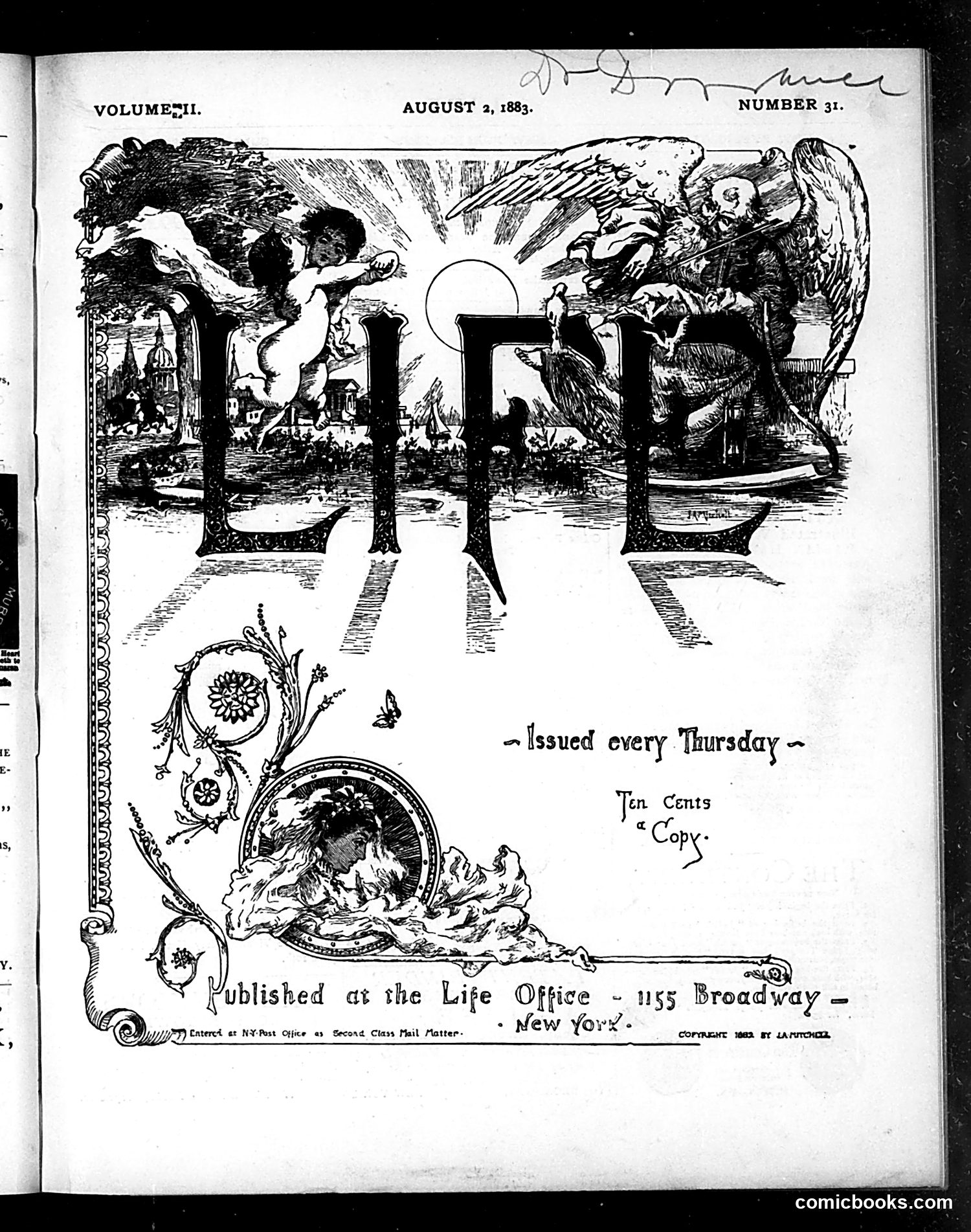
**August 2, 1883 | Volume II, Number 31** This is the cover/title page of *Life*, a satirical weekly costing ten cents. The elaborate illustration depicts a fantastical, allegorical scene with classical and mythological elements—cherubs, angels, a rising sun, and ornate decorative flourishes surrounding the large "LIFE" text. The imagery appears celebratory rather than political, using the magazine's standard artistic style of elaborate engraving. Without visible text identifying specific figures or events, the exact satirical target remains unclear. The design likely advertises the magazine's general satirical content rather than commenting on a particular political moment. Published at the Life Office, 1155 Broadway, New York.
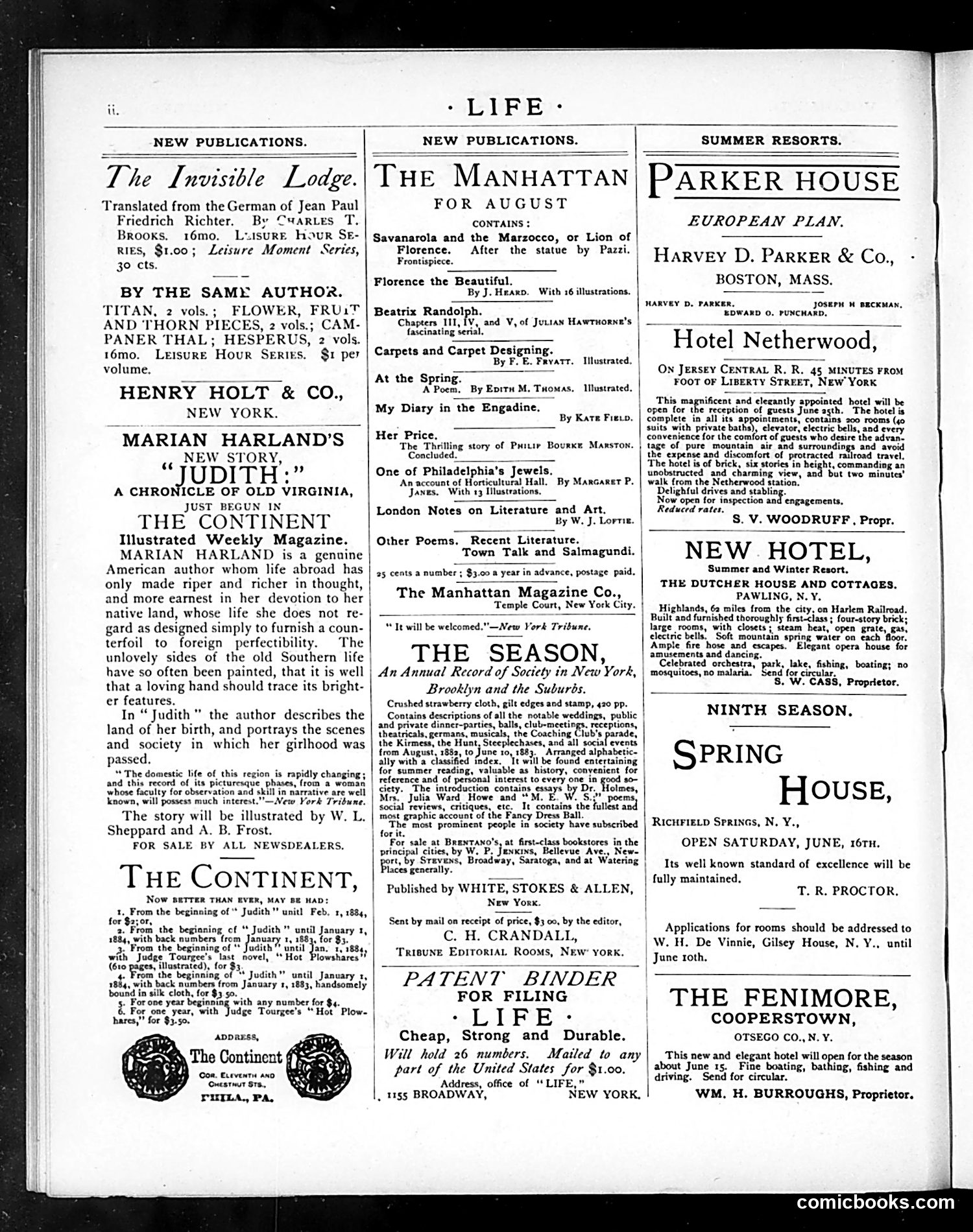
This page is **entirely advertisements** — there are no political cartoons or satirical content visible. The page contains publisher announcements for new books (including works by Jean Paul Richter and Marian Harland), magazine subscriptions, and hotel/resort advertisements. The latter section promotes summer destinations like Parker House in Boston, Hotel Netherland near Liberty Street in New York, the Dutcher House in Pawling, and Spring House in Richfield Springs. There is one small decorative emblem for "The Continent" magazine at the bottom left, but no cartoon or satirical imagery appears on this page. For historical context, you would need to examine other pages from this issue of *Life* magazine.
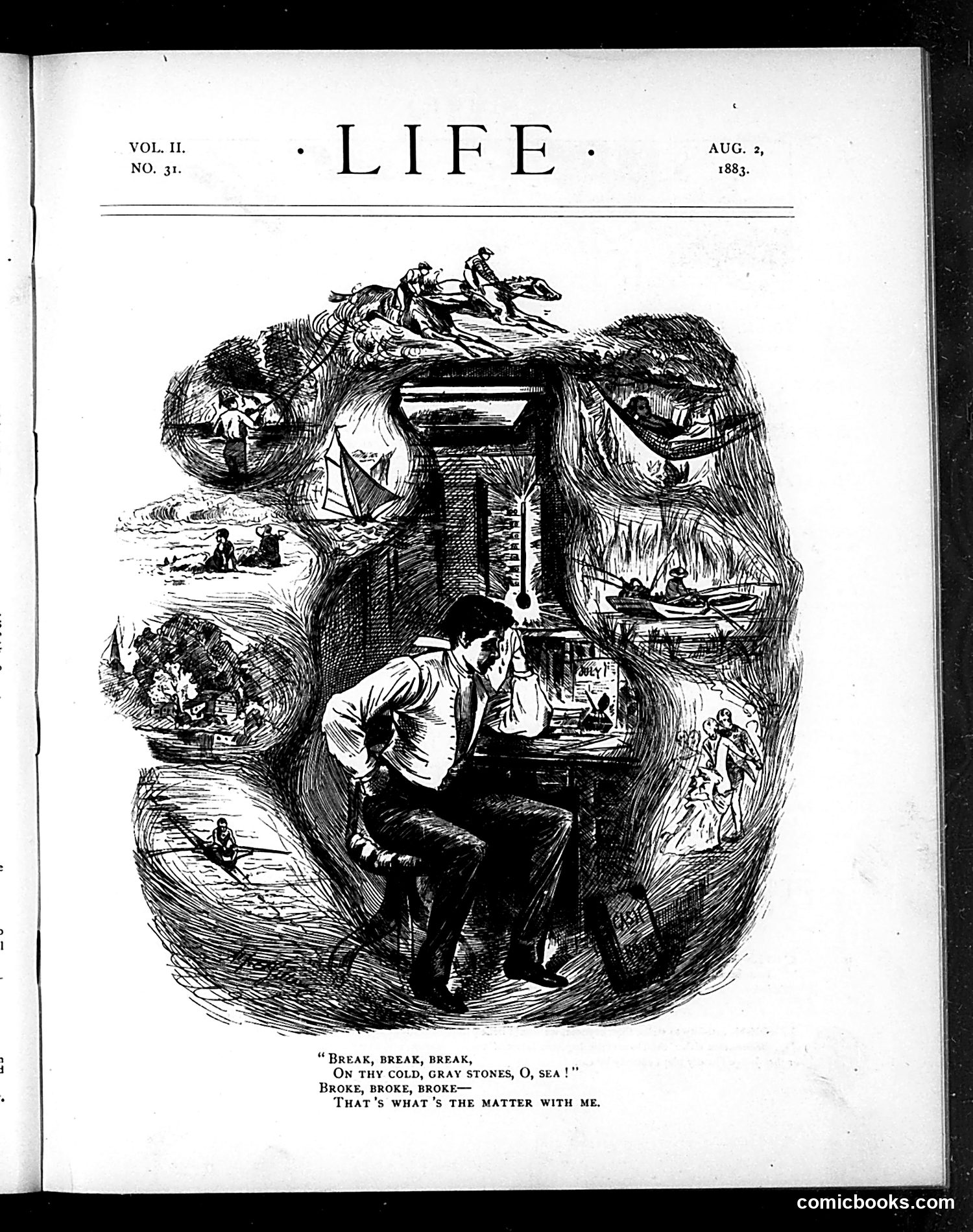
This illustration depicts a man sitting despondently inside what appears to be a seaside cave or grotto. Around him swirl various scenes of leisure activity—people boating, swimming, and enjoying beach recreation. The caption quotes Shakespeare's *The Tempest*: "Break, break, break, / On thy cold, gray stones, O, sea! / Broke, broke, broke— / That's what's the matter with me." The satire appears to target someone experiencing financial ruin or business failure during a period of general prosperity. While the Victorian leisure class enjoys seaside pleasures around him, this figure remains trapped in misery, suggesting either personal financial collapse or professional disgrace. The specific individual remains unclear without additional historical context, but the cartoon satirizes the contrast between public gaiety and private despair.
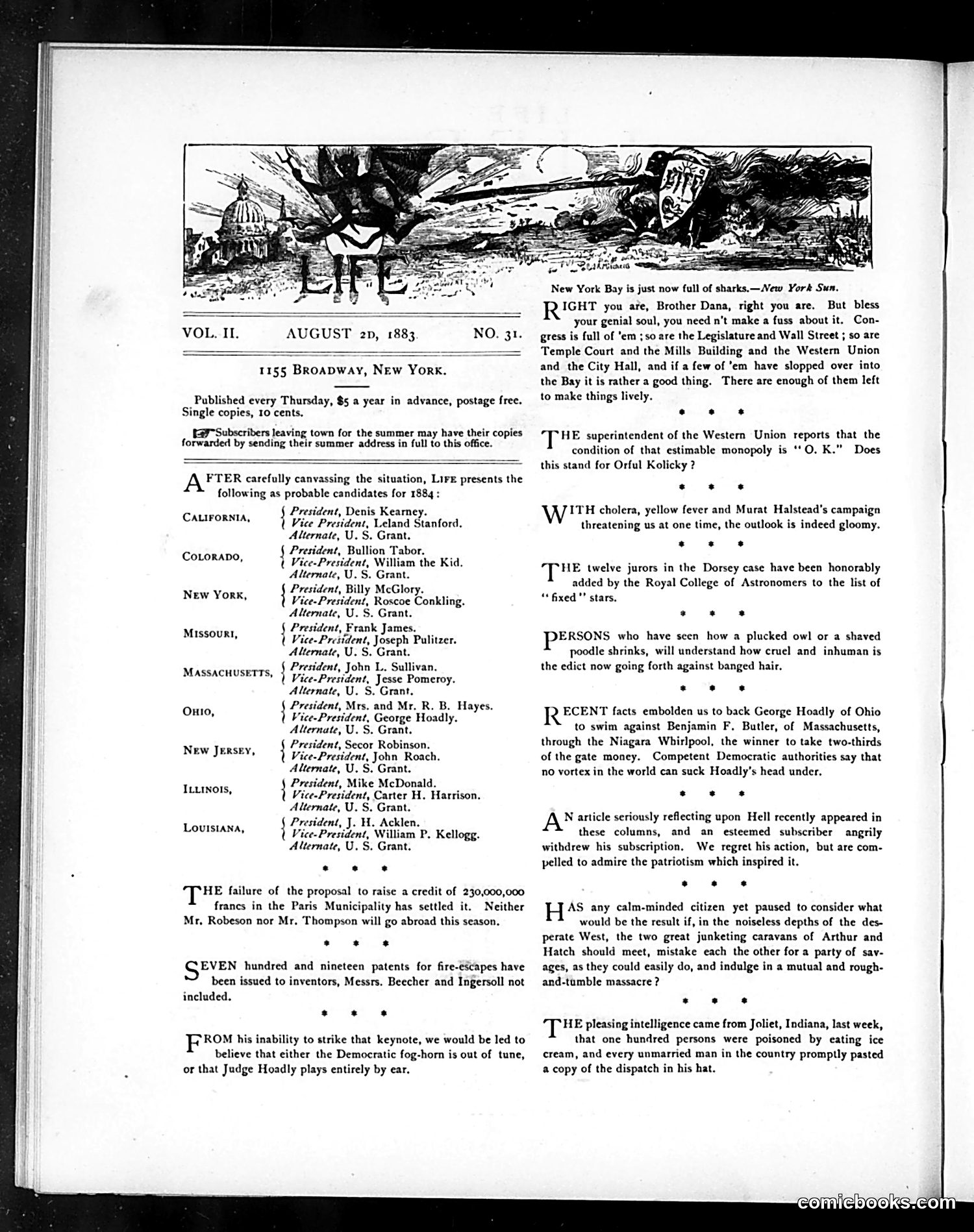
The masthead cartoon depicts "LIFE" as a personified figure surveying a chaotic landscape. The image shows classical architectural elements (a domed building, likely representing government) alongside darker, more turbulent scenes—possibly representing the tension between civic order and social disorder that characterized Gilded Age America. The magazine's content below lists candidates for various state offices in 1883, presenting satirical commentary on American politics. The text snippets mock contemporary issues: monopolies (Western Union's "O.K." status), public health crises (cholera and yellow fever), Democratic political weakness, and various social absurdities. The overall tone is cynical, typical of Life's role as a satirical publication critiquing political incompetence and social hypocrisy during the 1880s.
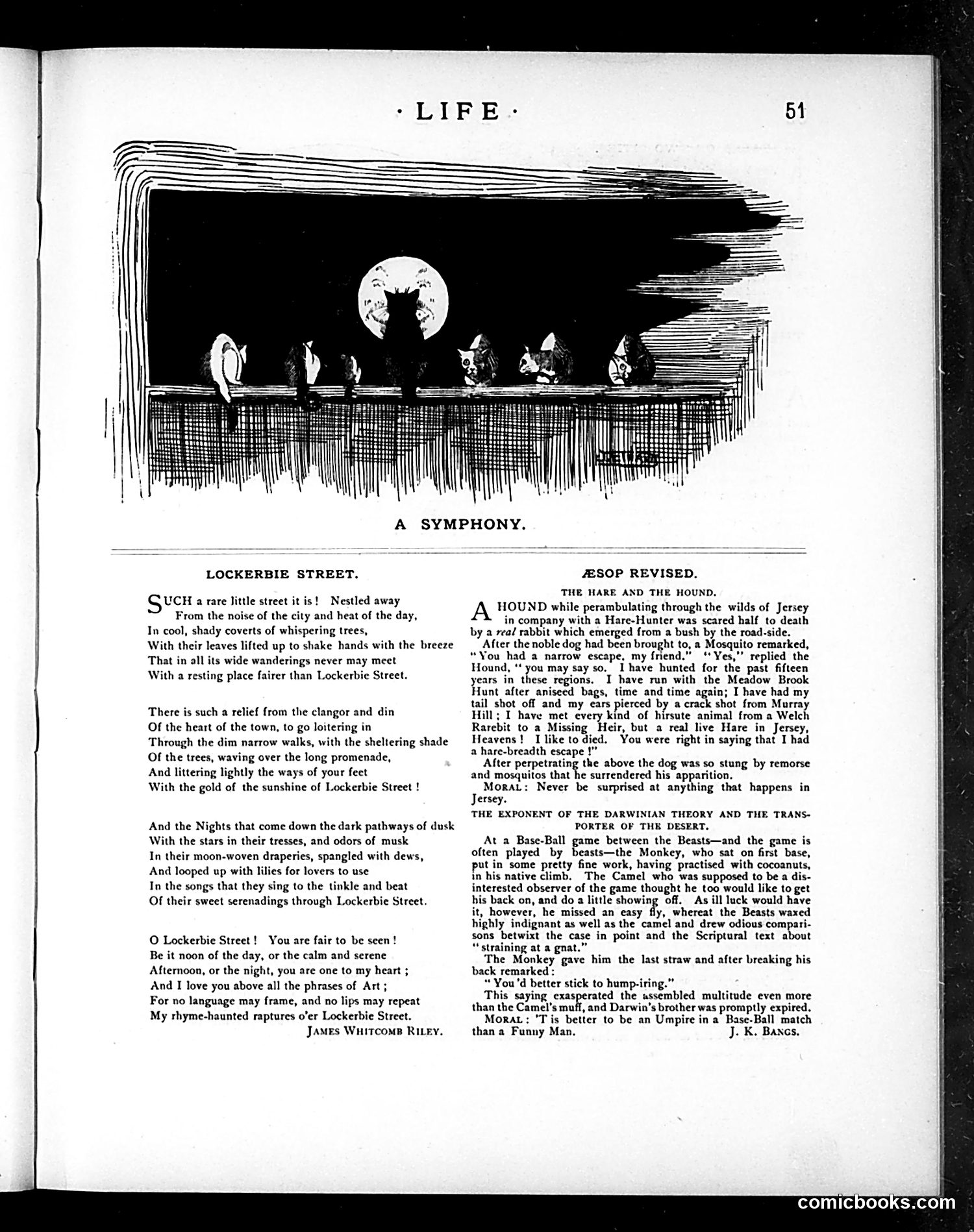
**The Cartoon ("A Symphony"):** The illustration shows silhouetted figures on a stage with a large moon backdrop—appearing to depict a theatrical or musical performance. The "symphony" title suggests this is satirizing either a specific concert performance or perhaps pretentious artistic culture of the era. **The Text Content:** The page contains two unrelated pieces: 1. **"Lockerbie Street"** by James Whitcomb Riley—a nostalgic poem praising a pleasant residential street as an escape from urban chaos. 2. **"Aesop Revised: The Hare and the Hound"** by J.K. Bangs—a humorous moral tale involving animals that critiques both Darwinian theory and the absurdity of taking Darwin too literally, concluding it's "better to be an Umpire in a Base-ball match than a Funny Man." The page mixes sentimental poetry, satirical fable, and artistic illustration without clear thematic connection.
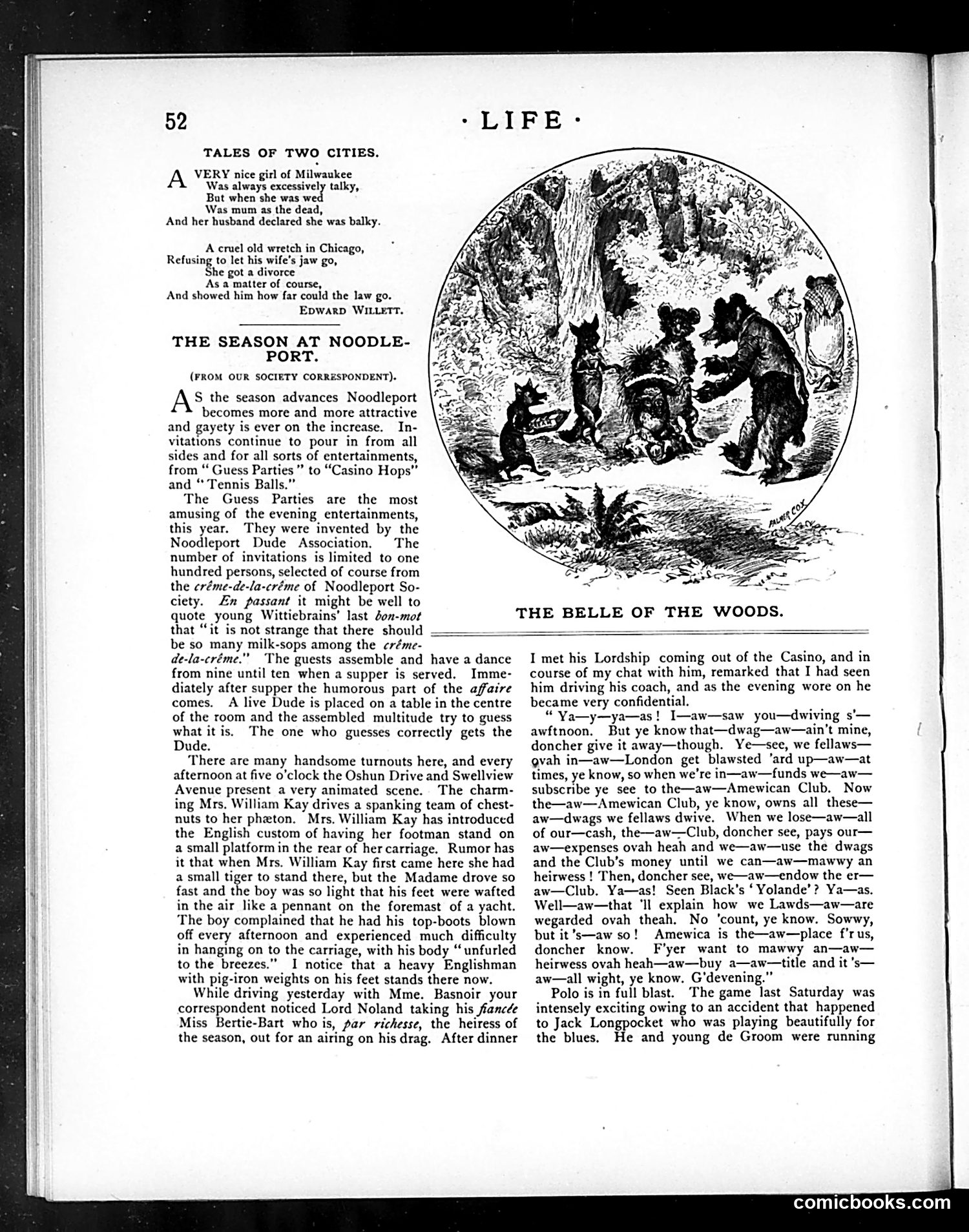
This page contains two distinct pieces: **"Tales of Two Cities"** - A brief poem by Edward Willett satirizing marital discord in Milwaukee and Chicago, mocking how divorce resolves disputes between quarrelsome spouses. **"The Belle of the Woods"** - A sketch accompanying an illustration showing figures in a wooded setting. The narrative appears to be a society gossip piece about Noodleport's social season, mentioning "Guess Parties," "Casino Hops," and the exclusive Noodleport Dude Association. It references Lord Noland, Mme. Basnoir, and social activities like polo and the American Club, satirizing upper-class leisure activities and pretentious social hierarchies of the era. The illustration depicts what appears to be an encounter in a forest setting, though the exact narrative connection is unclear from the visible text.
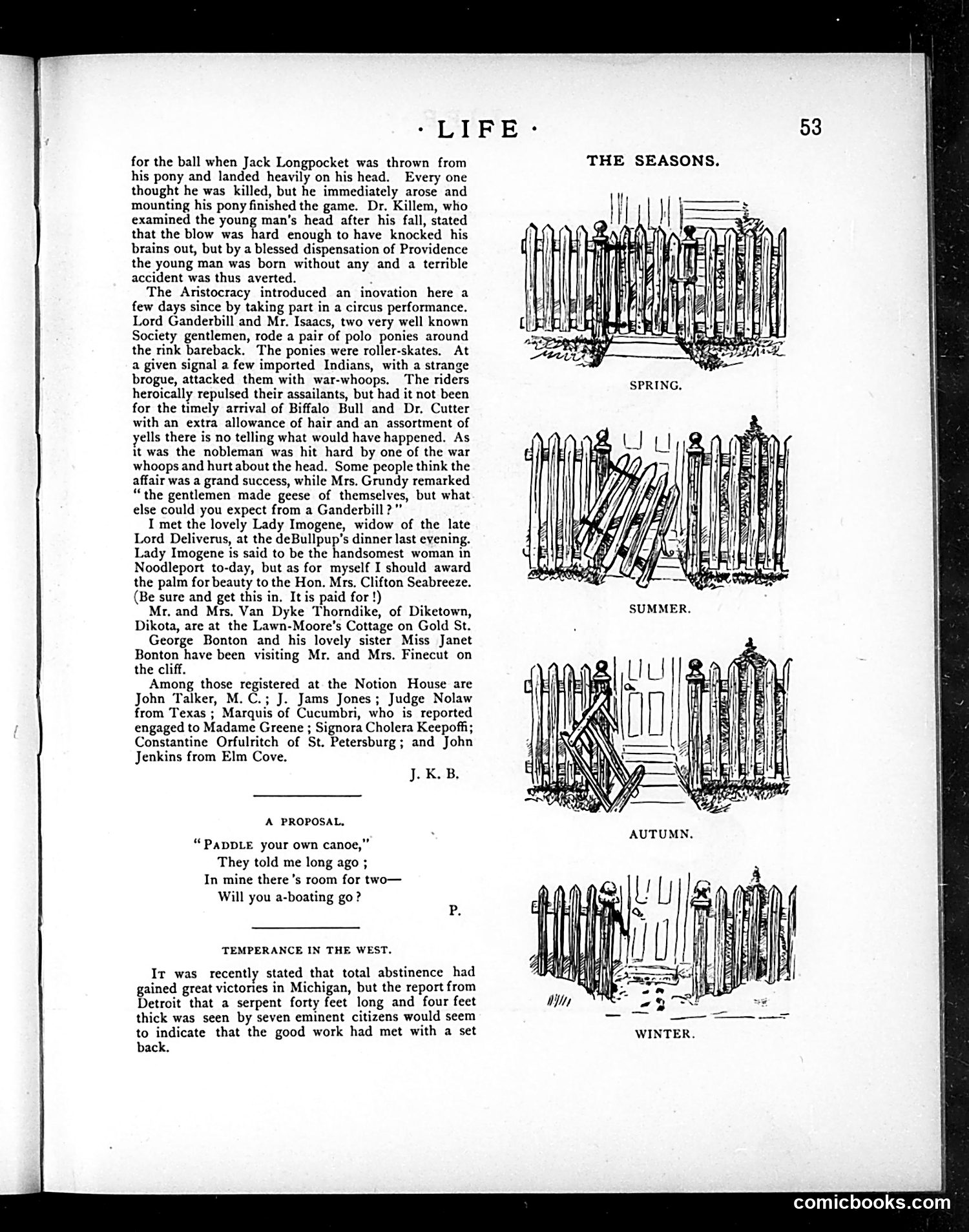
This page contains four illustrated panels depicting a picket fence through the four seasons (Spring, Summer, Autumn, Winter). Each shows the same fence structure with seasonal variations—Spring displays fresh growth, Summer shows full foliage, Autumn depicts falling leaves and decay, and Winter presents snow coverage. These are purely decorative illustrations without satirical or political content. They appear to be a charming artistic feature demonstrating seasonal change rather than commentary. The surrounding text discusses social events and includes anecdotes about various people and activities, but makes no connection to these seasonal images. This is simply illustrative content typical of Life magazine's mix of humor, social commentary, and artistic decoration.
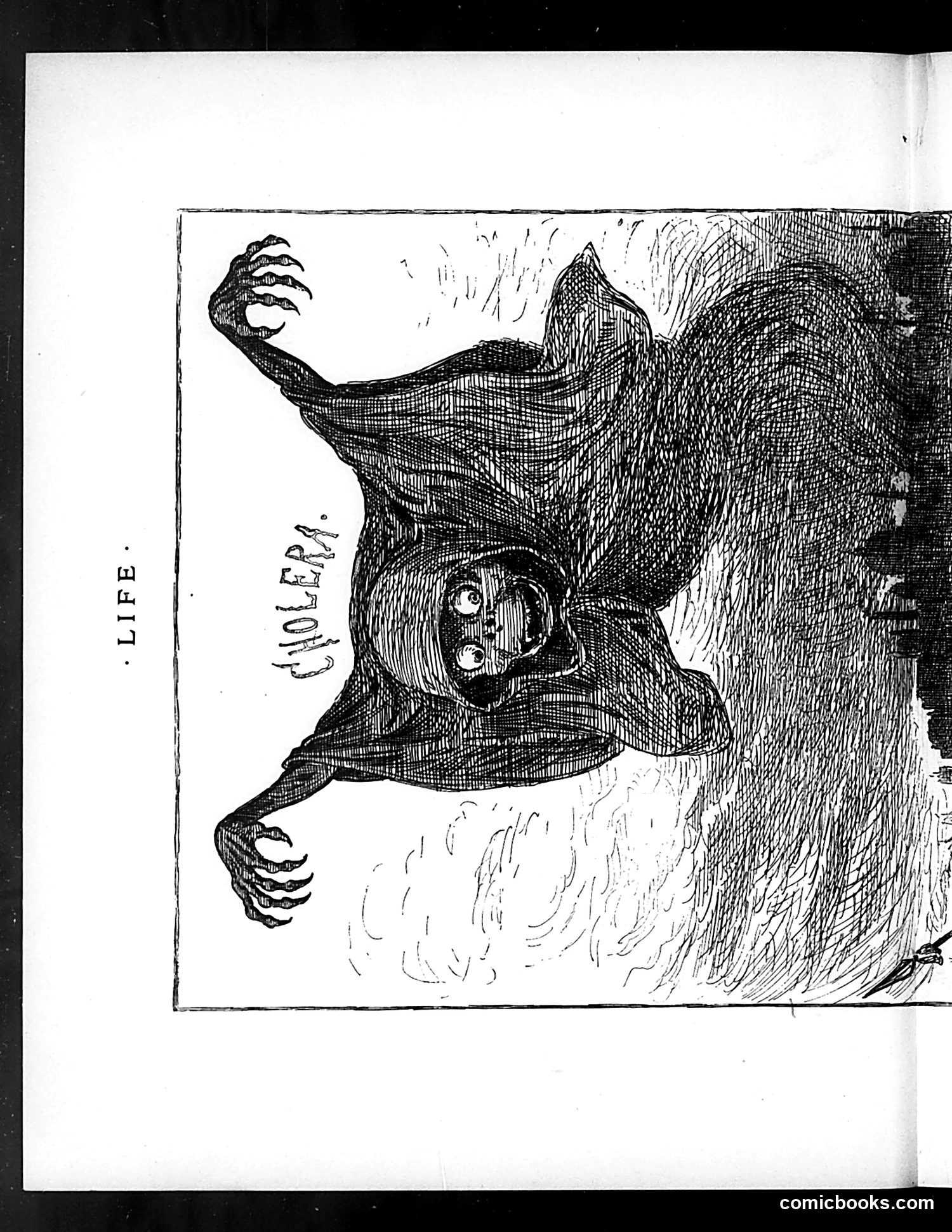
This etching depicts a grotesque figure identified as "Ghouls" (visible in the text), shown upside-down with an exaggerated, skull-like face and elongated limbs. The figure appears to be floating or suspended, rendered in detailed cross-hatching characteristic of period engravings. The cartoon likely represents a satirical commentary on something contemporary to the publication's era, though the specific historical reference remains unclear from the image alone. The grotesque, nightmarish quality suggests the artist was mocking or warning about something considered monstrous or threatening to society. The dramatic, inverted perspective emphasizes a sense of danger or disorder. Without additional context about Life magazine's date of publication or the surrounding articles, the precise political or social target of this satire cannot be definitively identified.
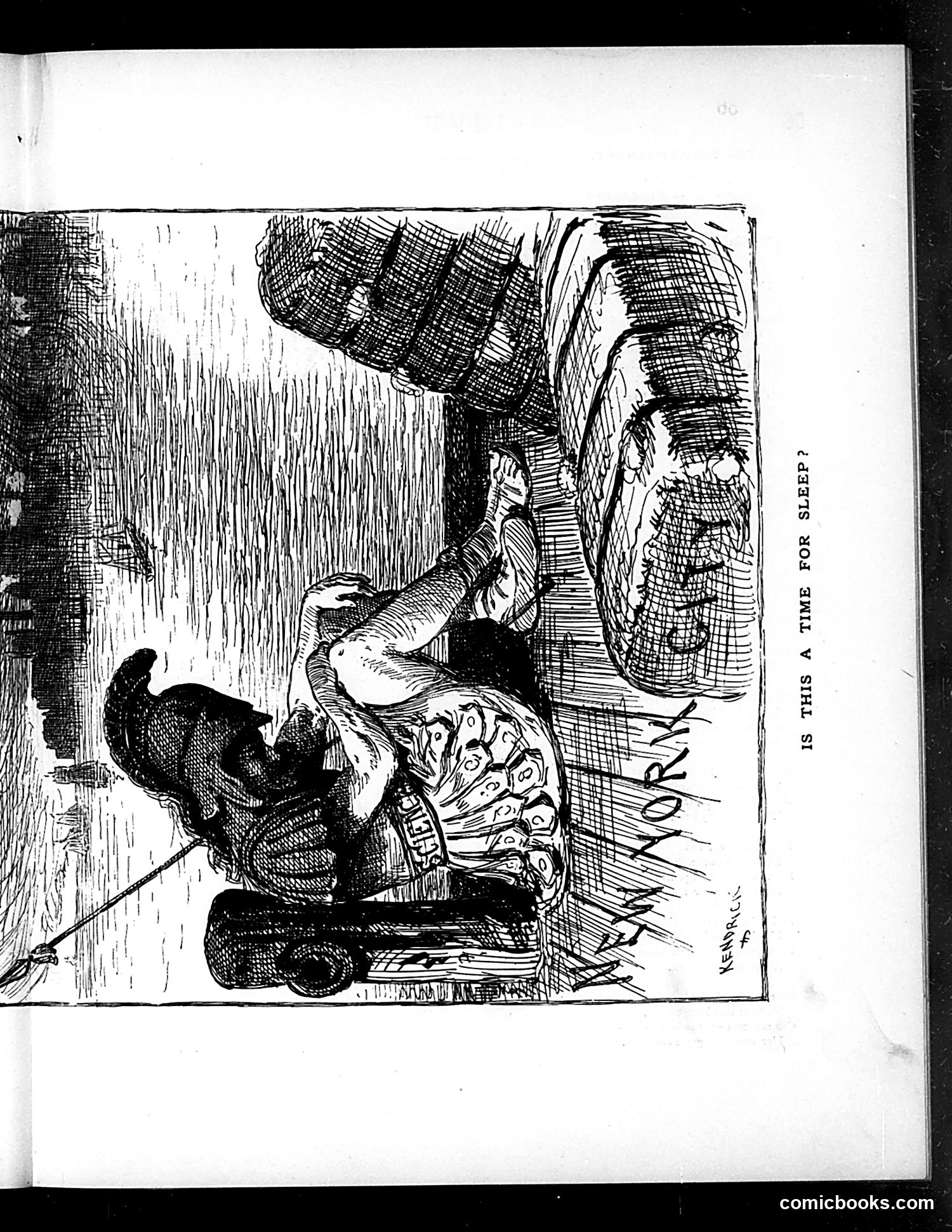
This is a political cartoon titled "IS THIS A TIME FOR SLEEP?" The image shows an elephant (the Republican Party symbol) apparently dozing or resting, while being confronted by what appears to be a donkey (the Democratic Party symbol) in an aggressive or confrontational posture. The cartoon critiques Republican complacency during a period of Democratic political activity or challenge. The elephant's sleep suggests the Republicans are inactive or unaware of threats, while the donkey's aggressive stance indicates the Democrats are actively pressing their agenda. Without a visible date, the specific historical context remains unclear, but the cartoon appears to satirize Republican political passivity during a time when the situation demanded active engagement or response.
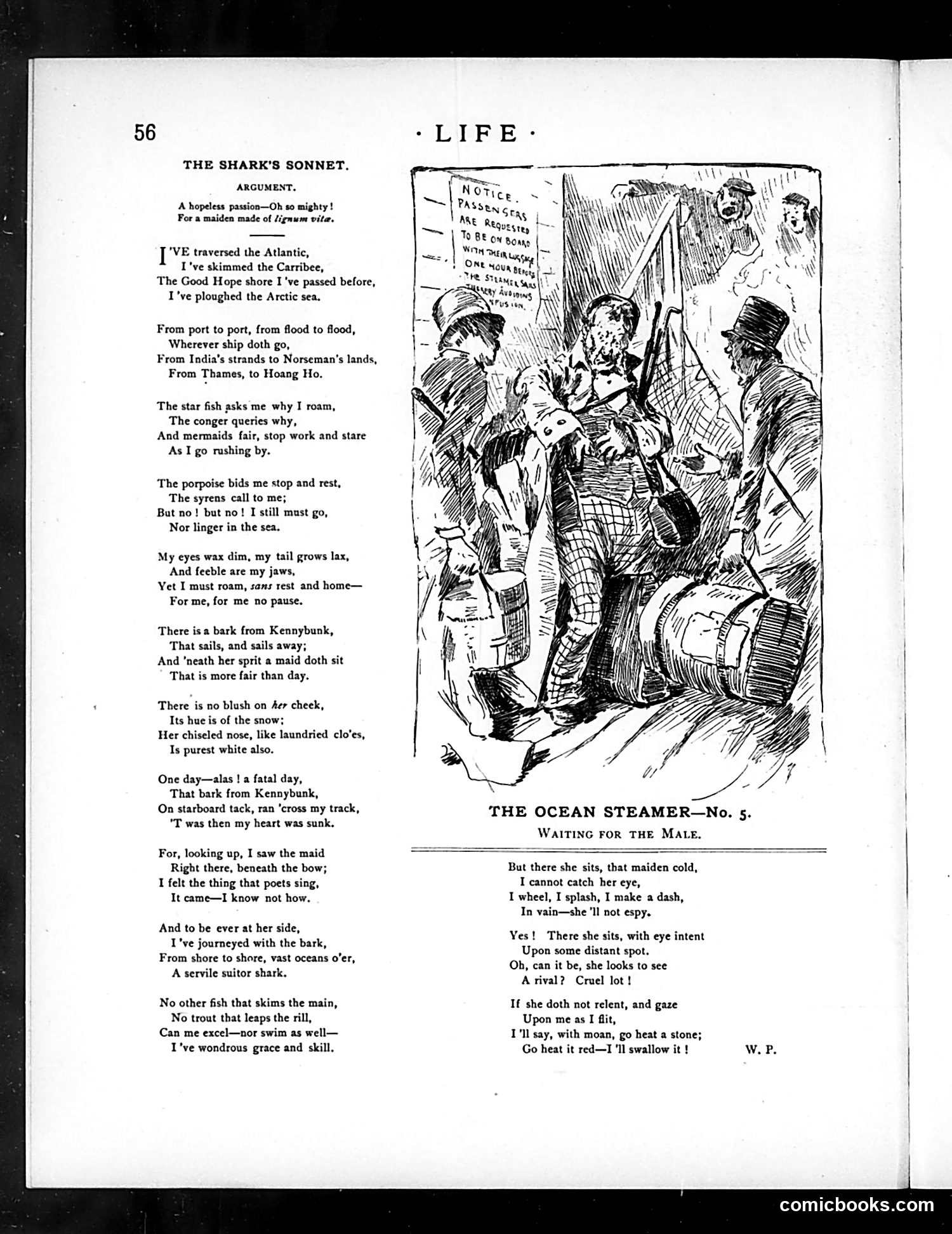
This page presents two humorous Victorian-era literary pieces that anthropomorphize sea creatures for comic effect. **"The Shark's Sonnet"** parodies romantic poetry by casting a lovelorn shark pursuing a wooden figurehead ("fignum vitae"—wood) from a ship from Kennybunk, Maine. The shark travels globally, ignoring other sea creatures' invitations, driven by unrequited passion. The satire mocks overwrought romantic verses and their melodramatic declarations of devotion—here absurdly applied to a shark chasing an inanimate object. **"The Ocean Steamer—No. 5"** appears to be a companion piece where a female creature (likely another marine animal or personified ship element) waits for the male shark to notice her, while the shark remains fixated elsewhere. This reversal satirizes romantic frustration and jealousy, suggesting the futility of one-sided passion. Both pieces use nautical settings and animal characters to gently mock sentimental Victorian romance literature and human emotional melodrama through whimsical absurdity.
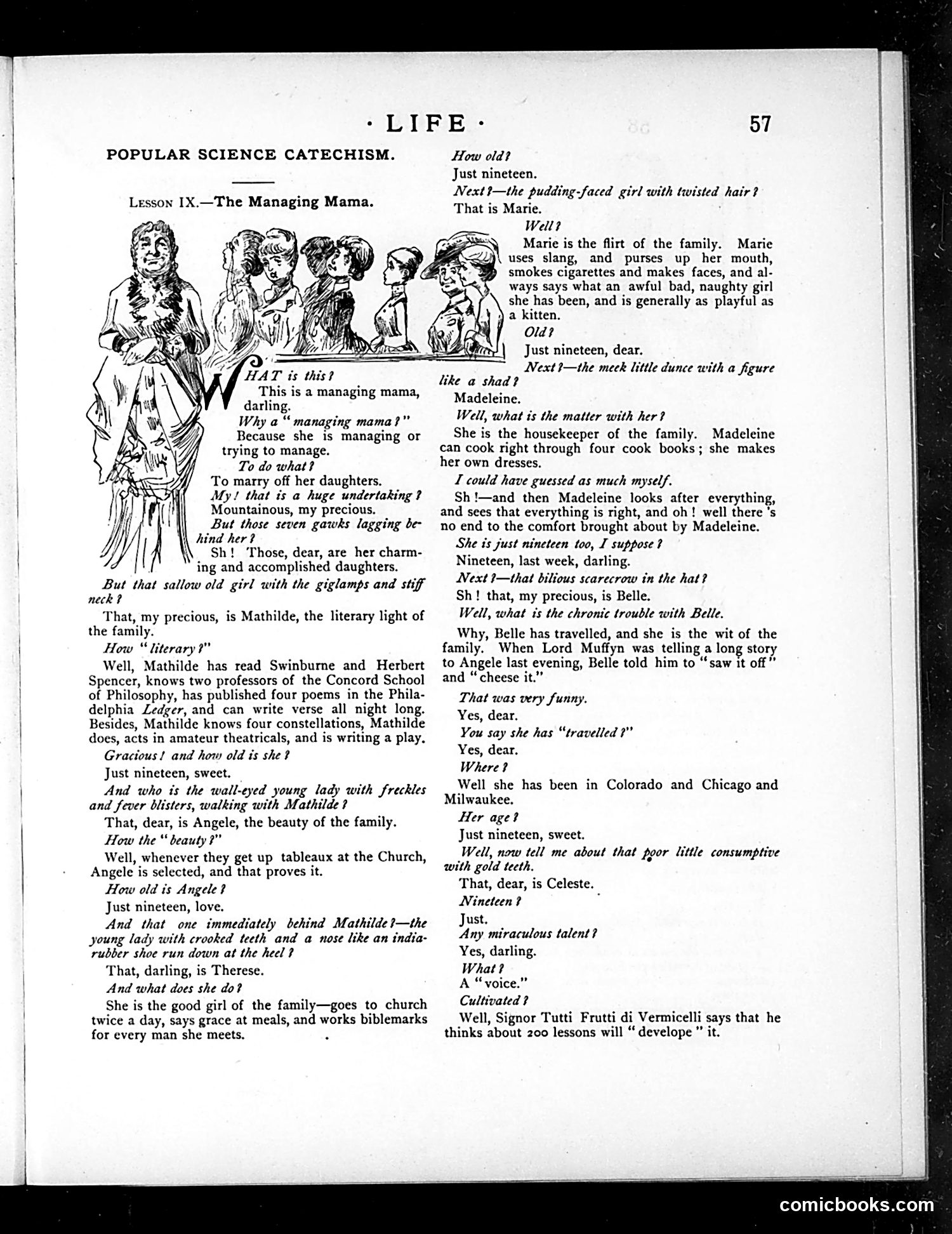
This is a humorous "catechism" (question-and-answer lesson) mocking the Victorian obsession with marrying off daughters. The cartoon depicts a mother shepherding seven nearly-identical nineteen-year-old daughters, each supposedly possessing unique accomplishments that make them marriageable. The satire works through exaggeration: Mathilde is "literary" (reads famous authors, knows philosophy professors, published four poems), yet all daughters are exactly nineteen. Each girl has a comically thin "talent"—Angele's beauty proven only by church tableaux selection; Marie is merely a flirtatious troublemaker; Therese's virtue consists of making Bible bookmarks; Madeleine cooks and cleans; Belle's "wit" is being rude; Celeste has an undeveloped singing voice requiring 200 lessons. The joke targets both the mother's desperate matchmaking efforts and the hollow, performative "accomplishments" young women were expected to cultivate for marriage prospects. The uniformity of their ages and mediocrity of their talents satirizes how interchangeable these daughters actually are despite their marketed distinctions.
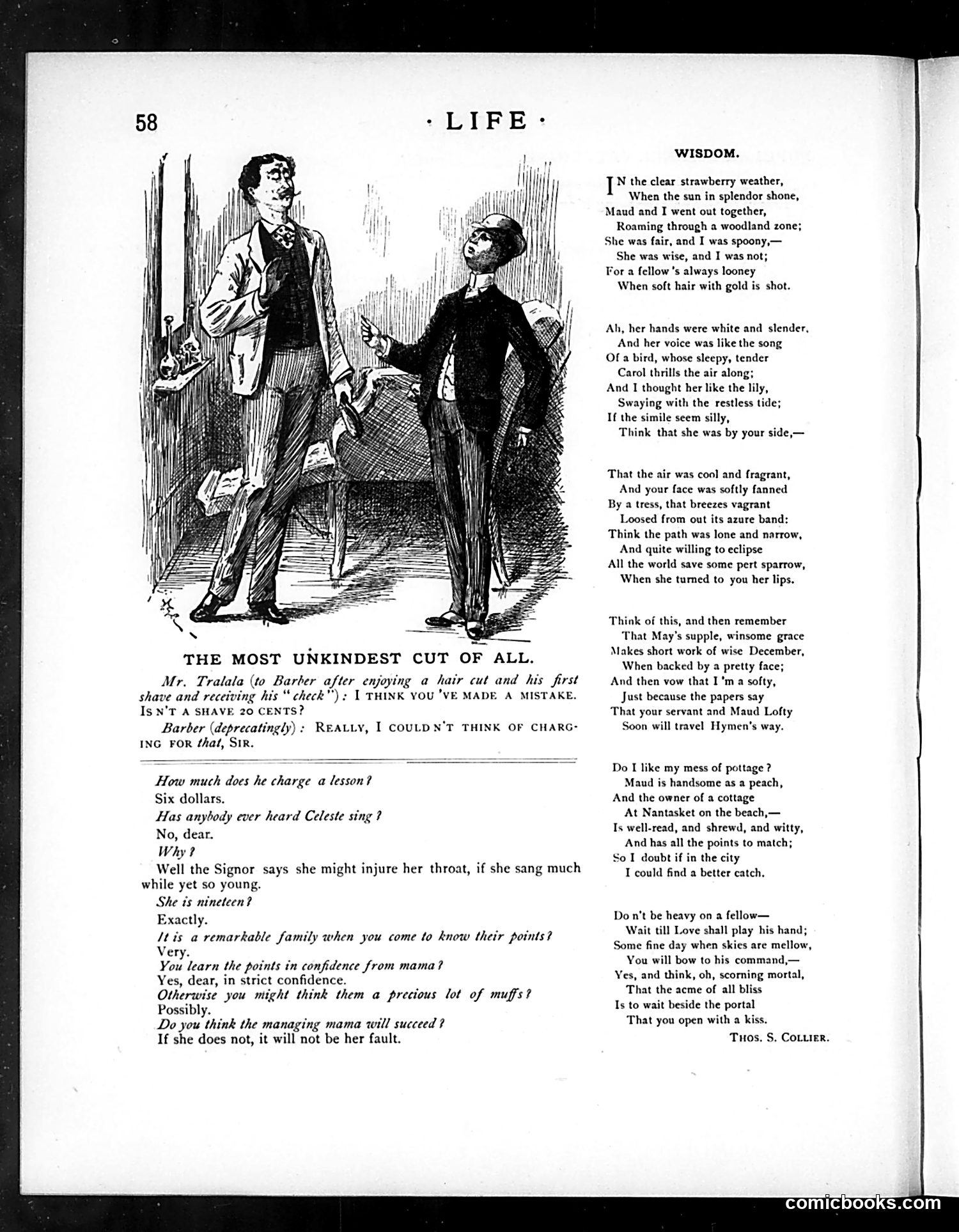
This cartoon satirizes a barber's attempt at flattery or manipulation. Mr. Tralala questions the barber's bill after receiving a haircut and shave, noting the shave should cost 20 cents. The barber deflects, claiming he couldn't charge for it—a transparent ploy to seem generous while actually avoiding payment discussion. The accompanying dialogue mocks a singing teacher (likely "Signor" and his student "Celeste") who claims the 19-year-old student cannot sing because it might injure her throat. The satire suggests this is a pretense—the family is being portrayed as shams relying on deception and managing the girl's prospects (likely for marriage, given the final poem's mention of "Hymen's way"). The joke targets social climbers and those who hide their mercenary intentions behind false courtesy or pseudointellectual excuses.
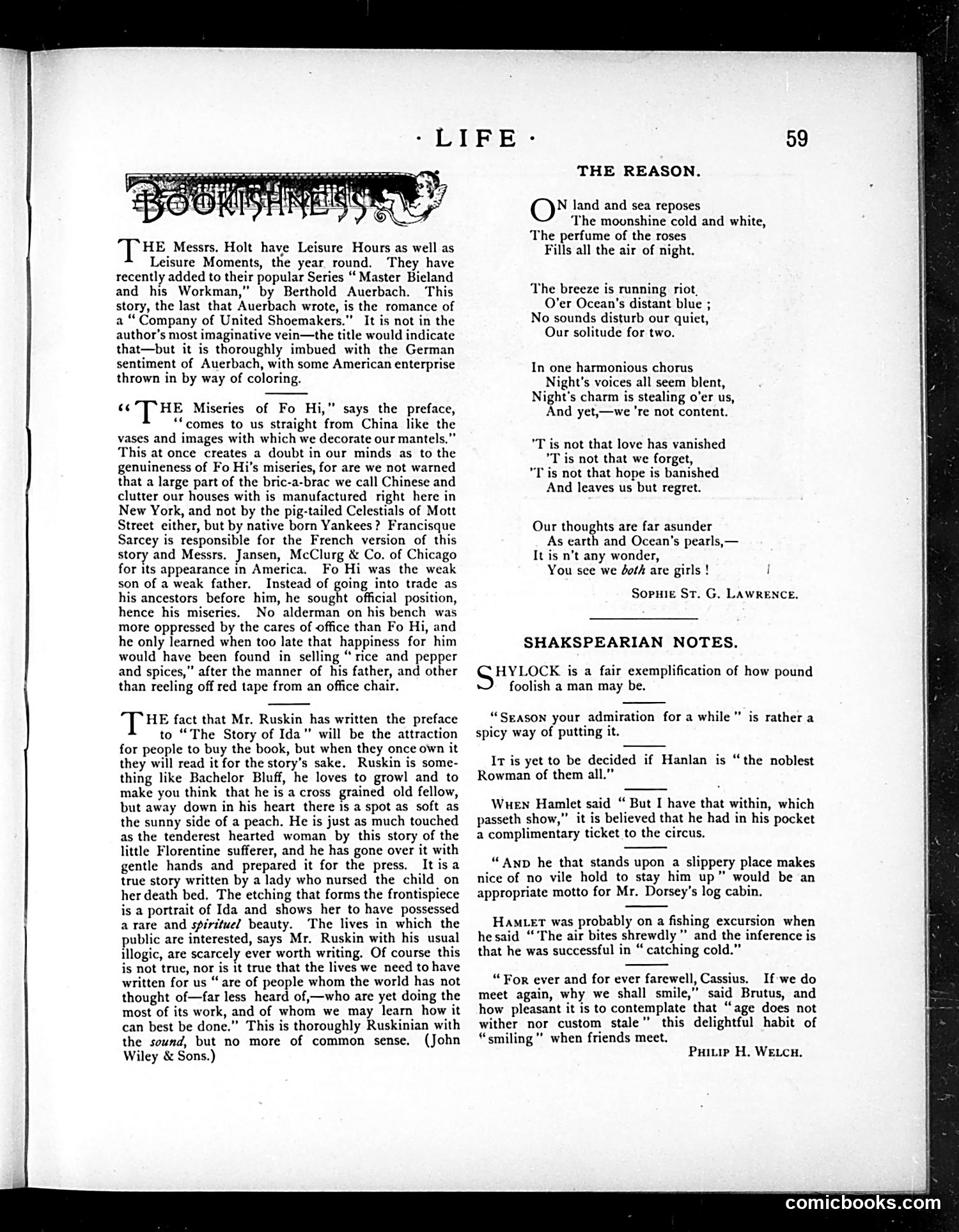
This is a book review and literary criticism page, not a political cartoon. It contains three distinct sections: **"Bookishness"** reviews three contemporary books: a German-American story about shoemakers by Berthold Auerbach; "The Miseries of Fo Hi," a Chinese tale that the reviewer humorously questions as authentically Chinese (noting fake "Chinese" bric-a-brac was manufactured in New York by Yankees, not "pig-tailed Celestials"); and Ruskin's preface to "The Story of Ida," about a Florentine child. **"The Reason"** is a sentimental poem by Sophie St. G. Lawrence about romantic estrangement—two people together yet emotionally distant, ending with the punchline that they're both girls (suggesting same-sex emotional complexity, unusual for the era). **"Shakespearian Notes"** offers witty glosses on Shakespeare passages, a common 19th-century literary feature. The page reflects *Life* magazine's role as a literary and cultural commentary publication for educated readers.
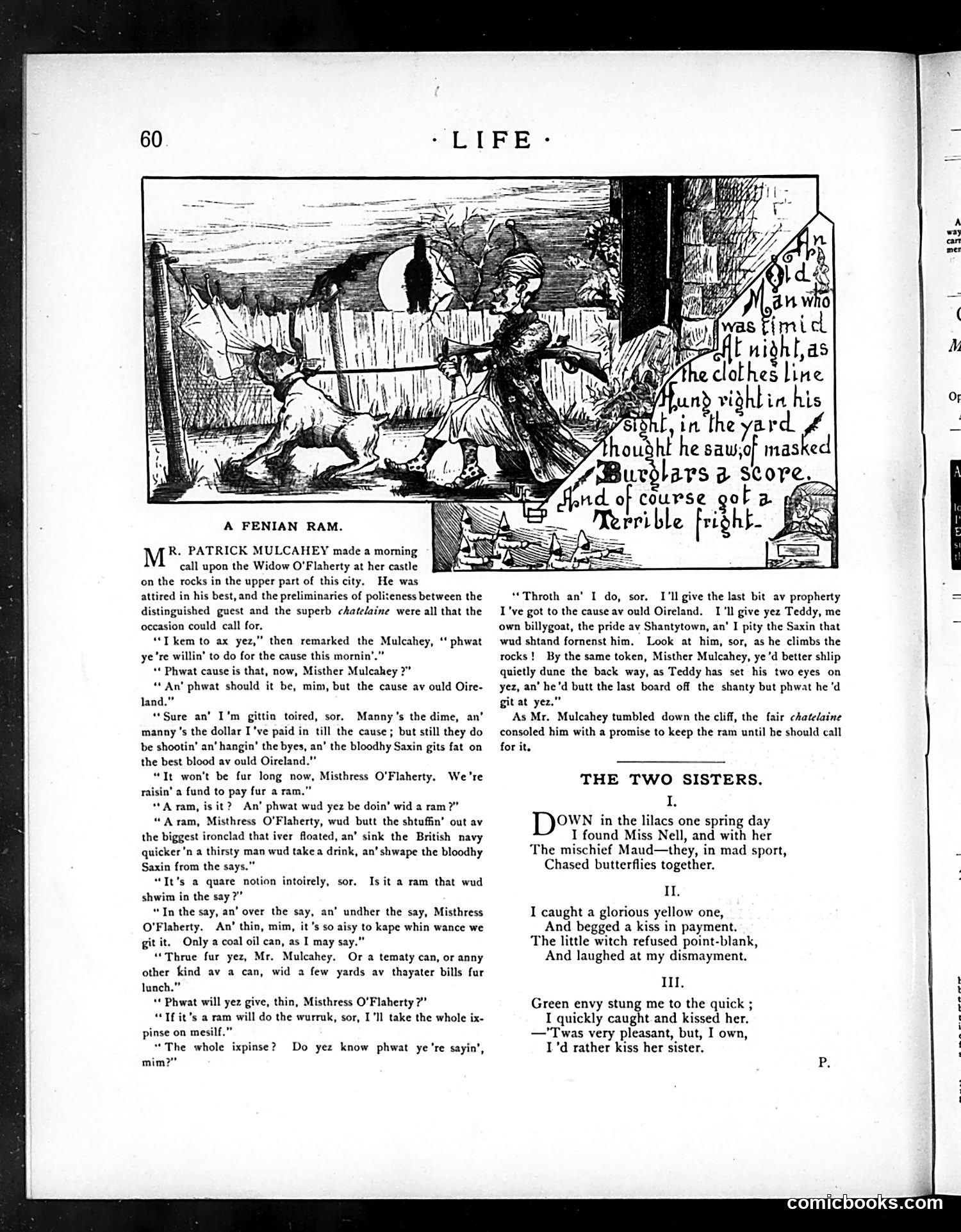
This cartoon mocks Irish-American fundraising efforts, likely referencing the Fenian Brotherhood (an Irish nationalist organization active in the 1860s-70s). The joke hinges on absurdity: Mr. Mulcahey solicits the Widow O'Flaherty for donations to build a submarine ram—a weapon supposedly to sink the British navy and liberate Ireland. The satire cuts two ways. It ridicules both the fantastical, impractical schemes promoted by Irish-American nationalist organizations *and* the gullible donors willing to fund them. The widow's agreement to donate her prize billygoat "Teddy" as the supposed weapon demonstrates how ridiculous the premise has become—yet she takes it seriously. The thick Irish dialect reinforces period stereotypes. The cartoon suggests that Irish-American fundraising mixed genuine patriotic sentiment with naive schemes and questionable financial accountability ("coal oil can," "theater bills"). The page's second item, "The Two Sisters," is a lighthearted romantic poem unrelated to the political satire above.
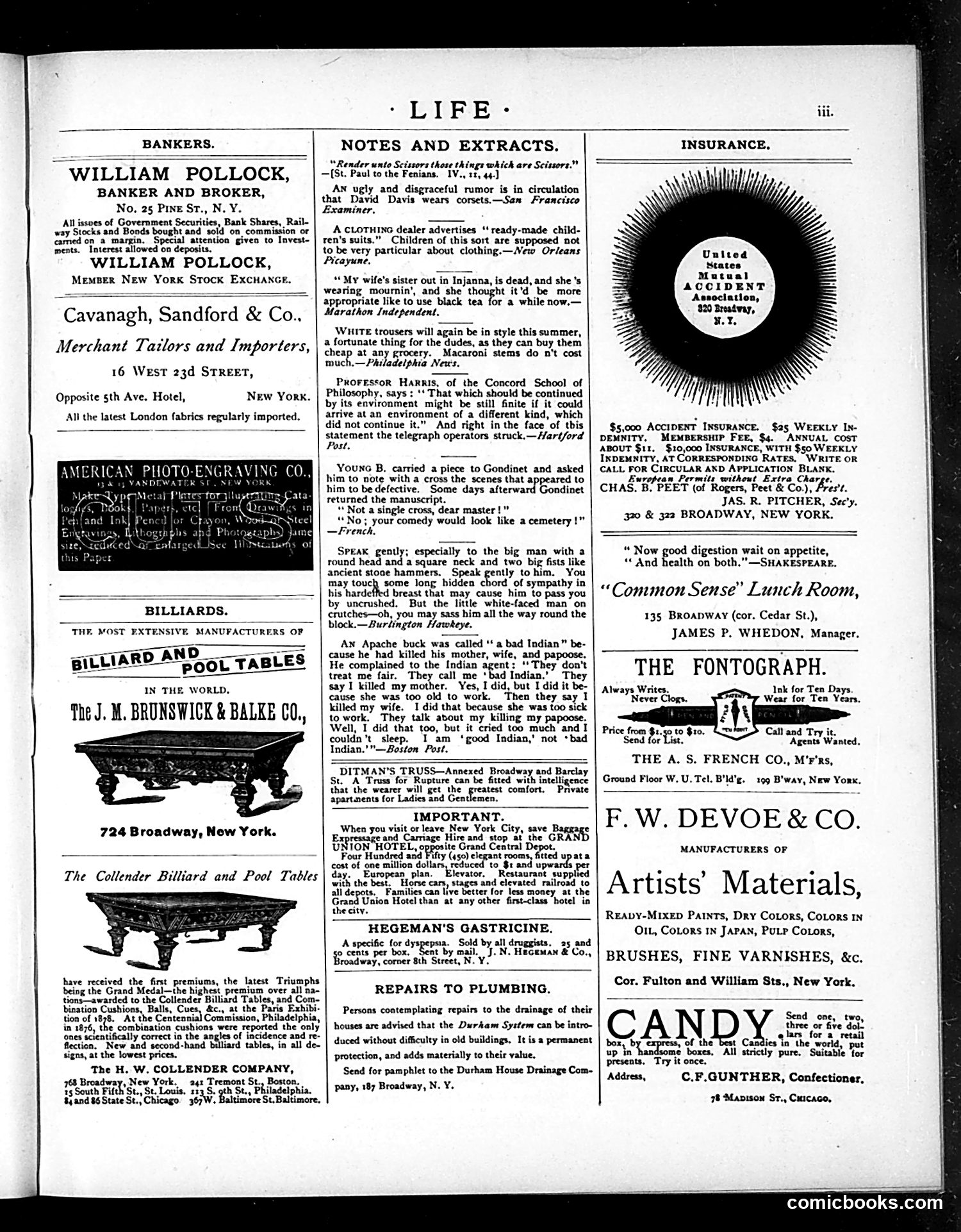
This page is primarily **advertisements and satirical notes**, not a political cartoon. The "NOTES AND EXTRACTS" section contains brief humorous observations on contemporary life and fashion. Key satirical points include: - **Fashion absurdities**: Jokes about men wearing corsets, white trousers made from cheap materials ("macaroni stems"), and ready-made children's clothing - **Social commentary**: A quip about telegraph operators striking (a contemporary labor issue), and mockery of philosophical jargon from the Concord School of Philosophy - **Ethnic stereotyping**: A crude joke about an Apache man's logic for killing family members—typical of 19th-century publications' offensive depictions of Native Americans - **Class humor**: Commentary on "dudes" and advice to speak gently to working-class men The bulk of the page features ads for financial services, billiard tables, tailors, and artist materials—reflecting *Life's* audience of educated, relatively wealthy urbanites in New York.
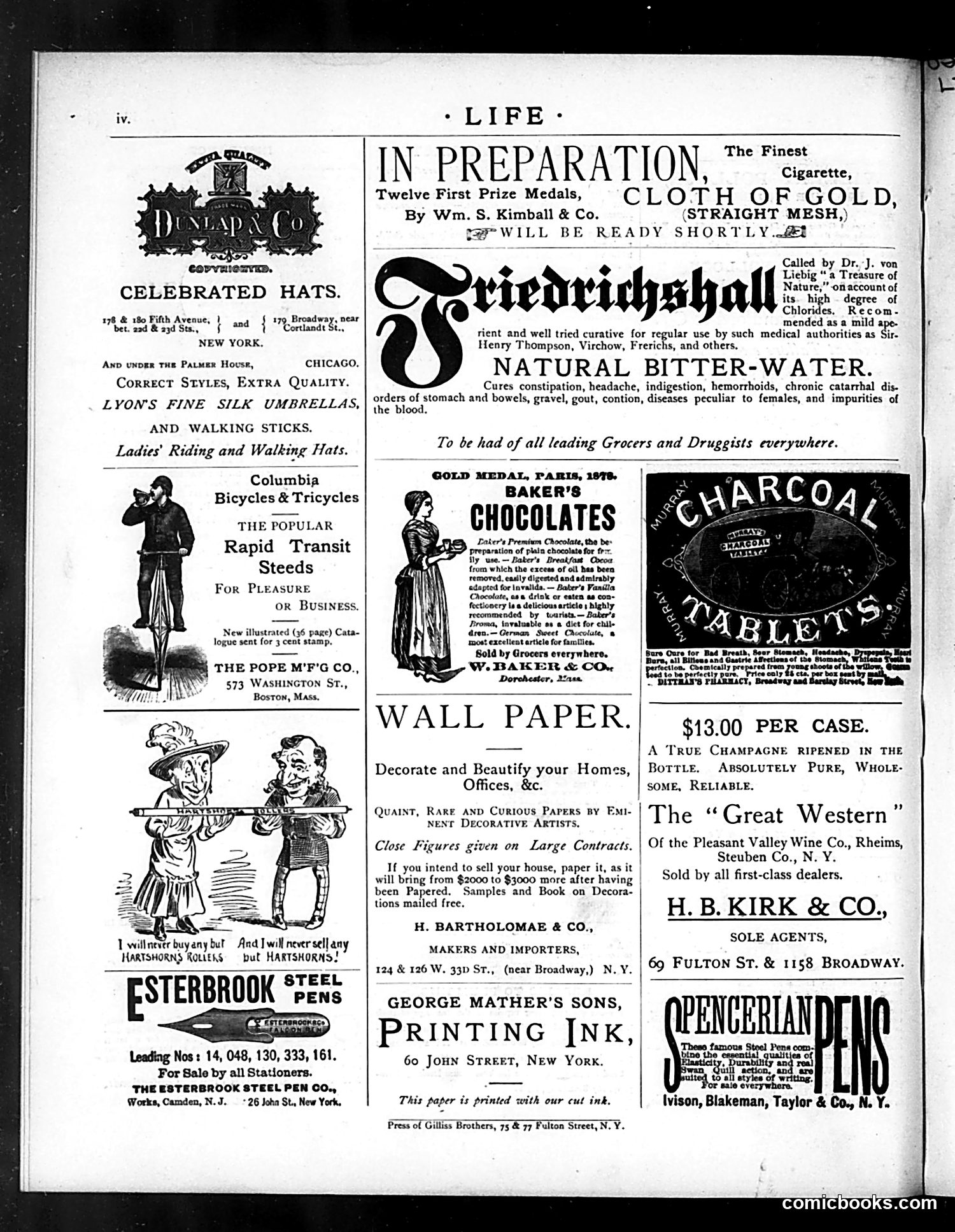
This page is primarily **advertising**, not political satire. It contains numerous late-19th-century product advertisements (hats, bicycles, pens, chocolate, wall paper, wine, pens) with one minor illustrated element. The only cartoon-like content appears at bottom-left: a small sketch of two figures discussing "Hartshorn's Rollers" (window shades), with dialogue bubbles stating "I will never buy any but Hartshorn's Rollers" and "And I will never sell any but Hartshorns!" This is straightforward product endorsement humor—a simple joke reinforcing brand loyalty rather than social satire. The exaggerated facial expressions suggest mild comedy, but there's no political commentary or historical reference embedded here. The page reflects Life magazine's business model: satirical content supported by extensive paid advertising to middle and upper-class readers of the era.