
Life, 1883-08-02 · page 13 of 16
Life — August 2, 1883 — page 13: what you’re looking at
What you’re looking at
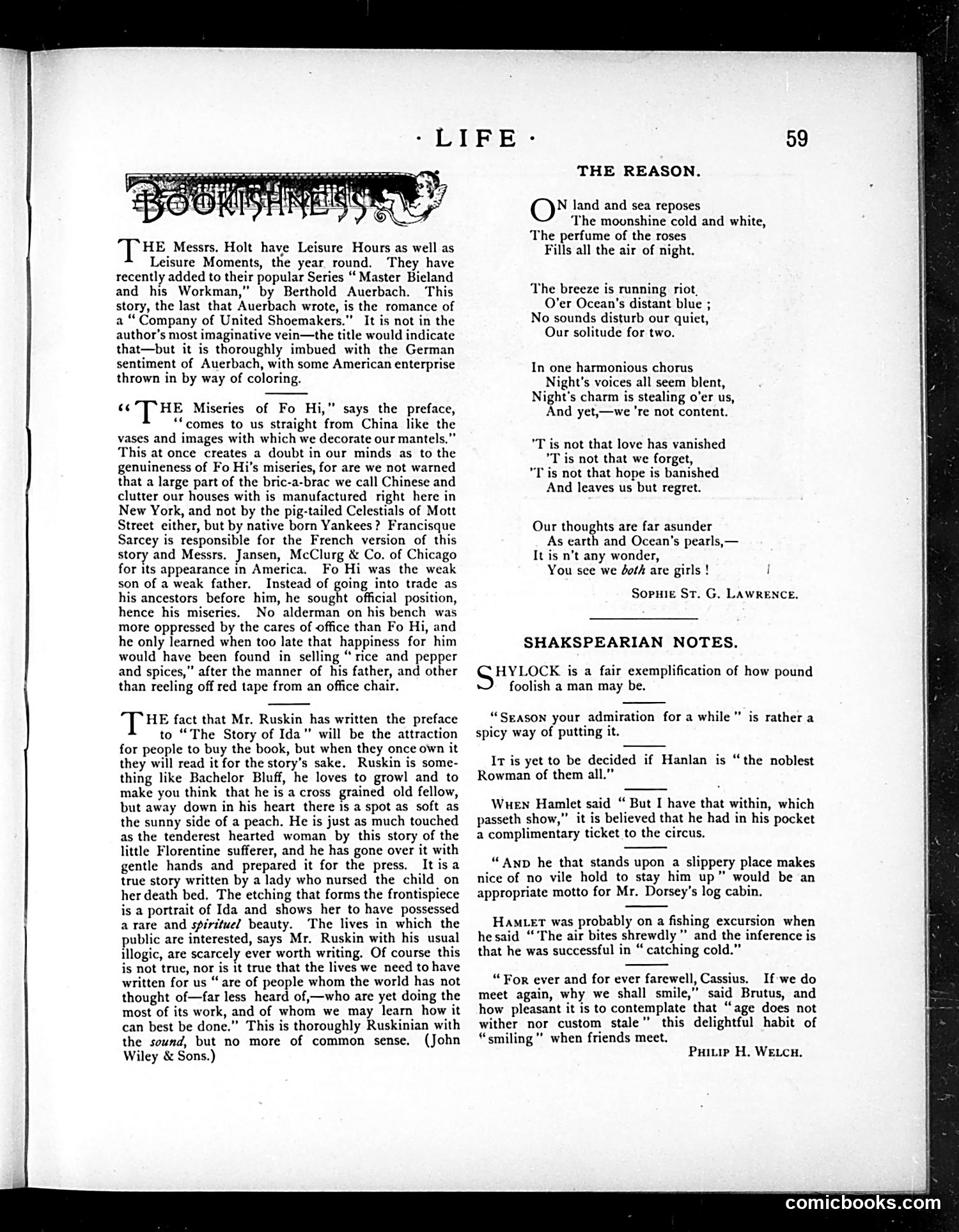
This is a book review and literary criticism page, not a political cartoon. It contains three distinct sections: **"Bookishness"** reviews three contemporary books: a German-American story about shoemakers by Berthold Auerbach; "The Miseries of Fo Hi," a Chinese tale that the reviewer humorously questions as authentically Chinese (noting fake "Chinese" bric-a-brac was manufactured in New York by Yankees, not "pig-tailed Celestials"); and Ruskin's preface to "The Story of Ida," about a Florentine child. **"The Reason"** is a sentimental poem by Sophie St. G. Lawrence about romantic estrangement—two people together yet emotionally distant, ending with the punchline that they're both girls (suggesting same-sex emotional complexity, unusual for the era). **"Shakespearian Notes"** offers witty glosses on Shakespeare passages, a common 19th-century literary feature. The page reflects *Life* magazine's role as a literary and cultural commentary publication for educated readers.
📄 Transcribed text from this page (OCR, searchable)
Machine-transcribed from the original scan — historical spelling and the odd misread are preserved.
HE Messrs. Holt have Leisure Hours as well as Leisure Moments, the year round. They have recently added to their popular Series “ Master Bieland and his Workman,” by Berthold Auerbach. This story, the last that Auerbach wrote, is the romance of a “ Company of United Shoemakers.” It is not in the author's most imaginative vein—the title would indicate that—but it is thoroughly imbued with the German sentiment of Auerbach, with some American enterprise thrown in by way of coloring. “cc HE Miseries of Fo Hi," says the preface, “*comes to us straight from China like the vases and images with which we decorate our mantels.”” This at once creates a doubt in our minds as to the genuineness of Fo Hi's miseries, for are we not warned that a large part of the bric-a-brac we call Chinese and clutter our houses with is manufactured right here in New York, and not by the pig-tailed Celestials of Mott Street either, but by native born Yankees? Francisque Sarcey is responsible for the French version of this story and Messrs. Jansen, McClurg & Co. of Chicago for its appearance in America. Fo Hi was the weak son of a weak father. Instead of going into trade as his ancestors before him, he sought official position, hence his miseries. No alderman on his bench was more oppressed by the cares of office than Fo Hi, and he only learned when too late that happiness for him would have been found in selling “rice and pepper and spices,” after the manner of his father, and other than reeling off red tape from an office chair. HE fact that Mr. Ruskin has written the preface to “The Story of Ida” will be the attraction for people to buy the book, but when they once own it they will read it for the story’s sake. Ruskin is some- thing like Bachelor Bluff, he loves to growl and to make you think that he is a cross grained old fellow, but away down in his heart there is a spot as soft as the sunny side of a peach. He is just as much touched as the tenderest hearted woman by this story of the little Florentine sufferer, and he has gone over it with gentle hands and prepared it for the press. Itisa true story written by a lady who nursed the child on her death bed. The etching that forms the frontispiece is a portrait of Ida and shows her to have possessed arare and sfirituel beauty. The lives in which the public are interested, says Mr. Ruskin with his usual illogic, are scarcely ever worth writing. Of course this is not true, nor is it true that the lives we need to have written for us “are of people whom the world has not thought of—far less heard of,—who are yet doing the most of its work, and of whom we may learn how it can best be done.” This is thoroughly Ruskinian with the sound, but no more of common sense. (John Wiley & Sons.) THE REASON. ON land and sea reposes ‘The mounshine cold and white, The perfume of the roses Fills all the air of night. The breeze is running riot, O’er Ocean's distant blue ; No sounds disturb our quiet, Our solitude for two. In one harmonious chorus Night’s voices all seem blent, Night's charm is stealing o'er us, And yet,—we ‘re not content. ’T is not that love has vanished ’T is not that we forget, *T is not that hope is banished And leaves us but regret. Our thoughts are far asunder As earth and Ocean's pearls,— It is n’t any wonder, You see we doth are girls ! | Sopnie St. G. LAWRENCE. SHAKSPEARIAN NOTES. YLOCK is a fair exemplification of how pound foolish a man may be. “Season your admiration for a while” is rather a spicy way of putting it. It is yet to be decided if Hanlan is “the noblest Rowman of them all.” Wuen Hamlet said “ But I have that within, which passeth show,” it is believed that he had in his pocket a complimentary ticket to the circus. “Anp he that stands upon a slippery place makes nice of no vile hold to stay him up” would be an appropriate motto for Mr. Dorsey's log cabin. Hamuet was probably on a fishing excursion when he said “ ‘The air bites shrewdly” and the inference is that he was successful in “ catching cold.” “ For ever and for ever farewell, Cassius. If we do meet again, why we shall smile,” said Brutus, and how pleasant it is to contemplate that “‘age does not wither nor custom stale” this delightful habit of “smiling” when friends meet. Puivip H. WELcH. comicbooks.com