
A complete issue · 16 pages · 1883
Life — July 26, 1883
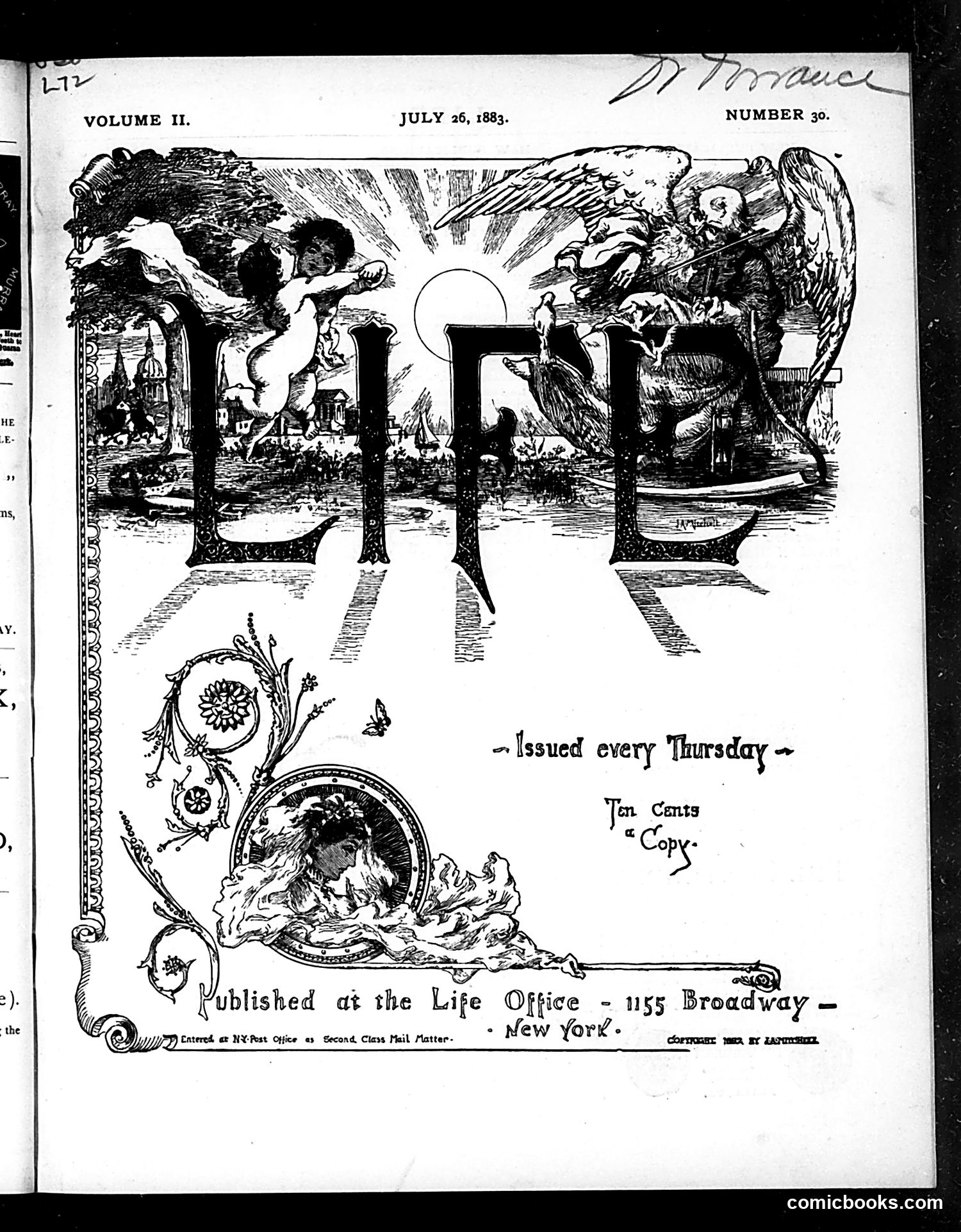
This is the cover of *Life* magazine's second volume, number 30. The large decorative letters "LIFE" dominate the center, framed by ornate Victorian-era artwork. The illustration features classical and allegorical figures—including cherubs, angelic beings, and what appears to be a winged figure on the right—set against a dramatic landscape with water and distant structures. The overall composition is elaborate and artistic rather than directly satirical. The decorative border and mythological imagery suggest *Life* positioned itself as a publication of cultural sophistication. The cover emphasizes the magazine's Thursday publication schedule and ten-cent price point. Publication details appear at bottom: "Life Office, 1155 Broadway, New York."
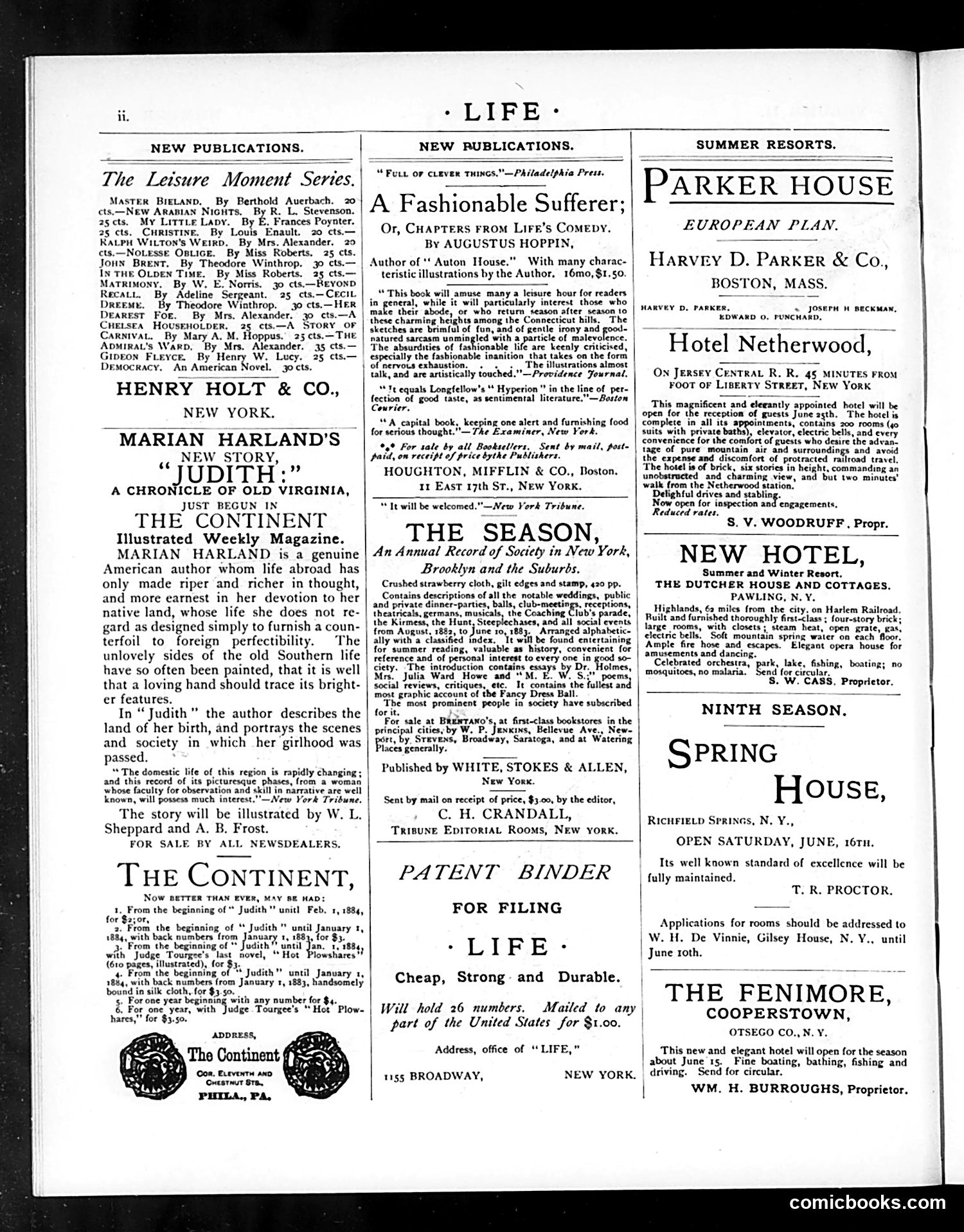
This page is **primarily advertisements** for summer resorts, new publications, and a patent binder. There are no political cartoons visible. The ads promote: - **Parker House** (Boston hotel) - **Hotel Netherwood** (New Jersey) - **New Hotel** (Pawling, NY) - **Spring House** (Richfield Springs, NY) - **The Fenimore** (Cooperstown, Ohio) Book advertisements include Marian Harland's novel "Judith" and Augustus Hoppin's "A Fashionable Sufferer," along with "The Season," a society chronicle of New York, Brooklyn, and suburbs. There's also an advertisement for a **Patent Binder for filing LIFE magazine**, available at the publication's Broadway office. This is a typical late-19th-century magazine page mixing editorial content with revenue-generating advertisements rather than satirical content.
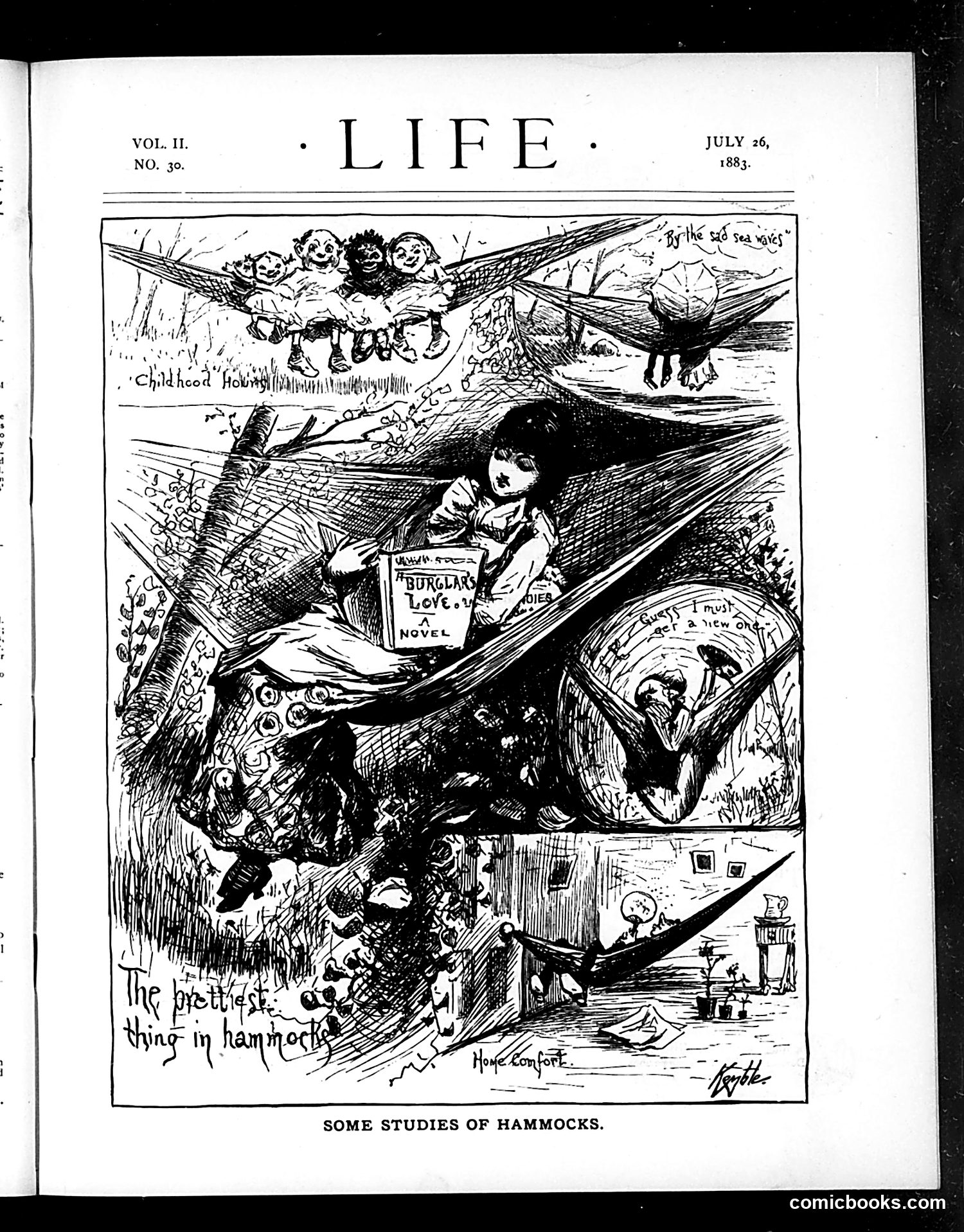
This illustrated feature shows various humorous scenarios of people relaxing in hammocks. The drawings depict "Childhood Hours" (children swinging together), "Home Comfort" (an adult reading a novel), and "The Best Thing in Hammocks" (someone napping peacefully). The satire gently mocks Victorian leisure culture and the era's romanticization of idle relaxation. The central figure reading what appears to be a sentimental novel while lounging satirizes the popularity of popular fiction and leisured middle-class life during the Gilded Age. The crude but detailed pen-work typical of 1880s Life magazine creates comedic exaggeration—the hammocks appear precarious, the figures ungainly—suggesting that despite civilization's pretensions to comfort and refinement, simple hammock-swinging reveals human vulnerability and the comic reality beneath genteel aspirations.
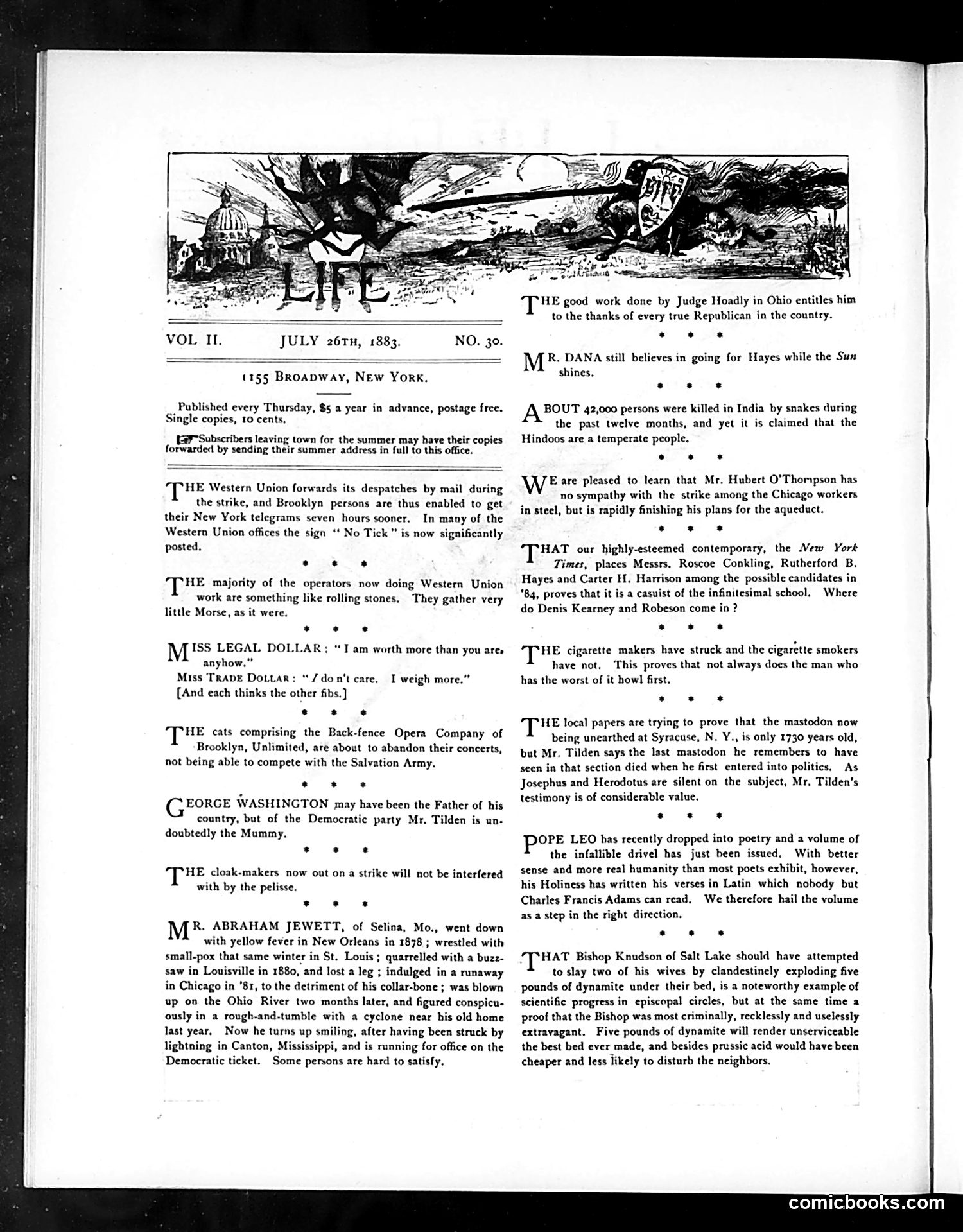
The masthead cartoon depicts Death as a skeletal figure seated amid a landscape of graves and destruction—a memento mori typical of 19th-century satirical imagery. The page comprises brief political commentary items rather than developed cartoons. Notable references include: - **Judge Hoadly's Ohio work** earning Republican praise - **Western Union strike** enabling faster telegram delivery - **Mr. Tilden** (Samuel J. Tilden, former Democratic presidential candidate) compared unfavorably to George Washington - **Bishop Knudson's dynamite scheme** satirizing clergy as dangerously eccentric - Commentary on cigarette makers and Pope Leo XIII's poetry The content reflects 1883 concerns: labor unrest, partisan politics, and social absurdities. The brevity and rapid-fire format was typical of Life's satirical style during this era.
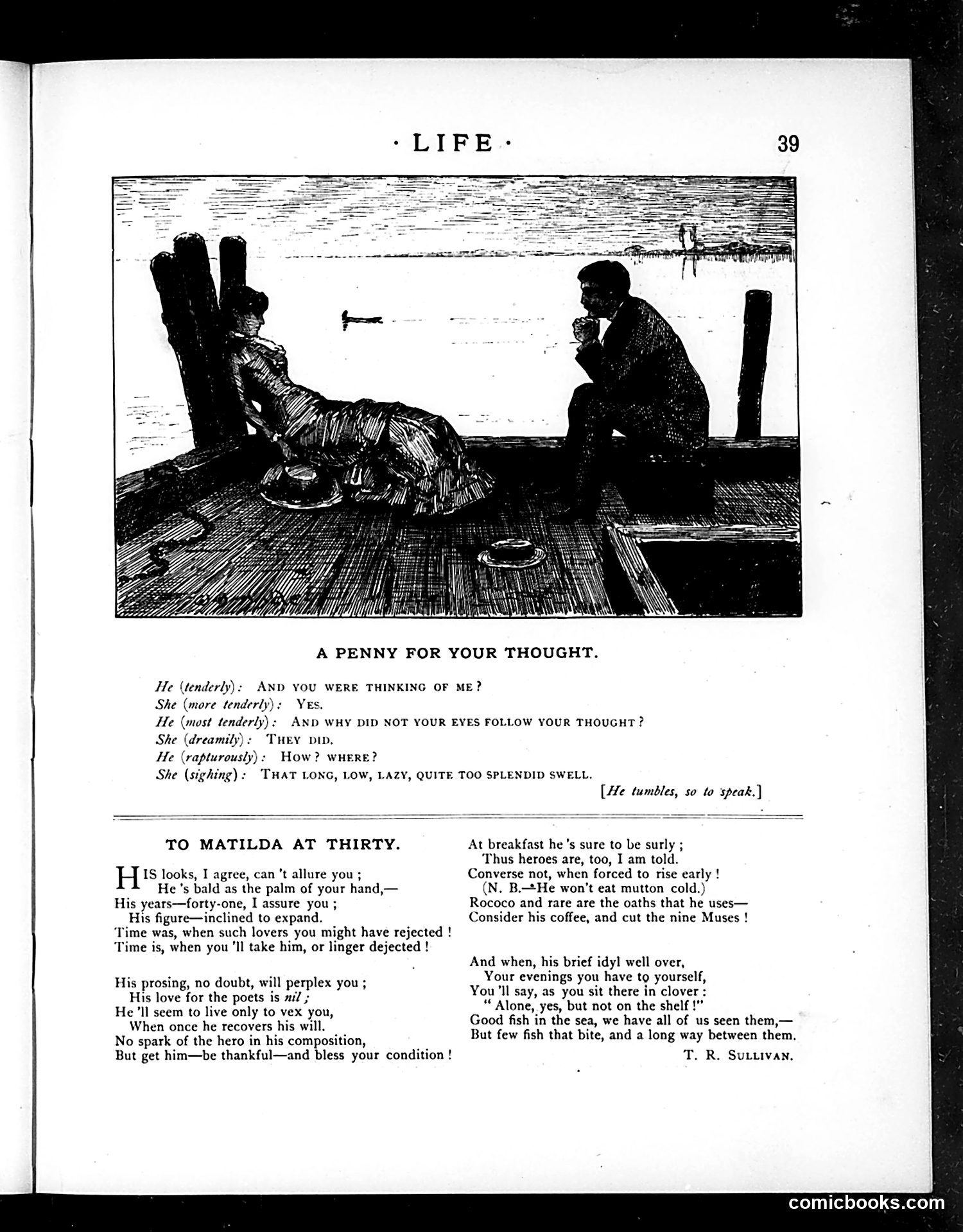
**The Cartoon "A Penny for Your Thought":** This illustration depicts two figures on a dock overlooking water. The tender dialogue concerns a woman lost in thought about a man, with her eyes following her daydream. The joke plays on the Victorian-era phrase "a penny for your thought"—a flirtatious device to prompt disclosure of romantic preoccupations. The satire gently mocks the predictability of romantic yearning and the tendency of couples to read each other's minds. **"To Matilda at Thirty":** This poem by T.R. Sullivan addresses a woman reaching thirty, examining how age affects romantic appeal and male attention. It sarcastically comments on male poets' shallow preferences and societal expectations, suggesting that aging women become invisible or less desirable, while humorously noting that catching a man's lasting interest remains as difficult as catching fish.
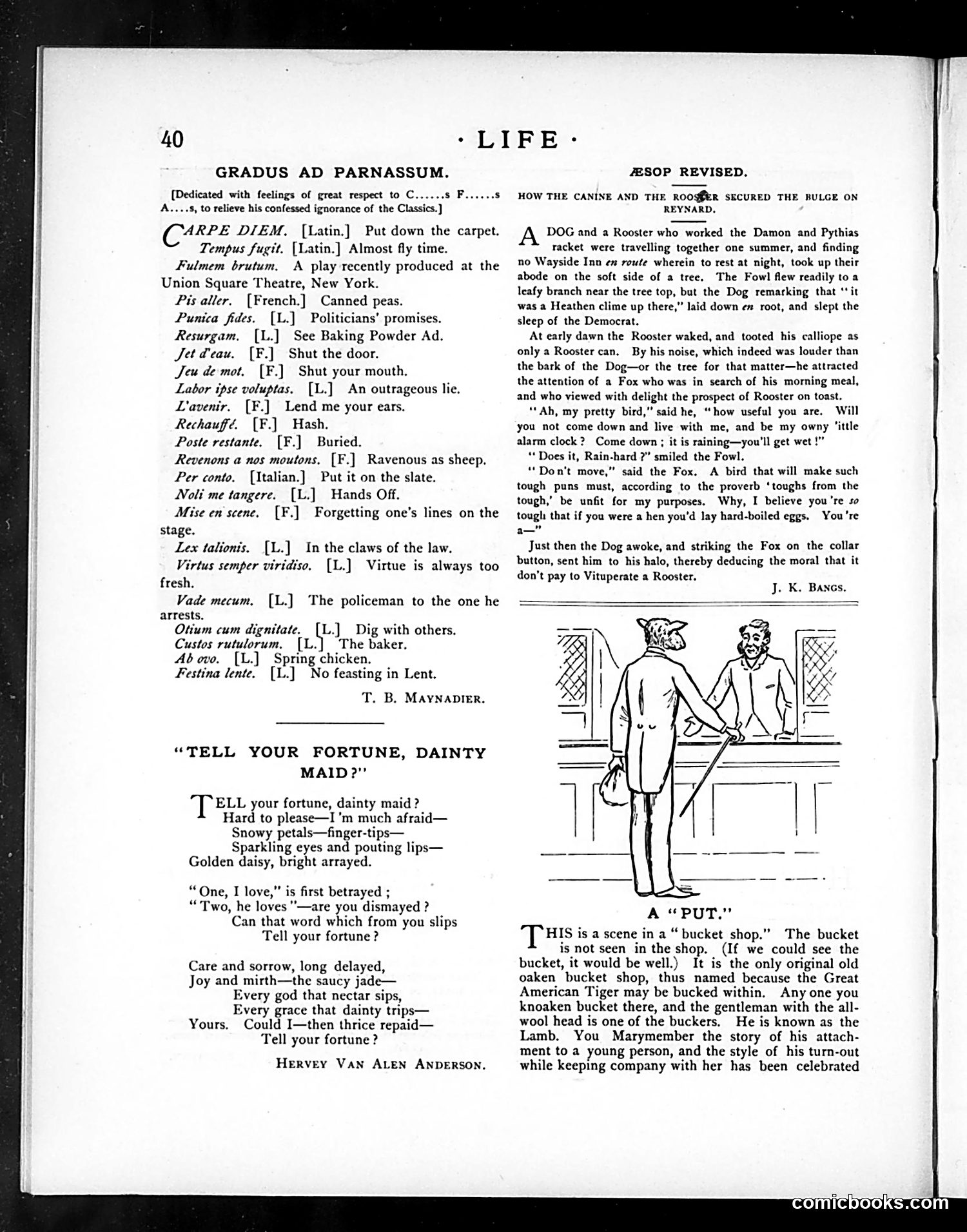
This page contains three distinct pieces: 1. **"Gradus ad Parnassum"** — A classical Latin phrase glossary with definitions, likely educational or satirizing scholarly pretension. 2. **"Tell Your Fortune, Dainty Maid?"** — A poem by Hervey Van Alen Anderson about fortune-telling, using romantic imagery (snowy petals, sparkling eyes). It plays on fortune-teller clichés while addressing romantic uncertainty. 3. **"A 'Put'"** — An illustrated scene captioned as occurring in a "bucket shop" (an illegal establishment for speculative trading). The cartoon depicts two men in what appears to be a brokerage or trading office. The accompanying text explains this references gambling on stock prices, with "Lamb" being slang for a naive investor. The humor likely derives from satirizing financial speculation and gullible investors during this period.
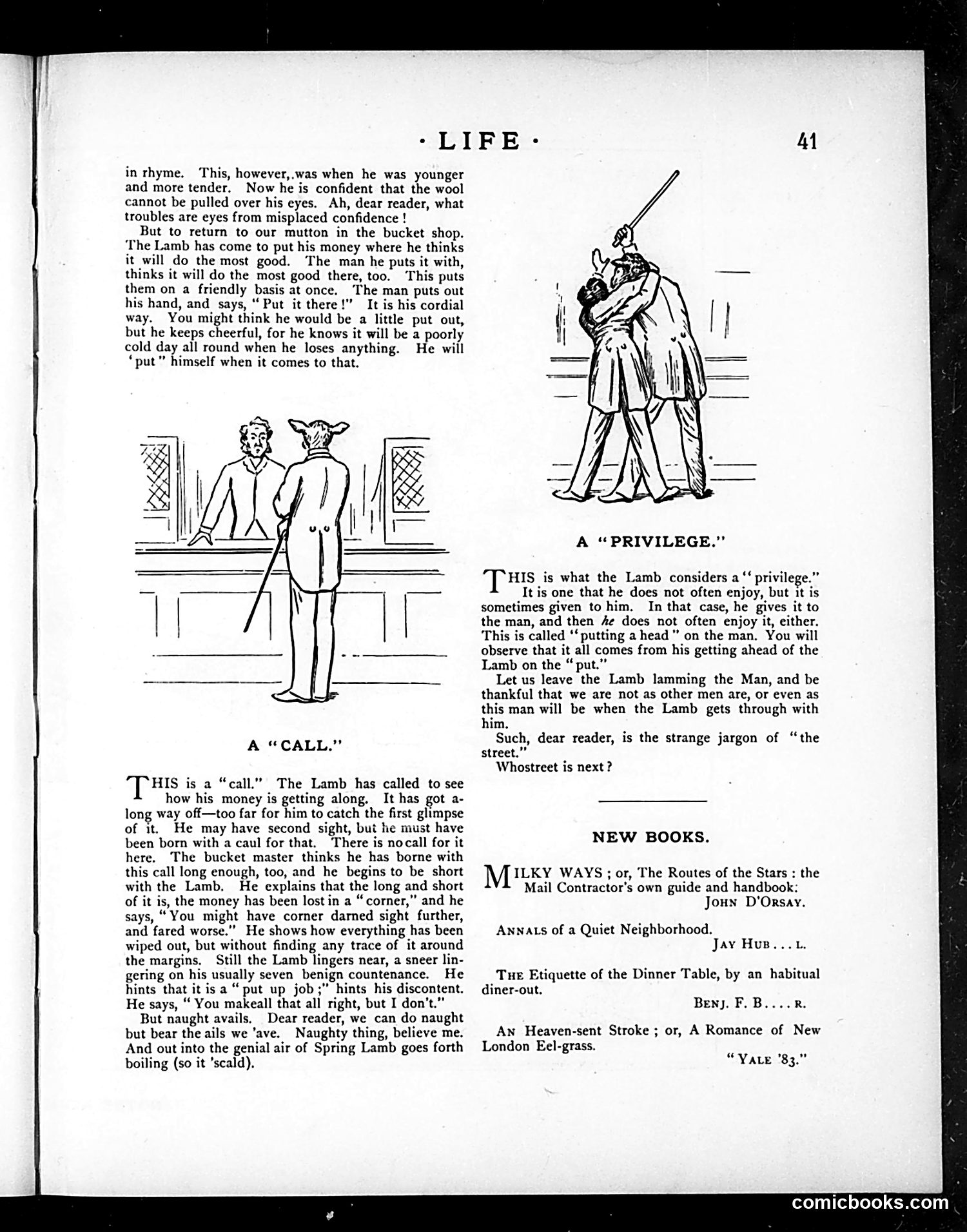
This page contains satirical commentary on class differences and social hierarchy, using "the Lamb" and "the Man" as character types representing the working and upper classes. **"A Call"** depicts a wealthy man summoning a subordinate to check on finances. The satire mocks how the rich assume their money is "lost" when it's simply been moved around—they expect servants to manage these details. **"A Privilege"** shows the man "putting a head" on the Lamb—literally striking him. The satire is that the Lamb considers even this violence a "privilege" because it means he's gotten ahead of his social superiors, suggesting the working class has such low expectations they're grateful for any acknowledgment. The text criticizes the strange language and social customs of "the street"—the world of business and social climbing.
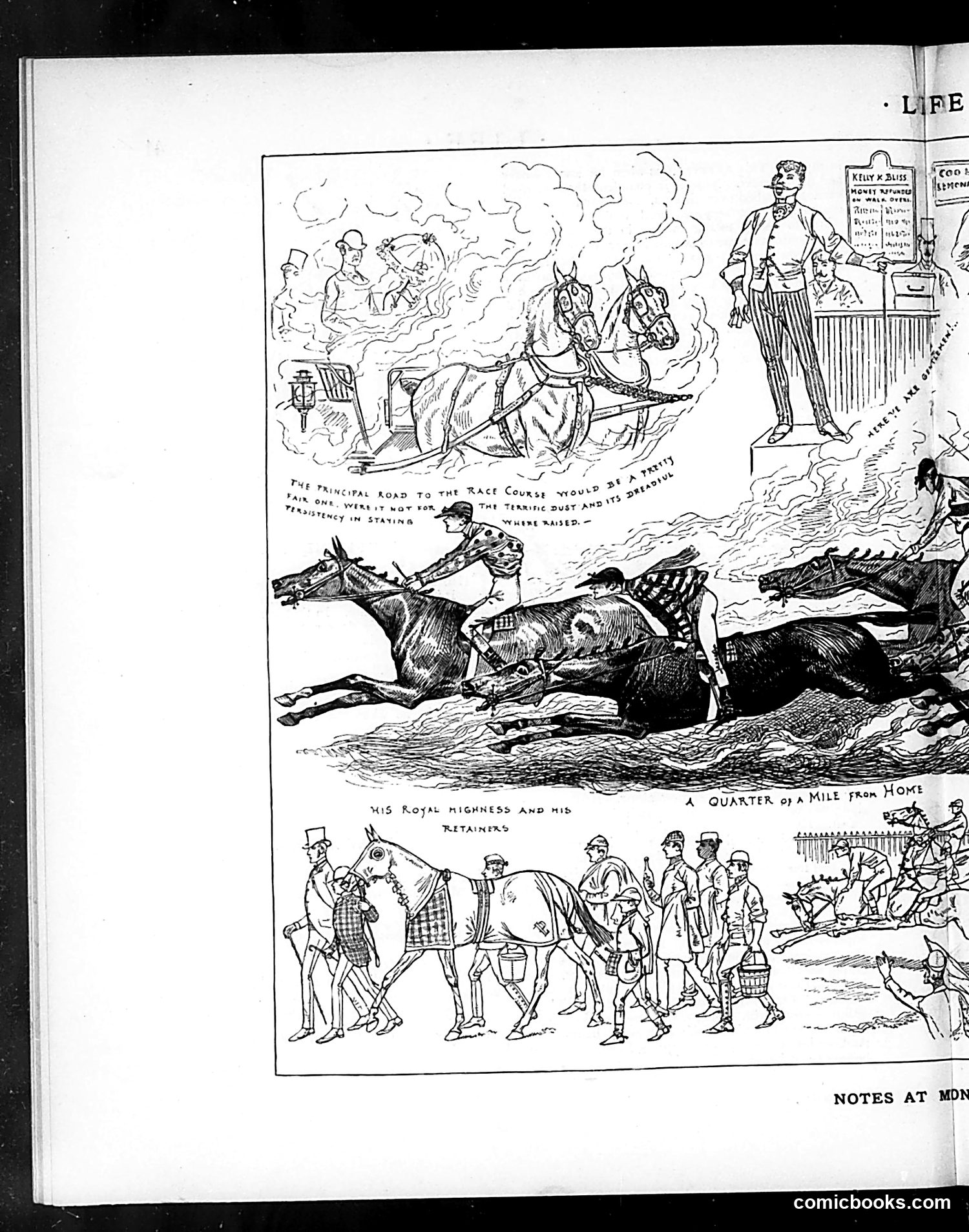
This page contains three satirical cartoon scenes depicting horse racing at what appears to be a prestigious racecourse (likely Ascot or similar British venue, given the formal dress). The top panel shows chaotic racing conditions with spectators fleeing from dust and smoke. The caption references "the principal road to the race course" being inadequate—satirizing poor infrastructure despite the event's importance. The middle panel depicts a dramatic horse fall or accident "a quarter of a mile from home," emphasizing racing's dangers. The bottom panel, "His Royal Highness and His Retinue," shows royal or aristocratic figures with attendants surrounding a horse, likely mocking the formal ceremony and class pretensions surrounding horse racing. The satire targets racing culture's combination of danger, poor public facilities, and excessive formality among the elite.
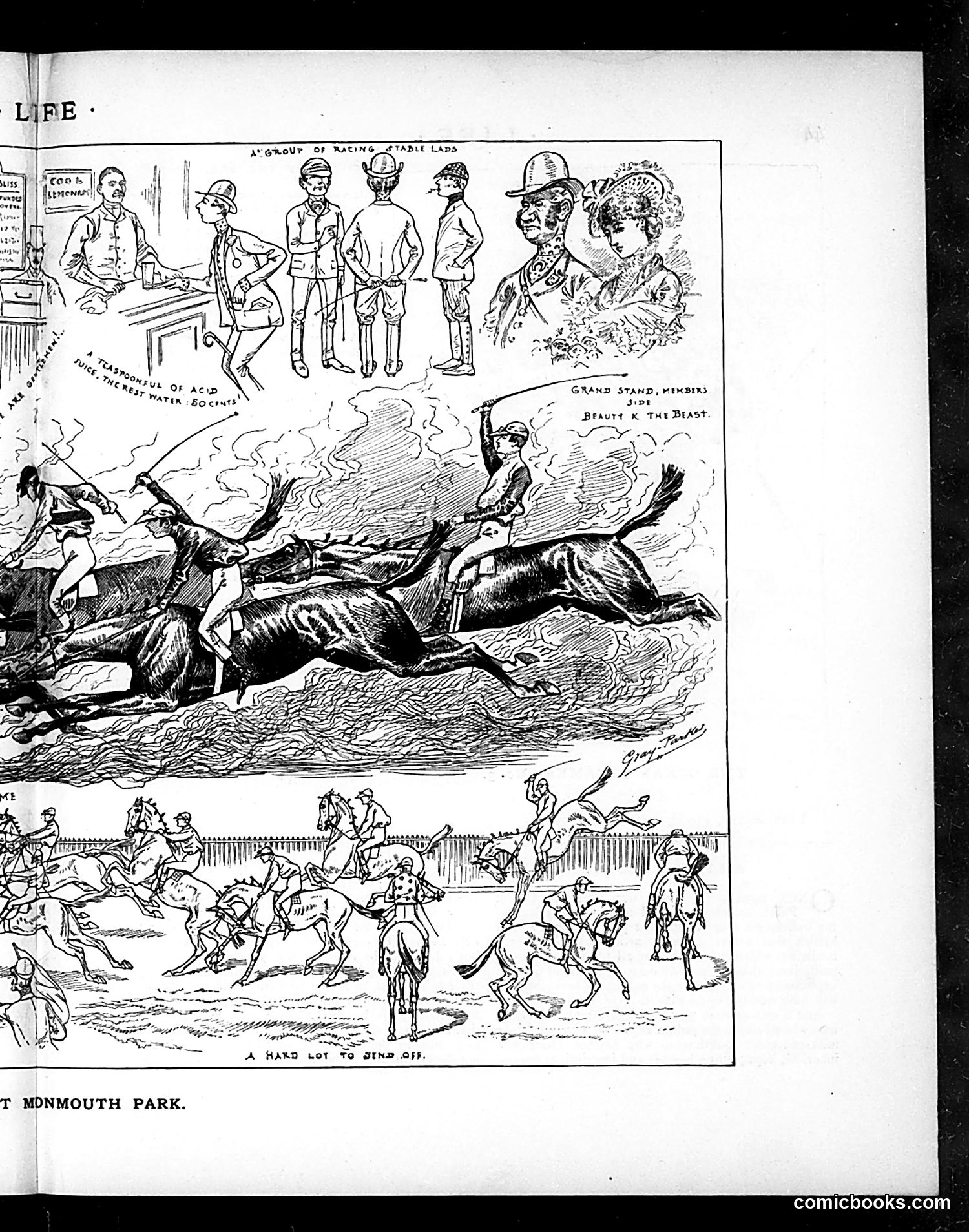
This page contains three satirical cartoons about horse racing and racing culture at Monmouth Park. The **top panel** shows "A Group of Racing Stable Lads" - caricatured figures in various racing attire, with text noting one is "Catty-ful of Stable Lads" and another reference to "the best water booths." The **middle panel** depicts riders on horseback during what appears to be a race or training scene, labeled "Grand Stand Slumbers" and "Beauty & The Beast." The **bottom panel** shows multiple riders in action, captioned "A Hard Lot to Send Off." The humor appears to target racing culture—likely poking fun at stable workers, questionable practices, and the chaotic nature of horse racing. Without clearer OCR text, the specific satirical targets remain somewhat unclear, though the cartoonist is clearly mocking racing industry figures and practices.
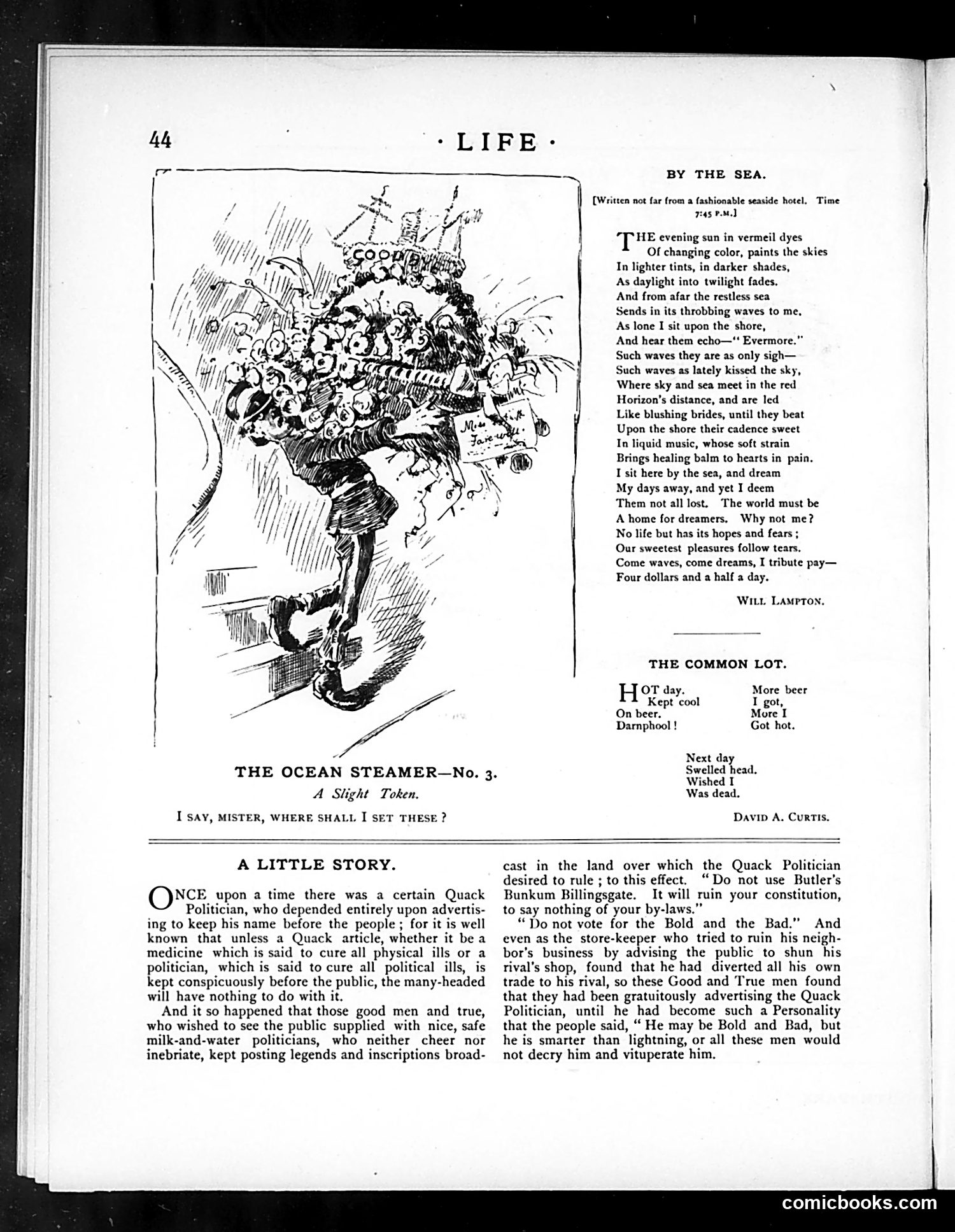
The cartoon depicts a hotel porter carrying an enormous stack of luggage balanced precariously on his head, captioned "I say, mister, where shall I set these?" The joke satirizes the absurd service expectations at fashionable seaside hotels—the porter's impossible burden suggests the ridiculousness of handling guests' excessive belongings. The accompanying poem by Will Lampton mocks the romanticized "seaside hotel experience," where guests pay "four dollars and a half a day" to sit by the shore and dream—presented as frivolous self-indulgence. "A Little Story" satirizes a "Quack Politician" (likely referencing a real political figure, though unclear which) who relies entirely on advertising to maintain public visibility. The satire suggests that opponents' negative campaigns paradoxically boost the politician's fame. The story uses a patent-medicine analogy to critique political marketing and warns that attempts to discredit a "bold and bad" politician through public vilification actually enhance his reputation and appeal.
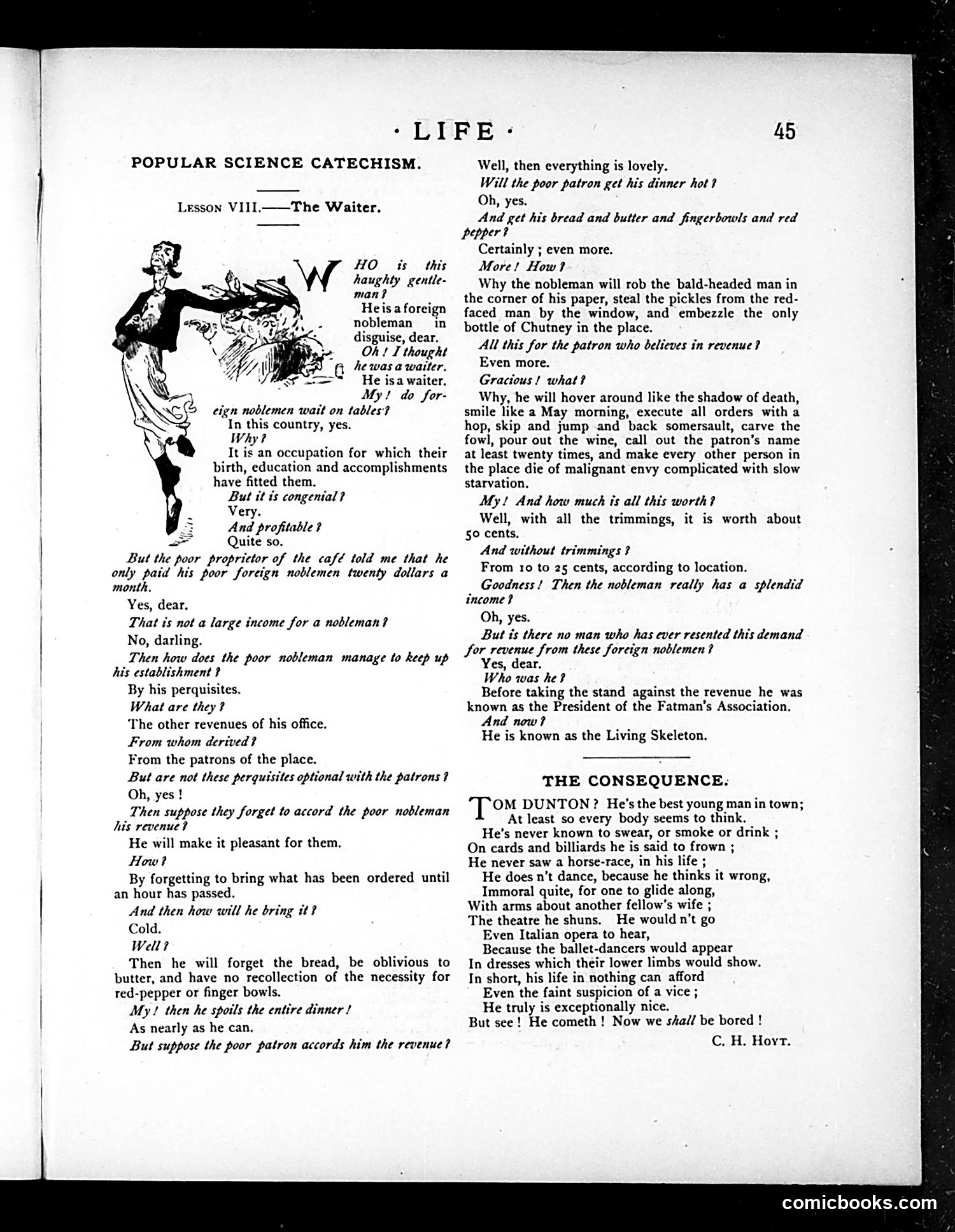
This page contains two pieces of social satire from 19th-century American Life magazine. **"The Waiter"** mocks the prevalence of impoverished European aristocrats working as waiters in American restaurants. The dialogue satirizes how these "foreign noblemen" extract unofficial "tips" from patrons through coercion: they provide excellent service only to those who pay extra, while deliberately sabotaging meals for those who don't (serving cold food, forgetting basics). The punchline notes one patron who resisted this extortion scheme was literally reduced from "President of the Fatman's Association" to "the Living Skeleton"—implying he starved from retaliation. **"The Consequence"** presents an ironic portrait of Tom Dunton, a moral paragon who abstains from drinking, gambling, dancing, theatre, and opera. The closing line—"Now we shall be bored!"—suggests his excessive righteousness makes him tedious social company, mocking Victorian moralism while implying that strict virtue lacks charm or spontaneity. Both pieces critique excess: one targeting service industry exploitation, the other rigid moral pretension.
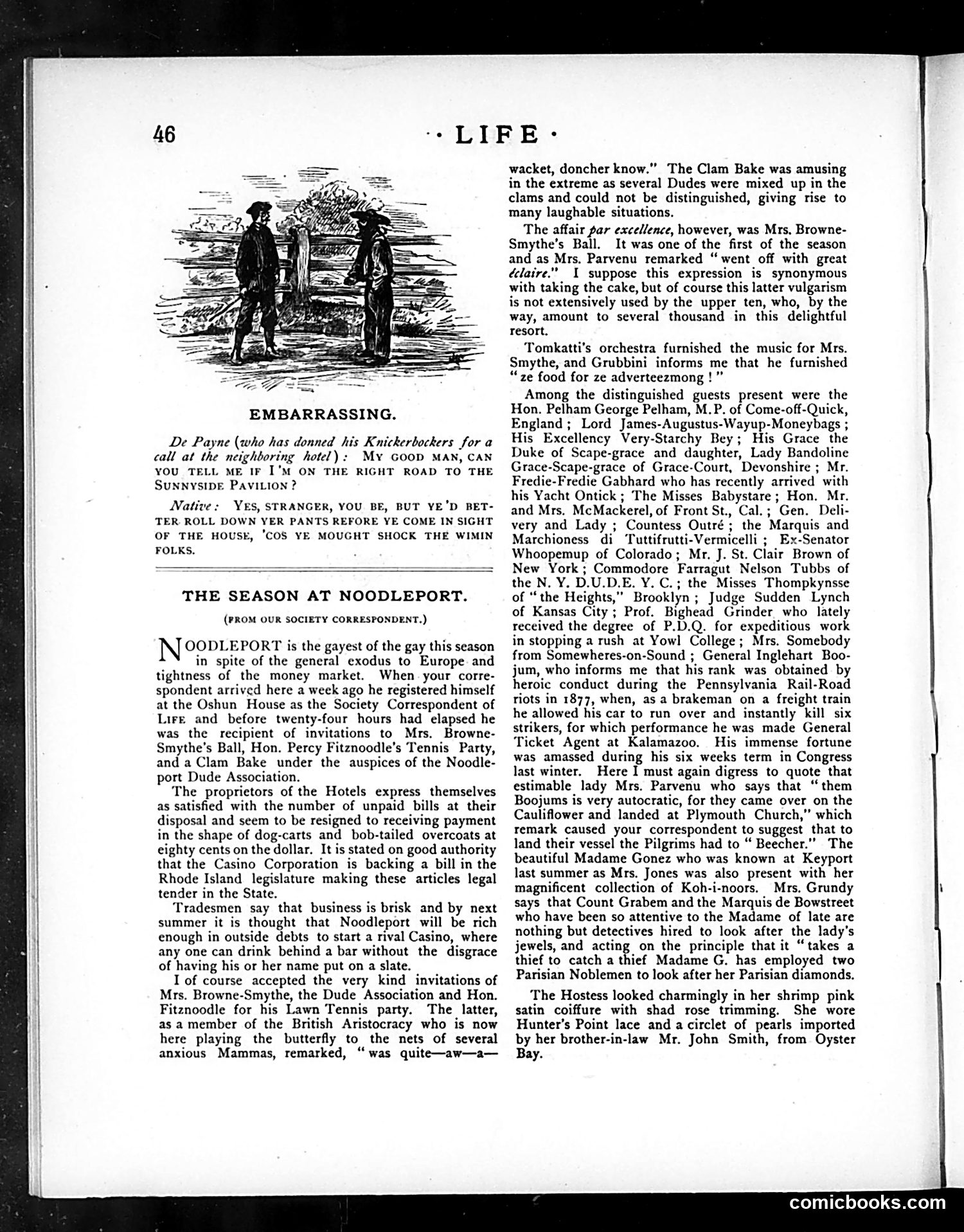
This page contains two satirical pieces mocking American social pretension and financial irresponsibility. **The cartoon "Embarrassing"** depicts a man in knickerbockers (knee-length pants) asking directions to a resort pavilion. A local native advises him to roll down his pants legs before approaching, warning they might "shock the wimin folks." The joke targets the affectation of wearing knickerbockers as fashionable leisure wear—suggesting the style looks ridiculous or indecent. **"The Season at Noodleport"** is a gossip-column parody satirizing a wealthy seaside resort. It mocks: - Resort proprietors accepting unpaid bills as payment - The pretentious names and titles of guests (obviously fabricated: "Lord James-Augustus-Wayup-Moneybags," "General Inglehart Boojum") - Wealthy vacationers' financial irresponsibility - The Gilded Age obsession with European aristocratic appearances The correspondent's sardonic tone—treating massive debts as charming eccentricity—amplifies the satire of leisure-class excess during an economic "tightness."
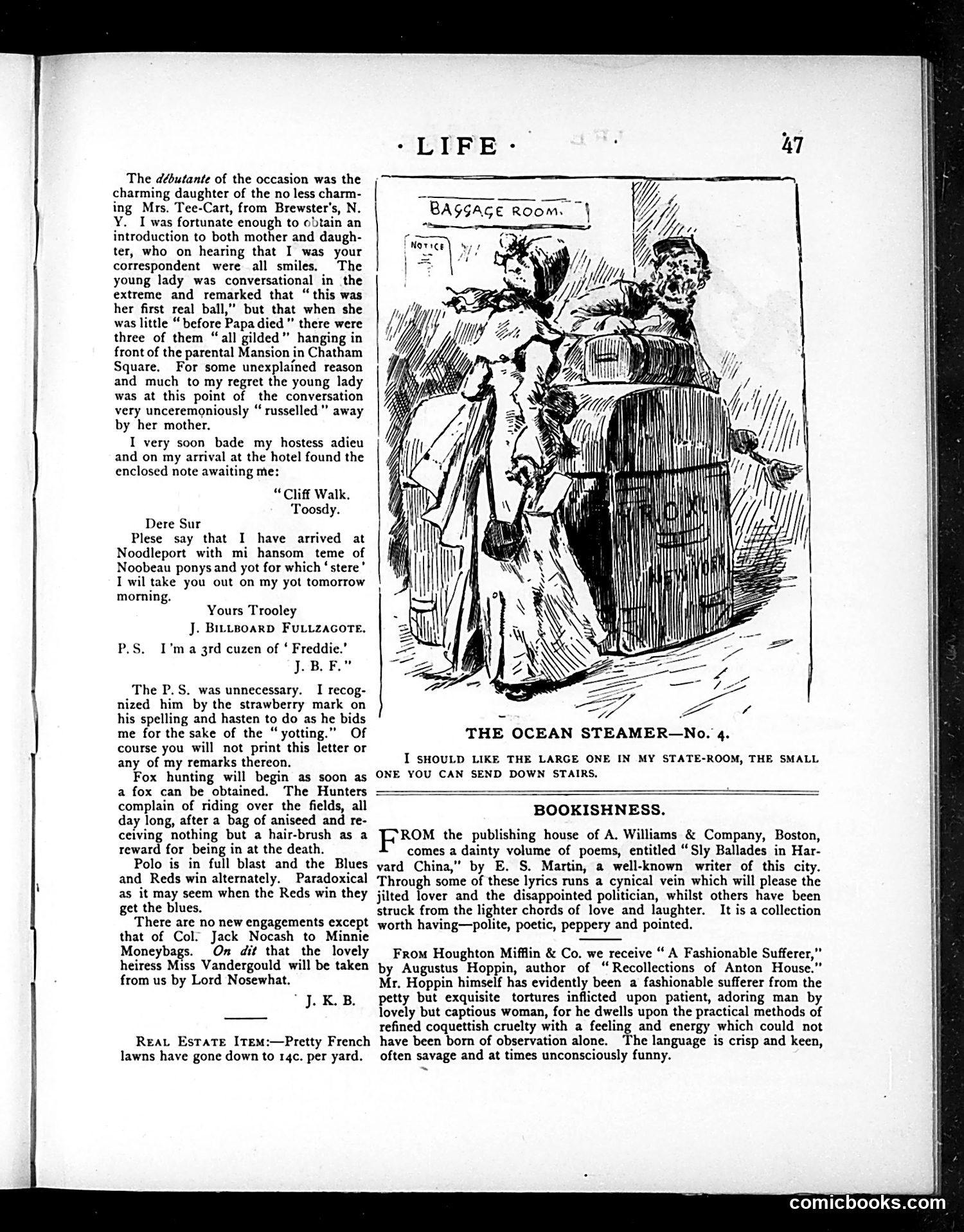
This page contains social satire targeting wealthy New York society. The main text describes a debutante ball where the author meets a nouveau-riche family ("Mrs. Tee-Cart from Brewster's, N.Y."). The young woman reveals her family once owned gilded chandeliers in their "parental Mansion in Chatham Square" before her father died—suggesting upward mobility and social climbing. The follow-up letter from "J. Billboard Fullzagote" (a transparent pseudonym mocking pretension) contains deliberately misspelled words ("yot" for yacht, "dere" for dear) satirizing illiterate wealthy people trying to adopt upper-class leisure activities like yachting. The cartoon shows crowded ocean steamer accommodations, captioned with a sarcastic request for luxurious cabin space and dismissive treatment of servants. The **point**: mockery of newly wealthy Americans' social ambitions, poor education, and ostentatious display of wealth.
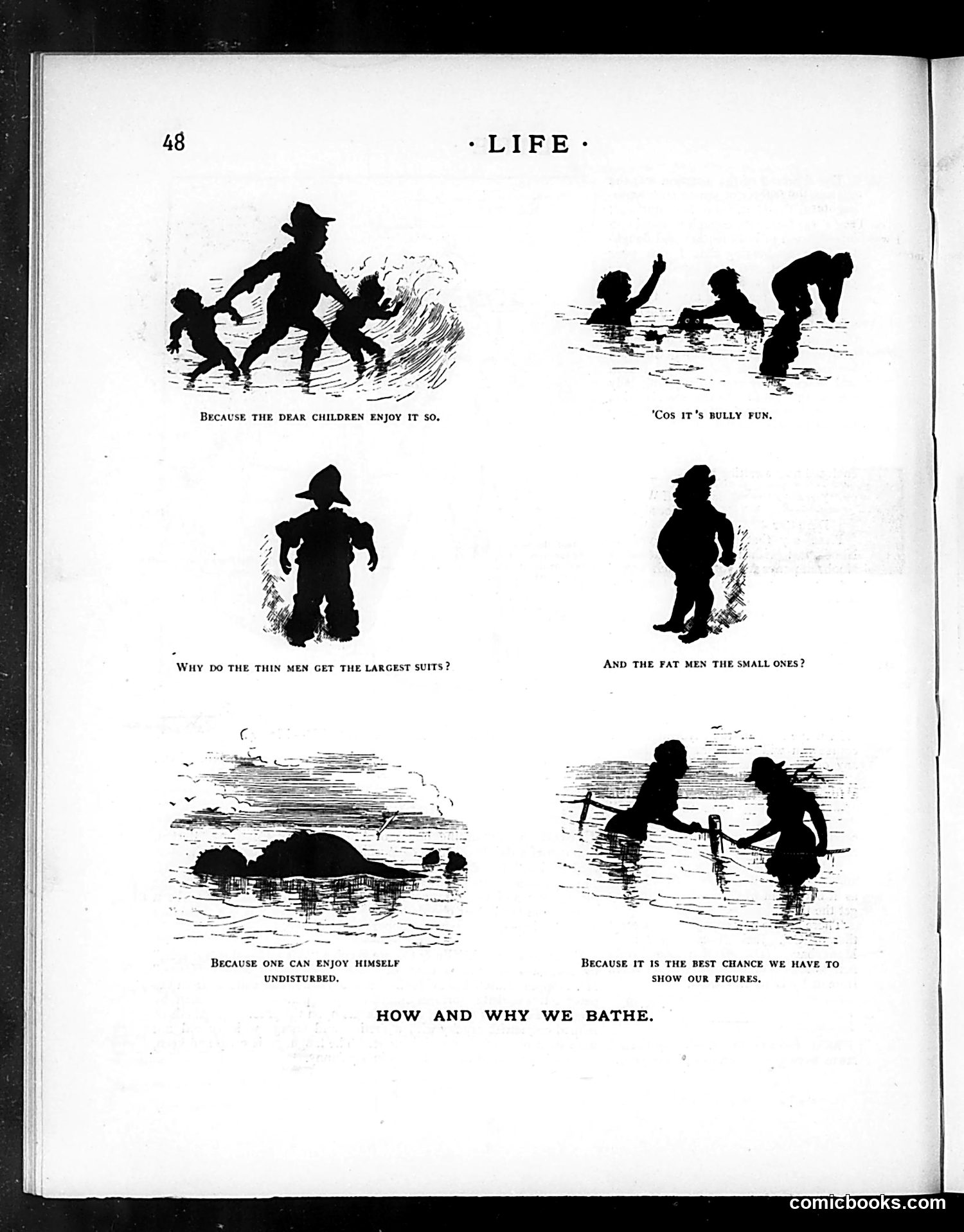
This page presents satirical silhouettes about bathing customs and body image. The six vignettes humorously explain "How and Why We Bathe": **Top panels**: Children play in water because they enjoy it; adults swim for entertainment. **Middle panels**: A joke about clothing—thin men supposedly get larger suits while fat men get smaller ones (implying either tailoring incompetence or intentional irony). **Bottom panels**: Adults bathe to enjoy privacy/solitude, and to display their physiques to others. The satire mocks vanity, body consciousness, and the contradictory reasons people engage in social bathing—simultaneously seeking privacy and wanting to show themselves off. It's early-20th-century humor targeting human self-consciousness and hypocrisy around physical appearance and social bathing culture.
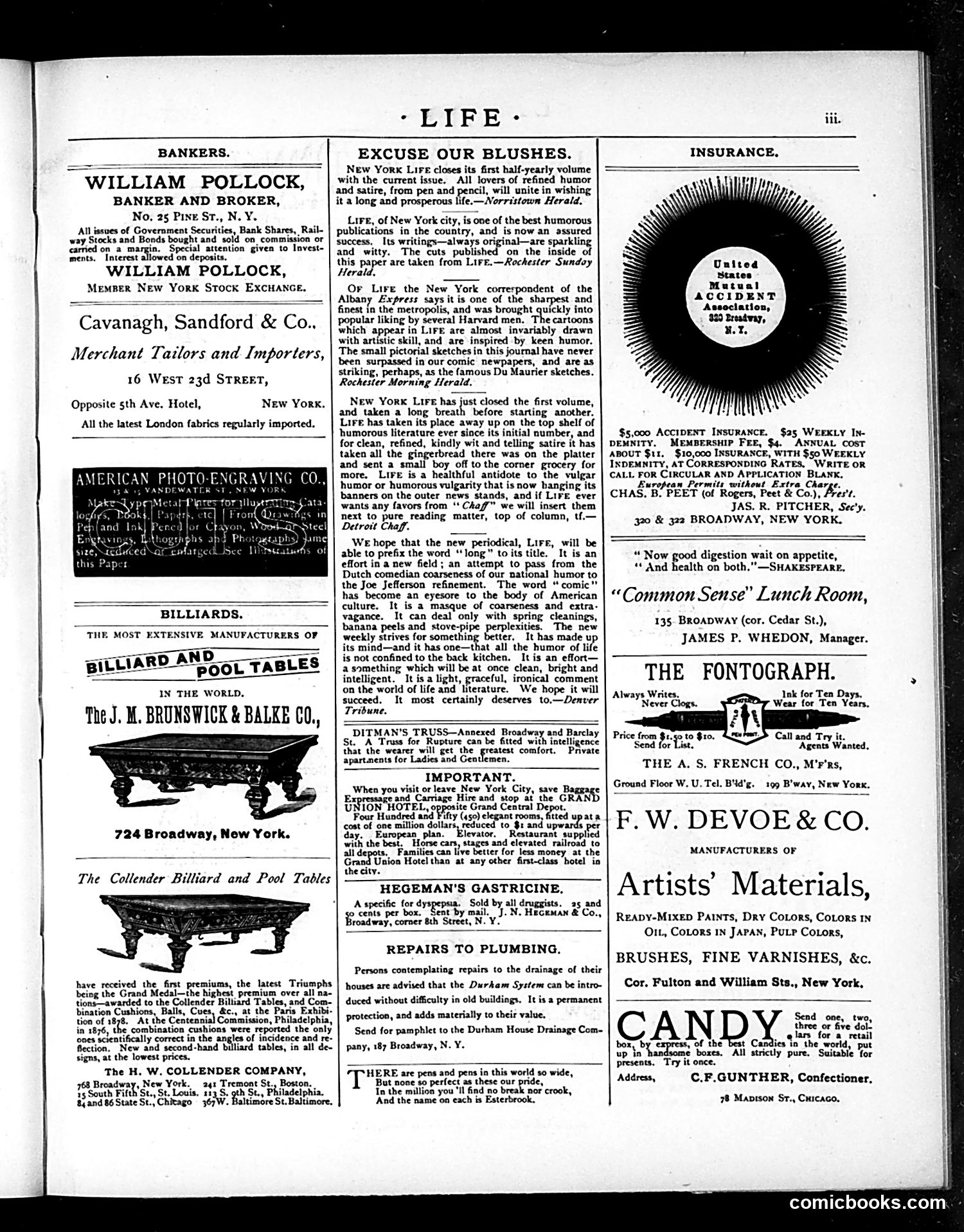
This page is primarily **advertisements** for financial services, billiard manufacturers, and merchants, interspersed with promotional quotes praising *Life* magazine itself. The central section, "Excuse Our Blushes," contains **reprinted testimonials** from other newspapers (Norristown Herald, Rochester Sunday Herald, Albany Express, Detroit Chaff) congratulating *Life* on completing its first half-yearly volume. These quotes praise the magazine's "refined humor," artistic cartoons, and "clean, refined, kindly wit"—positioning *Life* as superior to "vulgar humor" and "Dutch comedian coarseness" dominating American comic publications. The satire is self-directed: *Life* is humorously embarrassed by its own praise, hence "excuse our blushes." The magazine positions itself as an elevating, intelligent alternative to cruder competitor publications. There are **no identifiable political figures or specific events** referenced. This is essentially a magazine puffing itself through borrowed testimonials—typical self-promotion disguised as external validation.
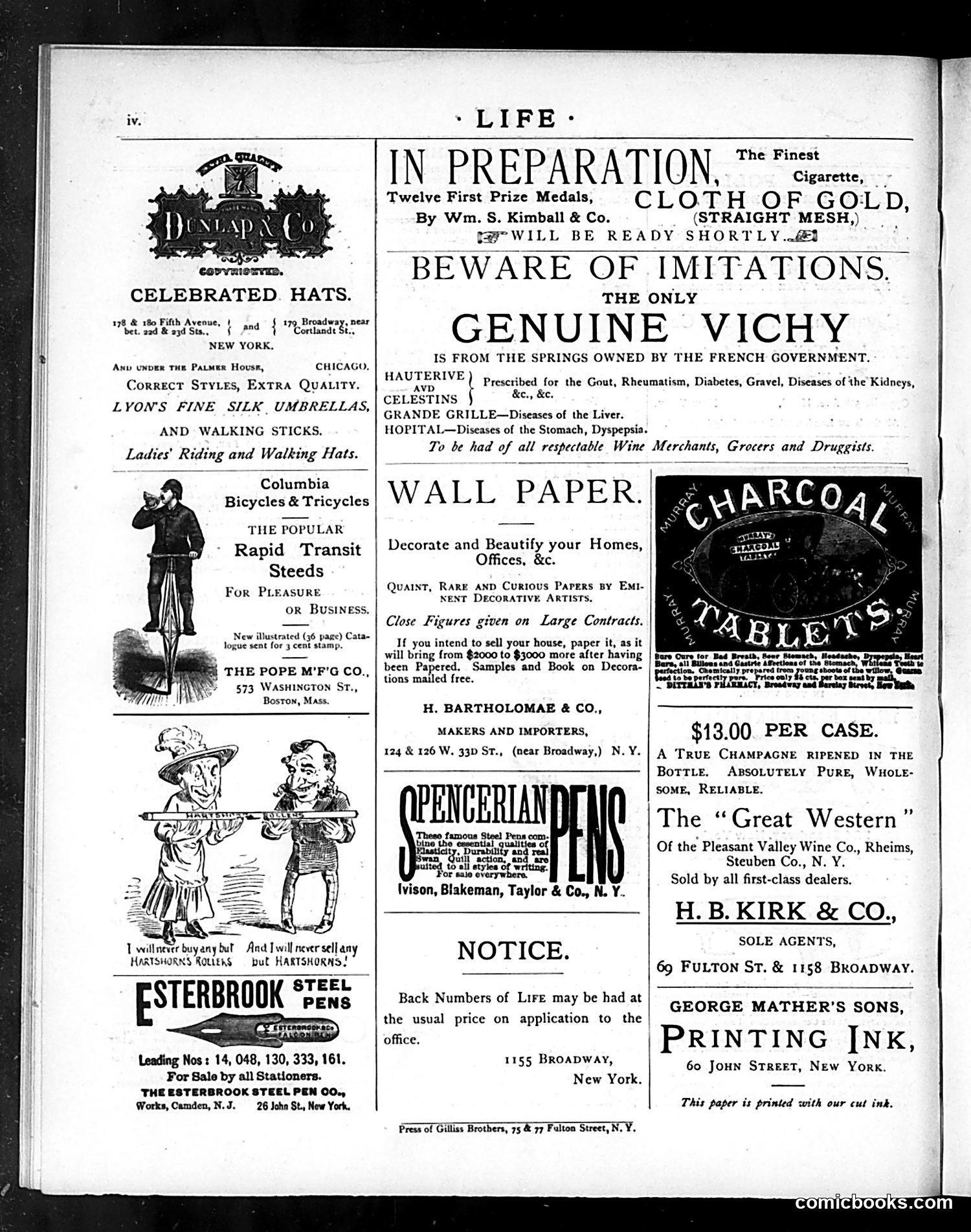
This is primarily an **advertising page** from a late 19th-century American satirical magazine, not a political cartoon page. The one **cartoon** present (lower left) shows two men in a comedic dispute over "Hartshorns Rouges"—a proprietary product. One declares he'll never buy anything *but* Hartshorns; the other insists he'll never *sell* anything but Hartshorns. The joke appears to be about competitive brand loyalty or perhaps a parody of aggressive marketing claims common in the era. The page is otherwise filled with period advertisements for luxury goods: celebrated hats, bicycles, silk umbrellas, steel pens, wall paper, champagne, Vichy water (marketed as a medicinal cure-all), and printing ink. The ads emphasize exclusivity, imported European goods, and health benefits—typical messaging for affluent Victorian-era consumers. **No clear political satire is evident** on this particular page; it functions primarily as a revenue-generating advertisement section.