
Life, 1883-07-26 · page 11 of 16
Life — July 26, 1883 — page 11: what you’re looking at
What you’re looking at
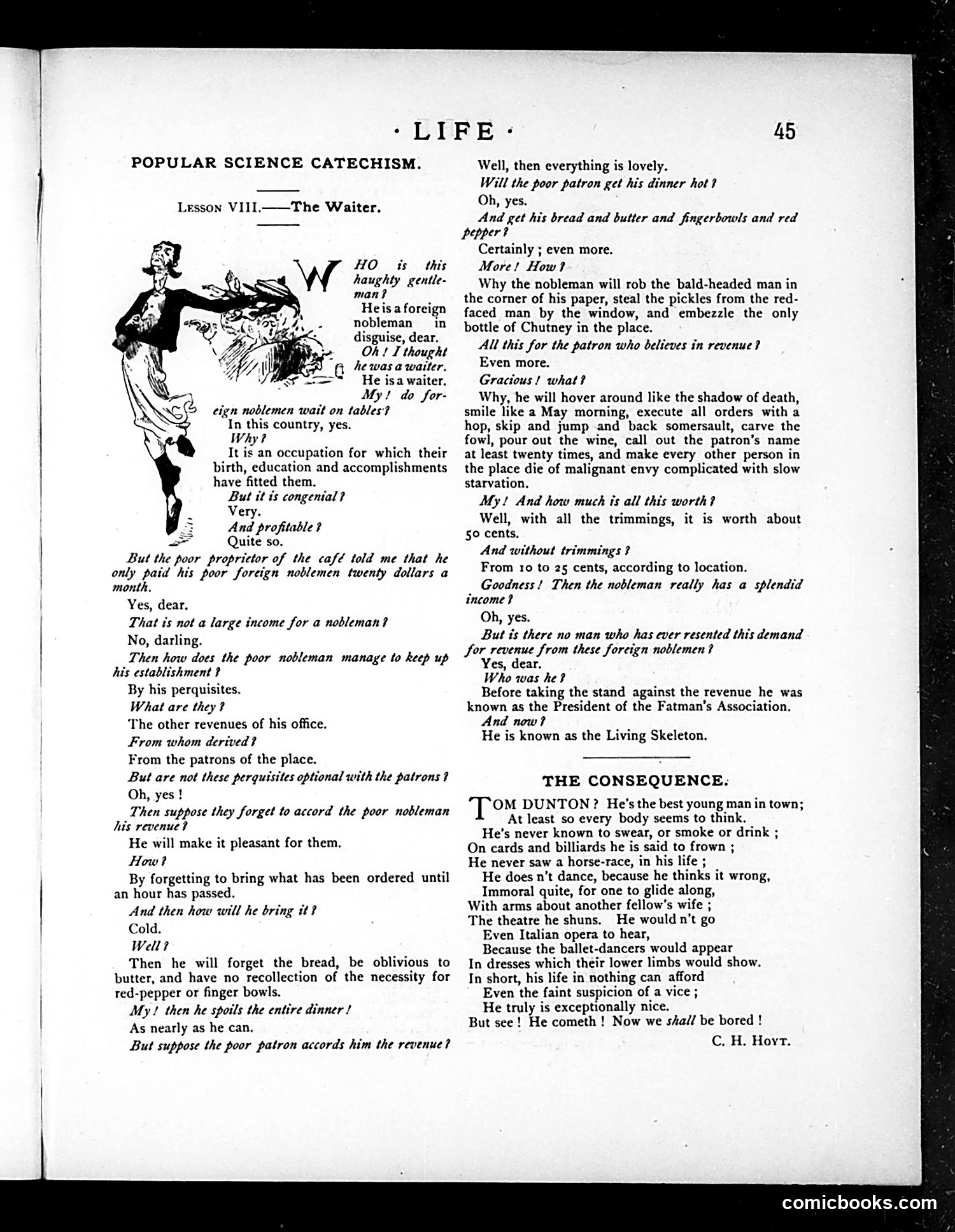
This page contains two pieces of social satire from 19th-century American Life magazine. **"The Waiter"** mocks the prevalence of impoverished European aristocrats working as waiters in American restaurants. The dialogue satirizes how these "foreign noblemen" extract unofficial "tips" from patrons through coercion: they provide excellent service only to those who pay extra, while deliberately sabotaging meals for those who don't (serving cold food, forgetting basics). The punchline notes one patron who resisted this extortion scheme was literally reduced from "President of the Fatman's Association" to "the Living Skeleton"—implying he starved from retaliation. **"The Consequence"** presents an ironic portrait of Tom Dunton, a moral paragon who abstains from drinking, gambling, dancing, theatre, and opera. The closing line—"Now we shall be bored!"—suggests his excessive righteousness makes him tedious social company, mocking Victorian moralism while implying that strict virtue lacks charm or spontaneity. Both pieces critique excess: one targeting service industry exploitation, the other rigid moral pretension.
📄 Transcribed text from this page (OCR, searchable)
Machine-transcribed from the original scan — historical spelling and the odd misread are preserved.
- LIFE: 45 POPULAR SCIENCE CATECHISM. Lesson VIII.——The Waiter. HO is this WW haughty gentle- man? Heis a foreign nobleman in disguise, dear. - Oh! I thought a} he was a waiter. = He isa waiter. My! do for- eign noblemen wait on tables? In this country, yes. Why? It is an occupation for which their birth, education and accomplishments have fitted them, But it is congenial? Very. And profitable? = Quite so. But the poor proprietor of the café told me that he only paid his poor foreign noblemen twenty dollars a month. Yes, dear. That is not a large income for a nobleman? No, darling. Then how does the poor nobleman manage to keep up his establishment ? By his perquisites. What are they? The other revenues of his office. From whom derived? From the patrons of the place. But are not these perquisites optional with the patrons? Oh, yes! Then suppose they forget to accord the poor nobleman his revenue? He will make it pleasant for them. How? By forgetting to bring what has been ordered until an hour has passed. And then how will he bring it? Cold. Well? Then he will forget the bread, be oblivious to butter, and have no recollection of the necessity for red-pepper or finger bowls. My! then he spoils the entire dinner! As nearly as he can. But suppose the poor patron accords him the revenue? Well, then everything is lovely. Will the poor patron get his dinner hot? Oh, yes. And get his bread and butter and fingerbowls and red pepper? Certainly ; even more. More! How? Why the nobleman will rob the bald-headed man in the corner of his paper, steal the pickles from the red- faced man by the window, and embezzle the only bottle of Chutney in the place. All this for the patron who believes in revenue? Even more. Gracious! what? Why, he will hover around like the shadow of death, smile like a May morning, execute all orders with a hop, skip and jump and back somersault, carve the fowl, pour out the wine, call out the patron’s name at least twenty times, and make every other person in the place die of malignant envy complicated with slow starvation, My! And how much is all this worth? Well, with all the trimmings, it is worth about 50 cents, And without trimmings? From 10 to 25 cents, according to location. Goodness! Then the nobleman really has a splendid income? Oh, yes. But is there no man who has ever resented this demand Sor revenue from these foreign noblemen? Yes, dear. Who was he? Before taking the stand against the revenue he was known as the President of the Fatman’s Association. And now? He is known as the Living Skeleton. THE CONSEQUENCE. OM DUNTON? He's the best young man in town; At least so every body seems to think. He’s never known to swear, or smoke or drink ; On cards and billiards he is said to frown ; He never saw a horse-race, in his life ; He does n’t dance, because he thinks it wrong, Immoral quite, for one to glide along, With arms about another fellow’s wife ; The theatre he shuns. He would n't go Even Italian opera to hear, Because the ballet-dancers would appear In dresses which their lower limbs would show. In short, his life in nothing can afford Even the faint suspicion of a vice ; He truly is exceptionally nice. But see! He cometh ! Now we shai/ be bored ! C, H. Hoyt. comicbooks.com