
A complete issue · 16 pages · 1883
Life — June 7, 1883
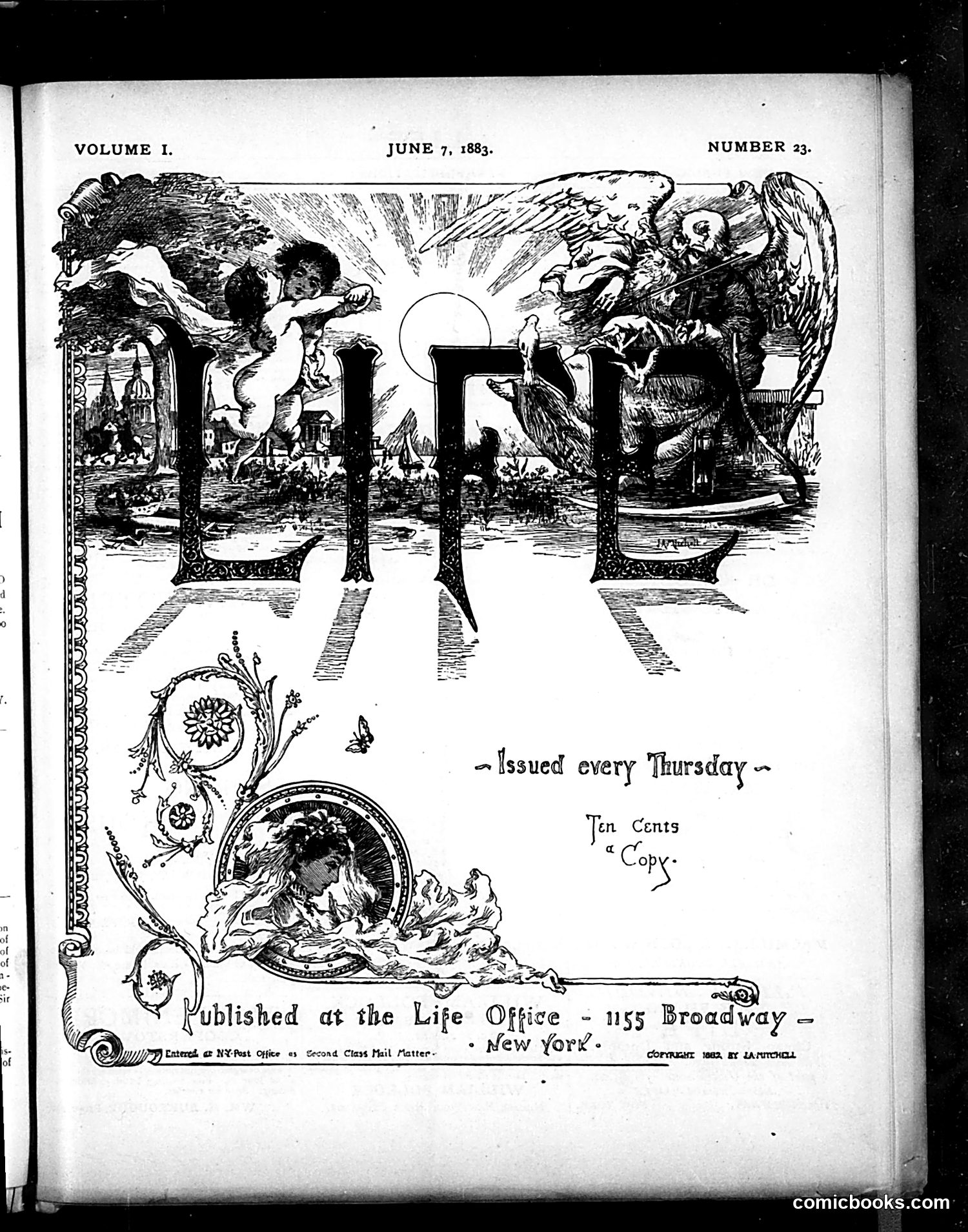
This is the cover of *Life* magazine's first volume, number 23. The central imagery features allegorical figures—including what appears to be classical representations of angels or cherubs—surrounding large decorative letters spelling "LIFE" that frame a landscape scene below. The specific political or social satire, if any, is unclear from this cover alone. The elaborate Art Nouveau-style decorative borders and the classical iconography suggest the magazine positioned itself as intellectually sophisticated. The masthead indicates it was published weekly at ten cents per copy from the Life Office in New York. Without additional context about 1883's current events, the exact satirical intent remains uncertain.
This page is **almost entirely advertising and announcements**, not political cartoons or satire. The content includes: - Book advertisements for Henry Holt & Co.'s "Leisure Moment Series" and novels by F. Marion Crawford - Announcements for *The Manhattan* magazine (June issue) - Hotel and resort advertisements (Campobello Island, Spring House, The Fenimore, Dutcher House and Cottages) - A patent binder advertisement - Banking services by William Pollock There are **no visible political cartoons or satirical illustrations** on this page. It represents typical late 19th-century magazine filler: commercial advertising mixed with literary promotions, reflecting how publications funded themselves during this era.
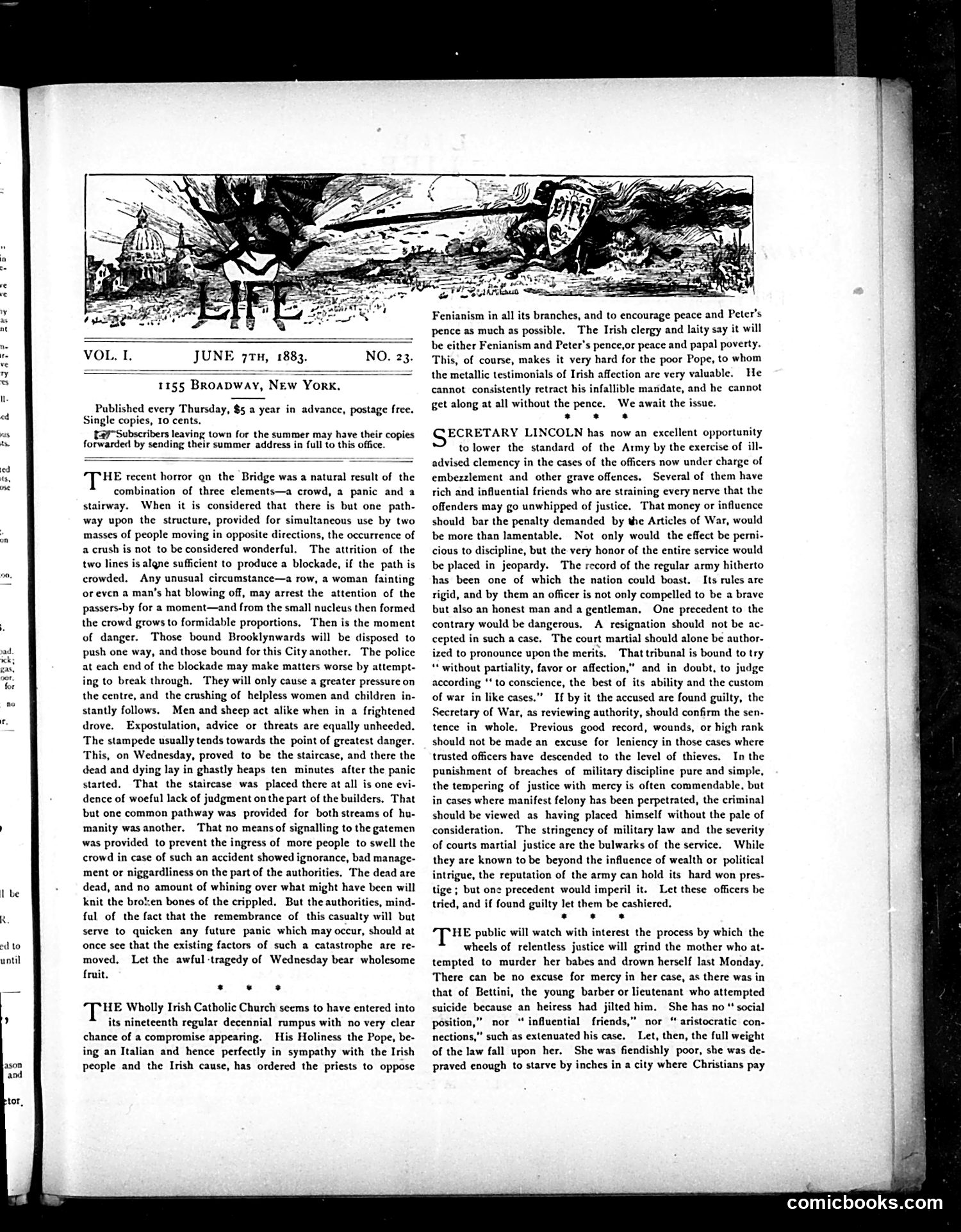
The masthead cartoon depicts a chaotic scene with figures in distress, likely referencing the recent Brooklyn Bridge tragedy mentioned in the text—a fatal crush that occurred when a panicked crowd caused a stampede on the bridge's opening. The articles criticize: 1. **Police and crowd management failures** during the Bridge incident, arguing inadequate measures caused unnecessary deaths 2. **Secretary of War's potential abuse of power** regarding Army officer discipline—the author warns against letting politics influence military justice 3. **Irish Catholic Church's involvement in Irish-American politics**, suggesting the Church is inappropriately interfering in secular matters under papal instruction The tone is reform-minded, attacking institutional mismanagement and institutional overreach in civic and military affairs.
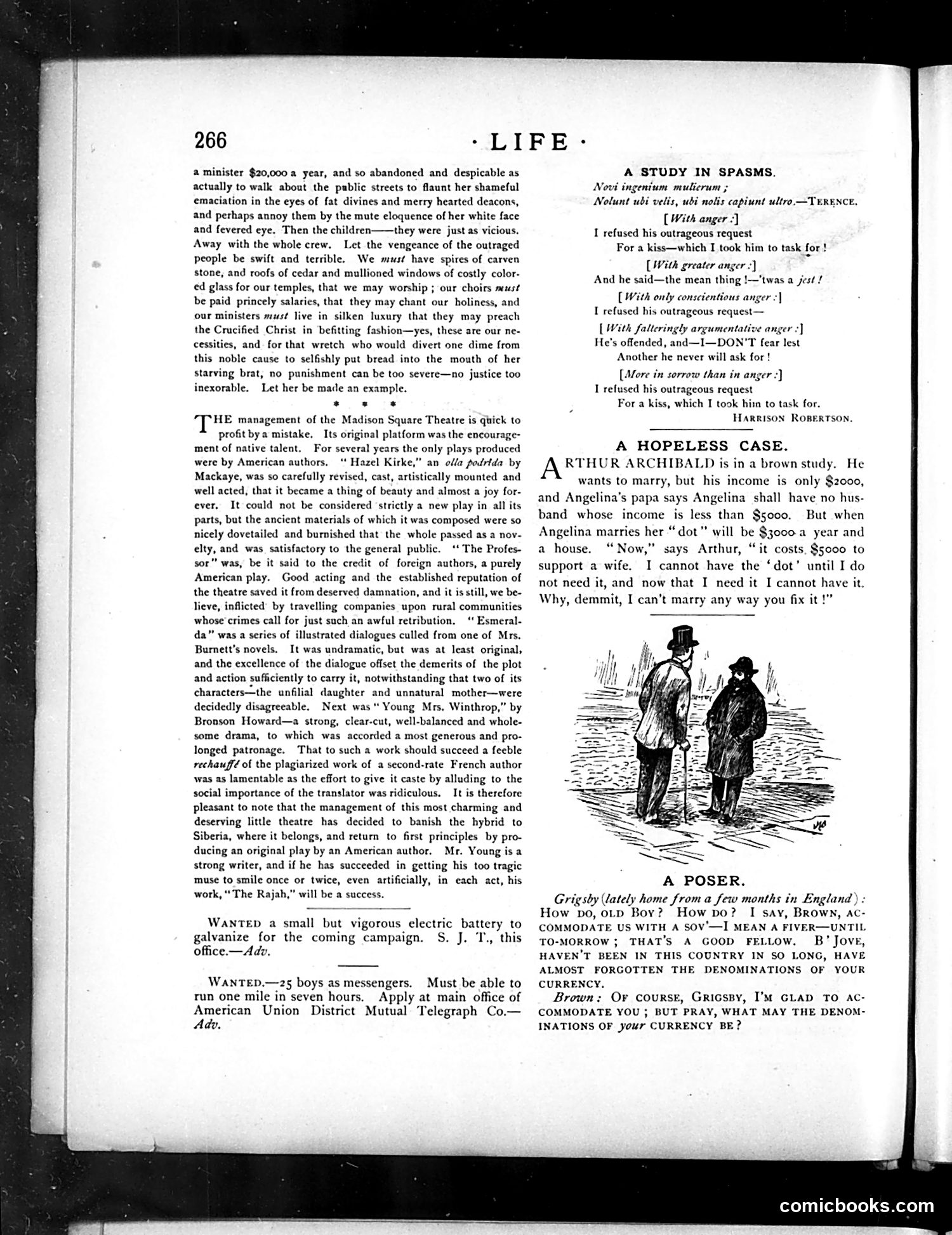
This page contains two satirical pieces. "A Study in Spasms" presents dialogue about refusing romantic advances with escalating anger. "A Hopeless Case" describes Arthur Archibald's financial predicament: he wants to marry Angelina, but his $2,000 income falls short of her father's $5,000 requirement. The humor targets Victorian-era economic barriers to marriage. "A Poser" cartoon depicts two men in conversation. One, recently returned from England, uses unfamiliar British currency terms ("a river"), confusing his American companion. The joke satirizes how British monetary denominations seemed exotic and incomprehensible to American audiences of the period. The piece mocks transatlantic cultural and linguistic differences in everyday commerce.
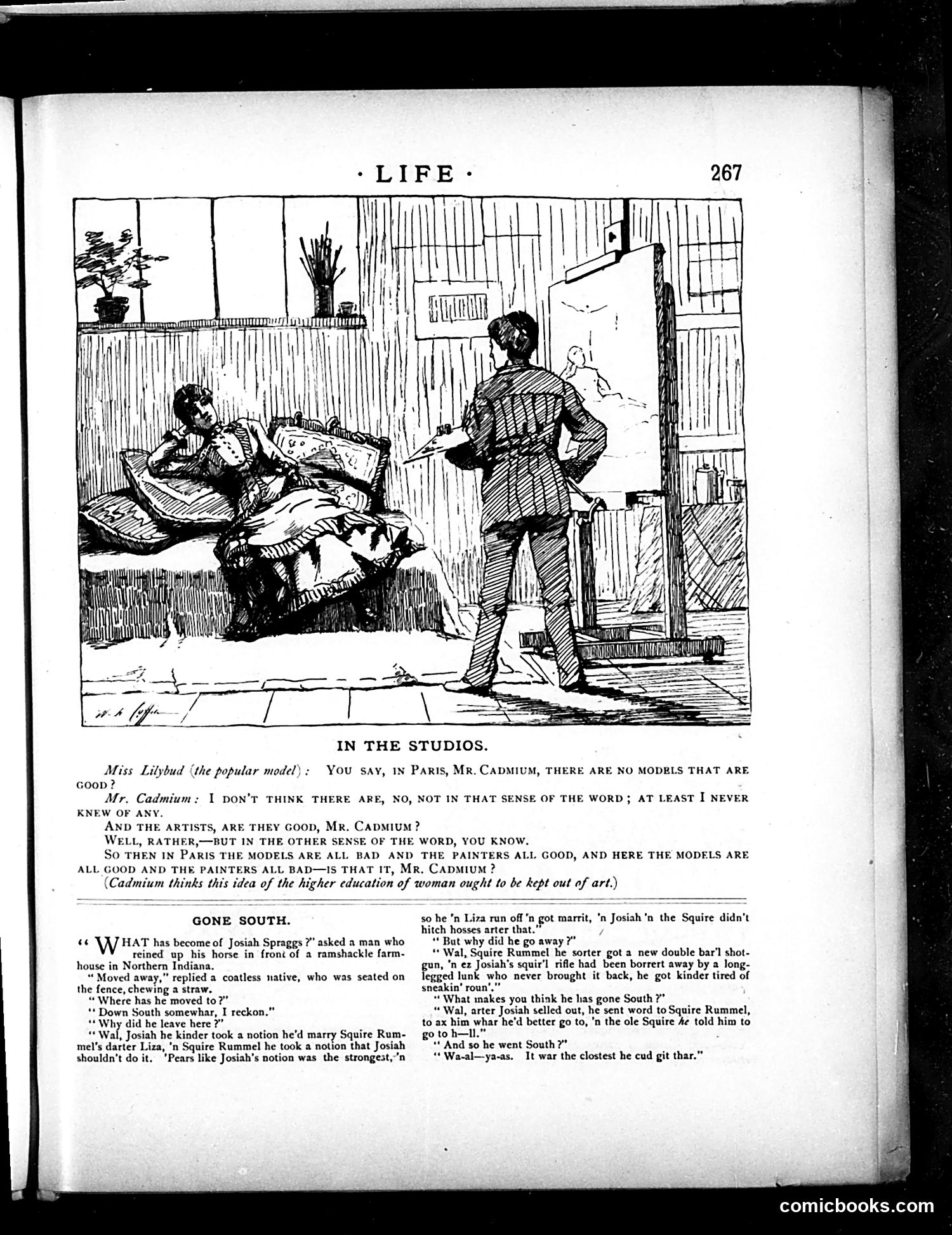
**Top Cartoon - "In the Studios":** This depicts an art studio scene satirizing the quality of artist models in Paris. A woman (identified as "Miss Lilybud, the popular model") reclines while a male artist critiques the state of models available to him. The dialogue suggests that Paris models are universally "bad," yet painters accept them anyway—a paradox the cartoon finds absurd. The satire mocks both the pretensions of the art world and the dubious quality of its working models, suggesting that artistic standards are compromised by necessity rather than genuine excellence. **Bottom Section - "Gone South":** This appears to be a humorous narrative about someone named Josiah Spragg who left his farmhouse. The dialogue-driven text follows his departure, mentioning characters like Squire Rummel and Josiah's departure "South," likely referencing the American South.
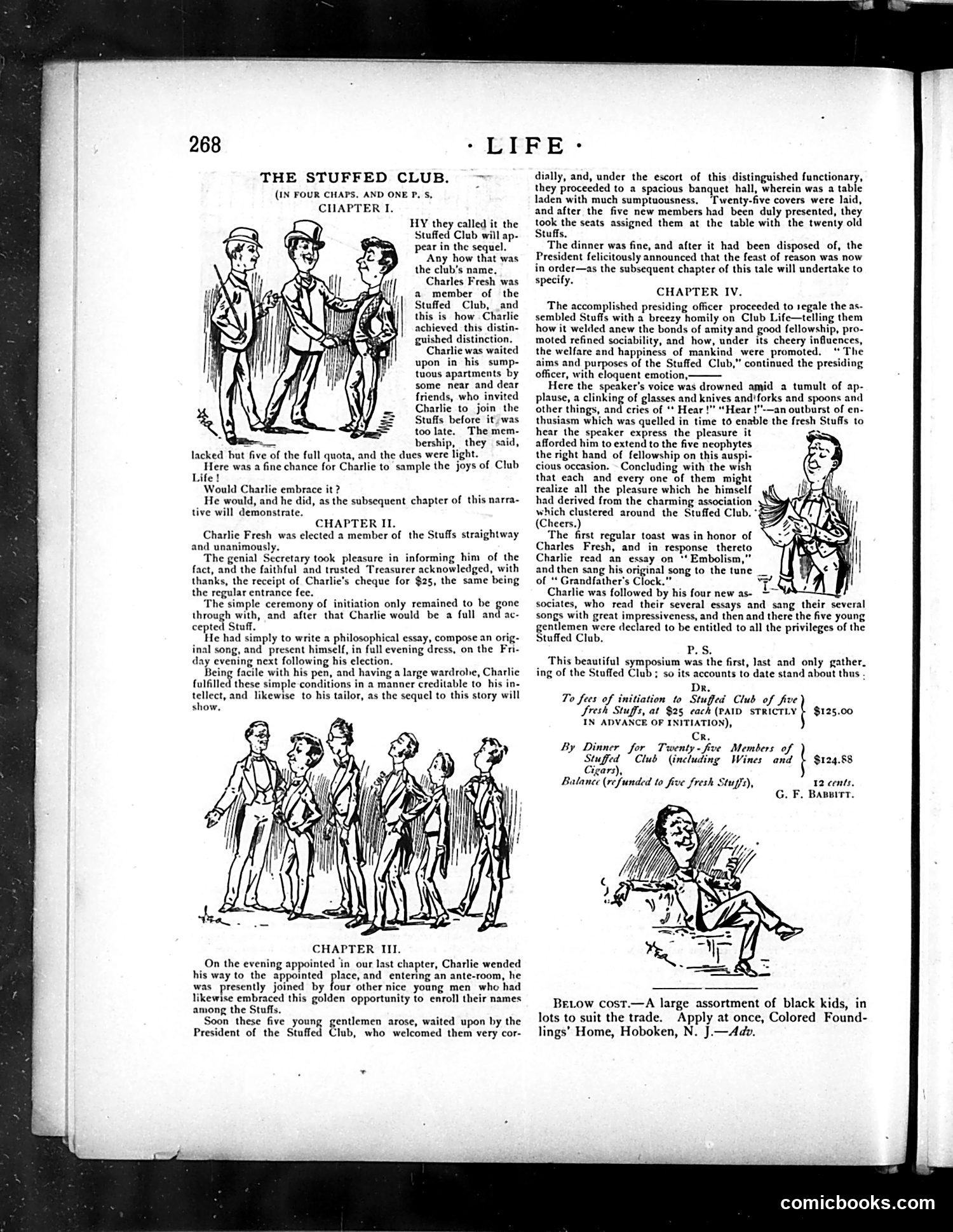
This page presents a serialized humorous story about "The Stuffed Club," a fictitious gentlemen's social organization. The narrative follows Charlie Fresh's initiation into this exclusive group. The illustrations depict well-dressed men in formal attire engaged in club activities—meetings, dinners, and ceremonies. The satire targets upper-class social clubs and their ritualistic initiation practices, which apparently involved elaborate dinners, toasts, and philosophical discourse meant to demonstrate exclusive refinement and brotherhood. The humor lies in mocking the pretentiousness and self-importance of such establishments and their members' earnest attempts at sophistication. The "stuffed" title likely references both the formal dress and the stuffiness of elite clubmen. The page also includes membership pricing and an advertisement for Black children, reflecting historical racial attitudes of the era.
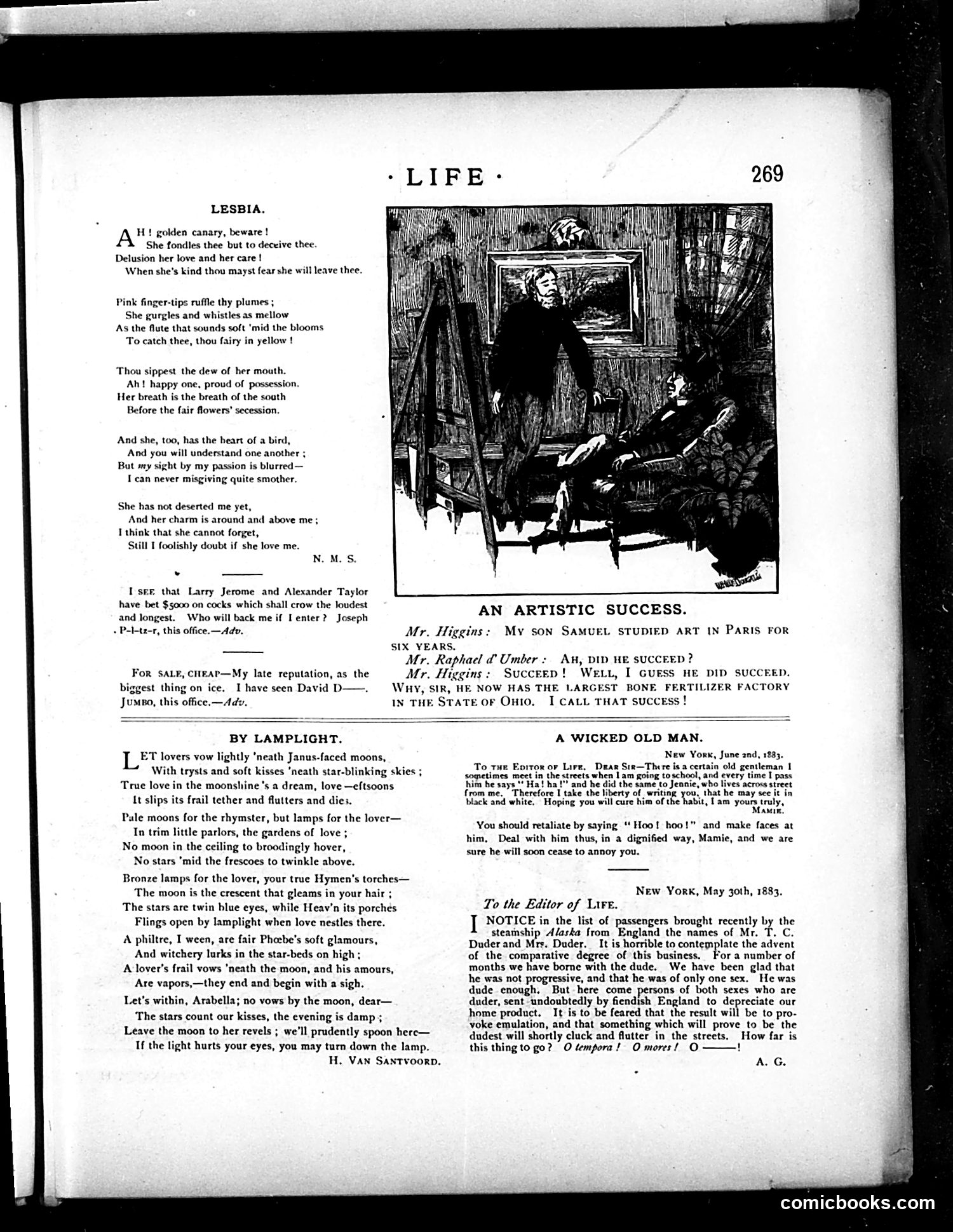
The main cartoon titled "AN ARTISTIC SUCCESS" depicts a conversation between two men about another's art studies. Mr. Higgins reports his son Samuel studied art in Paris for six years, and when asked if he succeeded, Higgins replies that yes, he succeeded—he now operates "the largest bone fertilizer factory in the state of Ohio." The satire mocks the gap between artistic aspiration and commercial reality. Parents investing in their children's European art education expected refined cultural achievement, but the punchline suggests the son's actual "success" is industrial manufacturing—a mundane, unglamorous business. This reflects period anxieties about American materialism versus European cultural pretension, and the comic deflation of parental hopes for artistic sons.
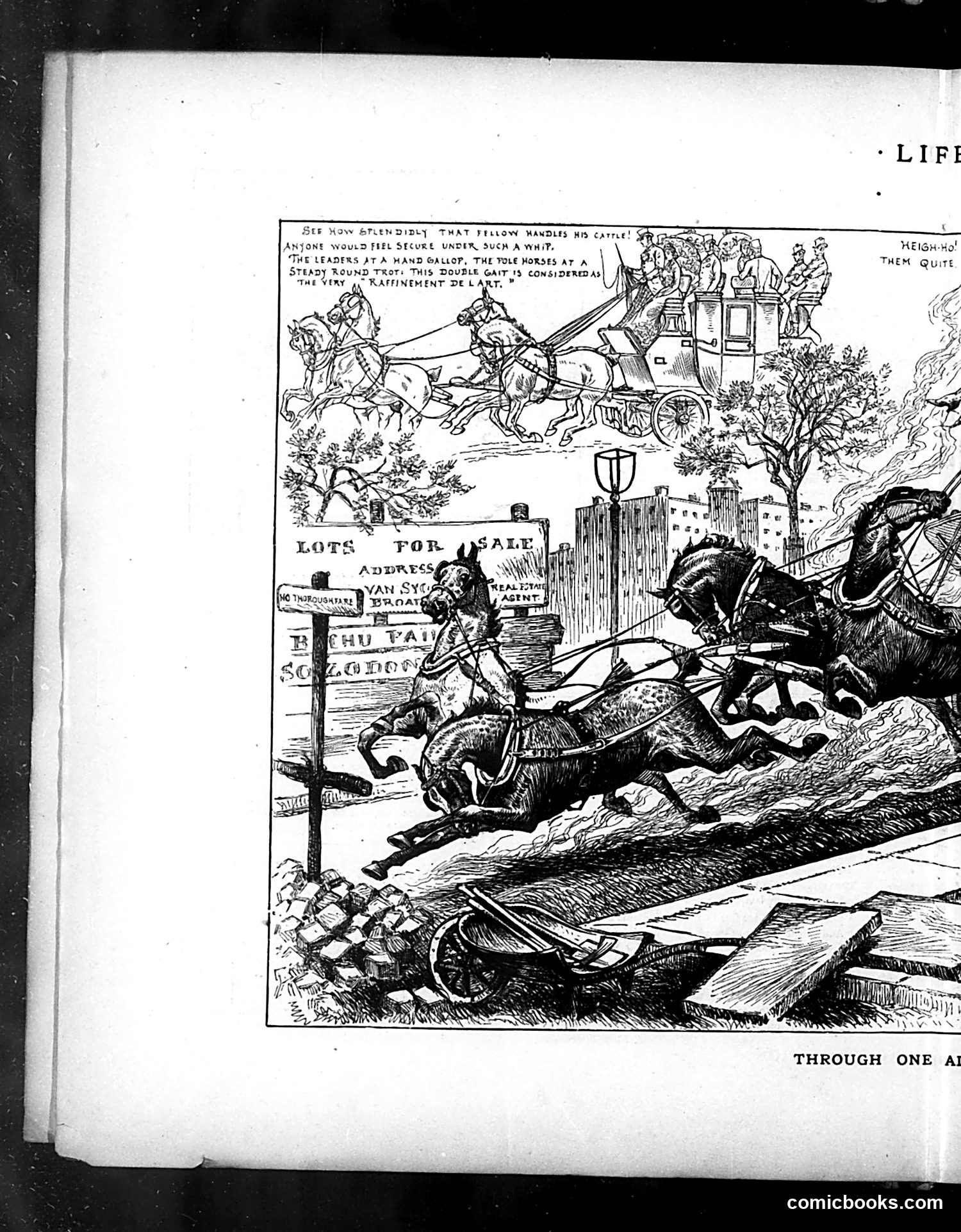
This page contains two satirical illustrations commenting on real estate and transportation in early 20th-century America. The **upper cartoon** depicts a wealthy family in an ornate carriage being pulled by horses, with text mocking how they "splendidly" handle their cattle (horses) and consider their "very rattlement" fashionable—satirizing aristocratic pretension about outdated transportation methods. The **lower illustration** shows a runaway horse-drawn carriage accident near property marked "LOTS FOR SALE" and "VAN SYK...COLONY," with a real estate sign visible. The chaos of the overturned vehicle and panicked horses mocks both the dangers of horse-drawn transportation and the speculative real estate boom of the era, suggesting the hazards of rapid urban development. The satire targets wealthy elites clinging to traditional conveyances while society modernizes.
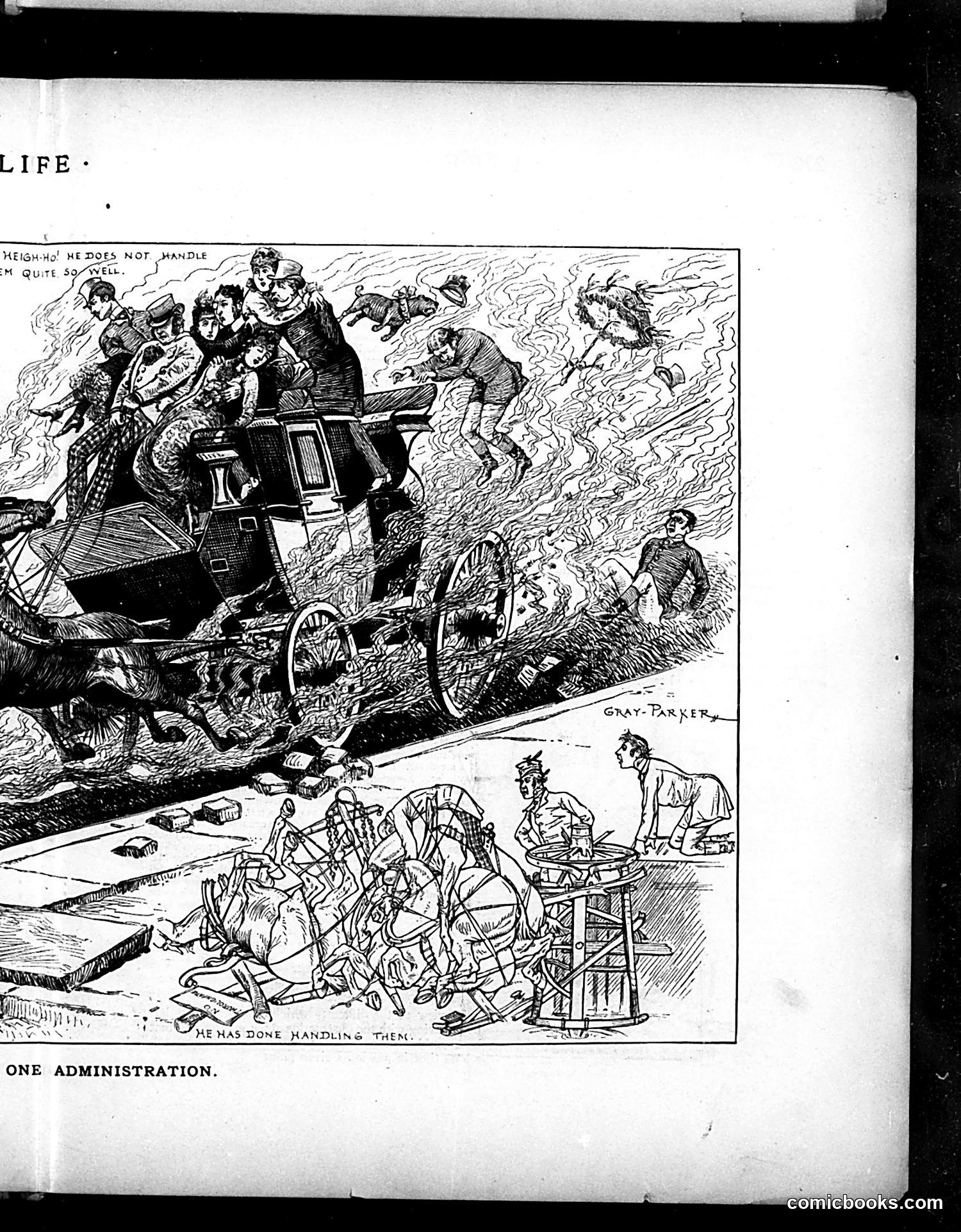
This Life magazine cartoon by Gray Parker satirizes government mismanagement through contrasting scenes. The upper panel shows a chaotic, overcrowded carriage or vessel struggling through turbulent waters with multiple figures barely maintaining control—labeled "Weighs! He does not handle it quite so well." The lower panel depicts the same group now grounded and stationary, with figures working on repairs or maintenance, captioned "He has done handling them." The satire appears to critique an administration's inability to effectively "handle" or govern the nation (represented by the vessel/carriage). The contrast suggests that once removed from power, the administration can finally "handle" things—implying their tenure was characterized by incompetence and chaos. Without a specific date visible, the target administration remains unclear, though the style suggests early 20th century.
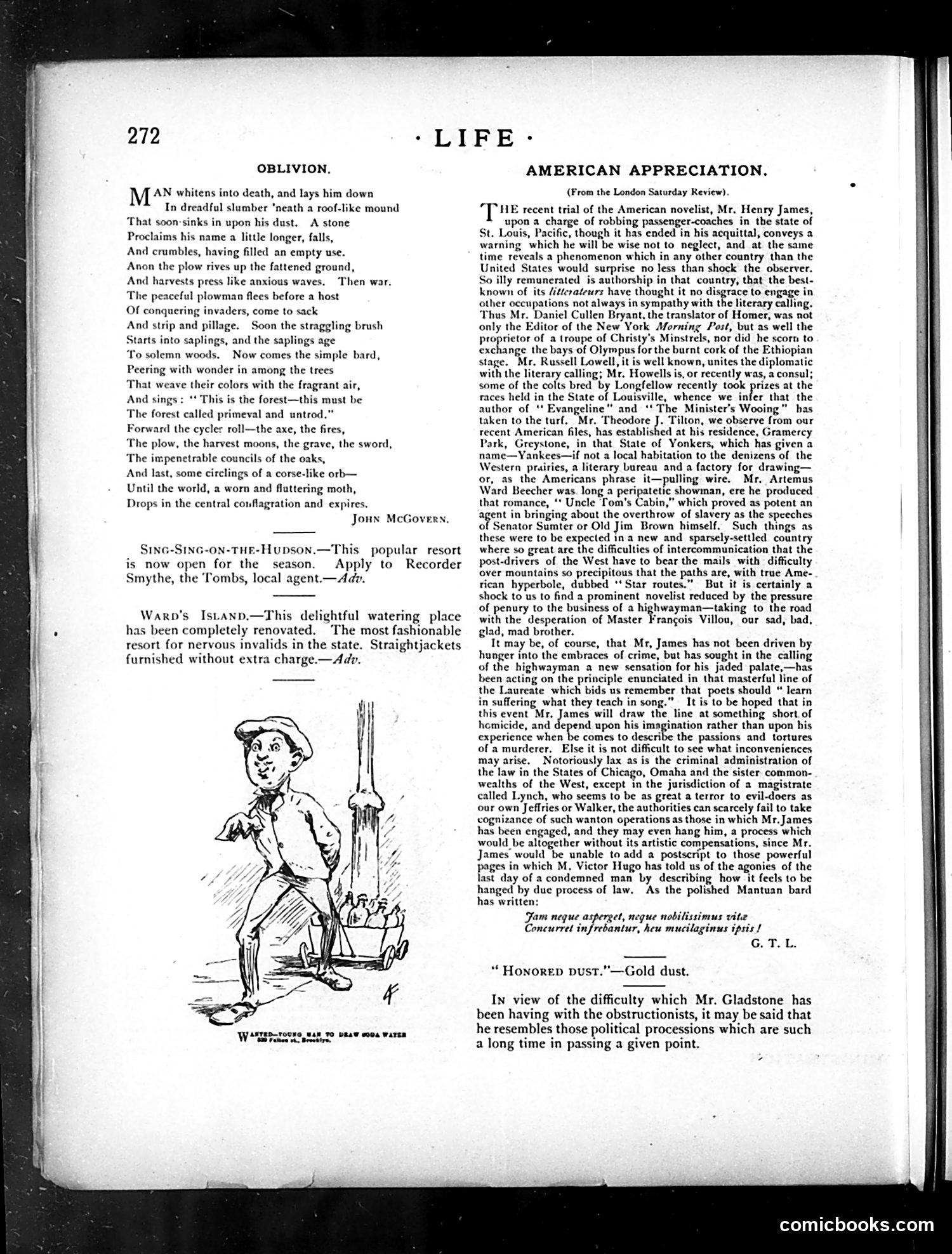
This page contains two distinct pieces: **Left side:** A serious, melancholic poem titled "Oblivion" by John McGovern about human mortality and nature's cycles—not satirical. **Right side:** British satire mocking American literary culture. A London *Saturday Review* piece falsely claims Henry James was tried for robbing stagecoaches. The joke: America pays writers so poorly that famous authors must take other jobs to survive. The piece humorously "explains" why major American writers (Bryant, Lowell, Howells, Tilton, Beecher) supposedly work as editors, diplomats, horse breeders, and showmen. The satire targets American economic conditions and cultural priorities—suggesting a country so commercially driven that even celebrated authors cannot earn adequate livings through writing alone. It's mock-serious, presenting obvious absurdities (James as a highway robber) as factual explanation for why American literature exists in such precarious circumstances.
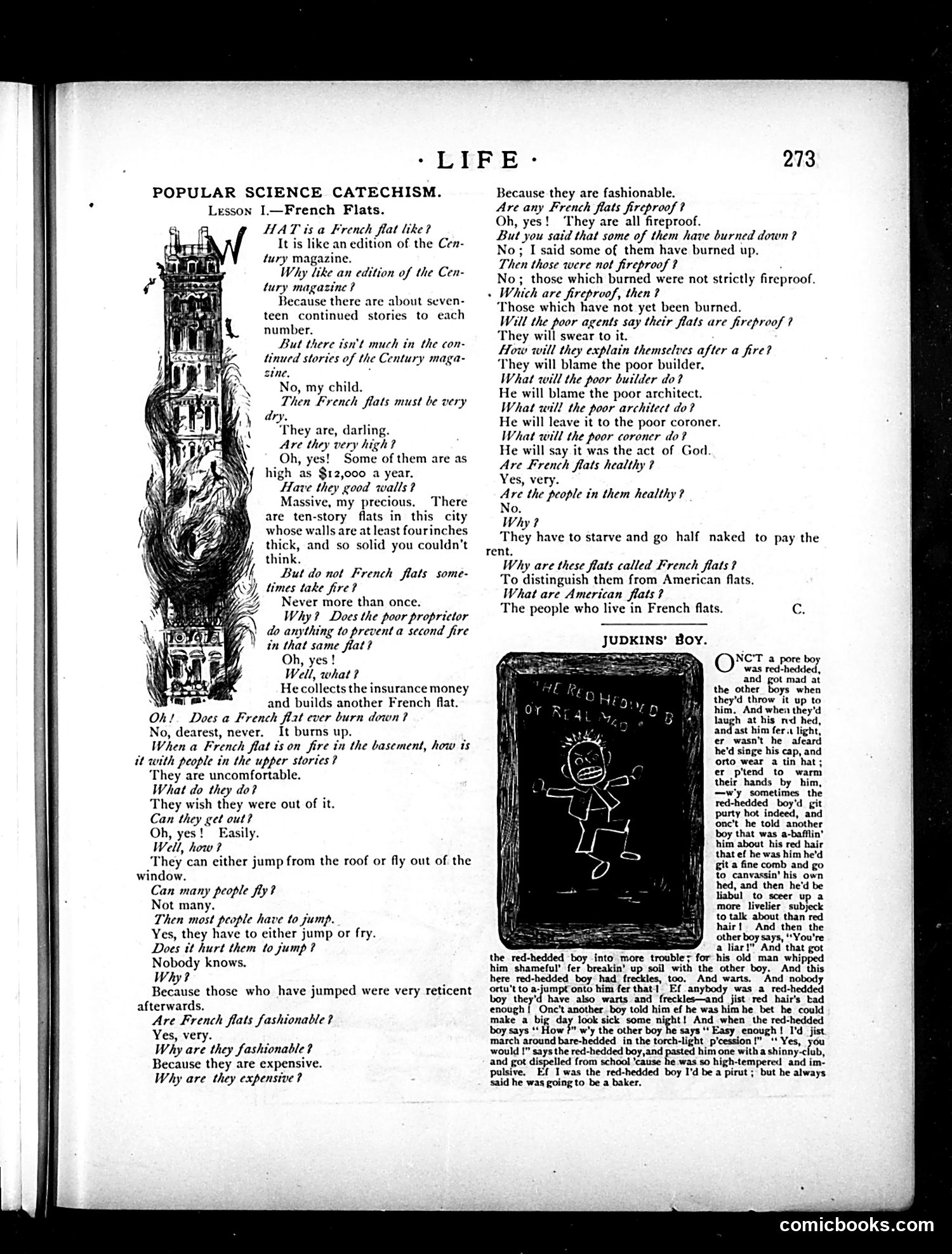
This page satirizes two contemporary social issues through mock-serious dialogue and a side illustration. **"Popular Science Catechism: French Flats"** uses a question-and-answer format to mock the burgeoning apartment building trend in American cities. "French flats" were multi-unit residential buildings—novel at the time—and the satire skewers their poor construction quality, fire hazards, and exorbitant rents. The humor turns on absurdist logic: buildings are "fireproof" until they burn; people escape fires by jumping; tenants must "starve and go half naked to pay rent." The final joke equates "American flats" with the impoverished people living in French flats, inverting the terminology. **"Judkins' Boy"** (right panel) illustrates a working-class boy taunted for his red hair and freckles. The crude chalk-on-slate drawing mimics child art, showing the boy's perspective. The narrative sympathizes with the boy's frustration at being mocked for physical traits beyond his control—a gentler social commentary on childhood bullying and class-based mockery. Together, the page critiques urban housing conditions and social cruelty through humor accessible to Life's middle-class readership.
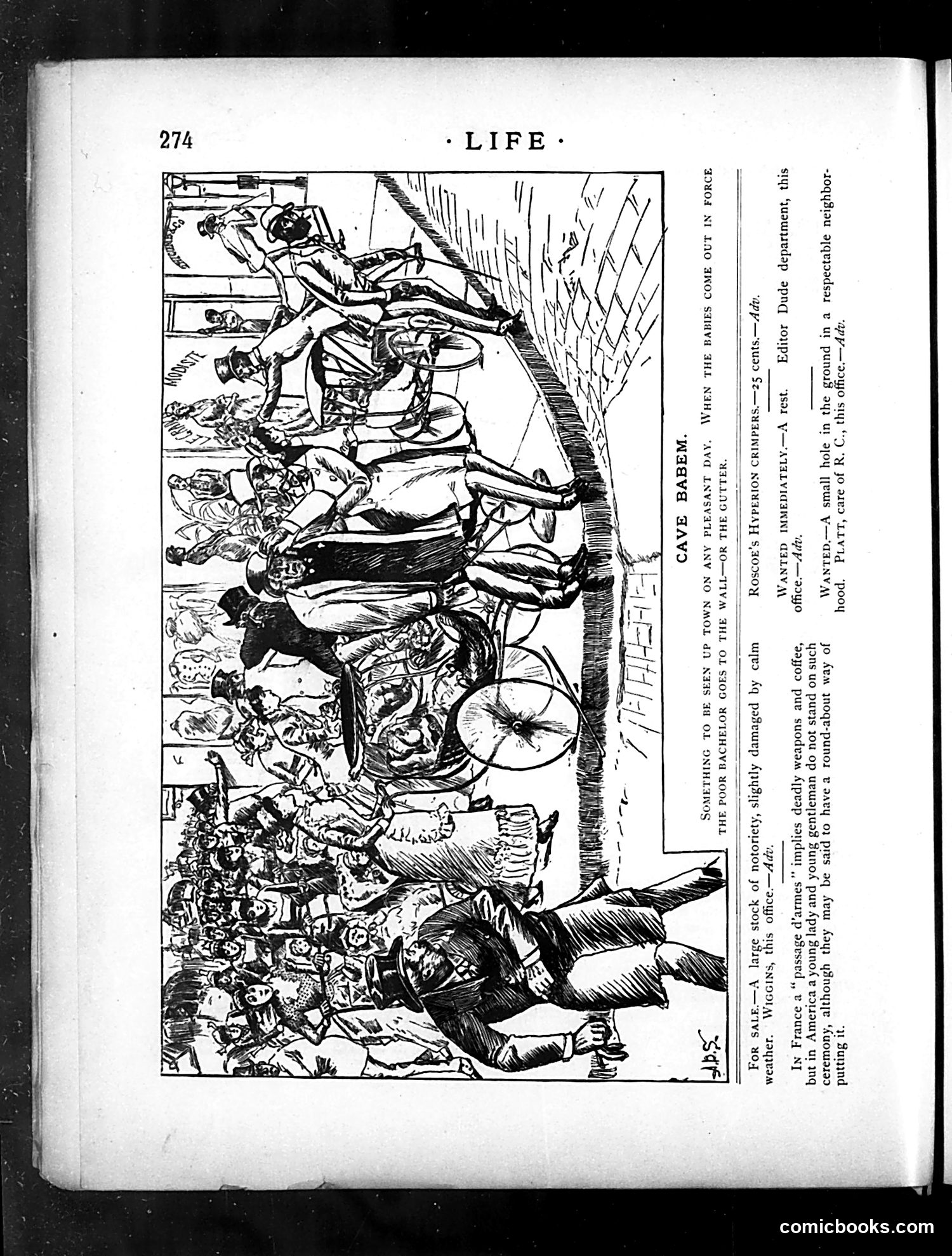
This cartoon satirizes primitive or crude "barbering" practices, likely referencing late 19th or early 20th-century concerns about unsanitary or dangerous personal services. The image depicts a crowded cave scene with numerous figures engaged in shaving and grooming activities under primitive conditions. The satire appears to mock either: - Quack barbers or untrained practitioners operating in unsanitary conditions - Immigrant or working-class barbershops portrayed as "caveman-like" and dangerous - Public health concerns about inadequate hygiene standards in personal service establishments The elaborate, chaotic composition—with many figures and activity—emphasizes the mayhem and lack of regulation. The "cave" setting suggests backwardness or lack of civilization, a common satirical device in early Life magazine. Without clearer OCR or additional context, the specific political target remains unclear, though the humor derives from contrasting primitive conditions with civilized services.
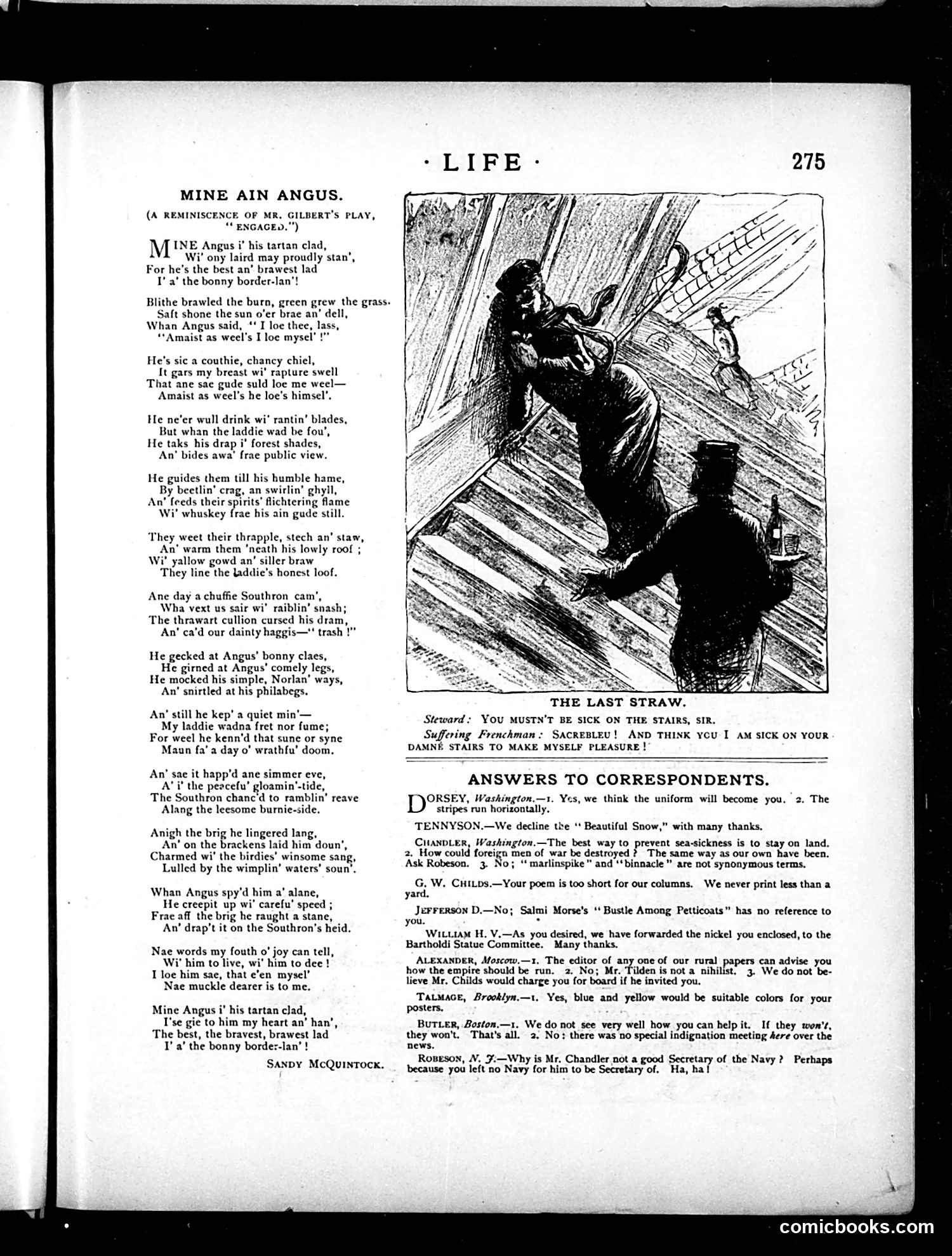
This cartoon depicts a confrontation on ship's stairs. The steward addresses a suffering passenger, saying "You mustn't be sick on the stairs, sir" while the passenger retorts that the steward should stop using the stairs to make himself pleasurable—suggesting the steward is deliberately causing discomfort to passengers. The joke satirizes the tension between ship's crew and passengers during an era of sea travel, likely highlighting poor service conditions or crew indifference to passenger suffering (possibly seasickness). The title "The Last Straw" suggests this is the final indignity in a series of complaints. The accompanying poem "Mine Ain Angus" by Sandy McQuintock appears to be unrelated Scottish verse, common filler content in Life magazine of this period.
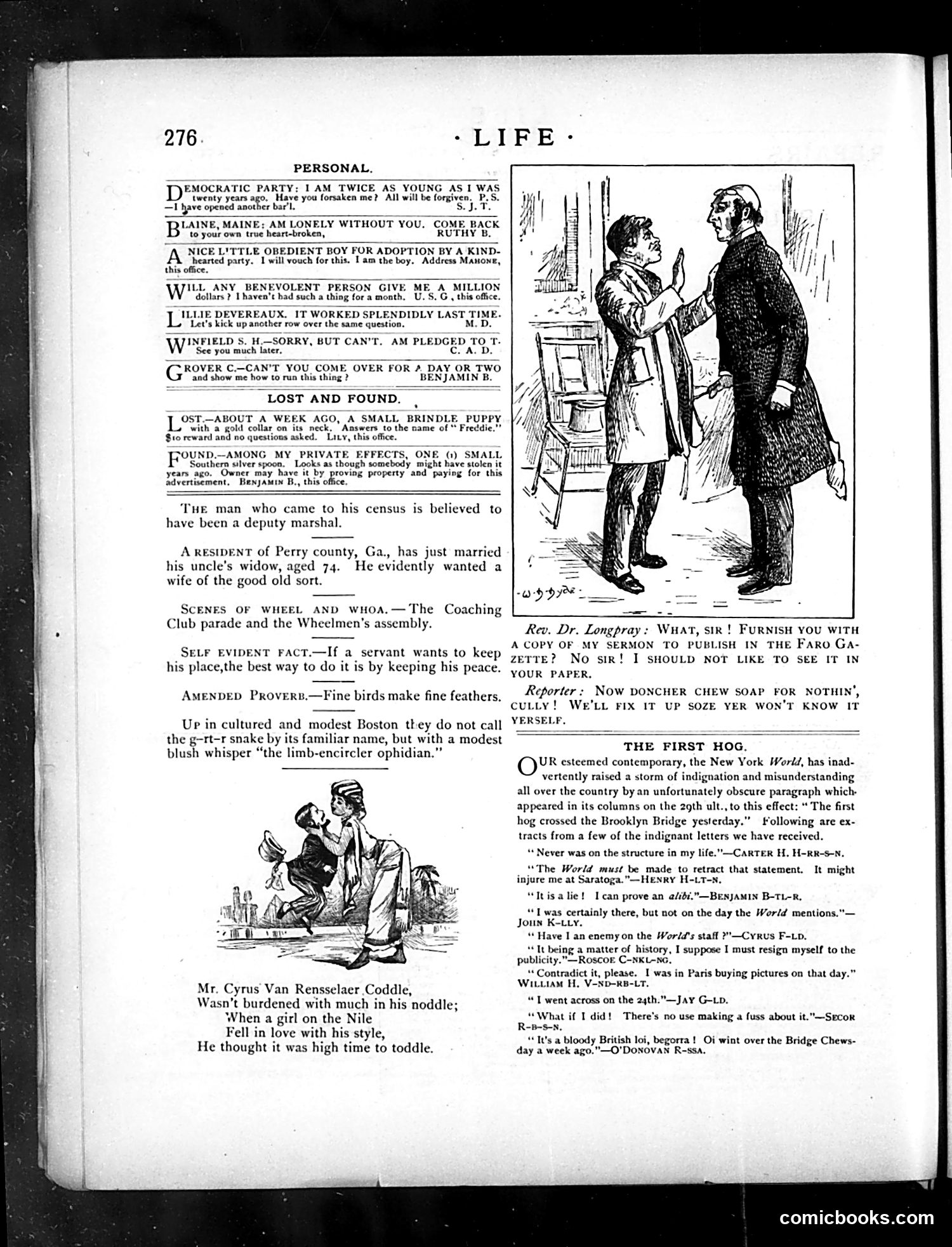
This page satirizes the *New York World* newspaper for publishing an ambiguous paragraph stating "The first hog crossed the Brooklyn Bridge yesterday." The satire mocks how prominent politicians and public figures responded with indignation, each insisting they weren't present—or reinterpreting the statement to protect their reputations. The joke targets vanity: the names (partially obscured with dashes) appear to reference real politicians of the era who feared being publicly associated with a pig crossing. Some deny involvement entirely; others claim they were elsewhere (in Paris, Saratoga). The humor lies in how seriously they took an innocuous statement, revealing their thin skins and preoccupation with public image. The accompanying comic poem about "Cyrus Van Rensselaer Coddle" reinforces the theme of foolishness and poor judgment among the upper classes.
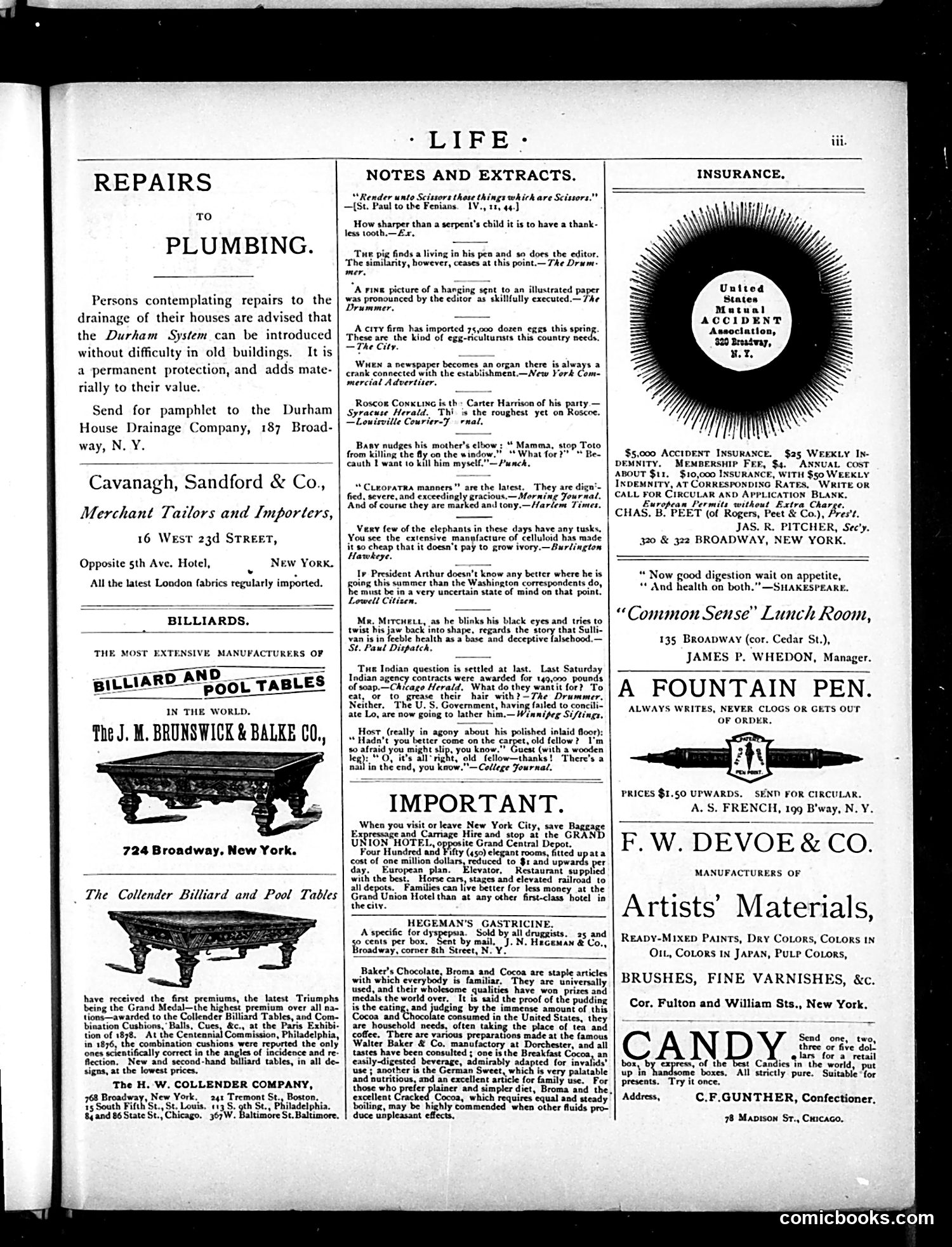
This page is **primarily advertisements** with a "Notes and Extracts" humor section. There are no political cartoons visible. The humor snippets are brief satirical quips on contemporary topics: - A joke about scissors and the Fenians (Irish nationalist group) plays on biblical phrasing - References to newspapers becoming "organs" (mouthpieces) with "cranks" attached - A gag about Roscoe Conkling (likely a political figure) compared to Chicago's Carter Harrison - Elephant jokes about celluloid replacing ivory in trade - President Arthur's uncertain summer travel plans (poking fun at administration confusion) - A reference to "Sullivan" (likely boxer John L. Sullivan) and his health - A joke about the U.S. Government using soap to "lather" Native Americans ("Lo")—a dark reference to broken treaty promises The advertisements promote plumbing systems, tailoring, billiard tables, insurance, fountain pens, lunch rooms, and art supplies. The page reflects 1880s-era commercial and political humor rather than visual satire.
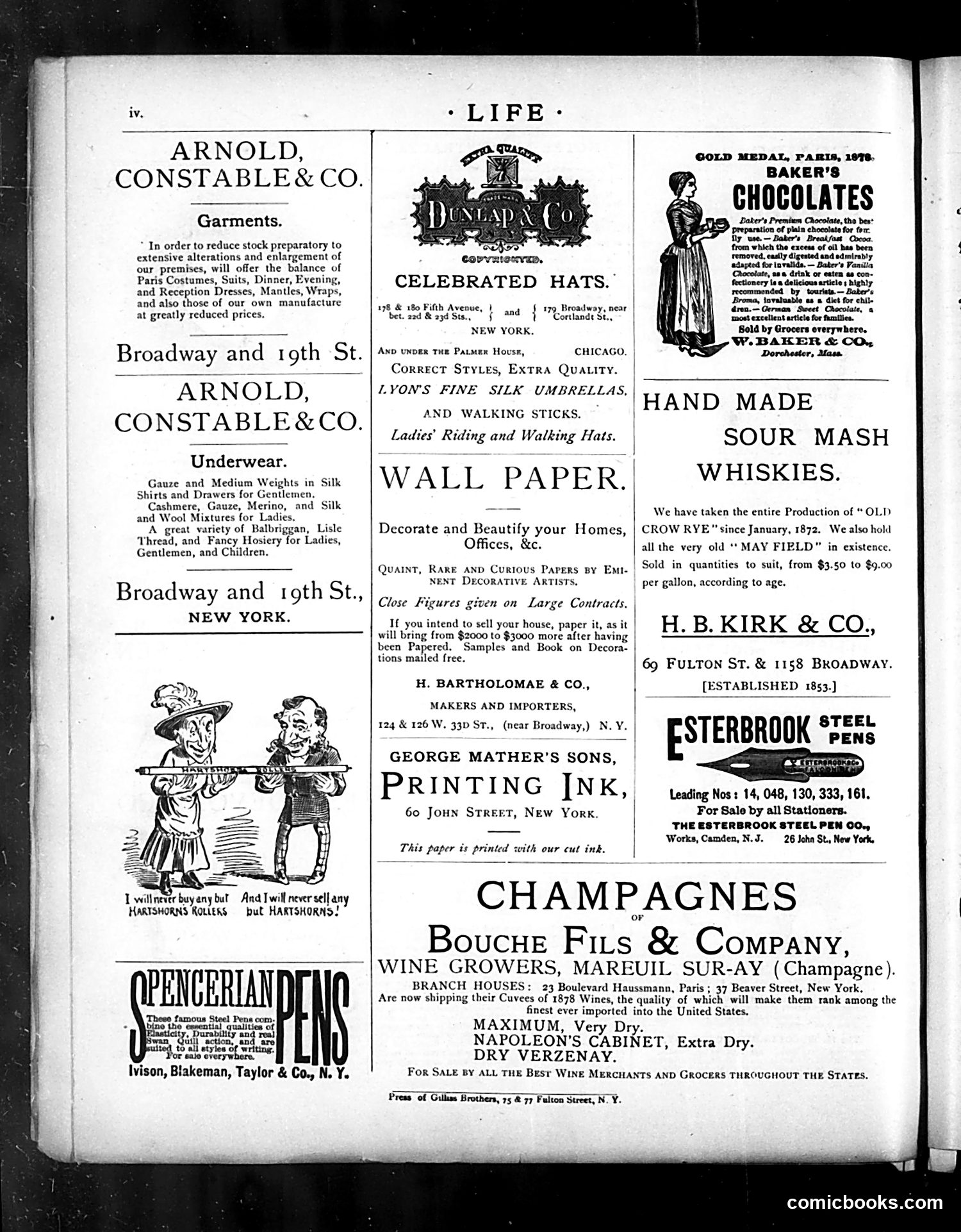
This is primarily an **advertising page** with one small cartoon. The page contains late-19th-century commercial advertisements for clothing, wine, pens, chocolates, and other goods. The **only cartoon** appears in the lower left: two figures labeled "I will never buy any but HARTSHORNS ROLLERS" and "And I will never sell any but HARTSHORNS!" The joke concerns **Hartshorn brand window rollers**—a common household product. The satire mocks consumer loyalty and sales-pitch enthusiasm by depicting exaggerated commitment to a mundane item. The figures appear to be a customer and shopkeeper, each humorously devoted to this specific brand. The rest of the page is straightforward commercial messaging typical of *Life* magazine's revenue model, featuring prestigious New York businesses and imported luxury goods (champagne, chocolates, fine hats) marketing to affluent readers.