
Life, 1883-06-07 · page 10 of 16
Life — June 7, 1883 — page 10: what you’re looking at
What you’re looking at
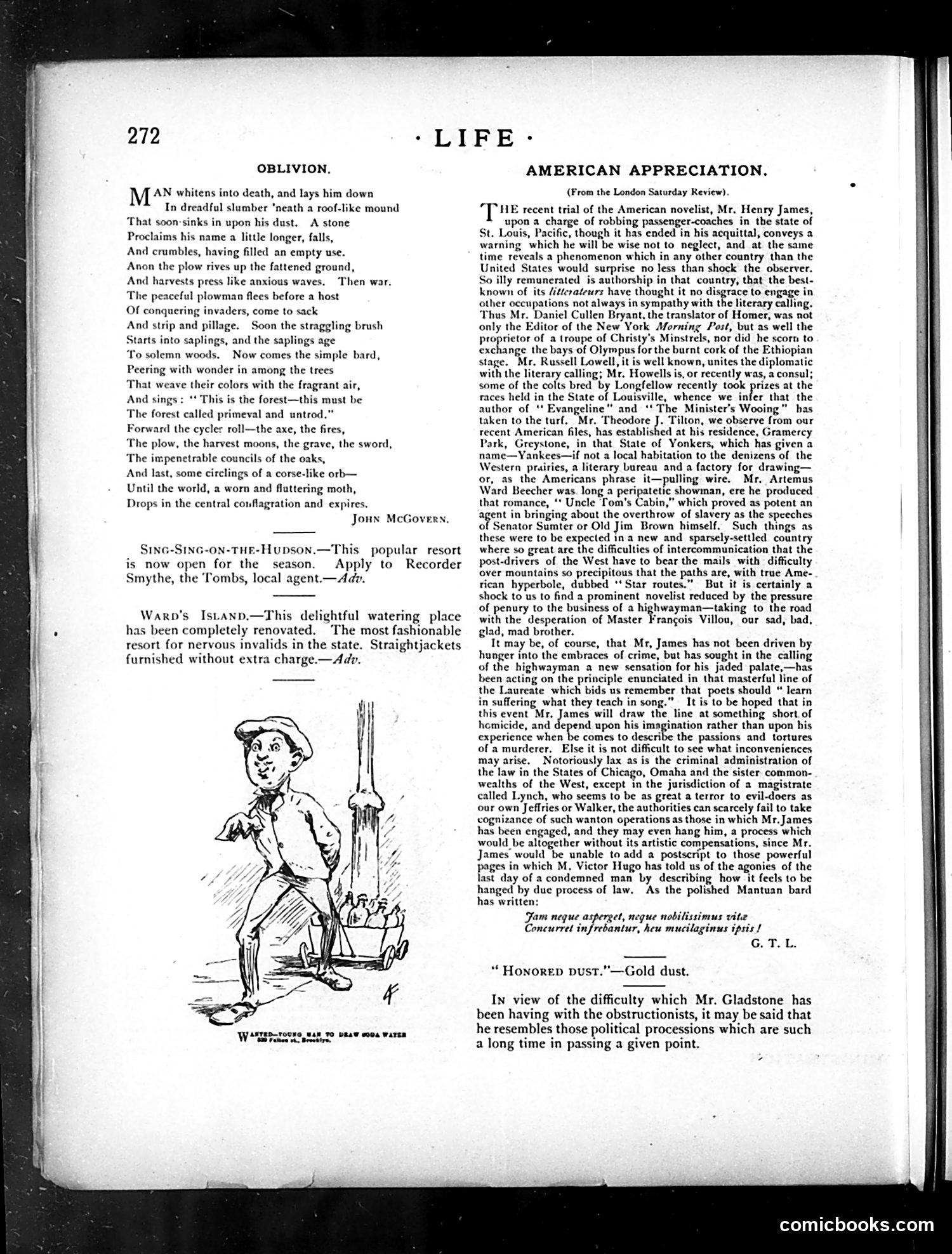
This page contains two distinct pieces: **Left side:** A serious, melancholic poem titled "Oblivion" by John McGovern about human mortality and nature's cycles—not satirical. **Right side:** British satire mocking American literary culture. A London *Saturday Review* piece falsely claims Henry James was tried for robbing stagecoaches. The joke: America pays writers so poorly that famous authors must take other jobs to survive. The piece humorously "explains" why major American writers (Bryant, Lowell, Howells, Tilton, Beecher) supposedly work as editors, diplomats, horse breeders, and showmen. The satire targets American economic conditions and cultural priorities—suggesting a country so commercially driven that even celebrated authors cannot earn adequate livings through writing alone. It's mock-serious, presenting obvious absurdities (James as a highway robber) as factual explanation for why American literature exists in such precarious circumstances.
📄 Transcribed text from this page (OCR, searchable)
Machine-transcribed from the original scan — historical spelling and the odd misread are preserved.
272 OBLIVION, M AN whitens into death, and lays him down In dreadful slumber "neath a roof-like mound That soon-sinks in upon his dust. A stone Proclaims his name a little longer, falls, And crumbles, having filled an empty use. Anon the plow rives up the fattened ground, And harvests press like anxious waves. Then war. The peaceful plowman flees before a host Of conquering invaders, come to sack And strip and pillage. Soon the straggling brush Starts into saplings, and the saplings age To solemn woods, Now comes the simple bard, Peering with wonder in among the trees That weave their colors with the fragrant air, And sings: ** This is the forest—this must be The forest called primeval and untrod.” Forward the cycler roll—the axe, the fires, The plow, the harvest moons, the grave, the sword, The impenetrable councils of the oaks, And last, some circlings of a corse-like orb— Until the world, a worn and fluttering moth, Drops in the central conflagration and expires. Joux McGovern. SinG-S1nG-ON-THE-Hupson.: now open for the season. ‘This popular resort Apply to Recorder Smythe, the Tombs, local agent.—Adv. Waro's Istanp.—This delightful watering place has been completely renovated. The most fashionable resort for nervous invalids in the state. Straightjackets furnished without extra charge —Adv. AXYED-TOUN WAN TO DEAW soDA Wares Wis rane aS acters: - LIFE: AMERICAN APPRECIATION. (From the London Saturday Review) “THE recent trial of the American novelist, Mr. Henry James, upon a charge of robbing passenger-coaches in the state of St. Louis, Pacific, though it has ended in his acquittal, conveys a warning which he will be wise not to neglect, and at the same time reveals a phenomenon which in any other country than the United States would surprise no less than shock the observer. So illy remunerated is authorship in that country, that the best- known of its /itterateurs have thought it no disgrace to engage in other occupations not always in sympathy with the literary calling. ‘Thus Mr. Daniel Cullen Bryant, the translator of Homer, was not only the Editor of the New York Morning Post, but as well the proprietor of a troupe of Christy's Minstrels, nor did he scorn to exchange the bays of Olympus for the burnt cork of the Ethiopian stage. Mr. Russell Lowell, it is well known, unites the diplomatic with the literary calling; Mr. Howells is, or recently was, a consul; some of the colts bred by Longfellow recently took prizes at the races held in the State of Louisville, whence we infer that the author of ‘* Evangeline" and ‘* The Minister’s Wooing” has taken to the turf. Mr. Theodore i. Tilton, we observe from our recent American files, has established at his residence, Gramercy Park, Greystone, in that State of Yonkers, which has given a name—Yankees—if not a local habitation to the denizens of the Western prairies, a literary bureau and a factory for drawing— or, as the Americans phrase it—pulling wire. Mr. Artemus Ward Beecher was. long a peripatetic showman, ere he produced that romance, ‘* Uncle Tom's Cabin,” which proved as potent an agent in bringing about the overthrow of slavery as the speeches of Senator Sumter or Old Jim Brown himself. Such things as these were to be expected in a new and sparsely-settled country where so great are the difficulties of intercommunication that the post-drivers of the West have to bear the mails with difficulty over mountains so precipitous that the paths are, with true Ame- rican hyperbole, dubbed ‘‘Star routes.” But it is certainly a shock to us to find a prominent novelist reduced by the pressure of penury to the business of a highwayman—taking to the road with the desperation of Master Francois Villou, our sad, bad, glad, mad brother. It'may be, of course, that Mr, James has not been driven by hunger into the embraces of crime, but has sought in the calling of the highwayman a new sensation for his jaded palate,—has been acting on the principle enunciated in that masterful line of the Laureate which bids us remember that poets should “ learn in suffering what they teach in song.” It is to be hoped that in this event Mr. James will draw the line at something short of homicide, and depend upon his imagination rather than upon his experience when be comes to describe the passions and tortures of a murderer. Else it is not difficult to see what inconveniences may arise. Notoriously lax as is the criminal administration of the law in the States of Chicago, Omaha and the sister common- wealths of the West, except in the jurisdiction of a magistrate called Lynch, who seems to be as great a terror to evil-doers as our own Jeffries or Walker, the authorities can scarcely fail to take cognizance of such wanton operations as those in which Mr. James has been engaged, and they may even hang him, a process which would be altogether without its artistic compensations, since Mr. James’ would be unable to add a postscript to those powerful pages in which M. Victor Hugo has told us of the agonies of the last day of a condemned man by describing how it feels to be hanged by due process of law. As the polished Mantuan bard has written: Fam neque asperget, neque nobilissimus vite Concurret infrebantur, heu mucilaginus ipsis! G. T. L. “ Honorep bust."—Gold dust. In view of the difficulty which Mr. Gladstone has been having with the obstructionists, it may be said that he resembles those political processions which are such a long time in passing a given point. comicbooks.com