
Life, 1883-06-07 · page 7 of 16
Life — June 7, 1883 — page 7: what you’re looking at
What you’re looking at
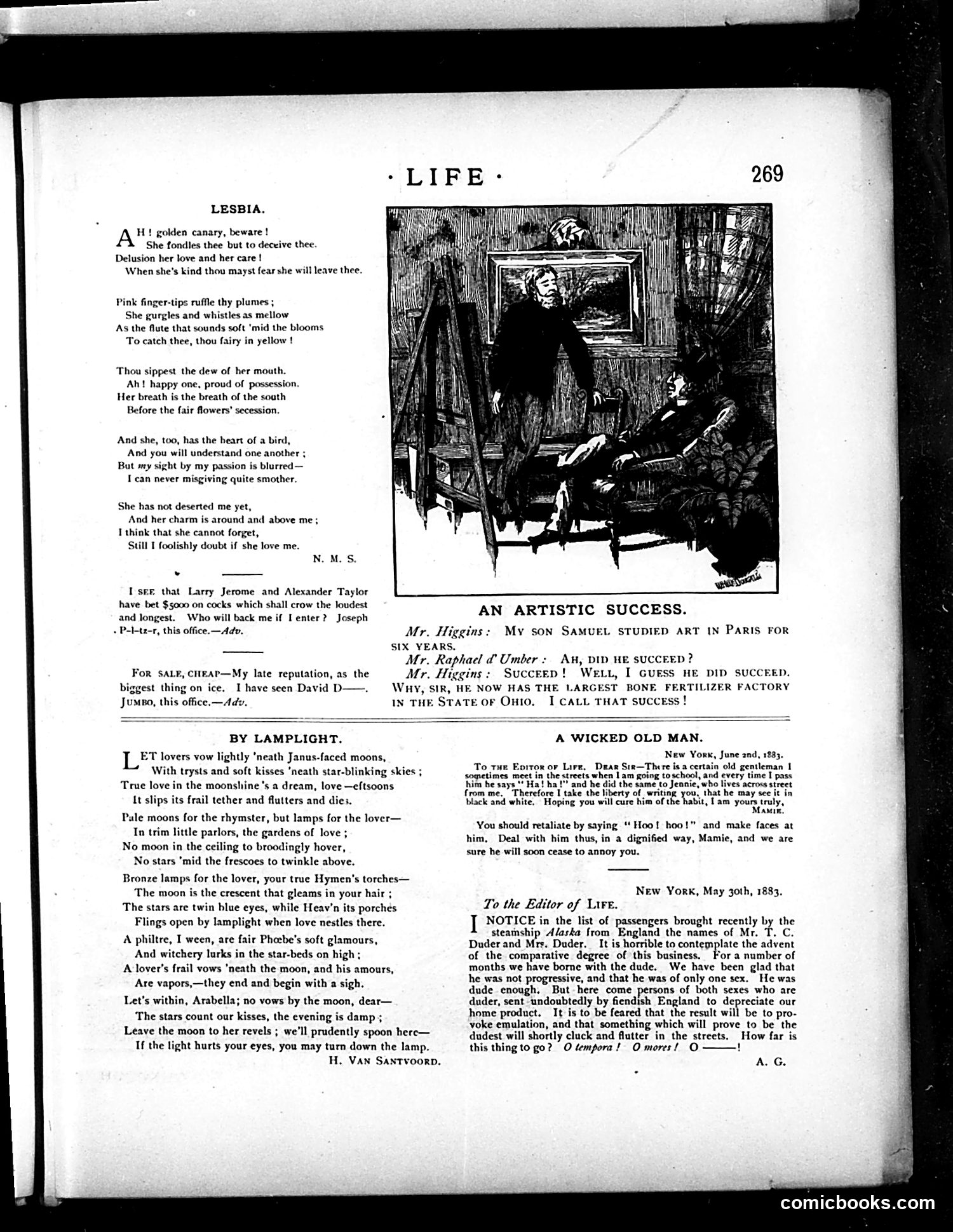
The main cartoon titled "AN ARTISTIC SUCCESS" depicts a conversation between two men about another's art studies. Mr. Higgins reports his son Samuel studied art in Paris for six years, and when asked if he succeeded, Higgins replies that yes, he succeeded—he now operates "the largest bone fertilizer factory in the state of Ohio." The satire mocks the gap between artistic aspiration and commercial reality. Parents investing in their children's European art education expected refined cultural achievement, but the punchline suggests the son's actual "success" is industrial manufacturing—a mundane, unglamorous business. This reflects period anxieties about American materialism versus European cultural pretension, and the comic deflation of parental hopes for artistic sons.
📄 Transcribed text from this page (OCR, searchable)
Machine-transcribed from the original scan — historical spelling and the odd misread are preserved.
LESBIA. Hf golden canary, beware! She fondles thee but to deceive thee. Delusion her love and her care! When she's kind thou mayst fear she will leave thee. Pink finger-tips ruffle thy plumes ; She gurgles and whistles as mellow As the flute that sounds soft ‘mid the blooms To catch thee, thou fairy in yellow ! Thou sippest the dew of her mouth. Ah! happy one, proud of possession, Her breath is the breath of the south Before the fair flowers’ secession, And she, too, has the heart of a bird, And you will understand one another ; But my sight by my passion is blurred— I can never misgiving quite smother. She has not deserted me yet, And her charm is around and above me ; Tthink that she cannot forget, Still I foolishly doubt if she love me. M.S. . I ser that Larry Jerome and Alexander Taylor have bet $5000 on cocks which shall crow the loudest and longest. Who will back me if I enter? Joseph + P--tz-1, this office.—Adv. For SALE, CHEAP—My late reputation, as the biggest thing on ice. [have seen David D—. JUMBO, this office. —Adv. AN ARTISTIC SUCCESS. Mr. Higgins: My son SAMUEL STUDIED ART IN PaRIS FOR SIX YEARS. Mr. Raphael d’ Umber: Att, Dip HE SUCCEED? Mr. Higgins: Succerp ! Why, sik, HE NOW HAS THE LARGEST BONE FERTILIZER FACTORY IN THE STATE OF OHIO. WELL, I GUESS HE DID SUCCEED. I CALL THAT SUCCESS ! BY LAMPLIGHT. LF lovers vow lightly neath Janus-faced moons, With trysts and soft kisses ‘neath star-blinking skies ; True love in the moonshine 's a dream, love —eftsoons. It slips its frail tether and flutters and dies. Pale moons for the rhymster, but lamps for the lover— In trim little parlors, the gardens of love ; No moon in the ceiling to broodingly hover, No stars ‘mid the frescoes to twinkle above. Bronze lamps for the lover, your true Hymen’s torches— ‘The moon is the crescent that gleams in your hair ; The stars are twin blue eyes, while Heav'n its porches Flings open by lamplight when love nestles there. A philtre, I ween, are fair Phorbe's soft glamours, And witchery lurks in the star-beds on high ; A lover's frail vows ‘neath the moon, and his amours, Are vapors,—they end and begin with a sigh. Let's within, Arabella; no vows by the moon, dear— The stars count our kisses, the evening is damp ; Leave the moon to her revels ; we'll prudently spoon here— If the light hurts your eyes, you may turn down the lamp. H. VAN Santvoorb. New York, June and, 1883. To rue Eoirox ov Lire. Drar Sin—There isa certain old gentleman 1 sometimes meet in the streets when Lam going toschool, and every time I pass him he says" Ha! ha!” and he did the same to Jennie, who lives across street from me. Therefore I take the liberty of writing you. that he may see it black and white, Hoping you will cure him of the habit, fam yours truly, Main: You should retaliate by saying ‘Hoo! hoo!” and make faces at him, Deal with him thus, in a dignified way, Mamie, and we are sure he will soon cease to annoy you. New York, May 30th, 1883, To the Editor of Lire. J NOTICE in the list of passengers brought recently by the steamship A/aska from England the names of Mr. T. C. Duder and Mrs. Duder. It is horrible to contemplate the advent of the comparative degree of this business. For a number of months we have borne with the dude. We have been glad that he was not progressive, and that he was of only one sex. He was dude enough. But-here come persons of both sexes who are duder, sent undoubtedly by fiendish England to depreciate our home product. It is to be feared that the result will be to pro- voke emulation, and that something which will prove to be the dudest will shortly cluck and flutter in the streets. How far is this thing to go? O tempora! O mores! O 1 A. G. comicbooks.com