
Life, 1883-06-07 · page 3 of 16
Life — June 7, 1883 — page 3: what you’re looking at
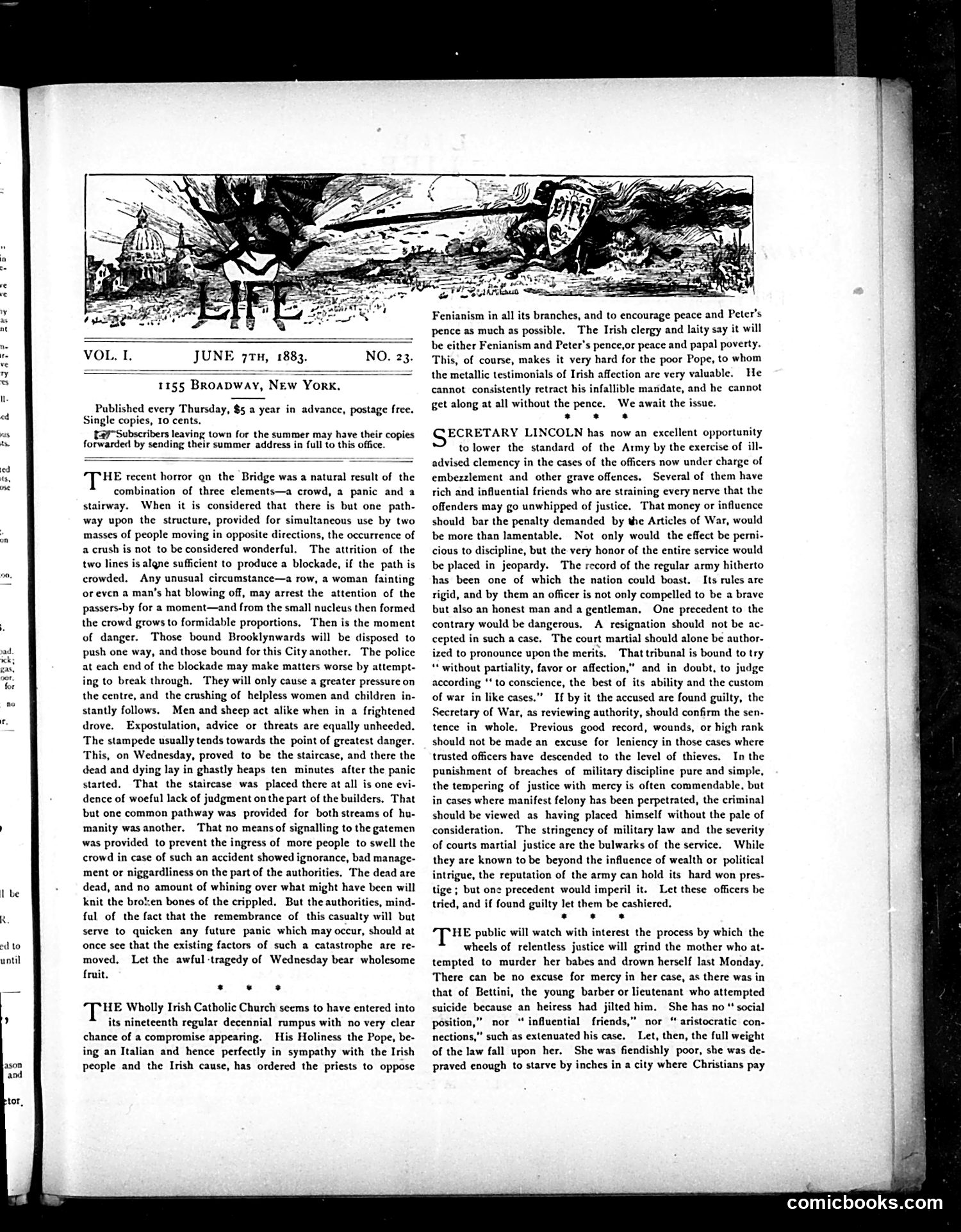
What you’re looking at
The masthead cartoon depicts a chaotic scene with figures in distress, likely referencing the recent Brooklyn Bridge tragedy mentioned in the text—a fatal crush that occurred when a panicked crowd caused a stampede on the bridge's opening. The articles criticize: 1. **Police and crowd management failures** during the Bridge incident, arguing inadequate measures caused unnecessary deaths 2. **Secretary of War's potential abuse of power** regarding Army officer discipline—the author warns against letting politics influence military justice 3. **Irish Catholic Church's involvement in Irish-American politics**, suggesting the Church is inappropriately interfering in secular matters under papal instruction The tone is reform-minded, attacking institutional mismanagement and institutional overreach in civic and military affairs.
📄 Transcribed text from this page (OCR, searchable)
Machine-transcribed from the original scan — historical spelling and the odd misread are preserved.
1155 BROADWAY) New York. Published every Thursday, $5 a year in advance, postage free. Single copies, 10 cents. fay~Subscribers leaving town for the summer may have their copies forwarded by sending their summer address in full to this office. THe recent horror gn the Bridge was a natural result of the combination of three elements—a crowd, a panic and a stairway. When it is considered that there is but one path- way upon the structure, provided for simultaneous use by two masses of people moving in opposite directions, the occurrence of accrush is not to be considered wonderful. The attrition of the two lines is algne sufficient to produce a blockade, if the path is crowded. Any unusual circumstance—a row, a woman fainting oreven a man’s hat blowing off, may arrest the attention of the passers-by for a moment—and from the small nucleus then formed the crowd grows to formidable proportions, Then is the moment of danger. Those bound Brooklynwards will be disposed to push one way, and those bound for this City another. The police at each end of the blockade may make matters worse by attempt- ing to break through. They will only cause a greater pressure on the centre, and the crushing of helpless women and children in- stantly follows. Men and sheep act alike when in a frightened drove. Expostulation, advice or threats are equally unheeded. The stampede usually tends towards the point of greatest danger. This, on Wednesday, proved to be the staircase, and there the dead and dying lay in ghastly heaps ten minutes after the panic started. That the staircase was placed there at all is one e dence of woeful lack of judgment on the part of the builders. That but one common pathway was provided for both streams of hu- manity was another, That no meansof signalling to the gatemen was provided to prevent the ingress of more people to swell the crowd in case of such an accident showed ignorance, bad manage- ment or niggardliness on the part of the authorities, The dead are dead, and no amount of whining over what might have been will knit the broken bones of the crippled. But the authorities, mind- ful of the fact that the remembrance of this casualty will but serve to quicken any future panic which may occur, should at once see that the existing factors of such a catastrophe are re- moved, Let the awful -tragedy of Wednesday bear wholesome fruit. s © 6 “THE Wholly Irish Catholic Church seems to have entered into its nineteenth regular decennial rumpus with no very clear chance of a compromise appearing. His Holiness the Pope, be- ing an Italian and hence perfectly in sympathy with the Irish people and the Irish cause, has ordered the priests to oppose sade, Sr bsble See Fenianism in all its branches, and to encourage peace and Peter's pence as much as possible. The Irish clergy and laity say it will be either Fenianism and Peter's pence,or peace and papal poverty. This, of course, makes it very hard for the poor Pope, to whom the metallic testimonials of Irish affection are very valuable. He cannot consistently retract his infallible mandate, and he cannot get along at all without the pence. We await the issue. es 8 8 ECRETARY LINCOLN has now an excellent opportunity to lower the standard of the Army by the exercise of ill- advised clemency in the cases of the officers now under charge of embezzlement and other grave offences, Several of them have rich and influential friends who are straining every nerve that the offenders may go unwhipped of justice. That money or influence should bar the penalty demanded by the Articles of War, would be more than lamentable. Not only would the effect be perni- cious to discipline, but the very honor of the entire service would be placed in jeopardy. The record of the regular army hitherto has been one of which the nation could boast. Its rules are rigid, and by them an officer is not only compelled to be a brave but also an honest man and a gentleman, One precedent to the contrary would be dangerous, A resignation should not be ac- cepted in such a case. The court martial should alone be author- ized to pronounce upon the merits. That tribunal is bound to try “* without partiality, favor or affection,” and in doubt, to judge according ‘‘ to conscience, the best of its ability and the custom of war in like cases.” If by it the accused are found guilty, the Secretary of War, as reviewing authority, should confirm the sen- tence in whole. Previous good record, wounds, or high rank should not be made an excuse for leniency in those cases where trusted officers have descended to the level of thieves. In the punishment of breaches of military discipline pure and simple, the tempering of justice with mercy is often commendable, but in cases where manifest felony has been perpetrated, the criminal should be viewed as having placed himself without the pale of consideration. The stringency of military law and the severity of courts martial justice are the bulwarks of the service. While they are known to be beyond the influence of wealth or political intrigue, the reputation of the army can hold its hard won pres- tige ; but one precedent would imperil it. Let these officers be tried, and if found guilty let them be cashiered. es 8 6 “THE public will watch wi erest the process by which the wheels of relentless justice will grind the mother who at- tempted to murder her babes and drown herself last Monday. There can be no excuse for mercy in her case, as there was in that of Bettini, the young barber or lieutenant who attempted suicide because an heiress had jilted him. She has no “ social position,” nor “influential friends,” nor “ aristocratic con- nections,” such as extenuated his case. Let, then, the full weight of the law fall upon her. She was fiendishly poor, she was de- praved enough to starve by inches in a city where Christians pay comicbooks.com