
A complete issue · 16 pages · 1883
Life — May 24, 1883
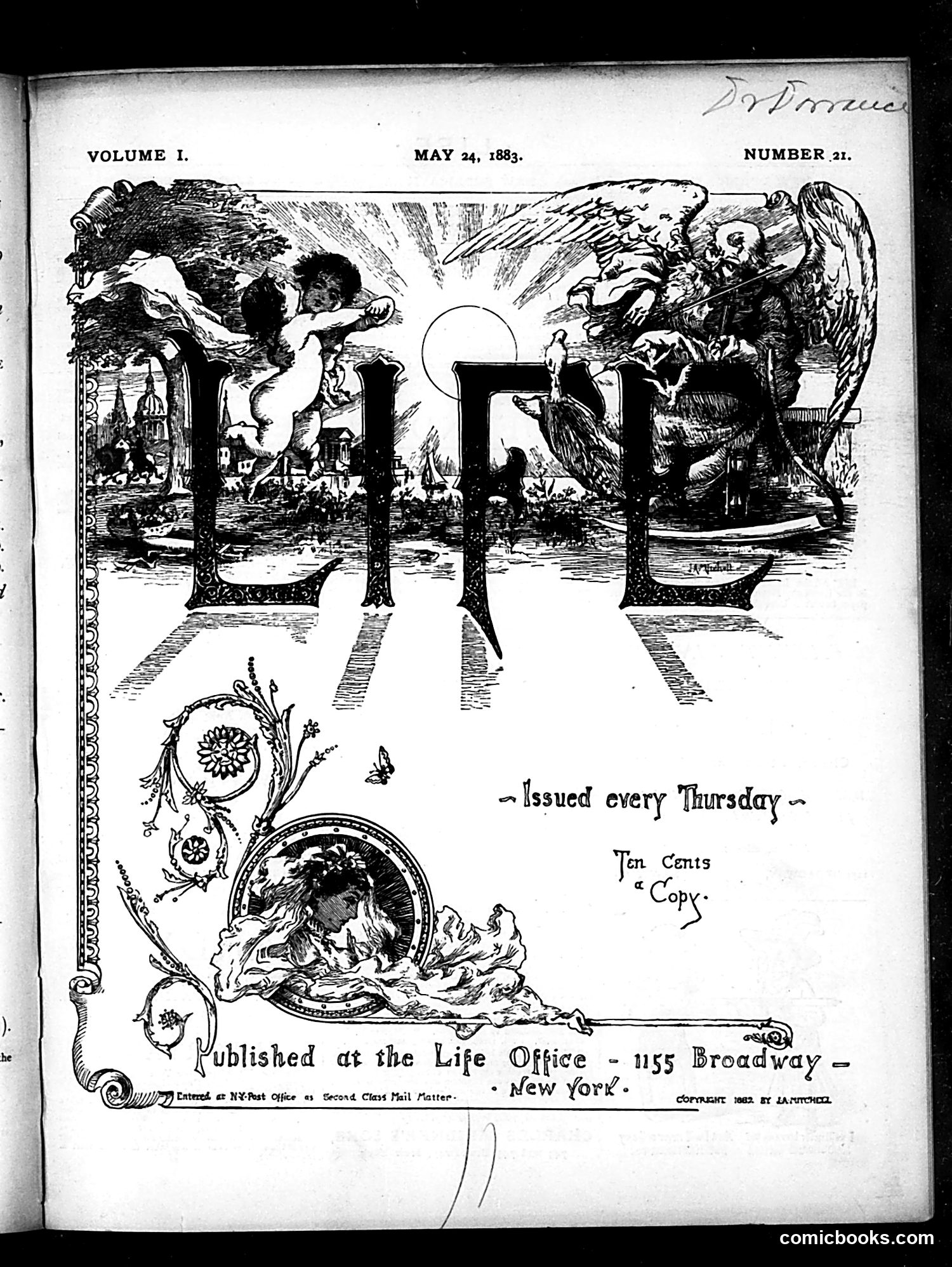
This is the cover of *Life* magazine's first volume, issue 21—a satirical weekly costing 10 cents. The elaborate illustration depicts classical and mythological figures surrounding large decorative letters spelling "LIFE." The imagery appears allegorical rather than depicting specific political figures or current events. Cherubs, an eagle, classical maidens, and ornate floral designs frame the title, suggesting *Life* presents itself as a publication of cultural sophistication and artistic merit. The ornamental style—with its Art Nouveau flourishes and mythological references—reflects 1880s aesthetic sensibilities. The cover emphasizes the magazine's identity as a venue for sophisticated satire and commentary, though without contemporary political caricatures visible on this particular page.
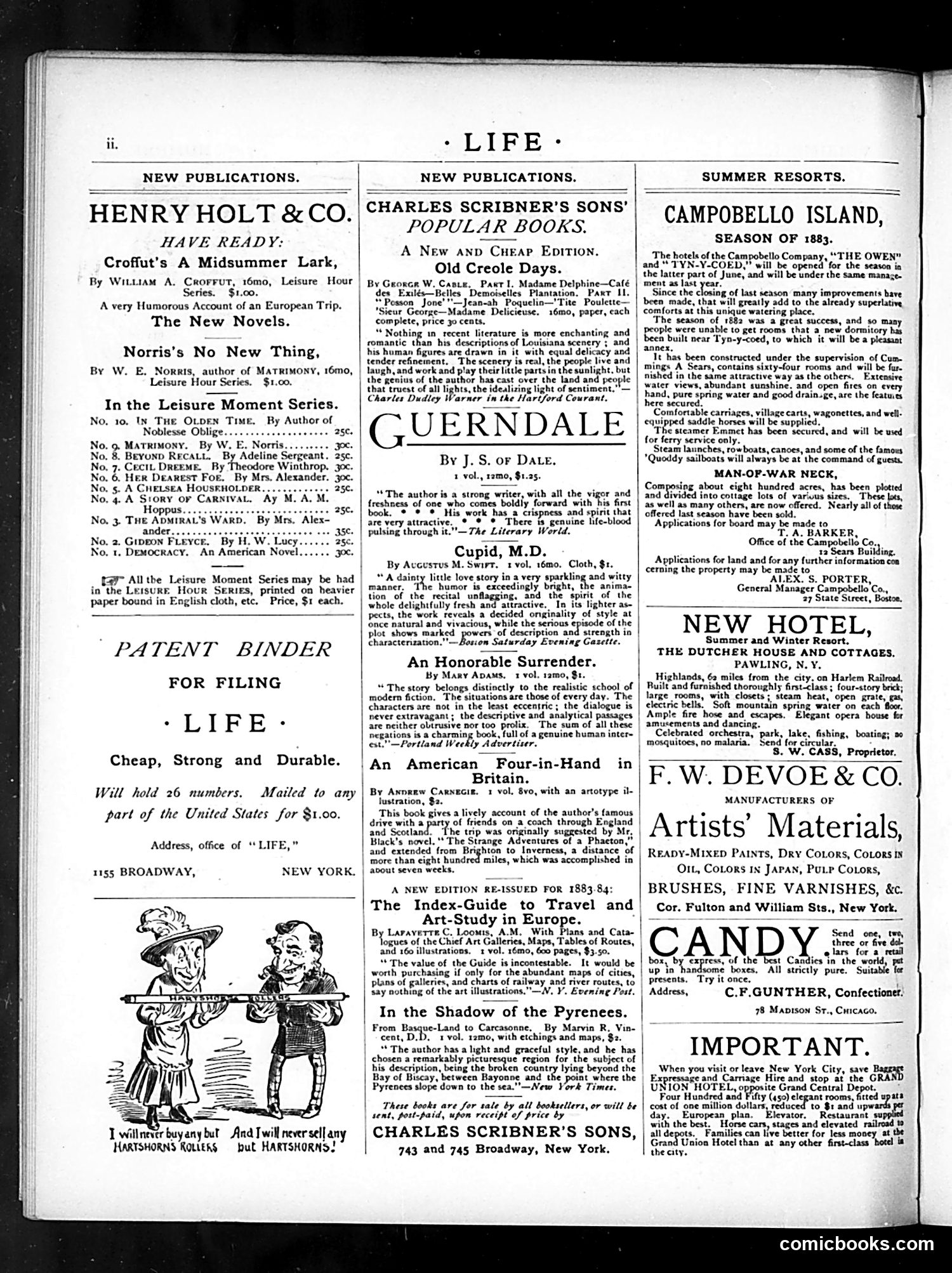
This page is primarily **advertisements for books and commercial products**, with one small political cartoon at the bottom left. The cartoon depicts two figures in what appears to be a merchant or trading dispute. One says "I will never buy but Hartshorne's Rollers" while the other responds "And I will never sell any but Hartshorne's!" This is **commercial satire** advertising Hartshorne's roller skates or similar wheeled products. The joke plays on absolute stubbornness from both buyer and seller—both insisting exclusively on this brand. It's designed to humorously reinforce brand loyalty while subtly mocking both consumer obsession and merchant marketing tactics. The remainder of the page contains book advertisements from Henry Holt & Co., Charles Scribner's Sons, and various other publishers and merchants typical of 1880s *Life* magazine advertising.
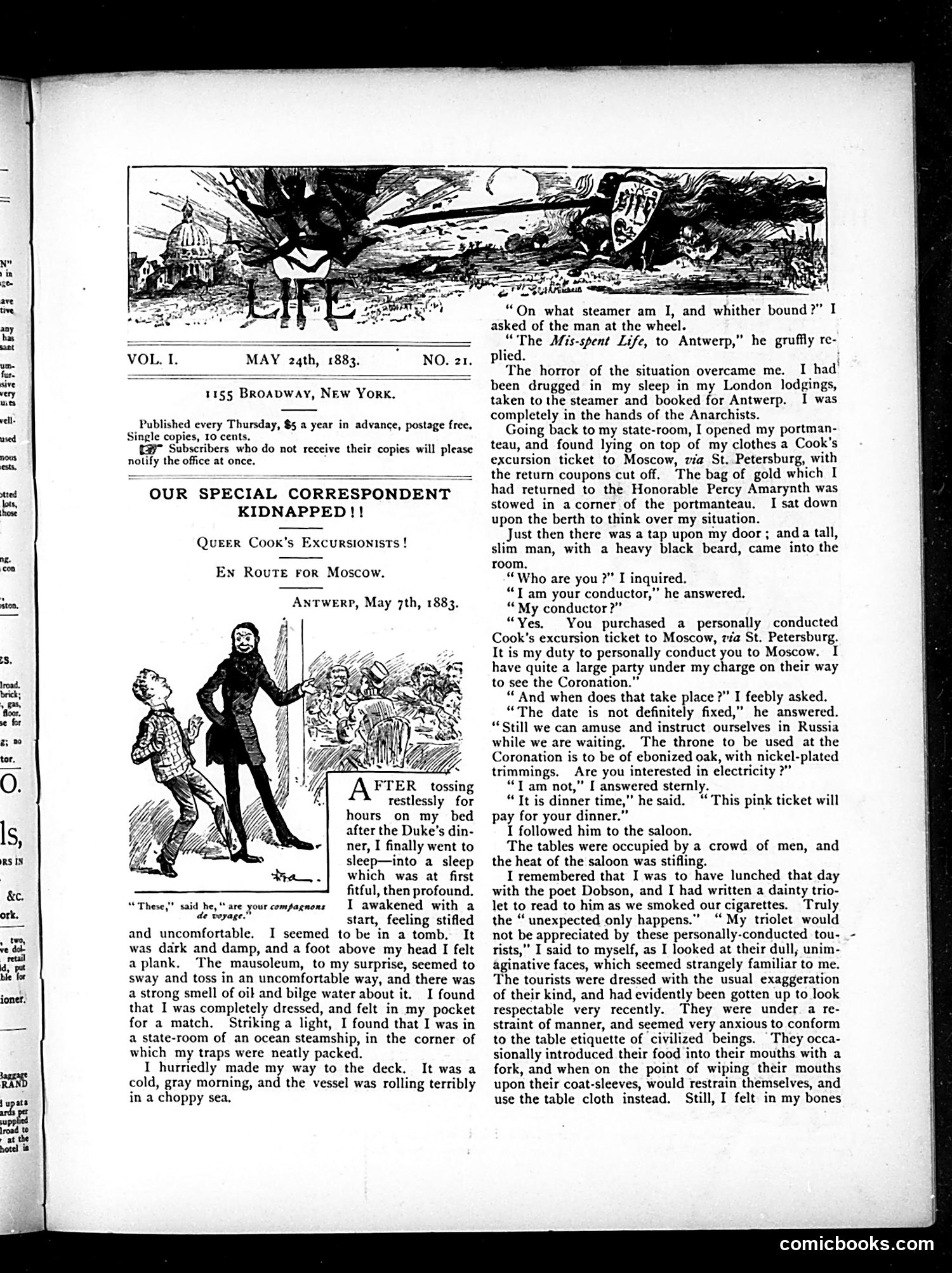
This satirical piece mocks **Thomas Cook's tourist excursions**, the famous Victorian travel company. The headline announces their correspondent has been "kidnapped" en route to Moscow for what Cook's advertised as a personally-conducted tour. The cartoon depicts a conductor forcibly restraining a small man, illustrating the article's complaint: tourists purchasing Cook's "personally conducted" tickets are essentially imprisoned under the conductor's authority during the journey. The accompanying narrative mocks both the conductor's rigid control and the tourists' gullible acceptance of regimented travel experiences. The satire targets the emerging tourism industry's dehumanizing practices—Cook's packaged tours reduced travelers to passive cargo, herded through experiences rather than exploring freely. The joke exposes the gap between romantic travel promises and the commercial reality: orderly conformity replacing adventure.
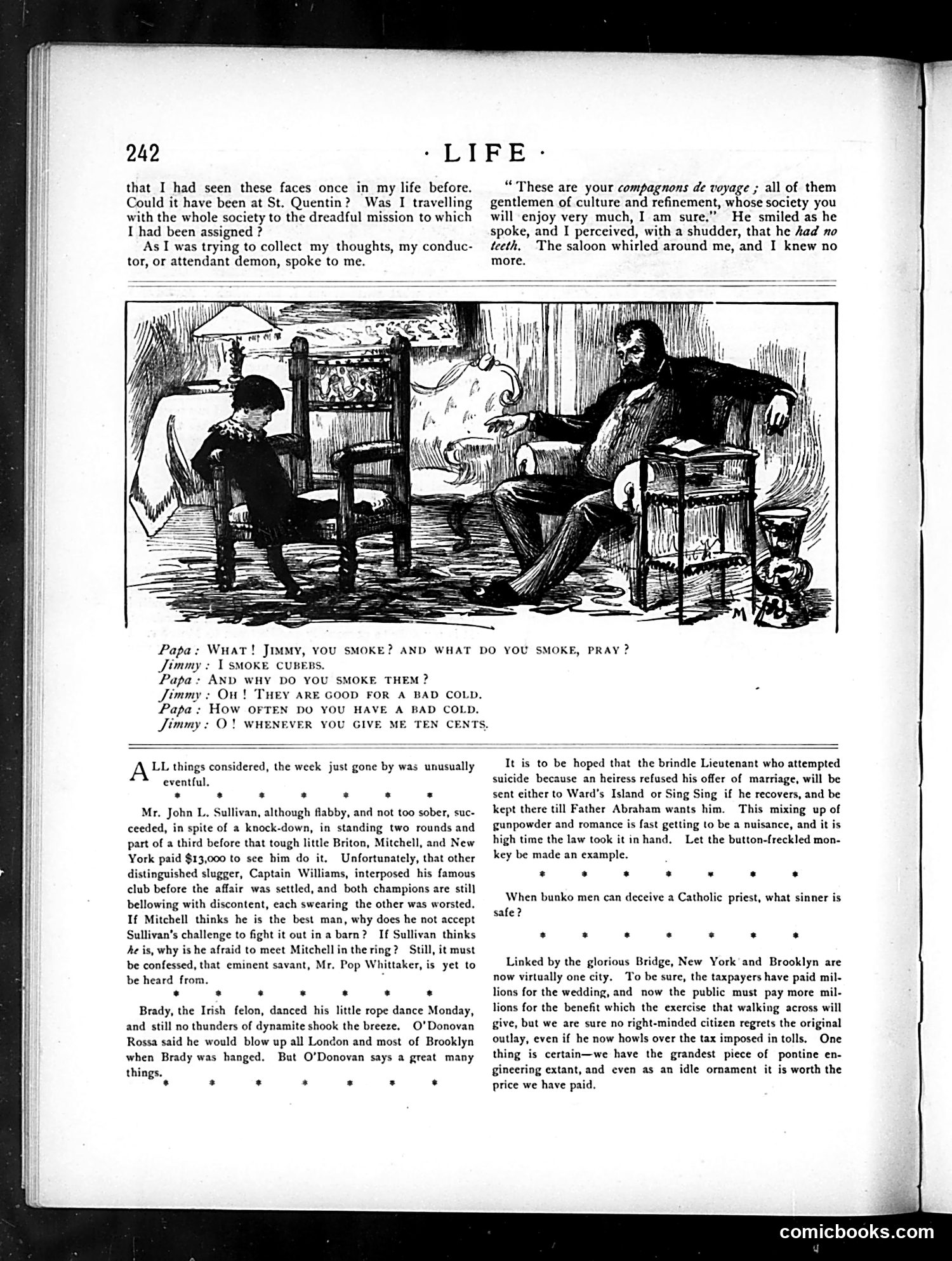
The central illustration depicts a dialogue between **Papa** (an older man) and **Jimmy** (a young boy), likely a father-son conversation about smoking. Papa asks what Jimmy smokes, and Jimmy replies "CUBES" (cigars), claiming they're "good for a bad cold" and that Papa gives him ten cents whenever he has one. This is **satirical commentary on child labor and parental negligence** in turn-of-the-century America. The joke targets: 1. **Parents enabling harmful habits** in children for profit 2. **Dubious health claims** about tobacco as medicine 3. **Child exploitation** under the guise of parental care The surrounding text discusses boxing matches and Irish immigrants, suggesting this page combines multiple satirical vignettes typical of Life magazine's social criticism format.
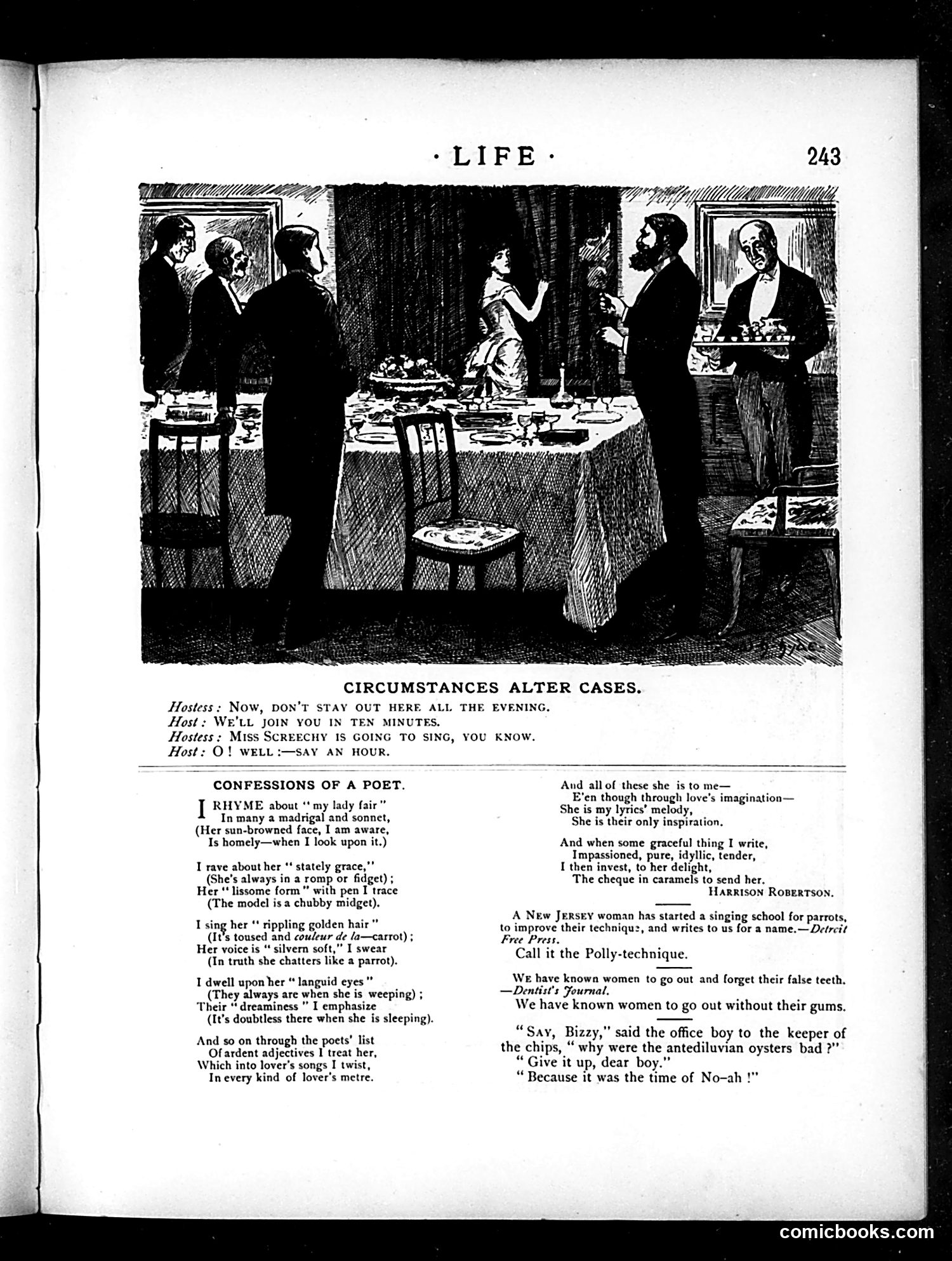
**The Cartoon "Circumstances Alter Cases":** This depicts a formal dinner party where the hostess asks guests to wait in the parlor while a guest (Miss Screechy) will sing. The host reluctantly agrees to delay departure, saying he'll join them in ten minutes. The satire targets the social obligation to endure amateur musical performances at polite gatherings—a common Victorian/Edwardian annoyance. The humor lies in the host's transparent reluctance and the implicit understanding that such "musical talent" is typically tedious rather than enjoyable. **"Confessions of a Poet" Section:** Harrison Robertson's poem humorously catalogs a poet's idealized muse, praising her appearance and treating her as pure inspiration. The subsequent jokes mock women's fashion (false teeth, forgotten guns), deflating the romantic poetry above through crude realism.
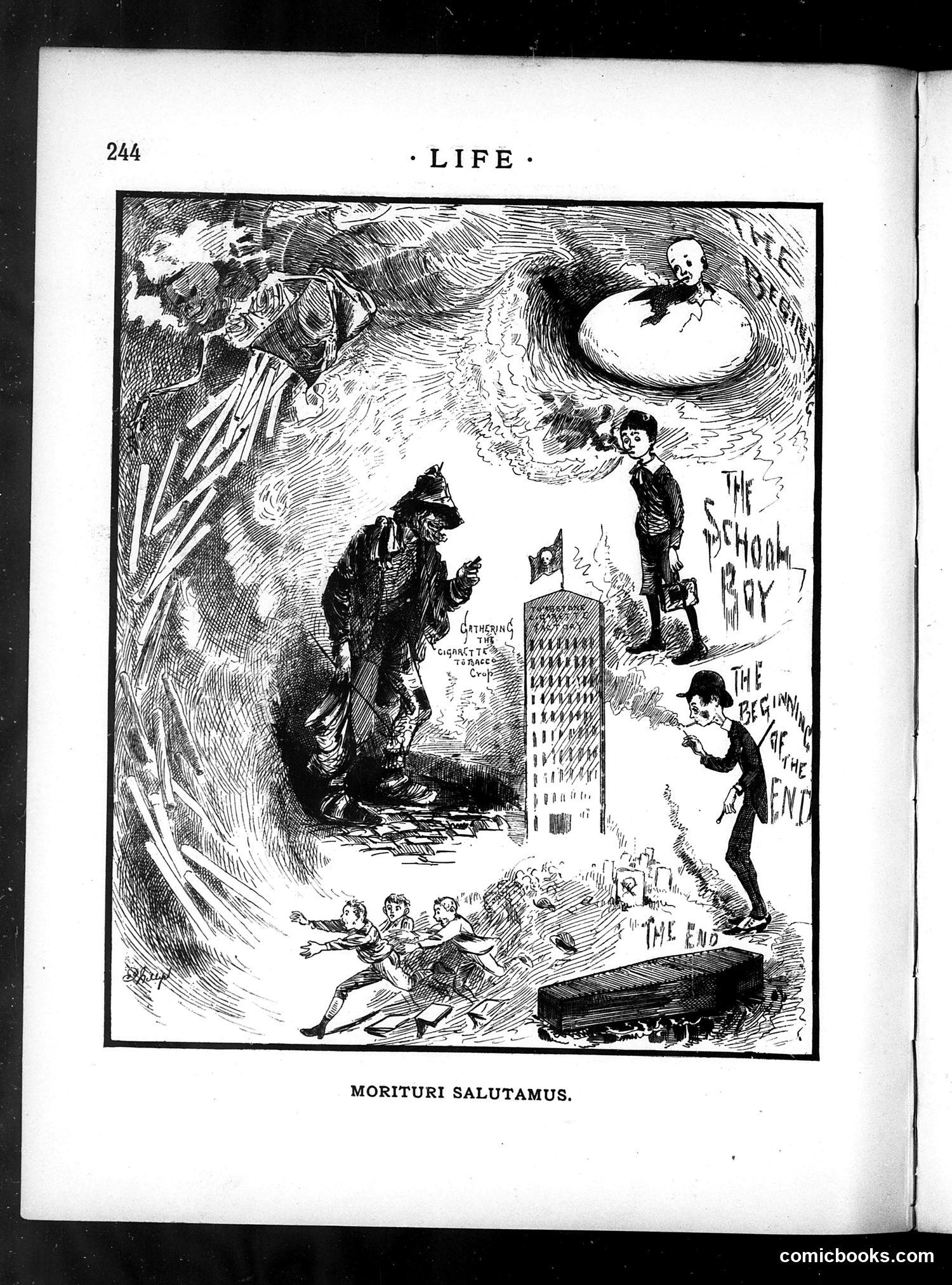
This satirical illustration depicts death ("Morituri Salutamus" - "Those About to Die Salute You") confronting various figures representing wayward youth and social problems. The central skeleton figure addresses schoolboys and young men engaged in vices labeled "gathering cigarette cases" and other misbehaviors. The composition shows "The School Boy," "The Beginning of the End," and "The End," suggesting a cautionary narrative about moral decline. The cartoon appears to critique the corrupting influences on youth—likely smoking, gambling, or other urban vices—portraying them as paths toward literal death. The allegorical skeleton serves as memento mori, warning young people that such behaviors lead to inevitable doom. This reflects turn-of-the-century American anxieties about adolescent morality and social decay.
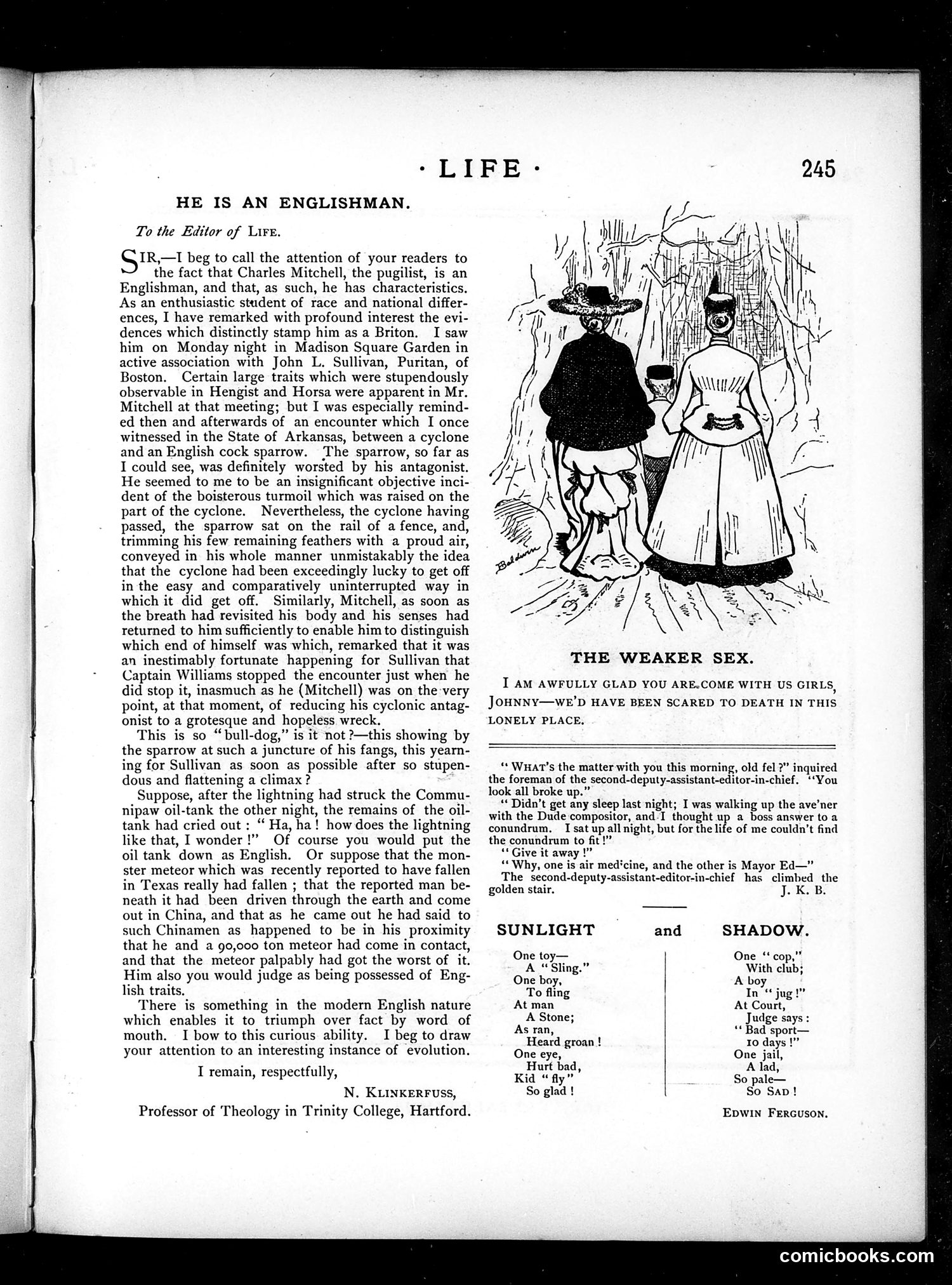
The page contains two distinct pieces: **"HE IS AN ENGLISHMAN"** - A letter to the editor from Professor N. Klinkerfuss of Trinity College, Hartford, defending Charles Mitchell as characteristically English. The writer describes Mitchell's encounter with a cyclone and sparrow, praising his composure as demonstrating "something in the modern English nature which enables it to triumph over fact by word of mouth." **"THE WEAKER SEX"** - A cartoon showing two men frightening women in a lonely place. The accompanying dialogue humorously depicts women's fear and men's dismissive attitude toward it. **"SUNLIGHT AND SHADOW"** - Two contrasting short poems by Edwin Ferguson using call-and-response structure, appearing to comment on optimism versus pessimism or masculine versus feminine perspectives. The page primarily consists of humorous commentary on national character and gender dynamics.
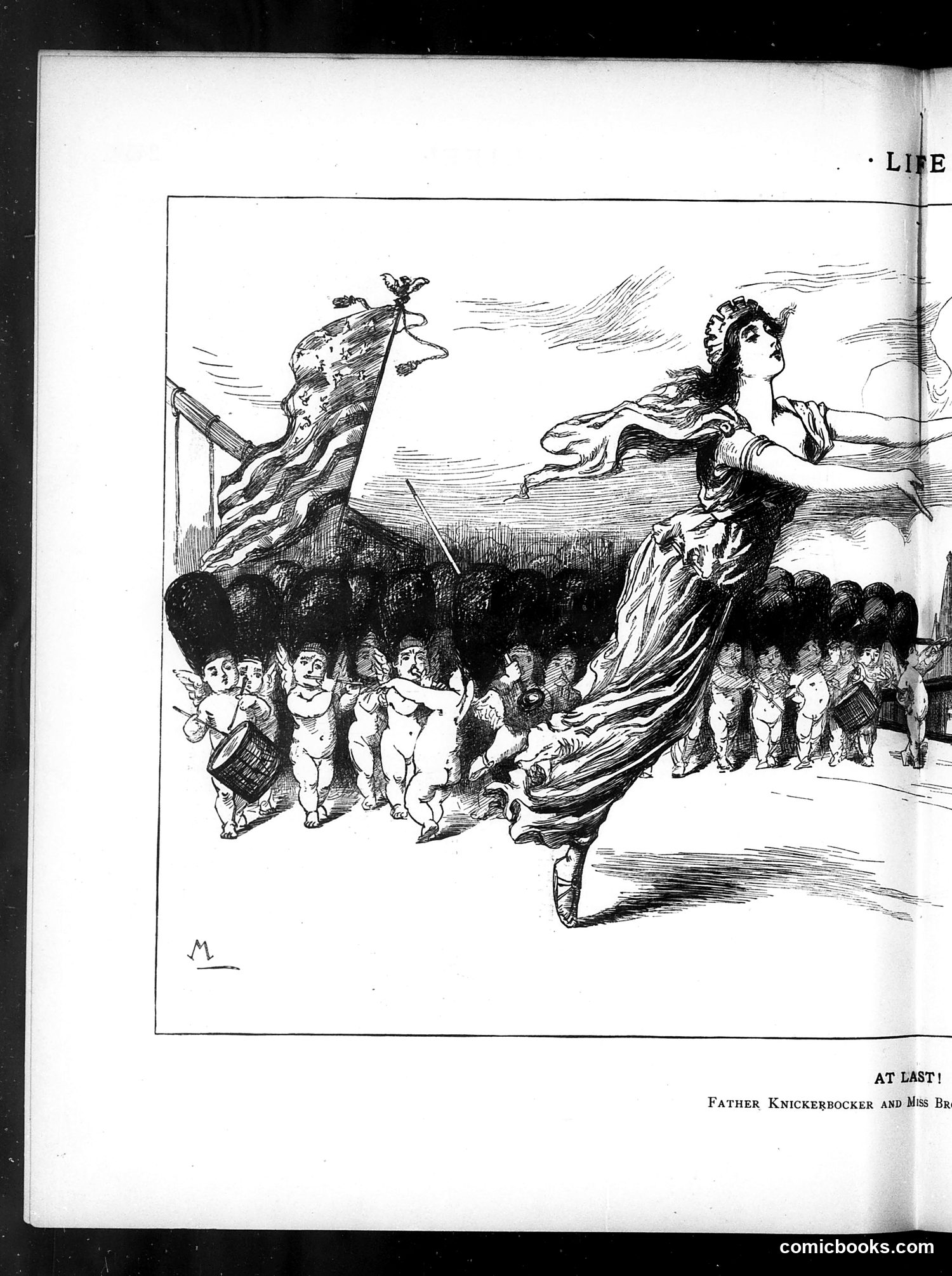
This illustration from *Life* magazine depicts an allegorical scene with Liberty (the classical female figure in flowing robes) leading a procession of cherubs and common people. A decorative ship's figurehead floats above, suggesting maritime/national themes. The caption references "Father Knickerbocker and Miss Br[itannia]" (text cut off), indicating this concerns American-British relations. The cherubs likely represent citizens or innocent parties, while Liberty's prominent leading position suggests the cartoon celebrates American independence or democratic values. The specific historical moment is unclear without the complete caption and date, but the imagery suggests this comments on American sovereignty or celebrates the nation's founding ideals during a period of Anglo-American tension or comparison.
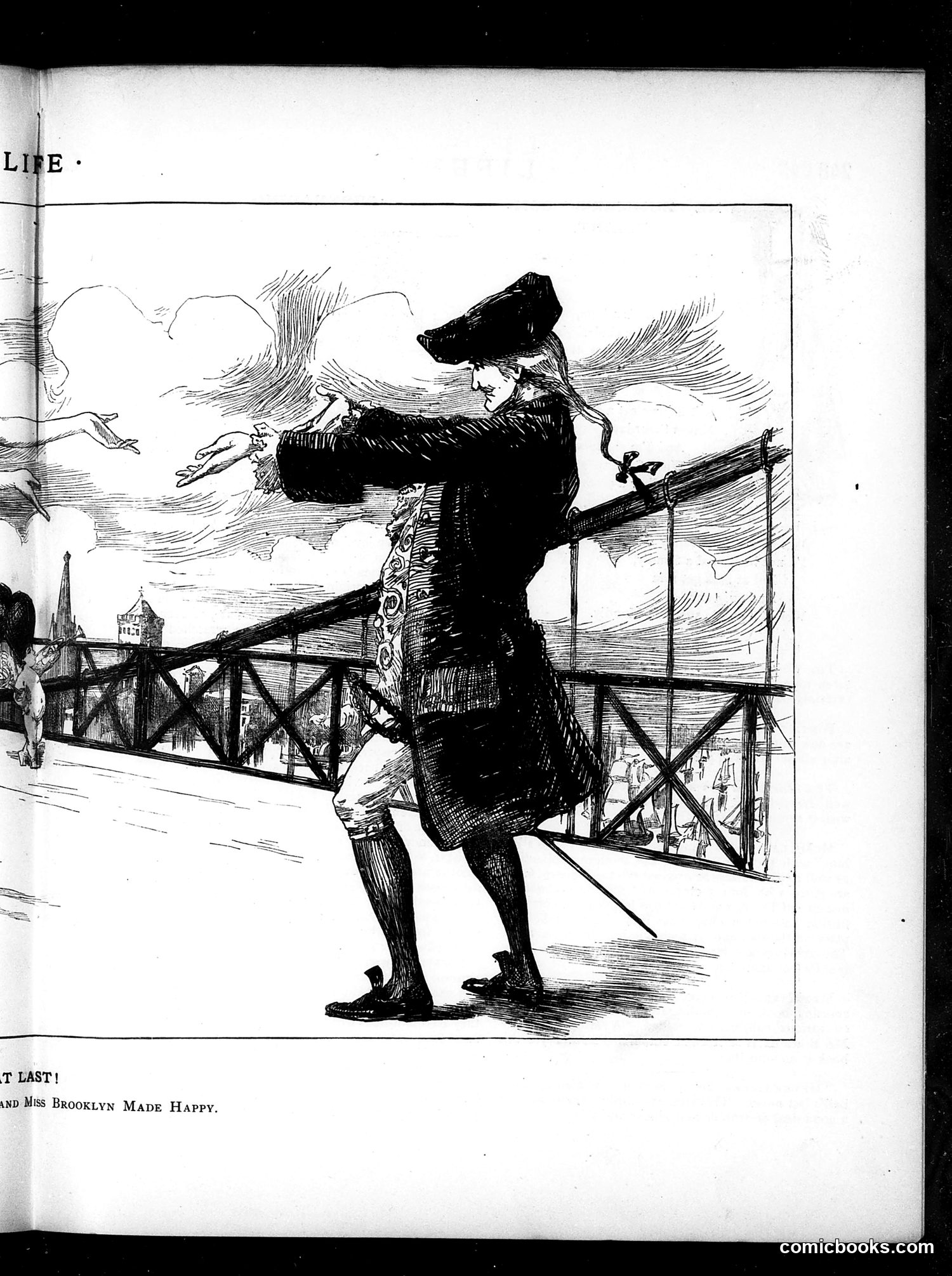
This appears to be a satirical illustration from Life magazine showing a fashionably dressed woman in an exaggerated pose on what looks like a bridge or promenade, with a parasol. The visible text references "Miss Brooklyn" being "made happy." The illustration likely satirizes the "Gibson Girl" aesthetic and upper-class leisure culture of early 20th-century America. The woman's dramatic posture, elaborate clothing, and the scenic bridge setting suggest she represents idealized femininity and urban sophistication. The reference to "Brooklyn" (then a separate city before 1898) and the emphasis on her being "made happy" may critique consumerism, vanity, or the superficiality of fashionable society. Without the complete text, the specific satirical target remains unclear, but the style reflects Life's characteristic mockery of contemporary social pretensions.
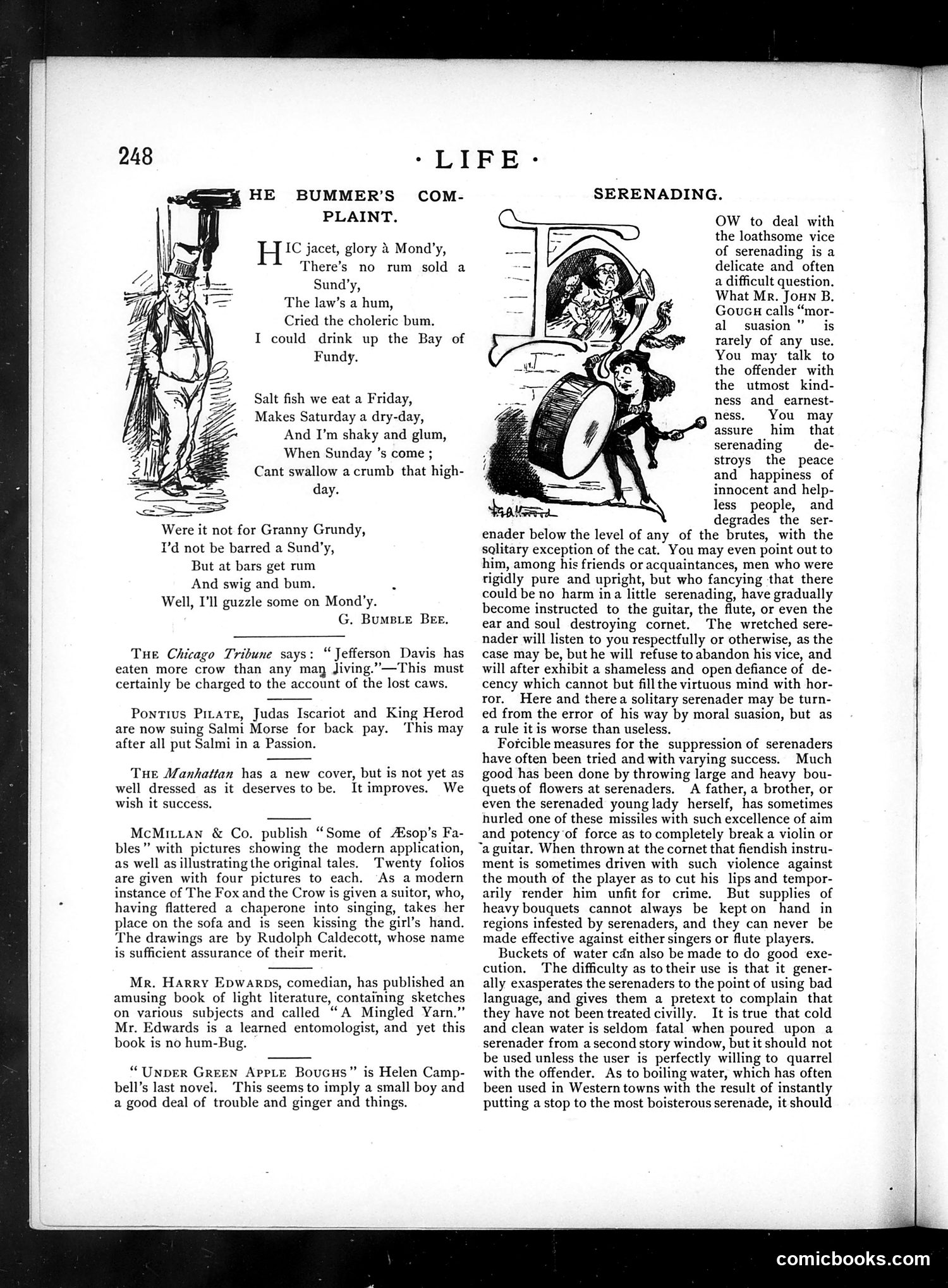
This page satirizes the 19th-century custom of serenading—young men performing music beneath windows of women they wished to court. The accompanying illustration shows a man with a drum being chased away, depicting the social nuisance aspect Life emphasizes. The text, attributed to "John B. Gough" (a real temperance reformer), mockingly treats serenading as a serious "vice" requiring intervention. Life's humor operates on multiple levels: it exaggerates the moral disapproval some citizens felt toward serenaders, treats the practice as a crime needing "forcible measures," and suggests absurdly violent remedies—throwing heavy bouquets to break instruments or injure performers. The article sardonically praises this violence as social good. The piece lampoons both uptight Victorian propriety (that serenading "degrades" people) and the excessive responses it provoked. It's fundamentally mocking prudish opposition to romantic courtship customs.
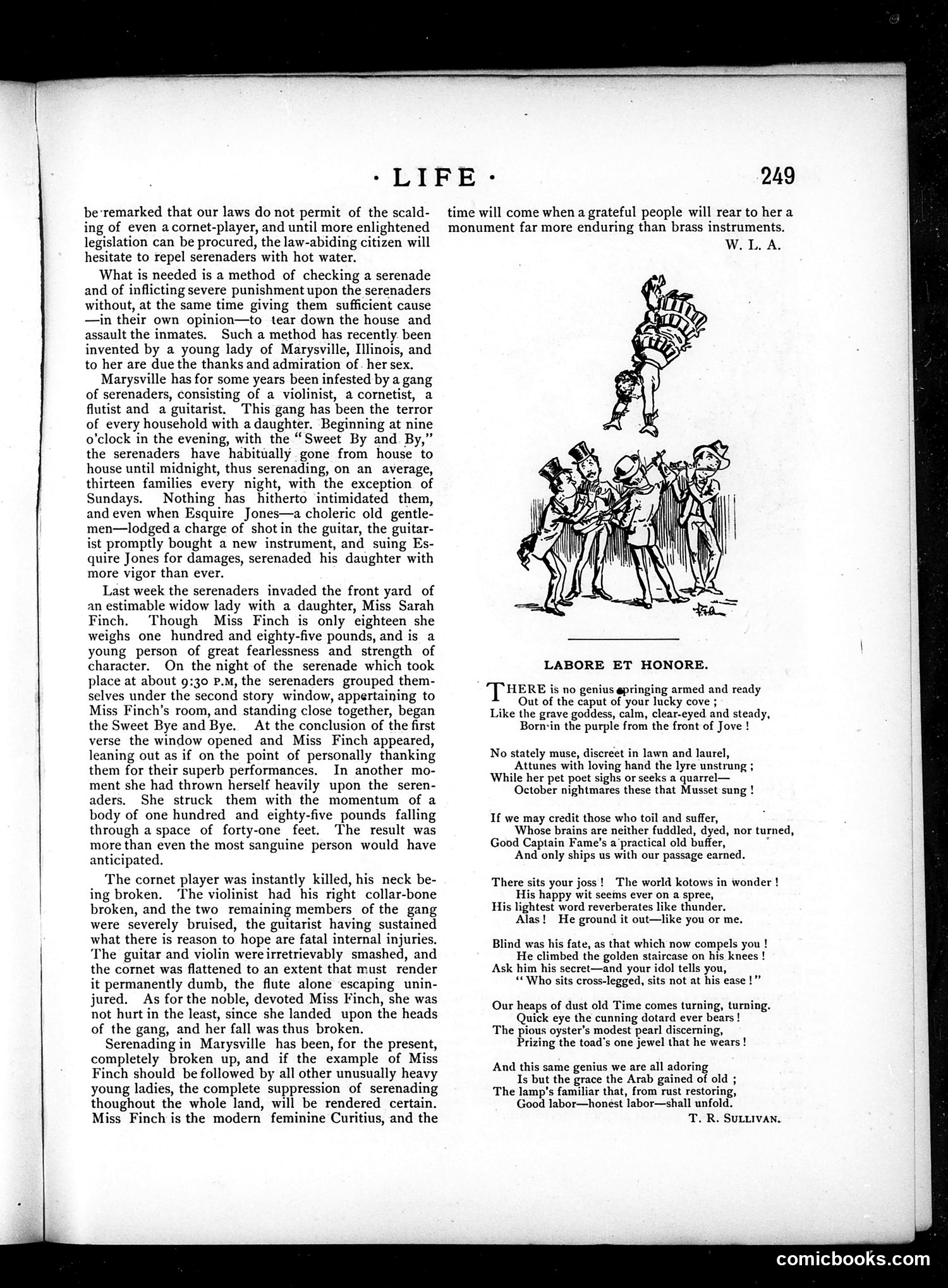
This page satirizes the social nuisance of unwanted serenading—a 19th-century courting practice where musicians would perform outside young women's homes at night. ## The Main Article The text humorously describes Miss Sarah Finch of Marysville, Illinois, who solved the serenade problem violently: she jumped from her window onto the musicians below, killing the cornet player, injuring others, and destroying their instruments. The piece adopts mock-heroic language, comparing her to Curtius (a Roman hero who sacrificed himself for Rome), treating her as a public benefactor. ## The Satire The joke targets both persistent serenaders and inadequate laws against them. The author notes existing laws don't permit scalding musicians with hot water, so Miss Finch's solution—however lethal—becomes darkly comedic as the only "effective" remedy. The accompanying illustration shows the violent scene. The bottom poem, "Labore et Honore" (Labor and Honor), appears unrelated—likely a separate literary contribution praising honest work. This reflects genuine frustration with nighttime serenading as a widespread social problem of the era.
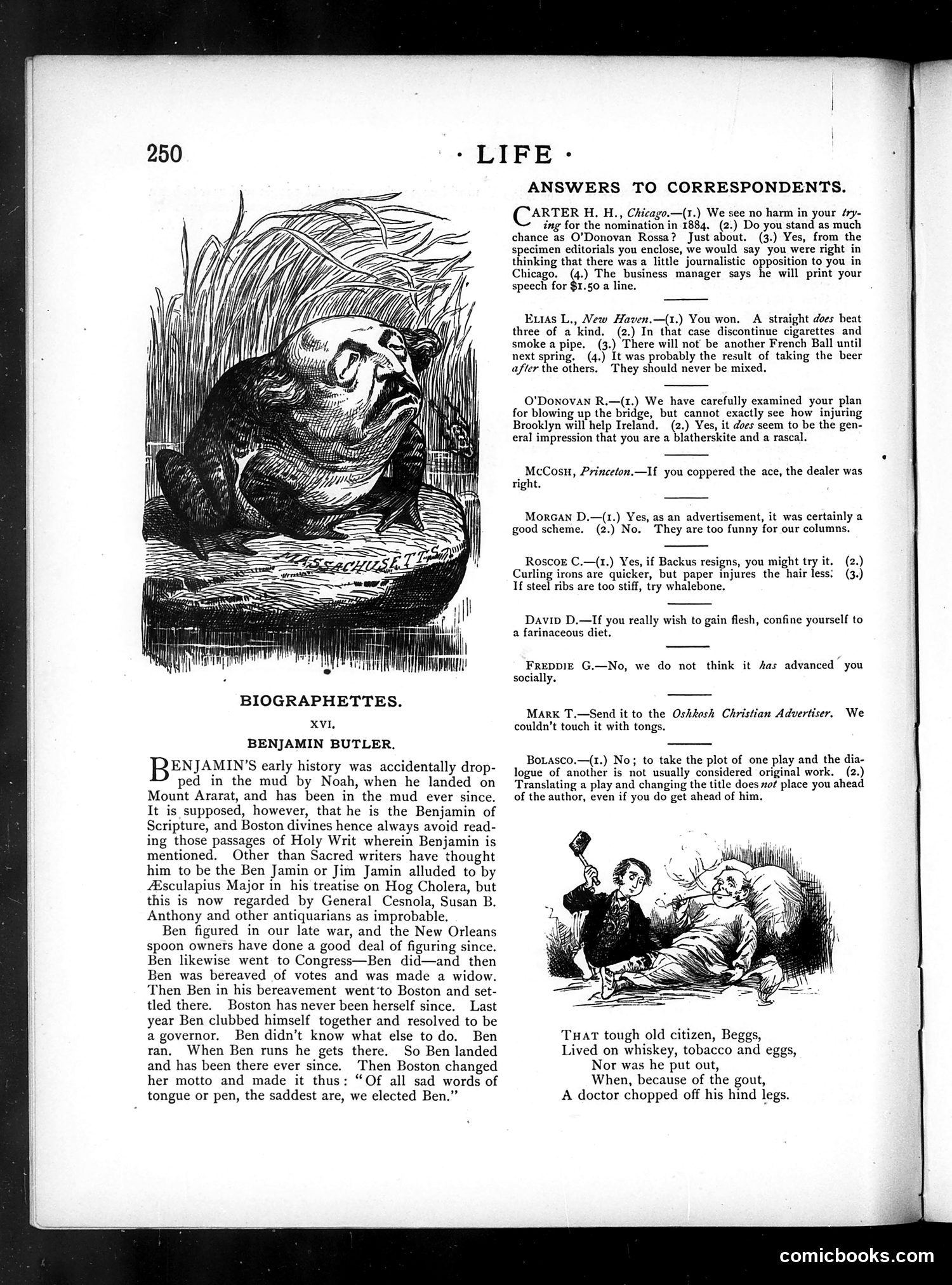
This is a vicious satirical biography of **Benjamin Butler**, a controversial Union general and politician. The cartoon attacks Butler's character through mockery: **The Satire's Points:** Butler is portrayed as inherently corrupt and muddy—his "early history was accidentally dropped in the mud by Noah." The piece ridicules his Civil War service (implying he stole silver spoons from New Orleans), his failed Congressional career, and his recent election as Massachusetts governor. **The Punchline:** Boston's city motto supposedly changed to "Of all sad words of tongue or pen, the saddest are, we elected Ben"—a dark parody of Whittier's famous line, suggesting electing Butler was Boston's greatest tragedy. **Context:** Butler was genuinely controversial—a Republican general seen as corrupt by his opponents. This reflects 1880s political animosity toward him as he pursued higher office. The accompanying "Answers to Correspondents" section mocks readers with absurdist responses, typical of Life's satirical format.
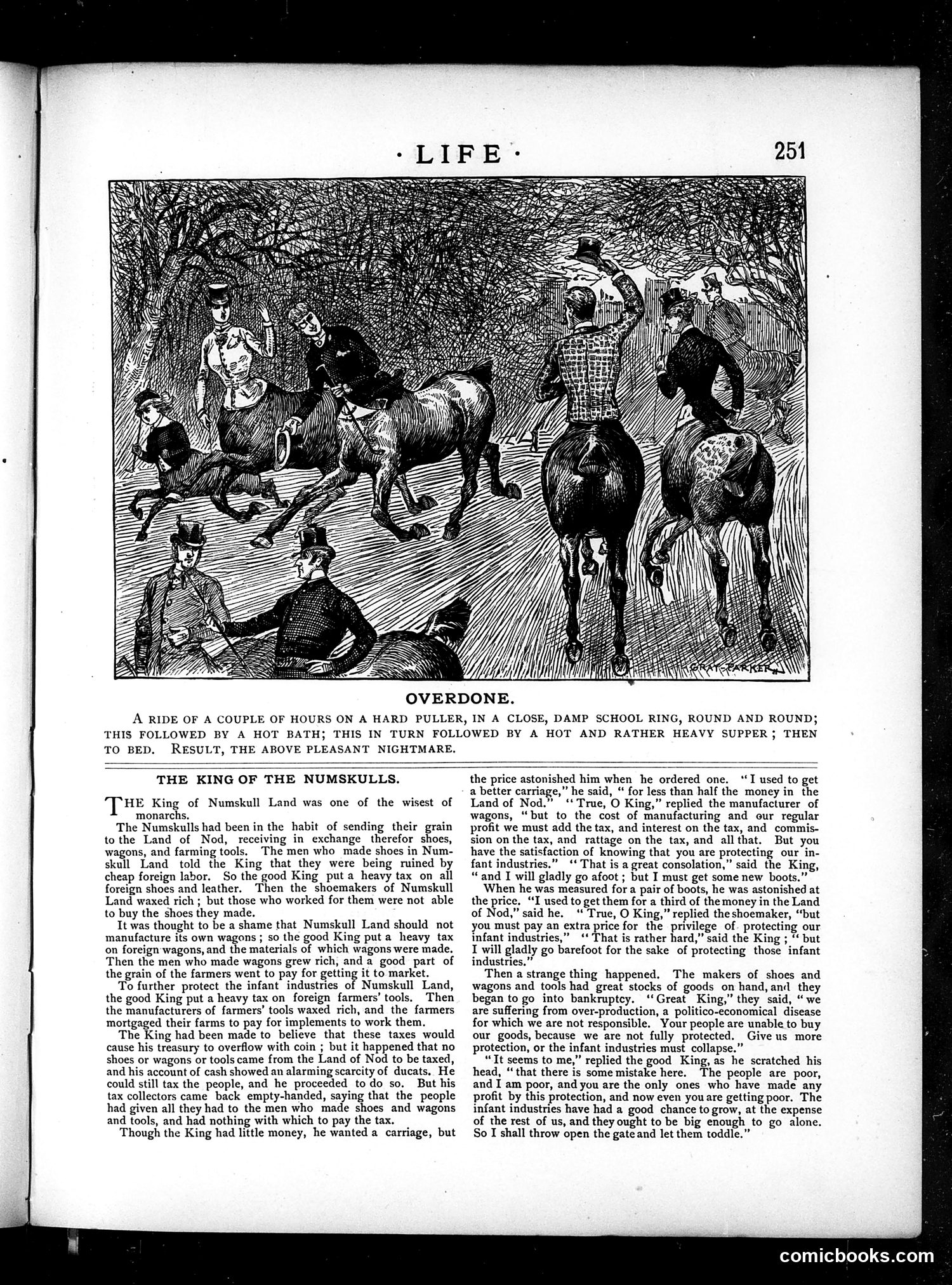
This is satirical political commentary on **protective tariffs**—likely referencing late-19th-century American trade policy debates. The story mocks a foolish monarch who imposes heavy taxes on foreign shoes, wagons, and farming tools to protect "infant industries." Initially, domestic manufacturers grow wealthy. However, the scheme backfires: farmers and common people, forced to buy expensive protected goods, go broke and cannot pay additional taxes. The treasury empties. Ironically, the king himself discovers these protected goods now cost triple what they once did—he can no longer afford them. The moral is clear: **protectionist tariffs ultimately harm everyone**, including the very industries they aim to protect, which collapse from overproduction when impoverished customers cannot buy their goods. The top illustration shows exhausted people on horseback after an unpleasant "overdone" ride—a visual metaphor for the painful consequences of economic excess.
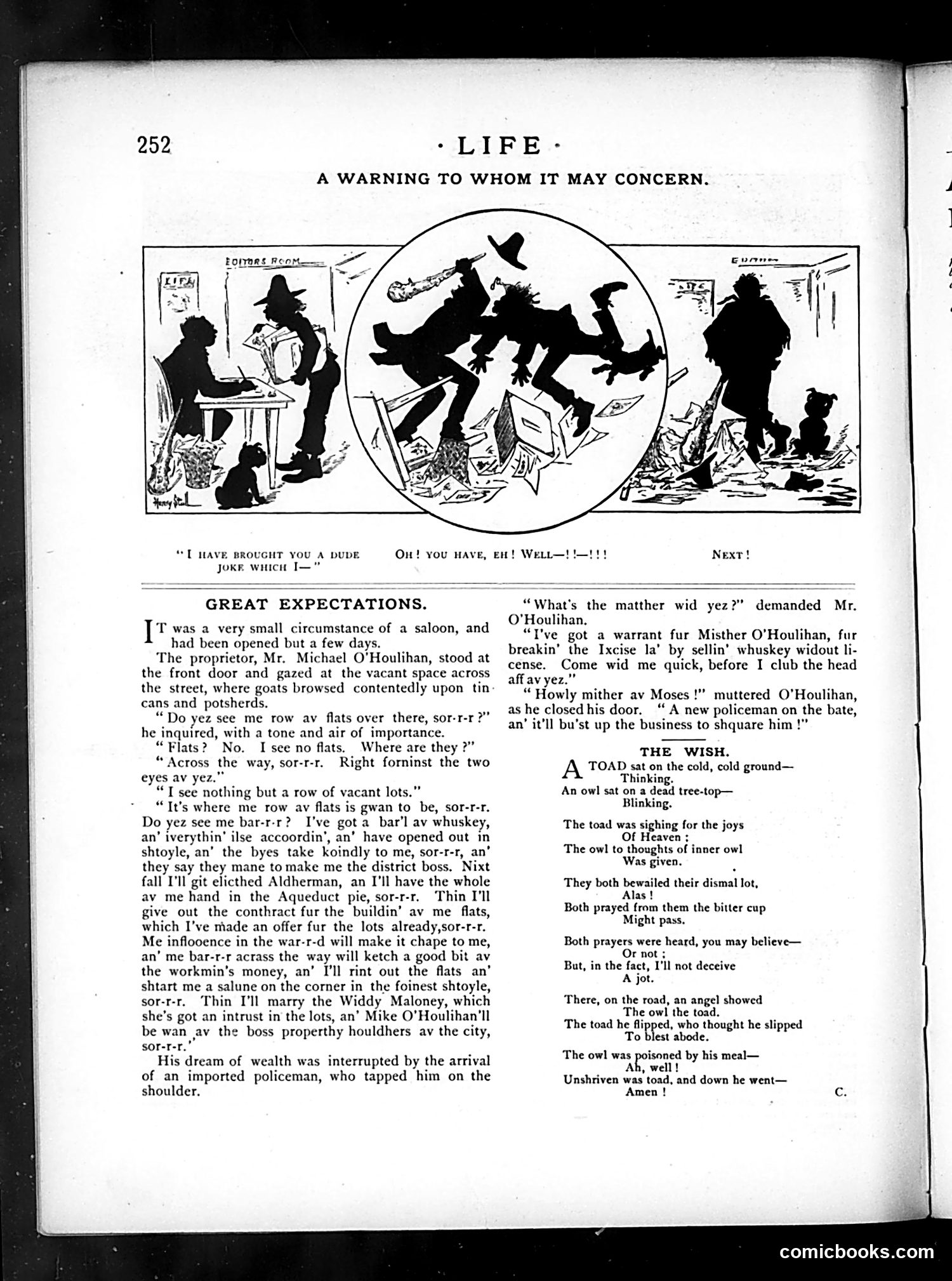
The top cartoon satirizes Irish-American political corruption and get-rich-quick schemes. Mr. O'Houlihan, characterized by heavy Irish brogue and dialect, dreams of building his fortune: opening a saloon, leveraging political connections to become a district boss, winning contracts for apartment buildings, and marrying a wealthy widow—all from vacant lots and a barrel of whiskey. His elaborate fantasy is punctured when an "imported policeman" arrives with a warrant for selling unlicensed whiskey, collapsing his ambitions instantly. The satire targets political machine corruption, influence-peddling, and the assumption that Irish immigrant saloon-keepers could manipulate municipal contracts and electoral power. The joke: grand schemes based on illicit operations and assumed political protection evaporate when law enforcement actually shows up. The poem "The Wish" is unrelated—a moral tale about a toad and owl whose prayers are answered darkly.
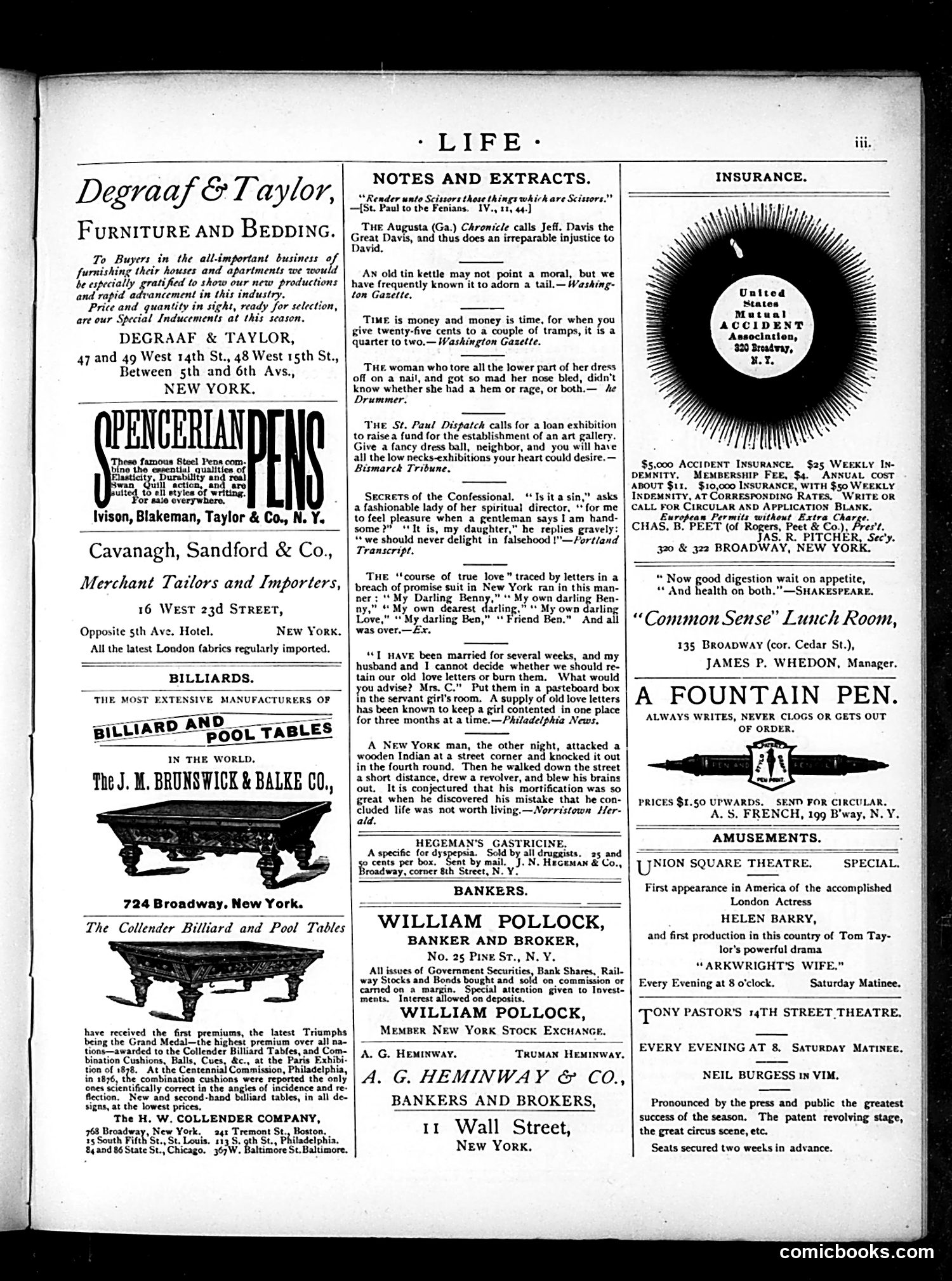
This page is primarily **advertising with satirical "Notes and Extracts"** rather than political cartoons. The advertisements feature furniture, pens, billiard tables, and financial services from 1870s New York businesses. The satirical section offers humorous social commentary typical of *Life* magazine's style. The jokes mock everyday absurdities: a woman's vanity about compliments (the priest's quip about "falsehood"), the declining romance in courtship letters that devolve from "My Darling" to mere "Friend Ben," and practical advice treating old love letters as servant-retention tools. One jab references "Jeff Davis" (likely Confederate President Jefferson Davis), suggesting lingering post-Civil War political tensions. The puns about tin kettles, time/money wordplay, and a drunk man fighting a wooden Indian showcase the magazine's preference for wordplay and physical comedy over pointed political critique. Overall, this reflects *Life*'s mid-Victorian humor: genteel, domestic-focused, and reliant on puns rather than sharp social satire.
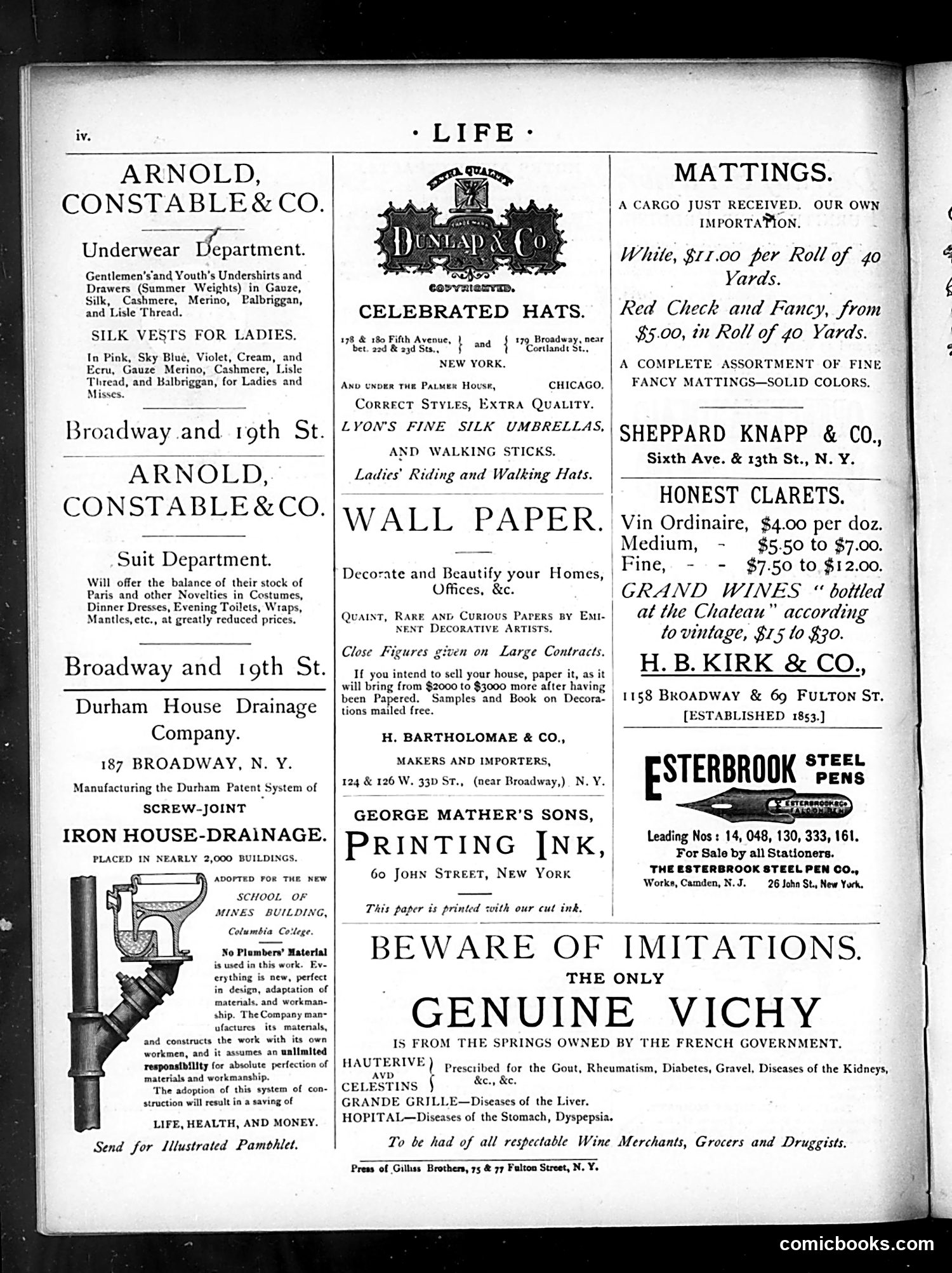
This is **not a cartoon or satirical content page**—it's entirely advertisements from a Life magazine issue. The page contains no political satire or social commentary. Instead, it features late-19th-century classified ads for New York businesses: Arnold, Constable & Co. (clothing), Dunlap Hats, Lyon's umbrellas, Sheppard Knapp mattings, H.B. Kirk wines, Esterbrook steel pens, and others. One notable ad warns "BEWARE OF IMITATIONS" regarding Vichy water, emphasizing it must be from French government-owned springs—reflecting period concerns about counterfeit products. The Durham House Drainage Company ad includes a small technical illustration of plumbing equipment, not a cartoon. This page represents typical late-1800s commercial advertising rather than editorial content or humor.