
A complete issue · 16 pages · 1883
Life — March 22, 1883
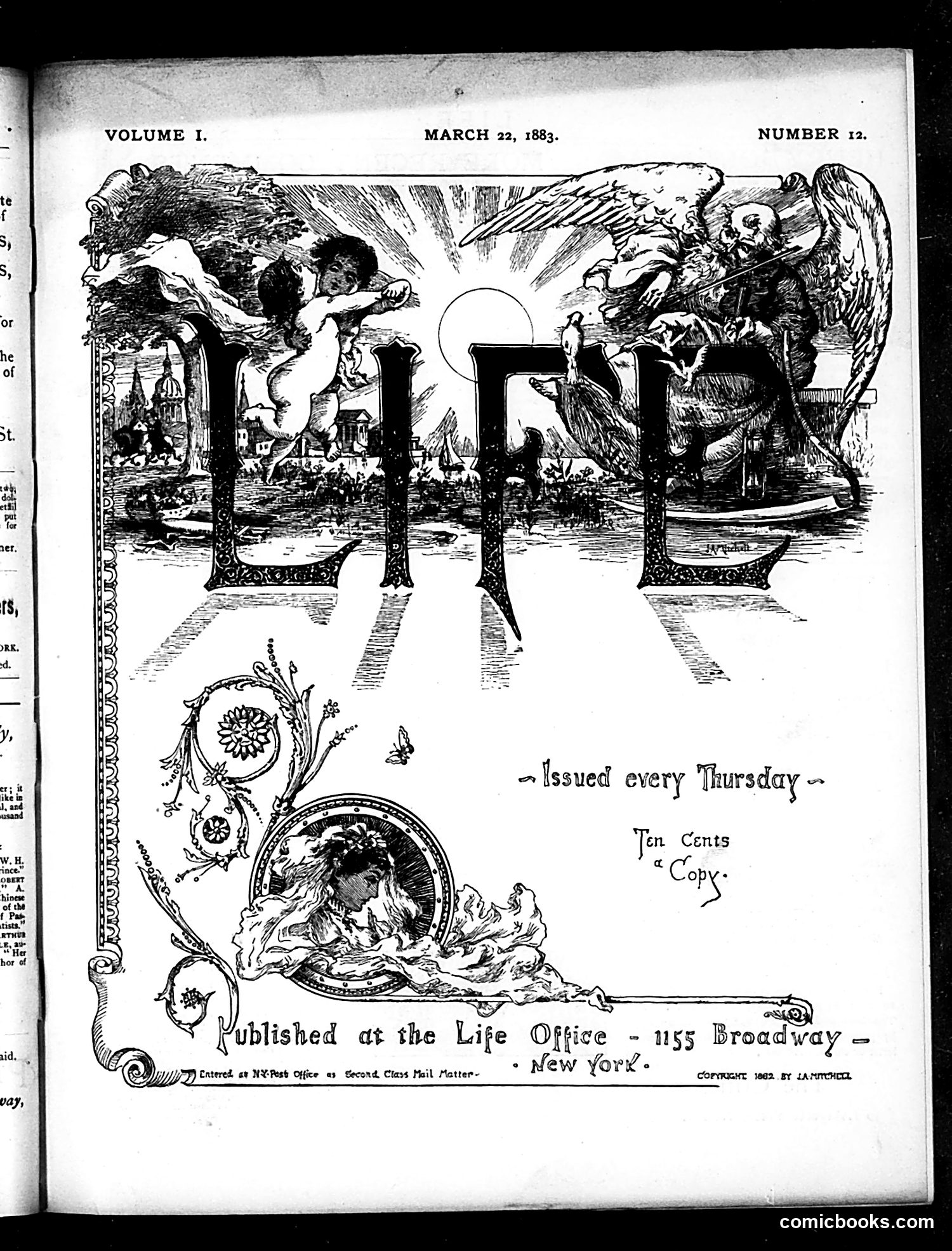
This is the cover/masthead for Life magazine's first volume, number 12. The large decorative letters "LIFE" dominate the center, surrounded by elaborate Victorian-era ornamental artwork featuring cherubs, angels, and classical imagery. The publication details indicate it was issued every Thursday for ten cents per copy, published at the Life Office on 1155 Broadway in New York. It was copyrighted by J. A. Mitchell in 1883. The ornate artistic style is typical of 1880s American satirical publications. However, this particular page contains no identifiable political cartoon or specific satirical content—it's primarily the publication's title page and masthead design, establishing the magazine's brand identity and distribution information for readers.
This page is primarily **advertising and editorial content**, not political cartoons. The left side features book advertisements (including "The Epic of Kings" and works on evolution/Christianity) and promotes *The Critic*, a weekly review journal of literature, fine arts, science, music, and drama. The right side contains **advertising for Life magazine itself**, with multiple endorsements praising it as "bright," "witty," and superior to other humorous weeklies. There's also an advertisement for Hartshorn's Self-Acting Shade Rollers and A.G. Heminway & Co. (bankers), plus hotel advertising. No political cartoons or satirical commentary appear visible on this page—it's a straightforward advertising and promotional section from the publication.
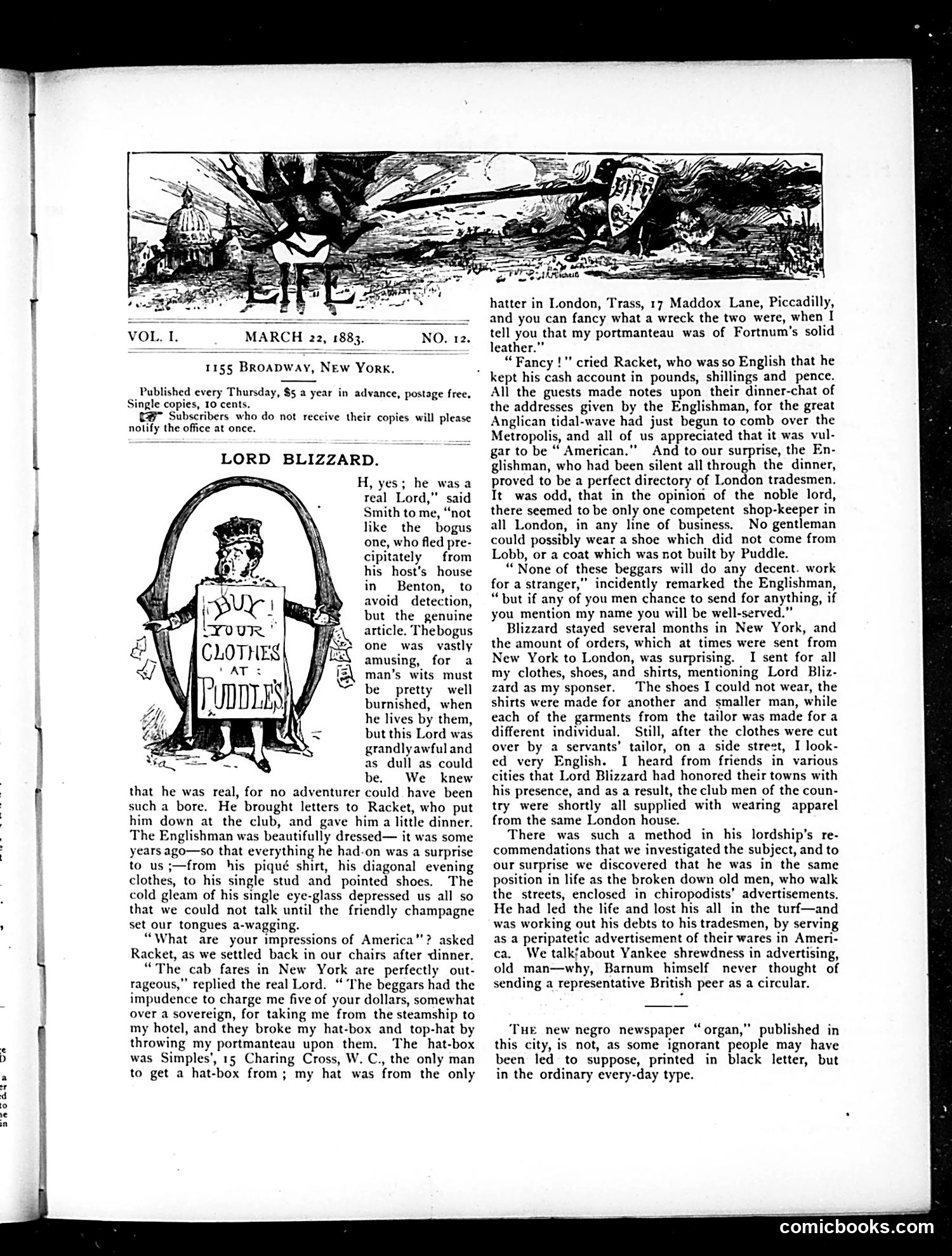
The main cartoon depicts "Lord Blizzard"—a personified figure representing the severe winter storm that struck New York. The figure wears tattered clothing labeled "your clothes" and appears skeletal or death-like, satirizing the blizzard's destructive impact on the city. The accompanying article is a humorous narrative about an Englishman claiming to be a "real Lord" who visited New York. The satire mocks both pretentious British nobility and gullible Americans who defer to titles. The story describes how this "Lord" ordered fine clothing from London tailors, exploiting American merchants' eagerness to serve English aristocracy. The piece ridicules class pretension and transatlantic social anxieties of the Gilded Age, while the blizzard cartoon comments on the winter's severe weather impacts on New York City.
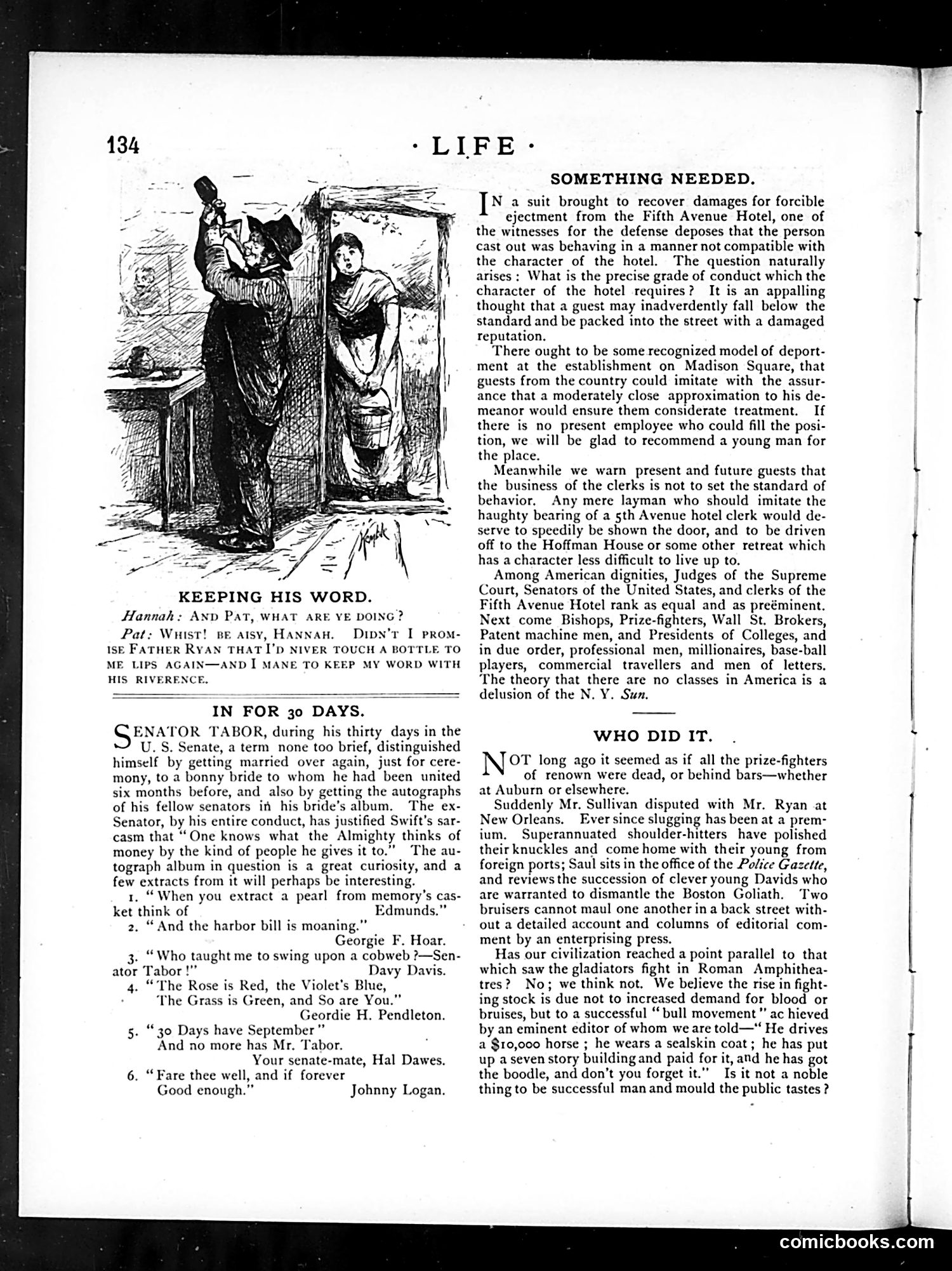
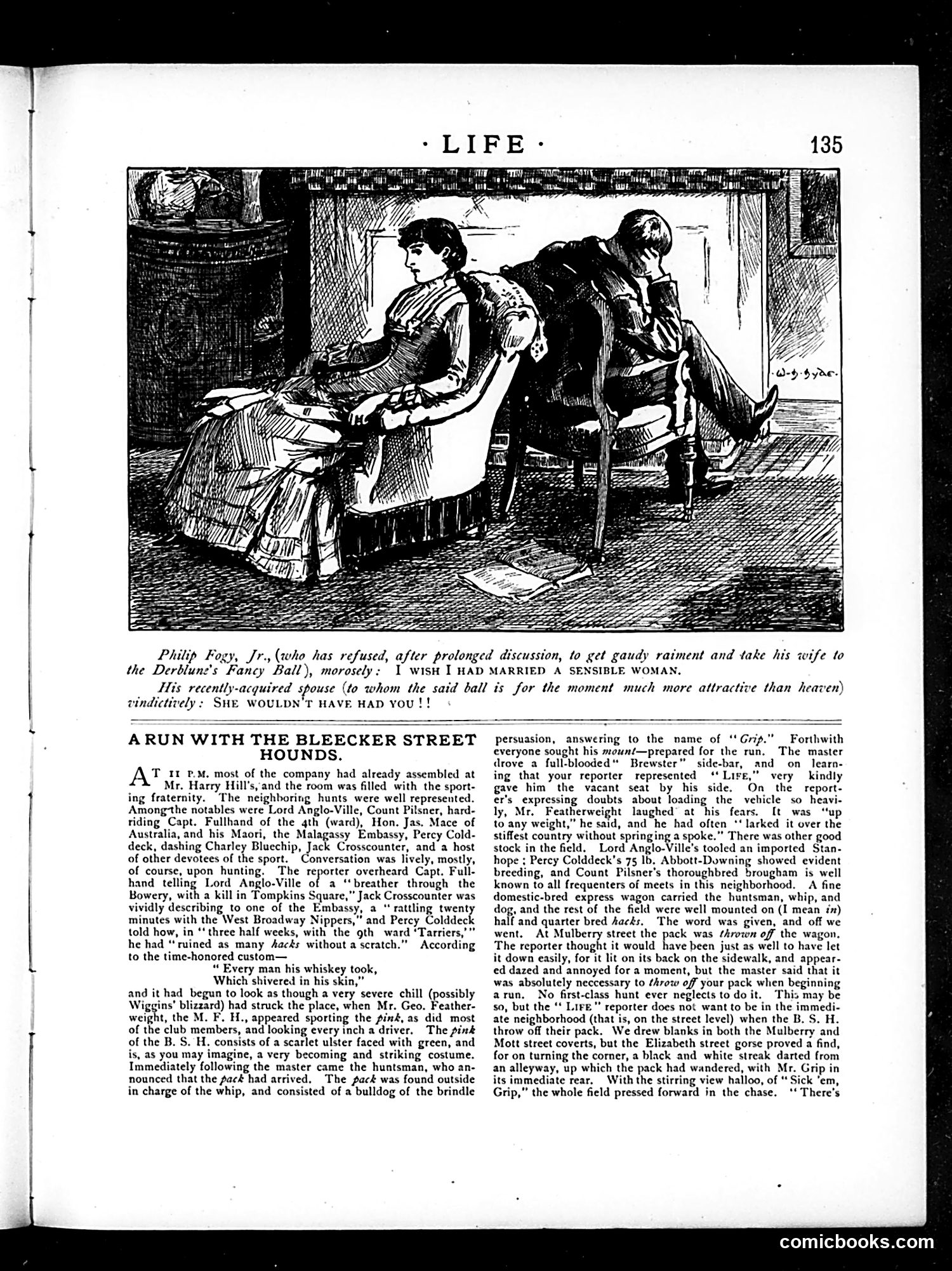
This page contains two distinct pieces: **Upper cartoon:** Shows a domestic argument where a man (Philip Fogy Jr.) refuses to attend a fancy ball, declaring "I wish I had married a sensible woman." His wife responds she wouldn't have married him either. This is straightforward marital satire—no specific political figures are identifiable—mocking Victorian-era gender tensions over social obligations and leisure activities. **Lower article:** "A Run with the Bleecker Street Hounds" describes a fox hunt conducted through New York City streets using dogs. The text details the chaos of the hunt passing through urban neighborhoods, with specific street names mentioned. This satirizes both the aristocratic sport of fox hunting and upper-class eccentricity, portraying wealthy New Yorkers engaging in absurdly inappropriate rural activities within the city itself.
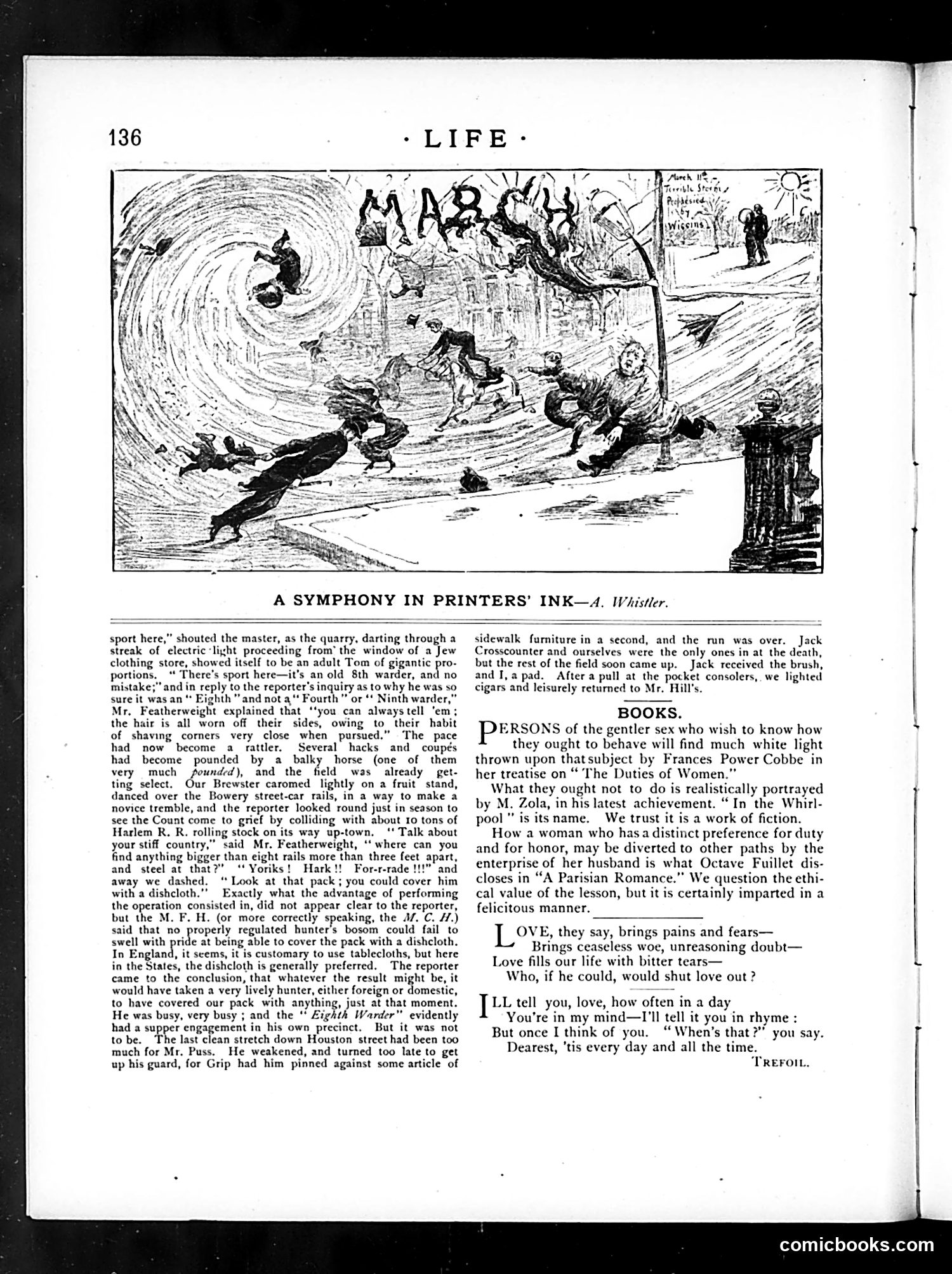
This satirical cartoon depicts a chaotic street scene where multiple figures appear to be engaged in a brawl or tumultuous activity. The swirling composition and dynamic poses suggest violent motion or disorder. The caption attributes the work to A. Whistler, likely James McNeill Whistler, the famous American artist known for his satirical and artistic commentary. The title's reference to "printers' ink" suggests this cartoon comments on journalism, publishing, or public discourse of the era. The accompanying text discusses a hunt or chase scene with references to speed, violence, and social commentary about English versus American customs. However, without clearer identification of specific figures or contemporary events referenced, the exact satirical target remains unclear from the image alone.
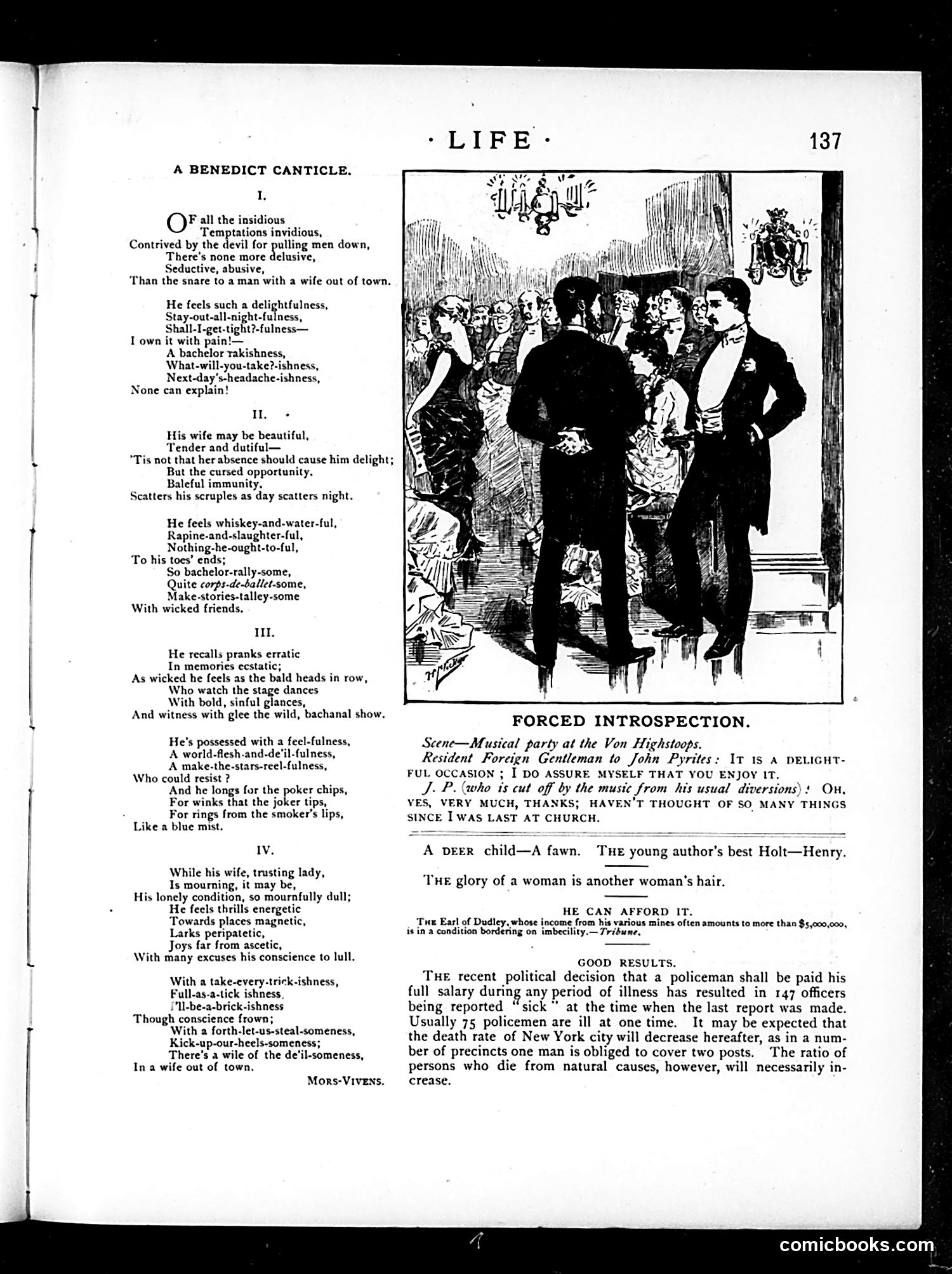
The cartoon depicts a musical party at the Von Highstoops residence where a foreign gentleman (identified as John Pyrites) is being introduced to the assembled guests. The satire centers on social pretension: Pyrites claims to be "cut off by the music from his usual diversions," suggesting he's a habitual carouser or rake separated from his typical entertainments. The joke targets both Pyrites's moral character and the host's gullibility in welcoming such a disreputable figure. The caption's sarcasm—praising this as "delightful"—underscores the absurdity of polite society accommodating a man of questionable virtue. The cartoon satirizes 19th-century social hypocrisy, where morally dubious individuals were nonetheless tolerated in respectable drawing rooms if they maintained appearances.
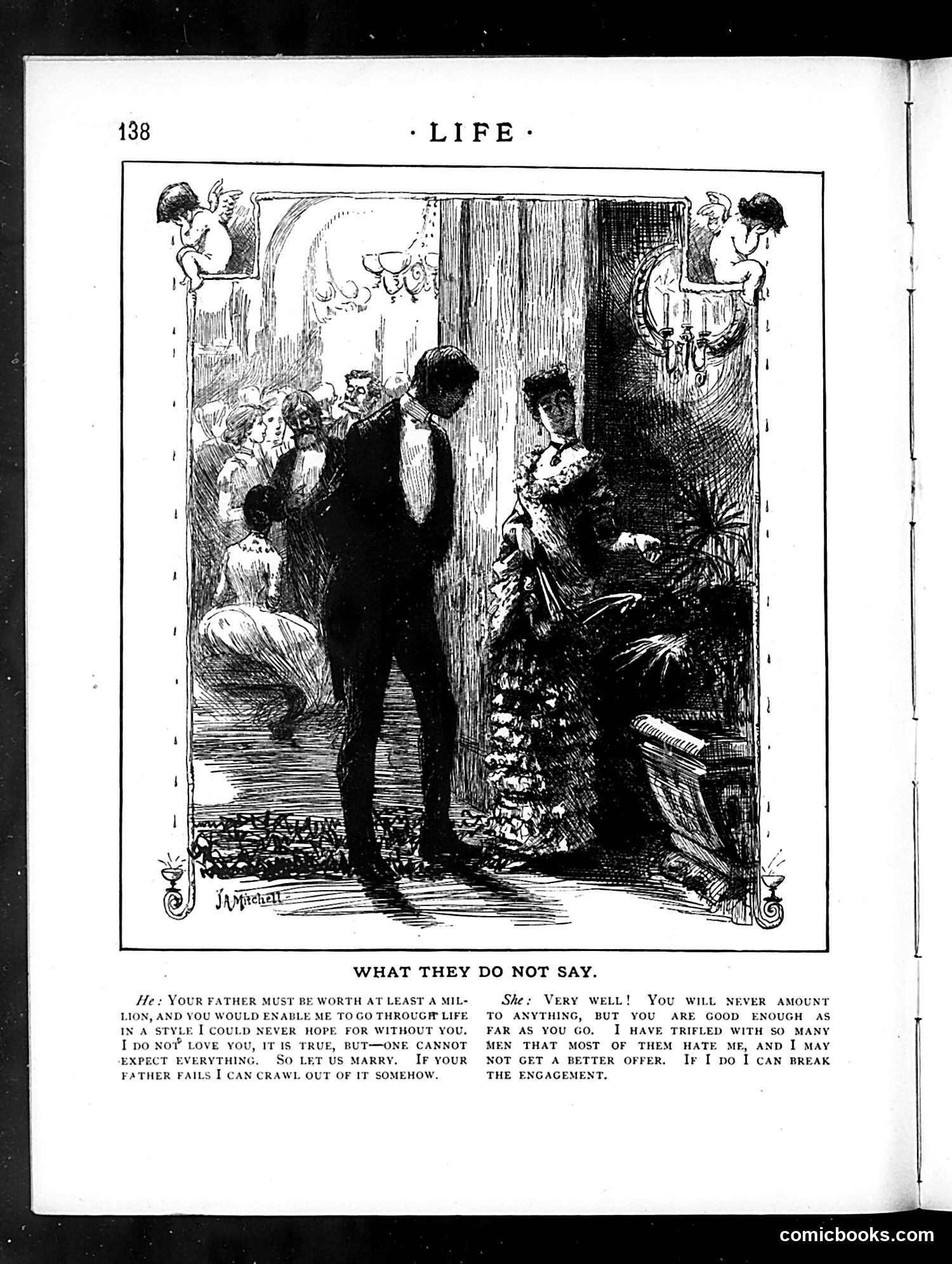
This illustration satirizes courtship and marriage negotiations among the wealthy. The title reveals the cartoon's point: what remains *unspoken* during romantic proposals. The man (in formal dress) and woman (elaborately gowned) appear to be in a betrothal scene. The accompanying dialogue makes the satire explicit: the man speaks of love while subtly emphasizing the woman's father's wealth as essential to their marriage. The woman's response acknowledges she attracts "many men that most of them hate," suggesting she knows her value lies in wealth rather than genuine affection. The cartoon mocks how upper-class engagements mask mercenary motives behind flowery romantic language. The cherubs decorating the frame add ironic contrast to this cynical view of love and marriage among society's elite.
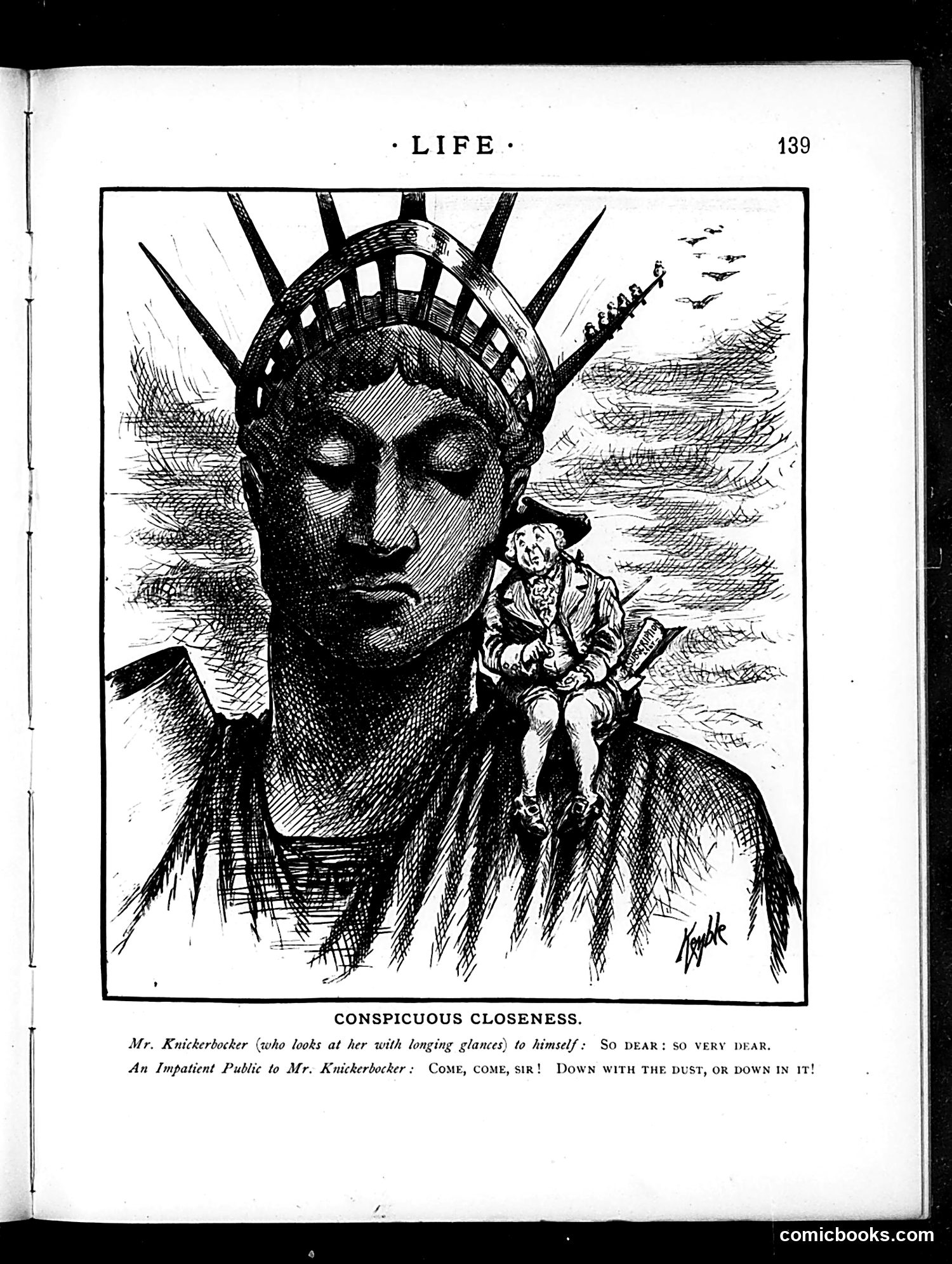
This political cartoon satirizes Mr. Knickerbocker's public displays of affection with a woman, depicted as the Statue of Liberty. The figure of Liberty dominates the composition, while the tiny Knickerbocker sits perched on her shoulder, gazing at her with "longing glances." The satire mocks his obvious romantic interest, with an impatient public demanding he cease this behavior ("Down with the dust, or down in it!"). The cartoon critiques what appears to be scandal or inappropriate public conduct by a prominent figure named Knickerbocker. The juxtaposition of his small human scale against Liberty's monumental size emphasizes the absurdity or audacity of his attachment to an idealized national symbol.
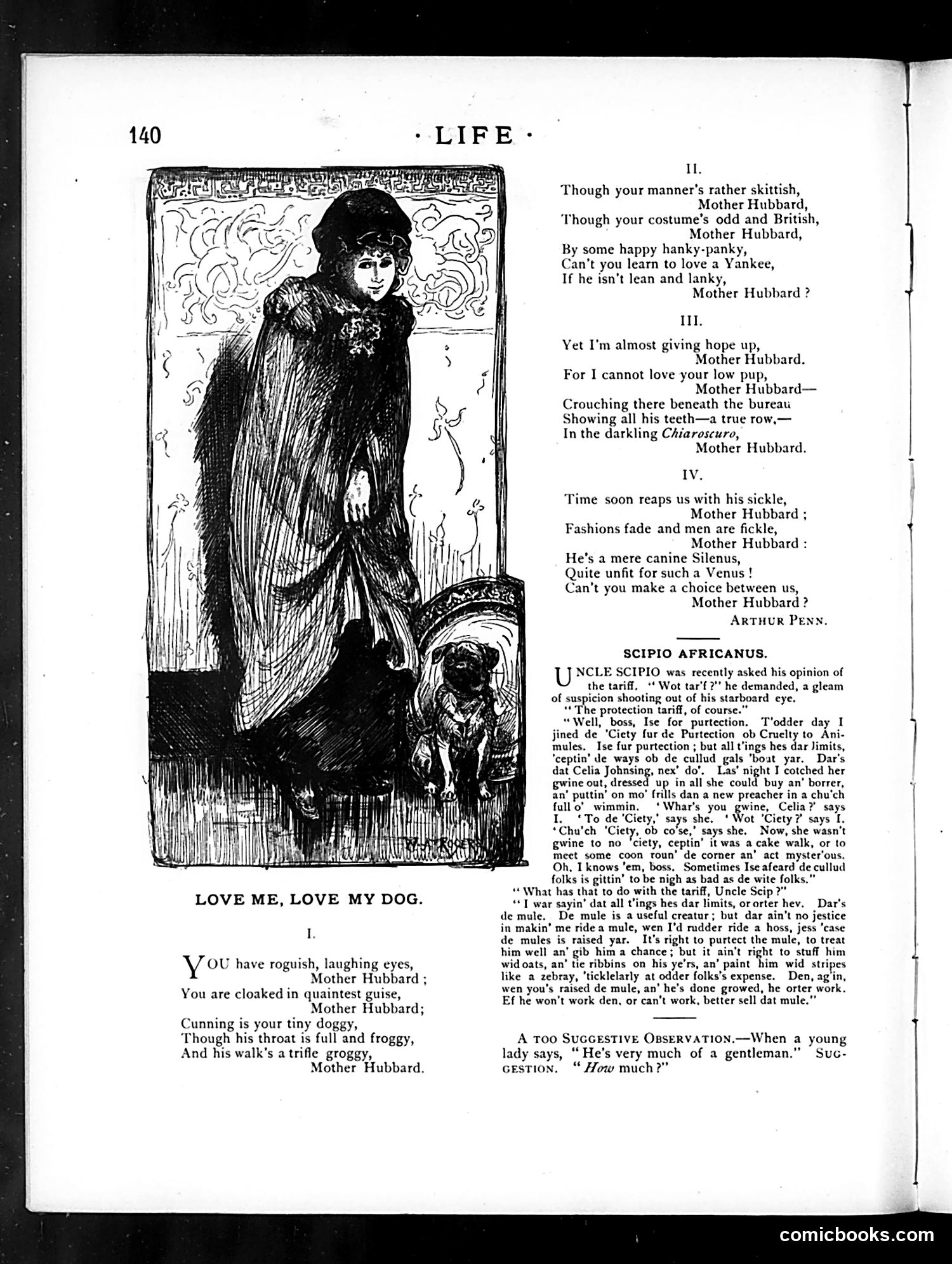
**"Love Me, Love My Dog"** is a romantic poem by Arthur Penn, illustrated with a woman and small dog. It uses "Mother Hubbard" (likely referencing the nursery rhyme character) as a playful addressee. The poem's conceit: an American suitor ("Yankee") attempts to woo a British woman by declaring love for her, though he despises her dog—ultimately asking her to choose between them. The satire mocks transatlantic courtship and romantic compromise. **"Scipio Africanus"** is a dialect-heavy comic piece featuring "Uncle Scipio," a Black character speaking in exaggerated vernacular. Asked about tariff protection, he digresses into observations about African American social life and mule-raising, eventually comparing economic protection policy to unnecessary animal care. The piece reflects period racial stereotypes and caricature common to Life magazine's satirical humor.
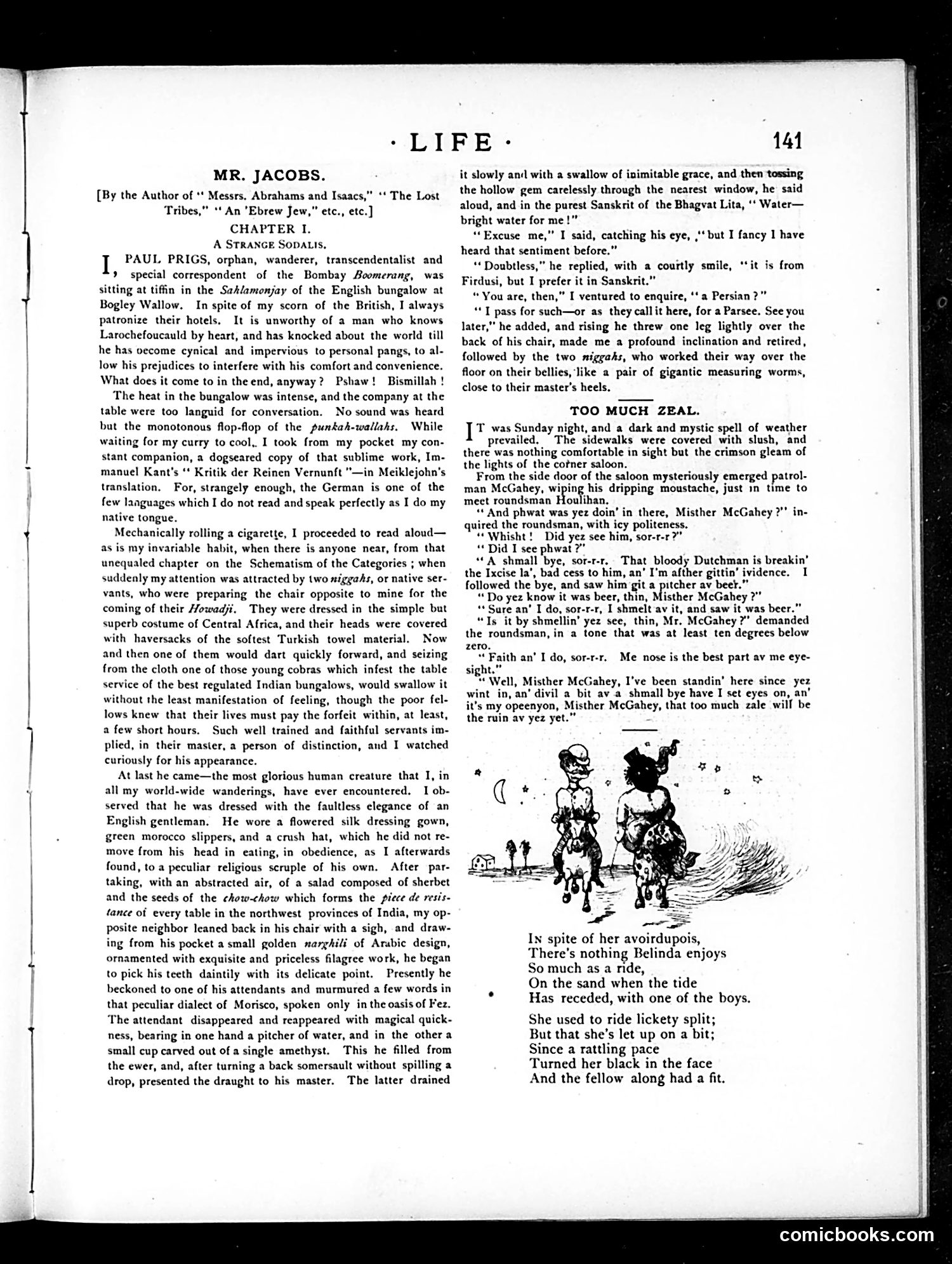
This page presents the opening chapter of a satirical serialized story mocking pretentious European travelers and orientalist affectation in colonial India. The protagonist, Paul Prigs, is a self-important "special correspondent" who affects intellectual superiority (reading Kant in German, speaking multiple languages) while patronizing British hotels despite professing disdain for the British. The satire intensifies when describing his mysterious dining companion—a figure of exaggerated, absurd elegance employing improbable servants and displaying ridiculous affectations (wearing a crush hat while eating, using a golden water pipe to pick his teeth). The accompanying illustration shows colonial-era figures on horseback, complementing the story's Indian setting. The humor targets pompous expatriates who adopt elaborate pretenses of worldliness and sophistication while remaining fundamentally ridiculous—standard satire of the period mocking colonial excess and orientalist fantasy.
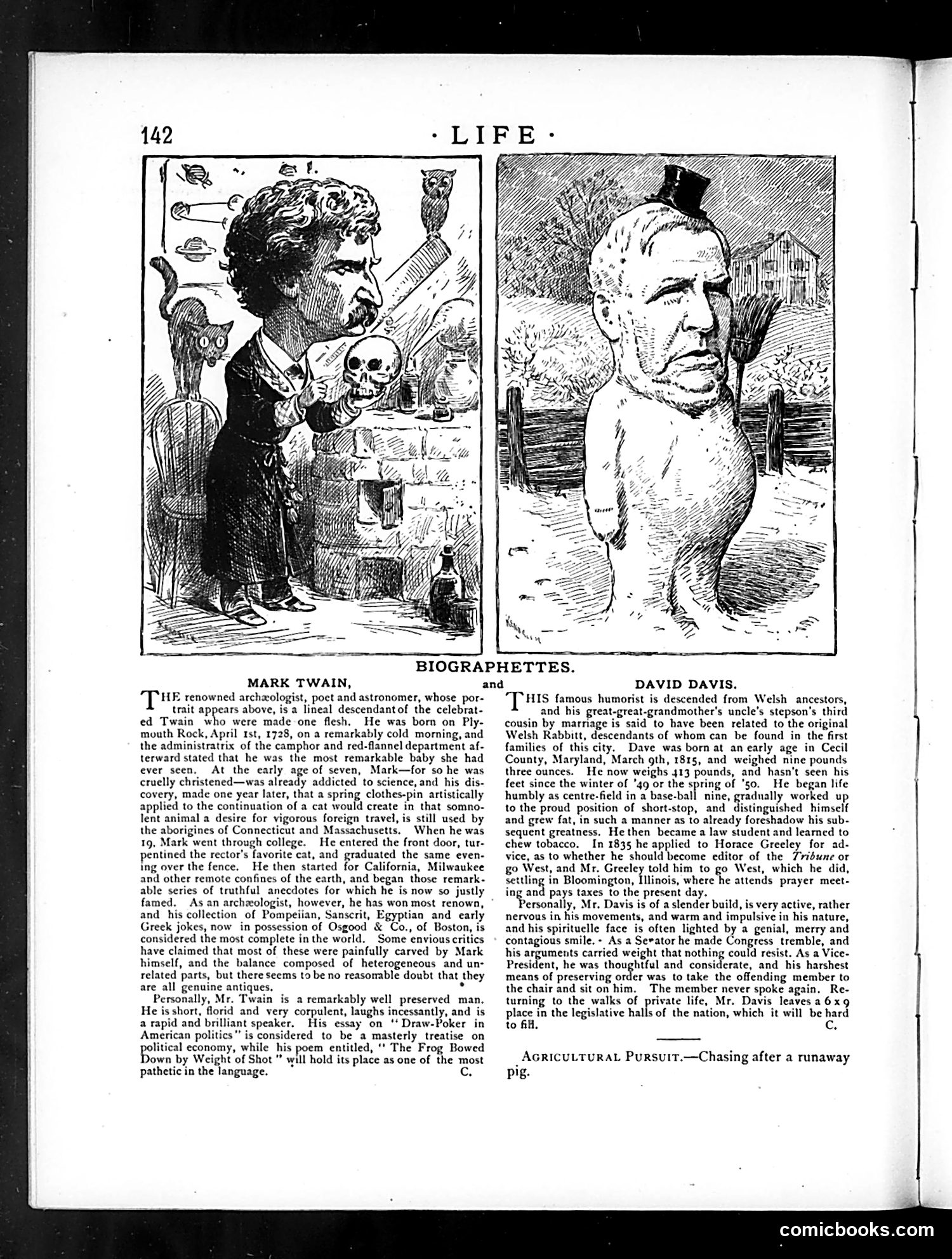
This page from *Life* magazine presents mock biographies of two prominent figures: **Mark Twain** and **David Davis**, accompanied by exaggerated caricature illustrations. The satire works through absurd fabrication: Twain's biography falsely claims he was born on Plymouth Rock in 1728 and credits him with ridiculous "discoveries" (like using clothespins on cats). It mockingly presents his tall tales as genuine archaeological artifacts. Davis's biography similarly invents absurd details—claiming he weighed 413 pounds and hasn't seen his feet since 1849/1850, and that as Vice-President he silenced a congressman by sitting on him. The humor relies on readers recognizing these as deliberate lies that exaggerate or mock the subjects' actual reputations. Twain was famous for tall tales; Davis was a prominent politician (likely Justice David Davis). The cartoons emphasize their physical appearance—Twain's intellectual messiness versus Davis's extreme corpulence—reinforcing the satirical tone. This represents 19th-century satirical magazine humor targeting public figures through biographical parody.
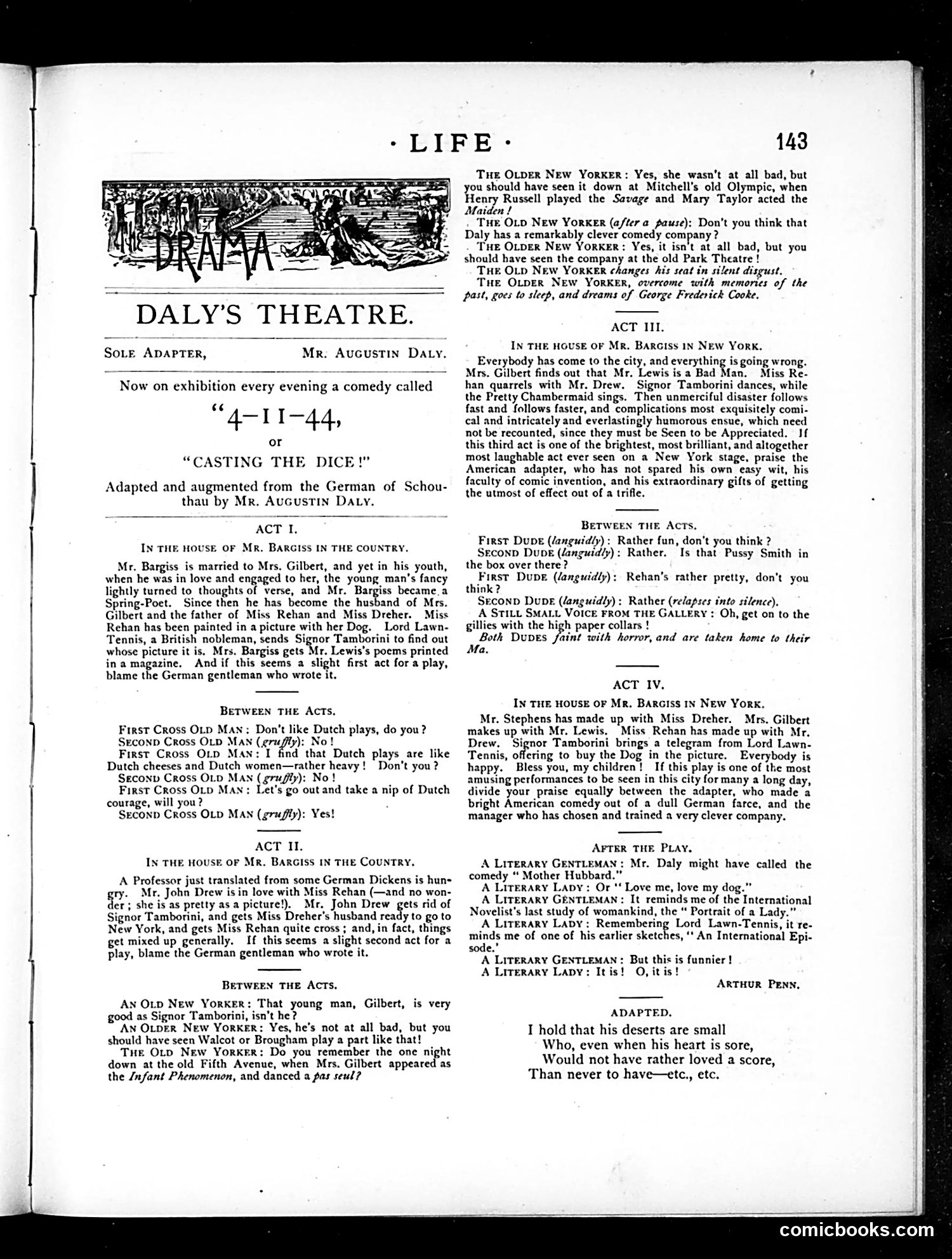
This page is a theatrical review of a play called "4-11-44" (or "Casting the Dice!") at Daly's Theatre, adapted by Augustin Daly from a German original. The satire operates on two levels: **The Play's Weakness**: The plot summary itself mocks the production—each act is described as thin and poorly constructed, with the reviewer repeatedly blaming "the German gentleman who wrote it" for providing weak material. **The Real Target**: The "Between the Acts" dialogue satirizes nostalgic New York theatregoers who constantly diminish current performances by comparing them to legendary actors and venues from the past (Mitchell's Olympic, the old Park Theatre). When one older patron finally admits Daly has a "remarkably clever comedy company," the other dismisses it and retreats into memories, "overcome...goes to sleep, and dreams of George Frederick Cooke"—a famous early 19th-century actor. The joke: audiences so trapped in theatrical nostalgia that they cannot appreciate present talent. Daly himself appears the competent adapter trying to salvage mediocre foreign material.
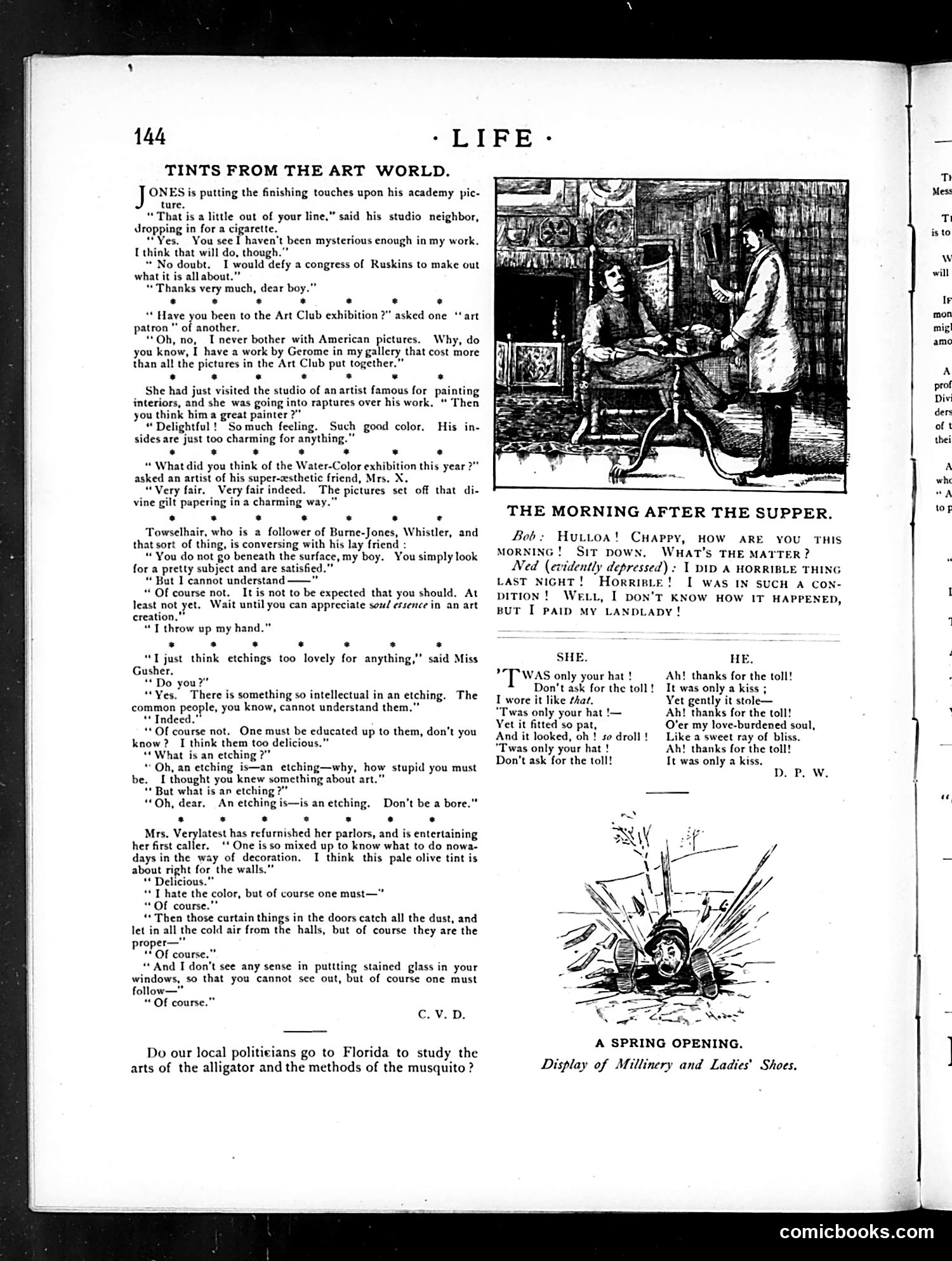
This page satirizes pretentious art-world snobbery through a series of short dialogues. The satire targets wealthy collectors and aesthetes who adopt fashionable artistic opinions without understanding art itself. **Key targets:** - Collectors who value expensive European paintings over American works merely for cost - "Super-aesthetic" patrons who judge art by how it coordinates with interior décor (gilt papering, wall colors) rather than artistic merit - Pseudo-intellectuals who praise etchings and other art forms without being able to explain what they are - Social climbers following arbitrary decorative trends ("of course one must") The humor relies on exposing the gap between pretense and substance—characters use sophisticated language about "soul essence" and "intellectual" merit while actually caring only about fashion and status. The final section mocks Mrs. Verylatest's decoration choices: she acknowledges her choices are ugly and impractical ("I hate the color") but follows them anyway because they're fashionable. This reflects Gilded Age anxieties about newly wealthy Americans acquiring culture as status symbol rather than genuine appreciation.
This page is primarily a contents/advertising page from *Life* magazine, not a satirical cartoon page. The notable content includes brief social commentary in the "Notes and Extracts" section, such as a joke about the Russian Czar ordering a coronation suit made of "wrought iron, four inches thick"—a satirical jab at Russian autocratic rigidity. There's also a punning poem about "Lire" (the Italian currency, but homophonous with "life"), wordplay typical of the magazine's light humor. The bulk of the page consists of insurance company advertisements and theater listings from 1880s New York venues like the Theatre Comique and Union Square Theatre, promoting shows including *Pinafore* and *McSorley's Inflation*. This reflects the magazine's business model of advertising to New York's middle and upper classes while maintaining satirical content elsewhere in the publication.
This page from *Life* magazine consists entirely of commercial advertisements—no political cartoons or satirical content appears here. The ads promote various New York businesses: The Equitable Life Assurance Society (insurance), Fairbanks scales, Pollock & Bixby (stock brokers), hat makers, art dealers, a resort hotel, tile merchants, candy makers, tailors, and an art gallery. The only editorial content is a brief promotional notice for *Life* itself, describing it as "A New Illustrated Weekly, Humorous, Satirical, Refined" and listing its contributors. This appears to be a typical late 19th-century magazine page mixing advertisements with self-promotion, rather than satirical commentary on contemporary politics or society.