
Life, 1883-03-22 · page 6 of 16
Life — March 22, 1883 — page 6: what you’re looking at
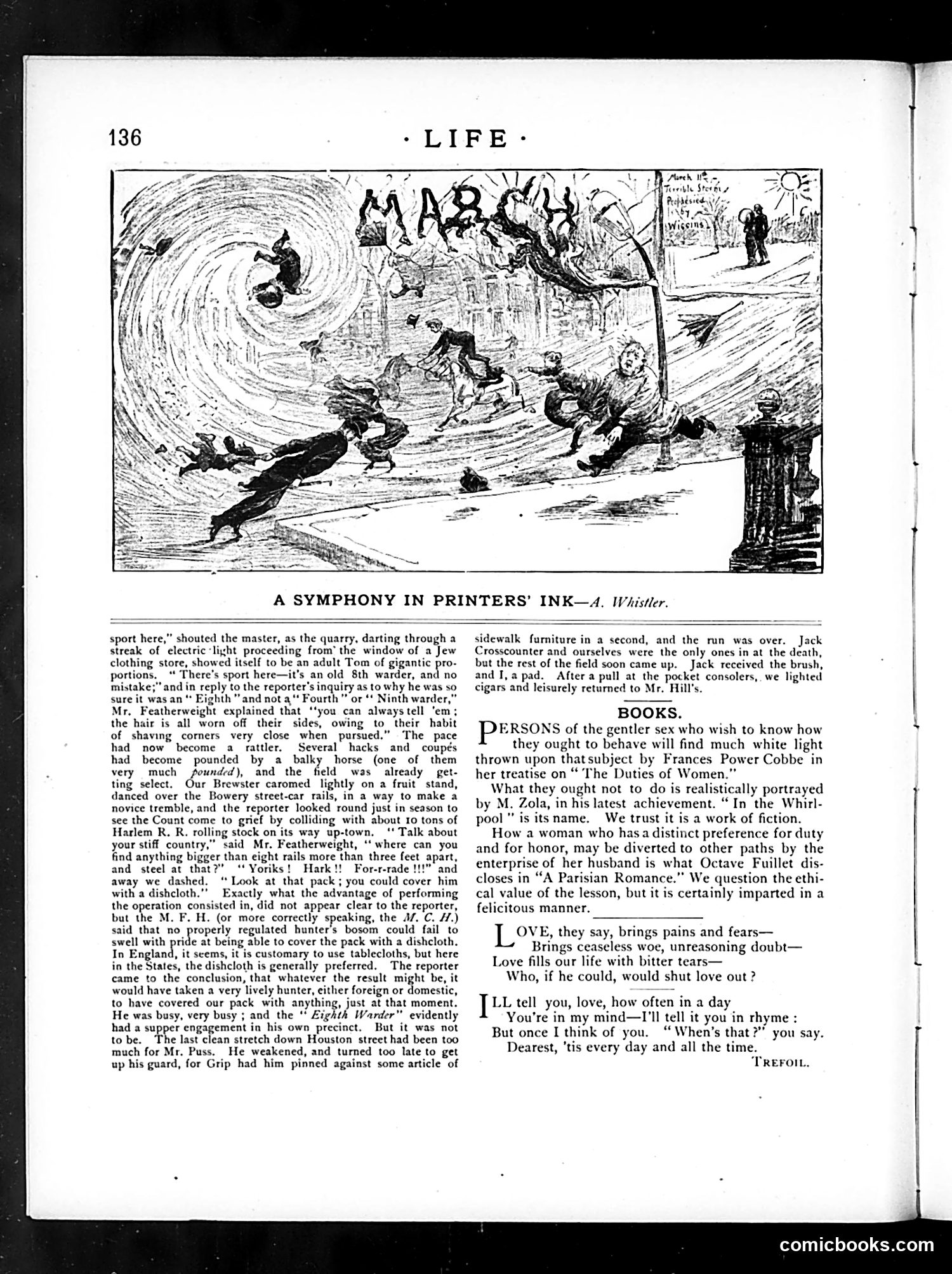
What you’re looking at
This satirical cartoon depicts a chaotic street scene where multiple figures appear to be engaged in a brawl or tumultuous activity. The swirling composition and dynamic poses suggest violent motion or disorder. The caption attributes the work to A. Whistler, likely James McNeill Whistler, the famous American artist known for his satirical and artistic commentary. The title's reference to "printers' ink" suggests this cartoon comments on journalism, publishing, or public discourse of the era. The accompanying text discusses a hunt or chase scene with references to speed, violence, and social commentary about English versus American customs. However, without clearer identification of specific figures or contemporary events referenced, the exact satirical target remains unclear from the image alone.
📄 Transcribed text from this page (OCR, searchable)
Machine-transcribed from the original scan — historical spelling and the odd misread are preserved.
Durch ue =, vble Stormy A SYMPHONY IN PRINTERS’ INK—4A. Whistler. sport here,” shouted the master, as the quarry, darting through a streak of electric ‘light proceeding from’ the window of a Jew clothing store, showed itself to be an adult Tom of gigantic pro- portions, “ There's sport here—it's an old 8th warder, and no mistake;” and in reply to the reporter's inquiry as to why he was so sure it was an“ Eighth "and not a“ Fourth” or ‘* Ninth warder,” Mr. Featherweight explained that “you can alwaystell ‘em; the hair is all worn off their sides, owing to their habit of shaving corners very close when pursued.” The pace had now become a rattler. Several hacks and coupés had become pounded by a balky horse (one of them very much founded), and the field was already get- ting select. Our Brewster caromed lightly on a fruit stand, danced over the Bowery street-car rails, in a way to make a novice tremble, and the reporter looked round just in season to see the Count come to grief by colliding with about 10 tons of Harlem R. R. rolling stock on its way up-town. ‘ Talk about your stiff country,” said Mr. Featherweight, ‘where can you find anything bigger than eight rails more than three feet apart, and steel at that?” ‘* Yoriks! Hark! For-r-rade !!!" and away we dashed. ‘ Look at that pack ; you could cover him with a dishcloth.""_ Exactly what the advantage of performing the operation consisted in, did not appear clear to the reporter, but the M. F. H. (or more correctly speaking, the Af. C. H.) said that no properly regulated hunter's bosom could fail to swell with pride at being able to cover the pack with a dishcloth. In England, it seems, it is customary to use tablecloths, but here in the States, the dishcloth is generally preferred. The reporter came to the conclusion, that whatever the result might be, it would have taken a very lively hunter, either foreign or domestic, to have covered our pack with anything, just at that moment. He was busy, very busy ; and the Zighth Warder” evidently had a supper engagement in his own precinct. But it was not to be. The last clean stretch down Houston street had been too much for Mr. Puss. He weakened, and turned too late to get up his guard, for Grip had him pinned against some article of sidewalk furniture in a second, and the run was over. Jack Crosscounter and ourselves were the only ones in at the death, but the rest of the field soon came up. Jack received the brush, and I,a pad. After a pull at the pocket consolers, we lighted cigars and leisurely returned to Mr. Hill's. BOOKS. ERSONS of the gentler sex who wish to know how they ought to behave will find much white light thrown upon thatsubject by Frances Power Cobbe in her treatise on “ The Duties of Women.” What they ought not to do is realistically portrayed by M. Zola, in his latest achievement. “In the Whirl- pool" is itsname. We trust it is a work of fiction. How a woman who has a distinct preference for duty and for honor, may be diverted to other paths by the enterprise of her husband is what Octave Fuillet dis- closes in “A Parisian Romance.” We question the ethi- cal value of the lesson, but it is certainly imparted in a felicitous manner. Love they say, brings pains and fears— Brings ceaseless woe, unreasoning doubt— Love fills our life with bitter tears— Who, if he could, would shut love out ? qu tell you, love, how often in a day You're in my mind—I'll tell it you in rhyme : But once I think of you. “ When’s that?” you say. Dearest, ‘tis every day and all the time. TREFOIL. comicbooks.com