
Life, 1883-03-22 · page 11 of 16
Life — March 22, 1883 — page 11: what you’re looking at
What you’re looking at
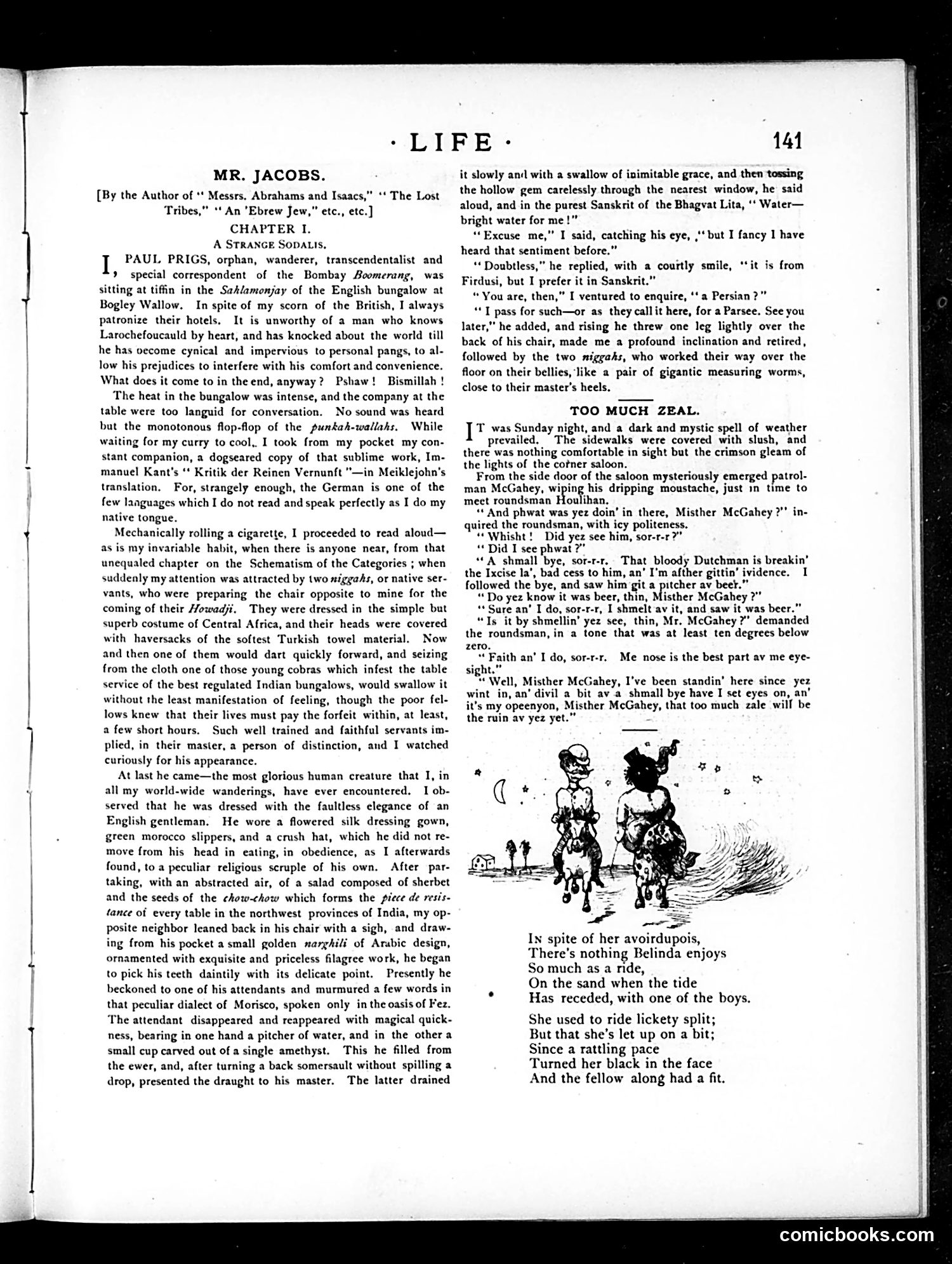
This page presents the opening chapter of a satirical serialized story mocking pretentious European travelers and orientalist affectation in colonial India. The protagonist, Paul Prigs, is a self-important "special correspondent" who affects intellectual superiority (reading Kant in German, speaking multiple languages) while patronizing British hotels despite professing disdain for the British. The satire intensifies when describing his mysterious dining companion—a figure of exaggerated, absurd elegance employing improbable servants and displaying ridiculous affectations (wearing a crush hat while eating, using a golden water pipe to pick his teeth). The accompanying illustration shows colonial-era figures on horseback, complementing the story's Indian setting. The humor targets pompous expatriates who adopt elaborate pretenses of worldliness and sophistication while remaining fundamentally ridiculous—standard satire of the period mocking colonial excess and orientalist fantasy.
📄 Transcribed text from this page (OCR, searchable)
Machine-transcribed from the original scan — historical spelling and the odd misread are preserved.
- LIFE: 144 MR. JACOBS. [By the Author of ** Messrs. Abrahams and Isaacs,” ‘t The Lost Tribes,” ‘An 'Ebrew Jew,” etc., etc.] CHAPTER I. A STRANGE SODALIS, PAUL PRIGS, orphan, wanderer, transcendentalist and 9 special correspondent of the Bombay Boomerang, was sitting at tiffin in the SaAlamonjay of the English bungalow at Bogley Wallow. In spite of my scorn of the British, I always patronize their hotels, It is unworthy of a man who knows Larochefoucauld by heart, and has knocked about the world till he has vecome cynical and impervious to personal pangs, to al- low his prejudices to interfere with his comfort and convenience. What does it come to in the end, anyway? Pshaw! Bismillah ! The heat in the bungalow was intense, and the company at the table were too languid for conversation. No sound was heard but the monotonous flop-flop of the punkah-wallahs, While waiting for my curry to cool, I took from my pocket my con- stant companion, a dogseared copy of that sublime work, Im- manuel Kant’s ‘* Kritik der Reinen Vernunft "—in Meiklejohn’s translation, For, strangely enough, the German is one of the few languages which I do not read and speak perfectly as I do my native tongue. Mechanically rolling a cigarette, 1 proceeded to read aloud— as is my invariable habit, when there is anyone near, from that unequaled chapter on the Schematism of the Categories ; when suddenly my attention was attracted by two niggahs, or native ser- vants, who were preparing the chair opposite to mine for the coming of their Howadji, They were dressed in the simple but superb costume of Central Africa, and their heads were covered with haversacks of the softest Turkish towel material. Now and then one of them would dart quickly forward, and seizing from the cloth one of those young cobras which infest the table service of the best regulated Indian bungalows, would swallow it without the least manifestation of feeling, though the poor fel- lows knew that their lives must pay the forfeit within, at least, a few short hours. Such well trained and faithful servants im- plied, in their master, a person of distinction, and I watched curiously for his appearance. At last he came—the most glorious human creature that I, in all my world-wide wanderings, have ever encountered. I ob- served that he was dressed with the faultless elegance of an English gentleman. He wore a flowered silk dressing gown, green morocco slippers, and a crush hat, which he did not re- move from his head in eating, in obedience, as I afterwards found, to a peculiar religious scruple of his own, After par- taking, with an abstracted air, of a salad composed of sherbet and the seeds of the chow-chow which forms the piece de resis- tance of every table in the northwest provinces of India, my op- posite neighbor leaned back in his chair with a sigh, and draw- ing from his pocket a small golden narghili of Arabic design, ornamented with exquisite and priceless filagree work, he began to pick his teeth daintily with its delicate point. Presently he beckoned to one of his attendants and murmured a few words in that peculiar dialect of Morisco, spoken only in the oasis of Fez. The attendant disappeared and reappeared with magical quick- ness, bearing in one hand a pitcher of water, and in the other a small cup carved out ofa single amethyst. This he filled from the ewer, and, after turning a back somersault without spilling a drop, presented the draught to his master. The latter drained it slowly and with a swallow of inimitable grace, and then tossing the hollow gem carelessly through the nearest window, he said aloud, and in the purest Sanskrit of the Bhagvat Lita, ‘* Water— bright water for me!” “Excuse me," I said, catching his eye, ,* but I fancy I have heard that sentiment before.” ** Doubtless,” he replied, with a courtly smile, ‘it is from Firdusi, but I prefer it in Sanskrit.” “You are, then,” I ventured to enquire, ‘‘ a Persian?” “I pass for such—or as they callit here, for a Parsee. See you later,” he added, and rising he threw one leg lightly over the back of his chair, made me a profound inclination and retired, followed by the two niggaks, who worked their way over the floor on their bellies, ‘like a pair of gigantic measuring worms, close to their master’s heels. TOO MUCH ZEAL. [7 was Sunday night, and a dark and mystic spell of weather prevailed. “The sidewalks were covered with slush, and there was nothing comfortable in sight but the crimson gleam of the lights of the cofner saloon. From the side door of the saloon mysteriously emerged patrol- man McGahey, wiping his dripping moustache, just in time to mect roundsman Houlihan, ‘And phwat was yez doin’ in there, Misther McGahey ?”” in- quired the roundsman, with icy politeness. ““Whisht! Did yez see him, sor-r-r?”" “ Did I see phwat ?” **A shmall bye, sor-r-r, That bloody Dutchman is breakin’ the Ixcise la’, bad cess to him, an’ I'm afther gittin’ ividence. I followed the bye, and saw him gi itcher av beer.” “Do yez know it was beer, thin, Misther McGahey ?” ** Sure an’ I do, sor-r-r, I shmelt av it, and saw it was beer.” “Is it by shmellin’ yez see, thin, Mr. McGahey ?” demanded the roundsman, in a tone that was at least ten degrees below zero. “Faith an’ I do, sor-r-r, Me nose is the best part av me eye- sight.” ee Well, Misther McGahey, I’ve been standin’ here since yez wint in, an’ divil a bit ava shmall bye have I set eyes on, an’ it’s my opeenyon, Misther McGahey, that too much zale will be the ruin av yez yet.” In spite of her avoirdupois, There's nothing Belinda enjoys So much as a ride, On the sand when the tide Has receded, with one of the boys. She used to ride lickety split; But that she’s let up on a bit; Since a rattling pace Turned her black in the face And the fellow along had a fit. comicbooks.com