
A complete issue · 16 pages · 1883
Life — March 8, 1883
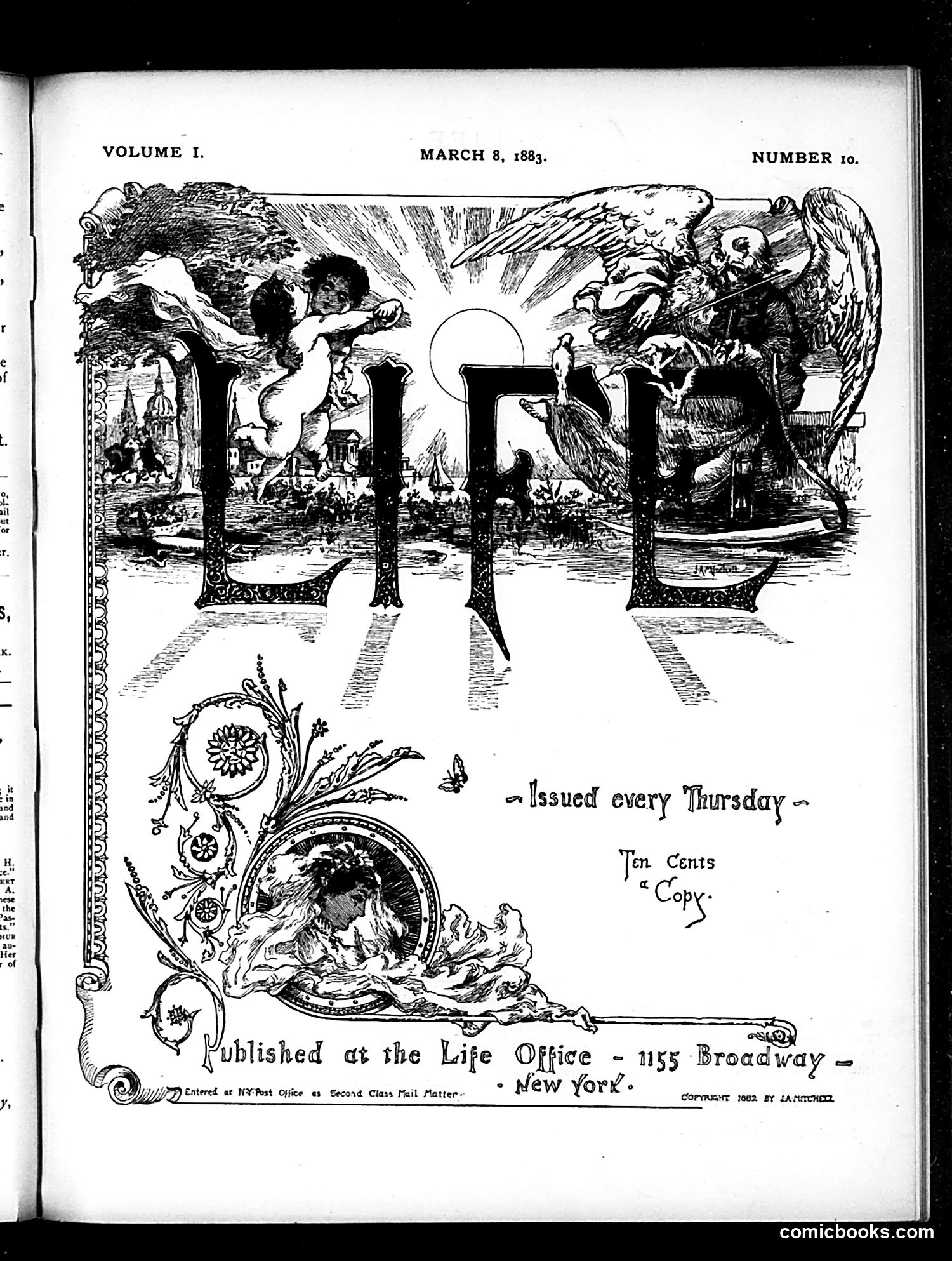
This is the cover of Life magazine's first volume, Number 10, dated March 8, 1883. The elaborate decorative border frames a fantastical scene featuring mythological or allegorical figures—including what appears to be cherubs, classical figures, and a demon-like creature—arranged around large ornamental letters spelling "LIFE." The imagery suggests this was Life's early incarnation as a satirical publication emphasizing artistic and literary content rather than news. The classical and fantastical aesthetic reflects 1880s aesthetic movements. The publication details indicate it was issued weekly at ten cents per copy from the Life Office at 1155 Broadway, New York. Without additional context or legible text identifying specific political figures or current events referenced in the illustration, the precise satirical target remains unclear from this cover alone.
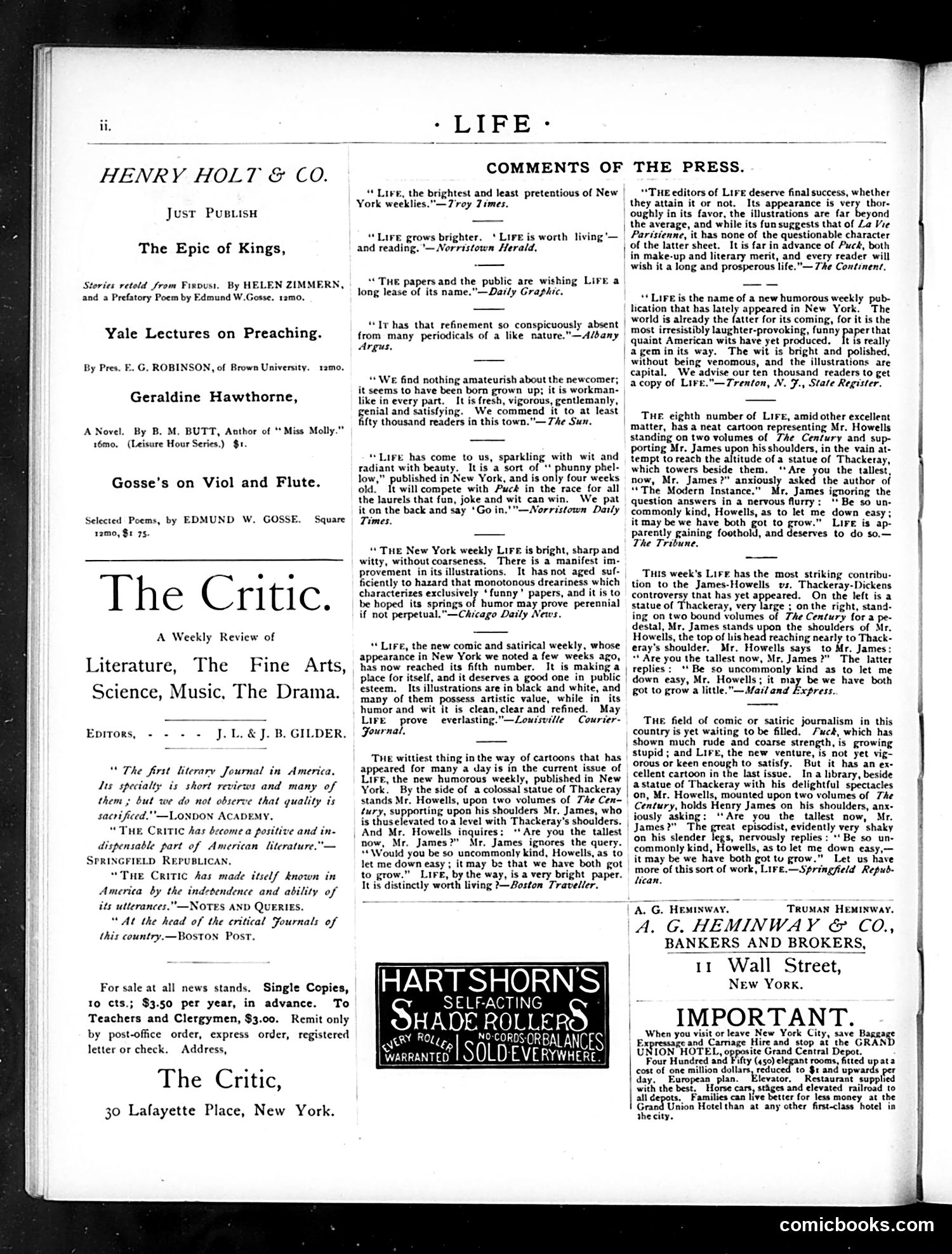
This page is primarily **advertising and editorial content** rather than political cartoons. The left column announces new publications from Henry Holt & Co., including "The Epic of Kings" and "Yale Lectures on Preaching." The central section features **"The Critic,"** a weekly review of literature, fine arts, science, music, and drama edited by J.L. & J.B. Gilder. Multiple testimonials praise it as "the first literary journal in America," emphasizing its focus on serious cultural criticism. The right side contains **press comments about "Life" magazine itself**—self-promotional quotes praising Life's wit, freshness, and satirical quality, distinguishing it from "coarser" humor publications. A Hartshorn's Shade Rollers advertisement and a Grand Union Hotel notice occupy the bottom. This page documents Life's identity as a **respectable, literary-focused satirical publication**, not crude humor.
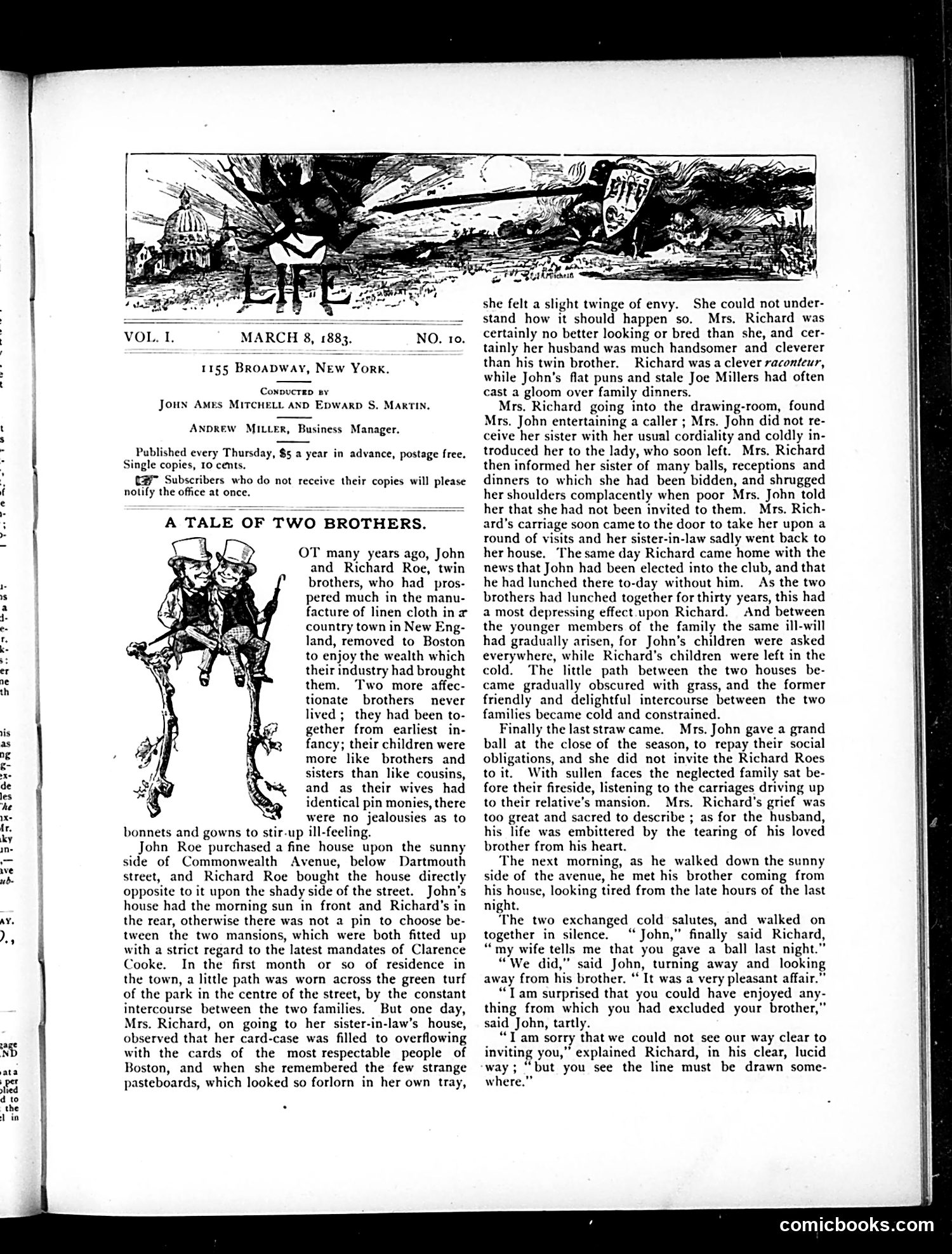
This page contains the opening of a short story titled "A Tale of Two Brothers," not a political cartoon. The illustration shows two identical twin brothers in 19th-century dress (top hats and coats) standing back-to-back in a somewhat confrontational pose. The story concerns two brothers, John and Richard Roe, who immigrated from England to Boston and became estranged due to social class differences and family rivalries. The narrative describes how their wives' jealousies—particularly Mrs. Richard resenting Mrs. John's social invitations and hospitality—deepened the rift between the families. This appears to be social satire examining class consciousness and family discord among the American upper-middle class of the 1880s, not political commentary.
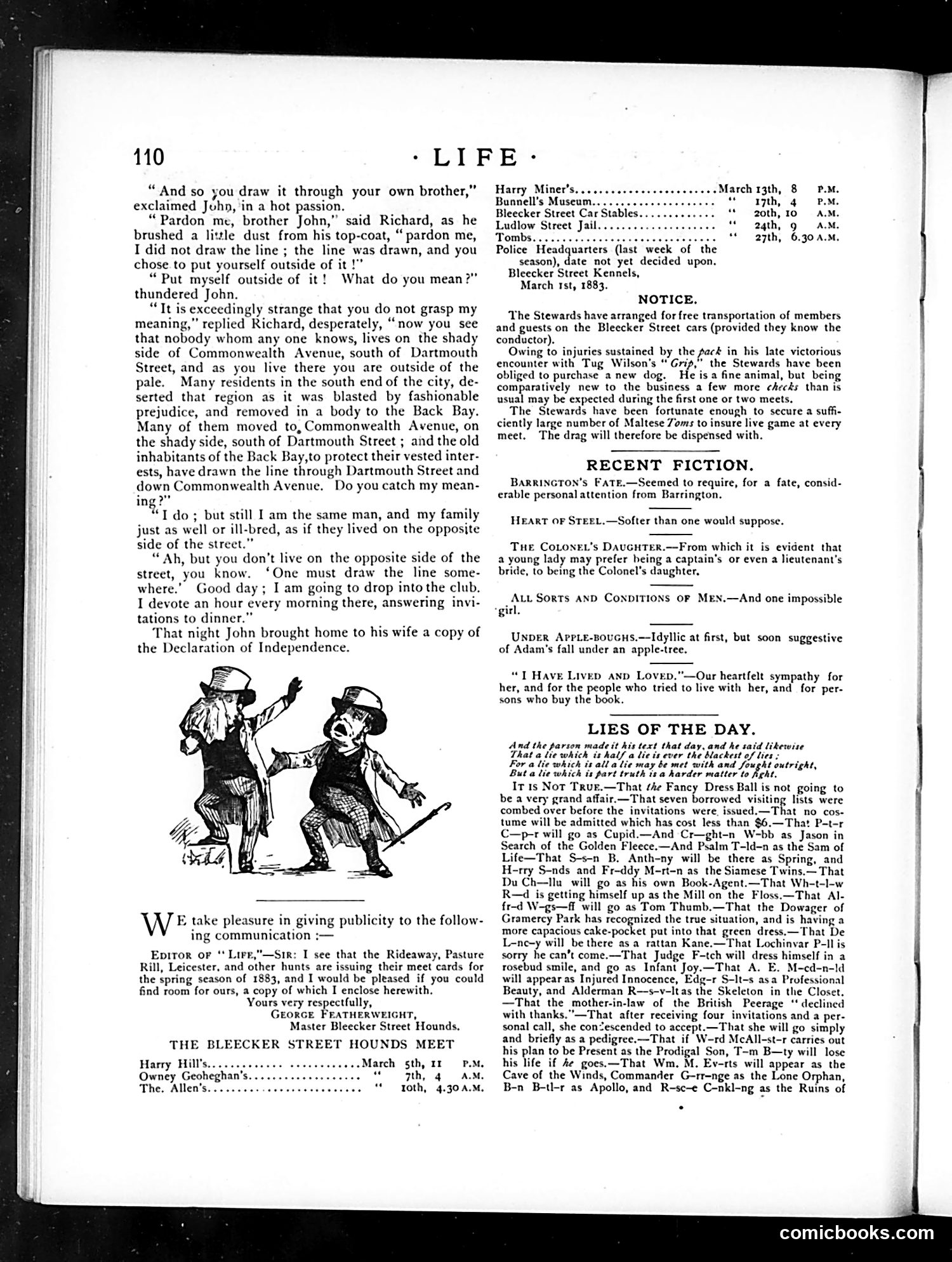
The main cartoon depicts two men in period dress engaged in heated debate. Based on the dialogue excerpt visible above it, they're arguing about social class and neighborhood respectability—one character defends living in a working-class area (Commonwealth Avenue, south of Dartmouth Street) while the other insists such proximity to "the Back Bay" residents is socially degrading. The satire targets 19th-century American class anxieties and snobbish social prejudices about Boston neighborhoods. The cartoon mocks rigid class consciousness by showing two men quarreling passionately over geographic and social distinctions that appear petty. The remainder of the page contains literary notices and book advertisements, including "Recent Fiction" titles and "Lies of the Day" gossip items typical of Life's satirical format.
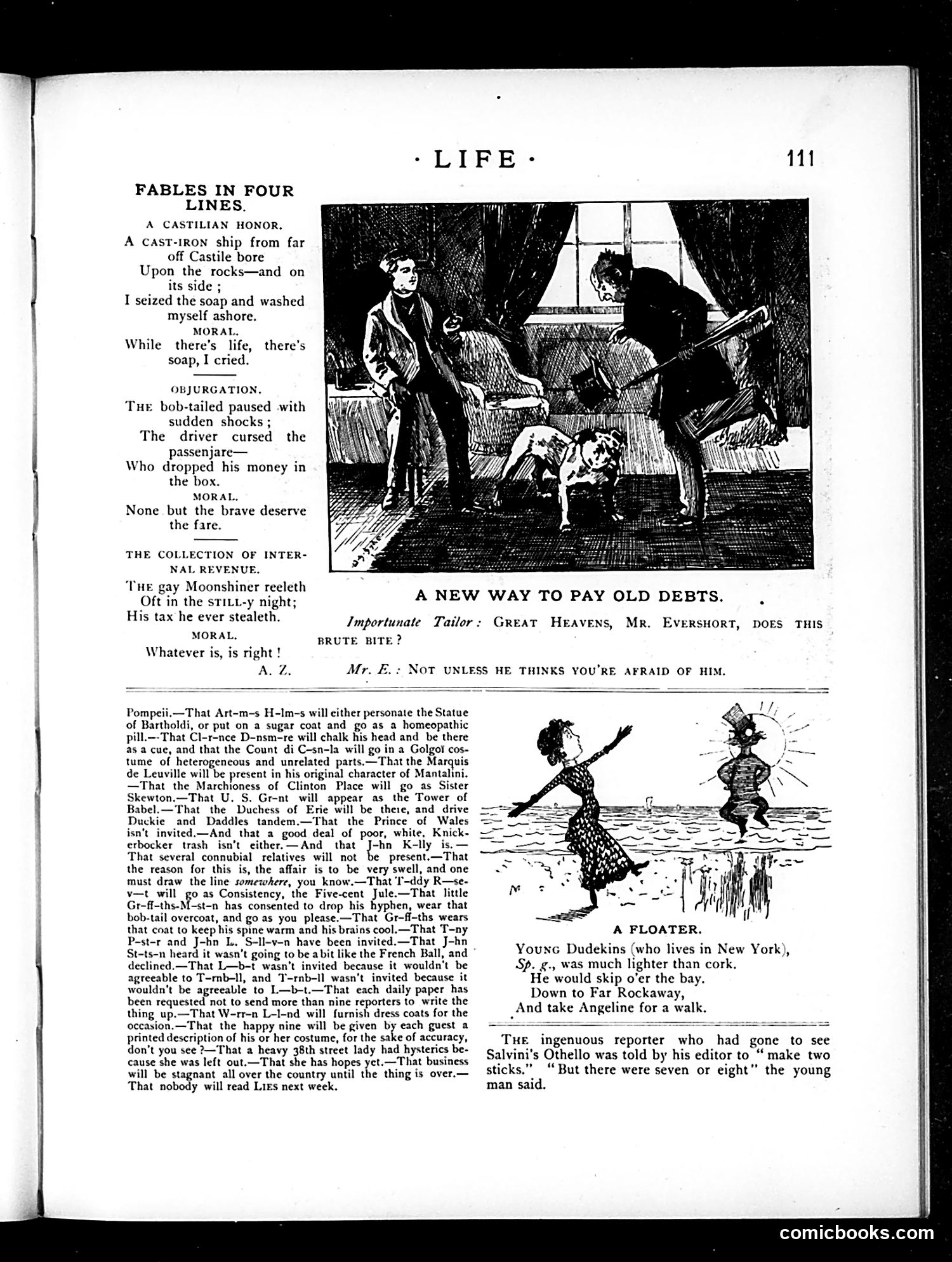
The main cartoon, "A New Way to Pay Old Debts," depicts a tailor violently beating a man (labeled "Mr. Everyhort") who apparently owes him money. The dialogue suggests the tailor has resorted to physical violence as debt collection. The satire critiques brutal debt-collection practices of the era. The tailor's extreme response—beating rather than using legal channels—mocks both incompetent creditors and the desperation of those owed money during what was likely a period of economic hardship. Below is "A Floater," a brief joke about a New York dandy named Dudekins who prefers floating on the bay to walking, punning on "lighter than cork" (frivolity) versus actual physical buoyancy. The left column contains miscellaneous satirical "Fables in Four Lines" on various social topics.
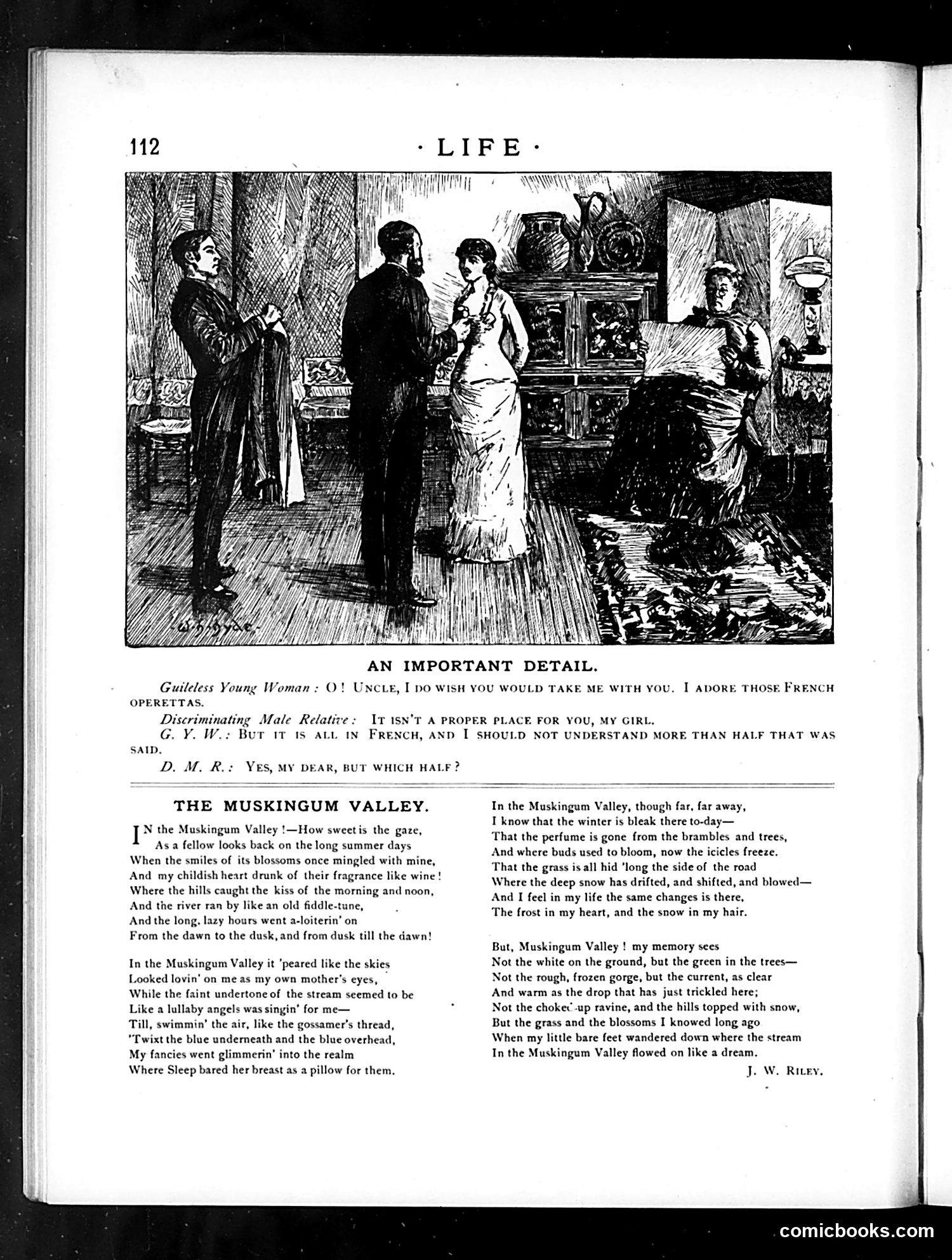
The upper illustration titled "AN IMPORTANT DETAIL" depicts a social scene where a young woman asks her uncle to take her to French operettas. The uncle refuses, saying it's "not a proper place" for her, though he admits the performances are "all in French" and he wouldn't understand more than half anyway. Another male relative asks which half he *would* understand. The satire targets male hypocrisy regarding female propriety and entertainment. The joke suggests the uncle's objection isn't genuinely moral but rather reflects his own limited comprehension—he's protecting her from content he himself doesn't fully grasp, making his guardianship seem arbitrary and self-serving rather than principled. The lower section contains an unrelated poem, "The Muskingum Valley" by J.W. Riley, a nostalgic piece about pastoral memories.
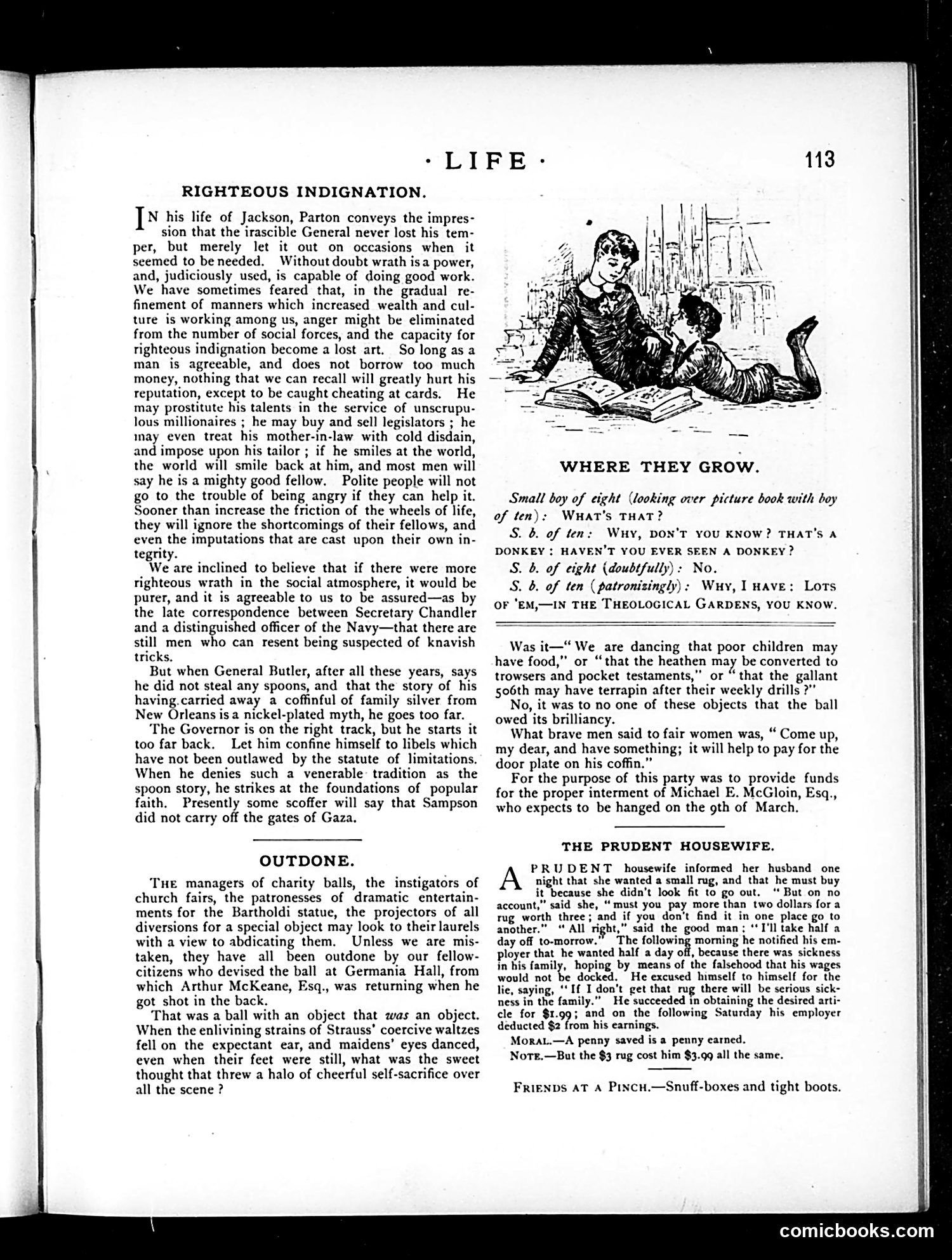
The illustration titled "WHERE THEY GROW" depicts a young boy examining a picture book while another boy (labeled as age ten) looks on. The accompanying dialogue humorously presents a child's misunderstanding: when asked what he's looking at, the boy claims it's "a donkey," but the older boy insists he's never seen one. This appears to be gentle satire on urban children's isolation from rural life and animals. The joke—that city children lack basic knowledge of farm animals—reflects early 20th-century concerns about urbanization's effects on youth education and experience. The surrounding text discusses various social topics including charity balls, family finances, and household economy, presenting satirical commentary on contemporary middle-class concerns and values rather than political figures.
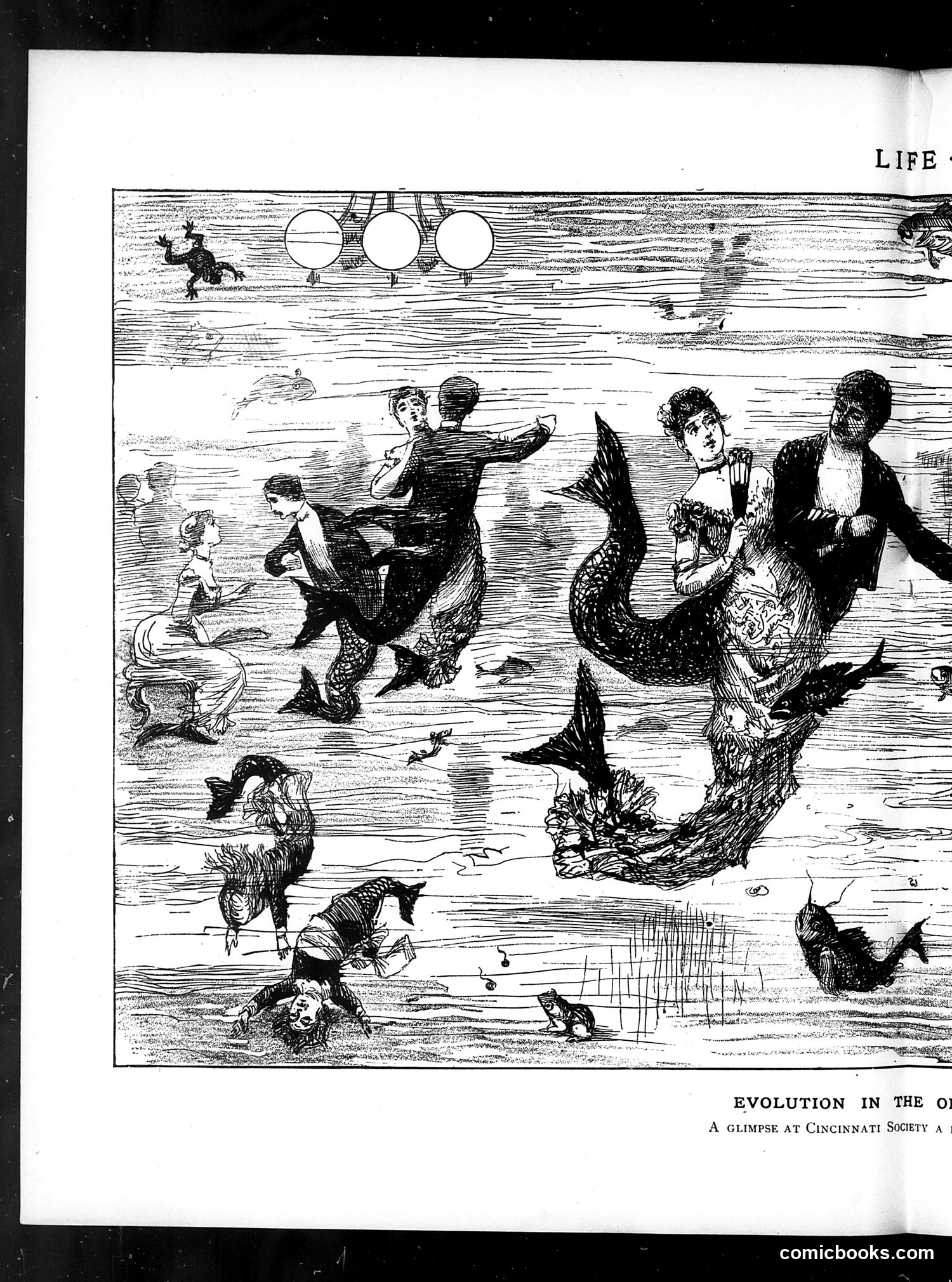
This is a satirical cartoon about evolution, likely from the early 20th century when Darwinian theory remained controversial in America. The image shows humans and mermaids emerging from water in various stages, with fish and sea creatures at the bottom—visually representing the evolutionary chain from aquatic to human life. The caption references "A Glimpse at Cincinnati Society"—suggesting this is social satire. Life magazine appears to be mocking Cincinnati's upper class by depicting them as only partially evolved from primitive aquatic creatures, implying they lack refinement or civilization. The three circles at the top may represent stages of development or simply add to the evolutionary theme. This combines scientific theory with social ridicule of a specific city's elite.
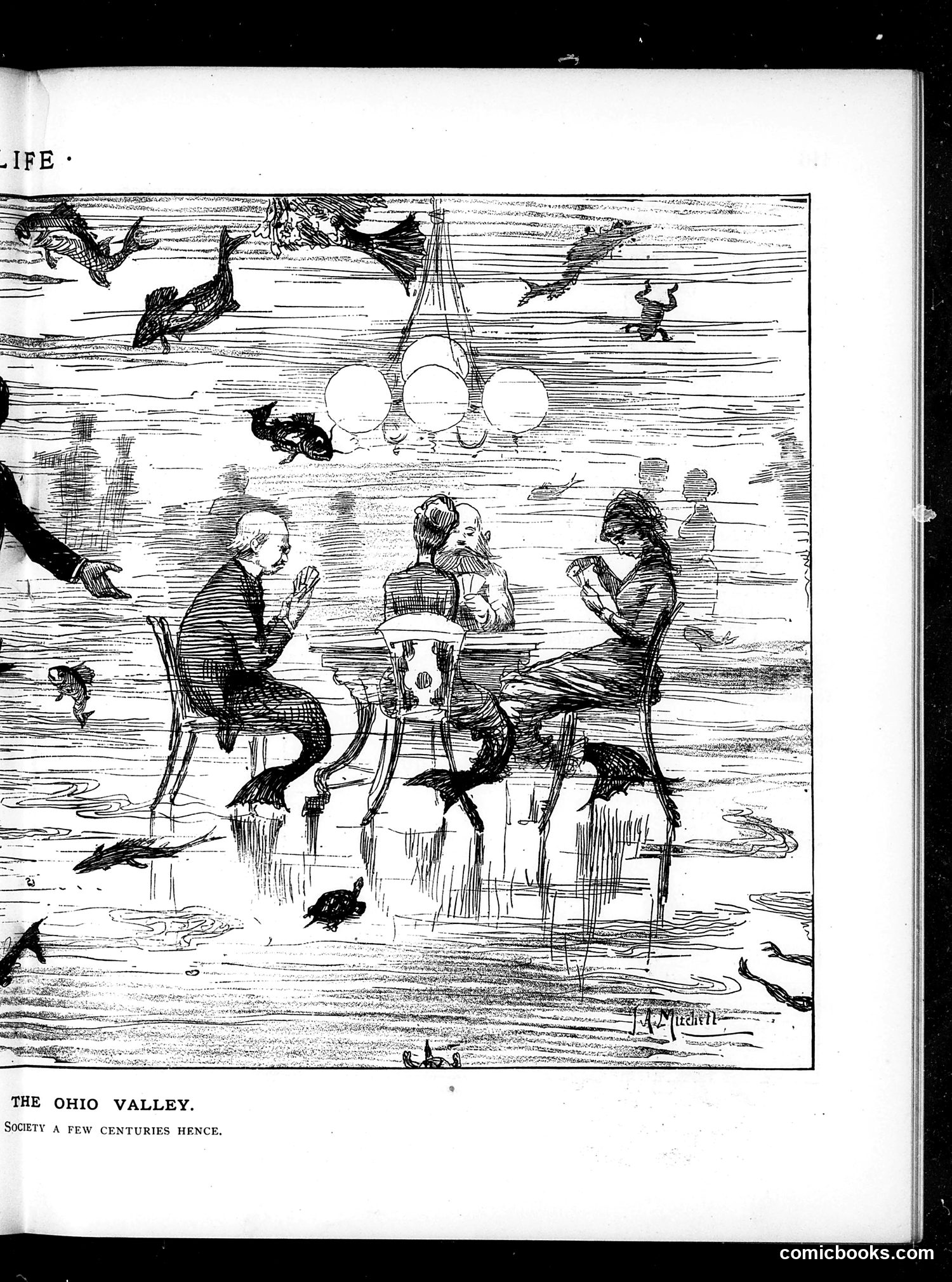
This satirical cartoon imagines a future Ohio Valley society transformed by evolution or devolution. Three humanoid figures with exaggerated, simian features sit underwater or in shallow water, engaged in refined social activity—having tea or conversation around a small table. The setting is surreal: fish and aquatic creatures swim overhead in the upper portion, while bubbles float around them. The satire likely mocks either: (1) contemporary Ohio Valley residents as crude or primitive, or (2) pseudoscientific evolutionary theories popular in the late 19th/early 20th century. The juxtaposition of "civilized" behavior (tea service, formal seating) with bestial appearance and aquatic environment creates absurdist humor, suggesting future degeneration or comic commentary on contemporary society and scientific speculation.
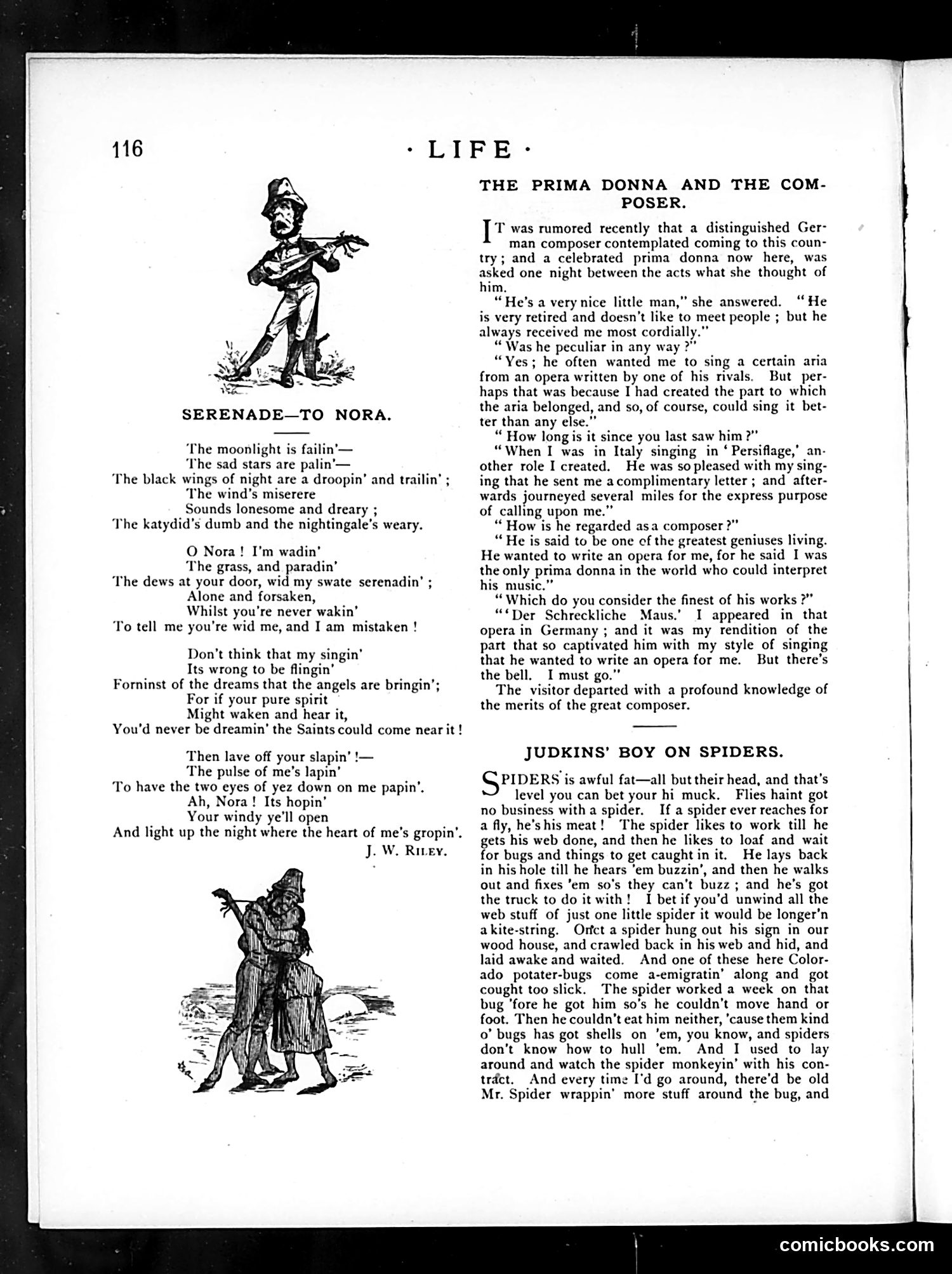
This page contains three distinct pieces of humor: **"Serenade—To Nora"** (left): A romantic poem in exaggerated Irish dialect, mocking sentimental Victorian courtship literature. The speaker serenades an unresponsive woman with overwrought nature imagery and pleading emotion. **"The Prima Donna and the Composer"** (top right): A satirical anecdote about a vain opera singer's self-importance. She monopolizes a conversation about a famous German composer by constantly centering herself—she created all his best roles, inspired his works, and is the only singer who can interpret his music. The satire targets her obliviousness to her own egotism and how she inadvertently reveals the composer's indifference to her. **"Judkins' Boy on Spiders"** (bottom right): A humorous monologue in rural dialect describing spider behavior and intelligence with folksy observation. The "boy" anthropomorphizes the spider's problem-solving, particularly when it encounters a Colorado potato beetle with a hard shell it cannot eat. All three pieces employ exaggerated dialect and character voice for comedic effect, typical of Life's satirical style.
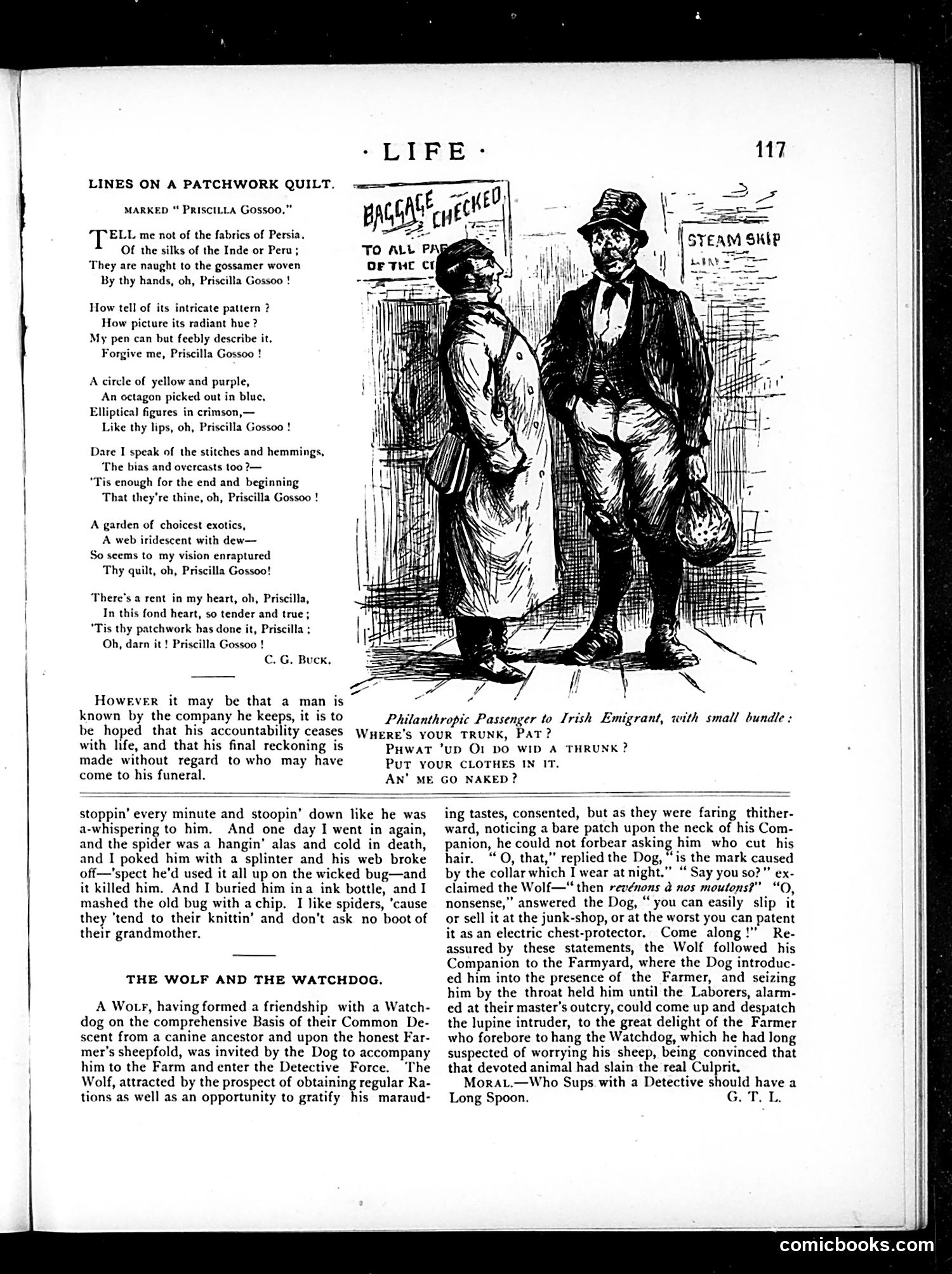
This page contains three distinct pieces of humor: **"Lines on a Patchwork Quilt"** is a sentimental parody—a flowery romantic poem about a woman named Priscilla Gossoo and her handmade quilt, deliberately overwrought with elaborate metaphors ("garden of choicest exotics"). The joke is the anticlimactic ending: all this praise culminates in a pun about a literal tear in the quilt needing mending. **The cartoon** depicts an Irish emigrant boarding a steamship with minimal belongings. A wealthy passenger condescendingly suggests he put his clothes in a trunk, missing the obvious point: the poor man has no trunk and can't afford one. The satire mocks upper-class obliviousness to working-class poverty. **"The Wolf and the Watchdog"** is a fable about a wolf befriending a watchdog, who invites him to work on a farm. The wolf, noticing a mark on the dog's neck, asks about it. The dog dismissively explains it away—until they reach the farm, where the dog betrays the wolf to the farmer, who kills him. The moral warns against trusting those with hidden motives.
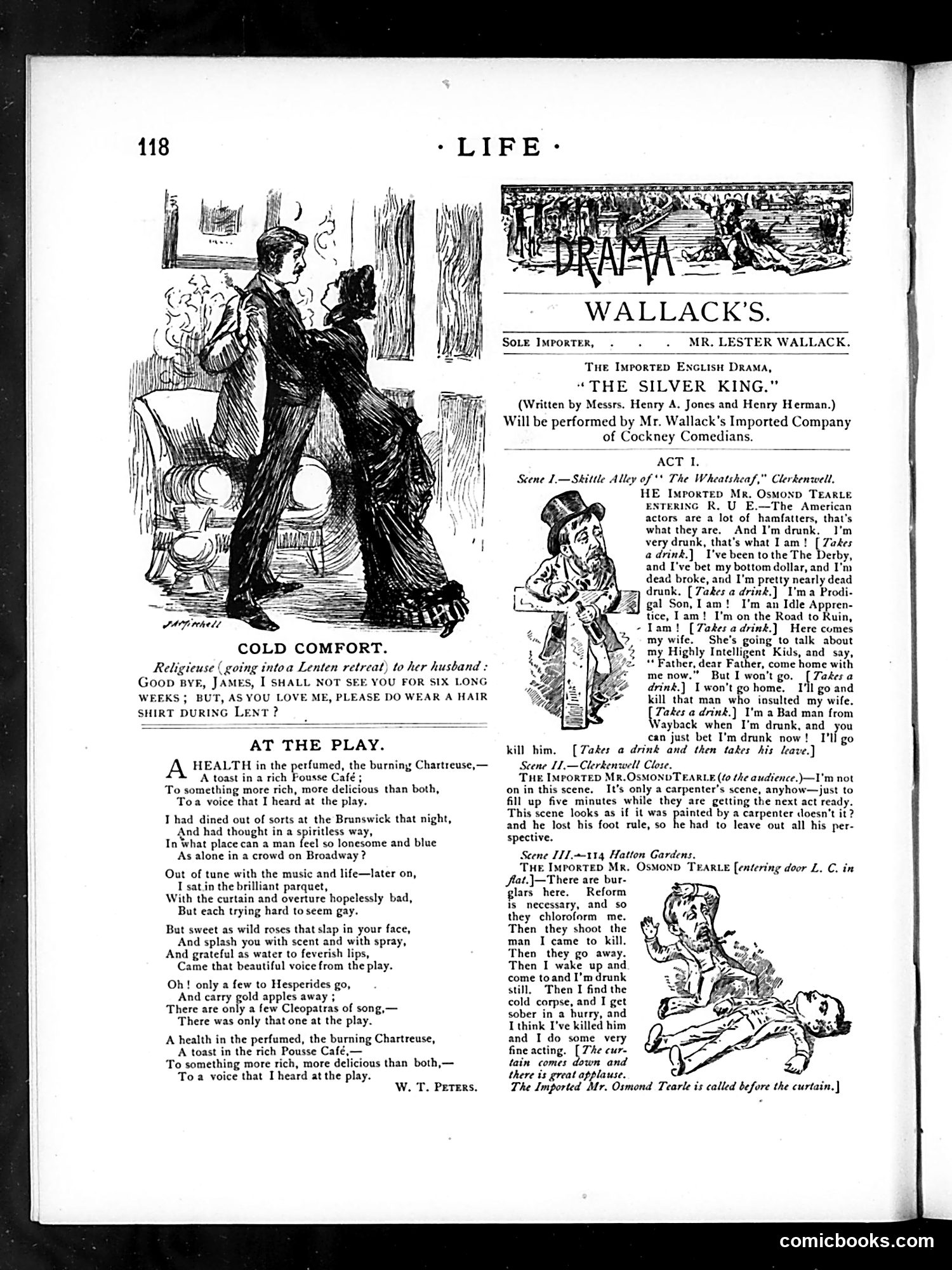
This page contains two distinct satirical pieces from Life magazine: **"Cold Comfort"** (left): A joke about a wife entering a six-week Lenten religious retreat. She asks her husband to wear a hair shirt (painful religious garment) during her absence—implying the sacrifice is meant to keep him faithful while she's away. The satire mocks both religious excess and marital tension. **"Wallack's Theatre Review"** (right): This viciously mocks a theatrical production of "The Silver King" performed by Mr. Lester Wallack's company of "Cockney Comedians." The review, presented as the actor's own dialogue, savagely critiques the overwrought, melodramatic acting style—the character constantly gets drunk, announces his own emotional states transparently ("I'm a Bad man from Wayback"), and the staging is incompetent (a carpenter designed a scene and "lost his foot rule"). The satire targets both pretentious imported English theatre and ham acting prevalent in that era.
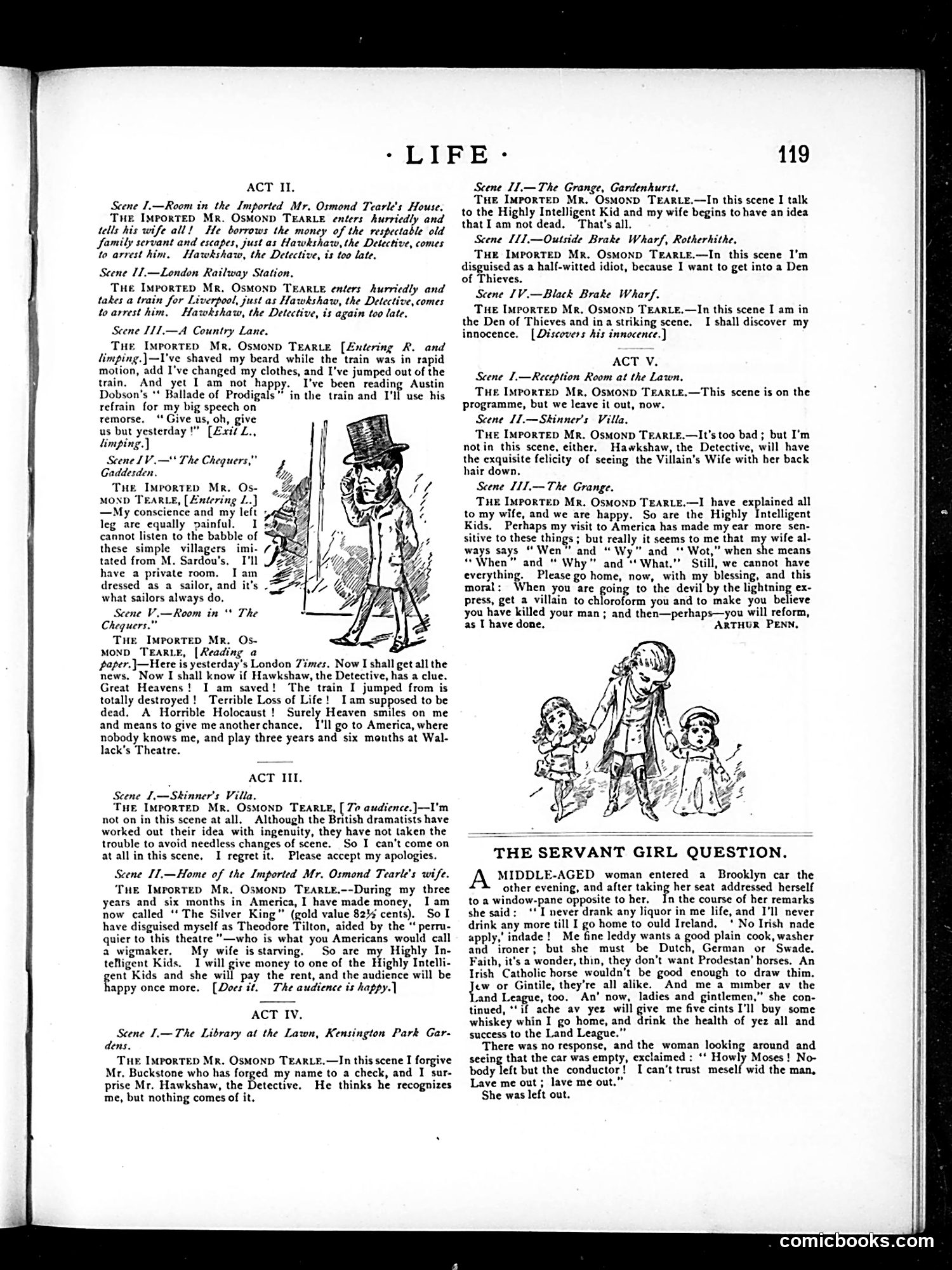
This page satirizes the melodramatic acting style and overwrought plots of **Osmond Tearle**, a British actor performing in contemporary theater (the illustrations show him in exaggerated poses typical of Victorian stage acting). The satire works on multiple levels: it mocks the absurd plot contrivances (a detective who is "too late" repeatedly, a convenient train crash that fakes the protagonist's death), the actor's self-important asides to the audience, and the reliance on cheap theatrical tricks (disguises, scene changes, moral redemptions). The text repeatedly breaks the fourth wall, with Tearle commenting directly to the audience about his own performance—particularly the admission in Act III that he isn't even in a scene but is offering "apologies" anyway. This undercuts the dramatic pretense. The accompanying illustrations caricature Tearle's exaggerated physical comedy and emotional expressions, emphasizing the artificiality of his performing style. **Life** magazine is essentially ridiculing both this particular actor and the broader theatrical conventions of overstated melodrama that audiences of the era found thrilling but which the magazine's editors found risible.
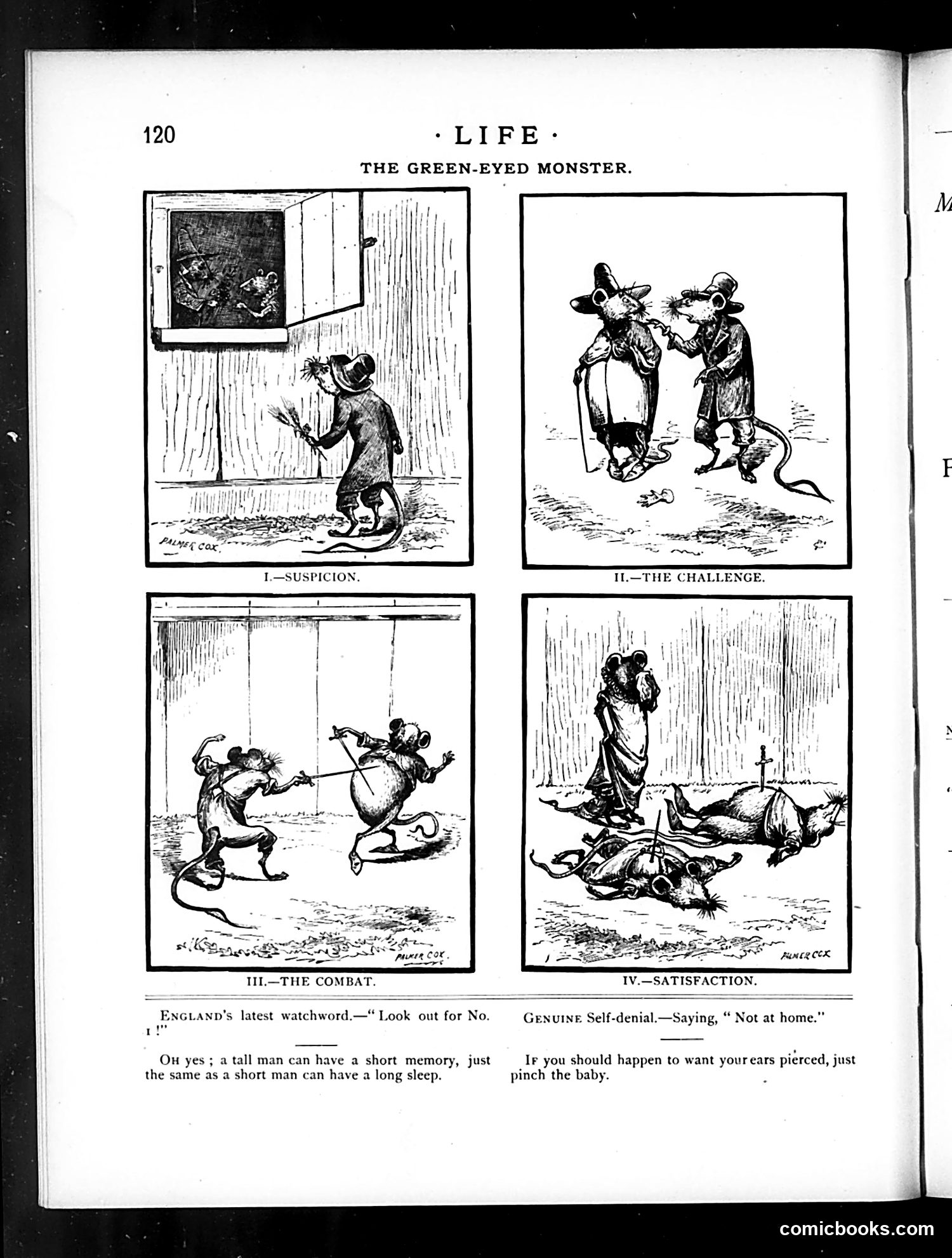
This four-panel anthropomorphic cartoon depicts mice experiencing jealousy. Panel I shows a mouse peering suspiciously at others through a window. Panel II presents two mice confronting each other aggressively ("The Challenge"). Panel III shows them fighting ("The Combat"). Panel IV concludes with one mouse standing victorious over defeated rivals ("Satisfaction"). The satire uses the "green-eyed monster" (a metaphor for jealousy, famously from Shakespeare) to mock human behavior through animal characters. The accompanying jokes—about selective memory, self-denial excuses, and the absurdity of ear-piercing babies—suggest commentary on social hypocrisy and interpersonal conflict driven by envy. The specific political target is unclear from the visible text alone, though "England's latest watchword" suggests contemporary British social critique, likely from Life's perspective as an American satirical publication.
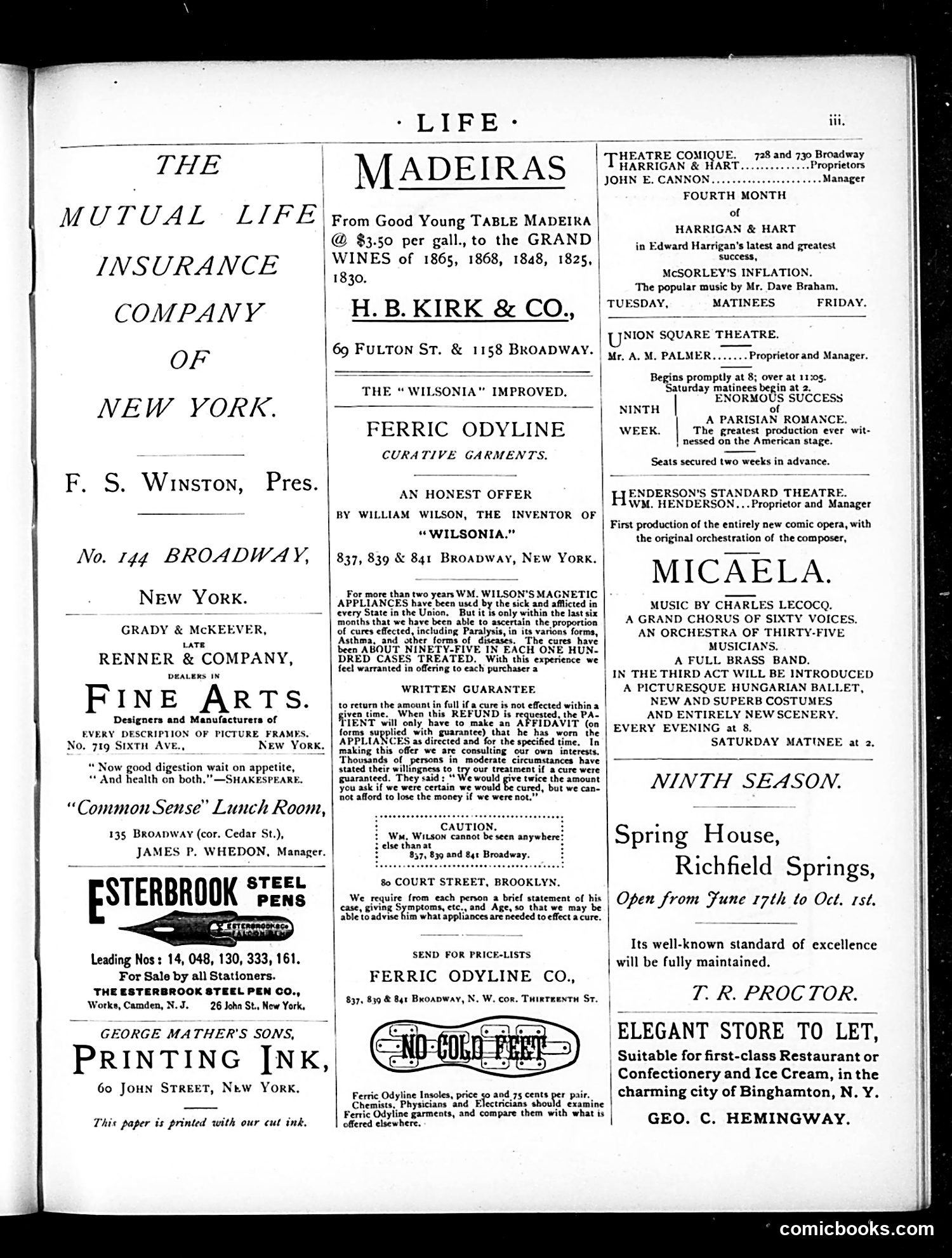
This page is primarily advertising, not a satirical cartoon. It consists of theater announcements and commercial advertisements from 1880s New York. The theatrical ads promote productions like *Micaela* (a comic opera by Charles Lecocq) and a "Parisian Romance" at various Broadway theaters. Edward Harrigan and Tony Hart, popular vaudeville performers, are featured at the Theatre Comique. Notably, William Wilson's "Ferric Odyline" patent-medicine company advertises magnetic appliances as cure-alls for paralysis, asthma, and other conditions—a common medical fraud of the era. Their "written guarantee" promising refunds if cures fail is typical of period quackery. Other ads include insurance, fine-art frames, ink, pens, and lunch rooms. The page reflects late-Victorian commercial culture: theater entertainment, pseudoscientific medicine, and business services competing for readers' attention.
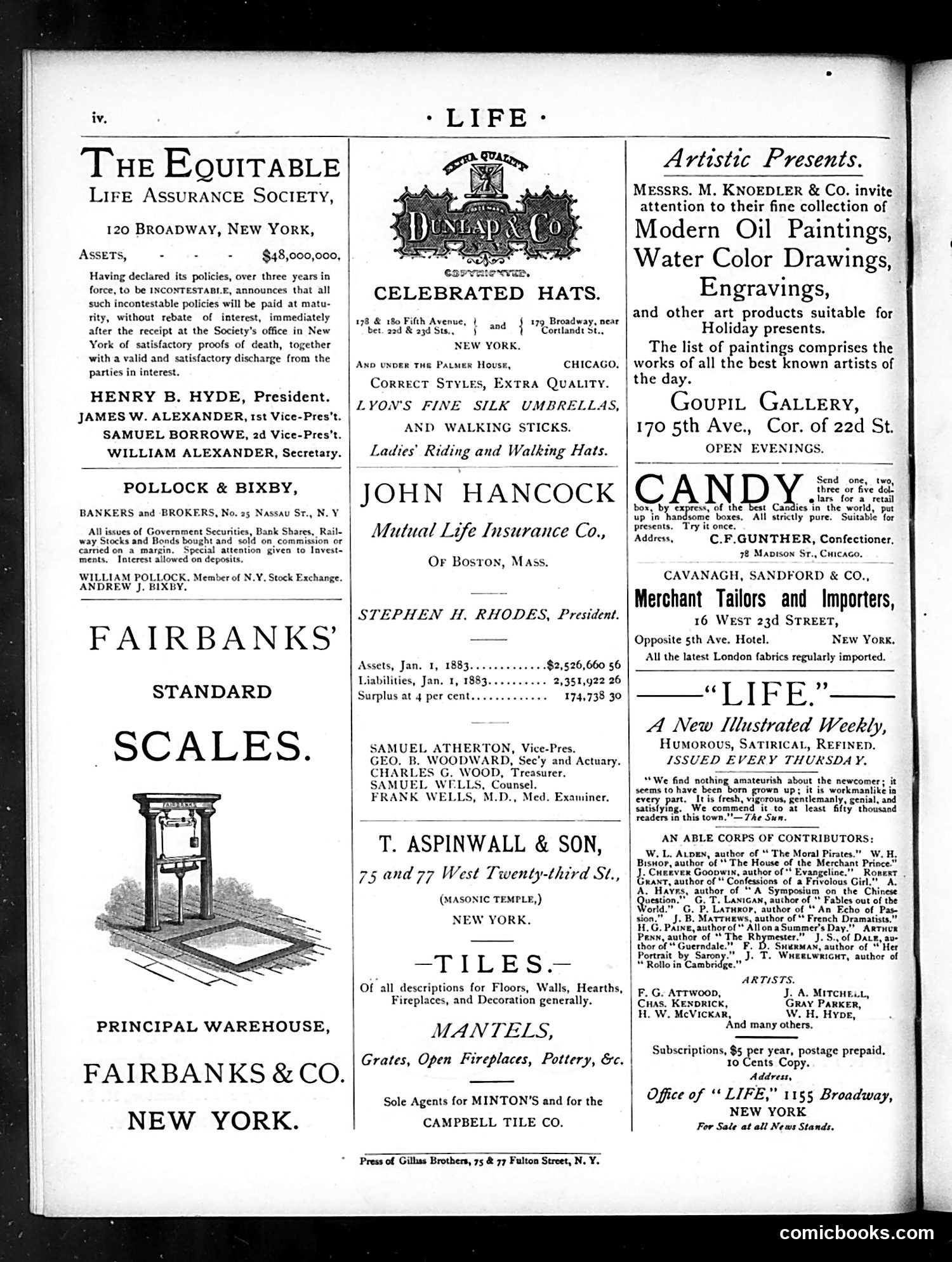
This is an advertising page from *Life* magazine, not a cartoon or satirical content page. It comprises business advertisements for financial institutions (Equitable Life Assurance, John Hancock Mutual Life Insurance, Pollock & Bixby Bankers), manufacturers (Fairbanks Scales, Dunlap hats, T. Aspinwall tiles), retailers (Goupil Gallery art, C.F. Gunther candies), and tailors. The only substantial editorial content is a promotional notice for *Life* itself—describing it as "A New Illustrated Weekly, Humorous, Satirical, Refined" and listing contributing writers. This serves as self-advertisement rather than political commentary. There are no visible political cartoons or satirical illustrations on this page to analyze.