
Life, 1883-03-08 · page 3 of 16
Life — March 8, 1883 — page 3: what you’re looking at
What you’re looking at
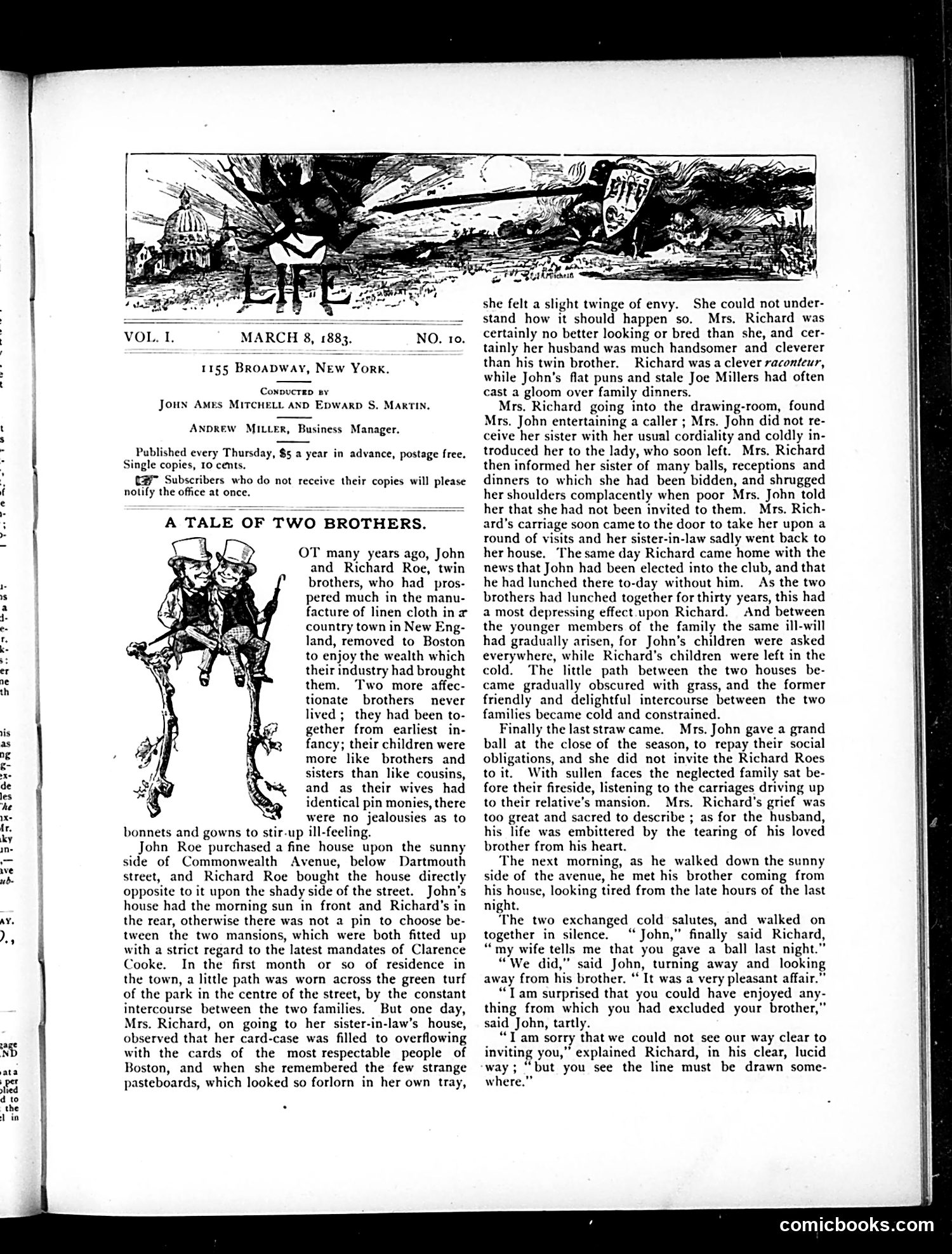
This page contains the opening of a short story titled "A Tale of Two Brothers," not a political cartoon. The illustration shows two identical twin brothers in 19th-century dress (top hats and coats) standing back-to-back in a somewhat confrontational pose. The story concerns two brothers, John and Richard Roe, who immigrated from England to Boston and became estranged due to social class differences and family rivalries. The narrative describes how their wives' jealousies—particularly Mrs. Richard resenting Mrs. John's social invitations and hospitality—deepened the rift between the families. This appears to be social satire examining class consciousness and family discord among the American upper-middle class of the 1880s, not political commentary.
📄 Transcribed text from this page (OCR, searchable)
Machine-transcribed from the original scan — historical spelling and the odd misread are preserved.
is. les X= | MARCH 8, 1883. 1155 Broapway, New York. ConpuctEp By Joun Ames MITCHELL AND EpwWarD S. MARTIN. ANDREW MILLER, Business Manager. Published every Thursday, $5 a year in advance, postage free. Single copies, 10 cents. C2" Subscribers who do not receive their copies will please notify the office at once. A TALE OF TWO BROTHERS. OT many years ago, John and Richard Roe, twin brothers, who had_pros- pered much in the manu- facture of linen cloth in x country town in New Eng- land, removed to Boston to enjoy the wealth which their industry had brought them. Two more affec- tionate brothers never lived ; they had been to- gether from earliest in- fancy; their children were more like brothers and sisters than like cousins, and as their wives had identical pin monies, there were no jealousies as to bonnets and gowns to stir-up ill-feeling. John Roe purchased a fine house upon the sunny side of Commonwealth Avenue, below Dartmouth street, and Richard Roe bought the house directly opposite to it upon the shady side of the street. John’s house had the morning sun in front and Richard's in the rear, otherwise there was not a pin to choose be- tween the two mansions, which were both fitted up with a strict regard to the latest mandates of Clarence Cooke. In the first month or so of residence in the town, a little path was worn across the green turf of the park in the centre of the street, by the constant intercourse between the two families. But one day, Mrs. Richard, on going to her sister-in-law’s house, observed that her card-case was filled to overflowing with the cards of the most respectable people of Boston, and when she remembered the few strange pasteboards, which looked so forlorn in her own tray, she felt a slight twinge of envy. She could not under- stand how it should happen so. Mrs. Richard was certainly no better looking or bred than she, and cer- tainly her husband was much handsomer and cleverer than his twin brother. Richard was a clever raconteur, while John’s flat puns and stale Joe Millers had often cast a gloom over family dinners. Mrs. Richard going into the drawing-room, found Mrs. John entertaining a caller ; Mrs. John did not re- ceive her sister with her usual cordiality and coldly in- troduced her to the lady, who soon left. Mrs. Richard then informed her sister of many balls, receptions and dinners to which she had been bidden, and shrugged her shoulders complacently when poor Mrs. John told her that she had not been invited to them. Mrs. Rich- ard’s carriage soon came to the door to take her upon a round of visits and her sister-in-law sadly went back to her house. e same day Richard came home with the news that John had been elected into the club, and that he had lunched there to-day without him. As the two brothers had lunched together for thirty years, this had a most depressing effect upon Richard. And between the younger members of the family the same ill-will had gradually arisen, for John’s children were asked everywhere, while Richard’s children were left in the cold. The little path between the two houses be- came gradually obscured with grass, and the former friendly and delightful intercourse between the two families became cold and constrained. Finally the last straw came. Mrs. John gave a grand ball at the close of the season, to repay their social obligations, and she did not invite the Richard Roes to it. With sullen faces the neglected family sat be- fore their fireside, listening to the carriages driving up to their relative’s mansion. Mrs. Richard's grief was too great and sacred to describe ; as for the husband, his life was embittered by the tearing of his loved brother from his heart. The next morning, as he walked down the sunny side of the avenue, he met his brother coming from his house, looking tired from the late hours of the last night. ‘The two exchanged cold salutes, and walked on together in silence. “John,” finally said Richard, “my wife tells me that you gave a ball last night.” “We did,” said John, turning away and looking away from his brother. “ It was a very pleasant affair.” “Tam surprised that you could have enjoyed any- thing from which you had excluded your brother,” said John, tartly. “Tam sorry that we could not see our way clear to inviting you,” explained Richard, in his clear, lucid way; “but you see the line must be drawn some- where.” comicbooks.com