
Life, 1883-03-08 · page 7 of 16
Life — March 8, 1883 — page 7: what you’re looking at
What you’re looking at
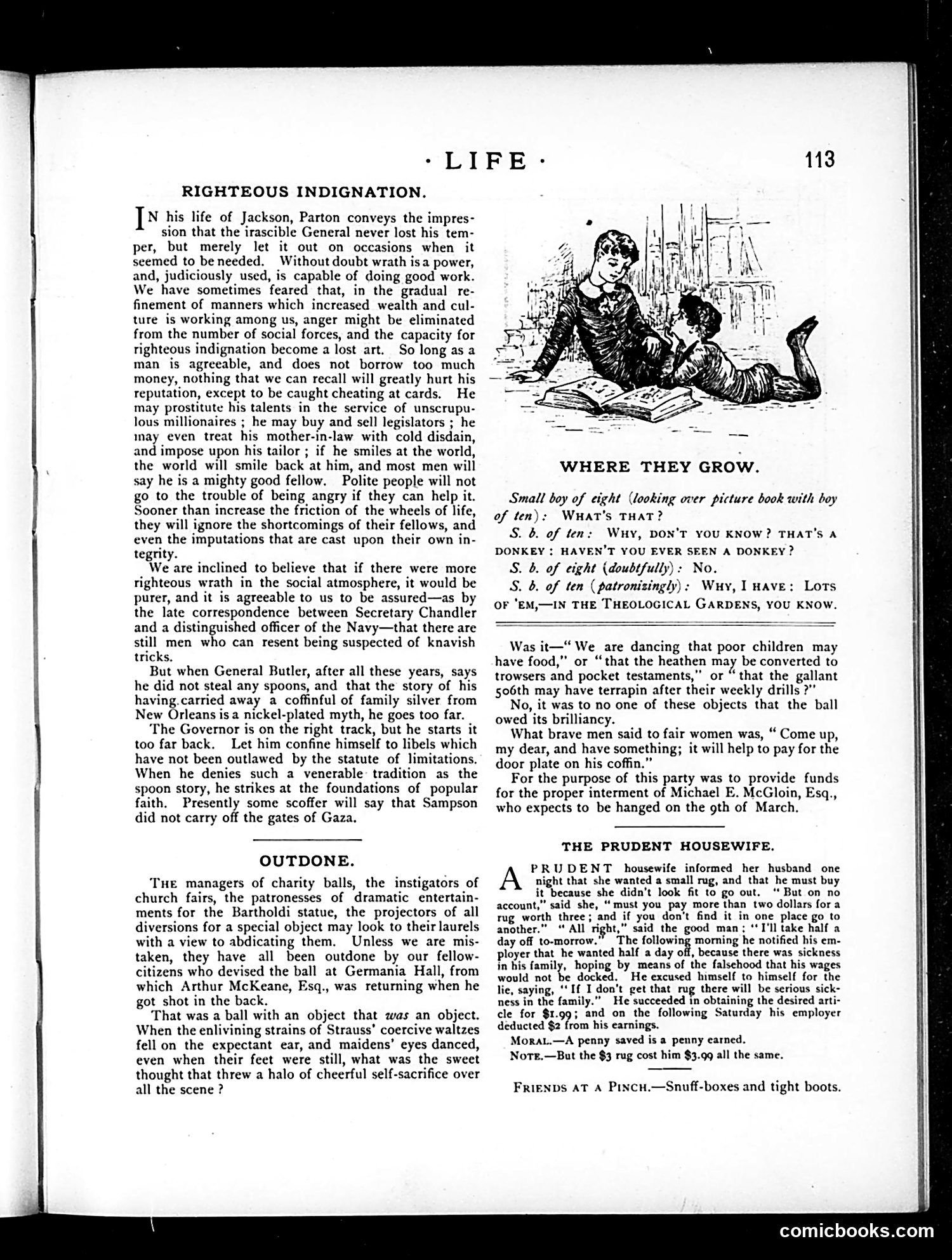
The illustration titled "WHERE THEY GROW" depicts a young boy examining a picture book while another boy (labeled as age ten) looks on. The accompanying dialogue humorously presents a child's misunderstanding: when asked what he's looking at, the boy claims it's "a donkey," but the older boy insists he's never seen one. This appears to be gentle satire on urban children's isolation from rural life and animals. The joke—that city children lack basic knowledge of farm animals—reflects early 20th-century concerns about urbanization's effects on youth education and experience. The surrounding text discusses various social topics including charity balls, family finances, and household economy, presenting satirical commentary on contemporary middle-class concerns and values rather than political figures.
📄 Transcribed text from this page (OCR, searchable)
Machine-transcribed from the original scan — historical spelling and the odd misread are preserved.
*~LIFE-: RIGHTEOUS INDIGNATION. [y his life of Jackson, Parton conveys the impres- sion that the irascible General never lost his tem- per, but merely let it out on occasions when it seemed to be needed. Without doubt wrath isa power, and, judiciously used, is capable of doing good work. We have sometimes feared that, in the gradual re- finement of manners which increased wealth and cul- ture is working among us, anger might be eliminated from the number of social forces, and the capacity for righteous indignation become a lost art. So long as a man is agreeable, and does not borrow too much money, nothing that we can recall will greatly hurt his reputation, except to be caught cheating at cards. He may prostitute his talents in the service of unscrupu- lous millionaires ; he may buy and sell legislators ; he may even treat his mother-in-law with cold disdain, and impose upon his tailor ; if he smiles at the world, the world will smile back at him, and most men will say he is a mighty good fellow. Polite people will not go to the trouble of being angry if they can help it. Sooner than increase the friction of the wheels of life, they will ignore the shortcomings of their fellows, and even the imputations that are cast upon their own in- tegrity. We are inclined to believe that if there were more righteous wrath in the social atmosphere, it would be purer, and it is agreeable to us to be assured—as by the late correspondence between Secretary Chandler and a distinguished officer of the Navy—that there are still men who can resent being suspected of knavish tricks. But when General Butler, after all these years, says he did not steal any spoons, and that the story of his having.carried away a coffinful of family silver from New Orleans is a nickel-plated myth, he goes too far. The Governor is on the right track, but he starts it too far back. Let him confine himself to libels which have not been outlawed by the statute of limitations, When he denies such a venerable: tradition as the spoon story, he strikes at the foundations of popular faith. Presently some scoffer will say that Sampson did not carry off the gates of Gaza. OUTDONE. Tue managers of charity balls, the instigators of church fairs, the patronesses of dramatic entertain- ments for the Bartholdi statue, the projectors of all diversions for a special object may look to their laurels with a view to abdicating them. Unless we are mis- taken, they have all been outdone by our fellow- citizens who devised the ball at Germania Hall, from which Arthur McKeane, Esq., was returning when he got shot in the back. That was a ball with an object that was an object. When the enlivining strains of Strauss’ coercive waltzes fell on the expectant ear, and maidens’ eyes danced, even when their feet were still, what was the sweet thought that threw a halo of cheerful self-sacrifice over all the scene ? WHERE THEY GROW. Small boy of eight (looking over picture book with boy of ten): Wat's THAT? S. b. of ten: Why, von'T You KNOW? THAT'S A DONKEY : HAVEN’T YOU EVER SEEN A DONKEY? S. b. of eight (doubtfully): No. S. 6. of ten ( patronizingly): Wy, 1 Have: Lots OF ‘EM,—IN THE THEOLOGICAL GARDENS, YOU KNOW. Was it—“ We are dancing that poor children may have food,” or “that the heathen may be converted to trowsers and pocket testaments,” or “that the gallant 506th may have terrapin after their weekly drills ?” No, it was to no one of these objects that the ball owed its brilliancy. What brave men said to fair women was, “ Come up, my dear, and have something; it will help to pay for the door plate on his coffin.” For the purpose of this party was to provide funds for the proper interment of Michael E. McGloin, Esq., who expects to be hanged on the gth of March. THE PRUDENT HOUSEWIFE. PRUDENT housewife informed her husband one A night that she wanted a small rug, and that he must buy it because she didn’t look fit to go out. ‘ But on no account,” said she, “must you pay more than two dollars fora rug worth three; and if you don’t find it in one place go to another.” “ All right,” said the good man; ‘‘I'll take half a day off to-morrow.” ‘The following morning he notified his em- ployer that he wanted half a day off, because there was sickness in his family, hoping by means of the falsehood that his wages would not Ye docked. He excused himself to himself for the lie, saying, ‘If I don’t get that rug there will be serious sick- ness in the family.” He succeeded in obtaining the desired arti- cle for $1.99; and on the following Saturday his employer deducted $2 from his earnings. Morat.—A penny saved is a penny earned. Nore.—But the $3 rug cost him $3.99 all the same. FRIENDS AT A Pincu.—Snuff-boxes and tight boots. comicbooks.com