
A complete issue · 16 pages · 1883
Life — February 1, 1883
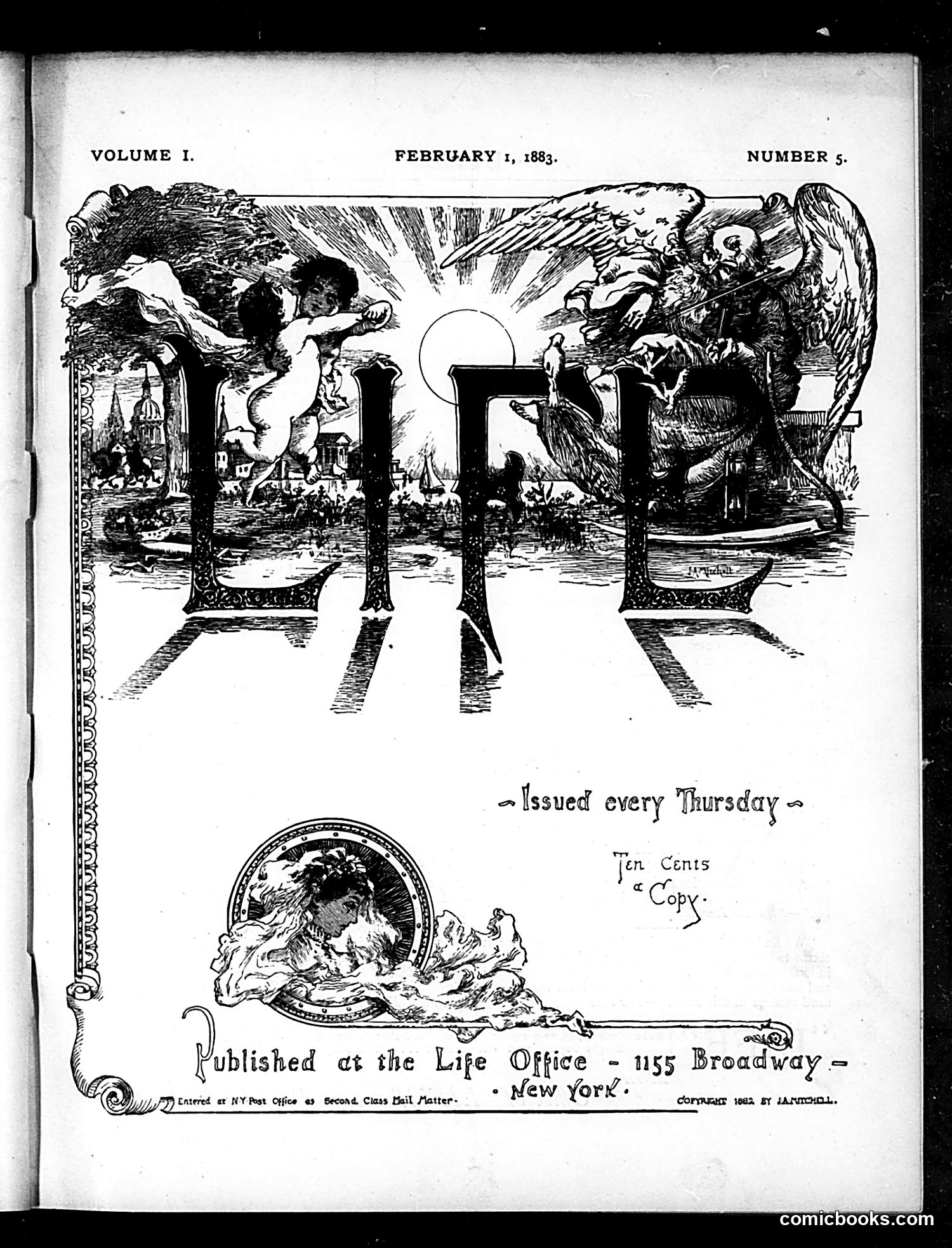
This is the cover of *Life* magazine's first issue (Volume 1, Number 5), published at 1155 Broadway in New York. The elaborate illustration depicts classical allegorical figures—cherubs and winged beings—overlooking a romantic landscape with a rising sun. The imagery suggests themes of enlightenment, new beginnings, or artistic inspiration typical of *Life's* aesthetic mission. The specific political or social satire is unclear from the image alone. The ornate, allegorical style was common for magazine mastheads of this era, serving more as artistic branding than commentary. Without additional context about what events or figures dominated early 1883, the particular satirical target—if any—cannot be determined from this cover alone.
This page is **entirely promotional material** — not a cartoon or satirical content. It comprises press quotes advertising the magazine *Life* itself. The page showcases favorable reviews from newspapers like *The Tribune*, *Washington Republic*, *Troy Times*, and *Boston Evening Star*, praising *Life* as a new illustrated weekly publication launched in New York (January 4, at ten cents per issue). The reviews emphasize its **artistic illustrations, refined humor, and high-quality typography** — positioned as sophisticated entertainment for "drawing room and club" audiences rather than mass market readers. One quote compares it favorably to *Punch*, suggesting it aims to be America's answer to the famous British satirical magazine. Subscription information appears at the bottom: $5 yearly, with office at 1155 Broadway, N.Y.
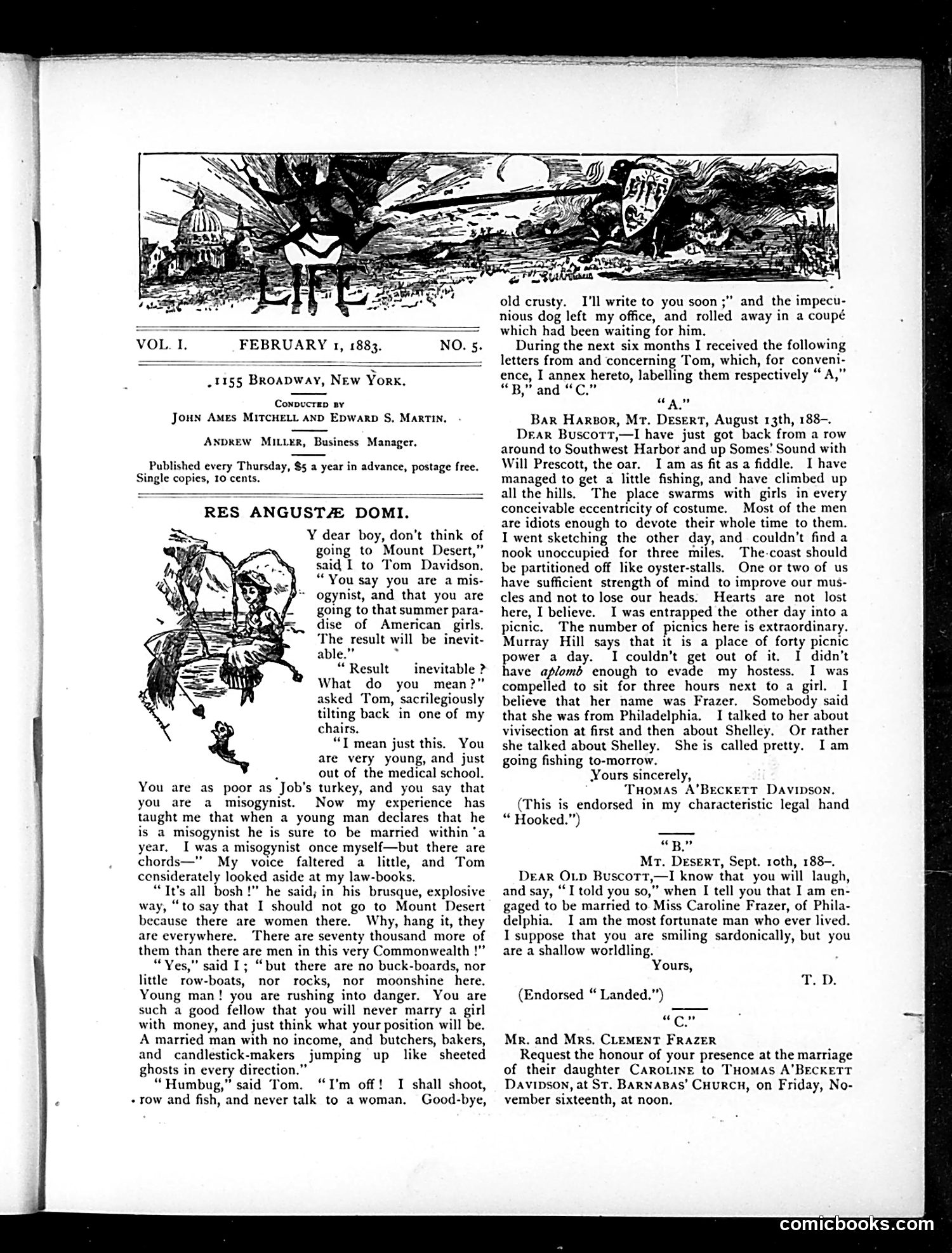
The page contains a satirical essay titled "RES ANGUSTÆ DOMI" (Latin for "narrow/straitened circumstances at home"), accompanied by an illustration of a young couple in apparent domestic discord. The text is a dialogue where Tom Davidson tries to dissuade a friend from marrying by describing his own miserable marriage—portraying married life as financially burdensome and emotionally constraining. He mentions "seventy thousand" women in the Commonwealth, sarcastically suggesting the friend will find one willing to marry a poor man. The satire targets romantic idealism about marriage while revealing anxieties about class, poverty, and gender roles in 1880s America. The cartoon's sketch of the couple reinforces the theme of domestic unhappiness and financial strain that the essay develops through Tom's cynical monologue.
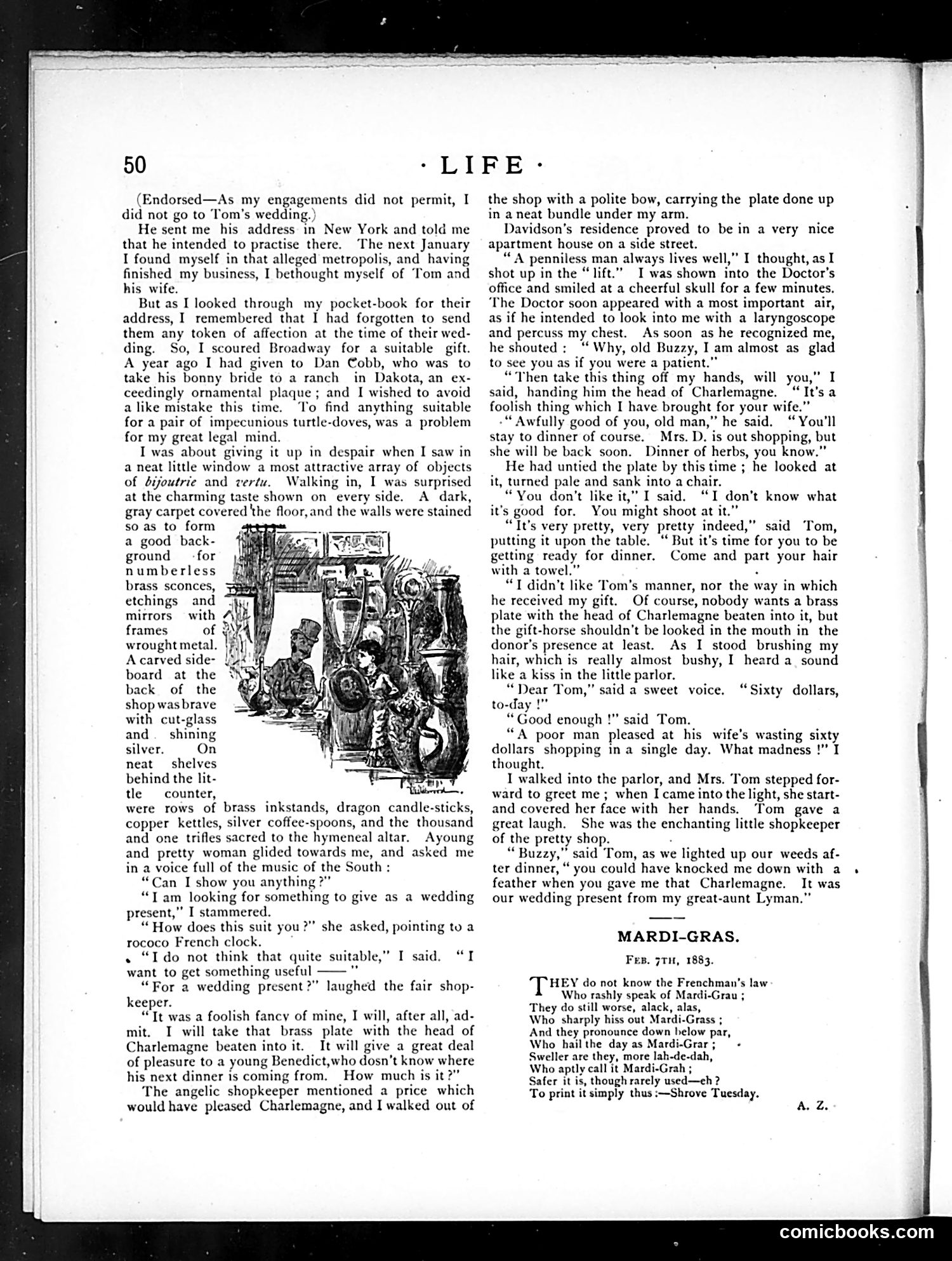
This page contains a narrative story titled "Mardi-Gras" (dated Feb. 7th, 1883) rather than political cartoons. The text describes a gentleman's misadventure shopping for a wedding gift in New Orleans, where he impulsively purchases an ornate brass plate decorated with the head of Charlemagne. The accompanying illustration shows a cluttered antique shop interior. The humor derives from the protagonist's poor judgment: he buys an impractical, gaudy gift—a decorative plate with a historical figure's head—when the shopkeeper and his acquaintance Tom both mock the choice as unsuitable for a newlywed's home. The satire targets Victorian-era pretension and the anxiety surrounding appropriate gift-giving conventions.
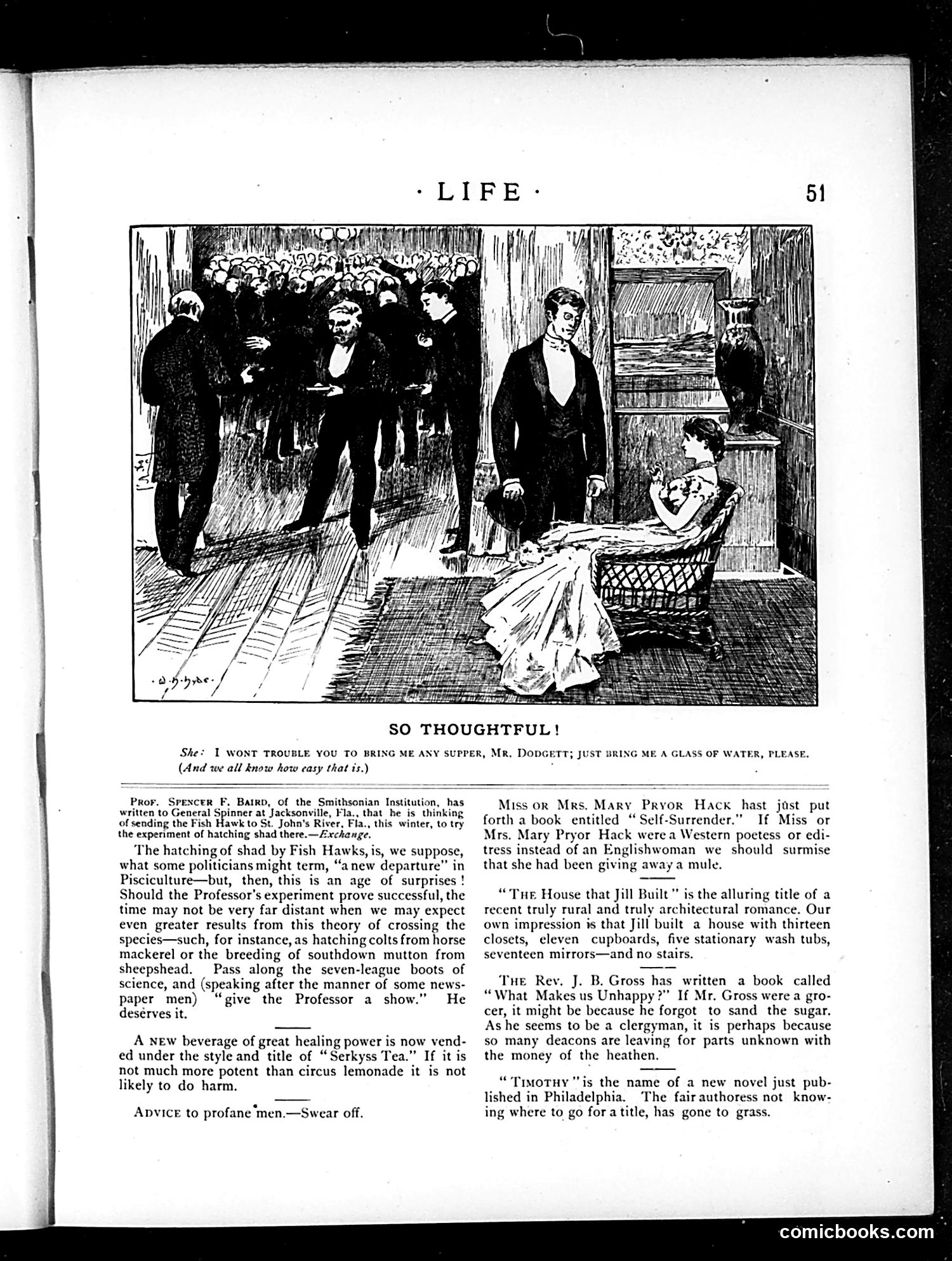
This cartoon satirizes upper-class social pretense. A well-dressed woman, seated and fanning herself, has asked a male servant (likely a Dodgett) for water instead of supper—supposedly out of consideration for his labor. The joke mocks her false thoughtfulness: she presents herself as considerate while making an unusual, arguably inconsiderate request that disrupts normal service. The gathered guests in the background suggest this is performative kindness displayed for social approval rather than genuine concern. The satire targets Victorian-era affectation—the performance of virtue and refinement among the wealthy as a status display. The cartoon implies that truly thoughtful people wouldn't make such peculiar demands masquerading as selflessness.
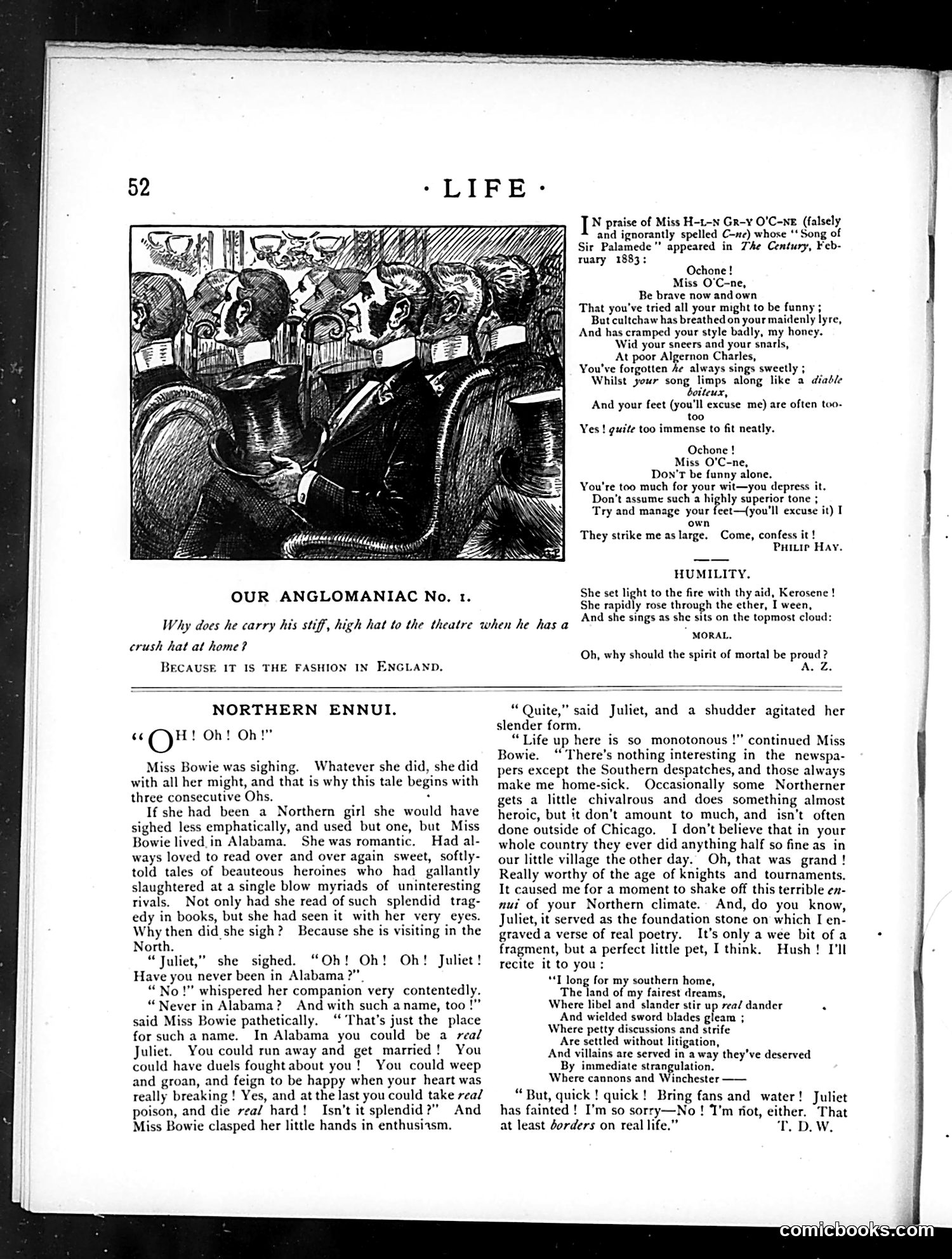
The main cartoon, "OUR ANGLOMANIAC NO. 1," satirizes English fashion pretension among Americans. It depicts a man wearing an absurdly tall top hat to the theater despite having a "crush" (romantic interest) at home. The caption's joke—"Because it is the fashion in England"—mocks Americans who slavishly adopt British fashions regardless of practicality or appropriateness. The rest of the page contains "Northern Ennui," a fictional story about Miss Bowie, a visiting Northerner who sighs dramatically about her Southern home. The narrative satirizes both romantic affectation and regional stereotypes, poking fun at women who romanticize their hometowns while finding contemporary life dull. The included verse parodies sentimental Southern nostalgia.
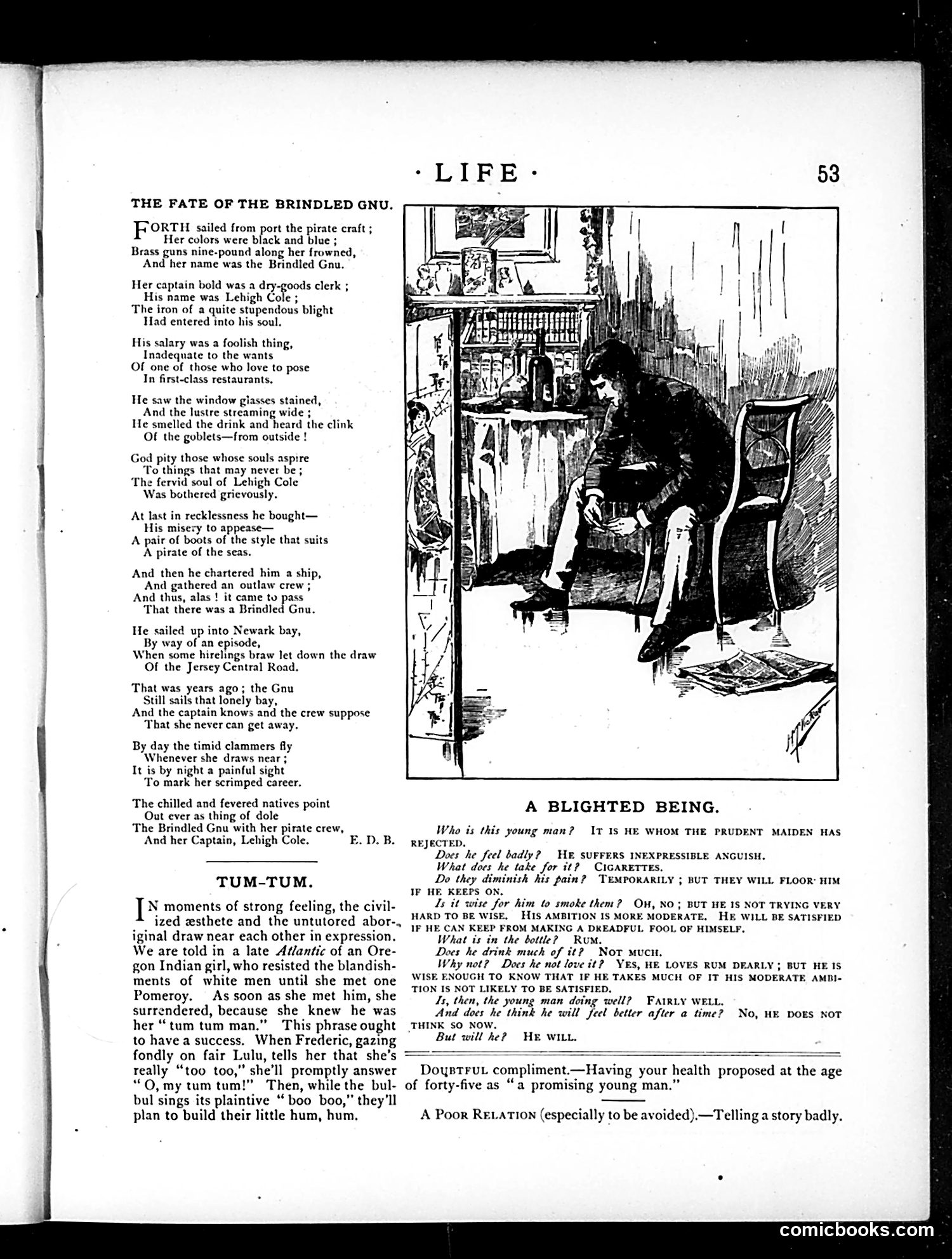
This page contains two distinct literary pieces rather than political cartoons: 1. **"The Fate of the Brindled Gnu"** - A narrative poem about a pirate ship captain (Leigh Cole) who is poorly paid despite working in fashionable restaurants. The accompanying illustration shows a dejected man in what appears to be a kitchen or dining establishment. The satirical point seems to target low wages for service workers despite working in upscale establishments—a social commentary on economic inequality. 2. **"Tum-Tum"** - A brief humorous piece mocking sentimentality and overwrought romantic expressions, suggesting that women's declarations of love ("too too") are often insincere or performative. Both pieces use satire to critique social pretension and economic injustice of the era, typical of *Life* magazine's satirical approach to American society.
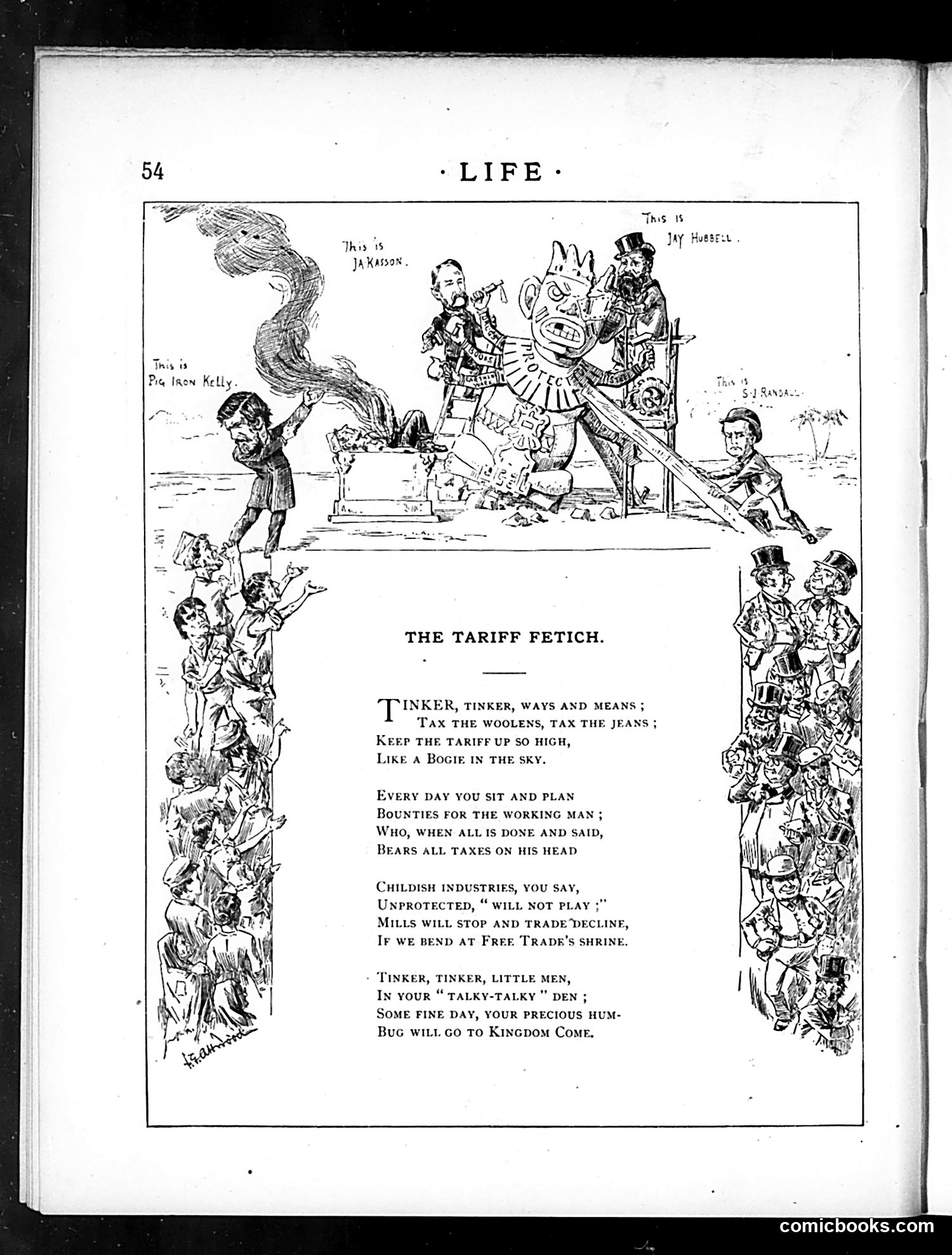
This Life magazine cartoon satirizes American protectionist tariff policies. The central illustration depicts political figures (labeled as Jameson, Jay Russell, and others) manipulating a large figure labeled as representing tariff protection—treating it like an idol or "fetich" (fetish). The poem criticizes politicians who maintain high tariffs to protect domestic industries while claiming this benefits workers. The satire argues this is actually false—the working man bears the tax burden, industries remain childish and uncompetitive, and free trade would ultimately benefit everyone. The flanking illustrations show common citizens crushed beneath the tariff's weight, emphasizing the ordinary person's suffering from these protectionist policies. This reflects late 19th/early 20th-century debates between protectionists and free-trade advocates.
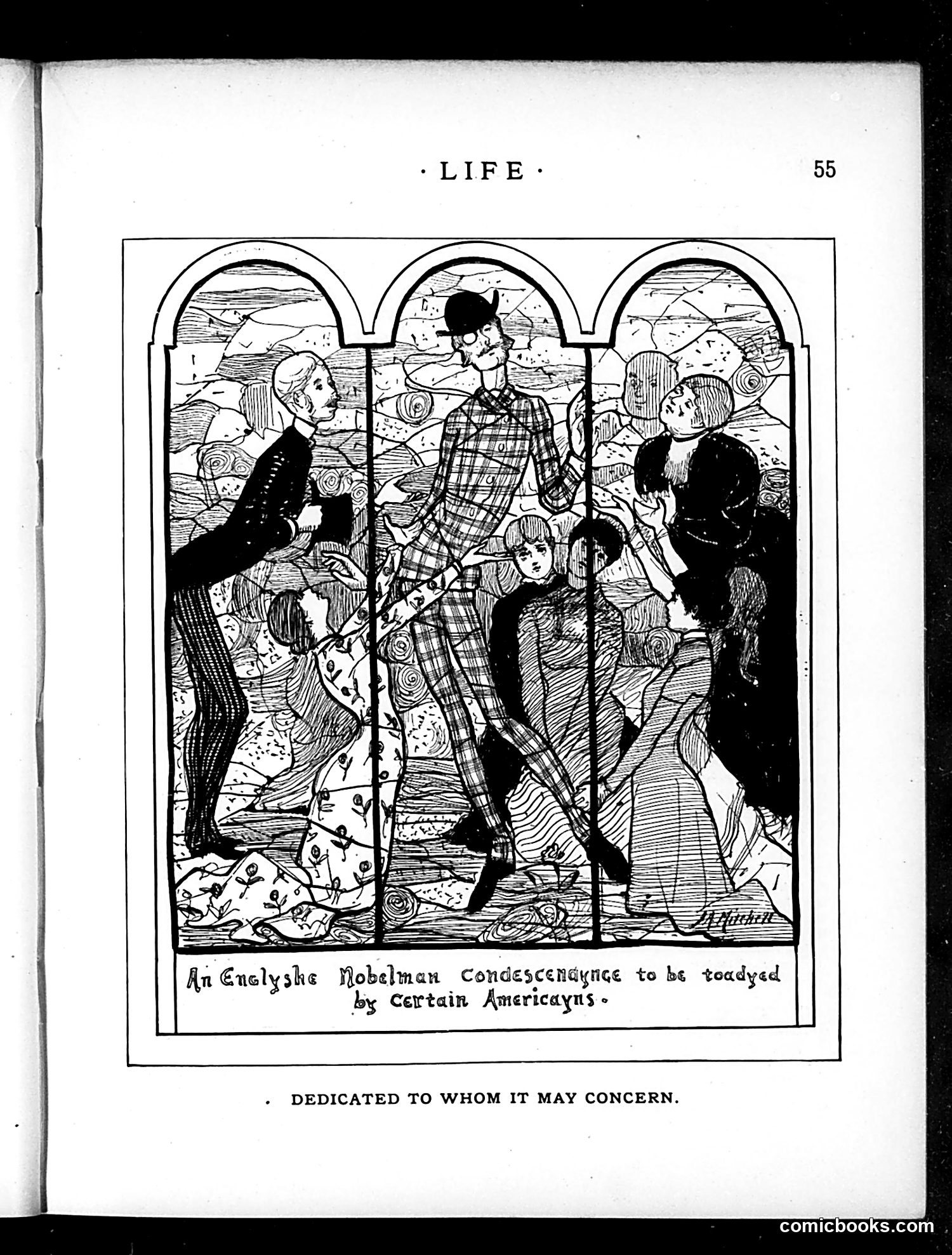
This satirical cartoon from *Life* magazine depicts "An English Nobleman Condescended to be readyed by Certain Americayns" — a joke about class differences and transatlantic cultural attitudes. The image shows a well-dressed English aristocrat (center, in plaid) being attended to by several American figures who are helping him prepare or "get ready." The elaborate arched frames and formal composition parody religious or formal portraiture. The satire targets English snobbery toward Americans, suggesting that even English nobility must rely on American assistance, while the condescending tone of the caption mocks the nobleman's presumed superiority. The humor derives from the contrast between the Englishman's apparent disdain and his actual dependence on American help — a commentary on Anglo-American relations that likely resonated with *Life's* American audience.
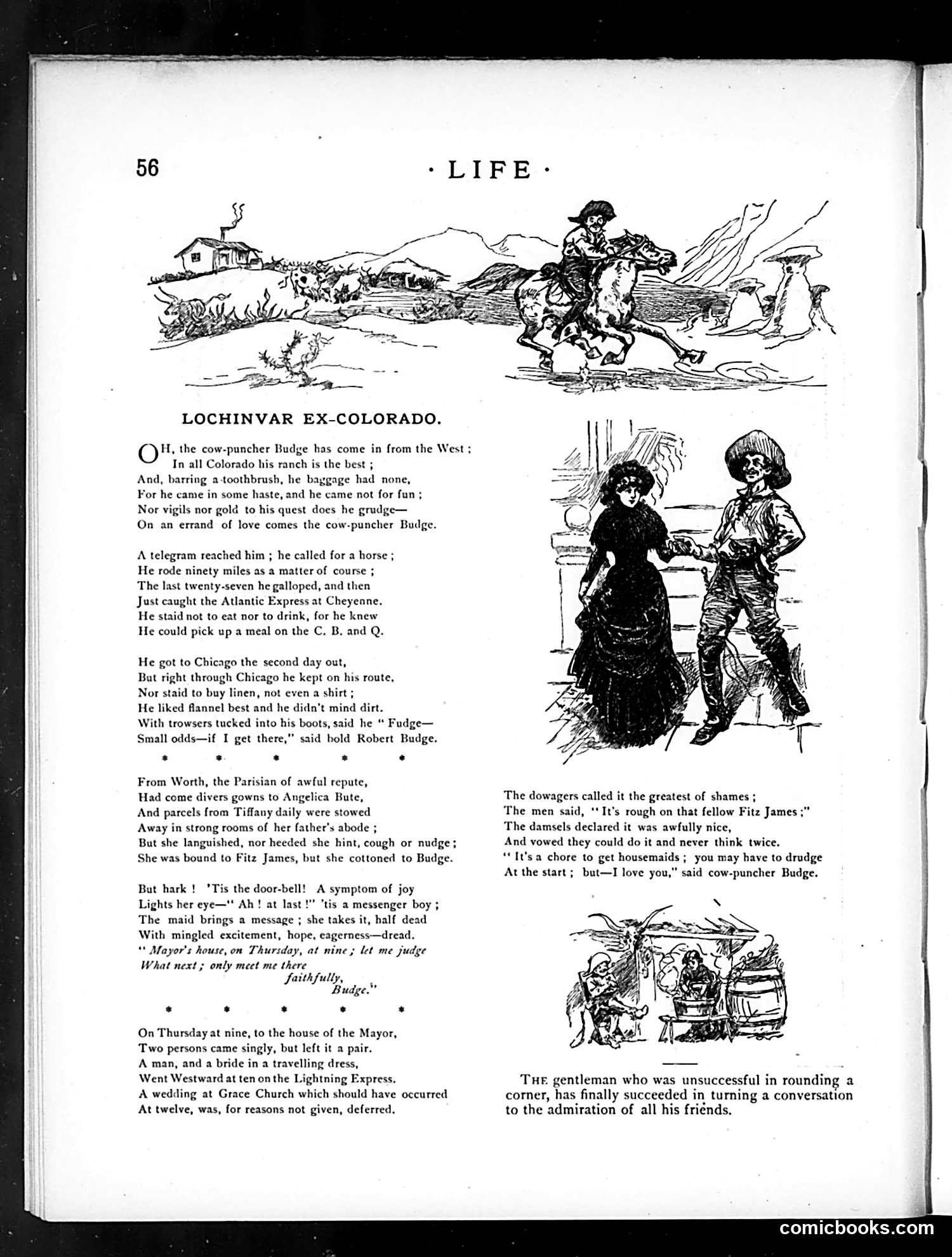
This poem parodies the romantic ballad "Lochinvar" by Walter Scott. A rough Colorado cow-puncher named Budge receives a telegram and rushes east to win Angelica Bute, a wealthy New York heiress. She's expected to marry the refined "Fitz James," but abandons that arranged society wedding to elope with Budge instead—leaving by train in traveling clothes. The satire mocks both genteel Eastern society (her dowries from Paris, Tiffany jewels, Grace Church wedding) and romantic convention. Budge's working-class lack of refinement (no luggage, flannel shirt, dirt-tolerant) contrasts with upper-class expectations, yet he succeeds through earnest devotion. The humor targets snobbish society's disapproval ("greatest of shames") while celebrating the heroine's choice of genuine love over social status.
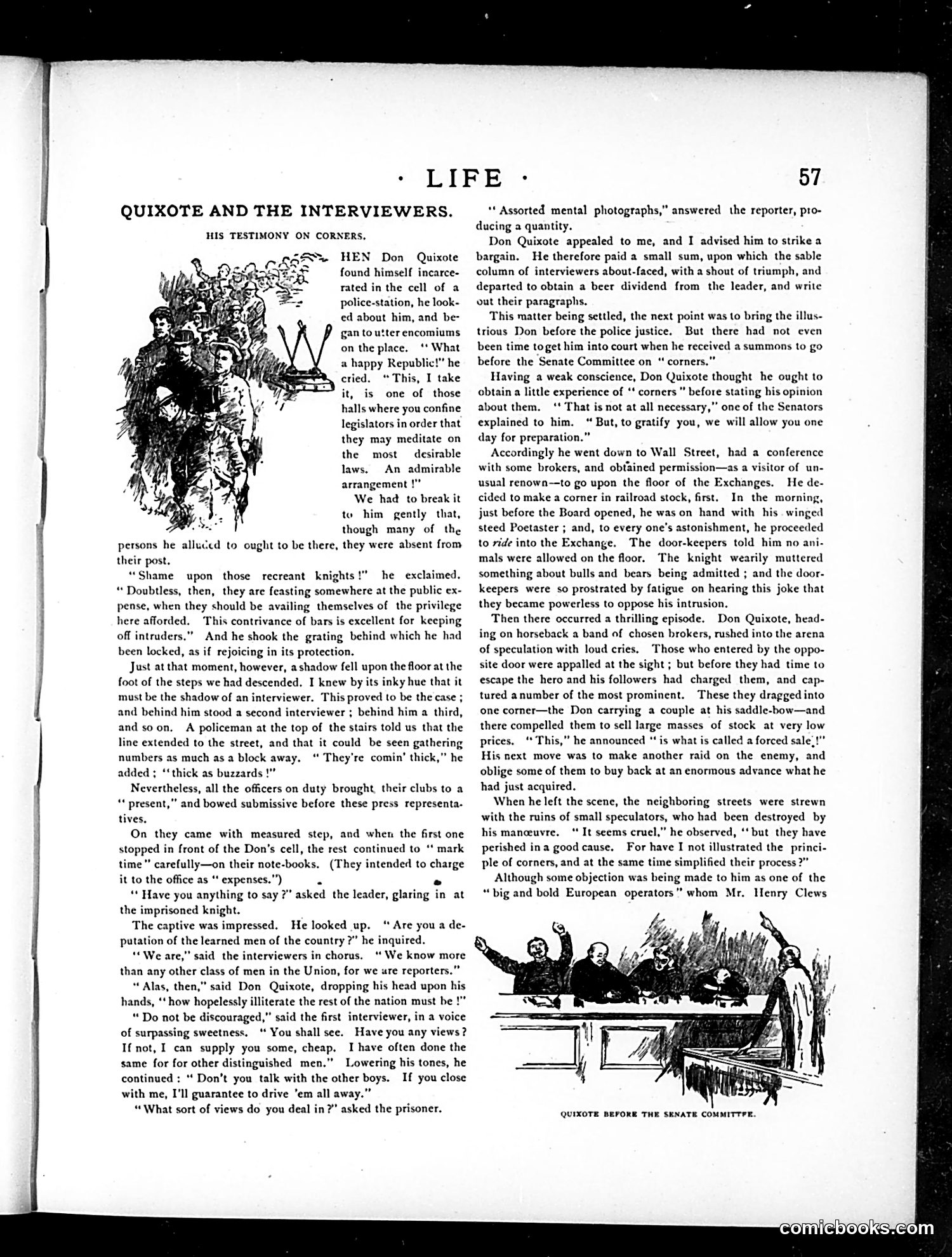
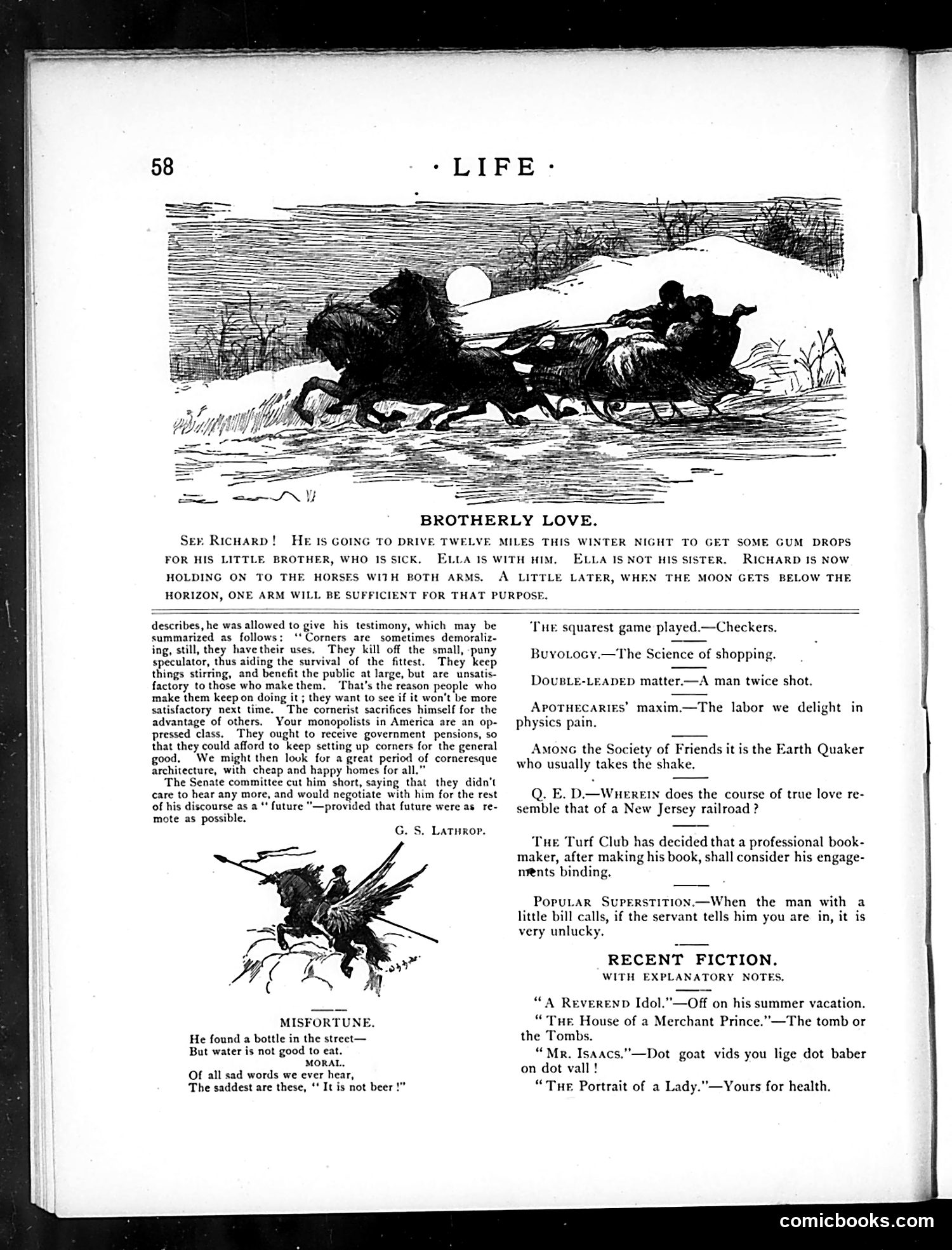
The main cartoon depicts a young man (Richard) driving a horse-drawn sleigh at night with a young woman (Ella). The caption's humor lies in its innuendo: Richard ostensibly travels twelve miles in winter to obtain cough drops for his sick brother, but the final line reveals the satire—"one arm will be sufficient for that purpose" once the moon sets, implying romantic activity rather than errand-running. This mocks courtship customs of the era, where young couples used pretexts to be alone together. The "brotherly love" title ironically contrasts the stated innocent purpose with the actual romantic intent. The page also contains various satirical quips about Wall Street speculation, checkers, shopping, and literary titles with humorous "explanations"—typical of Life magazine's witty, brief social commentary.
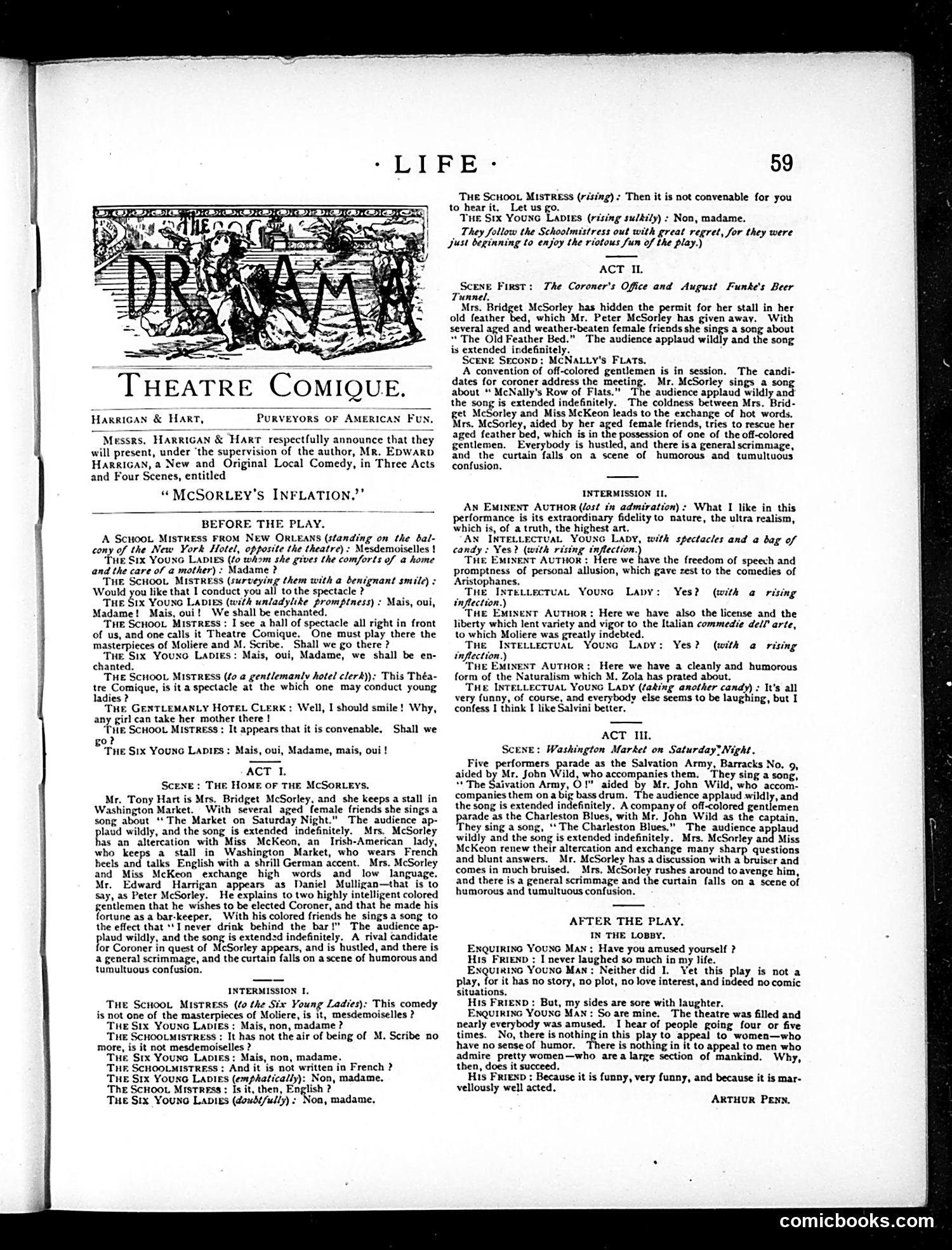
This page advertises a theatrical comedy by Harrigan & Hart, prominent 19th-century American entertainers. The satire operates on multiple levels: **The Frame Story**: A pretentious French schoolmistress from New Orleans escorts six young ladies to the Theatre Comique, seeking "masterpieces of Moliere and M. Scribe"—references to canonical European dramatists. She's scandalized by the actual Irish-American vaudeville performance and leaves in disgust, while her charges remain delighted. **The Play Itself**: "McSorley's Inflation" depicts working-class Irish-American characters—market vendors, bar-keepers, and Irish-German immigrants—in boisterous, unrefined situations involving political scheming for a Coroner position and market-stall conflicts. **The Joke**: The satire mocks both the schoolmistress's European cultural snobbery and the crude but genuinely entertaining American popular theater. It's a defense of American vernacular comedy against pretentious Continental taste, while also gently ridiculing the characters depicted.
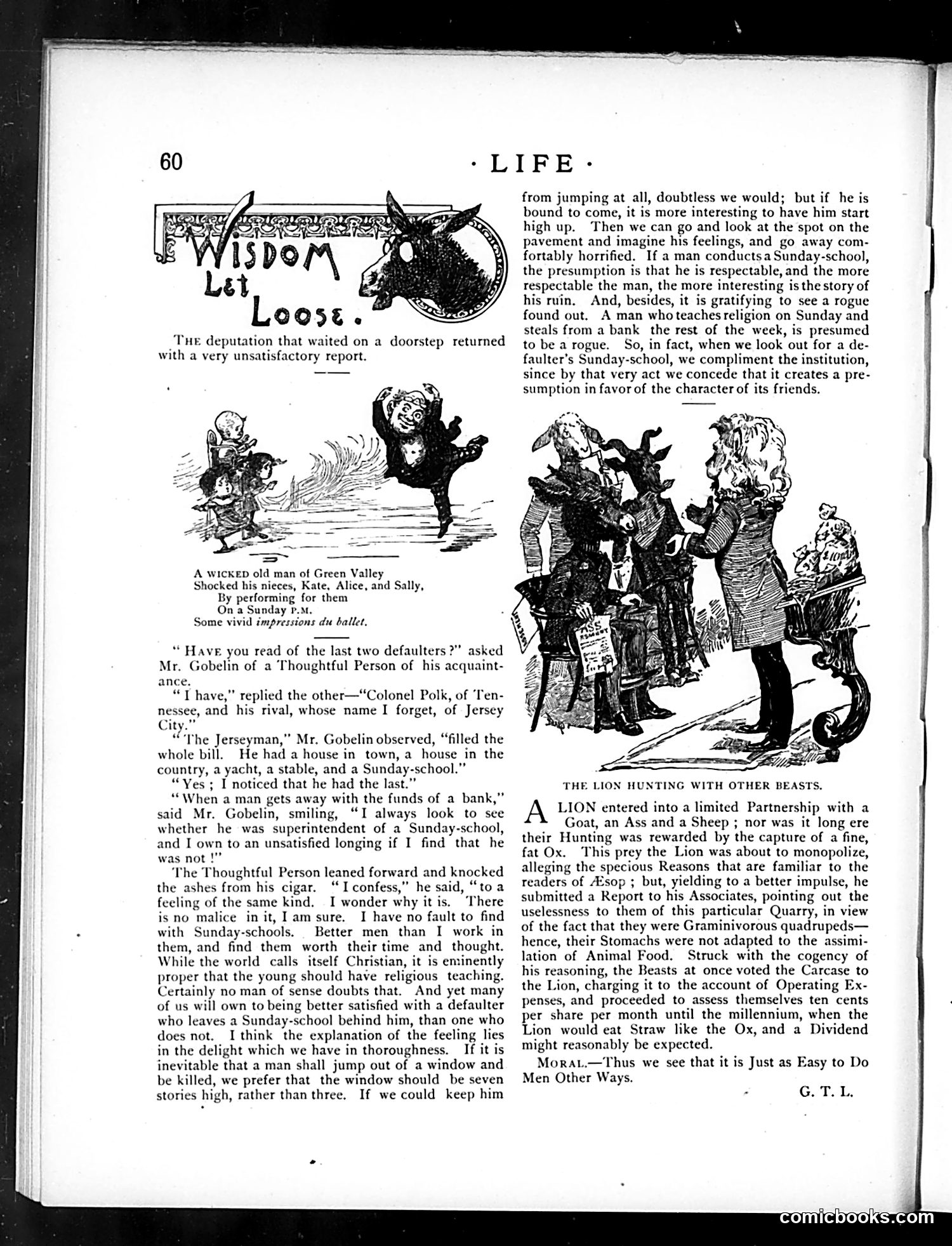
This page from *Life* magazine contains two satirical pieces mocking hypocrisy and financial fraud. **"Wisdom Let Loose"** (top) ridicules bank embezzlers who are also Sunday-school superintendents. The dialogue between Mr. Gobelin and a Thoughtful Person observes that respectable men (particularly those involved in religious education) who steal from banks are more "interesting" villains—their fall from grace is more dramatic. The satire targets how society grants moral credibility to religious figures, making their crimes more shocking. References to "Colonel Polk of Tennessee" and a Jersey City defaulter appear to reference actual banking scandals, though specific identities aren't clarified in the text. **"The Lion Hunting with Other Beasts"** (bottom) is an *Aesop's Fables* parody satirizing corporate profit-sharing schemes. A Lion partners with herbivorous animals to hunt an Ox, then monopolizes the kill by claiming it's worthless to vegetarians. The other animals accept this "reasoning" and agree to monthly assessments while the Lion keeps all benefits—a critique of how management exploits workers through sophistry and false economies. Both pieces expose how authority figures use rhetoric to justify unfair advantage-taking.
This page is **primarily advertising**, not a cartoon or satirical content. It consists entirely of commercial advertisements from late 19th-century New York businesses. The ads include: - **Financial services**: The Mutual Life Insurance Company, A.G. Heminway & Co. (bankers), Pollock & Bixby (brokers) - **Hotels and dining**: Grand Union Hotel, "Common Sense" Lunch Room - **Retail goods**: H.B. Kirk & Co. (whiskey), Cavanagh, Sandford & Co. (tailors), Esterbrook Steel Pens, Goupil Gallery (art) There are **no political cartoons or satirical images visible** on this page. The quoted lines from the lunch room advertisement ("Not that we think us worthy such a guest / But that your worth will dignify our feast") appear to be courtesy phrases rather than satire. This is a typical advertorial page from *Life* magazine's early era, when it functioned partly as a society and commercial publication.
This page is primarily **advertising**, not political satire. It contains four commercial advertisements from late 19th-century New York businesses: 1. **W. & J. Sloane** - carpet and rug merchant 2. **Fairbanks & Co.** - manufacturer of weighing scales 3. **The Critic** - a literary journal edited by J.L. and J.B. Gilder, positioned as America's premier review of literature, arts, and drama 4. **James Pyle's Pearline** - a laundry product claiming superiority over soap There are **no political cartoons or caricatures visible** on this page. The only illustration is a technical drawing of a Fairbanks scale. The page reflects turn-of-the-century consumer culture and advertising conventions, with endorsements positioned as authoritative (London Academy, Springfield Republican quotes for *The Critic*). The Pearline ad's warning against "vile imitations" suggests competitive market anxieties typical of the era.