
Life, 1883-02-01 · page 14 of 16
Life — February 1, 1883 — page 14: what you’re looking at
What you’re looking at
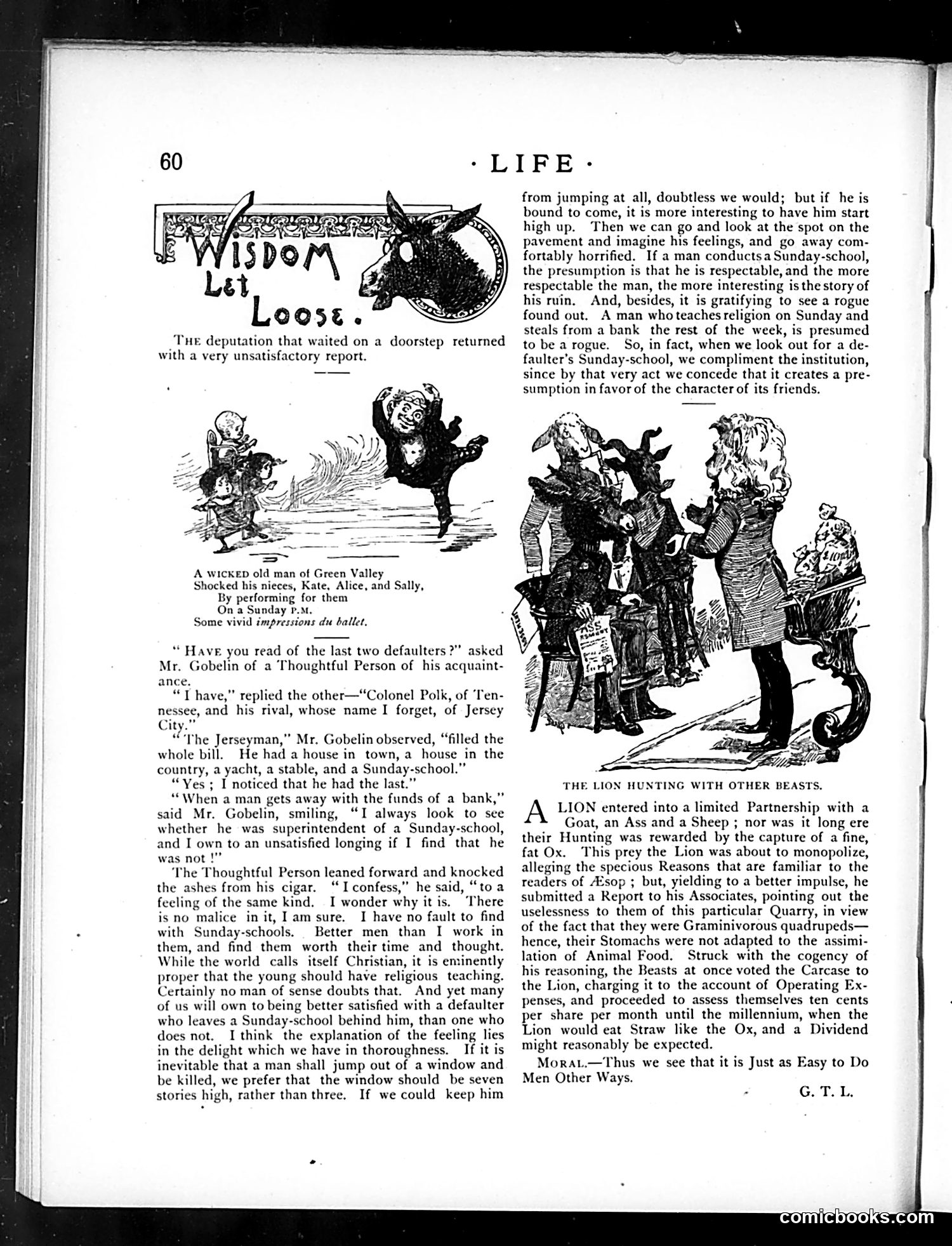
This page from *Life* magazine contains two satirical pieces mocking hypocrisy and financial fraud. **"Wisdom Let Loose"** (top) ridicules bank embezzlers who are also Sunday-school superintendents. The dialogue between Mr. Gobelin and a Thoughtful Person observes that respectable men (particularly those involved in religious education) who steal from banks are more "interesting" villains—their fall from grace is more dramatic. The satire targets how society grants moral credibility to religious figures, making their crimes more shocking. References to "Colonel Polk of Tennessee" and a Jersey City defaulter appear to reference actual banking scandals, though specific identities aren't clarified in the text. **"The Lion Hunting with Other Beasts"** (bottom) is an *Aesop's Fables* parody satirizing corporate profit-sharing schemes. A Lion partners with herbivorous animals to hunt an Ox, then monopolizes the kill by claiming it's worthless to vegetarians. The other animals accept this "reasoning" and agree to monthly assessments while the Lion keeps all benefits—a critique of how management exploits workers through sophistry and false economies. Both pieces expose how authority figures use rhetoric to justify unfair advantage-taking.
📄 Transcribed text from this page (OCR, searchable)
Machine-transcribed from the original scan — historical spelling and the odd misread are preserved.
-LIFE- _Tue deputation that waited on a doorstep returned with a very unsatisfactory report. A wickep old man of Green Valley Shocked his nieces, Kate, Alice, and Sally, By performing for them On a Sunday p.m. Some vivid impressions du ballet. “ Have you read of the last two defaulters ?” asked Mr. Gobelin of a Thoughtful Person of his acquaint- ance, “T have,” replied the other—“Colonel Polk, of ‘Ten- nessee, and his rival, whose name I forget, of Jersey City.” “The Jerseyman,” Mr. Gobelin observed, “filled the whole bill. He had a house in town, a house in the country, a yacht, a stable, and a Sunday-school.” “Yes ; I noticed that he had the last.” “When a man gets away with the funds of a bank,” said Mr. Gobelin, smiling, “I always look to see whether he was superintendent of a Sunday-school, and I own to an unsatisfied longing if I find that he was not !” he Thoughtful Person leaned forward and knocked the ashes from his cigar. “I confess,” he said, “to a feeling of the same kind. I wonder why it is. There is no malice in it, Iam sure. I have no fault to find with Sunday-schools. Better men than I work in them, and find them worth their time and thought. While the world calls itself Christian, it is eminently proper that the young should have religious teaching. Certainly no man of sense doubts that. And yet many of us will own to being better satisfied with a defaulter who leaves a Sunday-school behind him, than one who does not. I think the explanation of the feeling lies in the delight which we have in thoroughness. If it is inevitable that a man shall jump out of a window and be killed, we prefer that the window should be seven stories high, rather than three. If we could keep him from jumping at all, doubtless we would; but if he is bound to come, it is more interesting to have him start high up. Then we can go and look at the spot on the pavement and imagine his feelings, and go away com- fortably horrified. If a man conductsa Sunday-school, the presumption is that he is respectable, and the more respectable the man, the more interesting is the story of his ruin. And, besides, it is gratifying to see a rogue found out. A man whoteaches religion on Sunday and steals from a bank the rest of the week, is presumed to be a rogue. So, in fact, when we look out for a de- faulter’s Sunday-school, we compliment the institution, since by that very act we concede that it creates a pre- sumption in favor of the character of its friends. THE LION HUNTING WITH OTHER BEASTS, LION entered into a limited Partnership with a Goat, an Ass and a Sheep ; nor was it long ere their Hunting was rewarded by the capture of a fine, fat Ox. This prey the Lion was about to monopolize, alleging the specious Reasons that are familiar to the readers of Asop ; but, yielding to a better impulse, he submitted a Report to his Associates, pointing out the uselessness to them of this particular Quarry, in view of the fact that they were Graminivorous quadrupeds— hence, their Stomachs were not adapted to the assimi- lation of Animal Food. Struck with the cogency of his reasoning, the Beasts at once voted the Carcase to the Lion, charging it to the account of Operating Ex- penses, and proceeded to assess themselves ten cents per share per month until the millennium, when the Lion would eat Straw like the Ox, and a Dividend might reasonably be expected. Morau.—Thus we see that it is Just as Easy to Do Men Other Ways. - G.T.L.