A complete issue · 36 pages · 1934
Judge — May 1934
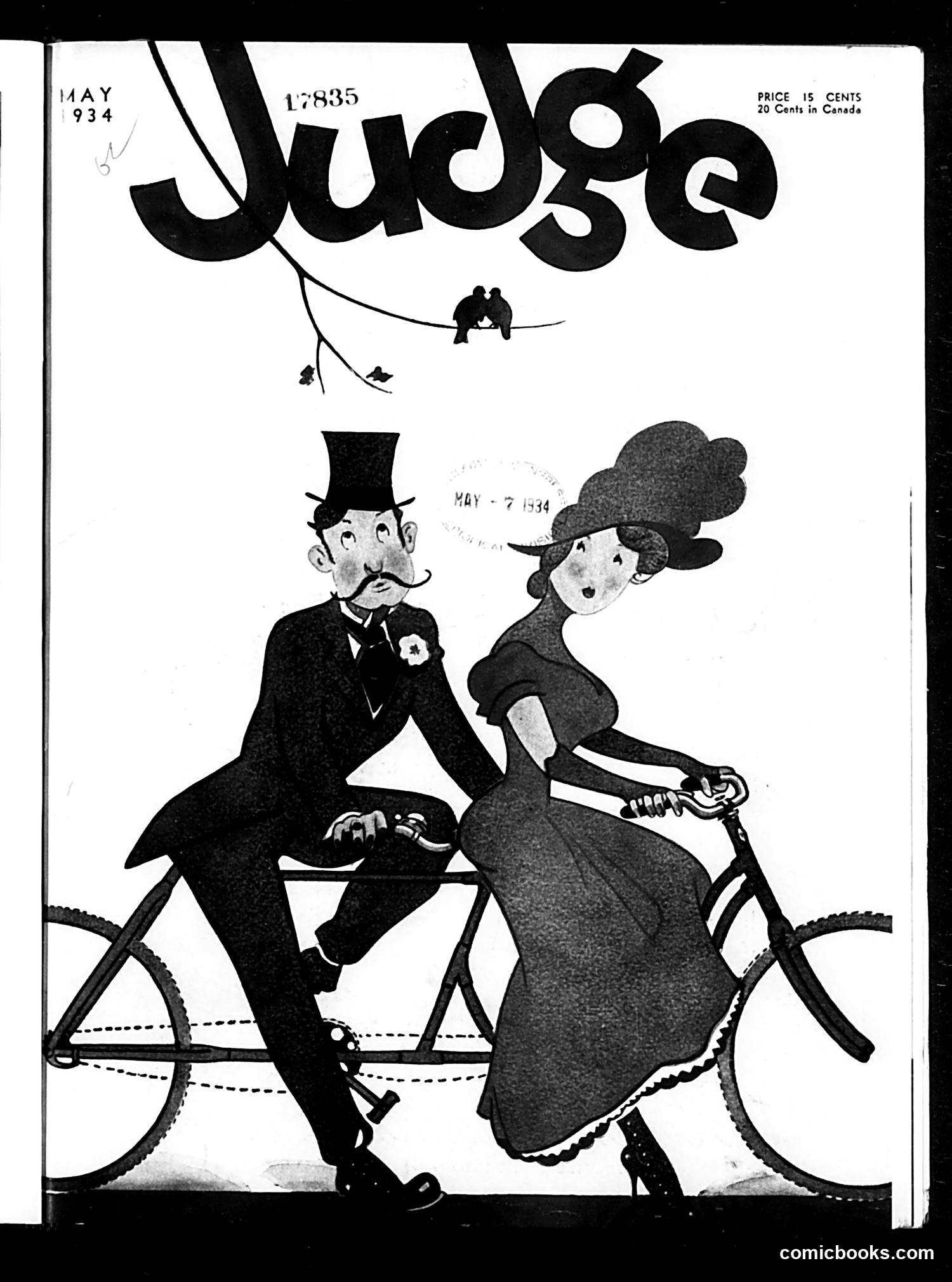
# Judge Magazine Cover Analysis - May 1934 This is a Judge magazine cover from May 1934 featuring an illustration of two elegantly dressed figures sharing a tandem bicycle. The man wears a top hat and monocle with an exaggerated mustache, while the woman sports a fashionable hat and dress typical of 1930s high society. The cartoon appears to satirize wealthy or upper-class romance and courtship during the Depression era. The tandem bicycle—requiring cooperation and coordination—likely comments on romantic partnership or marriage dynamics among the elite. The characters' refined appearance contrasts with economic hardship many Americans faced in 1934, suggesting social satire about the disconnected lifestyles of the wealthy. The specific individuals depicted remain unclear without additional context.
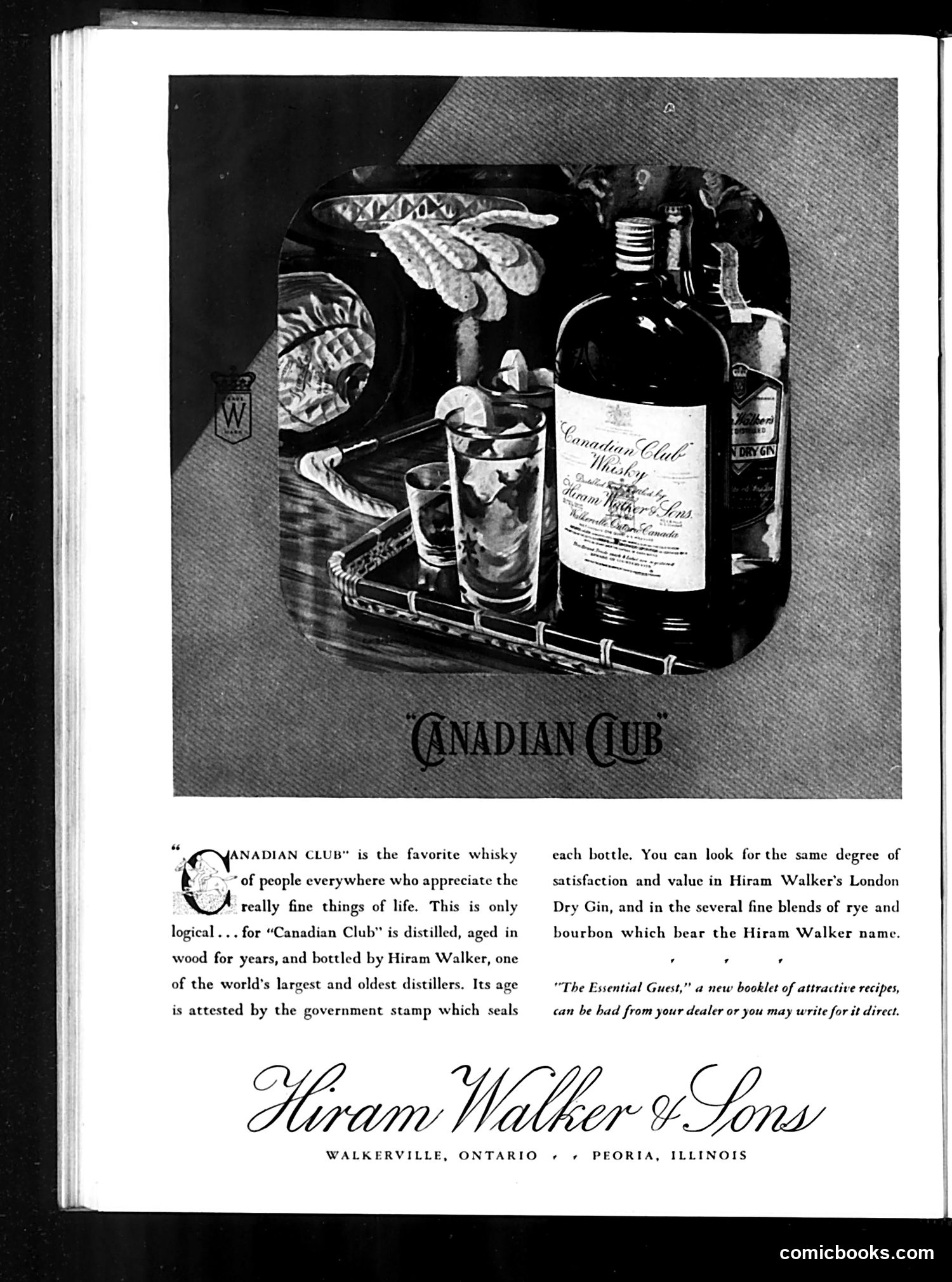
# Analysis This page is primarily **advertising, not political satire**. It's a full-page advertisement for Canadian Club whiskey, produced by Hiram Walker & Sons (located in Walkerville, Ontario and Peoria, Illinois). The ad uses an elegant still-life composition showing a bottle of Canadian Club whiskey, two glasses with ice and what appears to be drinks, and decorative plates with food imagery. The text emphasizes the whiskey's age, wood-aging process, and government certification of quality. There is no cartoon or political commentary here. Judge magazine included paid advertisements alongside its satirical content. This particular ad appeals to readers who "appreciate the really fine things of life" and promotes Canadian Club as a luxury product. The mention of "The Essential Guest" booklet suggests tie-in promotional materials.
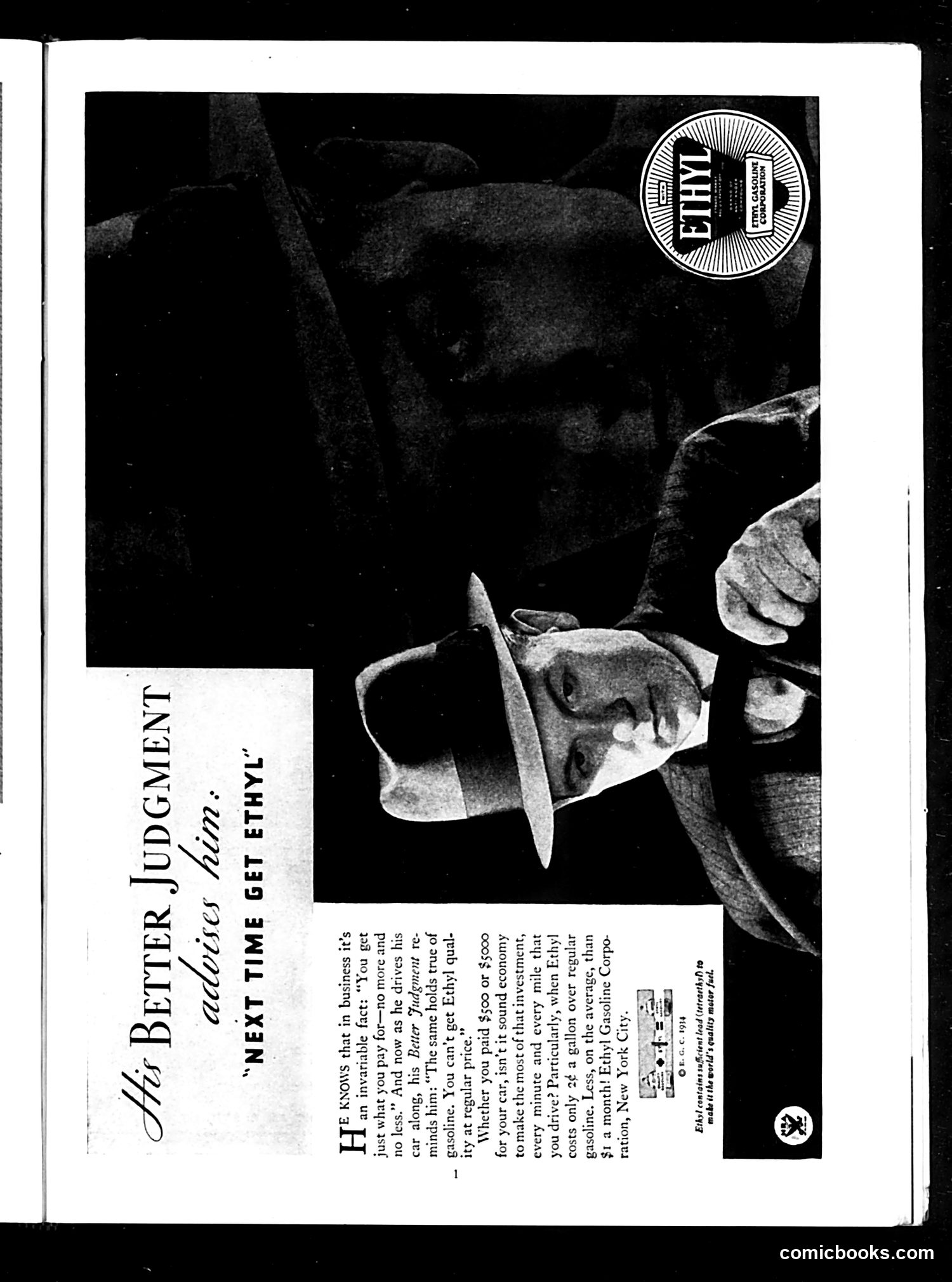
# Analysis This Judge magazine page advertises a product called "His Better Judgment" with the tagline "Carries Him 'Next Time Get Ethyl.'" The advertisement features a photograph of a man in a hat and coat, appearing to be in some kind of distressed or awkward situation. The accompanying text suggests the product relates to automobile fuel or additives—likely Ethyl gasoline, a popular brand of the early-to-mid 20th century known for anti-knock properties. The humor appears to play on the phrase "better judgment," implying that using Ethyl fuel represents smarter decision-making for drivers. The man's awkward pose suggests he's learned a lesson about fuel choice, making this a straightforward product advertisement rather than political satire. This represents typical Judge magazine promotional content from the gasoline/automotive industry era.
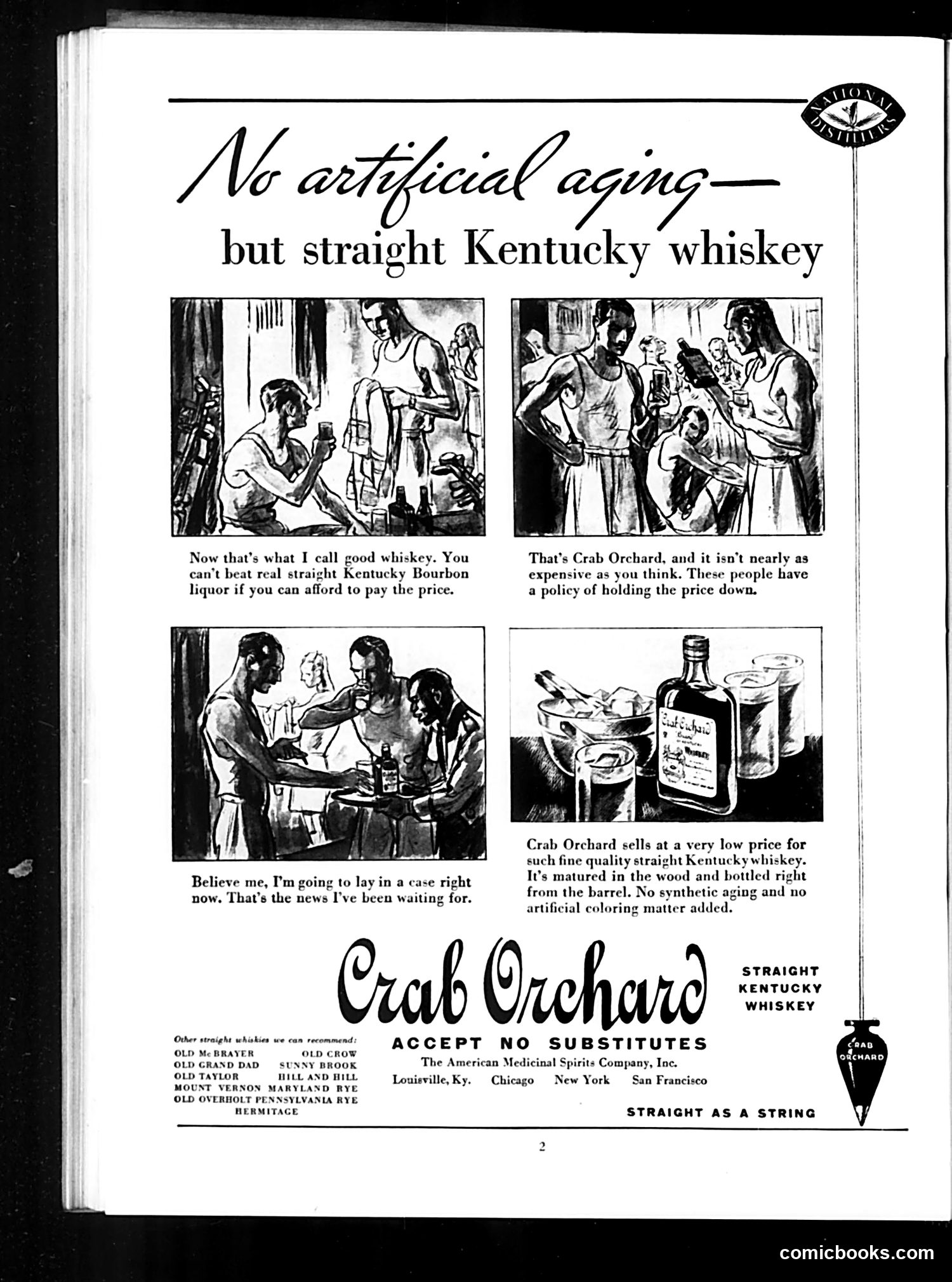
# Crab Orchard Whiskey Advertisement This is a **whiskey advertisement**, not political satire. The four comic panels tell a narrative promoting Crab Orchard brand straight Kentucky whiskey. The story shows people discussing whiskey quality and price. The dialogue emphasizes that Crab Orchard offers "good whiskey" at an affordable price—a selling point during economically conscious times. The final panels display the product itself and reiterate its authenticity: "matured in the wood and bottled right from the barrel. No synthetic aging and no artificial coloring matter added." The ad's tagline, "Straight as a String," plays on the product name while suggesting reliability and honesty. The manufacturer, American Medicinal Spirits Company, lists multiple whiskey brands they produce, reflecting Prohibition's end (whiskey was again legal).
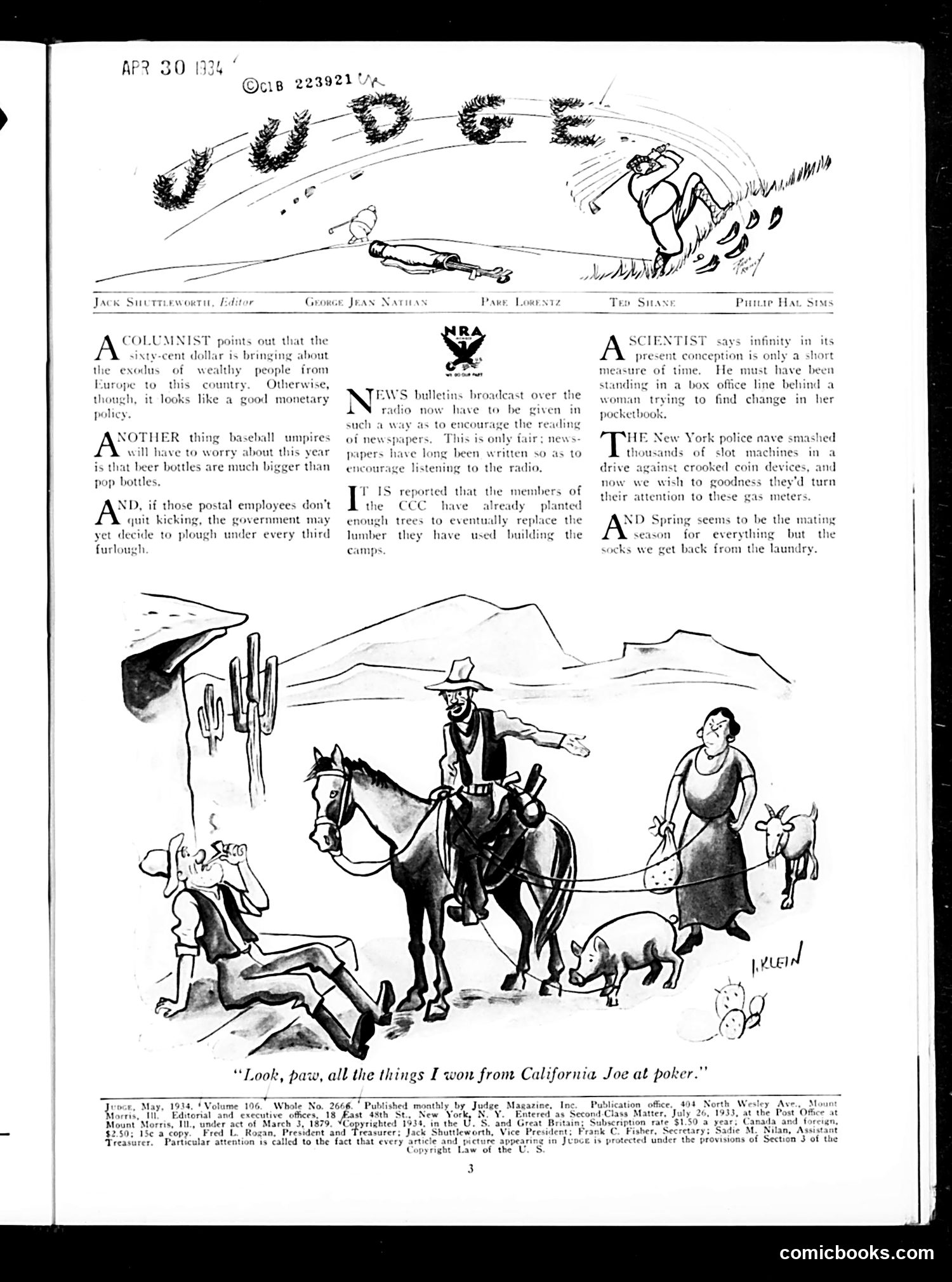
# Judge Magazine Satire Analysis (April 30, 1924) The main cartoon depicts a cowboy showing off his winnings to a woman with livestock, captioned "Look, paw, all the things I won from California Joe at poker." The satire mocks gambling culture and the notion of winning possessions (a horse, goats, pig) through card games—suggesting reckless wagering where people stake tangible assets rather than money. The accompanying brief commentary items target contemporary issues: postal employees' job security, beer bottle sizes (likely Prohibition-era humor), and NYC police efforts against slot machines. A scientist's observation about infinity and a woman's datebook offers absurdist humor about spring dating season. The page combines editorial satire with comic observations typical of Judge's format—mixing visual humor with topical commentary on 1920s American life.
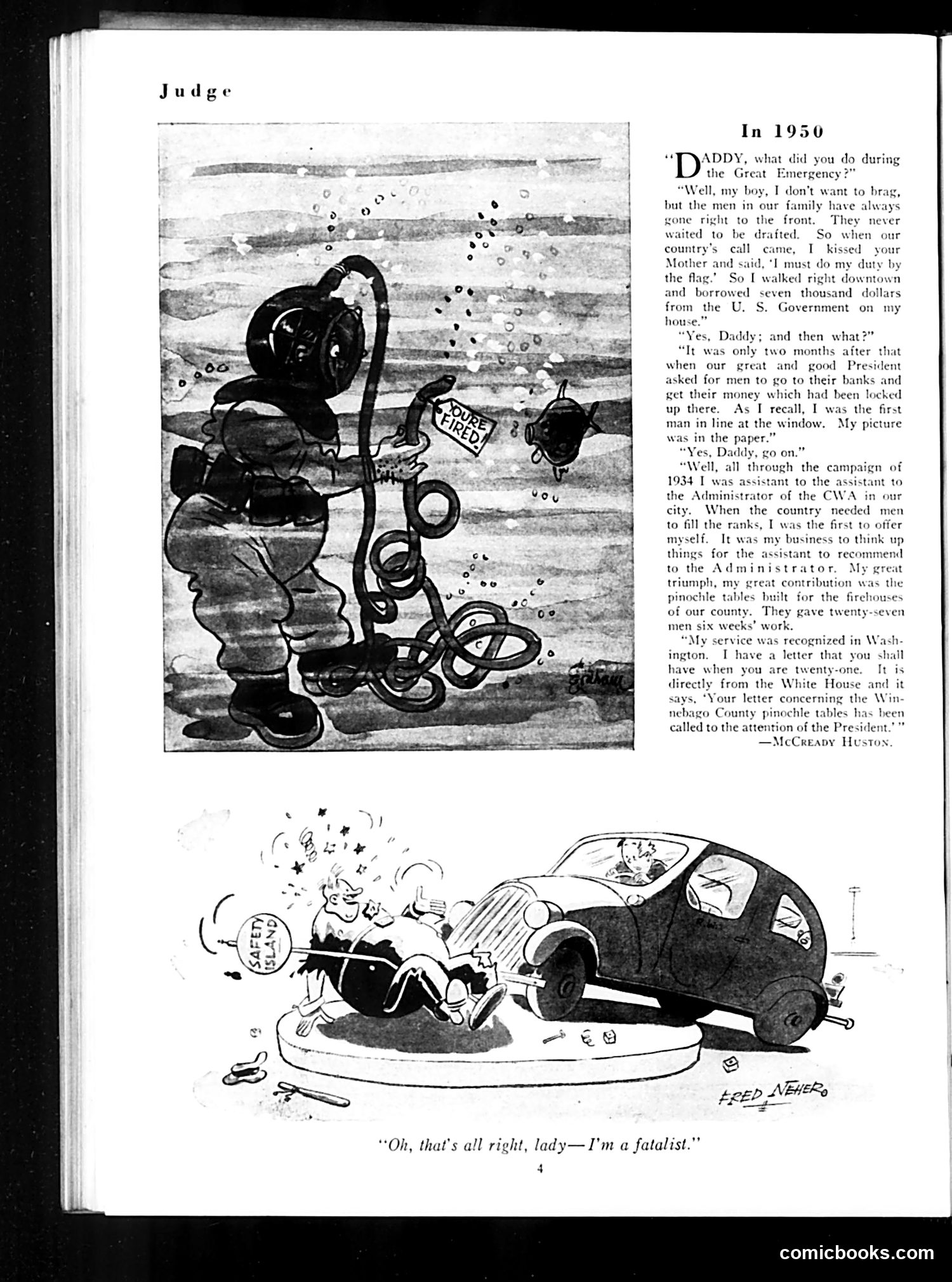
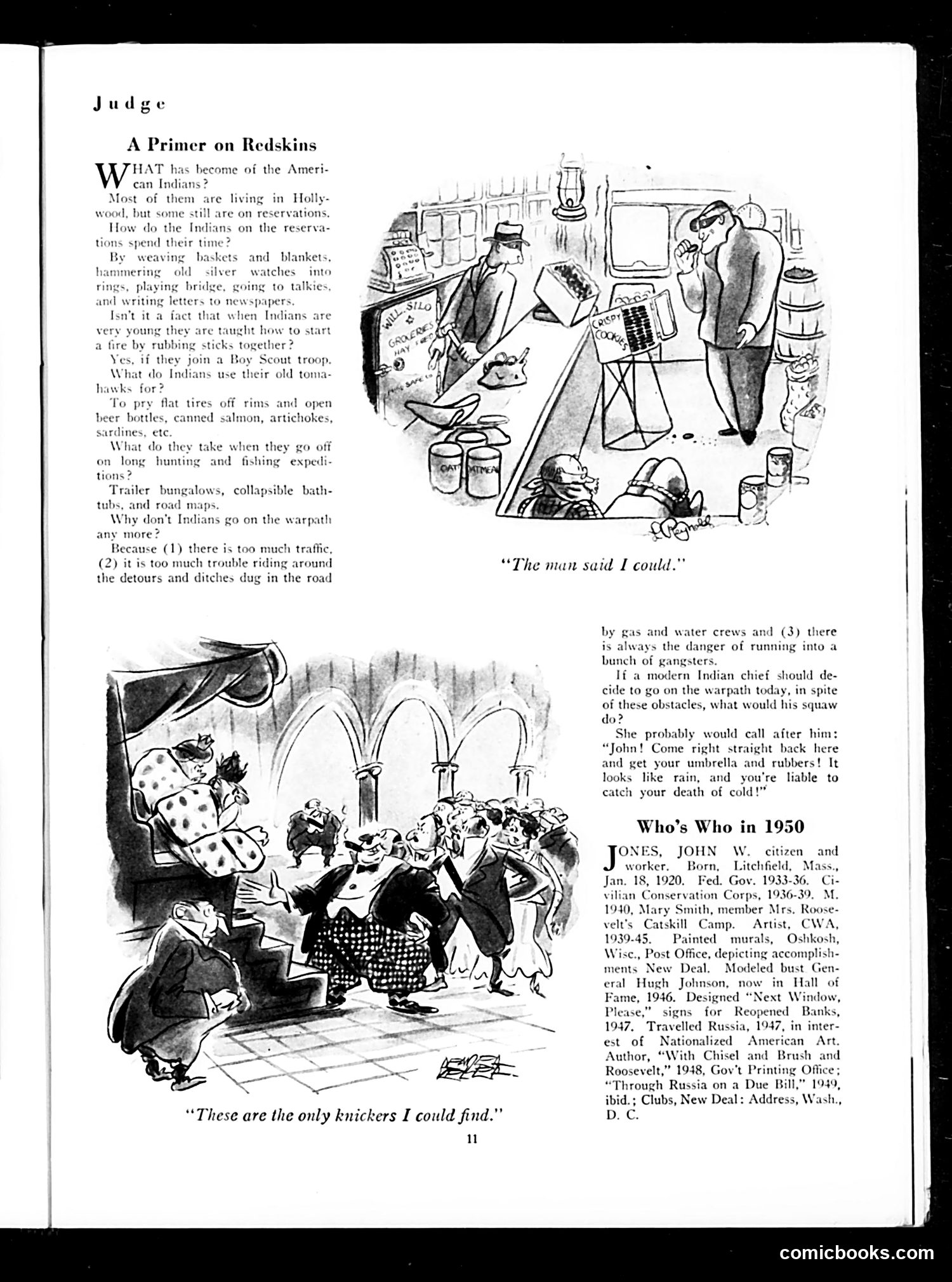
# Analysis of Judge Magazine Page **Top Cartoon:** A figure labeled "FIRED" sits amid tangled wires and mechanical parts, referencing New Deal employment programs. The text describes someone's contributions during the "Great Emergency" (the Depression/WWII era), including work with the CVA (Civilian Works Administration) and pinochle tables for firehouses. The narrator boasts of recognition from the White House—satirizing how Depression-era workers claimed credit for relief work and New Deal projects. **Bottom Cartoon:** Captioned "Oh, that's all right, lady—I'm a fatalist," shows a fender-bender accident. The joke mocks fatalism as an excuse for poor driving—a social commentary on personal responsibility versus accepting misfortune passively, typical of 1950s humor. Both reflect post-war American attitudes toward Depression nostalgia and contemporary social behavior.
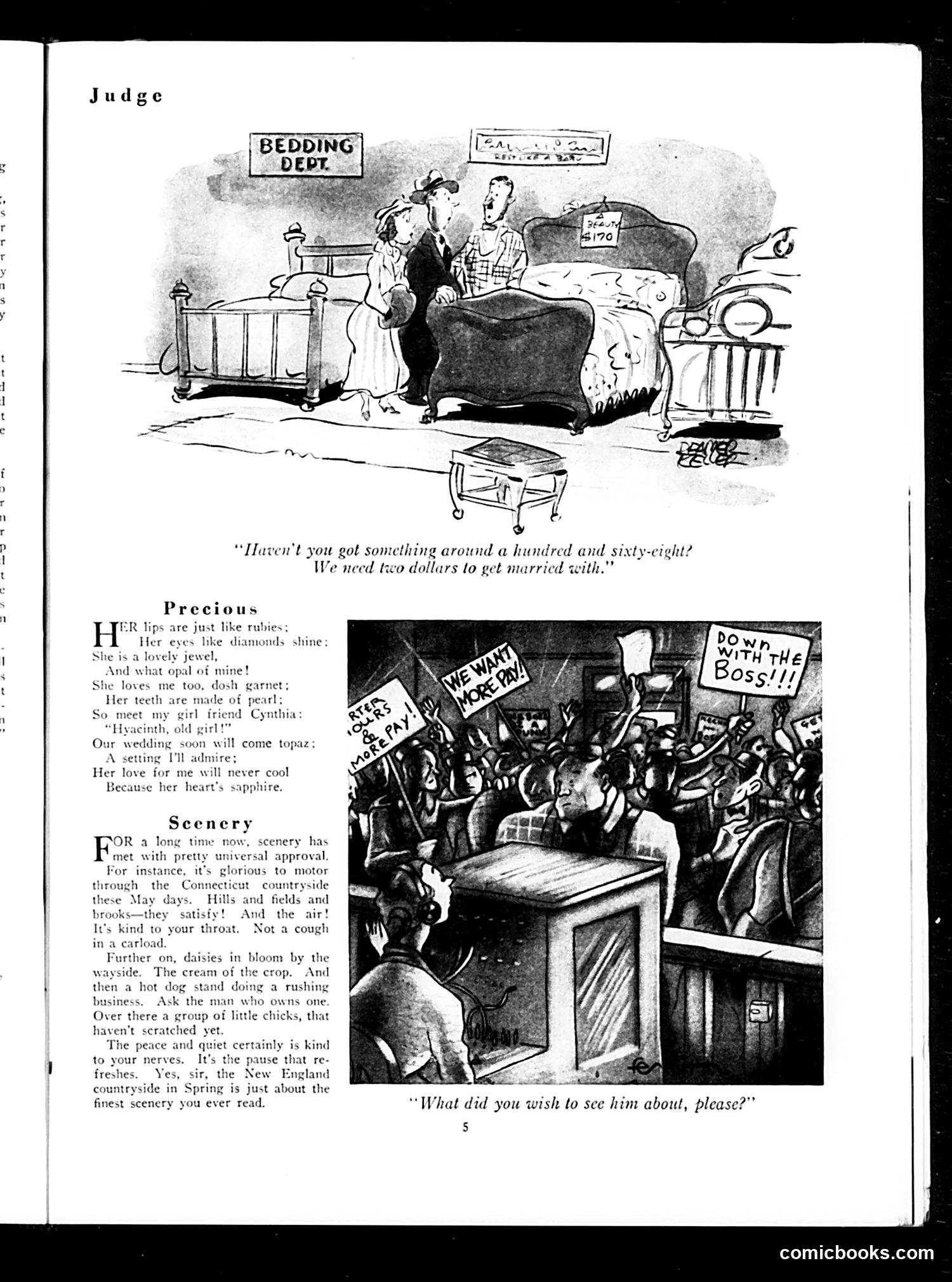
# Judge Magazine Page Analysis **Top Cartoon:** A couple in a bedroom discusses marriage costs. The man mentions needing "$1.68" for marriage, likely referencing minimal legal fees or marriage license costs. The satire mocks how cheaply marriage itself can be obtained, contrasting with broader expenses of courtship and married life. The "Bedding Dept." sign suggests this takes place in a department store, adding absurdist humor. **"Precious" Poem:** Sentimental verse praising a woman's beauty using conventional romantic language ("rubies," "diamonds," "sapphire heart"). **"Scenery" Section:** Praises New England countryside in Spring, emphasizing natural beauty and health benefits. **Bottom Photograph/Cartoon:** Shows workers confronting a boss with protest signs reading "WE WANT HIGHER PAY" and "DOWN WITH THE BOSS!!!" This depicts labor unrest or strike activity, reflecting early 20th-century industrial conflict.
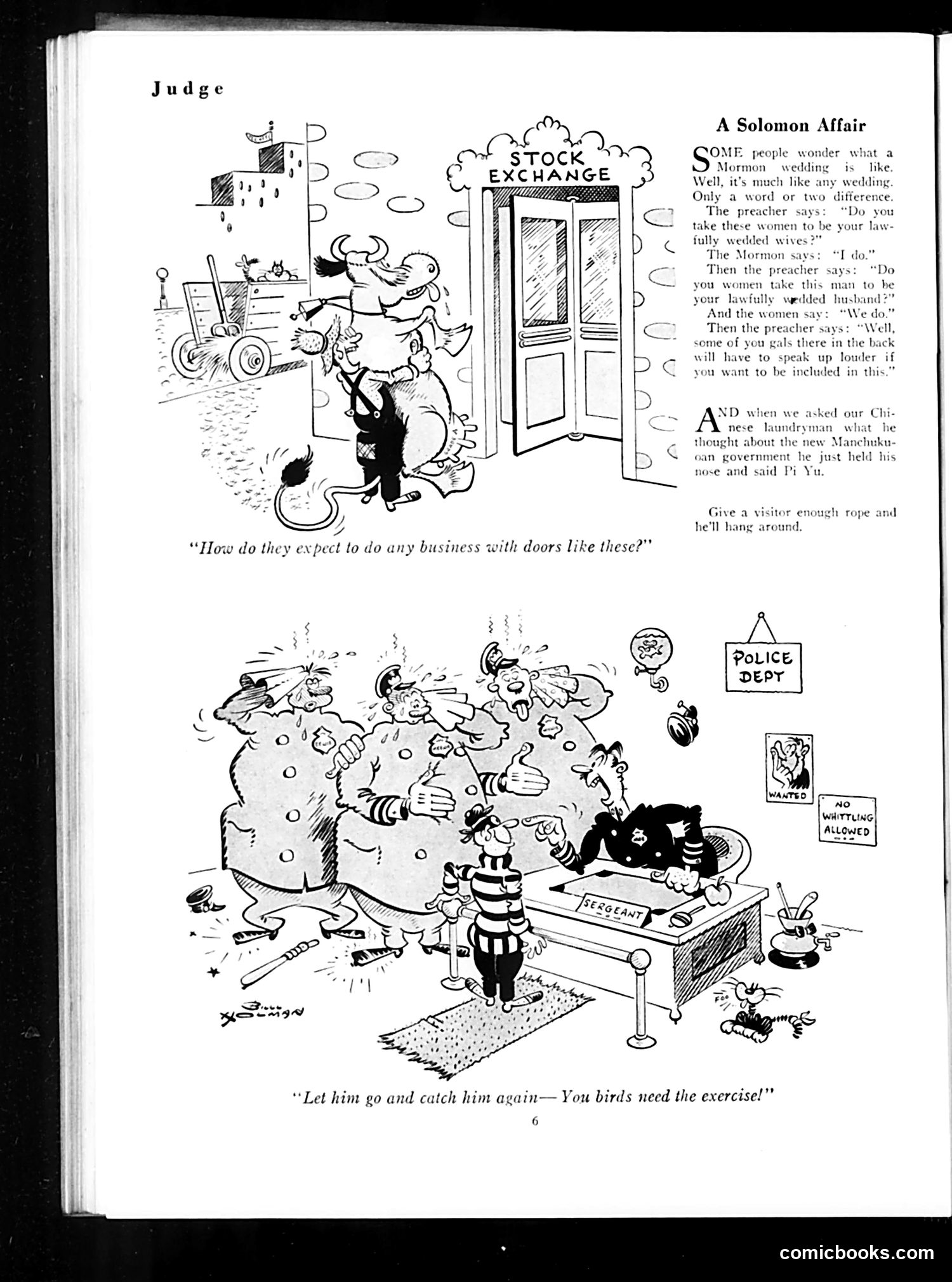
# Analysis of Judge Page This page contains two cartoons satirizing different targets: **Top cartoon** ("Stock Exchange"): Mocks the chaotic state of business dealings, showing a bull and bear (stock market symbols) conducting commerce through absurdly malfunctioning doors. The caption "How do they expect to do any business with doors like these?" suggests incompetent management or structural dysfunction in financial institutions—likely referencing early 20th-century market instability or banking practices. **Bottom cartoon** ("Police Dept"): Depicts a sergeant at a police desk surrounded by chaotic birds in the office, suggesting officers are unprofessional or undisciplined. The caption about "exercise" implies satirical criticism of police conduct or department management—perhaps commenting on corrupt or ineffectual law enforcement. Both cartoons use animal caricatures and visual chaos to critique institutional incompetence in business and law enforcement.
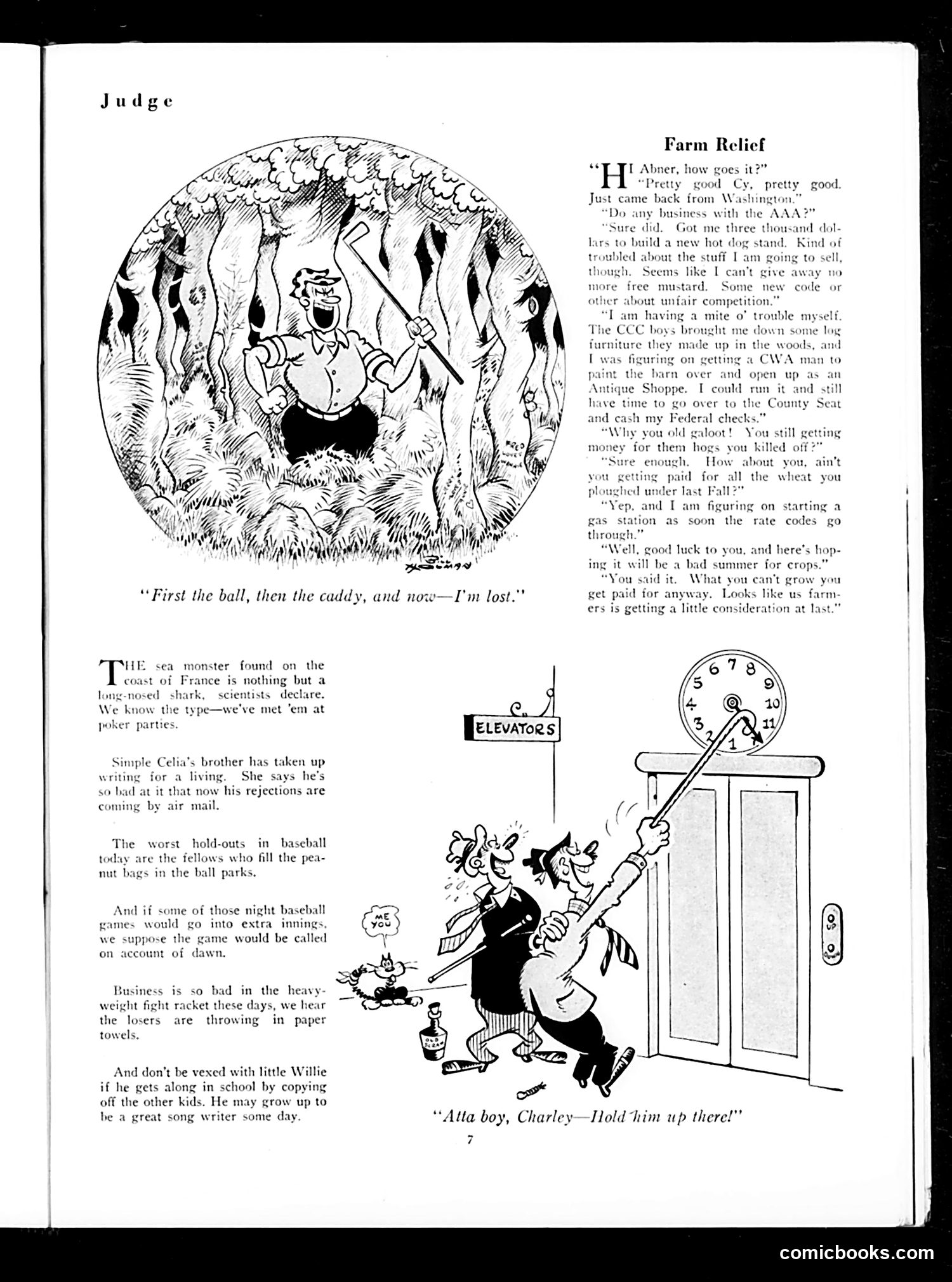
# Farm Relief Cartoon Analysis This page satirizes New Deal agricultural programs through a dialogue between two farmers, "Cy" and "Abner." The cartoon mocks how farmers are exploiting government relief agencies (AAA, CCC, CWA) meant to address Depression-era hardship. The joke: farmers receive subsidies ostensibly for farm relief—the AAA paid them to reduce crop production, the CCC employed workers on conservation projects—but they're actually using the money to start unrelated businesses (hot dog stands, gas stations, tourist shops). One farmer grotesquely notes he's "paid for all the wheat you ploughed under," referring to the government's controversial policy of paying farmers *not* to grow crops to raise prices. The final ironic exchange—wishing "it will be a bad summer for crops" because "what you can't grow you get paid for anyway"—exposes the perverse incentive structure: farmers profit more from *not* farming than farming. The cartoon criticizes both the New Deal's apparent inefficiency and farmers' opportunism in exploiting it.
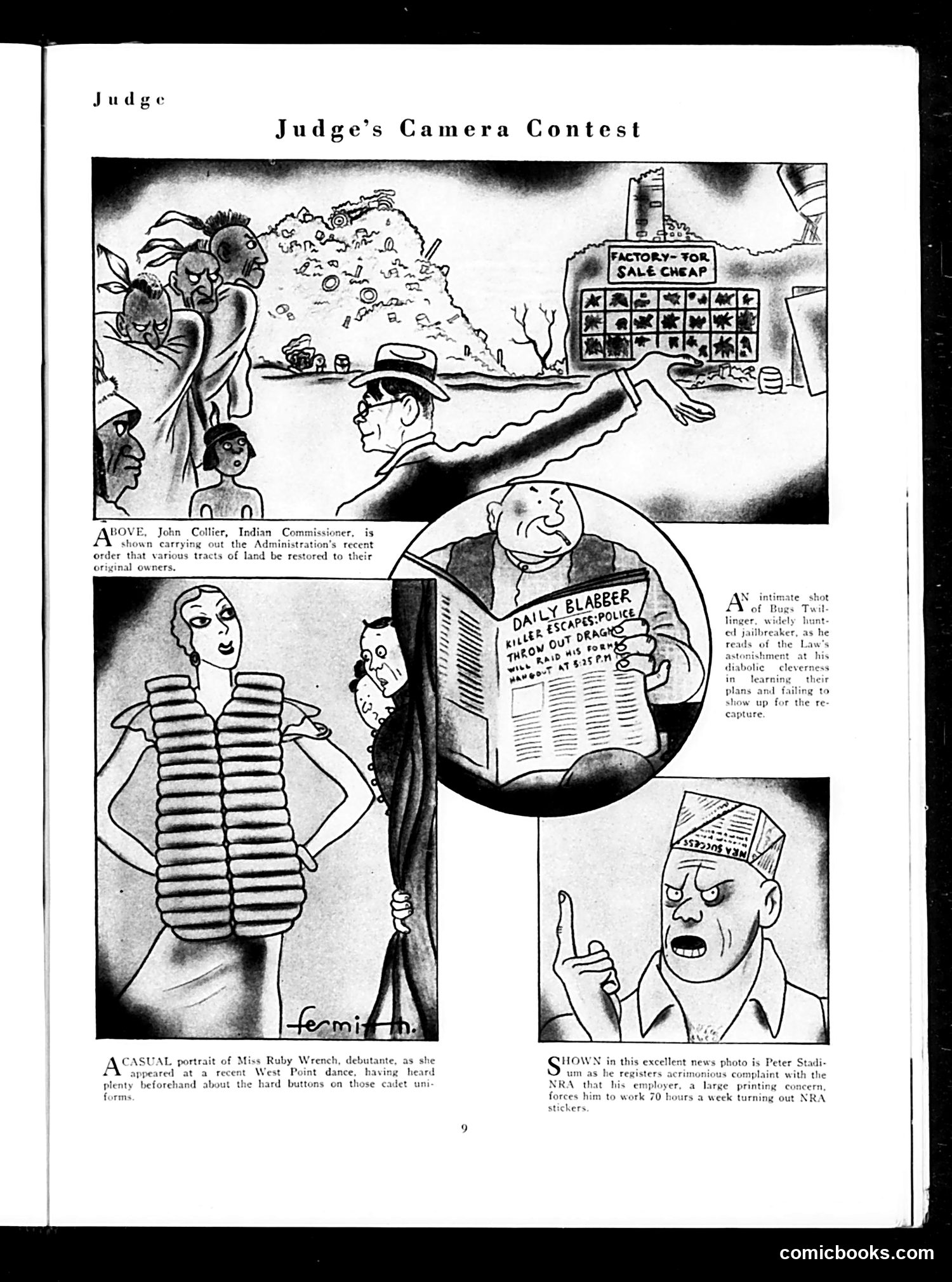
# Judge's Camera Contest - Analysis This page presents a satirical "camera contest" mocking various figures and social issues of the era (likely 1930s based on NRA reference). The top panel shows **John Collier, Indian Commissioner**, surveying land restoration efforts—satirizing government Indian policy. The middle-left depicts **Miss Ruby Wrench** in a cadet uniform, mocking women's fashion at West Point dances. The circled portrait shows a man reading the "Daily Blabber" newspaper with sensational crime headlines, satirizing tabloid journalism and public fascination with scandals. The bottom panel ridicules an **NRA employer** complaining about forced 70-hour work weeks under NRA (National Recovery Administration) regulations—critiquing New Deal labor policies as burdensome to business. The overall satire targets government overreach, tabloid culture, and workplace regulation during the Depression era.
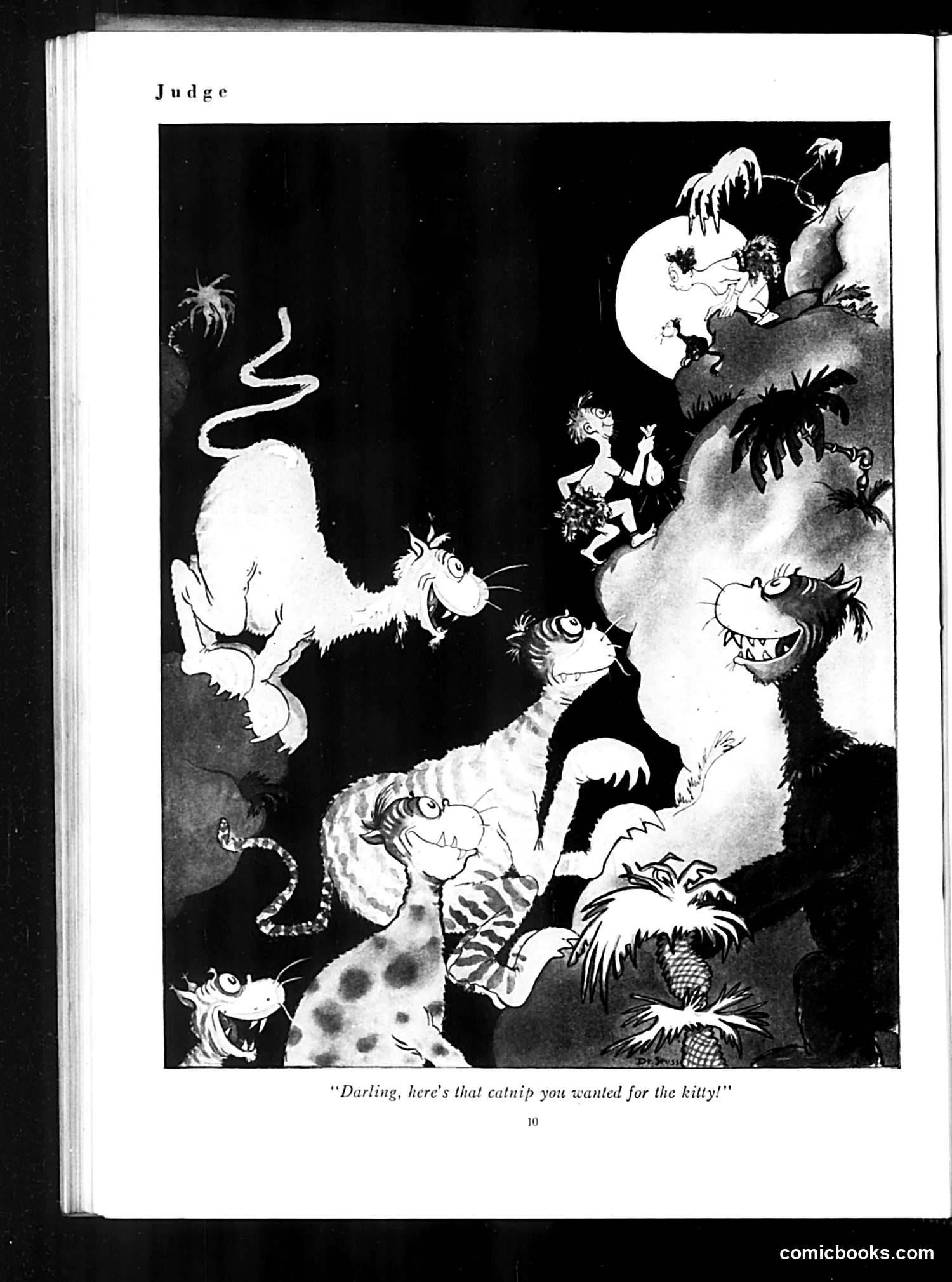
# Analysis This appears to be a humorous domestic scene rather than political satire. The cartoon shows a man presenting catnip to his wife, who is surrounded by numerous cats in various playful poses. The joke seems to be a visual pun or gentle satire about cat ownership and feline behavior—the woman is so surrounded by cats that the catnip gift becomes comical or ironic. The style is typical of Judge magazine's light, whimsical humor. Without additional context about the publication date or any topical references in Judge's editorial calendar, this reads as straightforward domestic humor playing on common observations about cat lovers and pet behavior rather than commentary on specific political or social events.