
Judge, 1934-05 · page 21 of 36
Judge — May 1934 — page 21: what you’re looking at
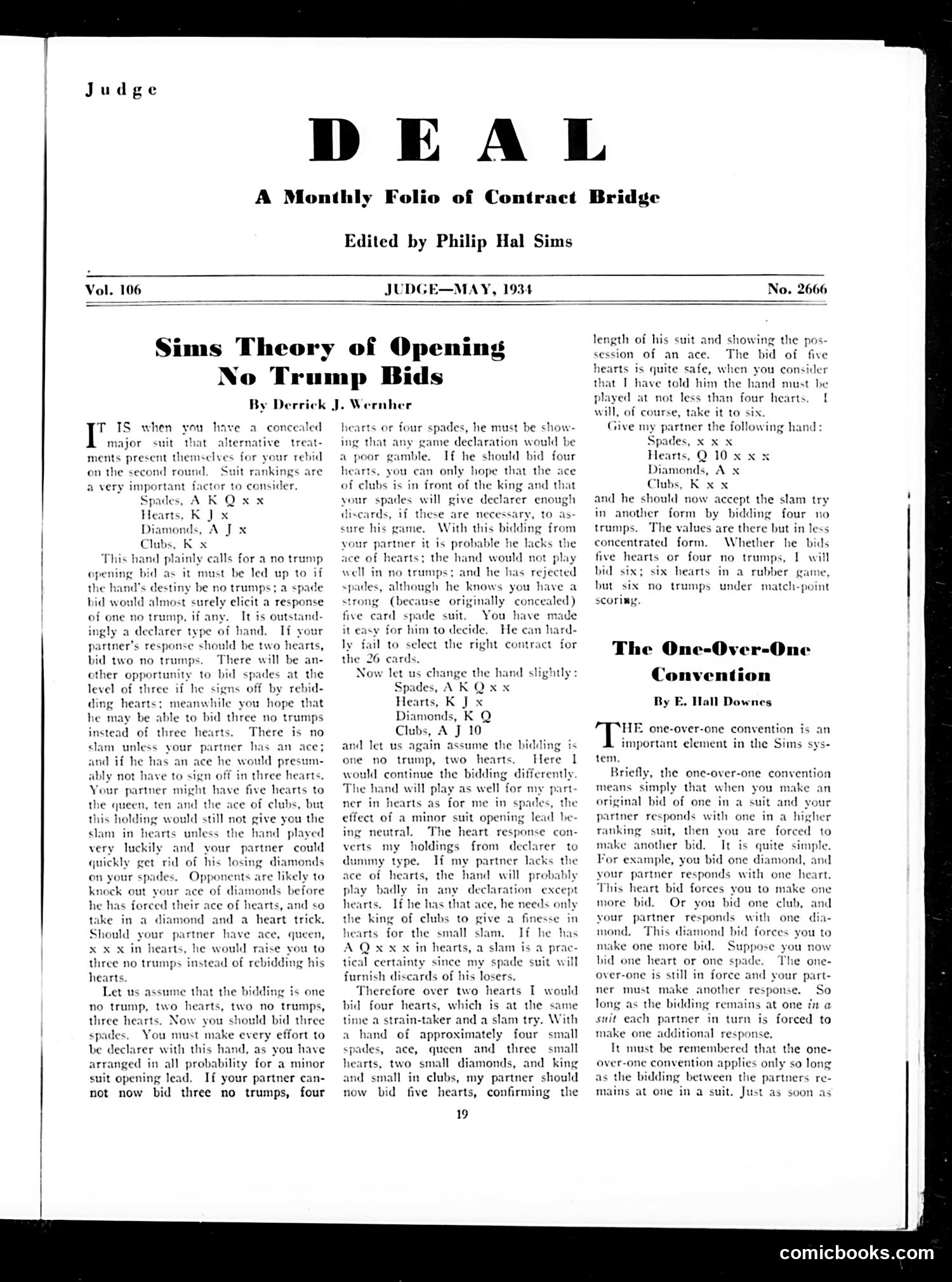
A restored page from Judge, 1934-05. Page through the whole issue in the reader above.
📄 Transcribed text from this page (OCR, searchable)
Machine-transcribed from the original scan — historical spelling and the odd misread are preserved.
Judge DEAL A Monthly Folio of Contract Edited by Philip Hal Sims Bridge Vol. 106 JUDGE—MAY, 1934 2666 No Tru s Theory of Opening p Bids By Derrick J. Wernher T IS when you h: major suit that ments present themselves for your re on the second round. Suit rank a very important factor concealed ive treat- Diamonds, A J x Clubs, K x ‘This hand plainly calls for a no trump opening bid as it must be led up to if the hand's destiny be no trumps; bid would almost surely elicit a response of one no trump, if any. It is outstand- igly a declarer type of hand. If your partner’s response should be two hearts, bid two no trumps. There will be an- other opportunity to bid spades at the level of three if he signs off by re ding hearts; meanwhile you hope that he may be able to bid three no trumps instead of three heart There is no slam unless your partner has an ace; and if he has an ace he would presum- ably not have to sign off in three hearts. Your partner might have five hearts to the queen, ten and the ace of clubs, but this holding would still not give you the slam in hearts unless the hand’ played very luckily and your partner could ckly get rid of his losing diame on your spades, Opponents are likely to knock out your ace of diamonds before he forced their ace of hearts, and so take in a diamond and a heart trick. Should your partner have ace, queen, x x x in hearts, he would raise you to three no trumps instead of rebidding his hearts. Let us assume that the bidding is one no trump, two hearts, two no trumps, three hearts. Now you should bid three spades. You must make every effort to be declarer with this hand, as you have arranged in all probability for a minor suit opening lead. If your partner can- not now bid three no trumps, four spade 1 or four spades, he must be show- ing that any game declaration would be a poor gamble. If he should bid { you can only hope that the of clubs is in front of the king and your spades will give dec rds, if these are ne sure his game. With this bidding from your partner it is probable he lacks the e of hearts; the hand would not play I in no tr zy and he has rejected although he knows you have a strong (because originally concealed) five card spade suit. You have m. it easy for him to des He can 1} ly fail to select the right contract for the 26 cards, ww let us change the hs Spades, AK Qx x it arer enough Hearts, K J x Diamonds, K Q Clubs, A J 10 and let us again assume the bidding one no trump, two hearts. Here I would continue the bidding differently The hand will play as well for my urt ner in hearts as for me in spades, the effect of a minor suit opening lead Te- ing neutral. The heart response con- verts my holdings from declarer to dummy type. If my partner ace of hearts, the hand will probably play badly in any declaration except ks the hearts. If he has that ace, he needs only the king of clubs to give a finesse in hearts for the small slam. If he has AQ in hearts, a slam is a pra tical certainty since my spade suit will furnish discards of his losers. Therefore over two hearts I would bid four hearts, which is at the same time a strain-taker and a slam try. With a hand of approximately four small spades, ace, queen and three hearts, two small diamonds, and king and small in clubs, my partner should now bid five hearts, confirming the 19 length of his suit and session of an bid of five rts is quite when you consider that I have told him the hand must be played not less than four hearts. [ will, of course, take it to six Give my partner the following han Spades, x x x Hearts, Q 10x x x Diamonds, A x Clubs, K x and he should now accept the slam try in another form by bidding four no trumps. The values are there but in less concentrated form. Whether he bids five hearts or four no trumps, I will bid six; six hearts in a rubber g. but six no trumps under mat scoring. showing the pos- nt The One-Over-One Cc By E. Hall Downes vent HE one-over-one convention is an important element in the Sims sys- tem. Briefly, the one-over-one convention means simply that when you make an original bid of one in a suit and your partner responds with one in a higher ranking suit, then you are forced to make another bid. It is quite simple. For example, you bid one diamond, and your partner responds with one heart. This heart bid forces you to make one more bid. Or you bid one club, and your partner responds with one dia- mond. This diamond bid forces you to make one more bid. Suppose you now hid one heart or one spade. The one- over-one is still in force and your part- ner must make another respons So long as the bidding remains at one in @ suit each partner in turn is forced to make one additional response. It must be remembered that the one- over-one convention applies only so long as the bidding between the partners re- mains at one in a suit. Just as soon as comicbooks.com