
Judge, 1934-05 · page 20 of 36
Judge — May 1934 — page 20: what you’re looking at
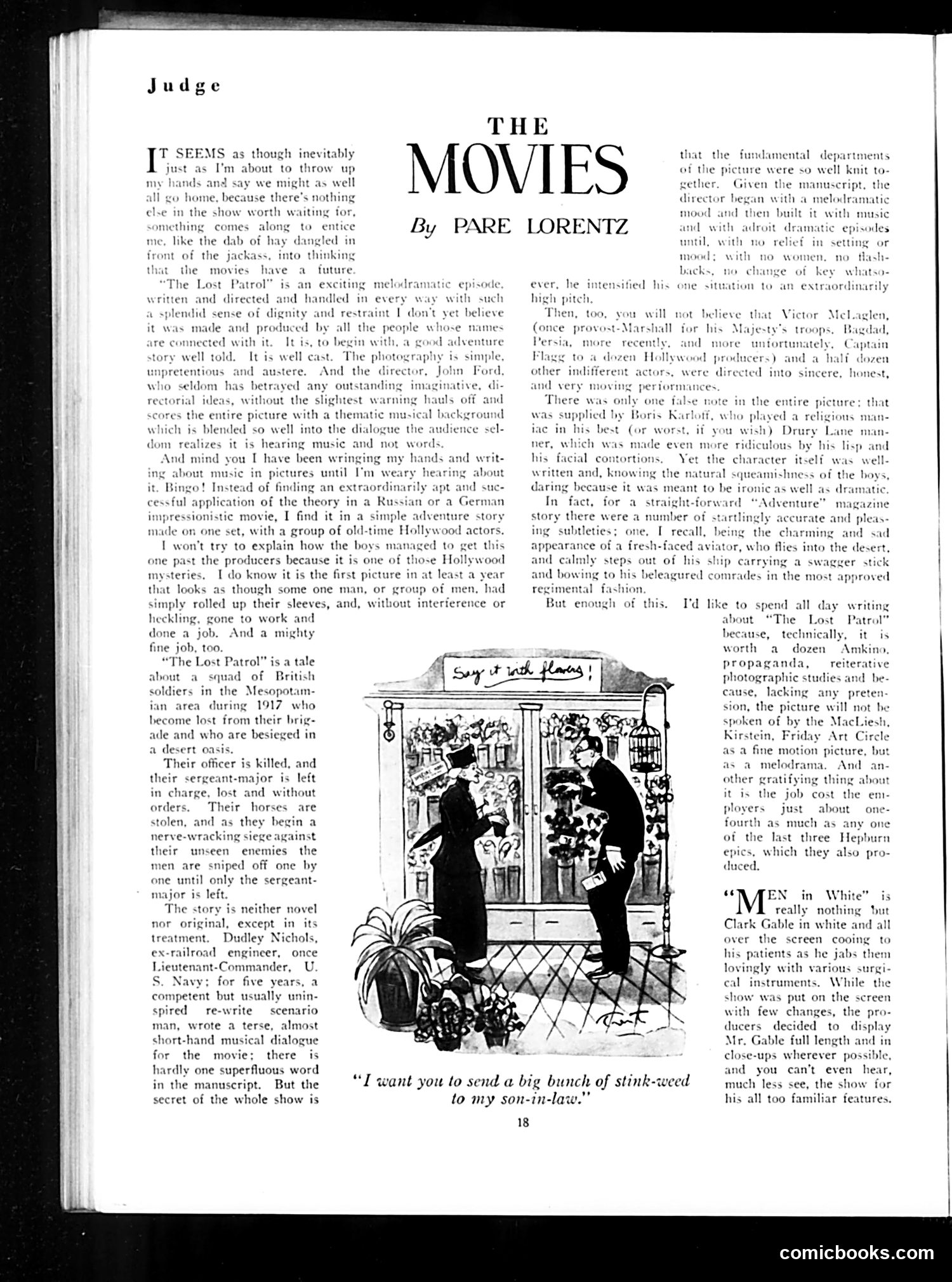
A restored page from Judge, 1934-05. Page through the whole issue in the reader above.
📄 Transcribed text from this page (OCR, searchable)
Machine-transcribed from the original scan — historical spelling and the odd misread are preserved.
THE T SEEMS as though inevitably just as I'm al s and say we might as well ut to throw up thing ere’: he show worth waiting for, o home, because me, like the dab of hay dangled in front of the jackass, into king hat the movies have a future written and directed and har Tin every way with such di sense of dignity and restraint | don't yet believe s made and produced by all ni © people whe e name A with, a hit, tis, to beg 1 advent tory well to! It is well cast. The pt le. and And the « John Ford, has betrayed any outstanding imaginative, di- i hauls off and scores the entire picture with a thematic musical background H into the dialogue 1- zes it is hearing music and not words 1 mind you [ have been wringing my hands and writ- bout music in pictures until I'm weary hearing about igo! Instead of finding an e dinar t and suc- cessful application of the theory in a Ru or a German stic movie, I find it in a simple adventure story made on one set, with a group of old-time Hollywood actors, I won't try to explain how the boys managed to get this the producers because it is one of those Hollywood mysteries. I do know it is the first picture in year that looks as though some one man, or group of men, had simply rolled up their sleeves, and, without inter: heckling, gone to work and d And a mighty tography is simy ou ter rect who seldom rectorial ideas, w ut the s test warning which is blended so w e audience s dom re \pressior one pas least . job. ne job, too. “The Lost Patrol” is a tale mut a squad of British soldiers in the Mesopotam- MOVIES that the fundamental departmer of the picture were so well knit to- the manuscript, gether. Given 1a melodramatic . mood and then built it with music LORENTZ and until, with director began wi h adroit dramatic episodes relief in setting or no women, ot key ever, he high pitch Then, too, you will not believe that Victor Mel irshall for his Majesty's troops, Persia, ni red more un producer Flagg to a dozen Hollyw other indiffer t actors, wer directed into and very movi The false note in the er was supplied by Boris Karlotf, who played a reli Was only oF jac in his best (or worst, if you wish) Drury Lane man- ner, whic his facial e was made even more ridiculous by 1 ortions. Ye e character itself was well- written and, knowing g the natural squeamishness of the boys, dari y his lisp and i because it was mea In fact, for a straight-forward “Adventure story wnumber of sta ing subtleties; one, [ recall, appearance of and calt nt to be ironic as well dramatic magazine there were ly accurate and pleas- the charming and sad a fresh-faced aviator, who flies into the desert, steps out of his ip carrying a swagger sti nrades in the most approved and bowi ig to his beleagured c¢ imental fashion. But enough of this. I'd like to spend all day writing yout “The Lost Patrol” because, technically, it is worth a dozen Amk propaganda, _ reiterative photographic studies and be- cause, lacking any pret jan a duri 1917 who become lost from their brig- ade and who are besieged in a desert oasis. Their officer is killed, and their sergeant-major is left in charge, lost and without orders. Their horses are stolen, and as they begin a nerve-wracking siege against the are sniped off one by one until only the sergeant- major is left. The story is neither novel nor original, except in its treatment, Dudley Nichols, ex-railroad engineer, once Lieutenant-Commander, U. S. Navy; for five years, a competent but usually spired re-write scenario man, wrote a terse, almost short-hand mu dialogue for the movie; there is hardly one superfluous word in the manuscript. But the secret of the whole show is their unseen enem i. I want you to send a big bunch of stink-weed on, the picture will not b spoken of by the MacLiesh, Kirstein, Friday Art Circle as a fine motion pictur: as a melodrama. And other gratify thing a it is the job cost the e ployers ju fourth as mu oft the last three Hep! epics, which they also pro- duced, » but in about — one- as any one arn ee EN in White” is really nothing but Clark Gable in white and all over the screen his patients as | lovingly with various surg cal instruments. While the ww Was put on the screen h few changes, the pro- ducers decided to display Mr. Gable full length and in close-ups wherever possible, and you can’t even hear, much less see, the show for his all too familiar features. wi comicbooks.com