
Judge, 1934-05 · page 13 of 36
Judge — May 1934 — page 13: what you’re looking at
What you’re looking at
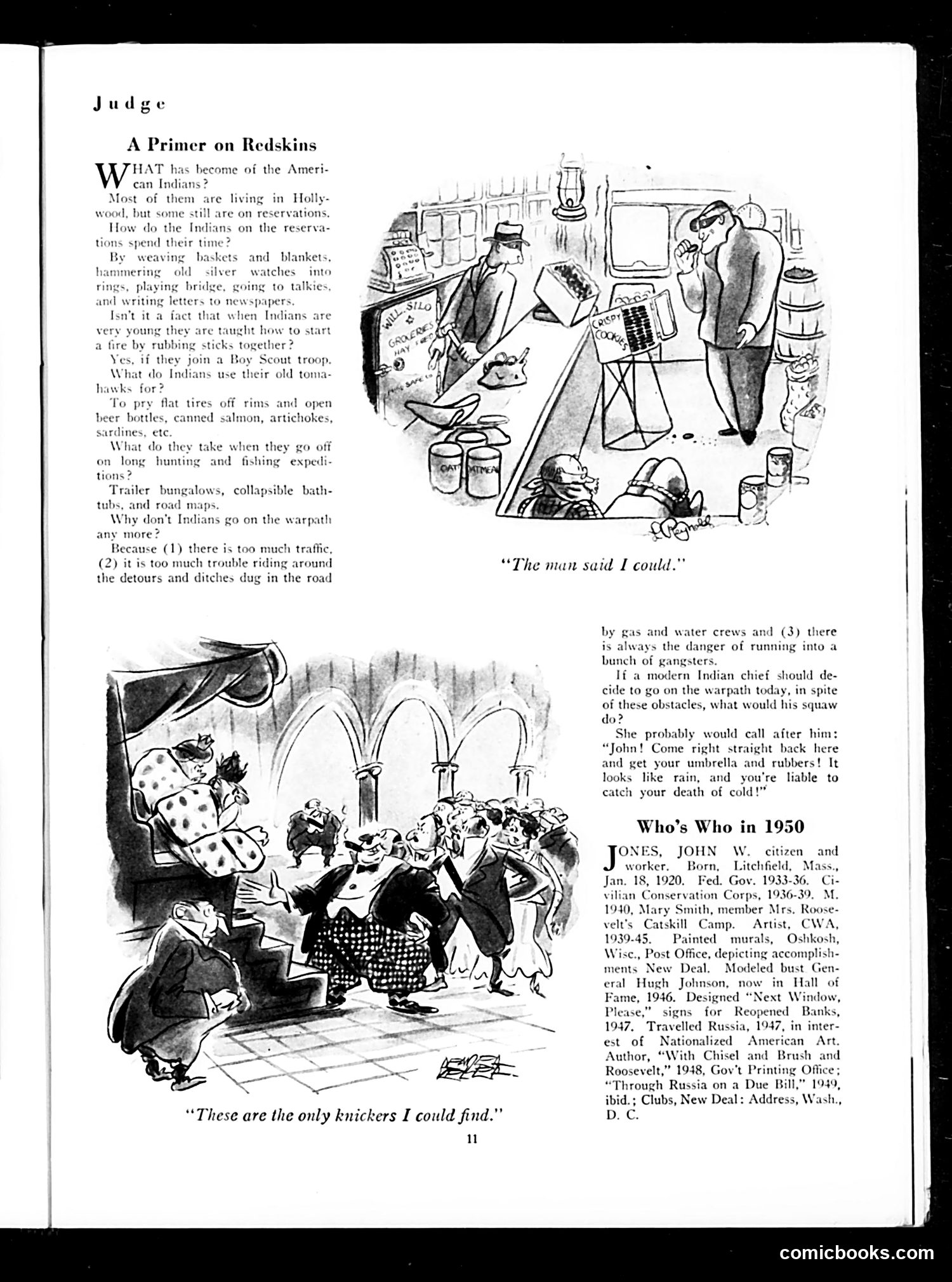
# A Primer on Redskins - Judge Magazine Satire This 1950 piece satirizes modern Native Americans through a mock "primer" format. The satire works by contrasting romanticized stereotypes of "Indians" (the period's terminology) with mid-20th-century American consumer culture. The jokes mock how reservation life has been absorbed into mainstream America: Indians now play bridge, attend movies ("talkies"), and use modern conveniences like trailer bungalows and road maps instead of traditional practices. The warpath is abandoned not for noble reasons but because of traffic, road construction, and gangsters. The cartoons illustrate this collision of cultures—one showing modern camping chaos, another depicting Native Americans in urban clothing searching for period costumes. The squaw character warns her chief about catching cold, replacing warrior traditions with domestic concerns. The "Who's Who" entry for John W. Jones appears unrelated—likely an actual New Deal administrator included for contrast or additional satire about government employment. The humor relies on outdated racial caricature and assumes readers found "Indianness" inherently comic when modernized.
📄 Transcribed text from this page (OCR, searchable)
Machine-transcribed from the original scan — historical spelling and the odd misread are preserved.
udge Judg A Primer on Redskins become of the Ameri- Most of th are living in Holly- wood, but some still are on reservations, How do the Indians on the reserva- tions spend their time? By weaving baskets and blankets, ering old er watches into . playing bridge, going to talkies Writing letters to newspapers "t ita fact that when Indians are very young they are taught how to start a y rubbing sticks together? Yes, if they join a Boy Scout troop. What do Indians use their old toma- hawks for? To pry flat tires off rims and open beer bottles, canned salmon, artichokes, sardines, ete. What do they take when they go off on long hunting and fishing expedi- tions? Trailer bungalows, collapsible bath- tubs, and road maps. Why don’t Indians go on the warpath any more? Because (1) there is too much traffic, (2) it is too much trouble riding around “The man said I could.” the detours and ditches dug in the road by gas and water crews and (3) there is always the danger of running into a bunch of gangsters. If a modern Indian chief should de- cide to go on the warpath today, in spite of these obstacles, what would his squaw do? She probably would call after him: “John! Come right straight back here and get your umbrella and rubbers! It looks like rain, and you're liable to catch your death of cold!” Who’s Who in 1950 ONES, JOHN W. citizen and worker. Born, Litchfield, Mass., Jan, 18, 1920, Fed. Gov. 1933-36, Ci- vilian Conservation Corps, 1936-39. M. 1940, Mary Smith, member Mrs. Roose- velt’s Catskill Camp. Artist, CWA, 1939-45. Painted murals, Oshkosh, Wisc., Post Office, depicting accomplish- ments New Deal, Modeled bust Gen- eral Hugh Johnson, now in Hall of Fame, 1946. Designed “Next Window, Please,” signs for Reopened Banks, 1947. Travelled Russia, 1947, in inter- est of Nationalized American Art. Author, “With Chisel and Brush and Roosevelt,” 1948, Gov't Printing Office; “Through Russia on a Due Bill,” 1949, ibid.; Clubs, New Deal: Address, Wash., “These are the only knickers I could find.” D.C. W comicbooks.com