
Judge, 1934-05 · page 14 of 36
Judge — May 1934 — page 14: what you’re looking at
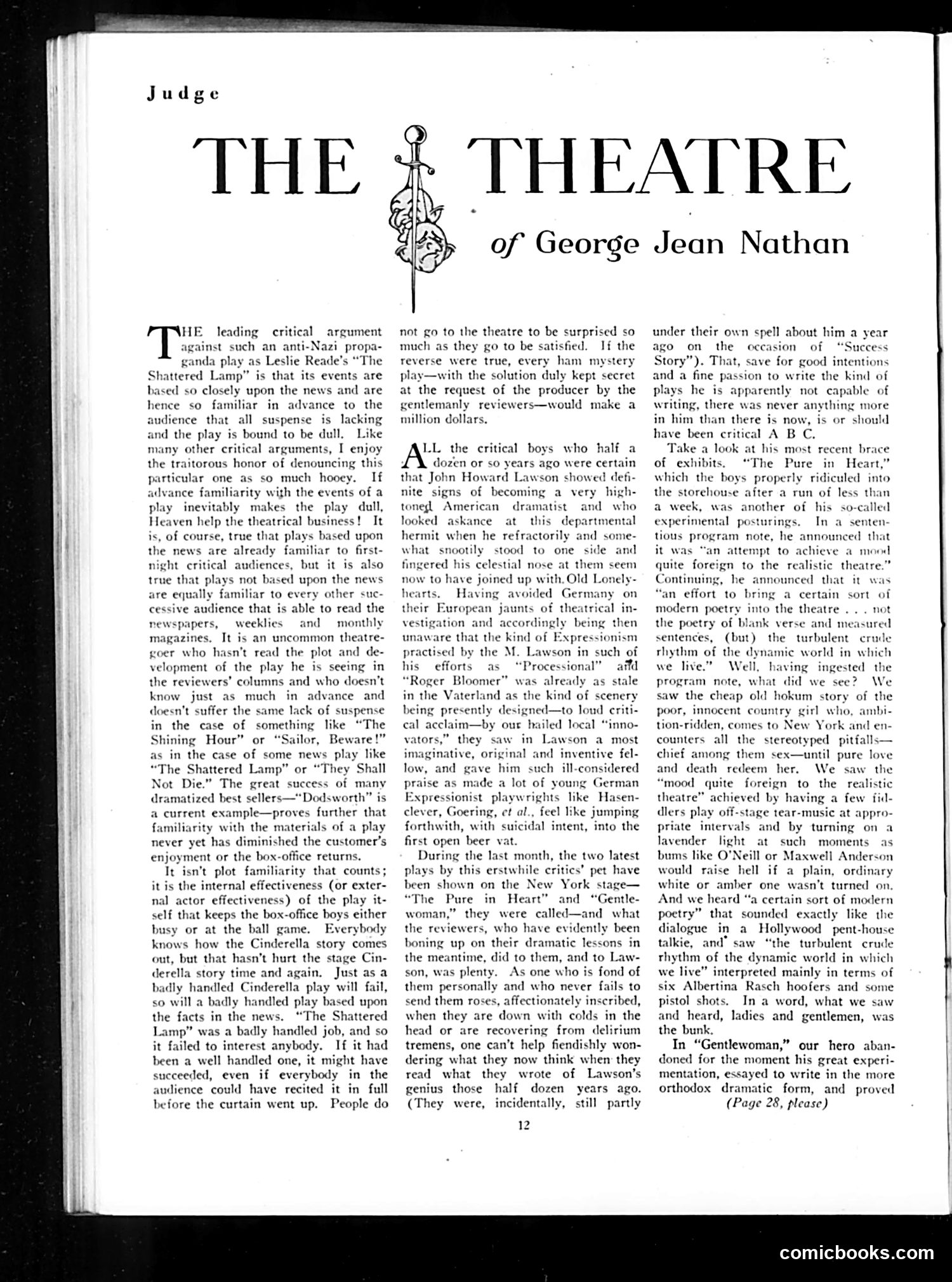
A restored page from Judge, 1934-05. Page through the whole issue in the reader above.
📄 Transcribed text from this page (OCR, searchable)
Machine-transcribed from the original scan — historical spelling and the odd misread are preserved.
HE leading critical argument gainst such an anti-Nazi pro nda play as Leslie Reade’s “The ttered Lamp” is that its events are based so closely upon the news and are I ¢ so familiar in advance to the audience that all suspense is lacking and the play is bound to be dull, Like many other critical arguments, I enja the traitorous honor of denouncing this particular one as so much hooey. If advance familiarity with the events of a play inevitably makes the play dull, Heaven help the theatrical business! It is, of course, true that plays based upon the news are already familiar to first- night critical audiences, but it is also true that plays not based upon the news are equally familiar to every other suc- cessive audience that is able to read the weeklies and — monthly It is an uncommon theatre- goer who hasn’t read the plot and de- velopment of the play he is seeing in the reviewers’ columns and who doesn’t know just as much in advance and doesn't suffer the same lack of suspense in the case of something like “The Shining Hour” or “Sailor, Beware!” s in the case of some news play like The Shattered Lamp” or “They Shall Not Die.” The great success of many dramatized best sellers—*Dodsworth” is a current example—proves further that familiarity with the materials of a play never yet has diminished the customer’s enjoyment or the box-office returns. It isn’t plot familiarity that counts; it is the internal effectiveness (or exter- nal actor effectiveness) of the play it- self that keeps the box-office boys either busy or at the I game. Everybody knows how the Cinderella story comes out, but that hasn't hurt the stage Cin- derella story time and n. Just asa badly handied Cinderella play will fail, so will a badly handled play based upon the facts in the news. “The Shattered Lamp” was a badly handled job, and so it failed to interest anybody. If it had been a well handled one, it might have succeeded, even if everybody in the audience could have recited it in full before the curtain went up. People do THEATRE of George not go to the theatre to be surprised so much as they go to be satisfied. If the reverse were true, every ham mystery play—with the solution duly kept secret at the request of the producer by the gentlemanly reviewers—would make a million dollars. LL the critical boys who half that John Howard wson showed defi nite signs of becoming a very toneg American dramatist and looked askance at this departmental hermit when he refractorily and some- what snootily stood to one side and fingered his celestial nose at them seem now to have joined up with. Old Lonely- hearts. ny on who vestigation and accordingly unaware that the kind of practised by the M. Lawson in such of his efforts as “Processional” aifd “Roger Bloomer” was already as stale in the Vaterland as the kind of scenery being presently designed—to loud criti- cal acclaim—by our hailed local “inno- vators,” they saw in Lawson a most imaginative, original and inventive fel- and gave him such ill-considered as made a lot of young German jonist playwrights like Hasen- clever, Goering, ef al., feel like jumping forthwith, with suicidal intent, into the first open beer vat. During the last month, the two latest plays by this erstwhile critics’ pet been shown on the New York st Phe Pure in Heart” and sentle- woman,” they were called—and what the reviewers, who have evidently been boning up on their dramatic lessons in the meantime, did to them, and to Law- son, was plenty. As one who is fond of them personally and who never fails to send them roses, affectionately inscribed, when they are down with colds in the head or are recovering from delirium tremens, one can’t help fiendishly won- dering what they now think when they read what they wrote of Lawson's genius those half dozen years ago. (They were, incidentally, still partly 12 being then pressionism Jean Nathan under their own spell about him a year ago on the occasion of “Suce Story”). That, save for good intentions and a fine passion to write the kind of he is apparently not capable of writing, there was never anything more in him than there is now, is or should have been critical A B C. Take a loc his most recent brac of exhibits. “The Pure in Heart, which the boys properly ridiculed into the storehou: ter a run of less than a week, another of his experimental posturings. In a senten- tious program e, he announced that it was “an attempt to achieve a mond foreign to the realistic theatre.” Continuing, he announced that it was “an effort to bring a certain sort of modern poetry into the theatre . . the poetry of blank verse and measured (but) the turbulent) crude rhythm of the dynamic world in which we live.” Well, having ingested the program note, what did we see? We saw the cheap old hokum story of the poor, innocent country girl who, ambi- tion-ridden, comes to New York and en- counters all the stereotyped pitfalls— chi mong them sex—until pure love and death redeem her. We the “mood quite foreign to the realistic theatre” achieved by having a few fid- dlers play off-stage tear-music at appro- priate intervals and by turning on a lavender light at such moments as bums like O'Neill or Maxwell Anderson would raise hell if a plain, ordinary white or amber one wasn’t turned on. And we heard “a certain sort of modern poetry” that sounded exactly like the dialogue a Hollywood pent-house talkie, and” saw “the turbulent crude thythm of the dynamic world in which we live” interpreted mainly in terms of six Albertina Rasch hoofers and some pistol shots. In a word, what we saw and heard, ladies and gentlemen, was the bunk. In “Gentlewoman,” our hero aban- doned for the moment his great experi- mentation, essayed to write in the more orthodox dramatic form, and proved (Page 28, please) was so-called not sentences, saw comicbooks.com