A complete issue · 36 pages · 1932
Judge — October 1932
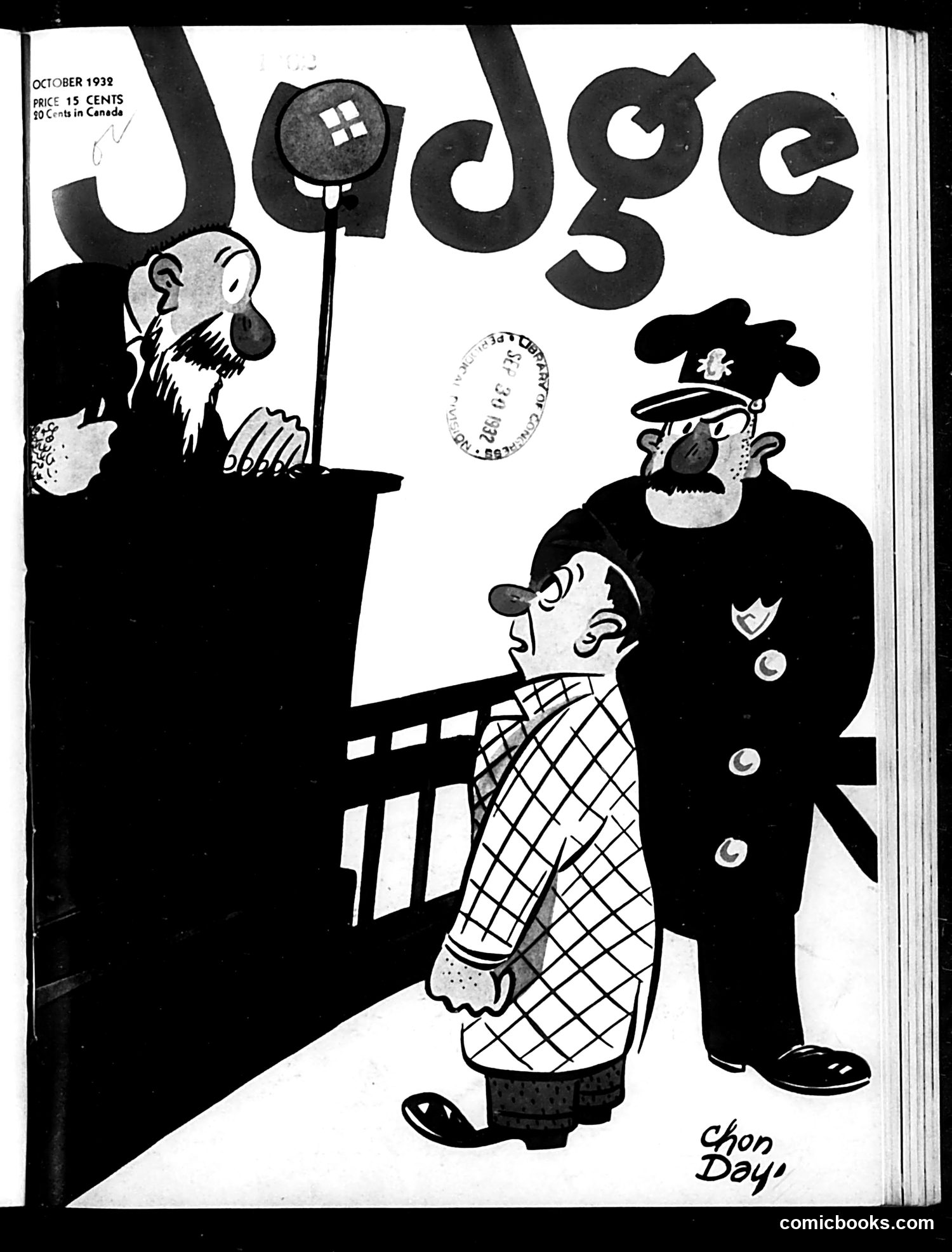
# Judge Magazine, October 1938 This cover satirizes military authority and bureaucratic intimidation. A uniformed officer with an exaggerated authoritarian appearance confronts a nervous civilian. The military figure's oversized features and aggressive posture suggest mockery of authoritarian leadership. The October 1938 date is significant—this coincides with the Munich Crisis, when Nazi Germany's expansionism dominated headlines. The cartoon likely critiques either fascist militarism abroad or domestic concerns about authoritarian power. The civilian's anxious expression and the officer's domineering stance suggest themes of oppression or coercion. The cartoonist (signed "Leon Barks") uses caricature to mock militaristic authority figures, a common Judge approach when addressing political threats to democratic values during the late 1930s.
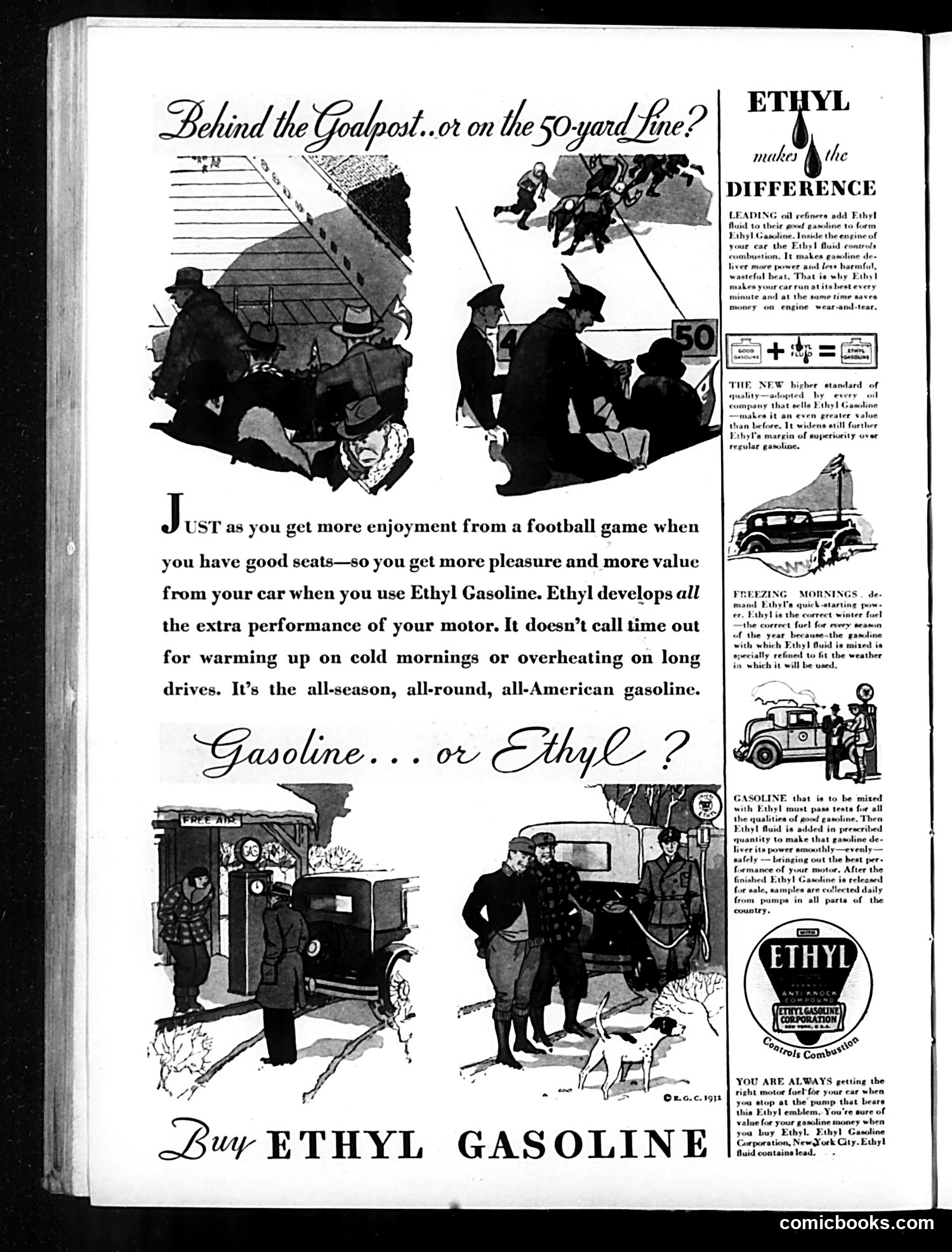
# Analysis This page is primarily an **advertisement for Ethyl Gasoline**, not satire. The top heading asks "Behind the Goalpost...or on the 50-yard line?" using a football analogy: just as good seats enhance enjoyment of a game, Ethyl Gasoline enhances car performance. The illustrations show everyday scenarios—people at gas stations and driving in winter—emphasizing Ethyl's reliability in cold weather and its anti-knock properties. The copy claims Ethyl is "all-American" and superior to regular gasoline. The "cartoon" elements are purely decorative vignettes supporting the sales pitch. There are no political figures or satirical commentary here—this is straightforward commercial promotion from the Ethyl Gasoline Corporation, highlighting their fuel additive's competitive advantages.

# Analysis This page is **primarily an advertisement**, not a satirical cartoon. It promotes General Electric MAZDA lamps, featuring a man in sunglasses holding a light bulb. The ad uses a testimonial format, quoting F. J. Pekoe, former president of the Ohio Retail Hardware Dealers Association, claiming that General Electric MAZDA lamps offer superior efficiency and economy compared to competitors. The copy emphasizes that buyers should look for the "G.E." mark on bulbs to ensure quality. There is **no political satire or social commentary** evident. This is straightforward product marketing from what appears to be an early-to-mid 20th century publication, emphasizing the cost-effectiveness of purchasing name-brand light bulbs over cheaper alternatives.
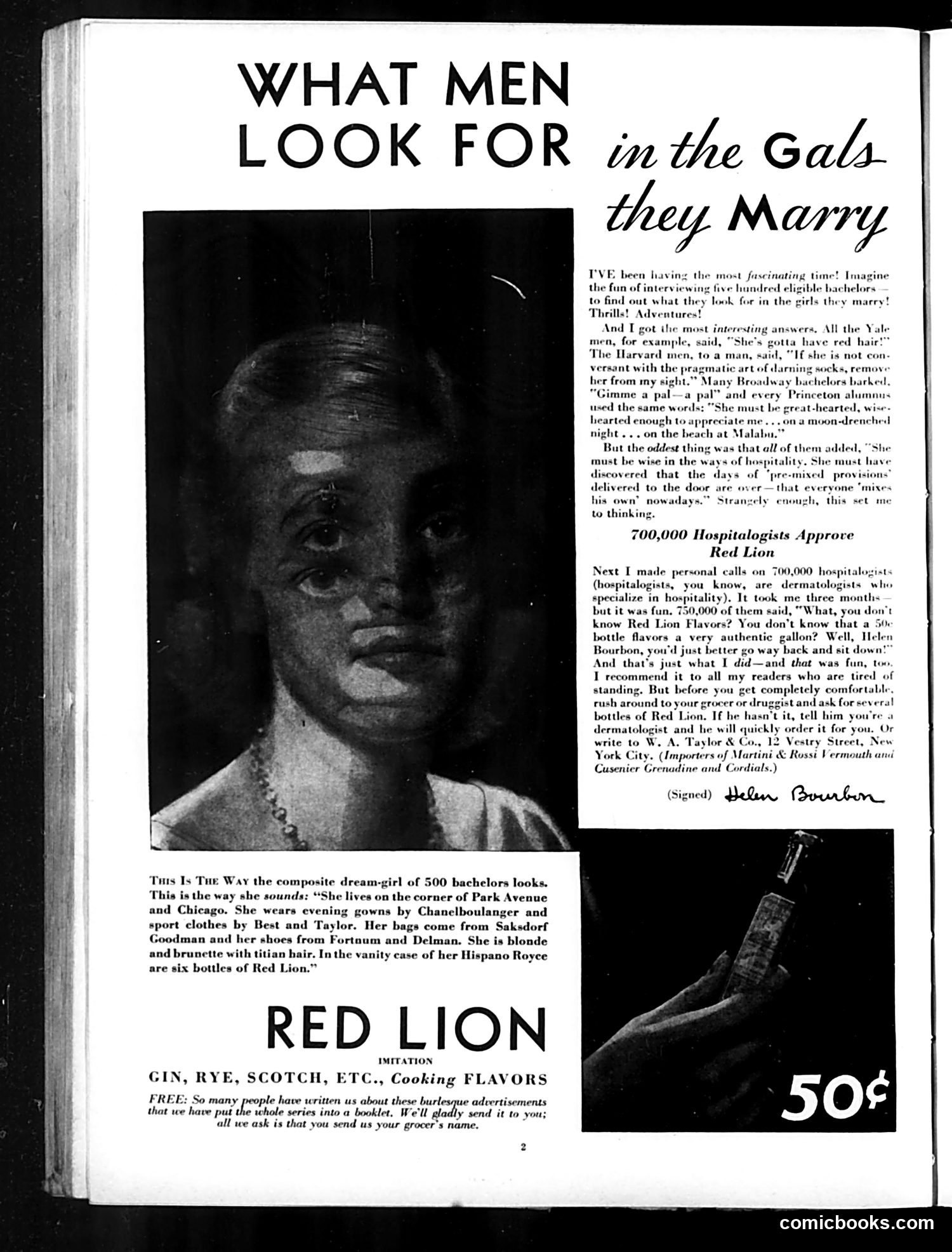
# Red Lion Advertisement (Judge Magazine) This page is primarily a **liquor advertisement** for Red Lion flavored spirits (gin, rye, scotch), not political satire. The ad uses a humorous framing device: an unnamed author claims to have interviewed 500 eligible bachelors about what qualities they seek in wives. The punchline suggests all 500 agreed the ideal woman should be hospitable, wise, and great-hearted—then reveals she should also stock Red Lion liquor in her home. The accompanying composite photograph shows an idealized "dream girl" styled fashionably for the era, described as living on Park Avenue in Chicago and wearing designer clothing. The ad's joke relies on mid-century gender stereotypes: that women's primary value is providing hospitality (particularly alcohol) to men. This reflects 1920s-30s advertising conventions targeting male readers.
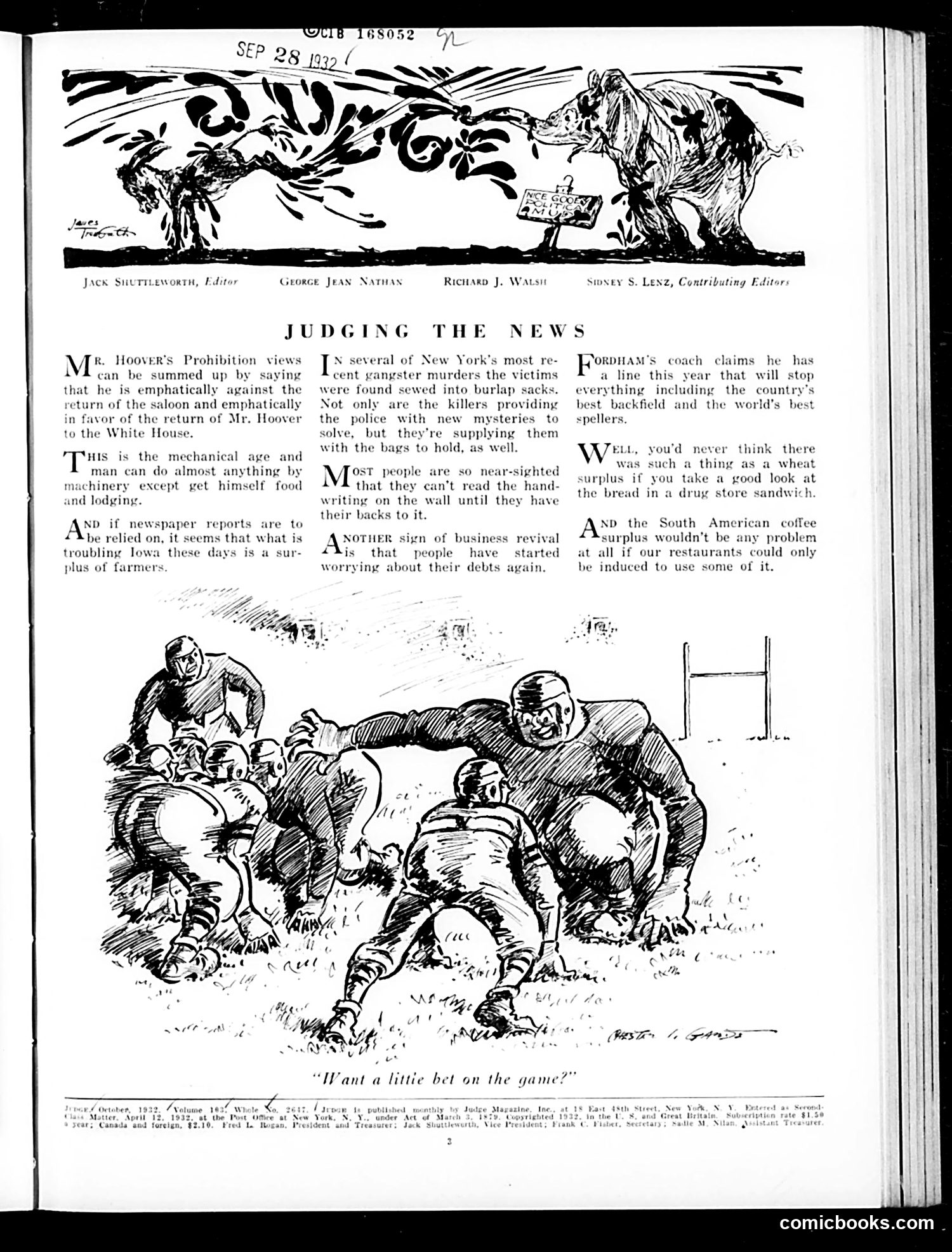
# "Judging the News" - October 1932 This editorial page satirizes contemporary issues through short commentary and a cartoon titled "Want a little bet on the game?" The cartoon depicts what appears to be three men in suits positioned around a prone figure, seemingly engaged in or proposing gambling. Given the October 1932 date (Great Depression era), this likely critiques corruption or improper dealings among businessmen or politicians. The text above addresses Prohibition enforcement (gangster murders, police mysteries), business revival (people worrying about debts), agricultural surplus problems, and resource management issues of the early 1930s. The cartoon's title suggests ironic commentary on risky financial or political "games" being played during economically unstable times, possibly mocking those profiting from others' misfortune during the Depression.
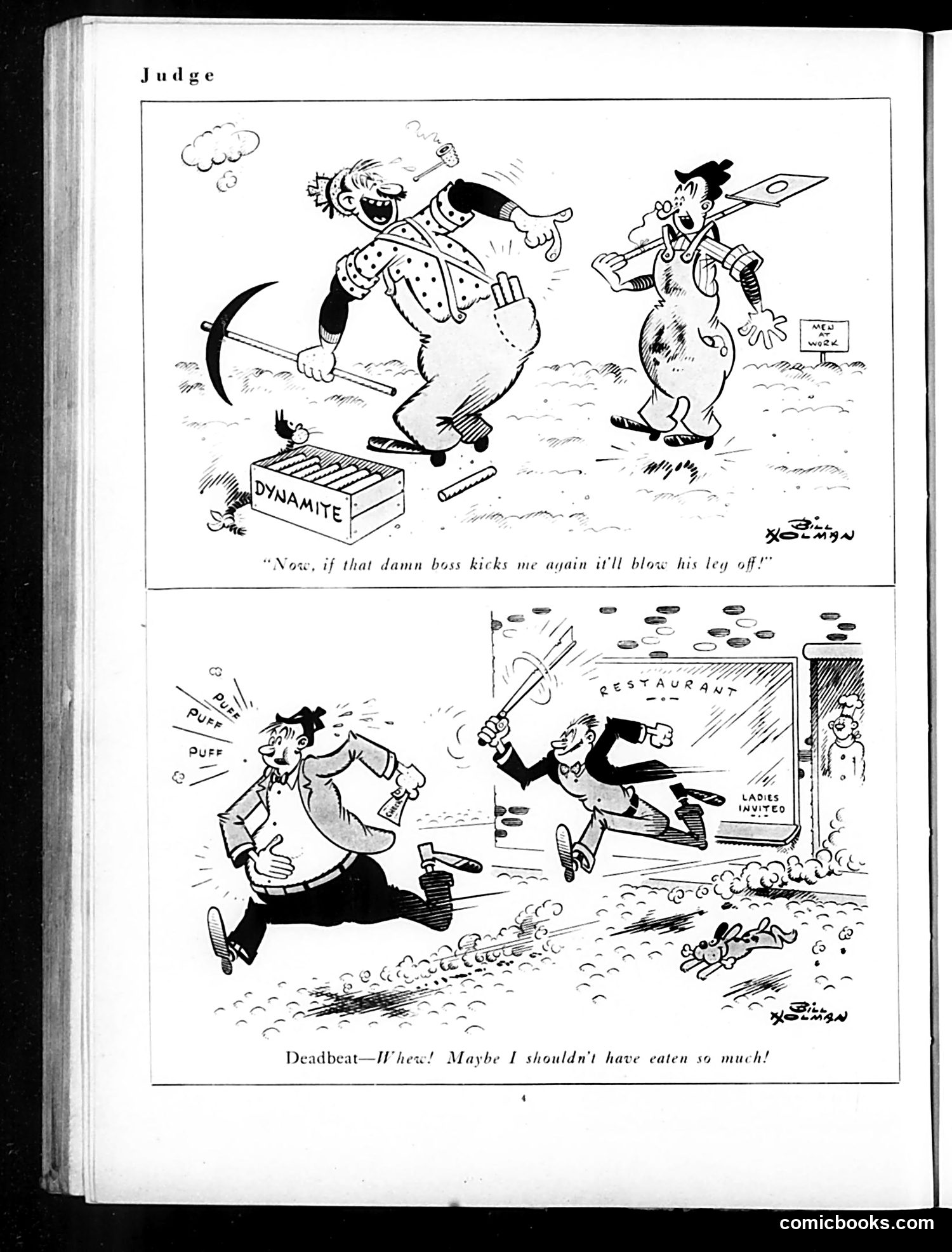
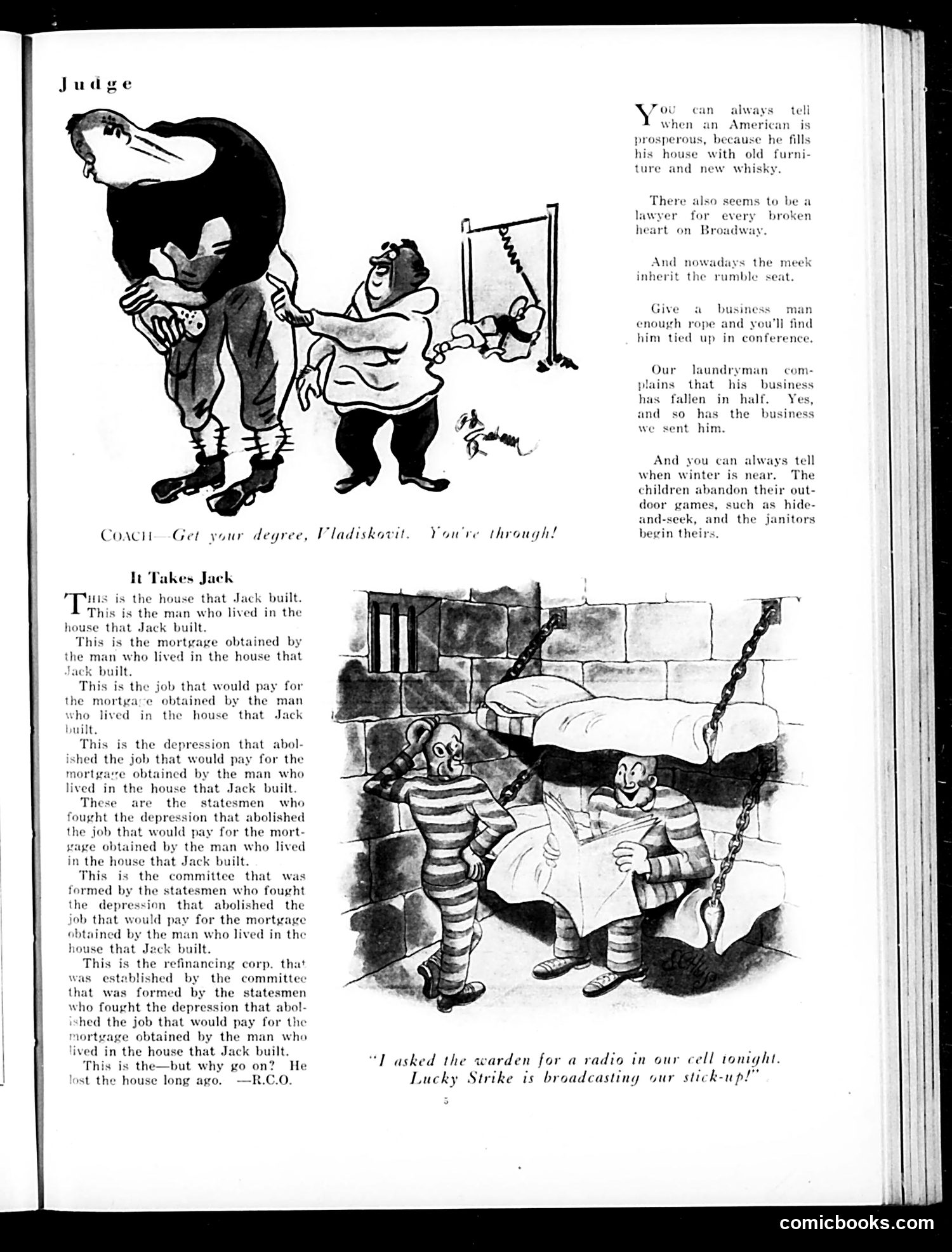
# Analysis The top cartoon titled "Judge" mocks a Russian official named Vladiskovitch, depicted in caricatured ethnic stereotypes, being told by a coach "Get your degree, Vladiskovitch. You're through!" This appears to satirize Russian immigration or diplomatic competence during a period of U.S.-Russian tension (likely early 20th century). The longer section "It Takes Jack" is a cumulative poem in the style of "The House That Jack Built," tracing economic consequences of Depression-era unemployment. It sarcastically chains together: a house, a mortgage, unpaid job, resulting depression, politicians who fought the depression, a committee, a refinancing corporation, and finally asks "who go on?"—suggesting endless bureaucratic failure to resolve the crisis. The accompanying cartoon shows prisoners in stocks, reinforcing themes of economic hardship and confinement.
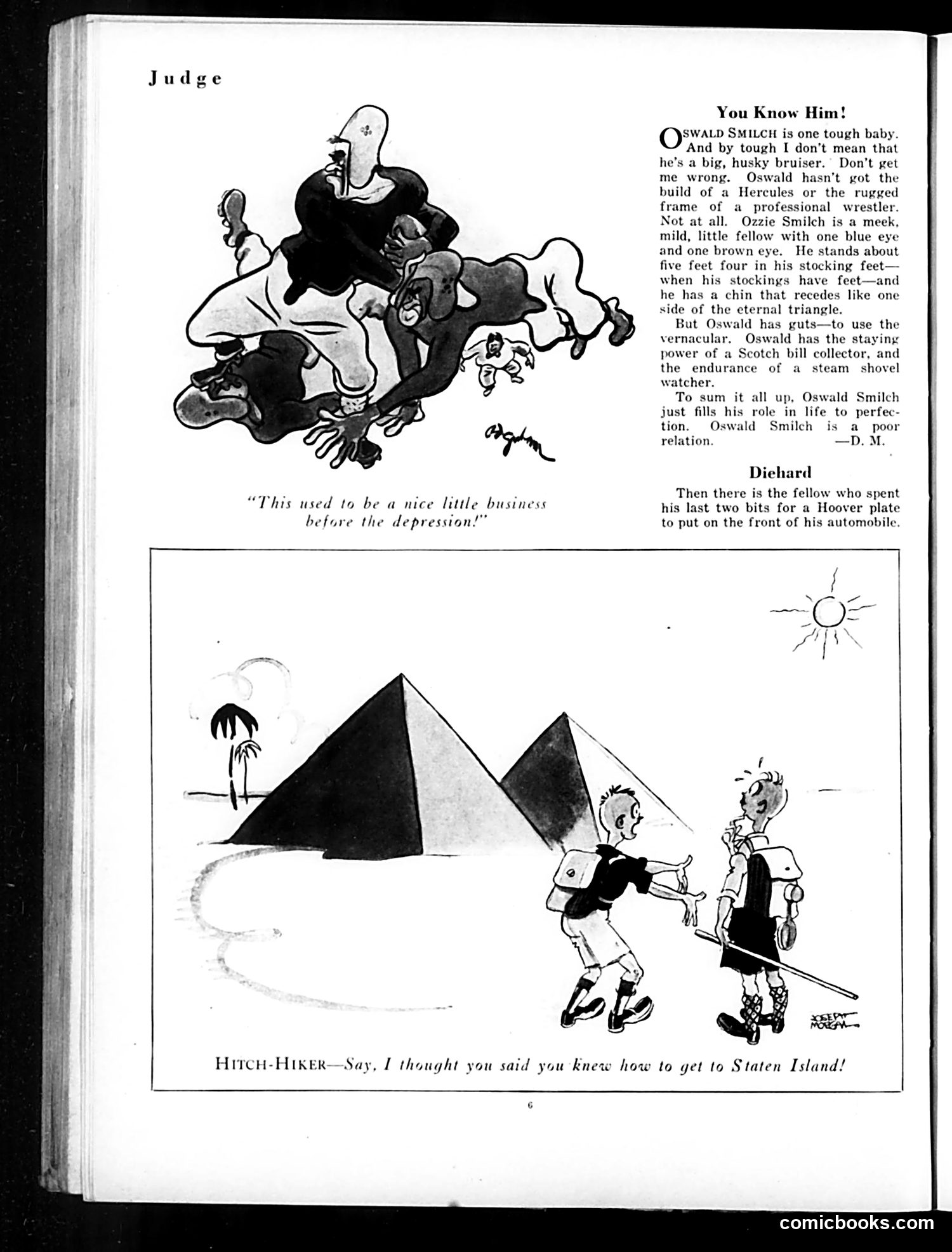
# Analysis of This Judge Magazine Page **Top Cartoon ("You Know Him!"):** A satirical character sketch of Oswald Smilch, presented as a stereotypically weak and ineffectual man—small-framed, meek, with physical quirks. The humor mocks his inability to succeed, characterizing him as a "poor relation" who merely "fills his role in life to perfection" through failure. **Bottom Cartoon ("Hitch-Hiker"):** Two characters appear lost in a desert landscape with pyramids, suggesting Egypt. The joke plays on miscommunication—one hitchhiker believed they were heading to Staten Island (New York), not this remote location, implying comedic incompetence in navigation or deception about directions. Both cartoons employ period-typical visual exaggeration and rely on character-based humor rather than specific contemporary events.
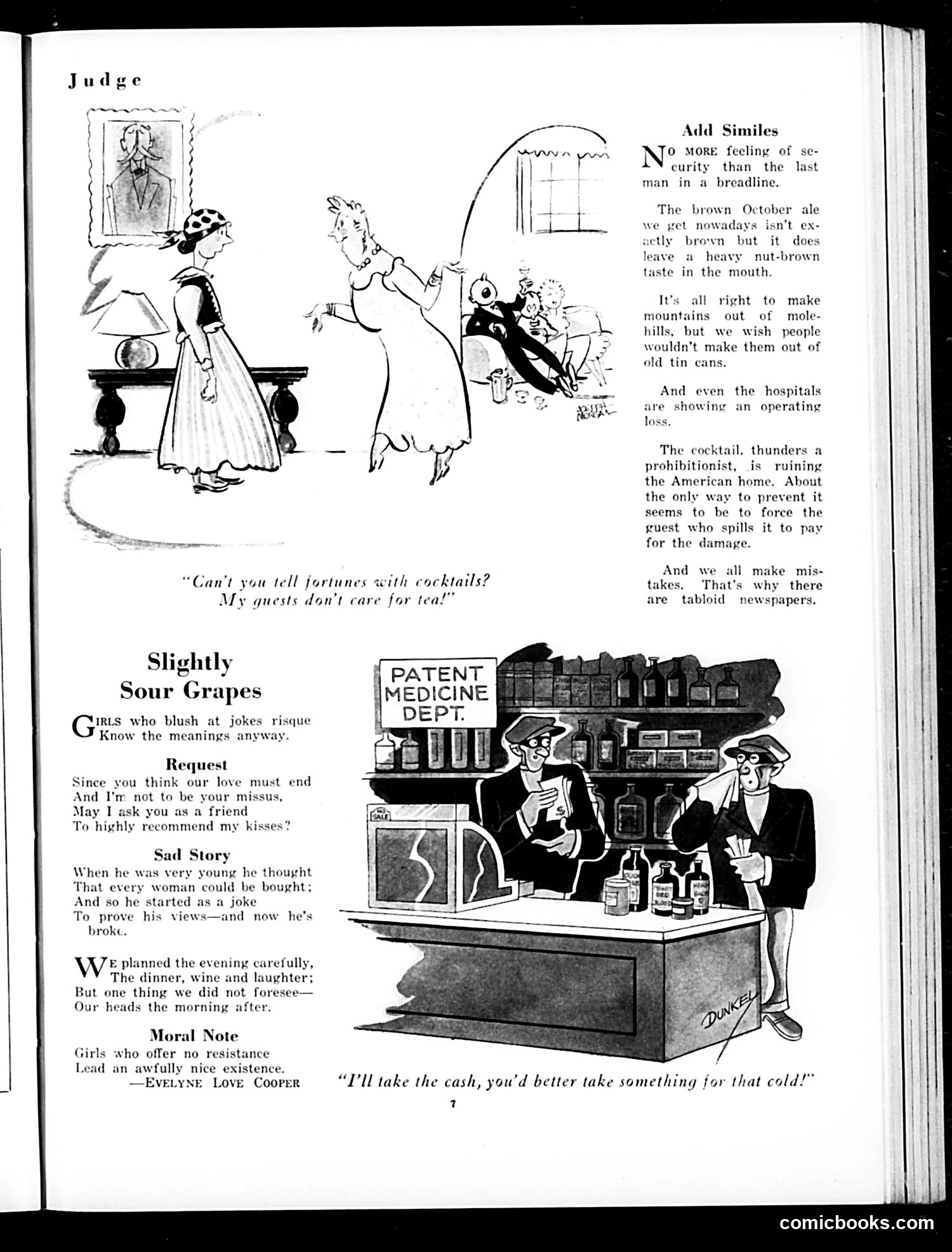
# Judge Magazine Page Analysis This page from *Judge* contains multiple satirical pieces targeting 1920s American social issues, particularly **Prohibition** and economic anxiety. The top cartoon mocks fortune-telling with cocktails, referencing the **Prohibition era** (1920-1933) when alcohol was illegal—guests secretly drinking cocktails at social gatherings. The "Add Similes" section uses comparative humor to critique contemporary problems: breadline poverty (Great Depression context), watered-down beer during Prohibition, hospitals losing money, and prohibition's failure to protect homes—the cocktail's real damage is spilled drinks guests must pay for, a wry commentary on enforcing an unpopular law. The "Patent Medicine Dept." cartoon shows two men at a drugstore counter discussing a cold remedy, likely satirizing how patent medicines were marketed as cure-alls during this period. The poetry sections ("Slightly Sour Grapes," "Request," "Sad Story") offer lighthearted commentary on romance, relationships, and hangovers—the latter clearly referencing secret drinking despite Prohibition. Overall, the page satirizes Prohibition's ineffectiveness and broader post-war social disruption.
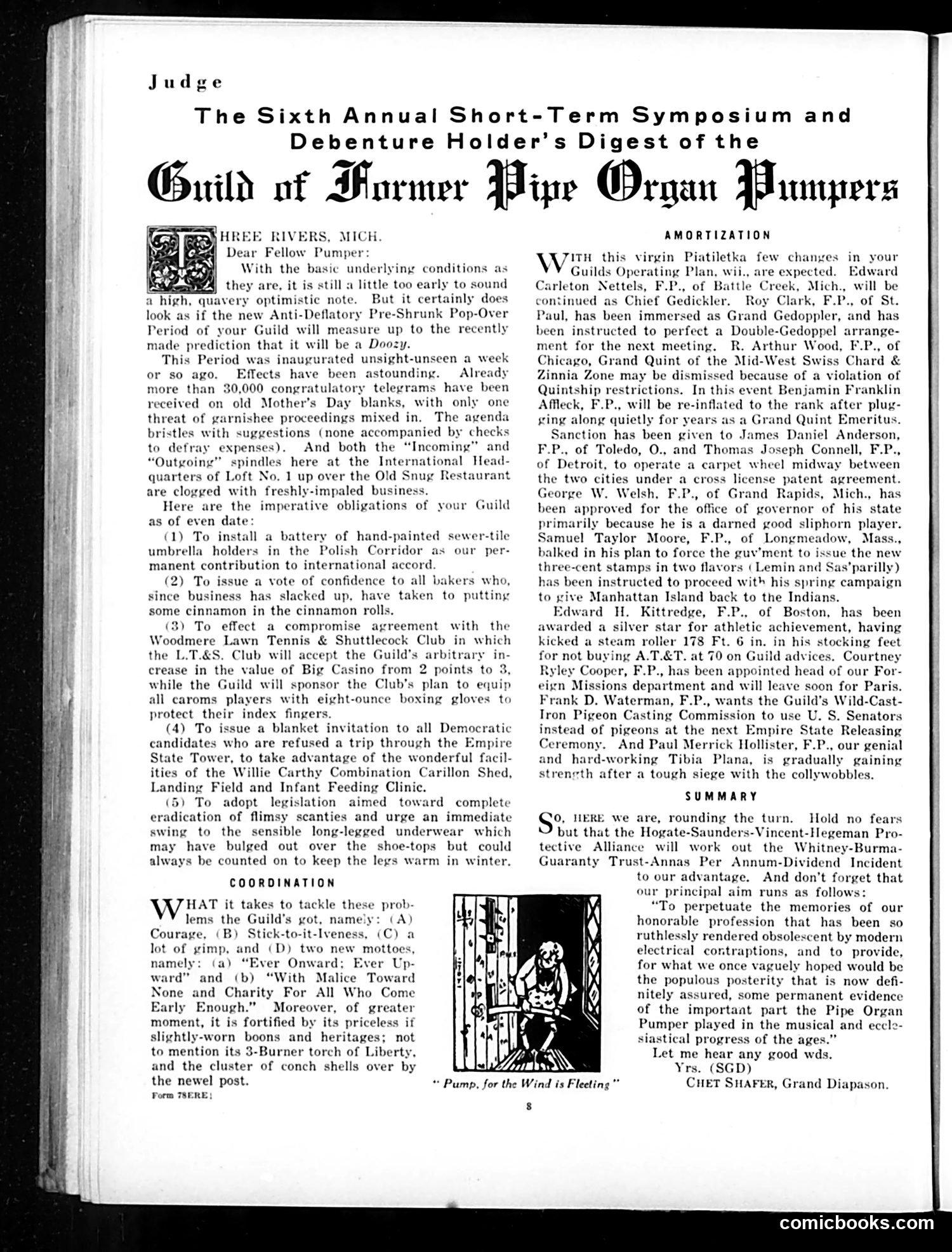
# Judge Magazine Satire: "Guild of Hormer Pipe Organ Pruners" This is **mock-serious organizational satire**—Judge parodies corporate and fraternal bureaucracy by inventing an absurd trade guild for "pipe organ pruners" (a nonsensical profession). The satire targets: - **Overblown institutional language**: Dense business jargon ("Anti-Deflate Pre-Shrunk Pop-Over Period," "Gedopplement") masks meaningless activity - **Fraternal lodge pretension**: The faux-official meeting minutes, numbered resolutions, and invented officers mimic actual organizational minutes - **Absurd "important" business**: Resolutions range from ridiculous (sewer-tile umbrella holders, cinnamon-roll confidence votes) to contradictory (equipping card players with boxing gloves) - **Corporate cheerleading**: The breathless optimism ("astounding effects") about nothing The embedded cartoon shows someone at a window captioned *"Pump, for the Wind is Fleeting"*—possibly the only coherent element—suggesting even whimsy deflates under bureaucratic weight. The satire mocks how organizations generate elaborate procedures to justify their own existence.
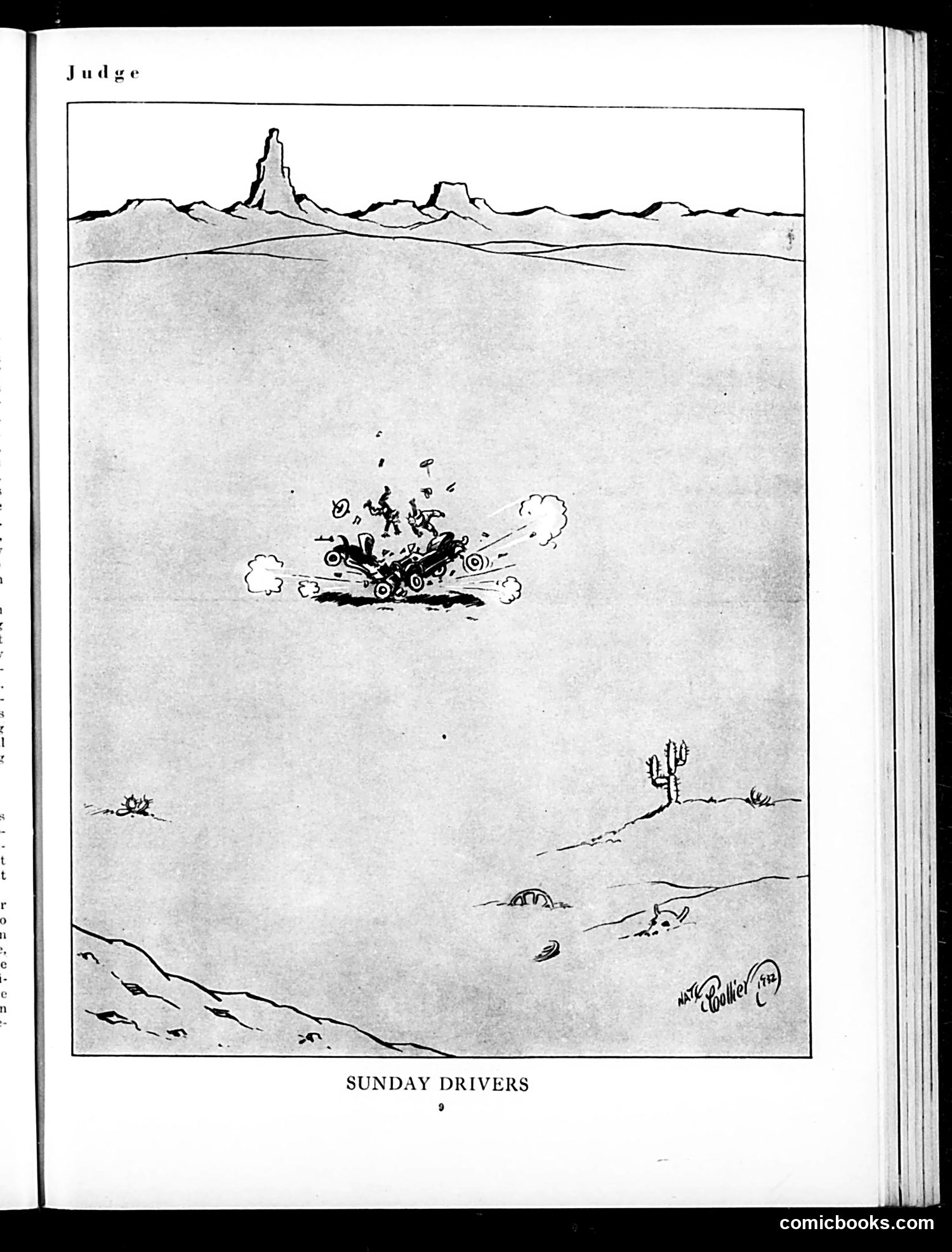
# "Sunday Drivers" - Judge Magazine Cartoon This cartoon satirizes reckless weekend motorists in the early automobile era. The image depicts a chaotic car crash in a desert landscape, with a vehicle exploding in a cloud of dust and debris. Scattered mechanical parts and smoke clouds surround the wreckage, while a cactus stands nearby—likely indicating the American Southwest. The title "Sunday Drivers" refers to casual, inexperienced drivers who took recreational car trips on weekends. The satire mocks their dangerous driving habits and the resulting accidents. The cartoon reflects early-20th-century anxieties about automobile safety and the recklessness of untrained drivers, making it a social commentary on road safety rather than political satire.
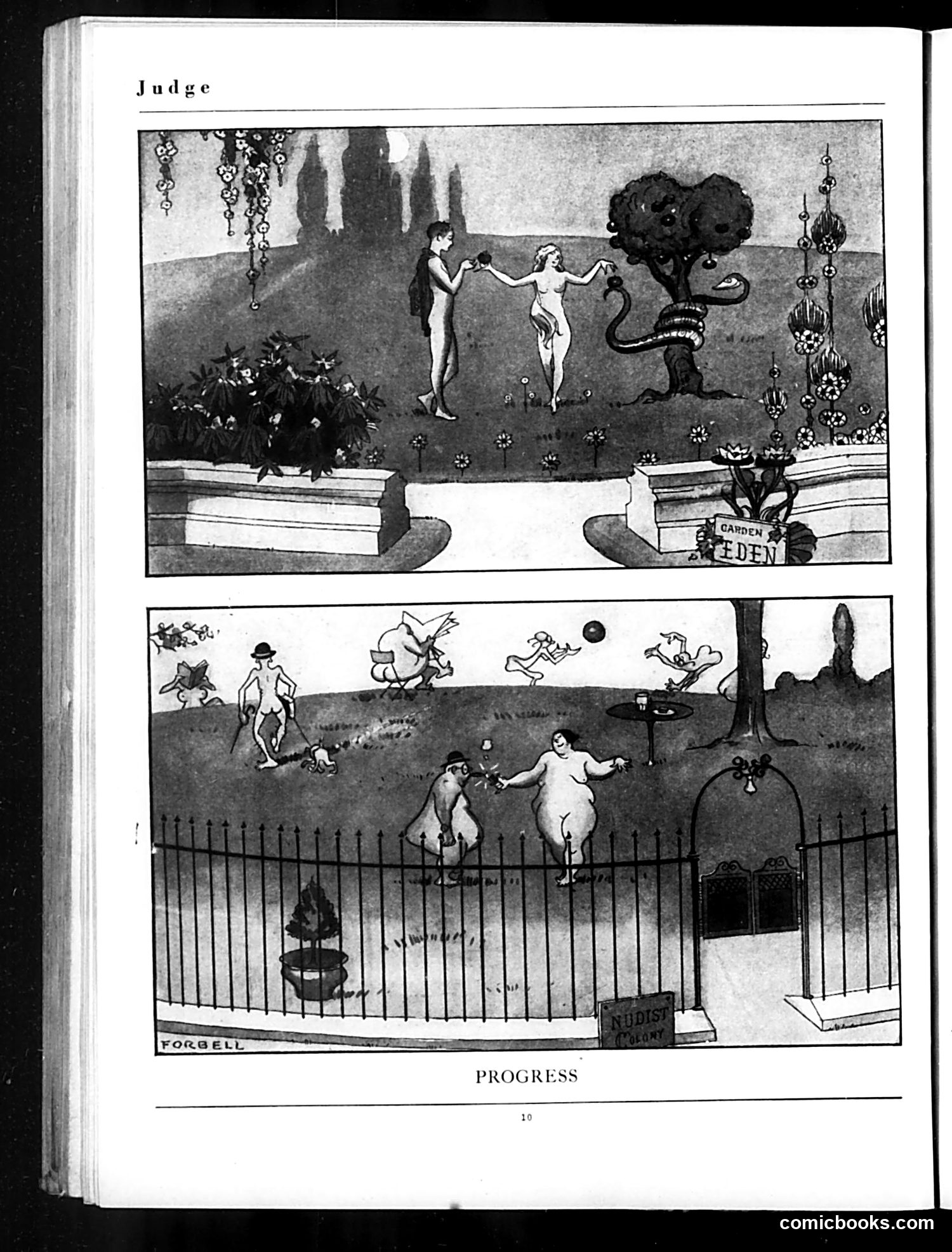
# "Progress" - Judge Magazine Cartoon Analysis This two-panel cartoon by Forbell satirizes the concept of human "progress." The top panel depicts the Garden of Eden—a paradisiacal scene with naked figures, exotic creatures, and ornamental vegetation, labeled "GARDEN OF EDEN." The bottom panel shows the same figures now confined behind an iron fence, labeled "NUDIST COLONY," engaged in the same activities but within restrictive boundaries. The satire critiques modernity's illusion of progress: civilization constrains rather than liberates humanity. Despite advancing society, modern people remain fundamentally imprisoned—now by laws, property ownership, and social restrictions—compared to humanity's "natural" state. The cartoon suggests that progress is merely progress toward greater control and confinement.