
Judge, 1932-10 · page 23 of 36
Judge — October 1932 — page 23: what you’re looking at
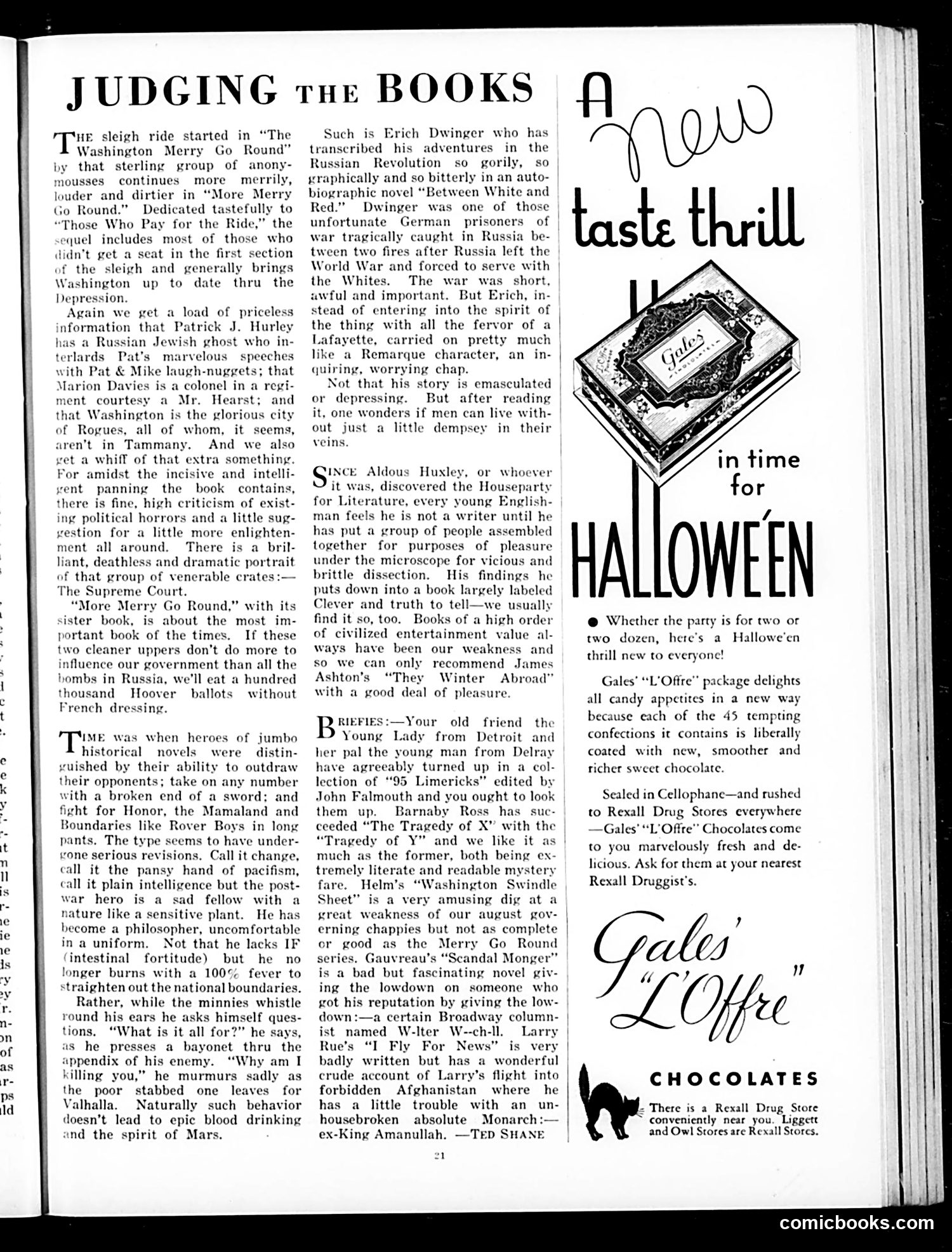
A restored page from Judge, 1932-10. Page through the whole issue in the reader above.
📄 Transcribed text from this page (OCR, searchable)
Machine-transcribed from the original scan — historical spelling and the odd misread are preserved.
1 c t JUDGING rue BOOKS fq s sleigh ride started in “The Washington Merry Go Round” by that sterling group of anony- mousses continues more merrily, louder and dirtier in “More Merry Go Round.” Dedicated tastefully to “Those Who Pay for the Ride,” the equel includes most of those who didn’t get a seat in the first section f the sleigh and generally brings Washington up to date thru the Depression. Again we get a load of priceless nformation that Patrick J. Hurley a Russian Jewish ghost who in- ards Pat’s marvelous speeches with Pat & Mike laugh-nuggets; that Marion Davies is a colonel in a regi- ment courte Mr. Hearst; and at Washington is the glorious city of Rogues, all of whom, it seems, ren't in Tammany. And we also t a whiff of that extra something. For amidst the incisive and intelli- vent panning the book contains, there is fine, high criticism of exist- ing political horrors and a little sug- yestion for a little more enlighten- ment all around. There is a bri liant, deathless and dramatic portrait of that group of venerable crates :— The Supreme Court. More Merry Go Round,” with its sister book, about the most im- portant book of the times. If these two cleaner uppers don’t do more to influence our government than all the bombs in Russia, we'll eat a hundred thousand Hoover ballots without French dressing. T 1E was when heroes of jumbo historical novels were distin- suished by their ability to outdraw their opponent ke on any number with a broken end of a sword; and fight for Honor, the Mamaland and Boundaries like Rover Boys in long pants. The type seems to under- sone serious revisions. Call it change, call it the pans and of pacifism, call it plain intelligence but the post- war hero is a sad fellow with a ature like a sensitive plant. He has vxecome a philosopher, uncomfortable in a uniform. ot that he lacks IF intestinal fortitude) but he no longer burns with a 100% fever to straighten out the national boundaries. Rather, while the minnies whistle round his ears he asks himself ques- tions. “What is it all for as he presses a bayonet thru the appendix of his enemy. “Why am I killing you,” he murmurs sadly as the poor stabbed one leaves for Valhalla. Naturally such behavior doesn’t lead to epic blood drinking and the spirit of Mars, t Such is Erich Dwinger who has transcribed his adventures in the Russ Revolution so gorily, so seraphically and so bitterly in an auto- biographic novel “Between White and Red. Dwinger was one of those unfortunate Germ prisoners of war tragically caught in Russia be- tween two fires after Russia left the World War and forced to serve with the Whites. The war w short, awful and important. But h, in- stead of entering into the spirit of the thing with all the fervor of a Lafayette, ried on pretty much like Remarque character, an in- quiring, worrying chap. Not that his story is emasculated or depressing. But after reading it, one wonders if men can live with- out just a little dempsey in their veins. NCE Aldous Huxley, or whoever it was, discovered the Houseparty for Literature, every young English- man feels he is not a writer until he has put a group of people assembled together for purposes of pleasure under the microscope for vicious and brittle dissection. His findings he puts down into a book largely labeled Clever and truth to tell—we usually find it so, too. Books of a high order of civilized entertainment value al- ways have been our weakness and so we can only recommend James Ashton’s “They Winter Abroad” with a good deal of pleasure. RIEFIES:—Your old friend the Young Lady from Detroit and her pal the young man from Delray have agreeably turned up in a col- lection of “95 Limericks” edited by John Falmouth and you ought to look them up. Barnaby Ross has _ suc- ceeded “The Tragedy of X” with the “Tragedy of Y” and we like it as | much as the former, both being ex- tremely literate and readable mystery are. Helm’s “Washington Swindle Sheet” is a very amusing dig at a ra t weakness of our august gov- erning chappies but not as complete or good the Merry Go Round series. Gauvreau’s “Scandal Monger” is a bad but fascinating novel giv- ing the lowdown on someone who got his reputation by giving the low- down:—a certain Broadway column- med W-lIter W--ch-ll. | Larry “I Fly For News” is very badly written but has a wonderful crude account of Larry’s flight into forbidden Afghanistan where he has a little trouble with an un- housebroken absolute Monarch ex-King Amanullah. —TED SHANE a laste thrill in time for HALLOWE @ Whether the party is for two or two dozen, here’s a thrill new to everyone! Hallowe'en Gales’ “L’Offre” package delights all candy appetites in a new way because each of the 45 tempting confections it contains is liberally coated with smoother and richer sweet chocolate. new, Sealed in Cellophane—and rushed to Rexall Drug Stores everywhere —Gales’ “L’ Offre’ Chocolates come to you marvelously fresh and de- licious. Ask for them at your nearest Rexall Druggist’s. ~ “ar? , " CHOCOLATES = There is a Rexall Drug Store | conveniently near you. Liggett and Owl Stores are Rexall Stores. comicbooks.com