
Judge, 1932-10 · page 22 of 36
Judge — October 1932 — page 22: what you’re looking at
A restored page from Judge, 1932-10. Page through the whole issue in the reader above.
📄 Transcribed text from this page (OCR, searchable)
Machine-transcribed from the original scan — historical spelling and the odd misread are preserved.
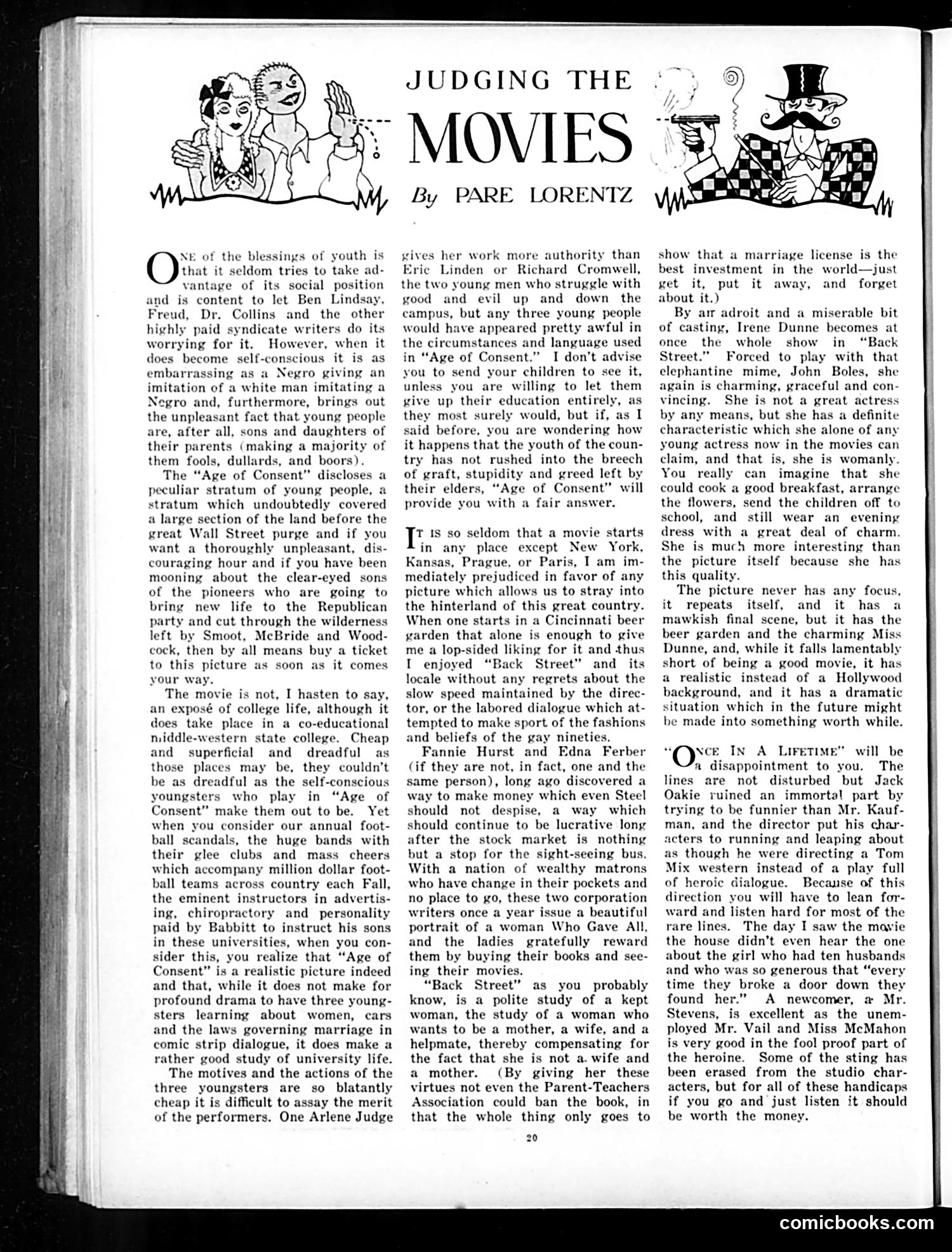
ae Ne of the blessings of youth is Oris: it seldom tries to take ad- vantage of its social position and is content to let Ben Lindsay, Freud, Dr. Collins and the other highly paid synd e writers do its worrying for it. However, when it does become self-conscious it is as embar ng as a Negro giving an imitation of a white man imitating a Negro and, furthermore, brings out the unpleasant fact that young people are, after all, sons and daughters of their parents (making a majority of them fools, dullard: dd boors). The “Age of Consent” discloses a peculiar stratum of young people, a stratum which undoubtedly covered rge section of the land before the great Wall Street purge and if you want a thoroughly unpleasant, dis- couraging hour and if you have been mooning about the clear-eyed sons of the pioneers who are going to bring new life to the Republican pa and cut through the wilderness left by Smoot, McBride and Wood- cock, then by all means buy a ticket to this picture as soon as it comes your way. The movie is not, I hasten to say, an exposé of college life, although it does take place in a co-educational niddle-western state college. Cheap and superficial and dreadful a those places may be, they couldn’t be as dreadful as the self-conscious youngsters who play in “Age of Consent” make them out to be. Yet when you consider our annual foot- ball scandals, the huge bands with their glee clubs and mass cheers which accompany million dollar foot- ball teams across country each Fall, the eminent instructors in adverti: ing, chiropractory and personality paid by Babbitt to instruct his sons in these universities, when you con- sider this, you realize that “Age of Consent” is a realistic picture indeed and that, while it does not make for profound drama to have three young- sters learning about women, cars and the laws governing marriage in comic strip dialogue, it does make a rather good study of university life. The motives and the actions of the three youngsters are so blatantly cheap it is difficult to assay the merit of the performers. One Arlene Judge JUDGING THE * MOVIES © By PARE LORENTZ sives her work more authority than Eric Linden or Richard Cromwell, the two young men who struggle with good and evil up and down the campus, but any three young people would have appeared pretty awful in the circumstances and language used n “Age of Consent.” I don’t advise you to send your children to see it, unless you are willing to let them give up their education entirely, as they most surely would, but if, as I said before, you are wondering how it happens that the youth of the coun- try has not rushed into the breech of graft, stupidity and greed left by their elders, “Age of Consent” will provide you with a fair answer. T Is so seldom that a movie starts in any place except New York, Kansas, Prague. or Paris, I am im- mediately prejudiced in favor of any picture which allows us to stray into the hinterland of this great country. When one starts in a Cincinnati beer yarden that alone is enough to give me a lop-sided liking for it and thus I enjoyed “Back Street” and its locale without any regrets about the slow speed maintained by the direc- tor, or the labored dialogue which at- tempted to make sport of the fashions and beliefs of the gay nineties. Fannie Hurst and Edna Ferber (if they are not, in fact, one and the same person), long ago discovered a way to make money which even Steel should not despise, a way which should continue to be lucrative long after the stock market is nothing but a stop for the sight-seeing bus. With a nation of wealthy matrons who have change in their pockets and no place to go, the: wo corporation writers once a year issue a beautiful portrait of a woman Who Gave All, and the ladies gratefully reward them by buying their books and see- ing their movies. “Back Street” as you probably know, is a polite study of a kept woman, the study of a woman who wants to be a mother, a wife, and a helpmate, thereby compensating for the fact that she is not a. wife and a mother. (By giving her these virtues not even the Parent-Teachers Association could ban the book, in that the whole thing only goes to 20 show that a marriage license is the best investment in the world—just get it, put it away, and forget about it.) By ar adroit and a miserable bit of casting, Irene Dunne becomes at once the whole show in “Back Street.” Forced to play with that elephantine mime, John Boles, she again is charming, graceful and con- vincing. She is not a great actr by any means, but she has a definite characteristic which she alone of any young actress now in the movies can claim, and that is, she is womanly. You really can imagine that she could cook a good breakfast, arrange the flowers, send the children off to school, and still wear an evening dress with a great deal of charm. She is much more interesting than the picture itself because she has this quality. The picture never has any focus it repeats itself, and it has a mawkish final scene, but it has the beer garden and the charming Miss Dunne, and, while it falls lamentably short of being a good movie, it has a realistic instead of a Hollywood background, and it has a dramatic situation which in the future might be made into something worth while. Nce IN A LiFetimMe” will be a disappointment to you. The lines are not disturbed but Jack Oakie ruined an immortal part by trying to be funnier than Mr. Kauf- man, and the director put his char- acters to running and leaping about as though he were directing a Tom Mix western instead of a play full of heroic dialogue. Because of this direction you will have to lean for- ward and listen hard for most of the rare lines. The day I saw the mavie the house didn’t even hear the one about the girl who had ten husbands and who was so generous that “every time they broke a door down they found her.” A newcomer, a Mr. Stevens, is excellent as the unem- ployed Mr. Vail and Miss McMahon is very good in the fool proof part of the heroine. Some of the sting has been erased from the studio char- acters, but for all of these handicaps if you go and just listen it should be worth the money. comicbooks.com