A complete issue · 36 pages · 1932
Judge — June 11, 1932
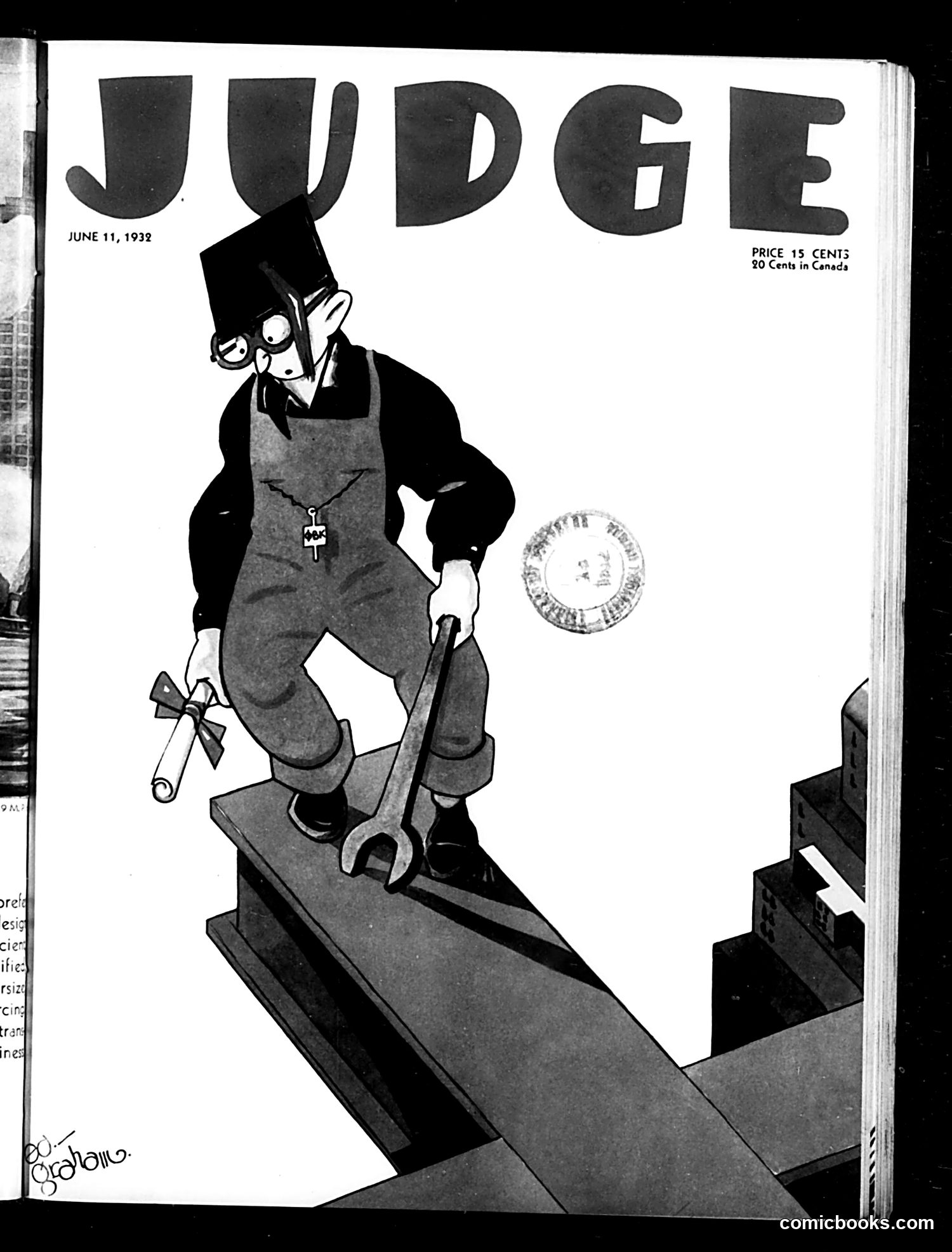
# Judge Magazine Cover Analysis - June 11, 1932 This cover depicts a judge or authority figure in judicial robes wielding a large wrench as a weapon, standing over what appears to be broken machinery or infrastructure. He holds a document (likely a legal decree) in one hand. Published during the Great Depression, this likely satirizes judicial intervention in economic or labor disputes. The broken machinery suggests industrial collapse, while the judge's aggressive posture with the wrench implies that legal judgments are making economic problems worse rather than fixing them. The cartoon probably critiques how courts' rulings on labor disputes, antitrust cases, or bankruptcy proceedings were perceived as destructive to recovery efforts during this economic crisis. The absurdist image of a judge as saboteur underscores the cartoonist's view that judicial decisions were hindering rather than helping economic repair.
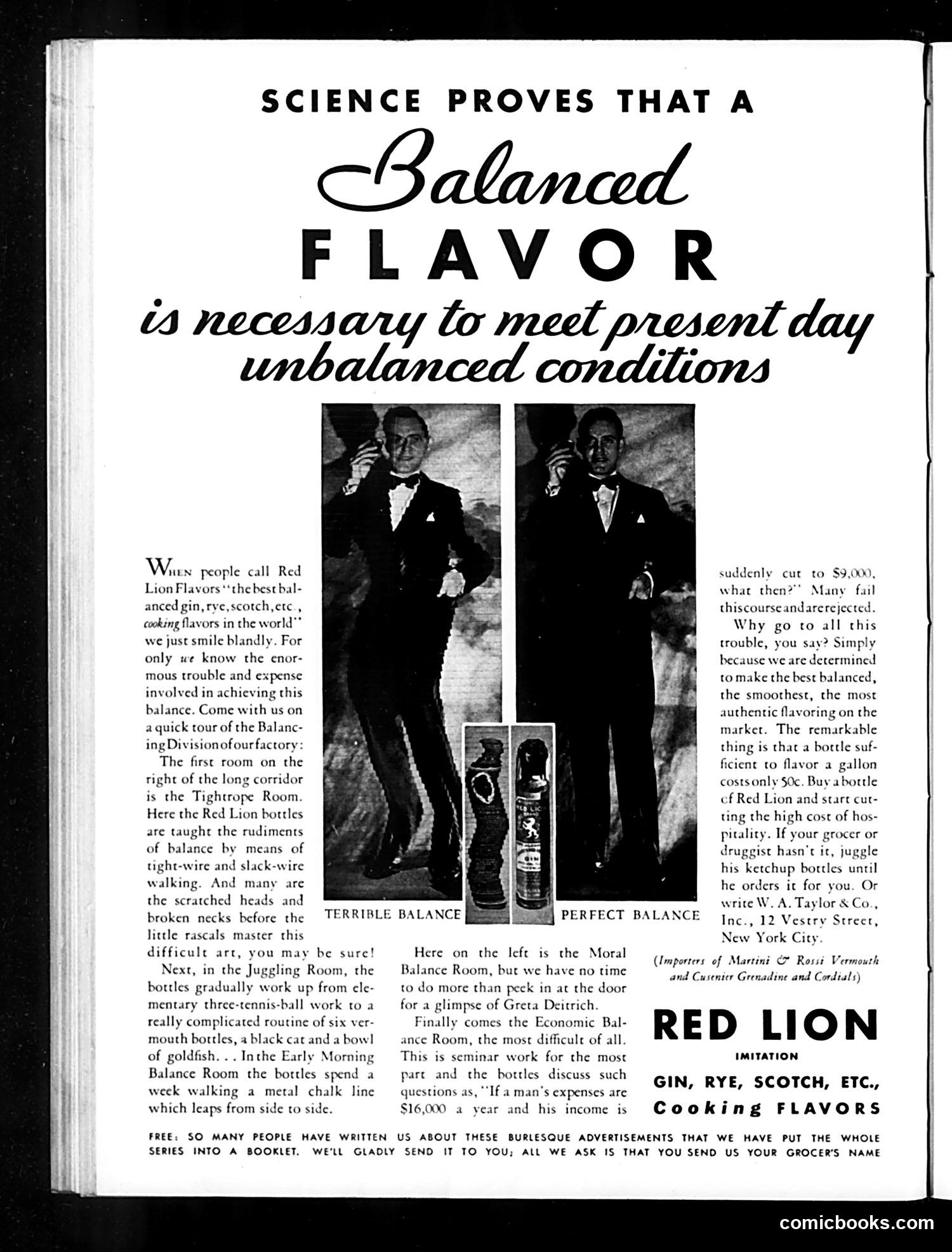
# Red Lion Advertisement, Judge Magazine This page is primarily a **liquor advertisement**, not political satire. It promotes Red Lion brand spirits (gin, rye, scotch, cooking flavors) through humor rather than commentary. The "joke" involves **balance**—literally and economically. The ad shows a man in formal dress in two states: "Terrible Balance" (left, unsteady) versus "Perfect Balance" (right, composed). This visual pun illustrates the product's claim about "balanced flavor." The accompanying text makes an economic argument: quality balanced flavoring costs only 5¢ per bottle to produce, yet Red Lion can charge significantly more. The ad sardonically suggests customers could "juggle his ketchup bottles" to trick grocers into ordering it—a tongue-in-cheek acknowledgment of the product's markup. This reflects **Prohibition-era marketing** (note "imitation" and "cooking" flavors as legal cover), using absurdist humor to sell spirits.
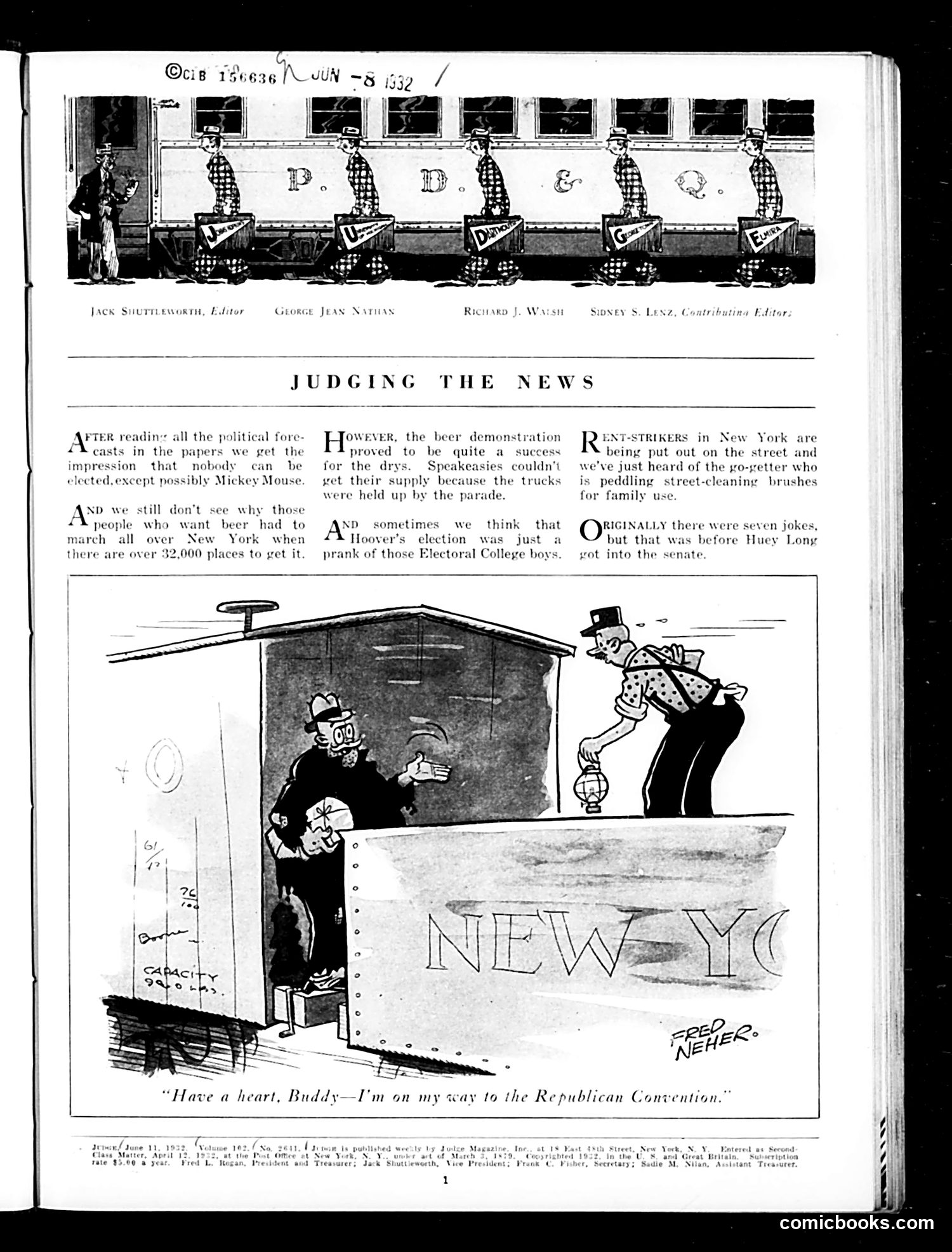
# "Judging the News" - Political Satire from Judge Magazine This page satirizes 1932 American politics through commentary and a cartoon. The text discusses: - **Political forecasts**: The writers note that only Mickey Mouse seems electable after reading predictions - **A beer demonstration**: Successfully blockading trucks during Prohibition enforcement - **Rent-strikers in New York**: Protesting street-cleaning brush sales - **Hoover's election**: Sarcastically comparing it to an "Electoral College boys" prank - **Senate jokes**: A reference to Huey Long entering the Senate The main cartoon depicts a newsstand operator telling a man heading to the Republican Convention: "Have a heart, Buddy—I'm on my way to the Republican Convention." The satire suggests pessimism about the Convention's prospects, likely during the Depression era when Republicans faced voter dissatisfaction.
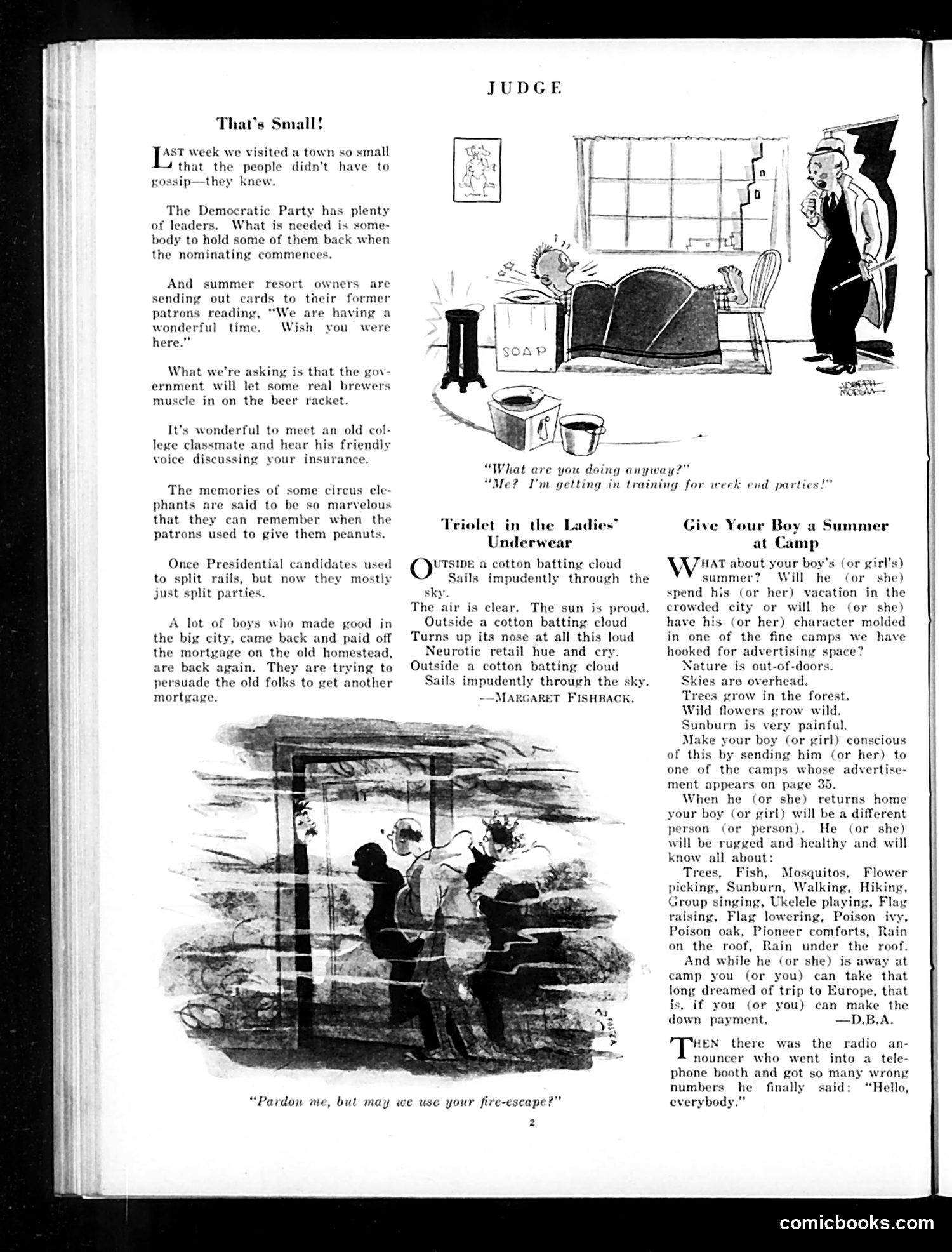
# Analysis of Judge Magazine Page This page contains editorial commentary and light humor rather than political cartoons. The main article "That's Small!" critiques Democratic Party leadership, suggesting they need better organization for nominations. It includes satirical observations about small-town gossip, summer resorts, circus elephants, and presidential campaigning. The cartoon at bottom shows people asking to use a fire escape, likely satirizing urban crowding or safety concerns. The right column promotes summer camps for children, framing outdoor experiences as character-building, though the tone seems somewhat tongue-in-cheek about mosquitoes, poison oak, and rain. A poem "Triolet in the Ladies' Underwear" offers whimsical commentary on cotton clouds and sky imagery. The page reflects early-to-mid 20th century American leisure culture and political organization concerns.
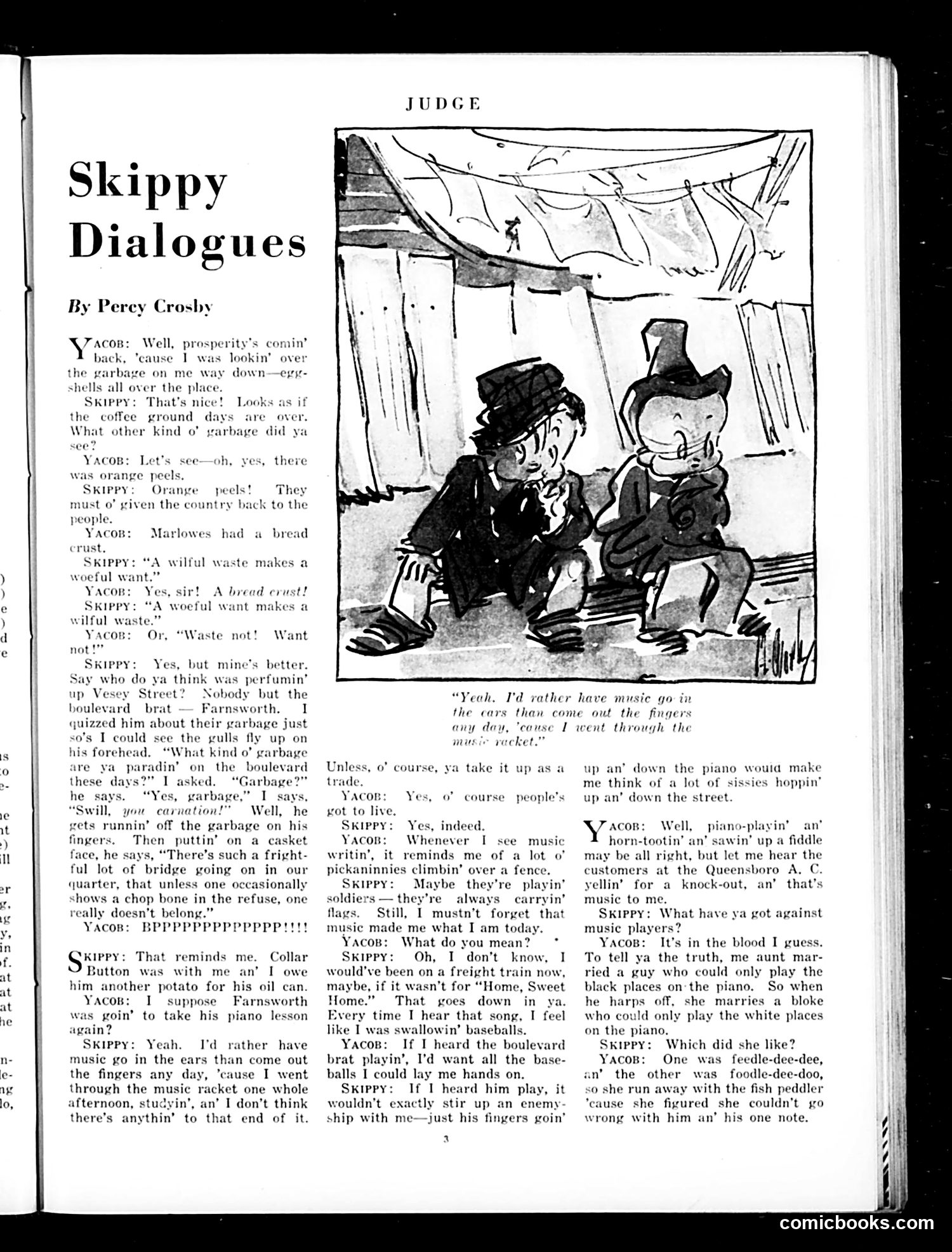
# "Skippy Dialogues" by Percy Crosby This page features a comic dialogue between two characters named Yacob and Skippy, apparently street urchins or working-class boys. The humor derives from their malapropisms, dialectal speech, and innocent misunderstandings of adult concepts. The jokes reference early 20th-century urban life: garbage disposal, bread lines (suggesting poverty), piano lessons, and music performances. Skippy's rough grammar and Yacob's responses create comedy through their naive interpretations—for instance, confusing "waste" with "a woeful want," or Skippy's dismissive attitude toward formal music education. The illustration shows two impoverished-looking boys in worn clothes and hats. The satire gently mocks working-class children's speech patterns while depicting period urban poverty and social conditions.
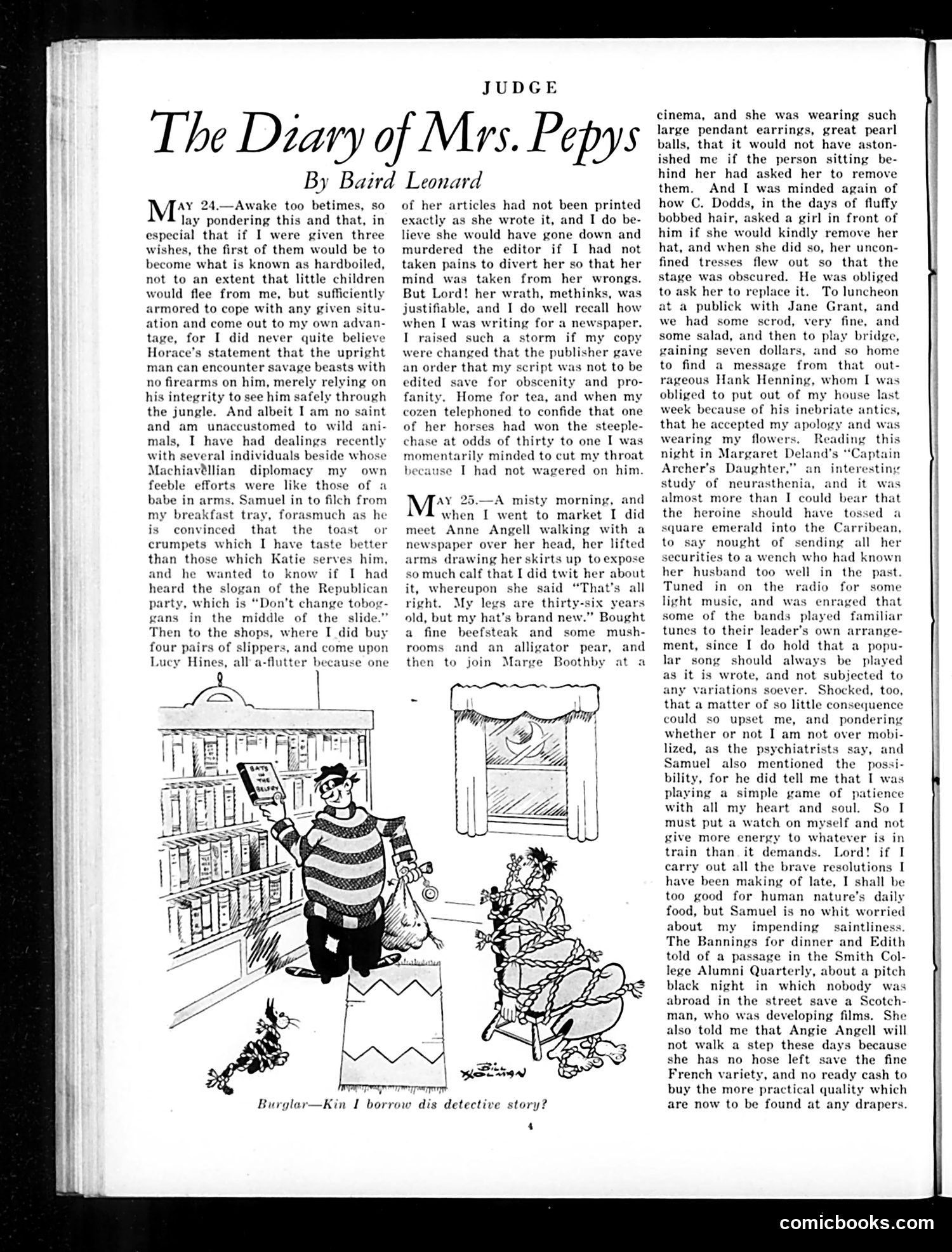
# "The Diary of Mrs. Pepys" by Baird Leonard This page features a satirical diary entry, a common Judge magazine format. The illustration shows a rotund man in striped clothing at a bookshelf with the caption "Burglar—Kin I borrow dis detective story?" The cartoon jokes about a burglar politely requesting to borrow a detective story from a homeowner—absurd because burglars steal rather than borrow. It's a play on contradiction: a criminal asking permission contradicts his profession. The diary entries reference everyday 1920s social concerns: editors rejecting manuscripts, women's fashion (earrings, bobbed hair), radio entertainment, and romantic complications. The humor targets middle-class anxieties about modern life, changing social customs, and romance. Mrs. Pepys emerges as a witty, somewhat exasperated narrator of her social world.
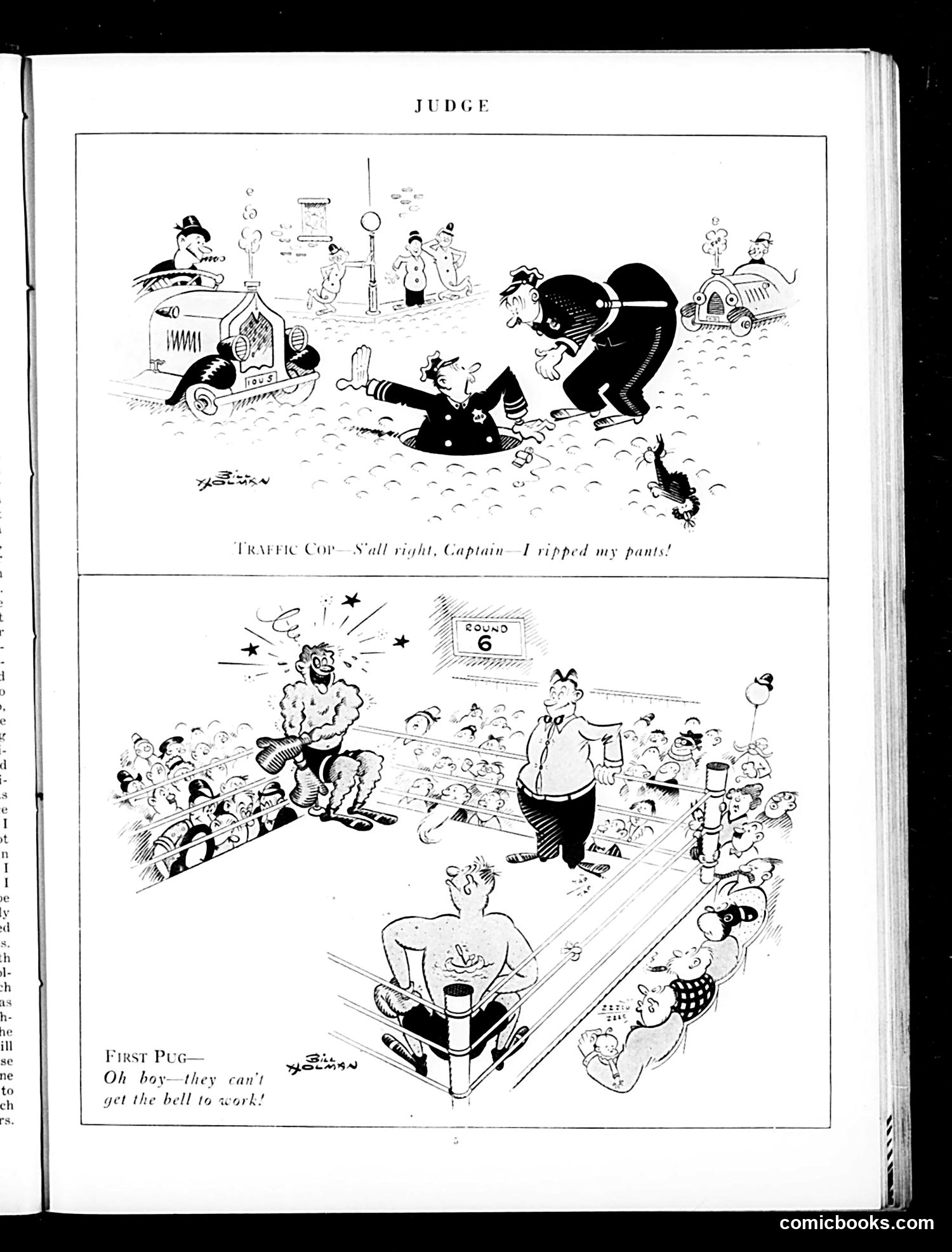
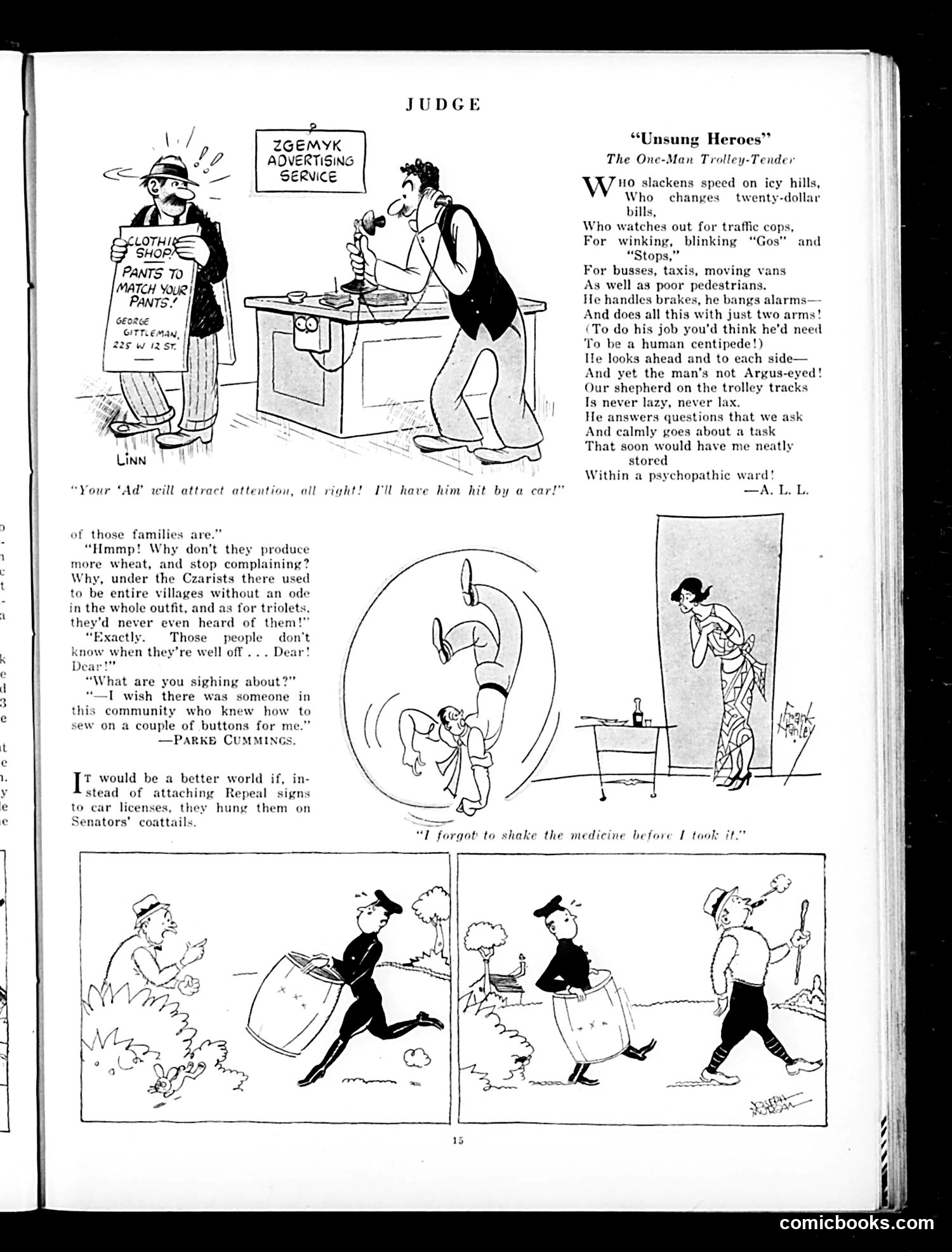
# Analysis of Judge Magazine Page: "Judge" **Top Cartoon - "Traffic Cop":** A traffic cop has apparently fallen and torn his pants while trying to manage chaotic street traffic. The humor derives from the dignity of authority literally compromised—the officer's embarrassment contrasts with his authoritative role directing various vehicles and pedestrians. This satirizes the challenges traffic police faced as automobile usage increased in early 20th-century American cities. **Bottom Cartoon - "First Pug":** A boxing match scene where a boxer is being struck, with spectators reacting. The caption "Oh boy—they can't get the bell to work!" suggests the fight continues despite technical failure, creating chaos. The humor plays on confusion and the absurdity of an ongoing match without proper procedure. Both cartoons rely on slapstick and situational humor typical of Judge's satirical style.
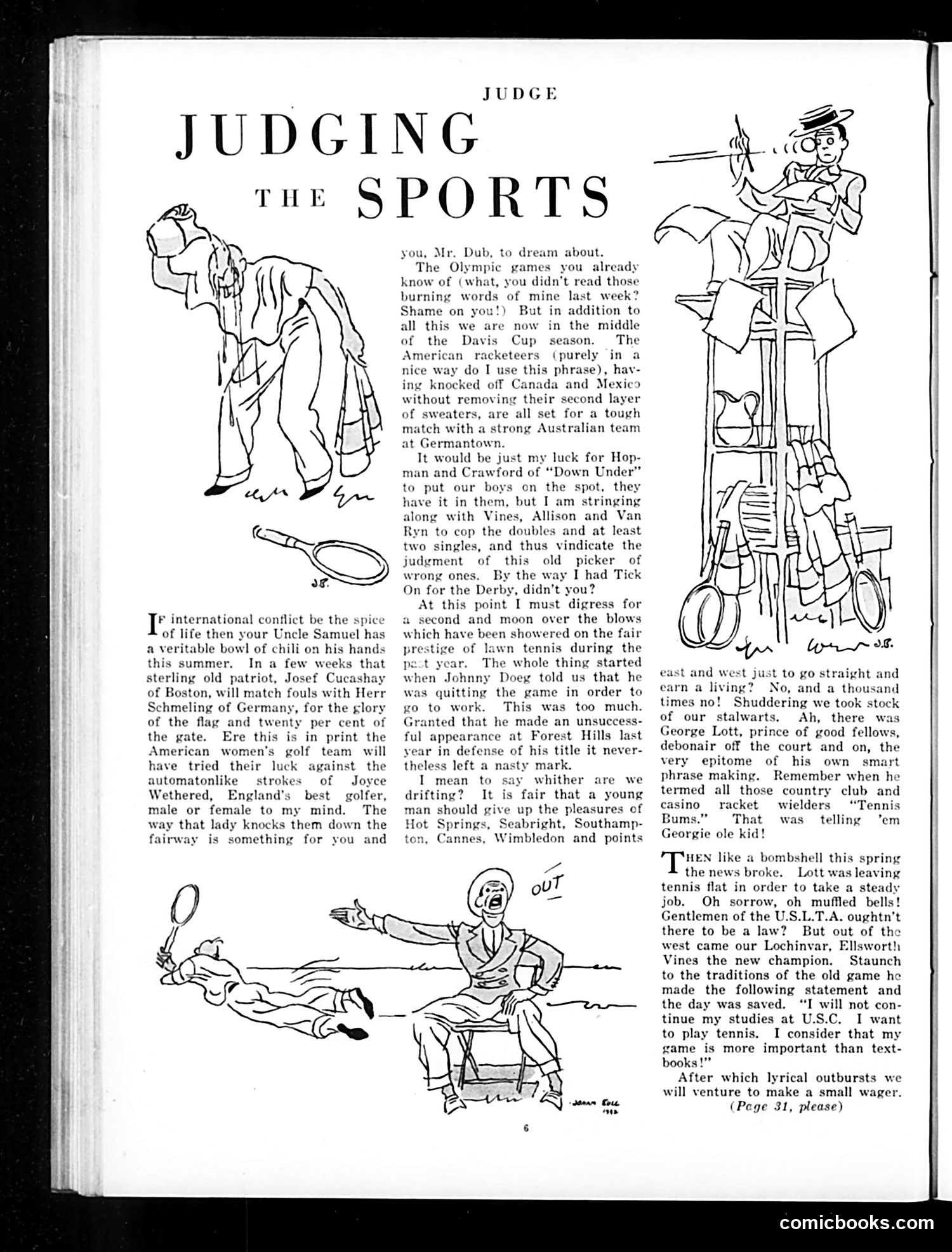
# "Judging the Sports" - Judge Magazine Sports Column This is a humorous sports column with satirical illustrations about 1920s tennis and athletics. The author discusses international tennis competitions, specifically the Davis Cup season and lawn tennis controversies. Key references include: - **Johnny Doeg**: A tennis player criticized for abandoning the sport to pursue work instead of competing - **George Lott**: Praised as a capable replacement champion - **U.S.L.T.A.**: The governing body, seemingly criticized for rules or decisions - **Forest Hills**: An important tennis venue where poor sportsmanship allegedly occurred The cartoons humorously depict tennis players in exaggerated poses. The overall satire mocks American tennis players' priorities (work over sport), administrative decisions, and questioning whether young athletes should sacrifice education for athletics. The tone is gently mocking rather than harsh.
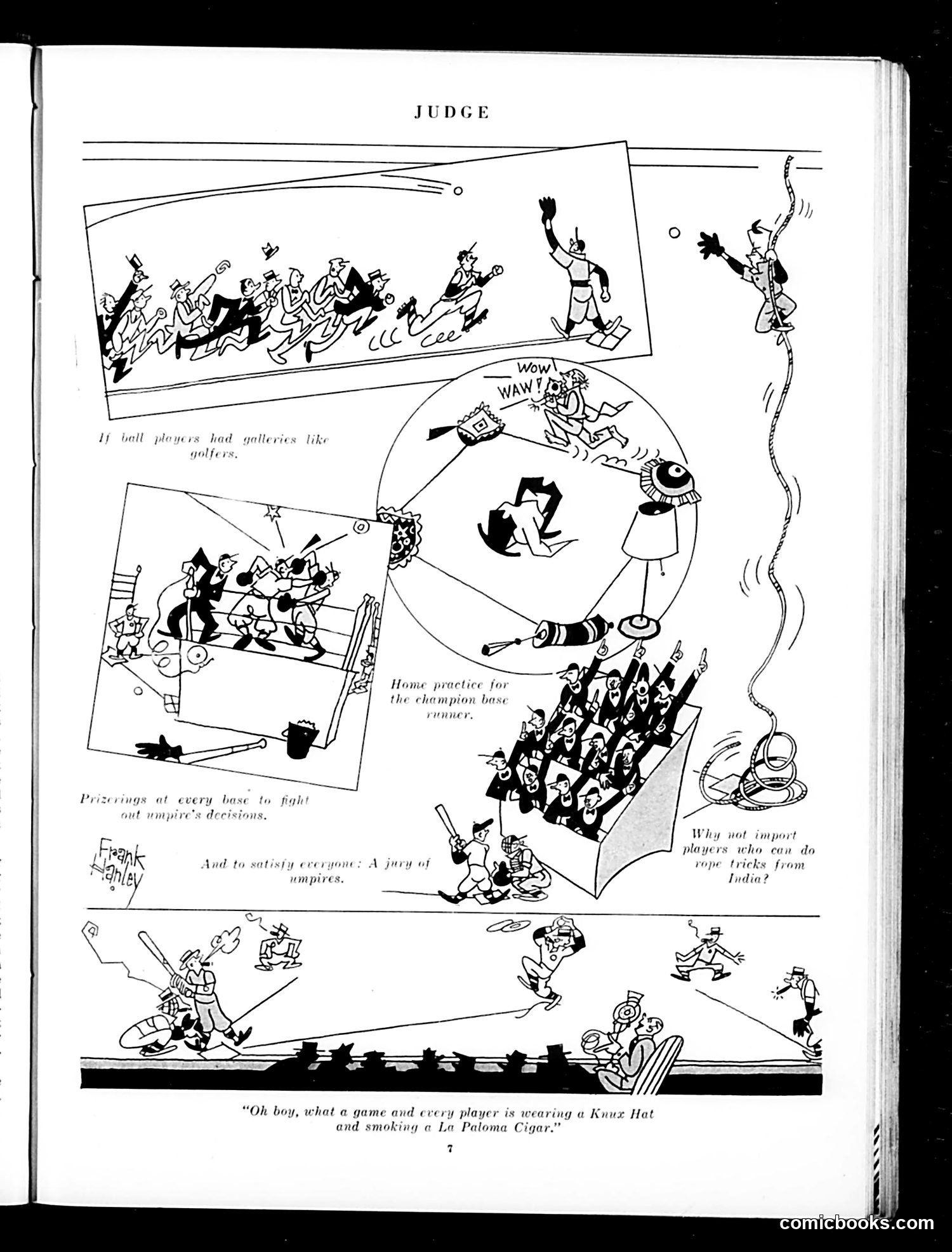
# Judge Magazine Baseball Satire This page satirizes early 20th-century baseball through multiple cartoon panels. The central image depicts "home practice for the champion base runner," showing chaotic scenes of players at bat, running bases, and a crowd of umpires—likely mocking the proliferation of officials or disputed calls in games. The satirical captions include "ball players had galleries like golfers," "prizings at every base to fight out umpire's decisions," and "a jury of umpires"—all suggesting baseball games had become overly complicated with too many authority figures and excessive argument. The final caption reveals this is product placement satire: the entire joke culminates in promoting "Knux Hat" and "La Paloma Cigar" as accessories every player supposedly wears and smokes, turning the sport's chaos into an advertisement. This reflects Judge's common practice of embedding commercial sponsorships within satirical content.
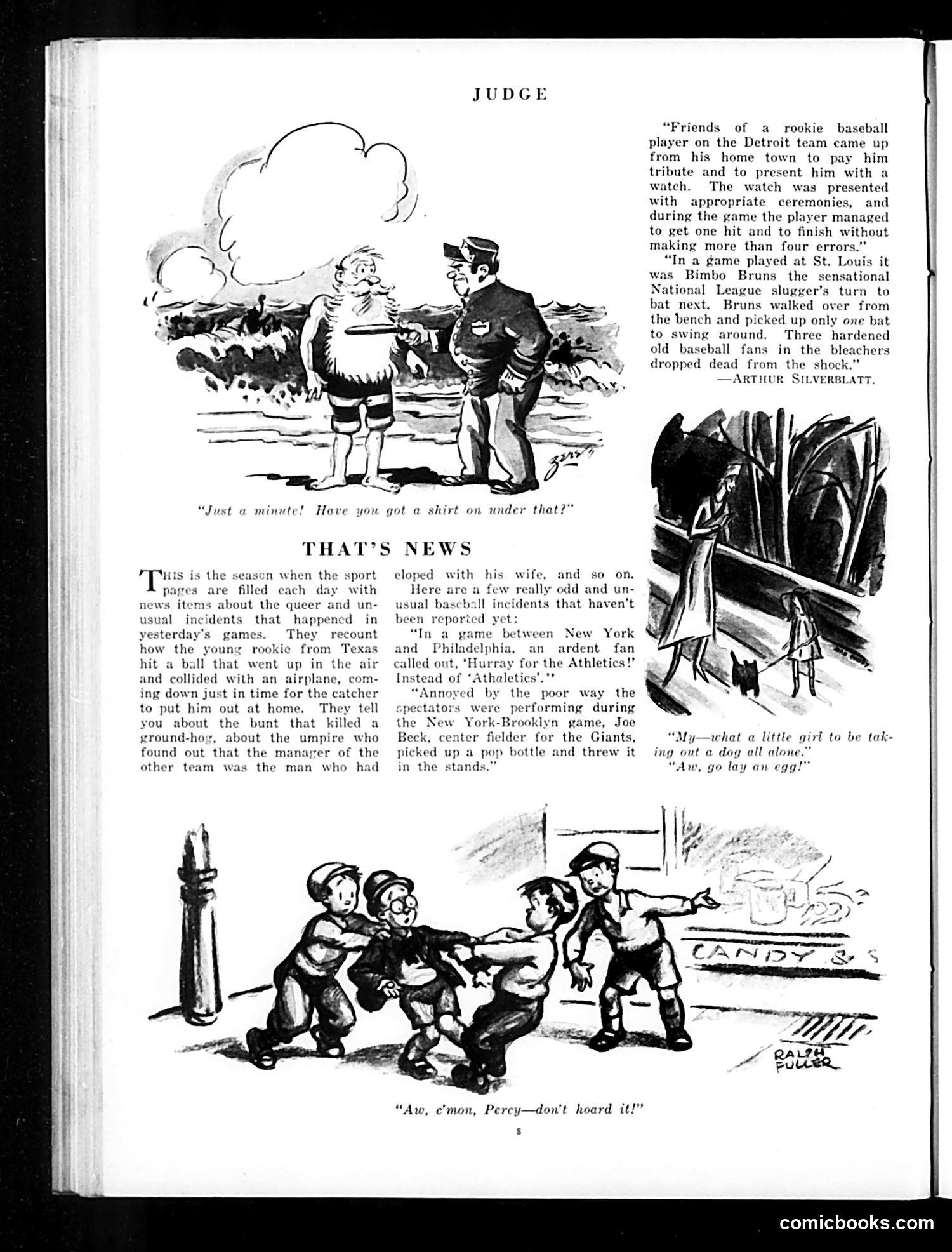
# Explaining This Judge Magazine Page This is a **baseball humor column** from Judge's sports section, featuring amusing anecdotes about the sport. The top cartoon shows Santa Claus confronted by an umpire or official asking "Have you got a shirt on under that?"—a visual gag playing on baseball uniform requirements. The main text, "That's News," collects oddball baseball incidents, mostly absurd tall tales: a rookie hitting a ball that collides with an airplane, a bunt killing a groundhog, an umpire discovering his manager is an ex-lover. These exaggerations mock the tendency of sports journalists to sensationalize or invent dramatic stories. The lower cartoon by Ralph Fuller shows children arguing over something, with the caption "Aw, c'mon, Percy—don't hoard it!"—likely referencing candy or treats at a ballpark, with a girl's comment about a child being outside alone followed by a sassy reply ("go lay an egg"—period slang for "scram"). The humor relies on **baseball culture absurdity and period sports journalism conventions** that modern readers might find quaint.
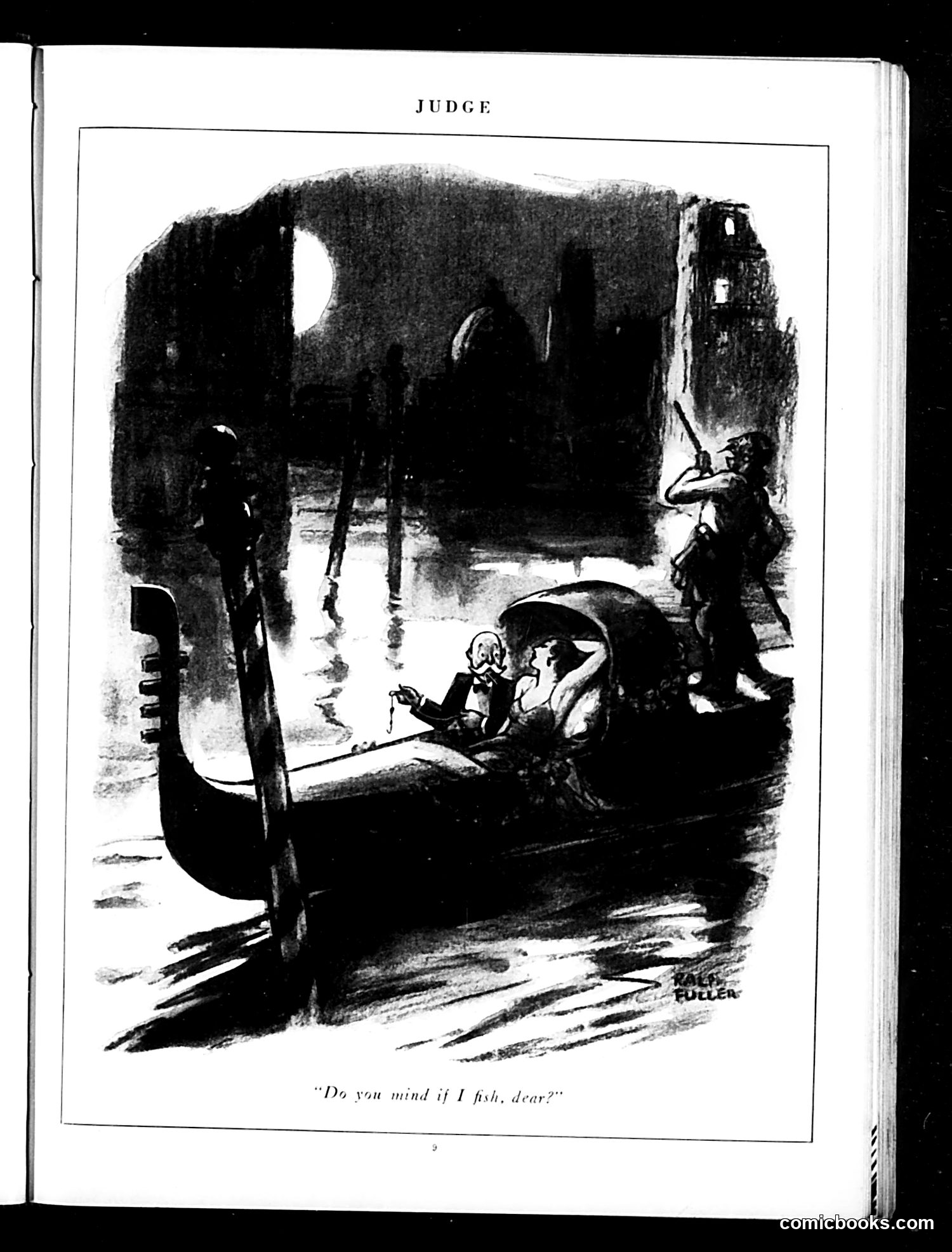
# Explanation for Modern Readers This is a cartoon from *Judge* magazine titled "Do you mind if I fish, dear?" The image depicts two figures in a gondola on what appears to be a Venetian canal, with dark architectural elements in the background. The satire appears to concern a husband asking permission from his wife to fish during what should be a romantic outing—the gondola being associated with romance in Venice. The humor likely plays on domestic power dynamics: the husband seeking approval for a leisure activity that might be considered inconsiderate to his companion. Without additional context about the magazine's publication date or specific political allusions, the exact target of the satire remains unclear, though it appears to mock either marital relationships or social pretension associated with European travel.
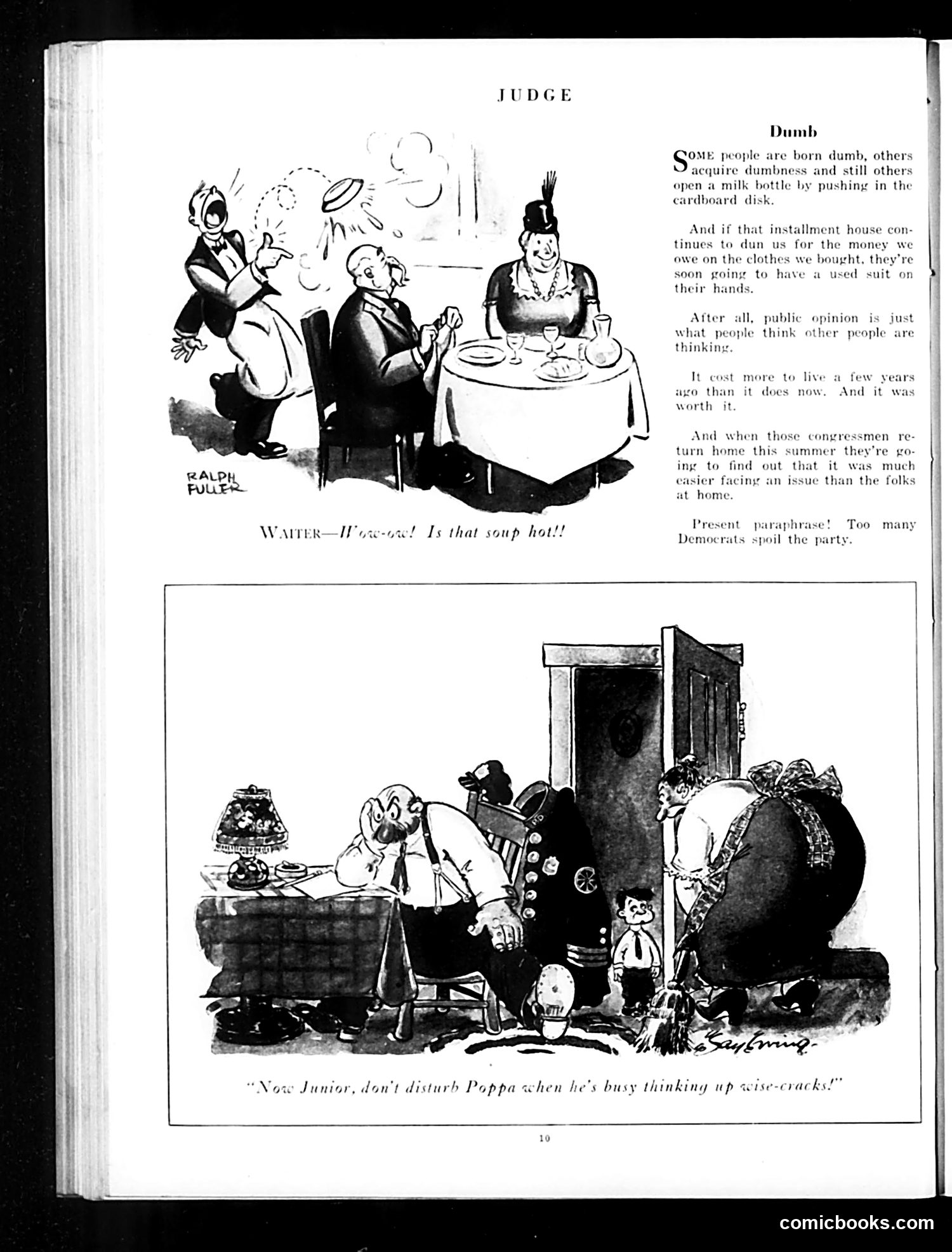
# "Judge" Magazine Page Analysis This page from *Judge* magazine satirizes American social and political foolishness through humor. The top cartoon depicts a waiter serving soup to diners, with the caption "Waiter—Wow-ow! Is that soup hot!!" The accompanying text column titled "Dumb" mocks various forms of stupidity: people who don't understand simple mechanics (like milk bottles), those trapped in installment debt cycles, and the disconnect between public opinion and reality. A pointed jab targets congressmen who find legislative issues easier to face than constituent complaints back home—implying politicians avoid accountability. The final quip, "Too many Democrats spoil the party," suggests partisan gridlock weakens governance. The second cartoon (bottom) shows a man at a desk surrounded by children, captioned "Now Junior, don't disturb Poppa when he's busy thinking up wise-cracks!"—mocking men who prioritize wit and satire over family responsibilities. Overall, the page satirizes American incompetence, political evasion, and misplaced priorities.