
Judge, 1932-06-11 · page 14 of 36
Judge — June 11, 1932 — page 14: what you’re looking at
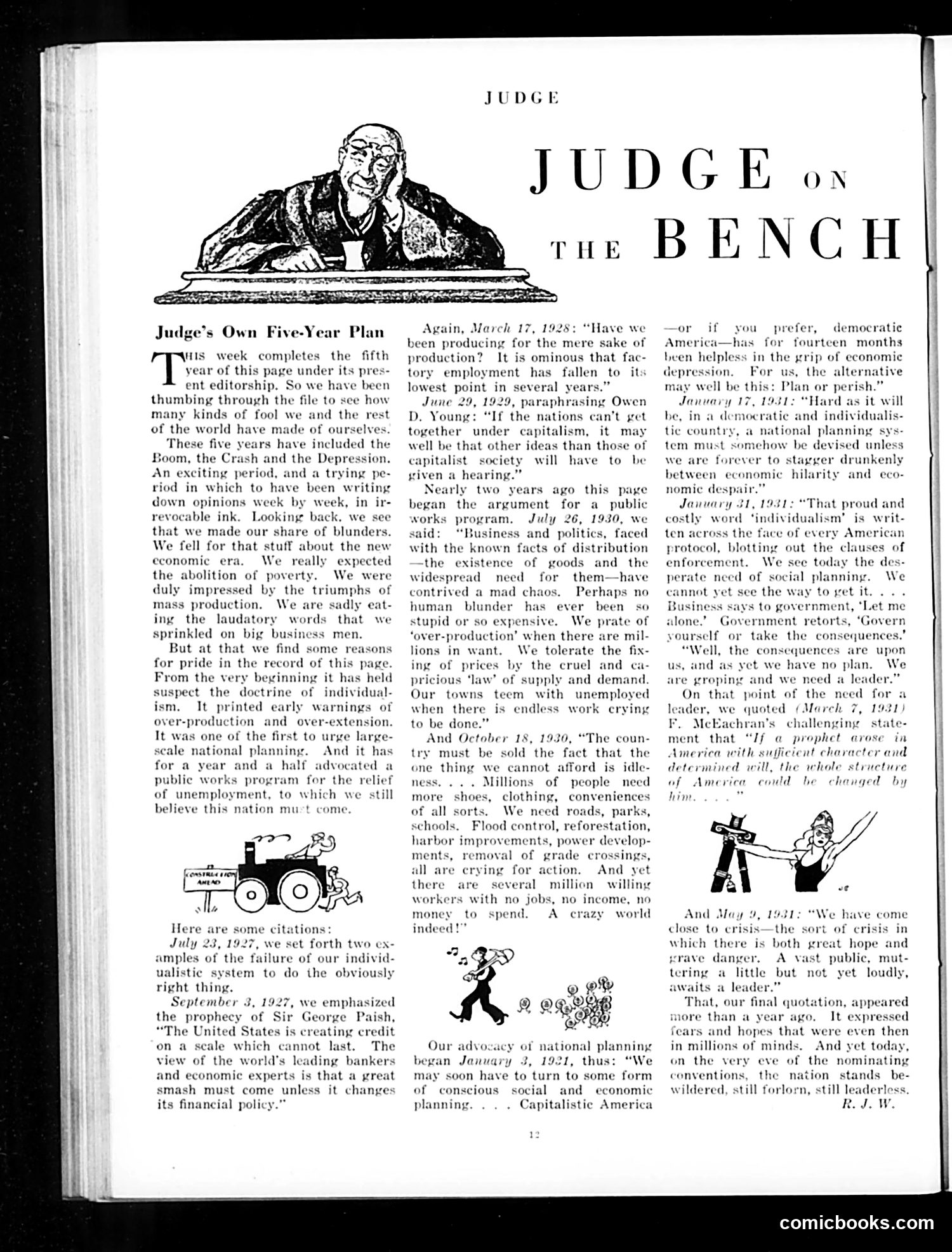
A restored page from Judge, 1932-06-11. Page through the whole issue in the reader above.
📄 Transcribed text from this page (OCR, searchable)
Machine-transcribed from the original scan — historical spelling and the odd misread are preserved.
udge’s Own Five-Year Plan HIS week completes the fifth year of this page under its pres- ent editorship. So we have been thumbing through the file to see how many kinds of fool we and the rest of the world have mac These five years have included the Boom, the Crash and the Depression. An exciting period, and a trying pe- riod in which to have been writing down opinions week by week, in ir- revocable ink. Looking back. we see that we made our share of blunder: We fell for that stuff about the new economic era. We really expected the abolition of poverty. We were duly impressed by the triumphs of mass production. We are sadly eat- ing the laudatory words that we sprinkled on big business men. But that we find some reasons for pride in the record of this page. om the very beyvinning it has held suspect the doctrine of individual- ism. It printed early warnings of over-production and over-extension. It was one of the first to urge large- seale national planning. And it has for a year and a half advocated a public works program for the relief of unemployment, to which we still believe this nation must come. of ourselves. Here are some citations: July 23, 1927, we set forth two ex- amples of the failure of our individ- ualistic system to do the obviously right thing. September 3, 1927, we emphasized the prophecy of Sir George Paish, “The United States is creating credit on a scale which cannot last. The view of the world’s leading bankers and economic experts is that a great smash must come unless it changes its financial pol JUDGE JUDGE on Again, March 17, 1928: “Have we been producing for the mere sake of production? It is ominous that fac- tory employment has fallen to its lowest point in al years.” araphrasing Owen D. Young: “If the nations can’t yet together under capitalism, it may well be that other ideas than those of capitalist. society will have to be siven a hearing.” Nearly two years ago this page began the argument for a_ public works program, July 26, 1930, aid: “Busines : with the known facts of distribution the existence of goods and the widespread need for them—have contrived a mad chaos. Perhaps no human blunder has ever been so stupid or so expensive. We prate of ‘over-production’ when there are mil- lions in want. We tolerate the fix- ing of prices by the cruel and ca- pricious ‘law’ of supply and demand. Our towns teem with unemployed when there is endless work crying to be done.” And October 18, 1930, “The coun- try must be sold the t that the one thing we cannot afford is idle- Millions of people need clothing, conveniences We need roads, parks, Flood control, reforestation, harbor improvements, power develop- ments, removal of grade crossings, all are crying for action, And yet there are several million willing workers with no jobs, no income, no money to spend. A cr world indeed!” ness... . more of all sorts. schools. shoes, Q QBLBB © Our advocacy of national planning began January 3, 1921, thus: “We may soon have to turn to some form of conscious social and economic planning. Capitalistic America or if you America—has prefer, for democratic fourteen months been helpless in the grip of economic depression. For us, the alternative may well be this: Plan or perish.” 1931: “Hard as it will be, in a democratic and individuali tic country, a national planning sys- tem mu how be devised unk we are to stayyer drunkenly between economic hilarity and nomic despair.” January 31,1931 nat proud and costly word ‘individualism’ is writ- ten across the face of every American protocol, blotting out the clauses of enforcement. We see today the des- e need of social planning. We t see the way to vet it... . siness s ‘Let me Government ret . ‘Govern If or take the consequences.’ l, the consequences are upon us, and as yet we have no plan. We are groping: and we need a leader.” On that point of the need for a leader, we quoted (March 7, 1931) McEachran’s challenging state- ment that “Jf @ prophet America with suficient character and determined will, the whole January 17, eco- lone.’ arose in structure him And May 9, 193 close to crisis We have come the sort of crisis in which there is both great hope and e danger, A vast public, mut- a little but not yet loudly, a leader.” , our final quotation, appeared nore than a year ago, It expressed fears and hopes that were even then in millions of minds. And yet today, on the very eve of the nominating conventions, the nation stands be- wildered, still forlorn, still leaderless. R.J.W. comicbooks.com