
Judge, 1932-06-11 · page 18 of 36
Judge — June 11, 1932 — page 18: what you’re looking at
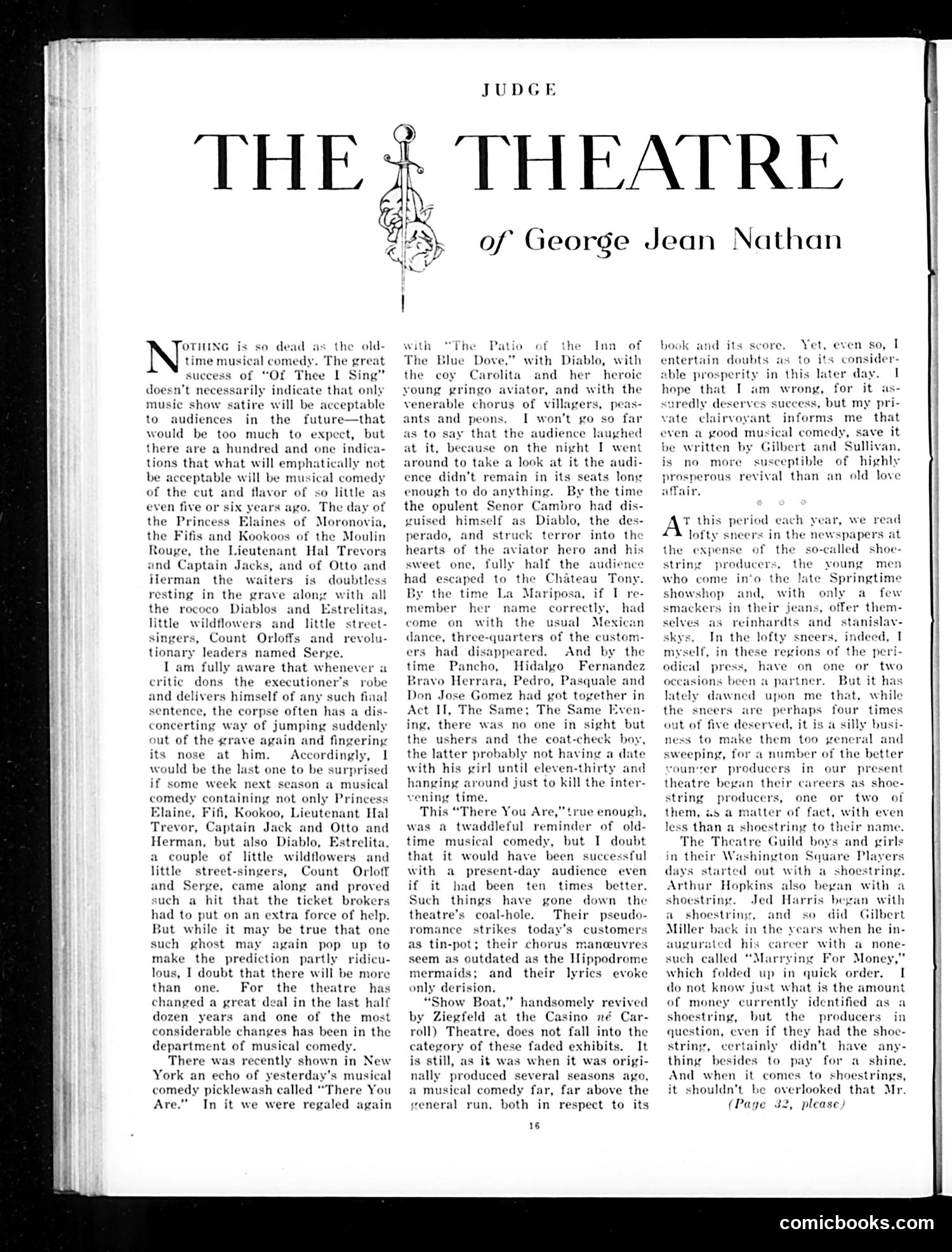
A restored page from Judge, 1932-06-11. Page through the whole issue in the reader above.
📄 Transcribed text from this page (OCR, searchable)
Machine-transcribed from the original scan — historical spelling and the odd misread are preserved.
OTHING is so dead as the old- N ime musical comedy. The great success of “Of Thee I Sing” "t nece indicate that only music show satire will be acceptable to audiences in the future—that would be too much to expect, but there are a hundred and one indica- tions that what will emphatically not be acceptable will be musical comedy of the cut and flavor of so little as even five or six years ago. The day of the Princess Elaines of Moronovia, the Fifis and Kookoos of the Moulin Rouge, the Lieutenant Hal Trevors and Captain Jacks, and of Otto and Herman the waiters doubtless resting in the grave along with all the rococo Diablos and Estrelitas, little wildflowers and little singers, Count Orloffs and tionary leaders named Serg! I am fully re that whenever a critic dons the executioner’s robe and delivers himself of any such final sentence, the corpse often has a dis- concerting way of jumping suddenly out of the grave again and fingering its nose at him. Accordingly, I would be the last one to be surprised if some week next season a musical comedy containing not only Princess Elaine, Fifi, Kookoo, Lieutenant Hal Trevor, Captain Jack and Otto and Herman, but also Diablo, Estrelita, a couple of little wildflowers and little street-singers, Count Orloff and rge, came along and proved uch a hit that the ticket brokers had to put on an extra force of help. But while it may be true that one such ghost may again pop up to make the prediction partly ridicu- lous, I doubt that there will be more than one. For the theatre has changed a great deal in the last half dozen years and one of the most considerable changes has been in the department of musical comedy. There was recently shown in New York an echo of yester comedy picklewash called Are.” street- revolu- s musical here You In it we were regaled again JUDGE with “The Patio of the The Blue Dove,” with Diablo, with the coy Carolita and her heroic young gringo aviator, and with the venerable chorus of villagers, peas- ants and peons. I won't go so far as to say that the audience laughed at it, because on the night I we) around to take a look at it the audi- ence didn’t remain in its seats long enough to do anything. By the time the opulent Senor mbro had dis- suised himself as olo, the des- perado, and struck into the hearts of the aviator hero and his sweet one, fully half the audience had escaped to the Chateau Tor By the time La Mariposa, if I r member her name correctly, had come on with the usual Mex dance, three-quarters of the custom- ers had disappeared. And by the time Pancho, Hidalgo Fernandez Bravo Herrara, Pedro, Pasquale and Don Jose Gomez had got toyeth in Act II, The Same; The Same Even- ing, there was no one in sight but the ushers and the coat-check boy, the latter probably not having a date with his girl until eleven-thirty and hanging around just to kill the inter- vening time. This “There You Are,” true enough, was a twaddleful reminder of old- time musical comedy, but I doubt that it would have been successful with a present-day audience even if it had been ten times better. Such things have gone down the theatre's I-hole. Th pseudo- romance strikes today’s customers 3 tin-pot; their chorus manceuvres s outdated as the Hippodrome merma and their lyrics evoke only derision. “Show Boat,” handsomely revived by Ziegfeld at the Casino né Car- roll) Theatre, does not fall into the category of these faded exhibits. It is still, as it was when it was origi- nally produced several seasons ayo, a musical comedy far, far above the general run, both in respect to its Inn of ror 16 RE Nathan book and its score. Yet, even so, I entertain doubts as to its consider- zble prosperity in this later day. I hope that IT am wrong, for it as- suredly deserves success, but my pri- vate clairvoyant informs me_ that even a good musical comedy, save it be written by Gilbert and Sullivan, is no more susceptible of highly prosperous revival than an old love affair. AN this period each year, we re lofty sne n the newspaper expense of the so-called shoe- producers, the young men who come in‘o the late Springtime showshop and, with only a_ few smackers in their jeans, offer them- selves as reinhardts and stanislav skys. In the lofty sneers, indeed, I myself, in these regions of the peri- odical press, have on one or two occasions been a partner. But it hi lately dawned upon me that, while the sneers are perhaps four times out of five deserved, it silly busi- ness to make them too general and sweeping, for a number of the better vunvrer producers in our present theatre began their careers as shoe- string producers, one or two of them, us a matter of fact, with even less than a shoestring to their name. The Theatre Guild boys and girls in their Washington Square P days started out with a shoestring. Arthur Hopkins also beyan with a shoestring. Jed Harris began with a shoestrin: and so did) Gilbert Miller back in the years when he ir augurated his career with noni such called “Marrying For Money,” which folded up in quick order. I do not know just what is the amount of money currently identified as a shoestring, but the producers in question, even if they had the shoe- stringy, ¢ inly didn’t have an) thing besides to pay for a shine. And when it comes to shoestrings, it shouldn’t be overlooked that Mr. (Page 32, please) the string comicbooks.com