
Judge, 1932-06-11 · page 26 of 36
Judge — June 11, 1932 — page 26: what you’re looking at
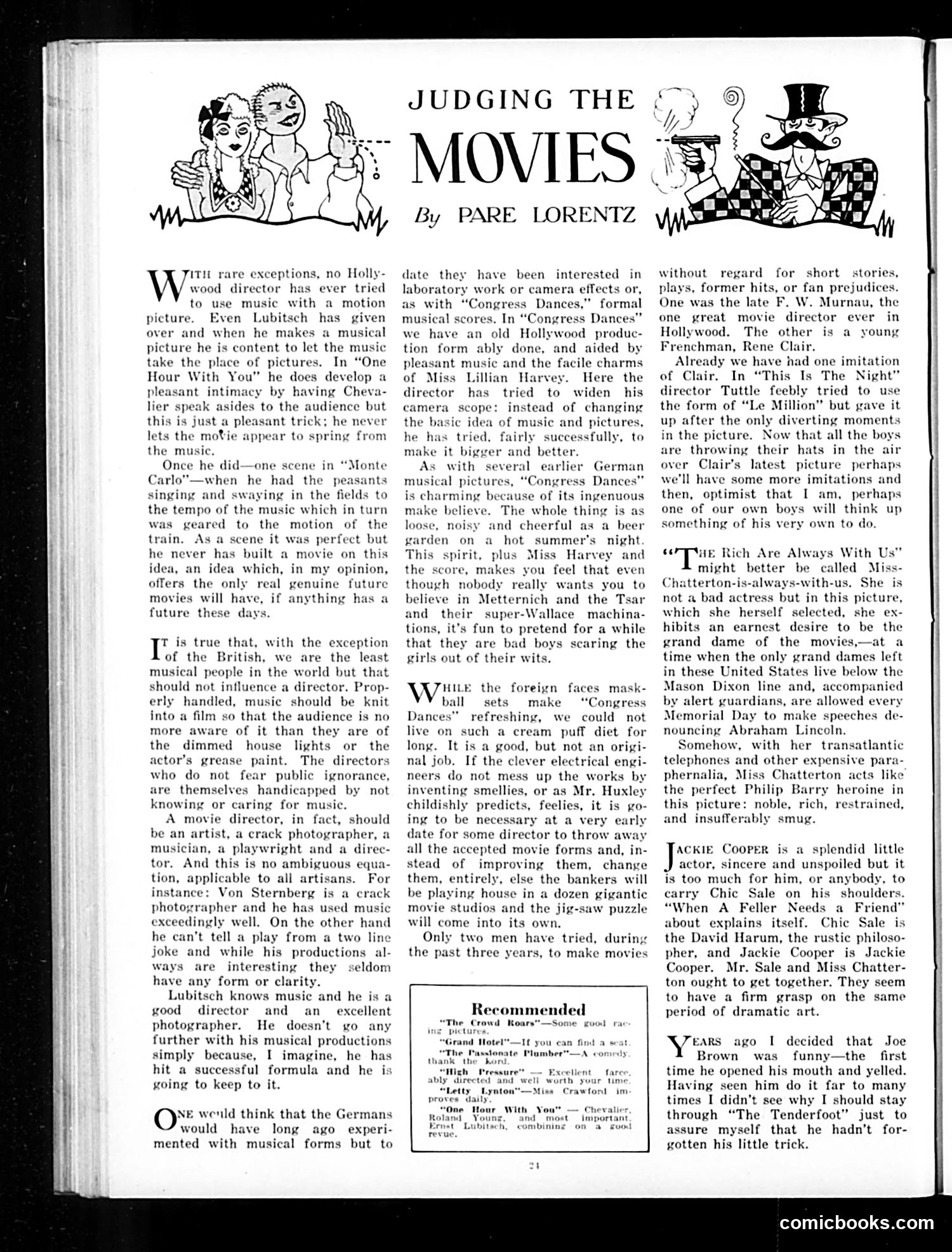
A restored page from Judge, 1932-06-11. Page through the whole issue in the reader above.
📄 Transcribed text from this page (OCR, searchable)
Machine-transcribed from the original scan — historical spelling and the odd misread are preserved.
TH rare exceptions, no Holly- wood director ever tried to use music with a motion pictur Even Lubitsch has giv over and when he makes a mus picture he is content to let the music take the place of pictures. In “One Hour With You” he does develop a pleasant intimacy by having Cheva- lier speak asides to the audience but this is just a pleasant trick; he neve lets the mofie appear to spring from the music. Once he did—one scene in “Monte Carlo"—when he had the f¢ nts singing and swaying in the fields to the tempo of the music which in turn was geared to the motion of the train. As a scene it was perfect but he never has built a movie on this which, in my opinion, the only real genuine future es will have, if anything has a at, with the exception of the British, we are the least musical people in the world but that should not influence a director. Prop- erly handled, music should be knit into a film so that the audience is no more aware of it than they are of the dimmed house lights or the actor’s grease paint. The directors who do not fear public ignorance, are themselves handicapped by not knowing or caring for music. A movie director, in fact, should be an artist, a crack photographer, a musician, a playwright and a dire tor. And this is no ambiguous equa- tion, applicable to all artisans. For instance: Von Sternberg is a crack photographer and he has used mus exceedingly well. On the other hand he can't tell a play from a two line joke and while his productions al- 8 are interesting they seldom have any form or clarity. Lubitsch knows music and he is a good director and an_ excellent photographer. He doesn’t go any further with his musical productions simply because, I imagine, he has hit a successful formula and he is going to keep to it. O wenld think that the Germans would have long ago experi- mented with musical forms but to JUDGING THE MOVIES By PARE LORENTZ interested in amera effects or, date they e been laboratory work or as with “Congress formal musical scores. In “Congress Dances” we have an old Hollywood produc- tion form ably done, and aided by pleasant music and the facile charms of Miss Lillian Harvey. Here the director has tried to widen his camera scope: instead of changing the basic idea of music and pictures, he has tried, rly successfully, to make it bigger As with several r musical pictures, German ‘Congress Dan : rming because of its ingenuous believe. The whole thing is as . noisy and cheerful as a beer garden on a hot summer's night This spirit, plus Miss Harvey and the score, makes you feel that even though nobody really wants you to believe in Metternich and the and their super-Wallace machina- tions, it’s fun to pretend for a while that they are bad boys scaring the ls out of their wits. Wii Dances” the sets faces mask- make “Congress refreshing, we could not live on such a cream puff diet for long. It is a good, but not an origi- nal job. If the clever elect engi- neers do not mess up the works by inventing smellies, or as Mr. Huxley childishly predicts, feelies, it is go- ing to be nec at a very earl. date for some director to throw aw Il the accepted movie forms and, in- ad of improving them, change them, entirely, else the bank will be playing hot in a dozen gigantic movie studios and the jig-saw puzzle will come into its own. Only two men have tried, during the past three years, to make movies foreign Recommended “The Crowd Koars*—Some good ras - Excellent fare ¢ yy \ without regard for short stories, plays, former hits, or fan prejudices. One was the late F. W. Murnau, the one great movie direct ever in Hollywood. The other is a young Frenchman, Rene Clair. Already we have had one imitation of Clair. In “This Is The Night” director Tuttle feebly tried to use the form of “Le Million” but gave it up after the only diverting moments in the picture. w that all the be are throwing their hats in the air over Clair’s latest picture perhaps we'll have some more imitations and then, optimist that I am, perhaps one of our own boys will think up something of his very own to do. ss e Rich Are Alw: With Us’ Tine better be called Miss- ys-with-us. She is not ud a s but in this picture, which she herself selected, she ex- hibits an earnest desire to be the grand dame of the movies,—at a time when the only grand dames left in these United States live below the Mason Dixon line and, accompanied by alert guardians, are allowed every Memorial Day to make speeches de- nouncing Abraham Lincoln. Somehow, with her transatlantic telephones and other expensive pa’ phernalia, Miss Chatterton acts lik the perfect Philip Bar heroine in this picture: noble, rich, restrained, and insufferably smug. Chatterton-is-alw ACKIE Cooper is a splendid little actor, sincere and unspoiled but it is too much for him, or anybody, to carry Chic Sale on his shoulder “When A Feller Needs Friend about explains itself. Chic Sale is the David Harum, the rustic philoso- pher, and Jackie Cooper is Jackie Cooper. Mr. Sale and Miss Chatter- ton ought to get together. They seem to have a firm grasp on the s period of dramatic art. Fears ago I decided that Joe Brown was funny—the first time he opened his mouth and yelled. Having seen him do it far to many times I didn’t see why I should stay through “The Tenderfoot” just to assure myself that he hadn’t for- gotten his little trick. comicbooks.com