A complete issue · 36 pages · 1932
Judge — April 2, 1932
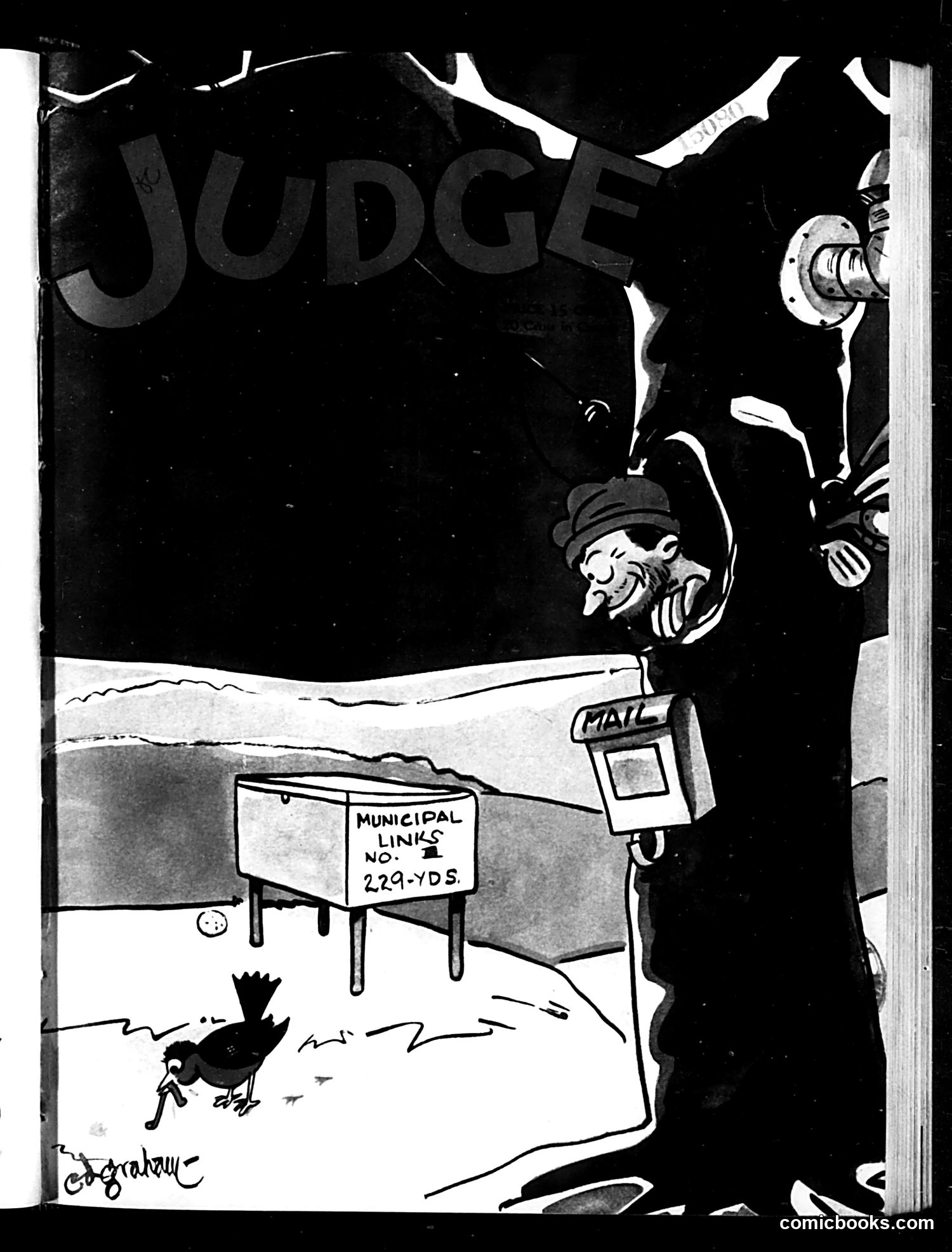
# Analysis of Judge Magazine Cartoon This cartoon satirizes municipal golf course management. The sign reads "Municipal Links No. 1 — 229 YDS," indicating a public golf facility. The caricatured figure appears to be a municipal official or judge overseeing the course, hence the magazine's title reference. The joke seems to target inefficiency or mismanagement at public golf links—a 229-yard hole is unusually short, suggesting either poor course design or bureaucratic bungling. The small bird in the lower left may emphasize the absurdity of the measurement. The cartoon critiques government-run recreational facilities, a common satirical target in Judge magazine during the early-to-mid 20th century. The specific date and context remain unclear without additional publication information.
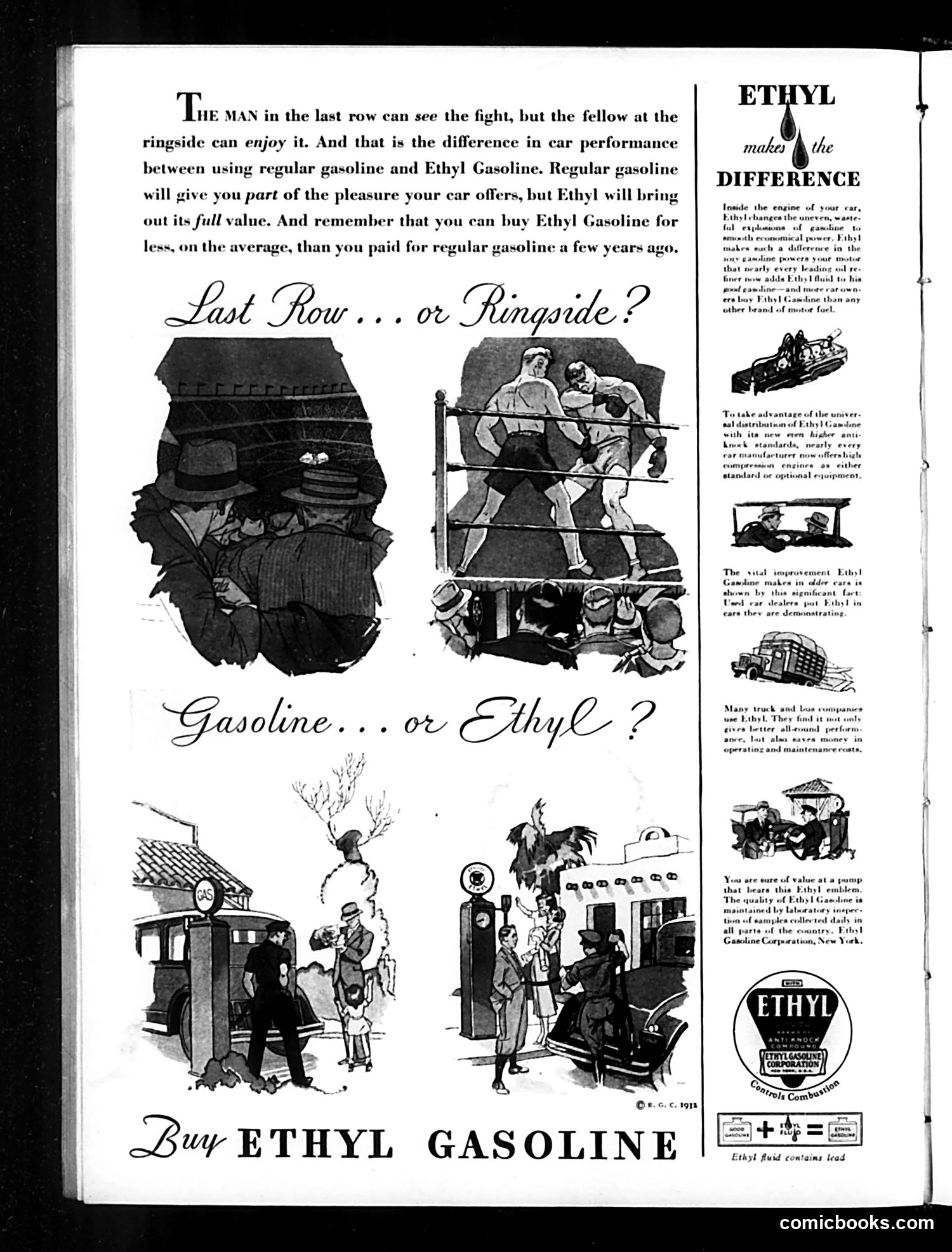
# Ethyl Gasoline Advertisement This is primarily a **commercial advertisement**, not political satire. The page promotes Ethyl Gasoline through comparative scenarios showing the performance difference between regular gasoline and Ethyl brand. The left illustration contrasts two viewing experiences: a "Last Row" spectator (presumably at a sporting event) versus a "Ringside" viewer—using this as a metaphor for car performance differences. Regular gasoline offers limited capability; Ethyl provides superior results. The lower vignettes depict everyday scenarios (farming, gas stations, trucks) where Ethyl's advantages manifest. The right column reinforces claims about engine efficiency and cost-effectiveness. This reflects **1920s-30s marketing**: establishing brand superiority through lifestyle imagery and practical benefits, emphasizing that Ethyl—though historically containing lead—delivered measurable performance advantages consumers valued.
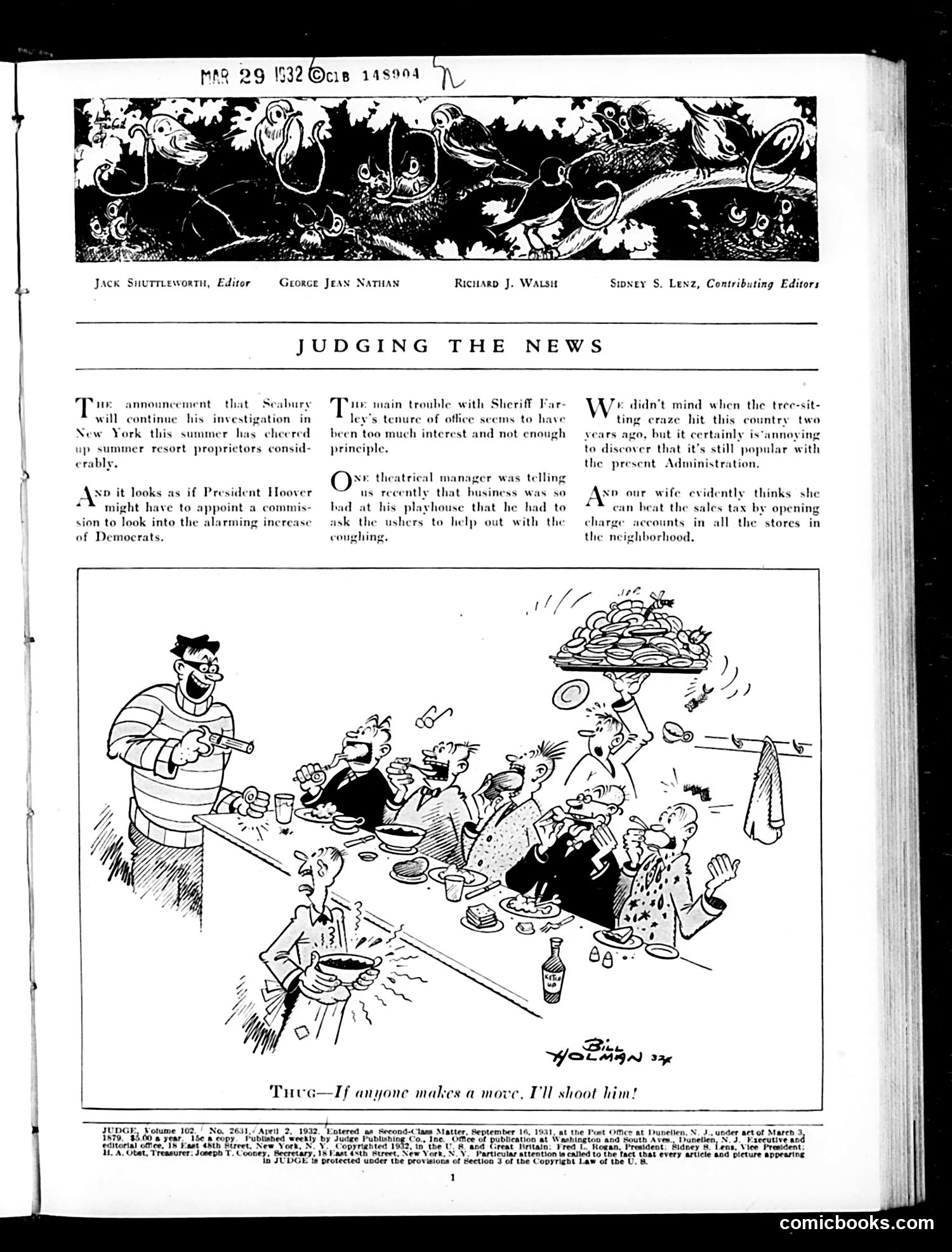
# Analysis of Judge Magazine Cartoon (April 2, 1932) The main cartoon depicts a chaotic dinner scene with a waiter threatening violence ("If anyone makes a move, I'll shoot him!"). This satirizes **Prohibition-era restaurant conduct** during the Great Depression. The exaggerated threat and rowdy diners suggest the lawlessness and danger associated with speakeasies and illegal alcohol service in the early 1930s. The editorial snippets above reference contemporary issues: **President Hoover** potentially appointing a commission regarding Democrats, **Sheriff Farley's** questionable tenure, and theatrical business troubles. The wife's comment about "beating the sales tax" through neighborhood store visits reflects **Depression-era consumer anxiety** about new taxation. Overall, the page satirizes 1932 American anxieties—law enforcement breakdown, economic hardship, and government instability during Hoover's final year in office.
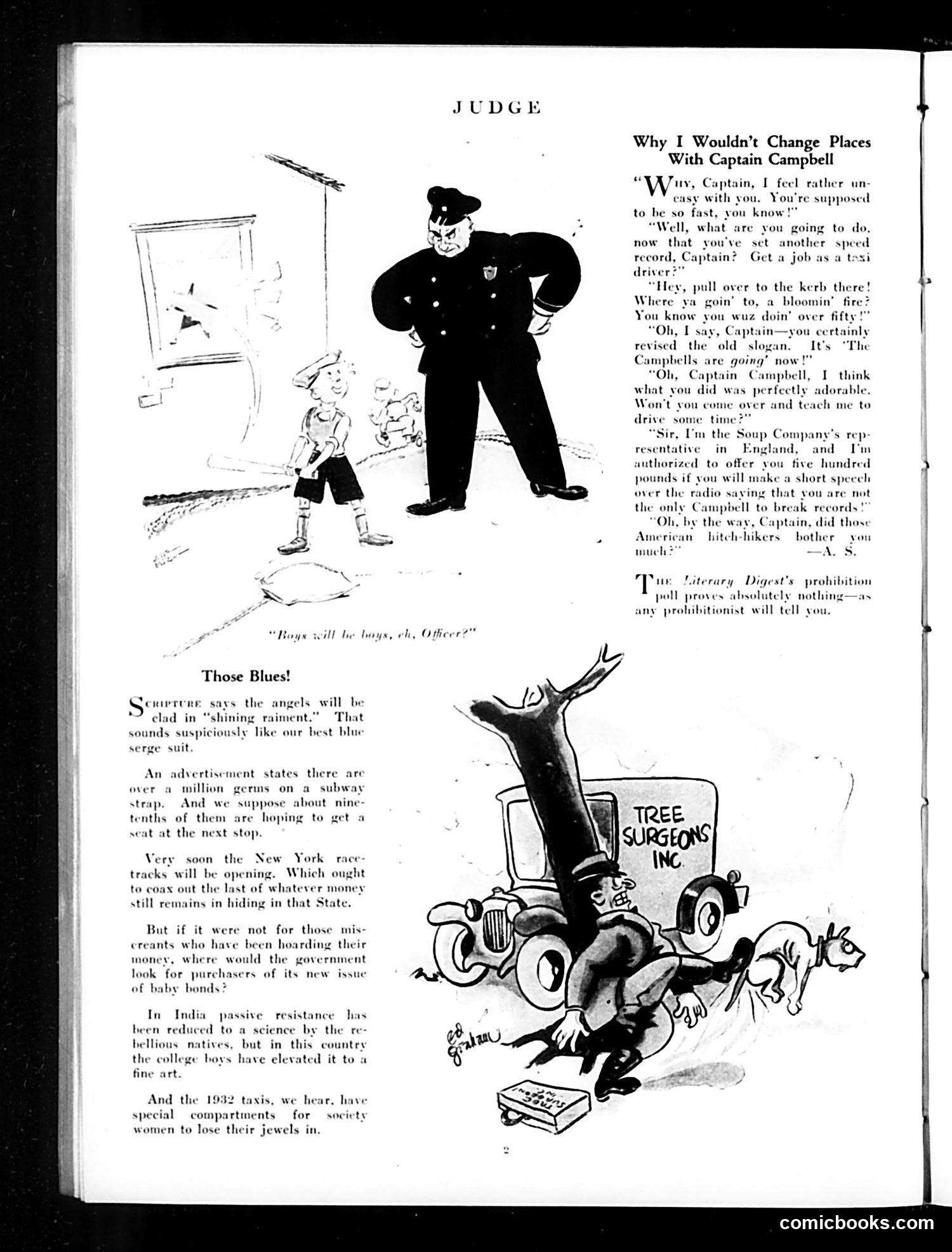
# Judge Magazine Page Analysis This page contains three distinct satirical pieces: 1. **"Why I Wouldn't Change Places With Captain Campbell"** (top): A conversation between a small figure and a large captain in uniform. The captain brags about setting speed records, but the smaller person (appearing to be from a soup company) offers him a lucrative radio endorsement deal instead—suggesting that commercial sponsorships and advertising were becoming more profitable than athletic achievement. The satire mocks both corporate advertising culture and celebrities' willingness to abandon their accomplishments for money. 2. **"Those Blues!"** (left): Jokes about blue serge suits, germs on subways, and upcoming New York racetracks—light social commentary on urban life and fashion. 3. **"Tree Surgeons Inc."** (bottom right): A cartoon showing what appears to be a charlatan operator with a truck, suggesting fraud or incompetence in emerging service industries.
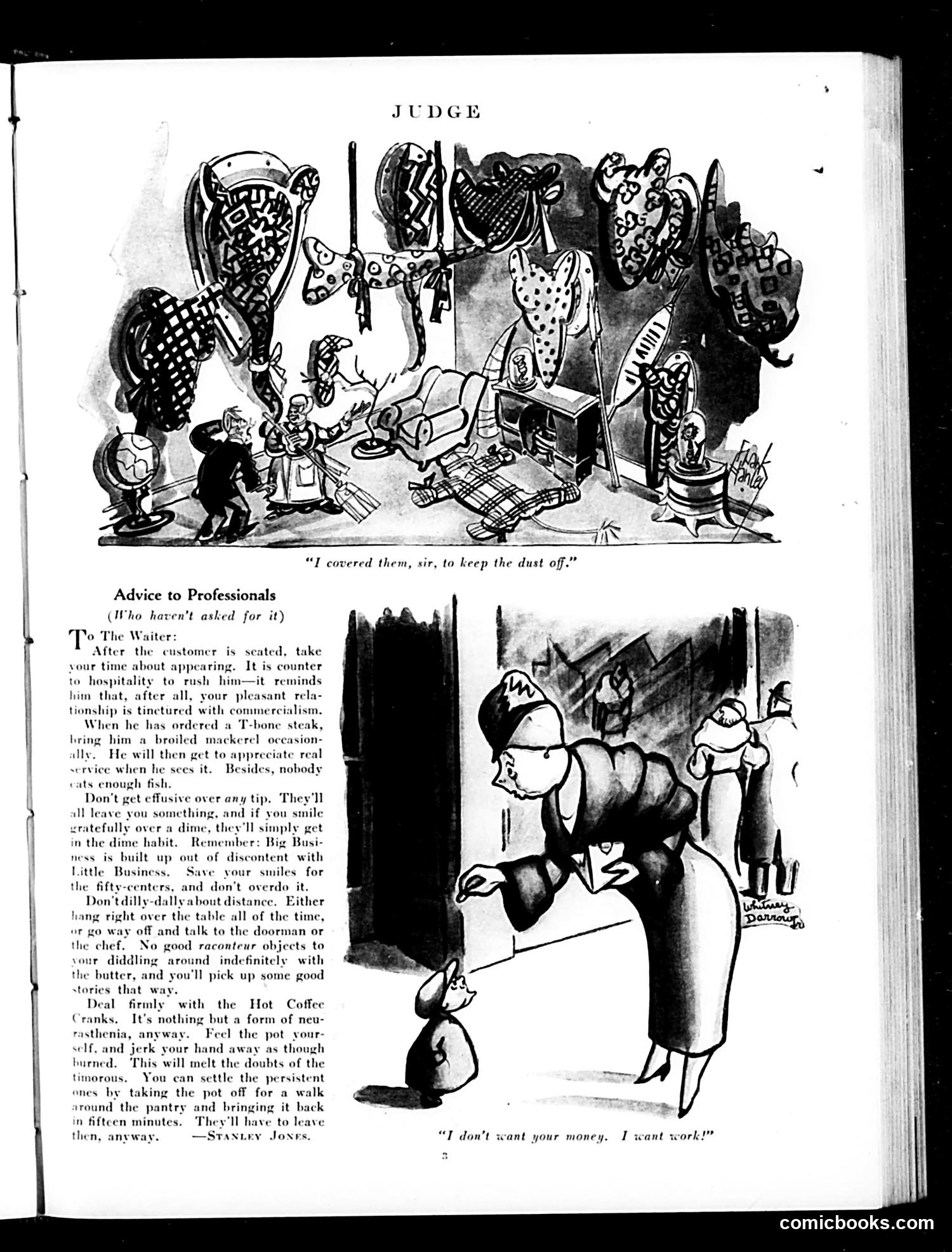
# Analysis of Judge Magazine Page The page contains two distinct cartoons: **Top cartoon ("I covered them, sir, to keep the dust off"):** This appears to be a satirical commentary on antique collecting or museum curation, showing elaborate, ornately decorated objects. The joke likely mocks pretentious collectors who obsess over preserving valuable items. **Bottom cartoon ("I don't want your money. I want work!"):** This depicts a waiter or service worker rejecting money from an employer. The caption suggests social commentary on labor dignity—the worker demands employment and fair treatment rather than charity or tips. This reflects early 20th-century debates about working conditions and wages versus handouts. The accompanying "Advice to Professionals" column offers satirical guidance to waiters on managing customers and tips, reinforcing class and service industry tensions of the era.
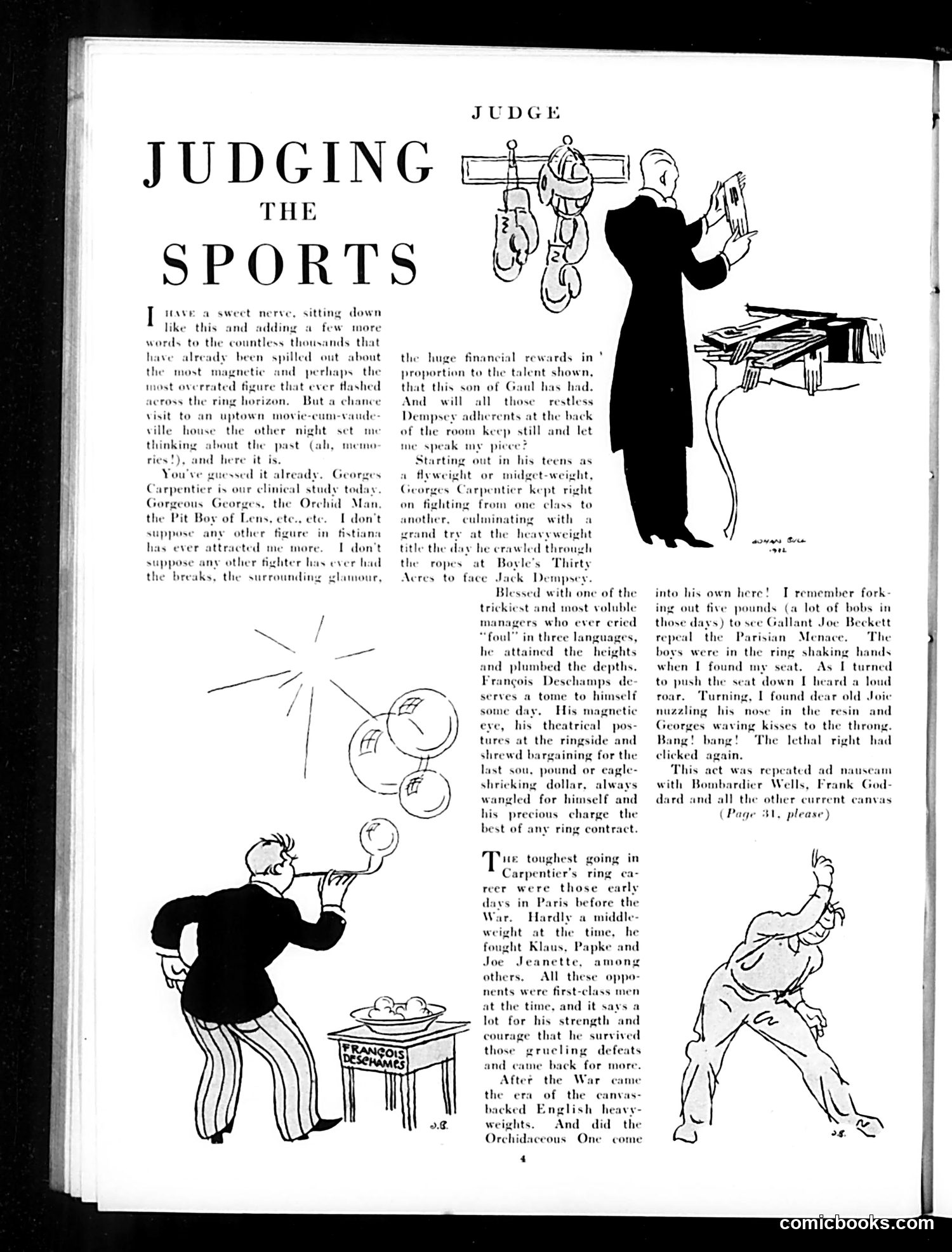
# "Judging the Sports" This page presents a satirical essay on boxing and fight management. The author discusses **Georges Carpentier**, a famous boxer, using him as the central subject of critique. The text mocks the financial and managerial side of professional boxing, mentioning Carpentier's rise from lightweight to heavyweight competition, culminating in a fight against Jack Dempsey. The satire focuses on fight managers—particularly **François Deschamps**—who negotiated contracts and "wangled" money from promoters. The cartoons (showing judges juggling balls and boxing scenes) illustrate the absurdity of boxing's business apparatus and the theatrical posturing involved in the sport. The piece critiques both the outsized financial rewards in boxing and the colorful personalities surrounding it, suggesting the sport is more about spectacle and profit than athletic merit.
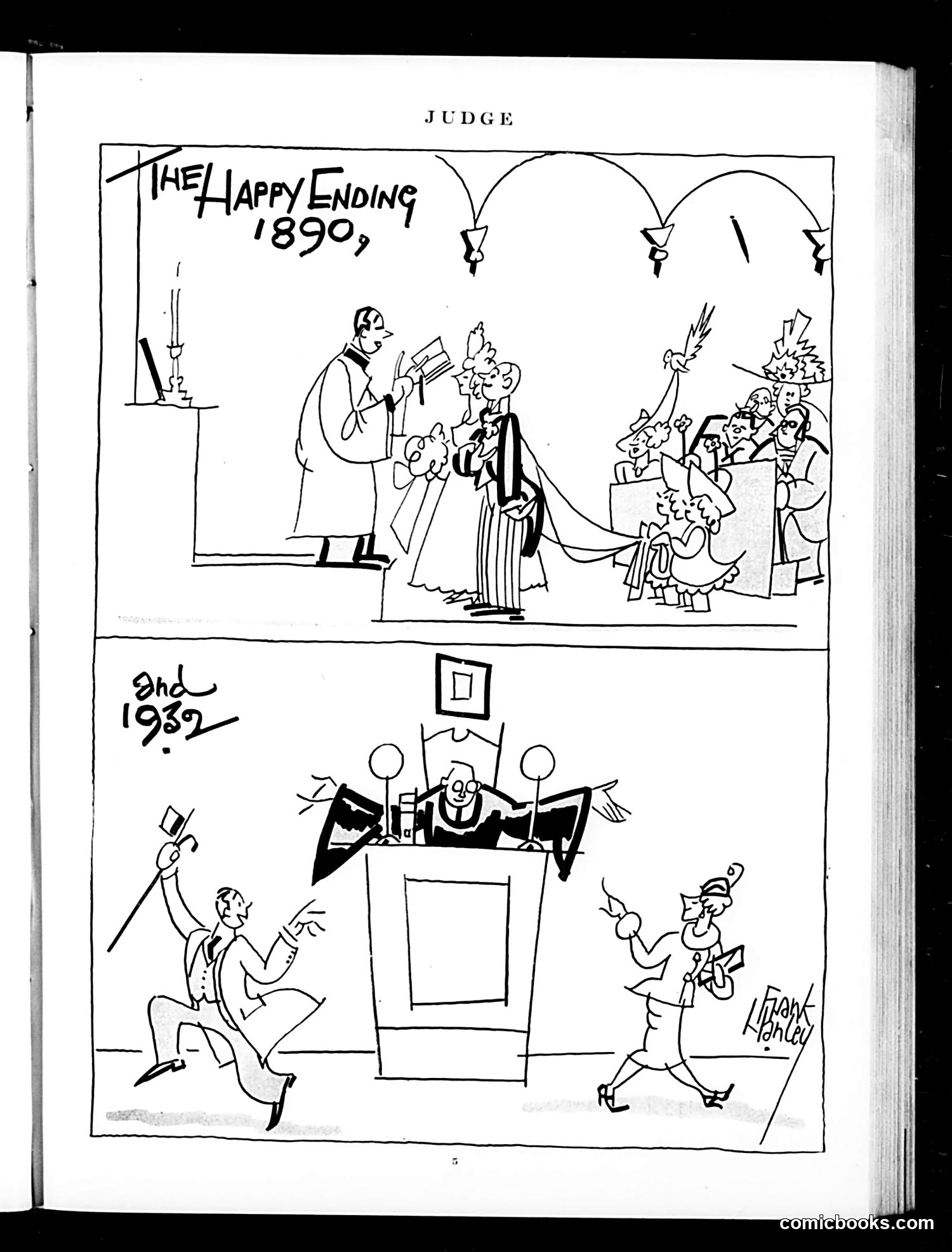
# Analysis of Judge Page This page contains two cartoons titled "The Happy Ending 1890" and "2nd 1932," both depicting judges presiding over courtroom scenes. The **1890 cartoon** (top) shows a judge conducting what appears to be a wedding ceremony, with couples and children celebrating—satirizing the judicial system's role in matrimonial matters. The **1932 cartoon** (bottom) depicts a judge presiding over two men dancing energetically with flags, while another figure plays musical instruments. This likely satirizes judicial decisions or legal rulings that had unexpected or absurd social consequences during the early Depression era. Without additional historical documentation, the specific judicial decisions or events being mocked remain unclear. The cartoons appear to critique judicial authority's broader social impacts, though the exact references require further context.
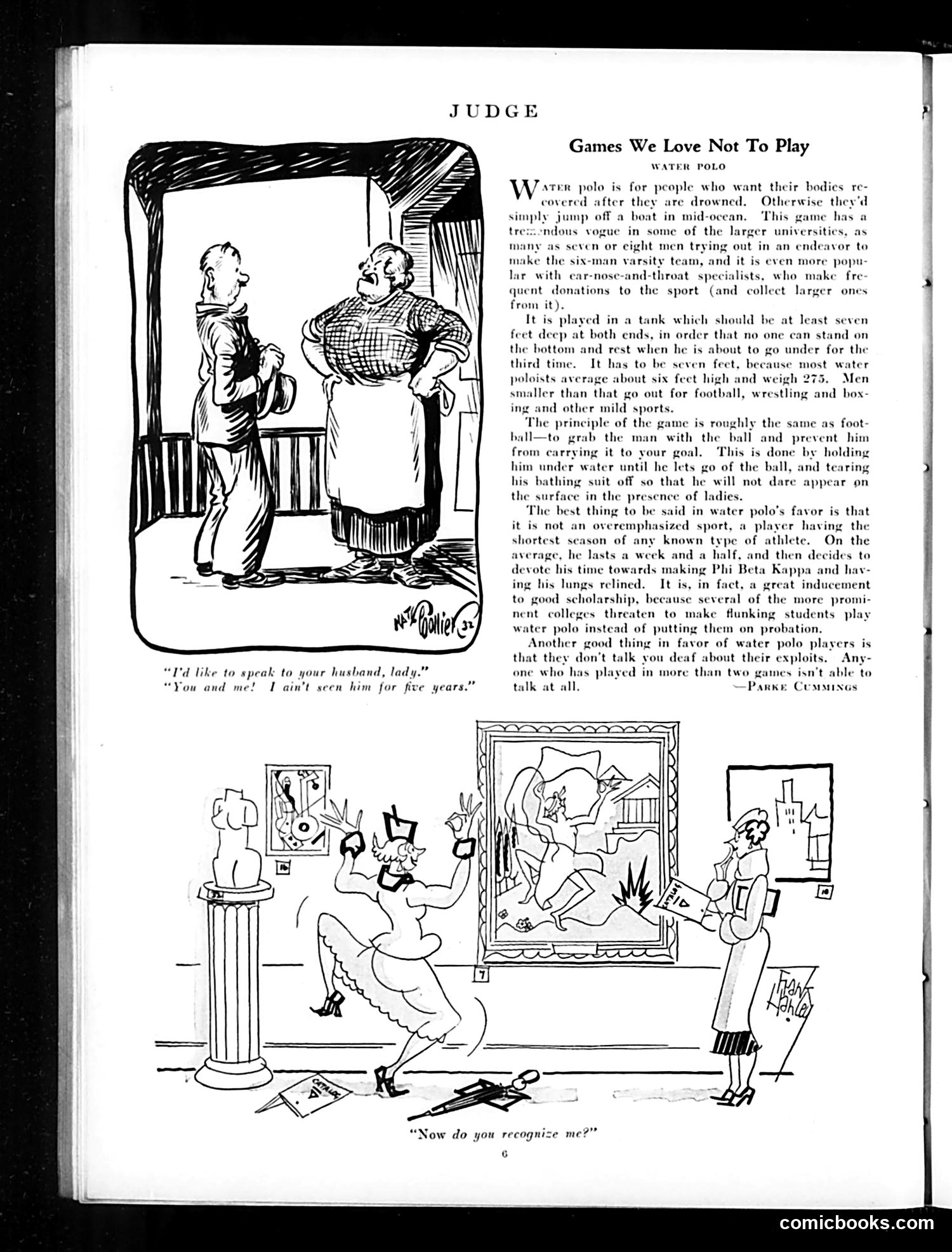
# Water Polo Satire The top cartoon shows a domestic scene where a woman confronts her husband about his absences, saying "I'd like to speak to your husband, lady" and "You and me! I ain't seen him for five years." The article explains water polo's rules and appeals, noting it's played in deep tanks and requires dedication. However, the satire's point is that the sport is so time-consuming and obscure that husbands abandon their wives to participate. The joke undercuts the sport's prestige by showing its actual social cost: marital neglect. The bottom cartoon (artist: Frank Phila) depicts a woman at an art gallery, asking "Now do you recognize me?" suggesting her husband only recognizes her from paintings, having been absent from home so long due to water polo obsession.
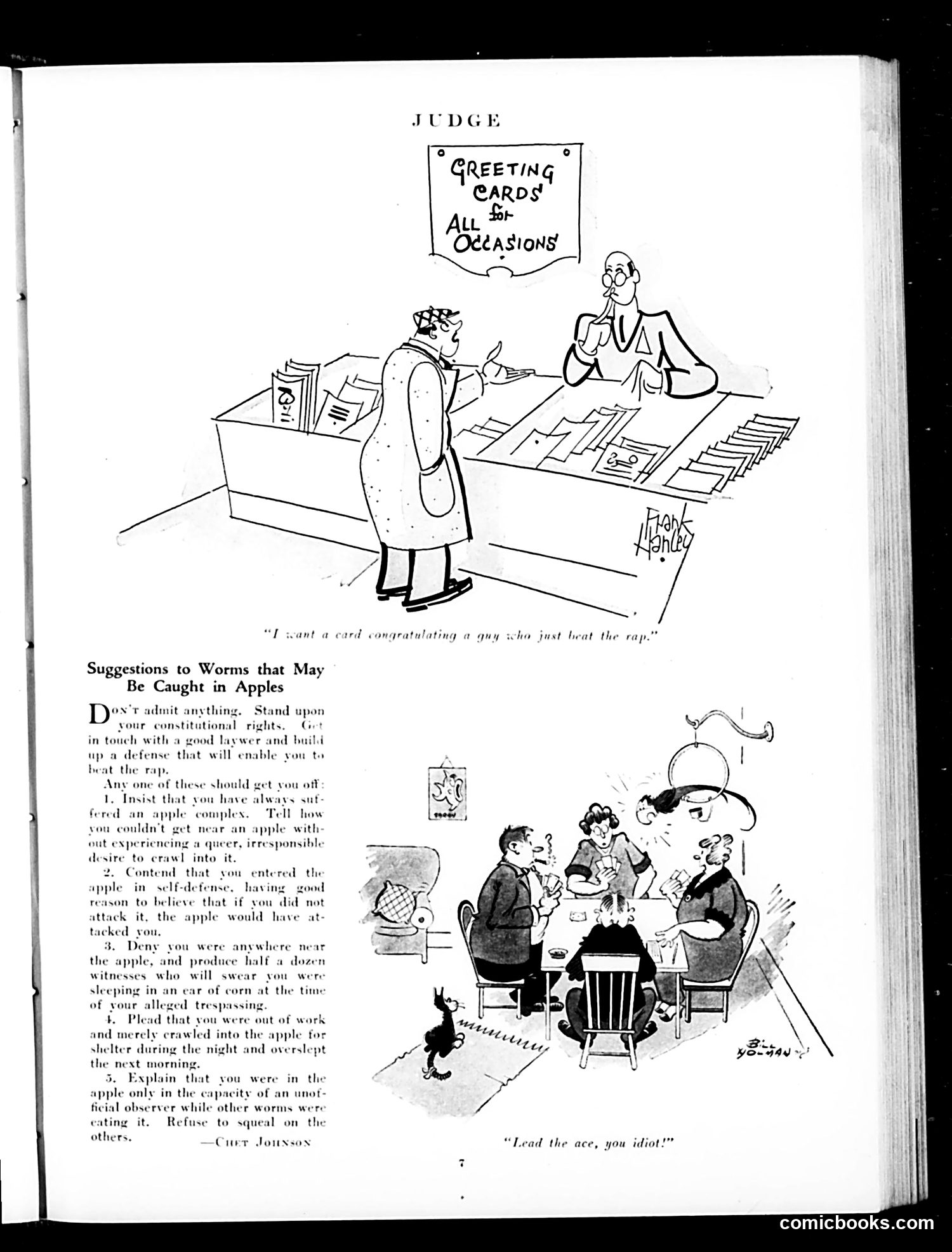
# Explanation for Modern Readers This page contains two distinct satirical pieces from Judge magazine: **Top Cartoon:** A customer at a greeting card shop asks for a card "congratulating a guy who just beat the rap"—meaning someone who evaded legal consequences. The joke mocks the normalization of crime and acquittal, suggesting greeting cards exist for every occasion, even criminal ones. **Bottom Section:** "Suggestions to Worms that May Be Caught in Apples" is legal satire. It parodies criminal defense strategies by applying them absurdly to worms found in apples. The advice includes: claiming constitutional rights, manufacturing alibis, producing false witnesses, pleading poverty, and refusing to testify against accomplices. The humor satirizes actual legal defenses used by criminals—suggesting these tactics are so transparent and common they could be applied to literally any situation. The accompanying cartoon shows people playing cards, with the caption "Lead the ace, you idiot!"—unrelated domestic humor typical of Judge's mixed-content format. Together, these pieces mock both the ease of evading justice and the predictability of courtroom defense strategies.
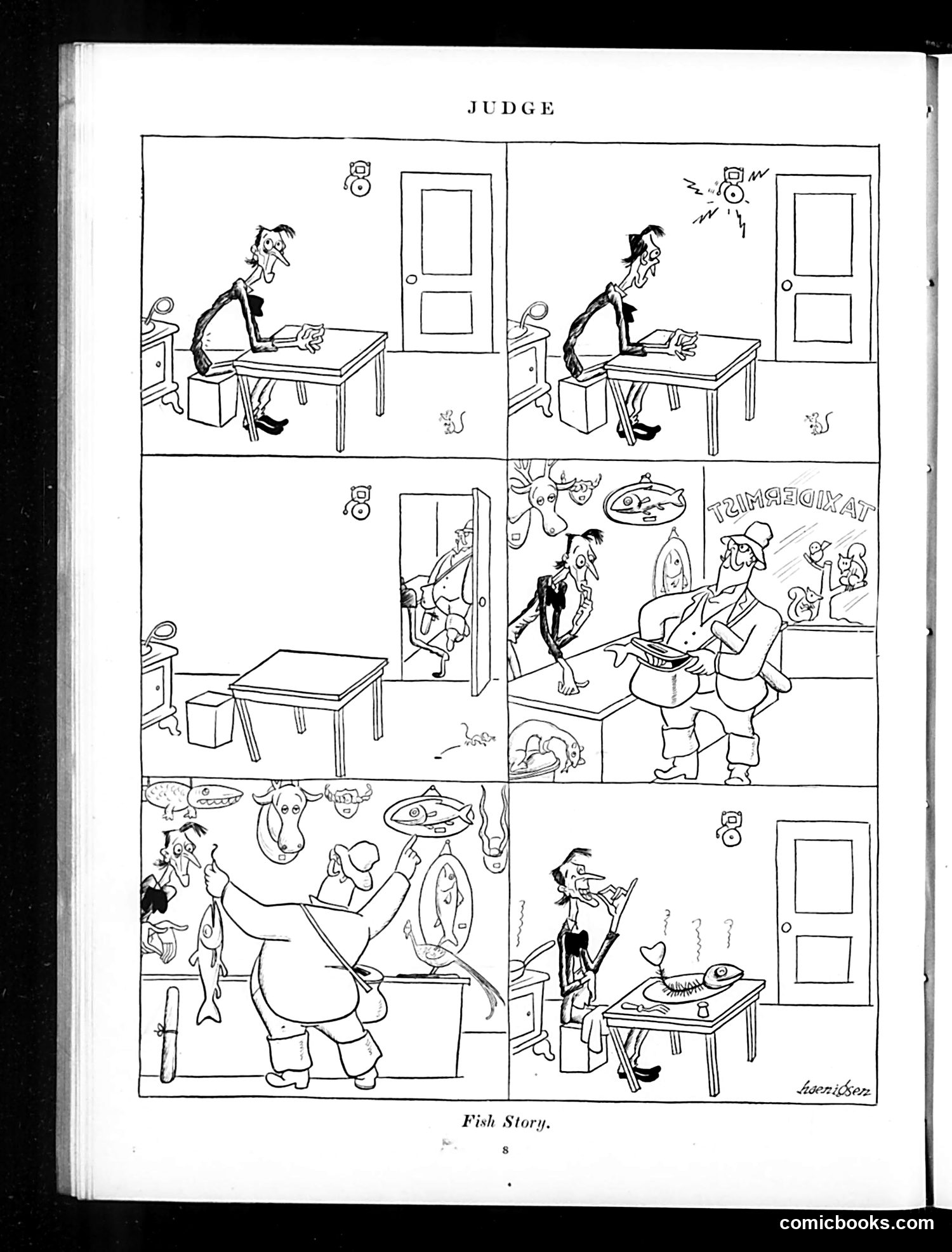
# "Fish Story" - Judge Magazine Cartoon This is a six-panel comic titled "Fish Story" satirizing exaggeration and lying. The narrative shows a Judge (identifiable by his robes and bench in the first panels) who appears to catch a fish. The story progresses through increasingly absurd retellings: what begins as a modest catch becomes, with each retelling, a progressively larger and more fantastical tale, complete with increasingly elaborate illustrations of giant fish. The final panel shows the judge at his desk with a comically oversized fish, suggesting he's adopted the exaggerated version as truth. The satire targets how stories grow through repetition and how people—even authority figures like judges—can become invested in false narratives. It's a commentary on dishonesty and the human tendency to embellish, particularly relevant to a satirical magazine focused on exposing social and political falsehoods.
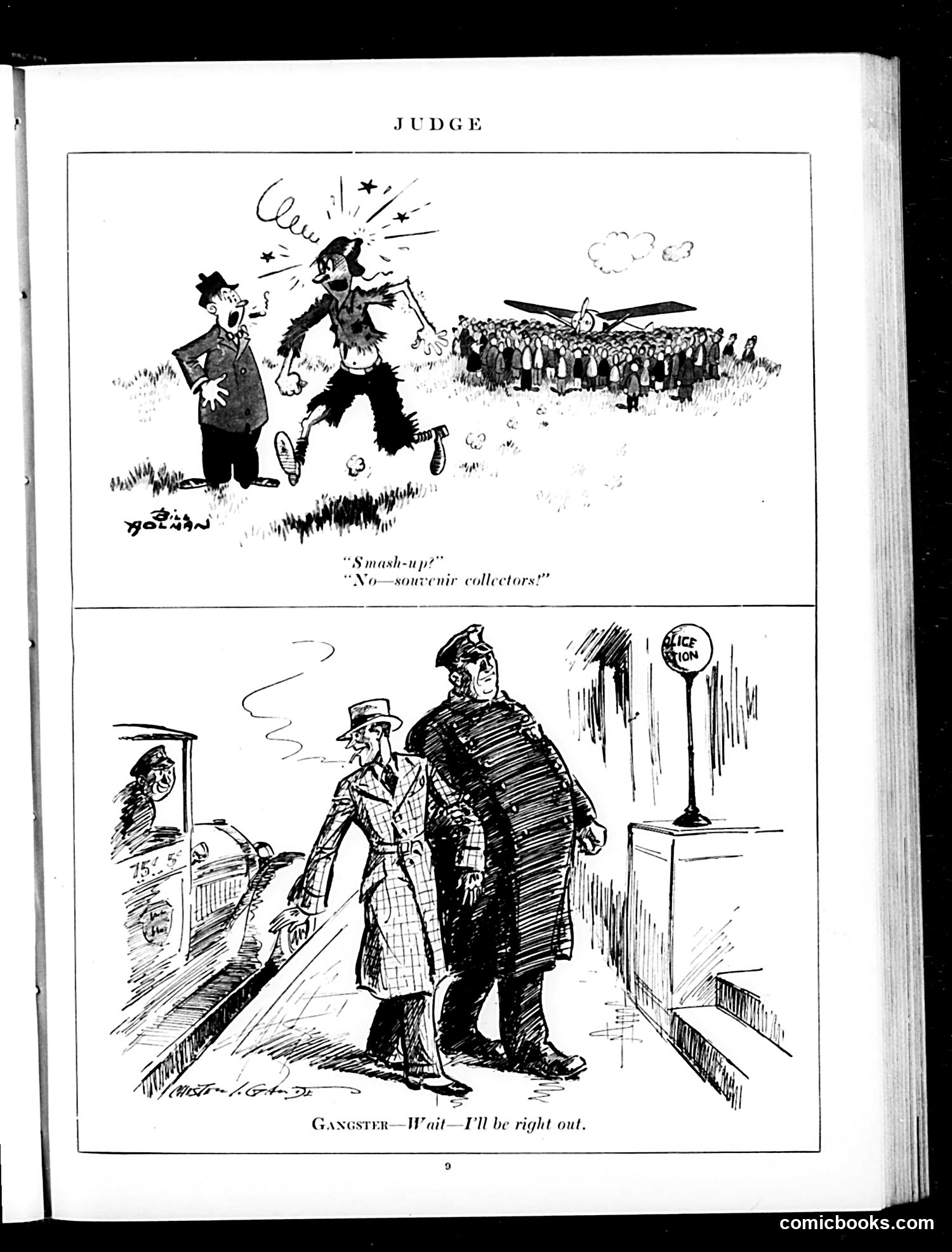
# Page Analysis: Judge Magazine Political Cartoons This page contains two separate cartoons satirizing early 20th-century social behavior. The **top cartoon** depicts a chaotic scene where a figure labeled "Jew" is being attacked by a mob while "souvenir collectors" watch. The caption suggests the violence is being rationalized as mere souvenir-gathering rather than acknowledged as an actual "smash-up" (pogrom or riot). This appears to satirize indifference to anti-Semitic violence, where perpetrators or observers dismiss serious attacks as casual collectibles. The **bottom cartoon** shows a "Gangster" at what appears to be a police station, telling someone he'll "be right out"—suggesting criminals operate with such impunity or corruption that even arrest poses no real consequence. Both cartoons critique lawlessness and social violence in contemporary America, though the top cartoon contains deeply offensive anti-Semitic imagery reflecting the era's prejudices.
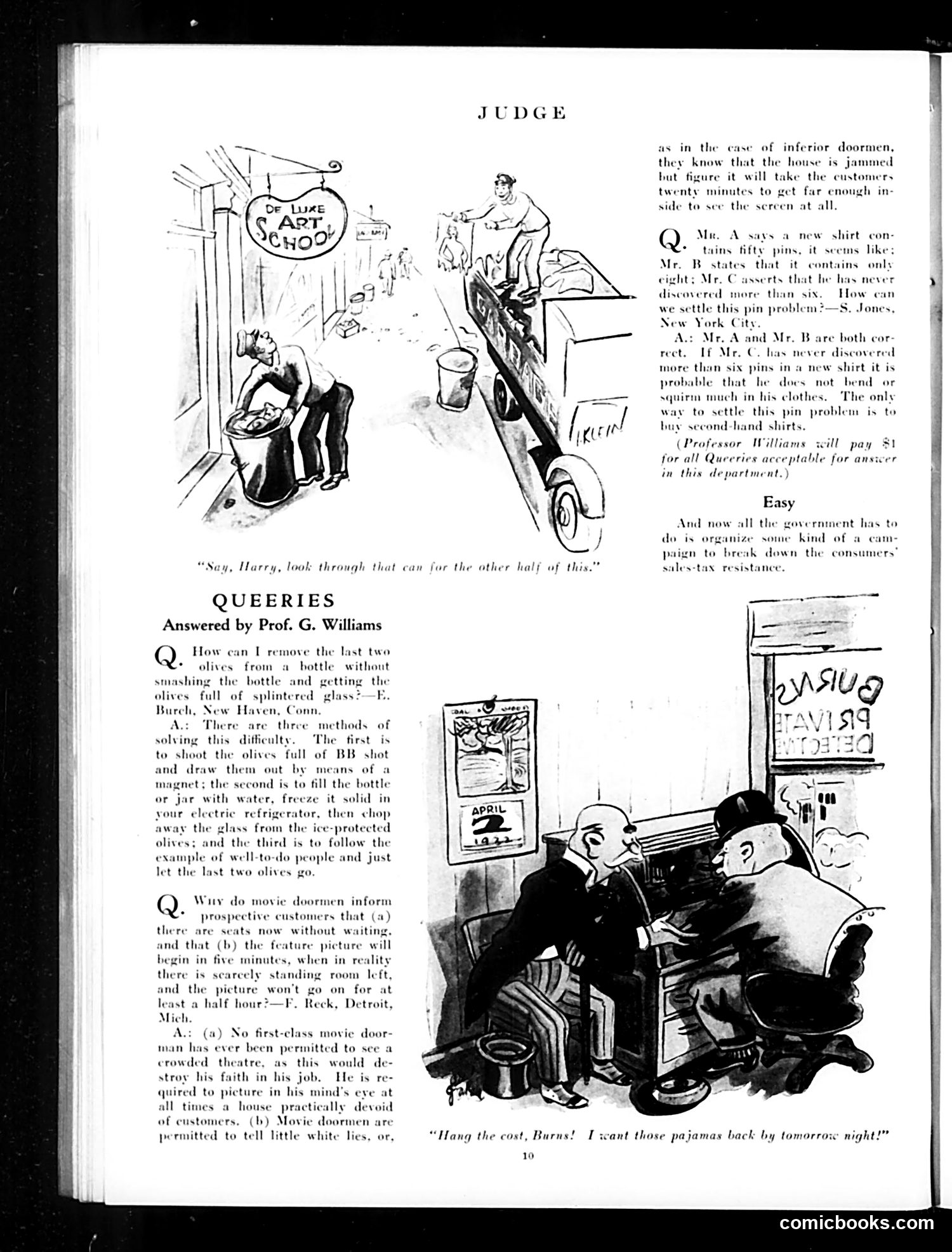
# Judge Magazine Page Analysis This page from Judge contains humorous advice columns and satirical cartoons typical of early 20th-century American humor. **The Cartoons:** The top illustration shows a "De Luxe Art School" where doormen cram customers into a theater despite fire code violations. The satire mocks theaters that falsely advertise available seating. The bottom cartoon depicts a couple at what appears to be a tailor or dry cleaner, with one person demanding pajamas back by tomorrow—satirizing the gap between promised service delivery and reality. **The "Queries" Section:** Readers submit absurd practical problems (removing olives from bottles, counting shirt pins), and Professor Williams responds with mock-serious but ridiculous solutions (using BB shot and magnets; freezing bottles solid). The humor lies in treating trivial consumer complaints with overwrought technical advice. **Social Context:** These pieces satirize modern consumer culture, retail dishonesty, and everyday frustrations of urban middle-class life. The final note about "sales-tax resistance" suggests contemporary economic concerns.