
Judge, 1932-04-02 · page 27 of 36
Judge — April 2, 1932 — page 27: what you’re looking at
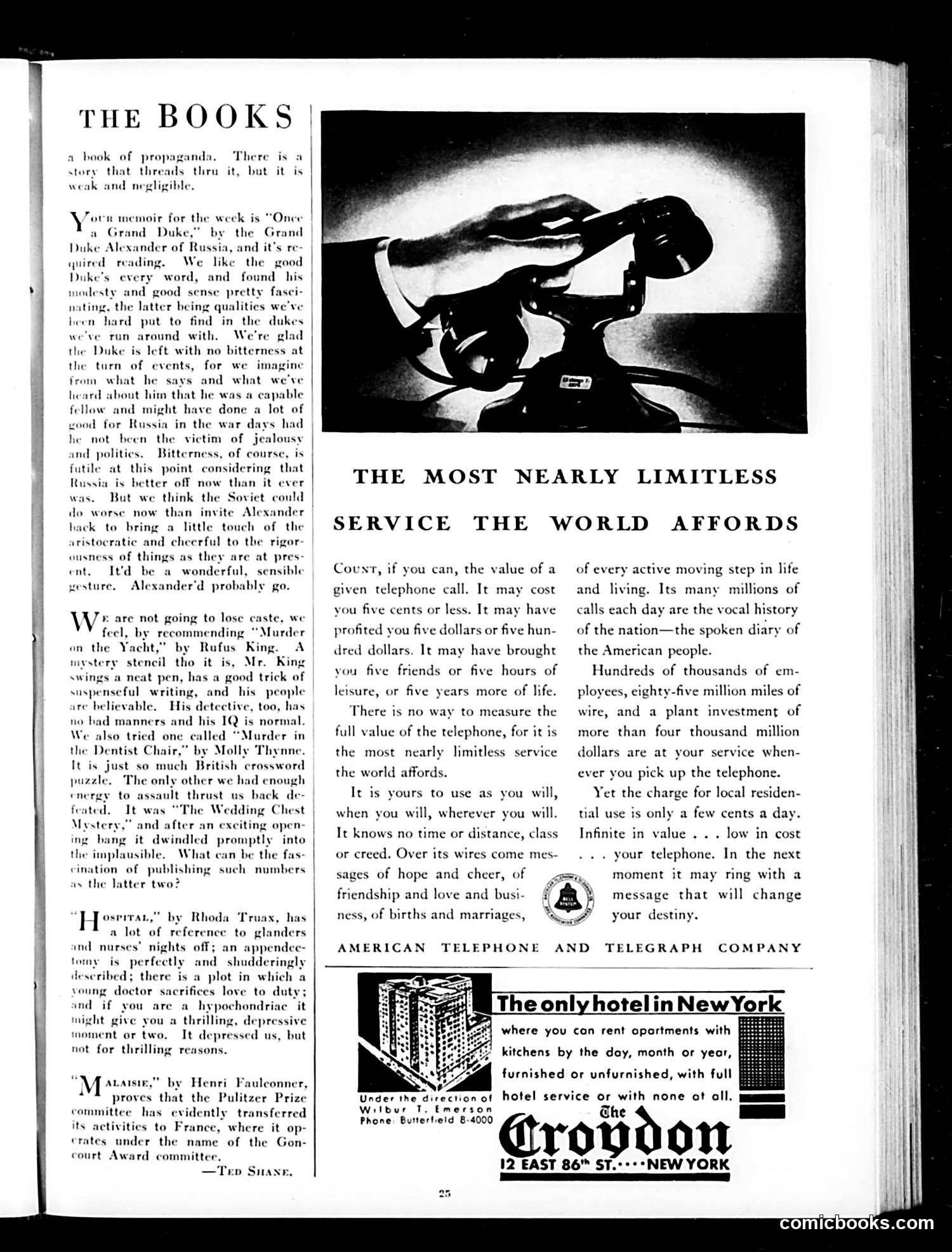
A restored page from Judge, 1932-04-02. Page through the whole issue in the reader above.
📄 Transcribed text from this page (OCR, searchable)
Machine-transcribed from the original scan — historical spelling and the odd misread are preserved.
THE BOOKS a book of propaganda. There is a that threads thru it, but it is weak and negligible. story Yo k memoir for the week is “Once a Grand Duke,” by the Grand Duke Alexander of Russia, and it’s re- quired reading. We like the good Duke's every word, and found his modesty and good sense pretty fasei- nating, the latter being qualities we've been hard put to find in the dukes we've run around with. We're glad the Duke is left with no bitterness at the turn of events, for we imagine and what we've heard about him that he was a capable fellow and might have done a lot of xood for Russia in the war d had he not been the victim of jealousy and politics. Bitterness, of futile at this point considering t Russia is better off now than it eve But we think the Soviet could do worse now than invite Alexander hack to bring a little of the sristocratic and cheerful to the rigor from what he says wa touch ousness of things as they are at pres- ent, It'd be a wonderful, yesture, Alexander'd probably go. sensible We are not going to lose caste, we feel, by recommending “Murder on the ht,” by Rufus King. A mystery stencil tho it is, Mr. King swings a neat pen, has a good trick of suspenseful writing, and his people ire believable. His detective, too, d manners and his 1Q is normal. We also tried one called “Murder in the Dentist Chair,” by Molly ‘Thynne. It is just so much British crossword puzzle, The only other we had enough ault thrust us back de- to as Mystery,” and after an exciting open ing bang it dwindled promptly into the implausible. What ean be the fas- cination of publishing such numbers is the latter two? “Horniman.” by Rhoda ‘Truax, has a lot of reference to glanders ind nurses’ nights off; an appende: tomy is perfectly and shudderingly described; there is a plot in which a voung doctor sacrifices love to duty ind if you are a hypochondriae t give you a thrilling, depressive nent or two. It depressed us, but not for thrilling reasons. Henri Faulconner, the Pulitzer Prize committee has evidently transferred its activit er s to s under the name court Award committee. of the Gon- —Tep Suanr. arse, is | It was “The Wedding Chest | THE MOST NEARLY LIMITLESS SERVICE THE WORLD AFFORDS Count, if you can, the value of a given telephone call. It may cost you five cents or less. It may have profited you five dollars or five hun- dred dollars. It may have brought you five friends or five hours of leisure, or five years more of life. There is no way to measure the full value of the telephone, for it is the most nearly limitless service the world affords. It is yours to use as you will, when you will, wherever you will. It knows no time or distance, class or creed. Over its wires come mes- sages of hope and cheer, of friendship and love and busi- ness, of births and marriages, *a AMERICAN TELEPHONE Wilbur T. Emerson AND TELEGRAPH where you con rent oportments with kitchens by the doy, month or year, furnished or unfurnished, with full la . F Under the direction of hotel service or with none ot oll. sz Phone. Butterfield. 8-4000 Crovu o on — 12 EAST 86" ST. of every active moving step in life and living. Its many millions of calls each day are the vocal history of the nation—the spoken diary of the American people. Hundreds of thousands of em- ployees, eighty-five million miles of wire, and a plant investment of more than four thousand million dollars are at your service when- ever you pick up the telephone. Yet the charge for local residen- tial use is only a few cents a day. Infinite in value . . . low in cost . «+ your telephone. In the next moment it may ring with a message that will change “A your destiny, COMPANY he +*NEW YORK