
Judge, 1932-04-02 · page 20 of 36
Judge — April 2, 1932 — page 20: what you’re looking at
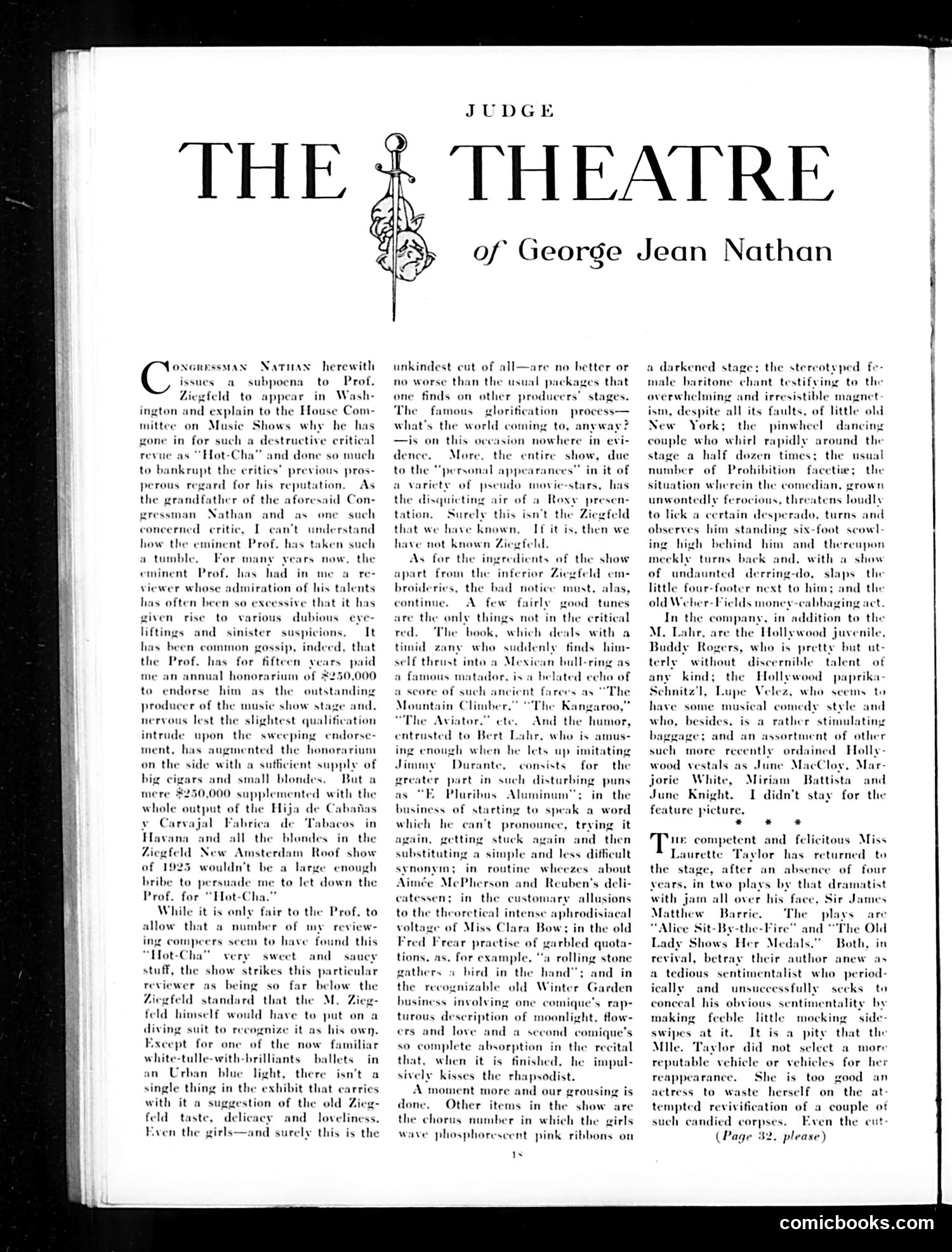
A restored page from Judge, 1932-04-02. Page through the whole issue in the reader above.
📄 Transcribed text from this page (OCR, searchable)
Machine-transcribed from the original scan — historical spelling and the odd misread are preserved.
THE oNGRESSMAN Natuan herewith C issues a subpoena to Prof. Ziegfeld to appear in) Wash- ington and explain to the House Com- mittee on Musie Shows why he has in for such a destructive critical revue as “Hot-Cha” and done so much to bankrupt the crities’ previous pros- perous regard for his reputation, As the grandfather of the aforesaid Con- gressman athan and as one critic, I can’t understand eminent Prof. has taken such a tumble. For many years now, the eminent Prof. has had in me a re- viewer whose admiration of his talents that it has dubious gone such concerned how the has often been so excessive given rise to liftings and suspicions, has been common gossip, indeed, that the Prof. has for fifteen years paid me an annual honorarium of $250,000 to endorse him as the outstanding producer of the music show stage and, nervous lest the slightest qualification intrude upon the sweeping ment, has augmented the honorarium on the side with a sufficient supply of rs and small blondes. But a $250,000 supplemented with the output of the Hija de 1 Fabrica de ‘Tabacos in nd all the blondes in’ the eld New Amsterdam Roof show wouldn't be a large enough bribe to persuade me to let down the Prof. for “Hot-Cha.” While it is only fair to the Prof. to allow that a number of my revie ing compeers seem to have found this “Hot-Cha” very sweet and saucy stuff, the show strikes this particular reviewer as being so far below the Ziegfeld standard that the M. Zie feld himself would have various sinister endorse- Cabatas to put on diving suit to recognize it as his own. Except for one of the white-tulle-with-brilliants in Urban blue light, there isn’t a single thing in the exhibit that e: with it a suggestion of the old feld taste, and loveliness, Even the girls—and surely this is the now familiar ballets in delicacy JUDGE THEATRE unkindest cut of all—are no better or no worse than the usual packages that one finds on other producers’ T famous glorification what's the world coming to, any ? —is on this oves dence. show, due to the in it of a variety of pseudo movie-stars, has stages, process— ion nowhere in ev More, the “personal appe entire rances” the disquieting air of a Roxy presen- tation, Surely this isn’t the Ziegfeld that we have known, If it is, then we have not known Ziegfeld. As for the ingredients of the show apart from the inferior Ziegfeld em- broideries, the bad notice must, continue. A few fairly good tunes are the only things not in the critical red. The book, which deals with a timid zany who suddenly finds him- self thrust into a Mexican bull-ring as a famous matador, is a belated echo of a score of such ancient farees as “The Mountain Climber.” “The Kangaroo,” “The Aviator.” ete. And the humor, entrusted to Bert Lahr, who is amus- ing enough when he lets up imitating Jimmy Durante, consists for the greater part in such disturbing puns as “E Pluribus Aluminum’; in’ the business of starting to speak a word which he can't’ pronounce, trying it gain, getting stuck nd then substituting a simple nd less difficult synonym; in routine wheezes Aimée McPherson essen; in’ the to the theoretical intense voltage of Miss Clara Bow; in the old Fred Frear practise of tions, as, for example, gathers « bird in the the recognizable old alas, and Reuben’s deli- customary allusions garbled quota- a rolling stone hand”; and in Winter Garden comique’s rap- turous description of moonlight, flow- ers and love business involving one and a second comique's so complete absorption in the recital that, when it is finished, he impul- sively kisses the rhapsodist. A moment more and our grousing is done. Other items in the show are the chorus number in which the girls wave phosphorescent pink ribbons on 1s jorie of George Jean Nathan a darkened st the typ male baritone chant testifying to the overwhelming and irresistible ma ism, despite all its faults, of little New York; the pinwheel danci couple who whirl rapidly around the stage a half dozen times; the usual number of Prohibition facetiw; the situation wherein the comedian, ster grown unwontedly ferocious, threatens loudly to lick a certain desperado, turns and observes him standing six-foot scowl ing high behind him and thereupon meekly turns back and, with of undaunted derring-do, slaps the little four-footer next to him; and the old Weber-Fields money-cabbaging act. In the company, in addition to the M. Lahr, are the Hollywood juvenile, Buddy Rogers, who is pretty but ut- terly without discernible nt of any kind; the Hollywood paprika Schnitz'l, Velez, have musical comedy style and who, besides. is a rather stimulating baggag. nd an: such more recently wood vestals as June MacCloy. Mar Whi Miriam Battista and Knight. I didn't stay for the feature picture. * a show Lupe who seems to some ssortment of other ordained Holly- June : competent and felicitous Miss urette T: jor has returned to ge, after an absence of four s by that dramatist with jam all over his face, Sir Ji Matthew Barrie. The plays “Alice Sit-By-the- and “The Old Shows Her Medals.” Both, in their author anew as a tedious sentimentalist. who period- and unsuccessfully seeks te his obvious sentimentality. by feeble little swipes at it. It is Mlle. Taylor did not. select a reputable vehicle or vehicles for her reappearance. She is too mocking side- a pity that the more good an actress to waste herself on the at tempted revivification of a couple of such candied corpses. Even the cut (Page 32, please) comicbooks.com