
Judge, 1932-04-02 · page 34 of 36
Judge — April 2, 1932 — page 34: what you’re looking at
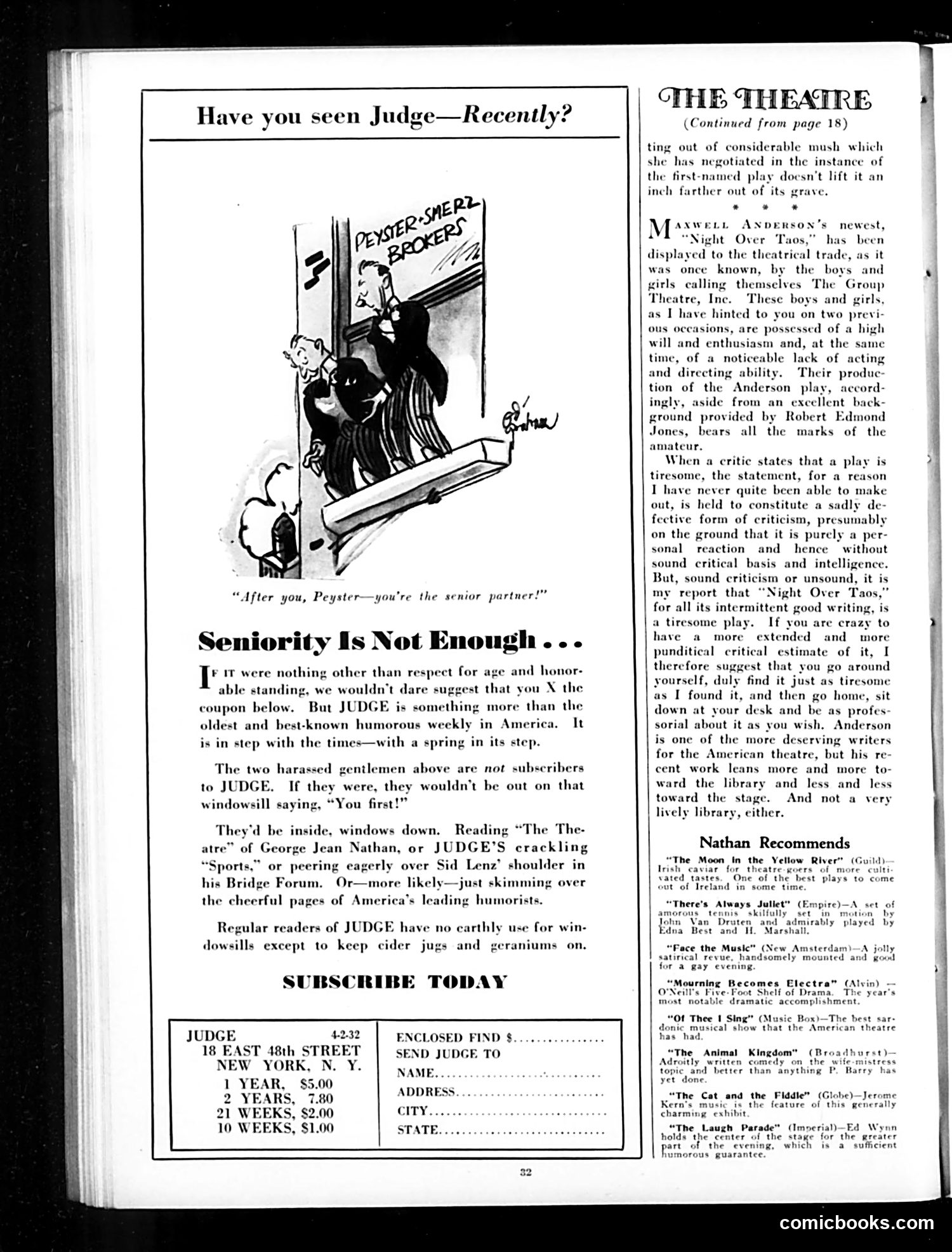
A restored page from Judge, 1932-04-02. Page through the whole issue in the reader above.
📄 Transcribed text from this page (OCR, searchable)
Machine-transcribed from the original scan — historical spelling and the odd misread are preserved.
Have you seen Judge—Recently “After you, Peyster—you're the senior partner!” Seniority Is Not Enough... T Ir were nothing other than respect for age and honor- able standing, we wouldn't dare suggest that you X the coupon below. But JUDGE is something more than the oldest and best-known humorous weekly in America. It is in step with the times—with a spring in its step. The two harassed gentlemen above are not subscribers to JUDGE. If they were, they wouldn't be out on that “You first!” windowsill saying They'd be inside, windows down, Reading “The The- re” of George Jean Nathan, or JUDGE’S crackling “Sports,” or peering eagerly over Sid Lenz’ shoulder in Bridge Forum. Or—more likely—just skimming over the cheerful pages of America’s leading humorists. ular readers of JUDGE have no earthly use for win- Is except to keep cider jugs and geraniums on, SUBSCRIBE TODAY JUDGE 4-232 18 EAST 48th STREET NEW YORK, N. Y. 1 YEAR, $5.00 2 YEARS, 7.80 21 WEEKS, $2.00 10 WEEKS, $1.00 ENCLOSED FIND §. SEND JUDGE TO NAME... ADDRESS... CITY:....++ THE THEATRE (Continued from page 18) ting out of considerable mush which she has negotiated in the instance of the first-named play doesn’t lift it an inch farther out of its grave. *_ * * Massree ANDERSON’s newest, : “Night Over Taos,” has been displayed to the theatrical trade, as it once known, by the boys and girls calling themselves The Group Theatre, Inc. These boys and girls, as I ous occ ave hinted to you on two previ- sions, are possessed of a high will and enthusiasm and, at the time, of a noticeable lack of ing and directing ability. Their produc- tion of the Anderson play, accord- ingly, aside from an excellent back- ground provided by Robert Edmond Jones, bears all the marks of the amateur. When a critic states that a pl. tiresome, the statement, for a reason I have never quite been able to make out, is held to constitute a sadly de- fective form of criticism, presumably on the ground that it is purely a per- sonal reaction and hence without sound critical basis and intelligence. But, sound ¢ sm or unsound, it is report that “Night Over Taos,” for all its intermittent good writing, is a tiresome play. If you are c to have more extended and more punditical critical estimate of it, I therefore suggest that you go around yourself, duly find it just as tiresome as I found it, and then go home, sit down at your desk and be as profes- sorial about it as you wish, Anderson is one of the more deserving writers for the American theatre, but his re- cent work leans more and more to- ward the library and less and less toward the stage. And not a very lively library, either. ne Nathan Recommends “The Moon In the Yellow River” (Guild). Irish caviar for theatre-goers of more culti vated tastes. One of the best plays to come out of Ireland in some time “There's Always Jullet” (Empire)—A set of ° lly set in. motion by John Van Dr and admirably played by Edna Best and H. Marshall. “Face the Music” (New Ams: satirical revue, handsomely me for a gay evening. “Mourning Becomes Electra” (Alvin) — O'Neill's Five-Foot Shelf of Drama. The year's most notable dramatic accomplishment “Ot Th donic music has had. Sing” (Music B. show that t —The best sar- nerican theatre “The Animal Kingdom" (Broadhurst) itly written comedy on the wife-mistress and better than anything P. Barry has me. “The Cat and the Fiddle” ( Kern's music is the feature of th charming exhibit “The Laugh Parade* (Imperial)—Ed Wynn holds the center of the stage for the greater art of the evening, which is a sufficient he)—Jerome s generally humorous guarantee, comicbooks.com