
Judge, 1932-04-02 · page 24 of 36
Judge — April 2, 1932 — page 24: what you’re looking at
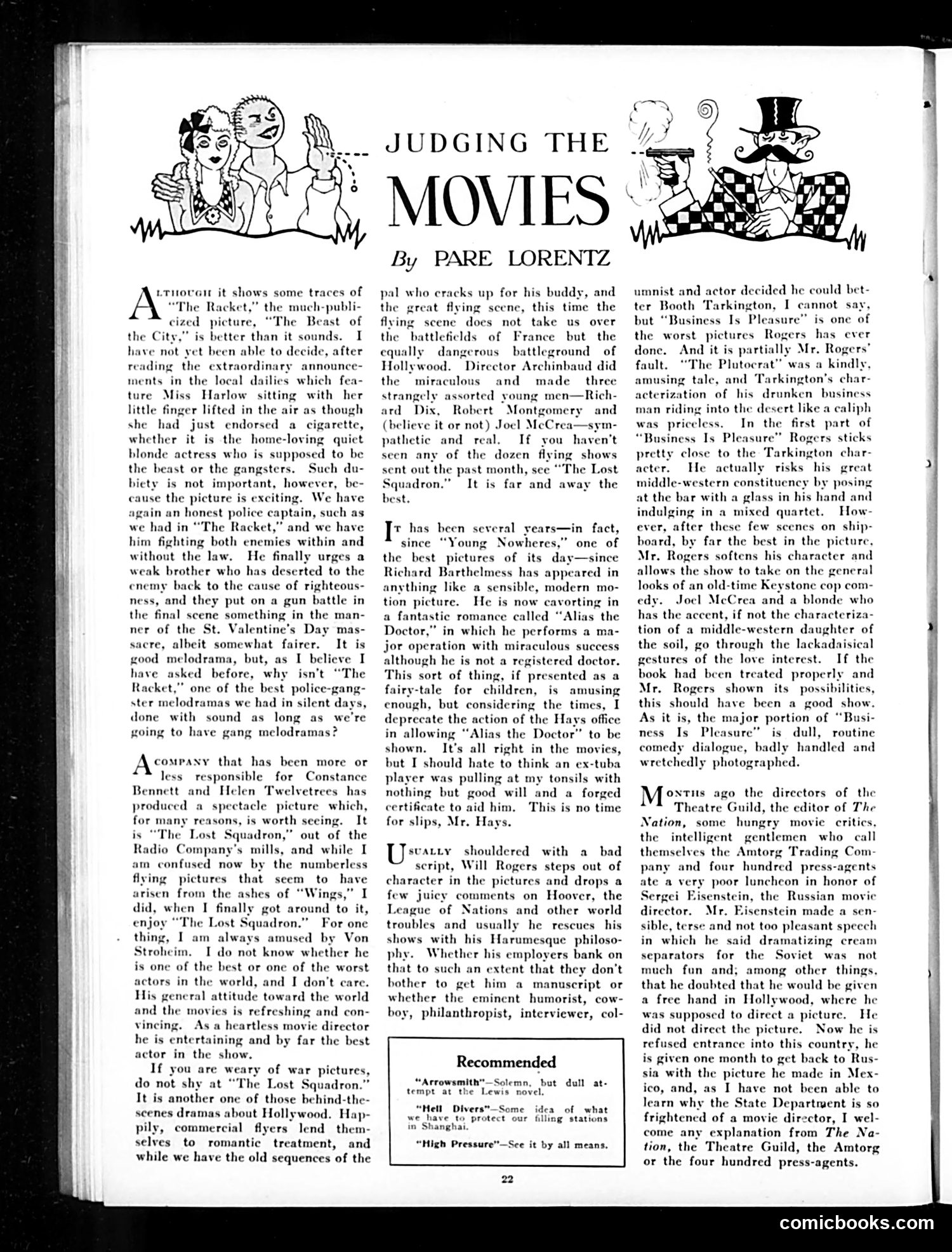
A restored page from Judge, 1932-04-02. Page through the whole issue in the reader above.
📄 Transcribed text from this page (OCR, searchable)
Machine-transcribed from the original scan — historical spelling and the odd misread are preserved.
THovalt it shows some traces of “The Racket,” the much-publi- cized picture, “The Beast of the City,” is better than it sounds. I have not yet been able to decide, after reading the extraordinary announce- ments in the local d s which f ture Miss Harlow sitting with her little finger lifted in the air as though she had just endorsed a cigarette, whether it is the home-loving quiet blonde actress who is supposed to be the beast or the gangsters. Such du- biety is not important, however, b cause the picture is exciting. We have in an honest police captain, such as we had in “The Racket,” and we have him fighting both enemies within and without the law. He finally urges a weak brother who has deserted to the enemy back to the cause of righteous- ness, and they put on a gun battle in the final scene something in the man- ner of the St. Valentine's Day mas- sacre, albeit somewhat fairer. It is good melodrama, but, as I believe I have asked before, why isn’t “The Racket,” one of the best police-gang- ster melodramas we had in silent days, done with sound as long as we're going to have gang melodramas? Acomrasy that has been more or less responsible for Constance Bennett and Helen Twelvetrees has produced a spectacle picture whic for many reasons, is worth seeing. It is “The Lost Squadron,” out of the Radio Company's mills, and while I am confused now by the numberless flying pictures that seem to have arisen from the ashes of “Wing I did, when I finally got around to it, enjoy “The Lost Squadron.” For one thing, I am always amused by Von Strohcim. I do not know whether he is one of the best or or actors in the world, and I don't care. His general attitude toward the world and the movies is refreshing and con- vincing. As a heartless movie director he is entertaining and by far the best actor in the show. If you are weary of war pictures, do not shy at “The Lost Squadron.” It is another one of those behind-the- scenes dramas about Hollywood. Hap- pily, commercial flyers lend them- selves to romantic treatment, and while we have the old sequences of the > of the worst JUDGING THE MOVIES By PARE LORENTZ pal who cracks up for his buddy, and the great flying scene, this time the flying scene does not take us over the battleticlds of France but the equally dangerous battleground of Hollywood. Director Archinbaud did the miraculous and made three assorted young men—Rich- Robert Montgomery (believe it or not) Joel McCrea— pathetic andre: If you hs seen any of the dozen flying shows sent out the past month, see “The Lost Squadron.” It is far and away the best. in fact, one of y—since Richard Barthelmess has appeared in anything like a sensible, modern mo- tion picture. He is now cavorting in a fantastic romance called ‘Alias the Doctor,” in which he performs a ma- jor operation with miraculous success although he is not a registered doctor. This sort of thing, if presented as a fi tale for children, is amusing enough, but considering the times, I deprecate the action of the Hays office in allowing “Alias the Doctor” to b shown. It’s all right in the movies, but I should hate to think an ex-tuba player was pulling at my tonsils with nothing but good will and a forged certificate to aid him, This is no time for slips, Mr. Hays. suatty shouldered with a bad script, Will Rogers steps out of character in the pictures and drops a few juicy comments on Hoover, the League of Nations and other world troubles and usually he rescues his shows with his Harumesque_philoso- phy. Whether his employers bank on that to such an extent that they don't bother to get him a manuscript or whether the eminent humorist, cow- boy, philanthropist, interviewer, col- Recommended “Arrowsmith"—Solemn, but dull at- tempt at the Lewis novel, “Hell Divers"—Some idea of what we have to protect our filling stations in Shanghai “High Pressure”—Sce it by all means. umnist and actor decided he could bet- ter Booth Tarkington, I cannot say, but “Business Is Pleasure” is one of the worst pictures Rogers has ever done. And it is partially Mr. Rogers’ fault. “The Plutocrat” was a kindly, amusing tale, and Tarkington's char- acterization of his drunken business man riding into the desert like a caliph was priceless. In the first part of “Business Is Pleasure” Rogers sticks pretty close to the Tarkington char- er. He actually risks his great western constituency by posing a glass in his hand and indulging in a mixed quartet. How- ever, after these few scenes on ship- board, by far the best in the picture, Mr. Rogers softens his character and allows the show to take on the general looks of an old-time Keystone cop com- edy. Jocl McCrea and a blonde who has the accent, if not the che tion of a middle-western ds the soil, go through the 1 gestures of the love interest. If the book had been treated properly and Mr. Rogers shown its possi this should have been a good show. As it is, the major portion of “Busi- ness Is Pleasure” is dull, routine comedy dialogue, badly handled anc wretchedly photographed. I ontits ago the directors of the Theatre Guild, the editor of The Nation, some hungry movie critics, the intelligent gentiemen who call themselves the Amtorg Trading Com- pany and four hundred press-agents te a very poor luncheon in honor of rE enstein, the Russian movie director. Mr. Eisenstein made a sen- sible, terse and not too pleasant speech in which he said dramatizing cream separators for the Soviet was not much fun and; among other things. that he doubted that he would be given a free hand in Hollywood, where he was supposed to direct a picture. He did not direct the picture. Now he is refused entrance into this country, he is given one month to get back to Rus- sia with the picture he made in Mex- ico, and, as I have not been able to learn why the State Department is so frightened of a movie director, I wel- come any explanation from The Na- tion, the Theatre Guild, the Amtorg or the four hundred press-agents. a is comicbooks.com