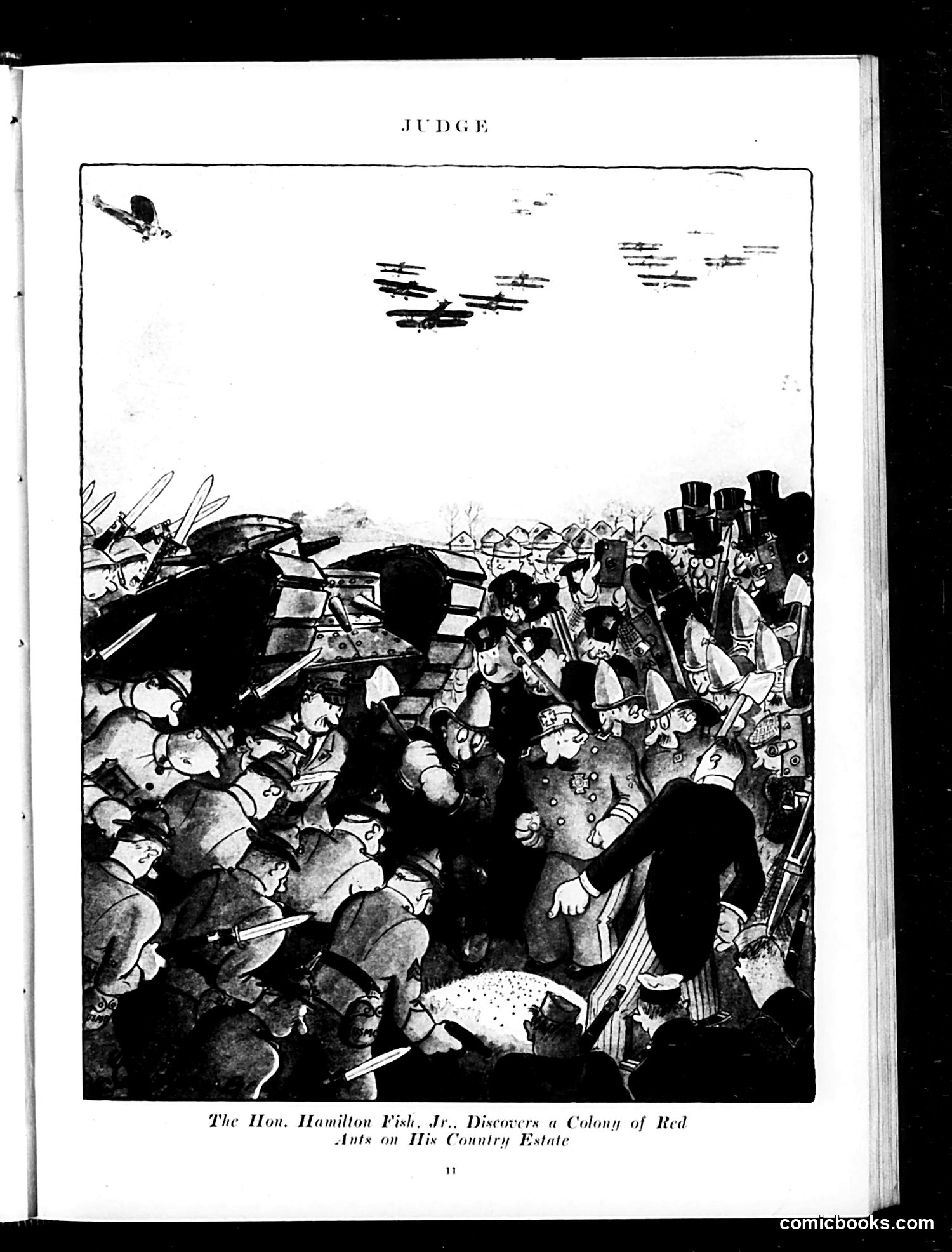
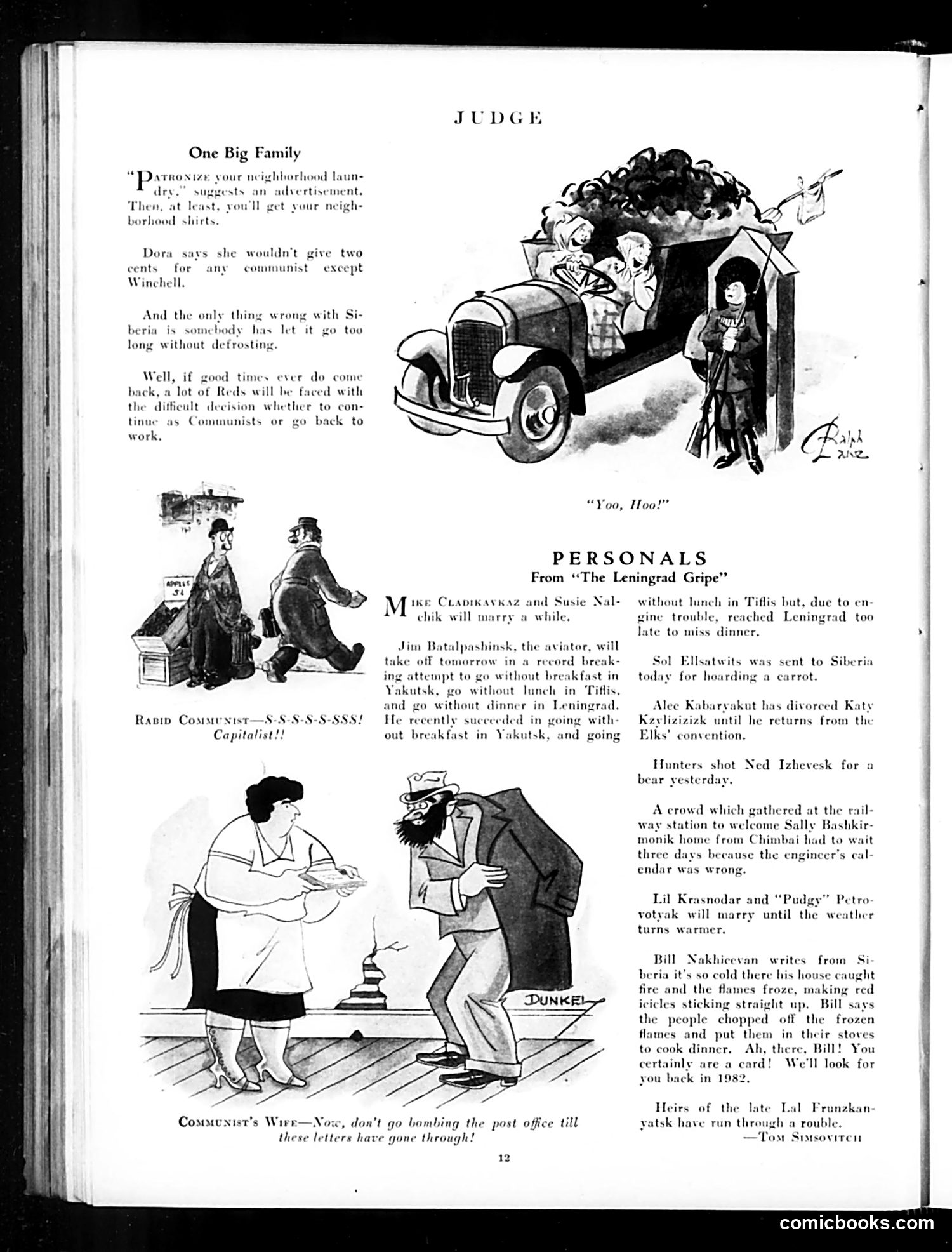
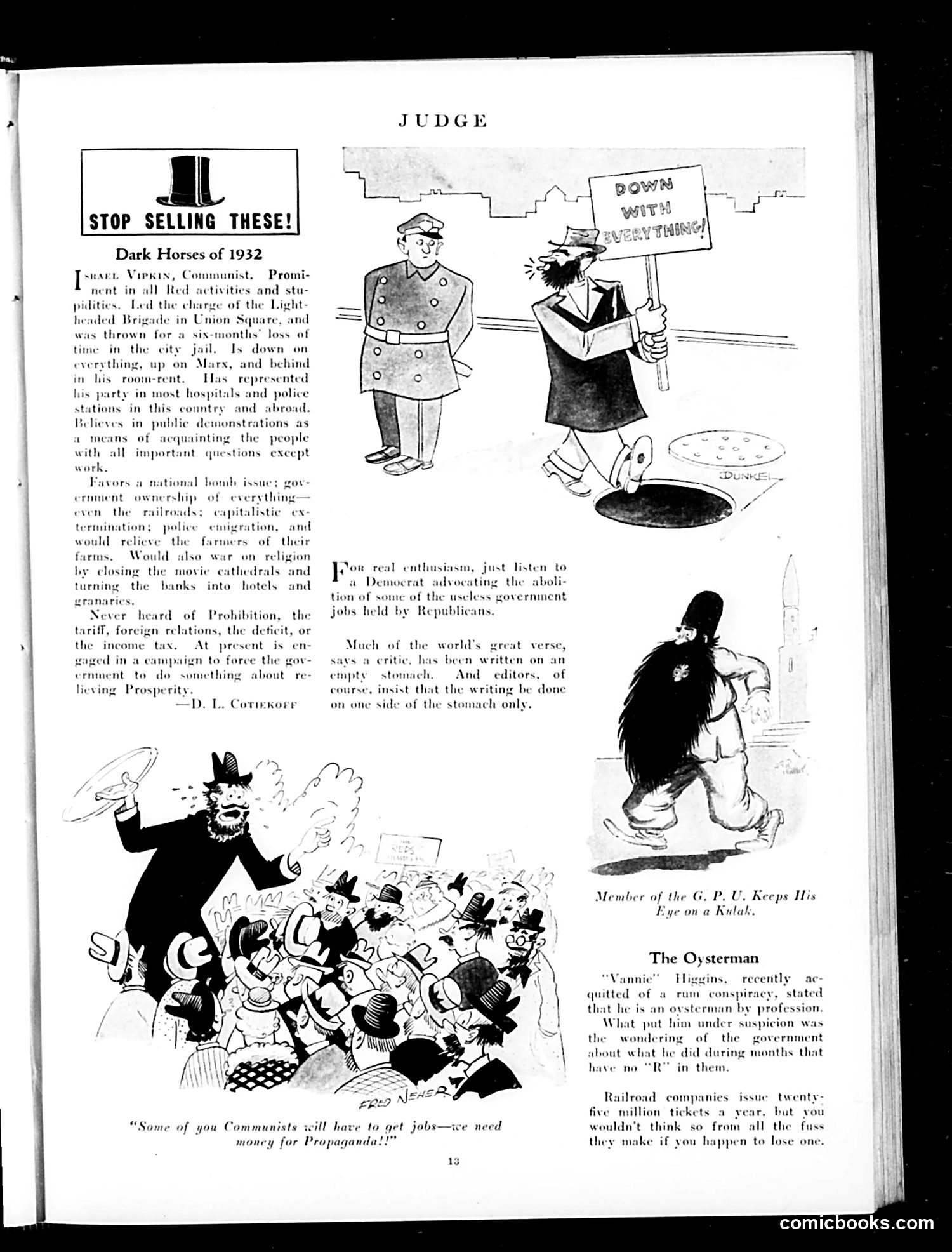
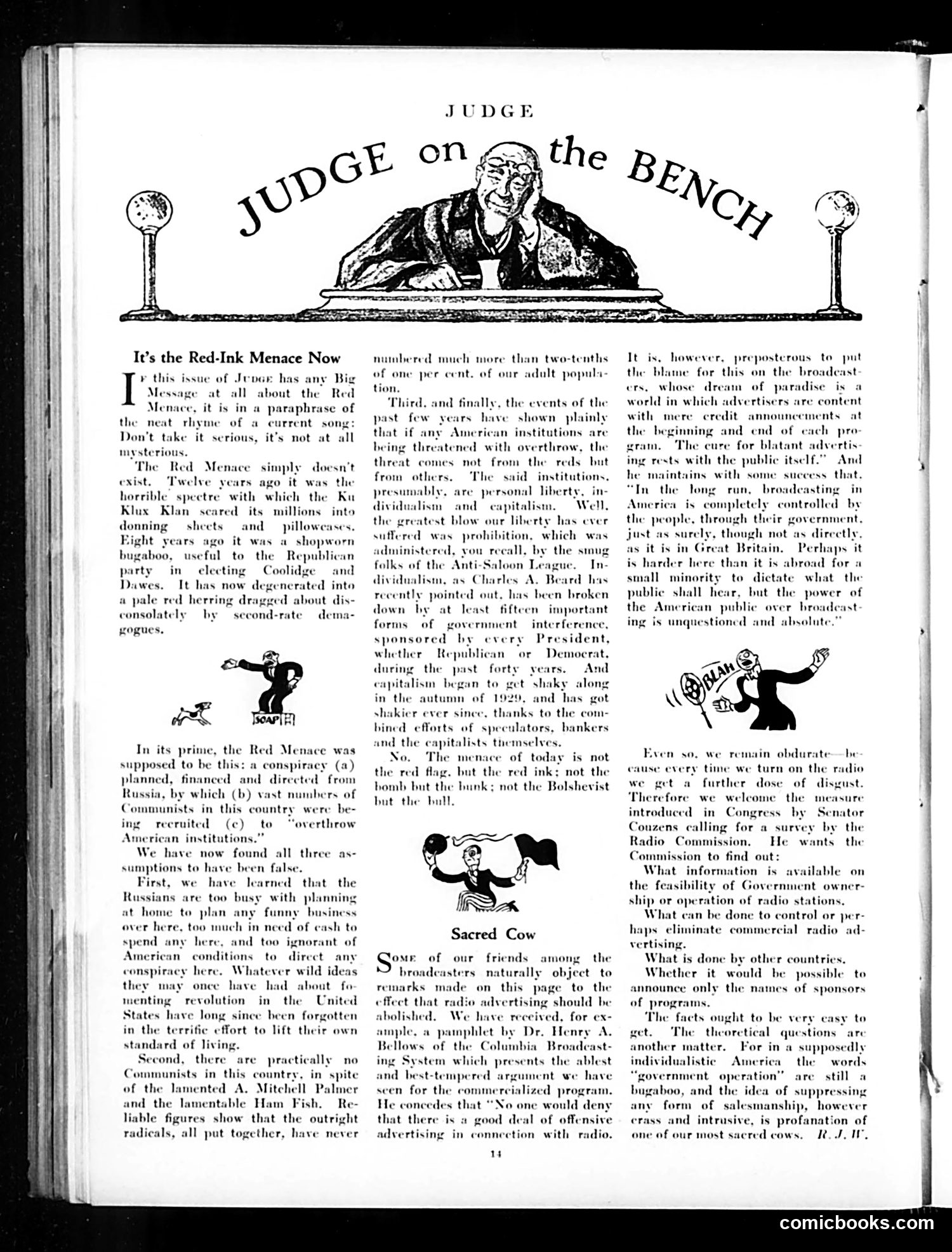
A complete issue · 36 pages · 1932
Judge — February 13, 1932
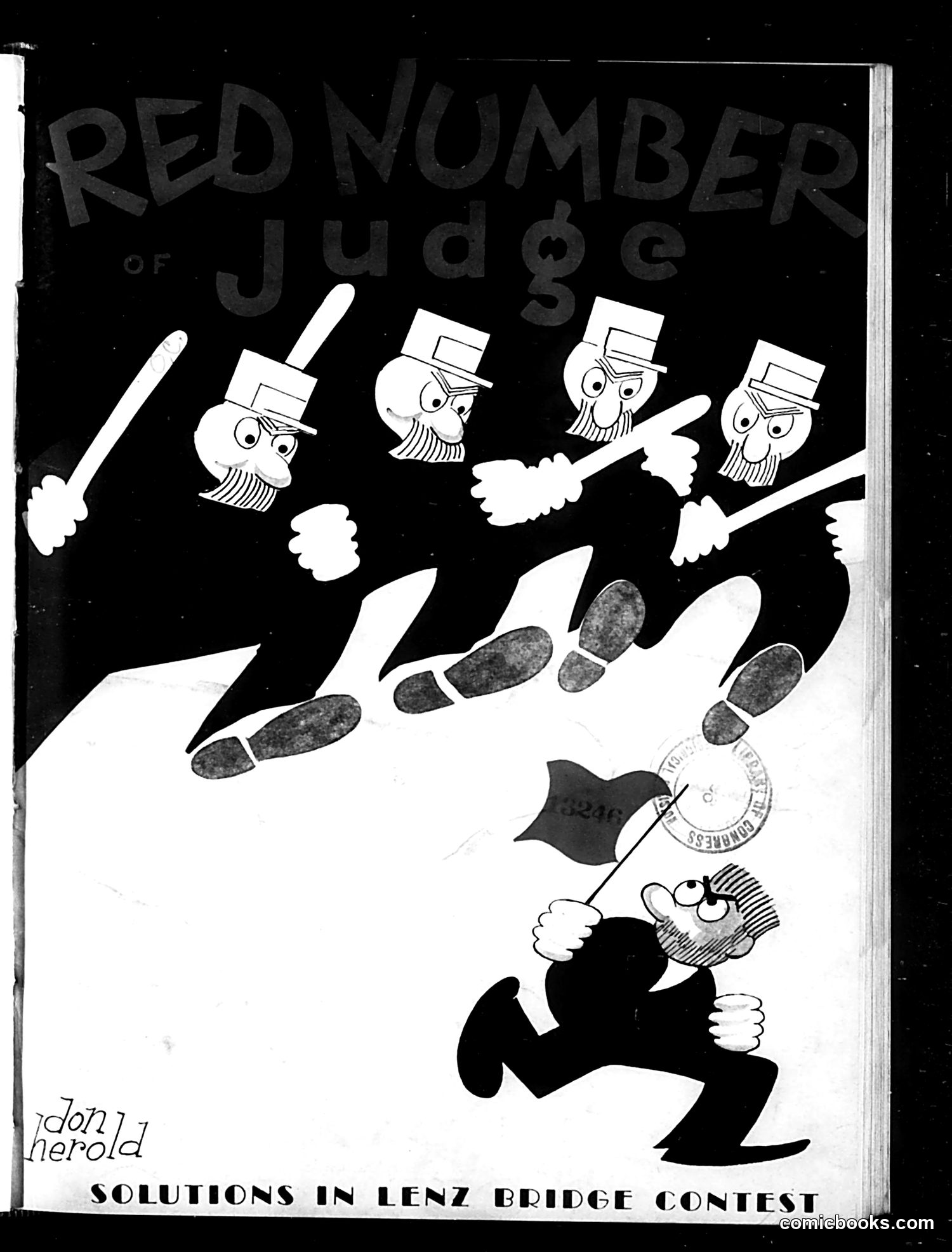
# "Red Number of Judge" — Lenz Bridge Contest Solutions This appears to be a cover for Judge magazine's "Red Number" (a special issue), featuring a satirical cartoon about a "Lenz Bridge Contest." The image shows a character in black (likely representing a judge or contest official) being pelted with papers/solutions by five caricatured heads wearing top hats above—these appear to represent competing entries or contestants. The papers rain down on the official, suggesting an overwhelming volume of submissions. The satire mocks either the contest's popularity, the judge's difficulty in evaluating numerous proposals, or possibly the absurdity of the bridge-design competition itself. The artist is John Harold (signed lower left). Without more historical context, the specific bridge and contest remain unclear, though this likely references a real contemporary engineering or design competition.
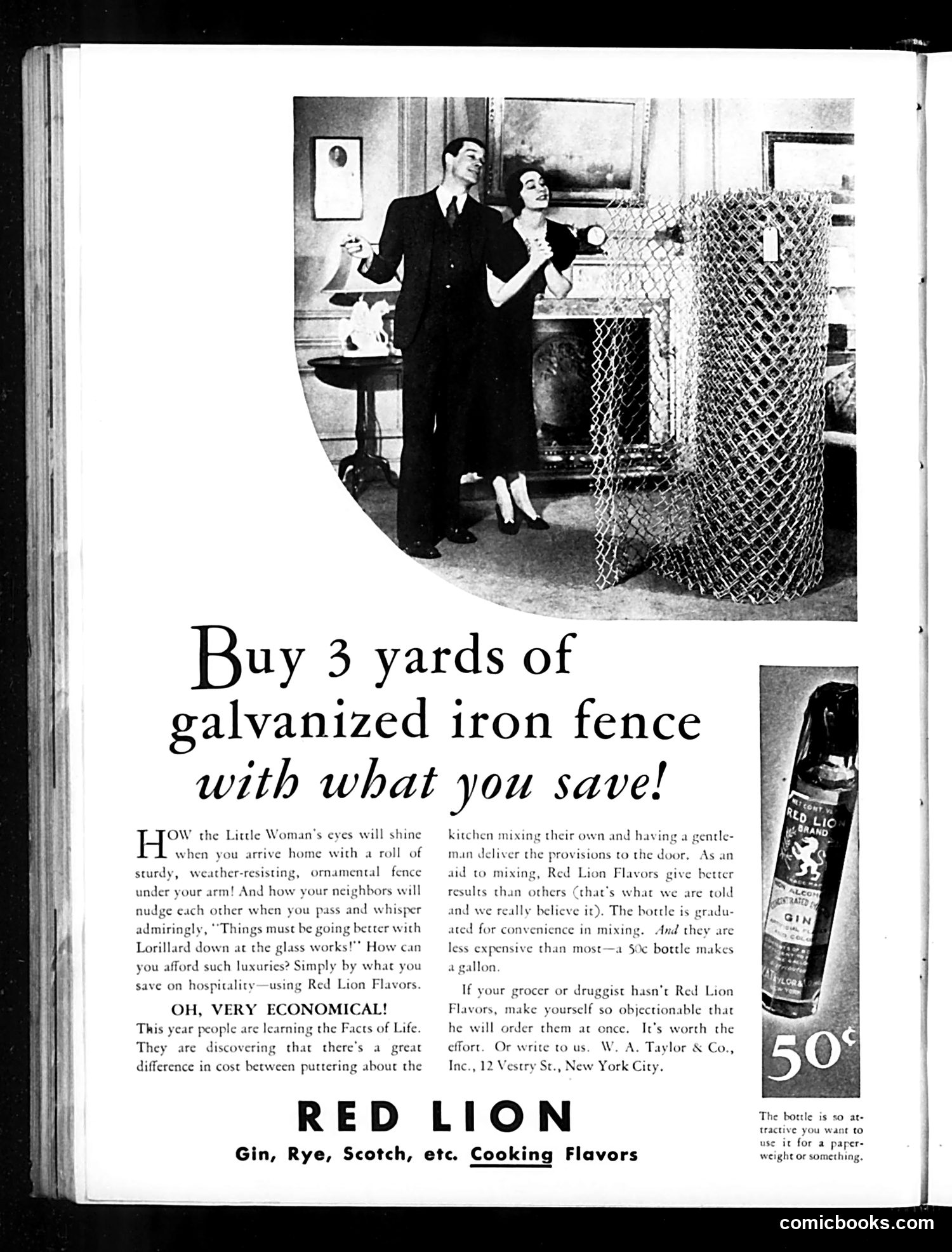
# Analysis This page is primarily a **product advertisement**, not political satire. It advertises Red Lion cooking flavors (gin, rye, scotch extracts) for home cooking. The ad's humor derives from a common 1920s-30s domestic scenario: a well-dressed couple appears delighted by their homemade meal, with the man remarking that "things must be going better with Lord and Lady" since the wife learned to cook using Red Lion Flavors. The accompanying text sarcastically appeals to Depression-era economics ("Oh, very economical!"), encouraging households to save money on restaurant meals by cooking at home with these affordable flavor extracts. The fence offer in the headline is a loss-leader promotion meant to drive product sales. The satire is gentle—mocking both gender roles and economic desperation rather than attacking specific political figures or events.
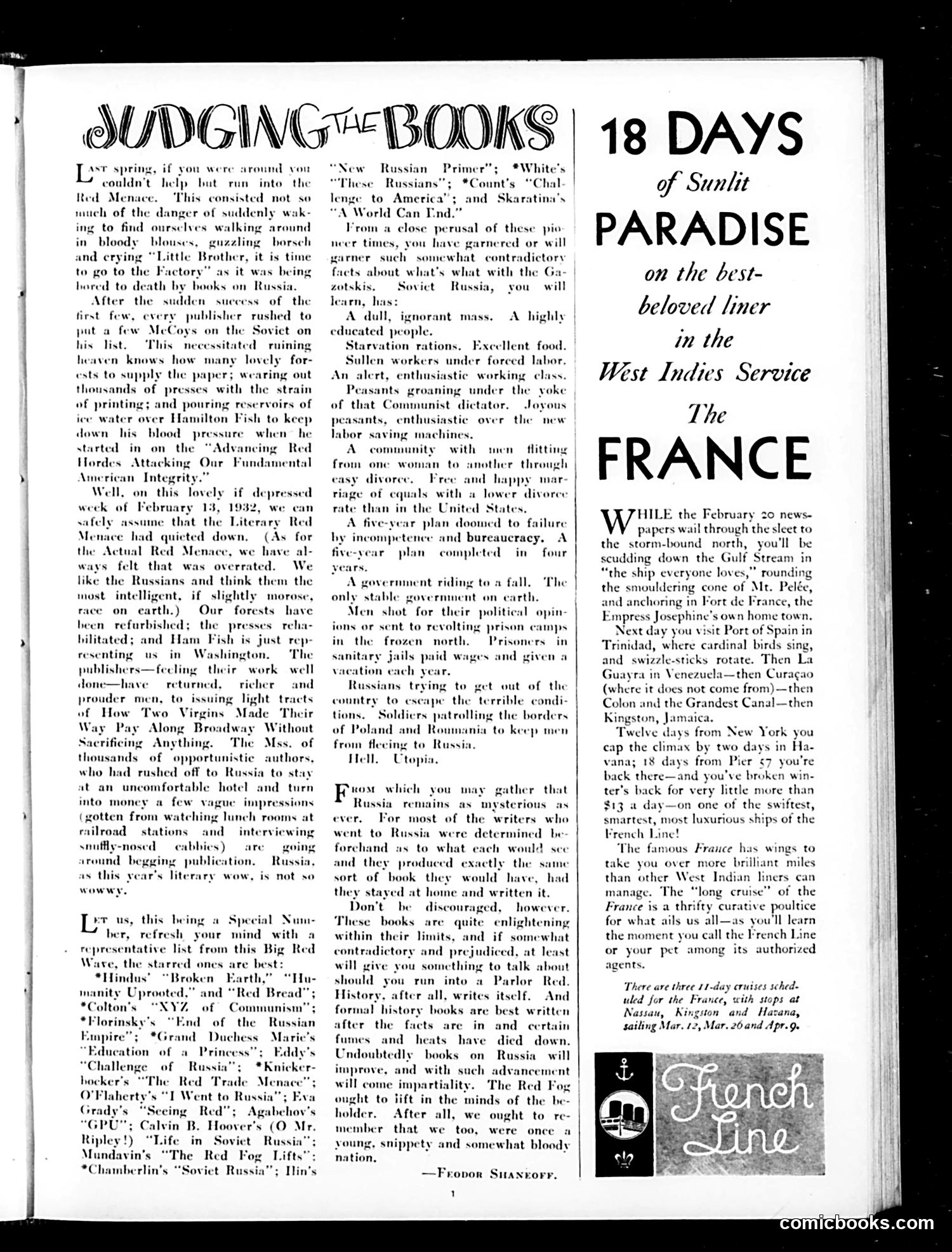
# Analysis This page is primarily **editorial content, not a political cartoon**. The left column contains "Judging the Books," a satirical book review section critiquing recent Russian-themed publications. The author mocks publishers' rush to capitalize on anti-Soviet sentiment by releasing numerous books about Russia, noting many are contradictory, poorly researched, and written by unqualified authors. The right side advertises **the SS France**, a luxury ocean liner in the West Indies Service. This appears to be a paid advertisement rather than satirical content. The "Judging the Books" section represents Judge magazine's typical approach: using humor to mock American commercial culture's opportunistic trends, here the publishing industry's exploitation of Cold War anxieties about Russia.
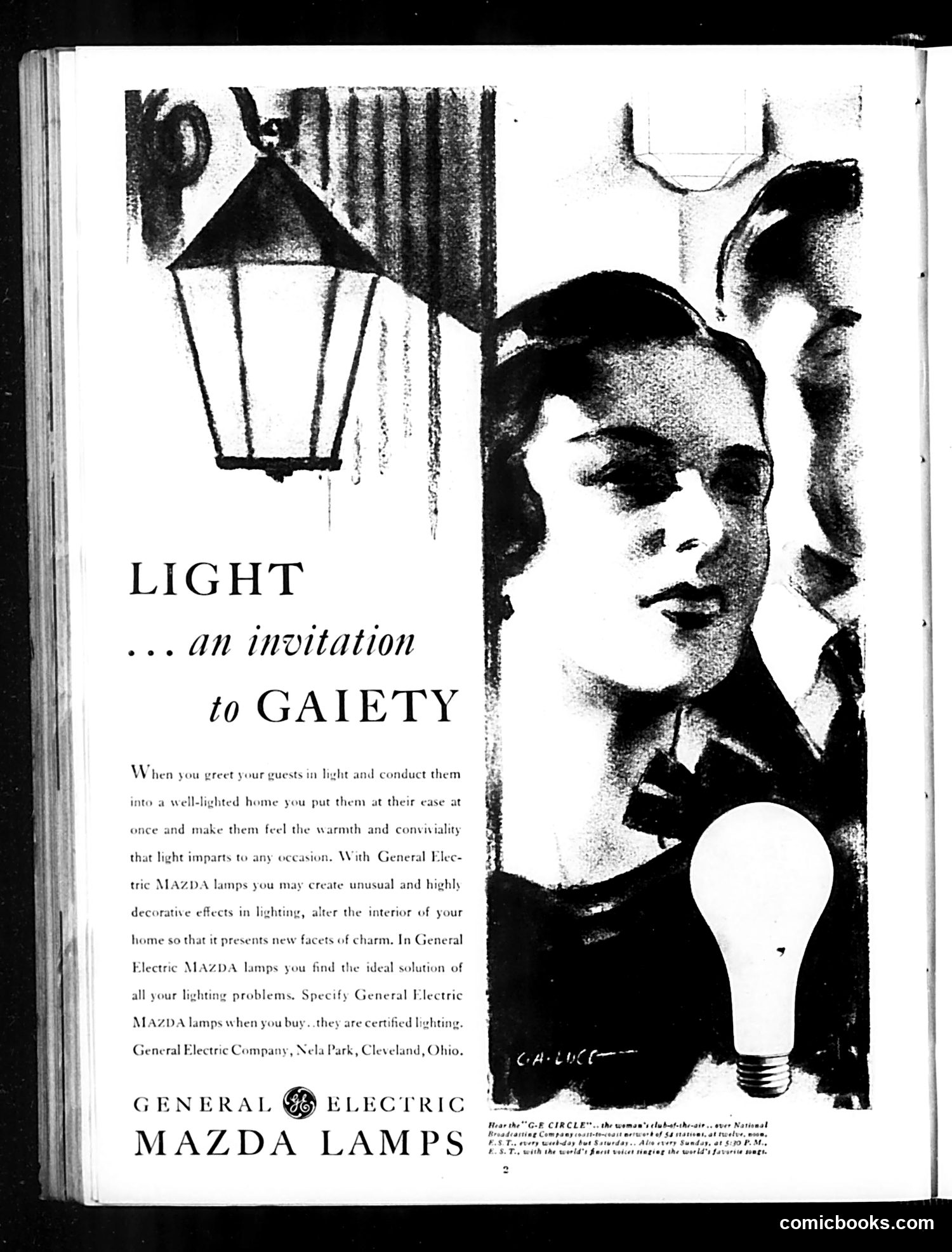
# Analysis This page is **primarily an advertisement**, not political satire. It's a General Electric MAZDA Lamps marketing campaign titled "Light...an invitation to GAIETY." The ad uses a glamorous woman's portrait alongside a lightbulb to promote home lighting. The copy appeals to social aspirations—suggesting that proper lighting creates an atmosphere of "warmth and conviviality" for entertaining guests, thereby elevating one's social standing ("gaiety"). The accompanying lantern illustration reinforces the decorative/aesthetic angle. This represents typical 1920s-30s advertising strategy: linking consumer products to lifestyle desires and social prestige rather than functional benefits. **No political satire is present here.** This is straightforward commercial messaging in a humor magazine's advertising section.
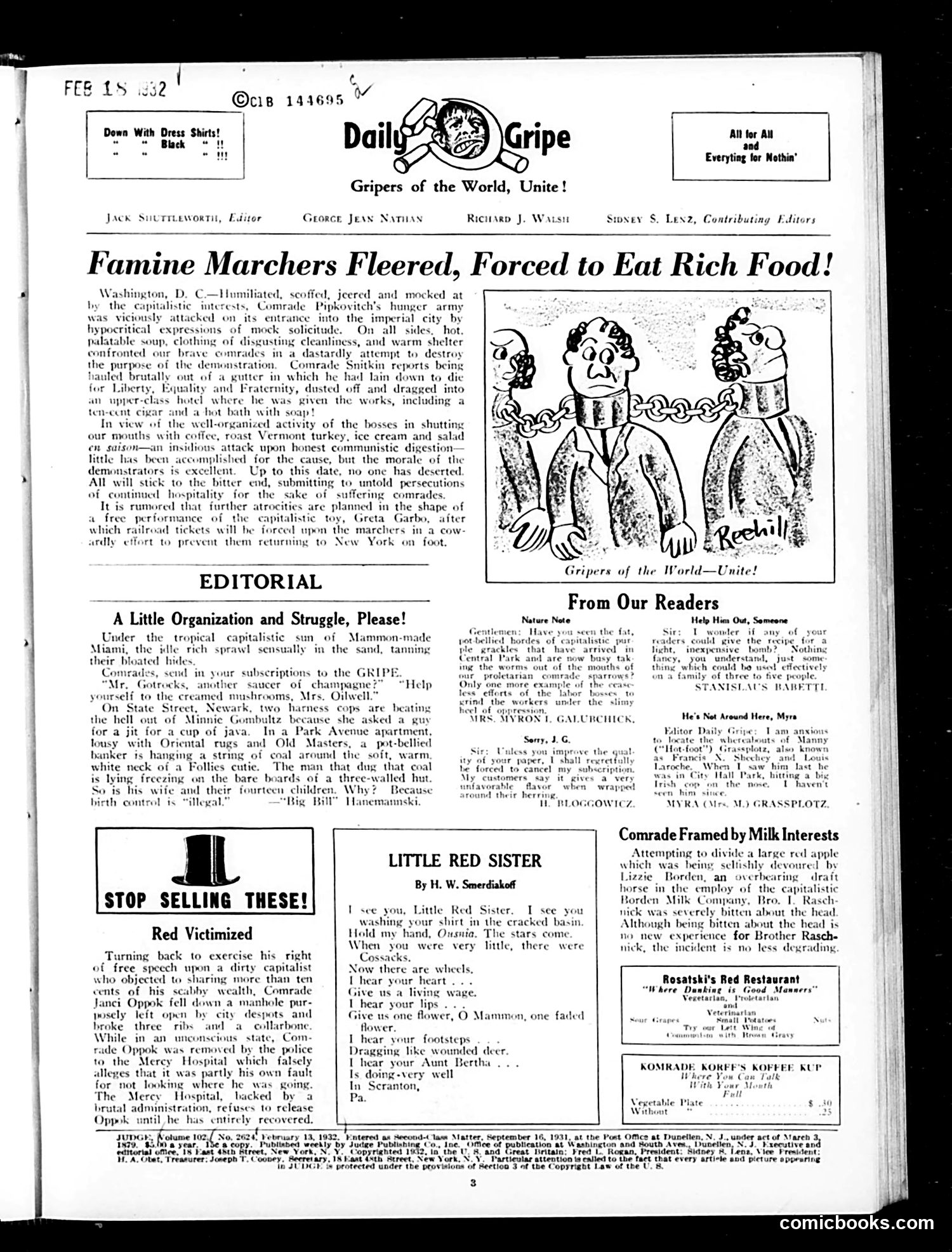
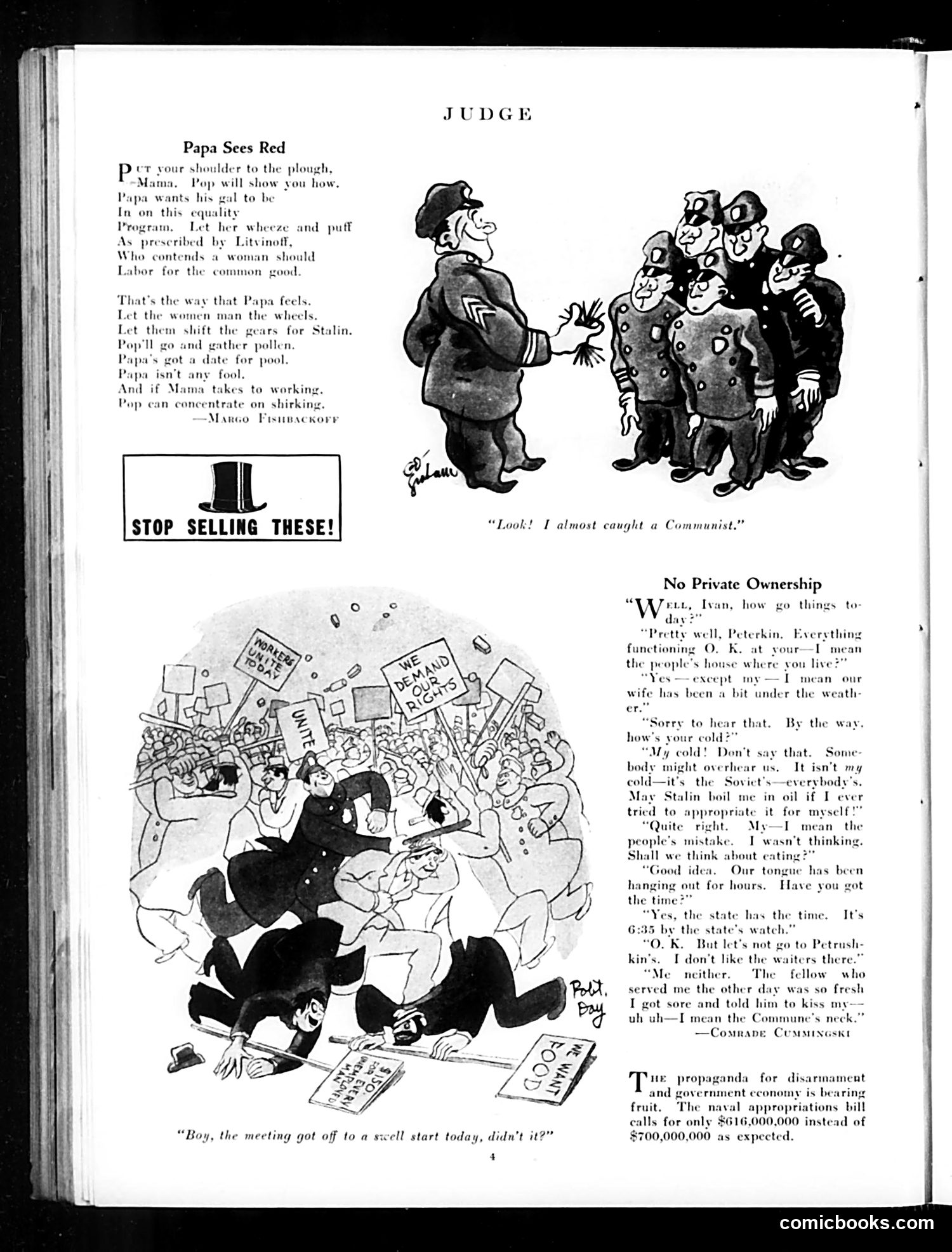
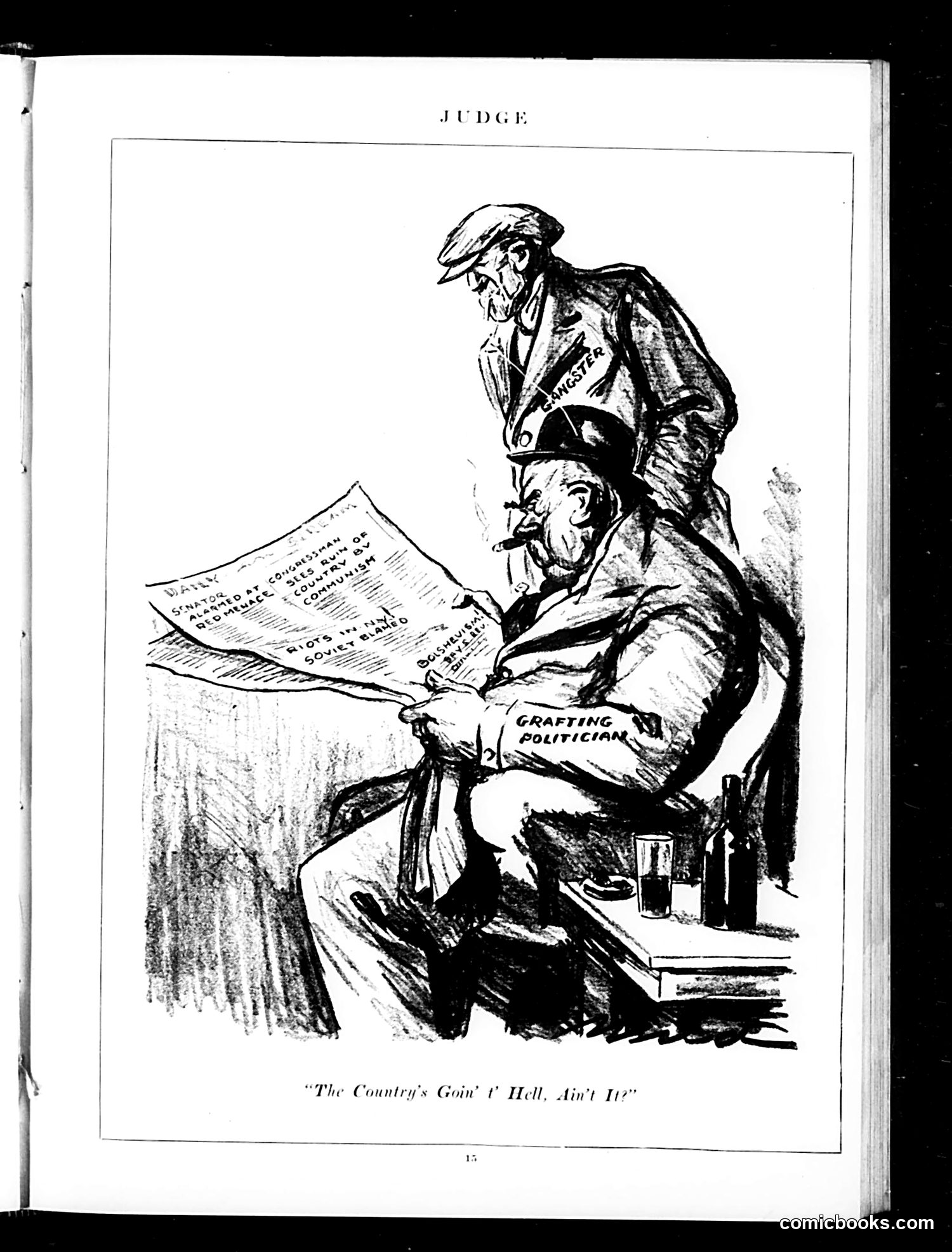
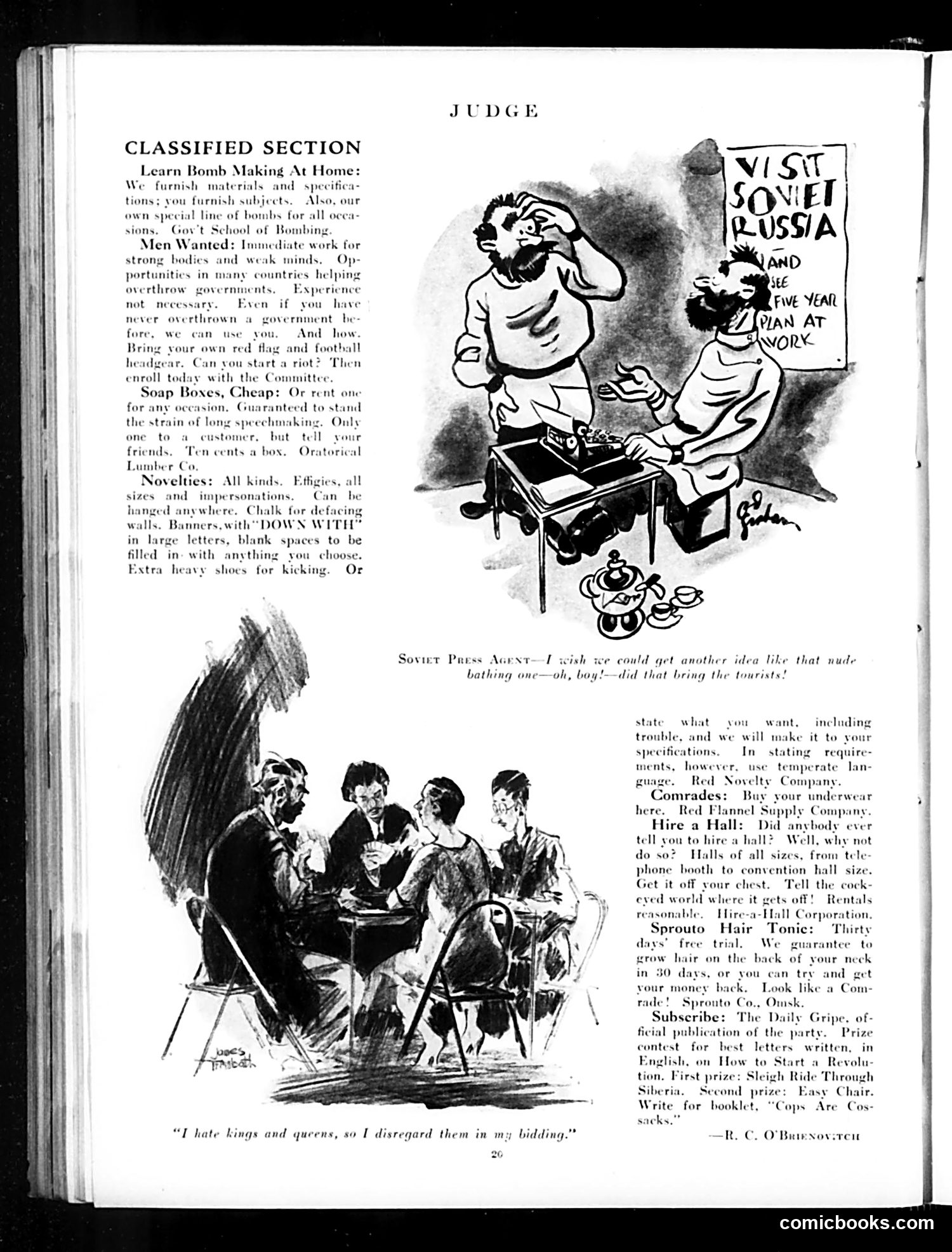
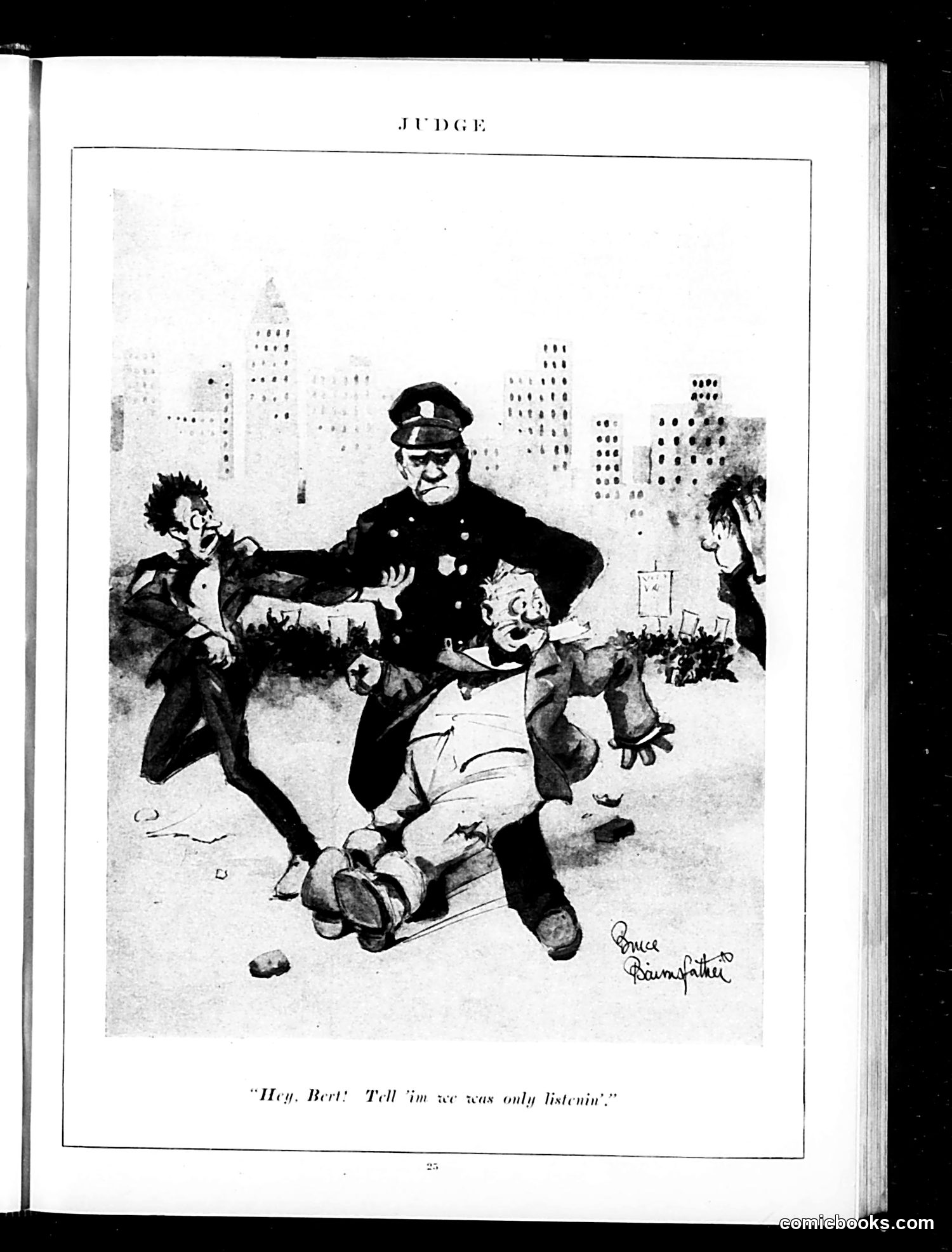
# Political Satire Analysis This Judge magazine page contains anti-communist Cold War propaganda. The top cartoon mocks Papa (likely Stalin) seeing "red" — showing him alarmed among what appear to be Soviet officials. The caption "Look! I almost caught a Communist" suggests paranoid communist leadership. The lower cartoon depicts a chaotic meeting with protest signs reading "WE DEMAND" and "WORKERS," satirizing communist organizing or propaganda efforts as disorderly mob activity. The "No Private Ownership" dialogue mocks Soviet collectivization, with characters suggesting private property confiscation. The final note about reduced naval appropriations ($610M vs. $700M expected) reflects 1940s-50s defense budget debates. Overall, the page uses exaggeration and mockery to portray communism as threatening, disorganized, and fundamentally opposed to American values like private property.
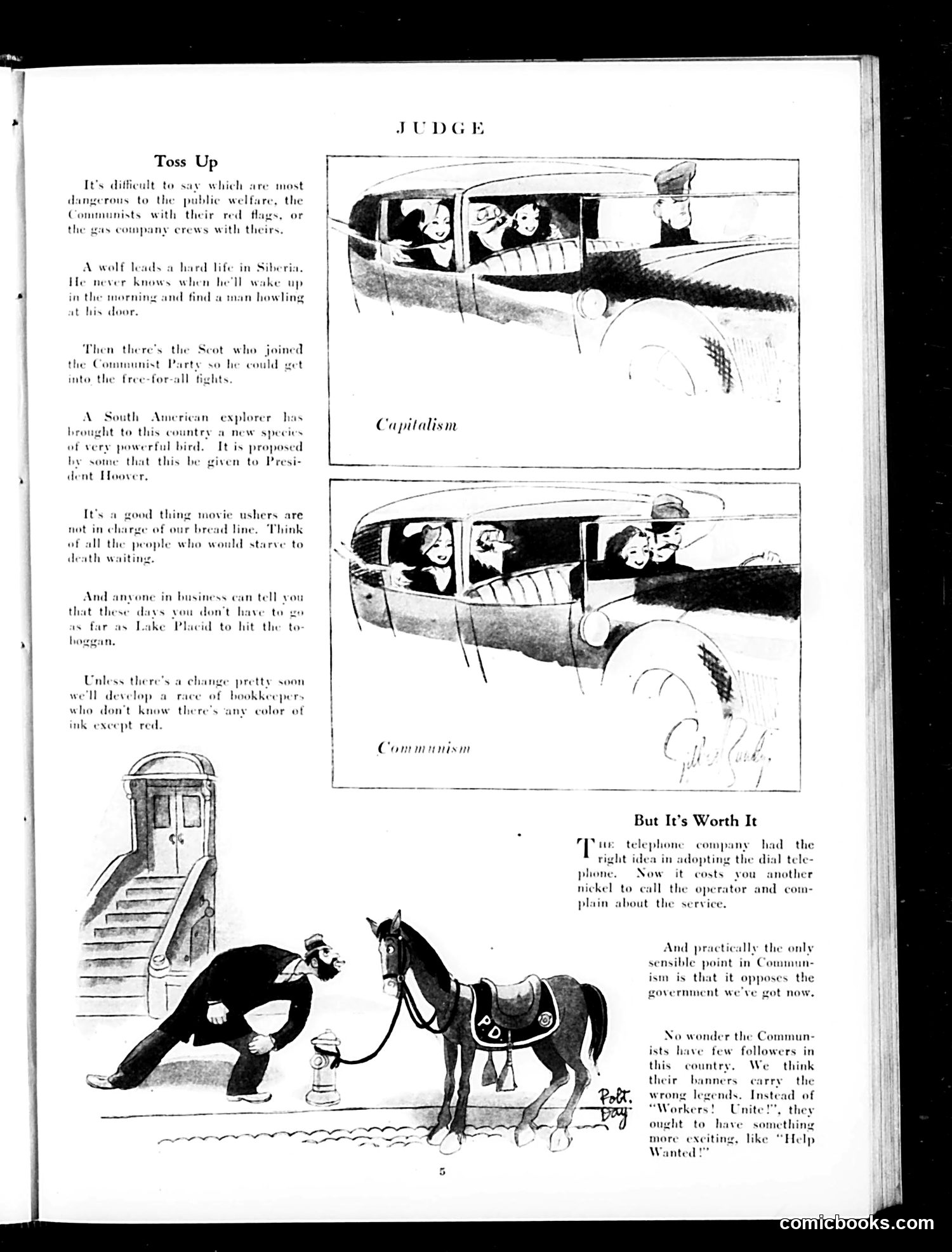
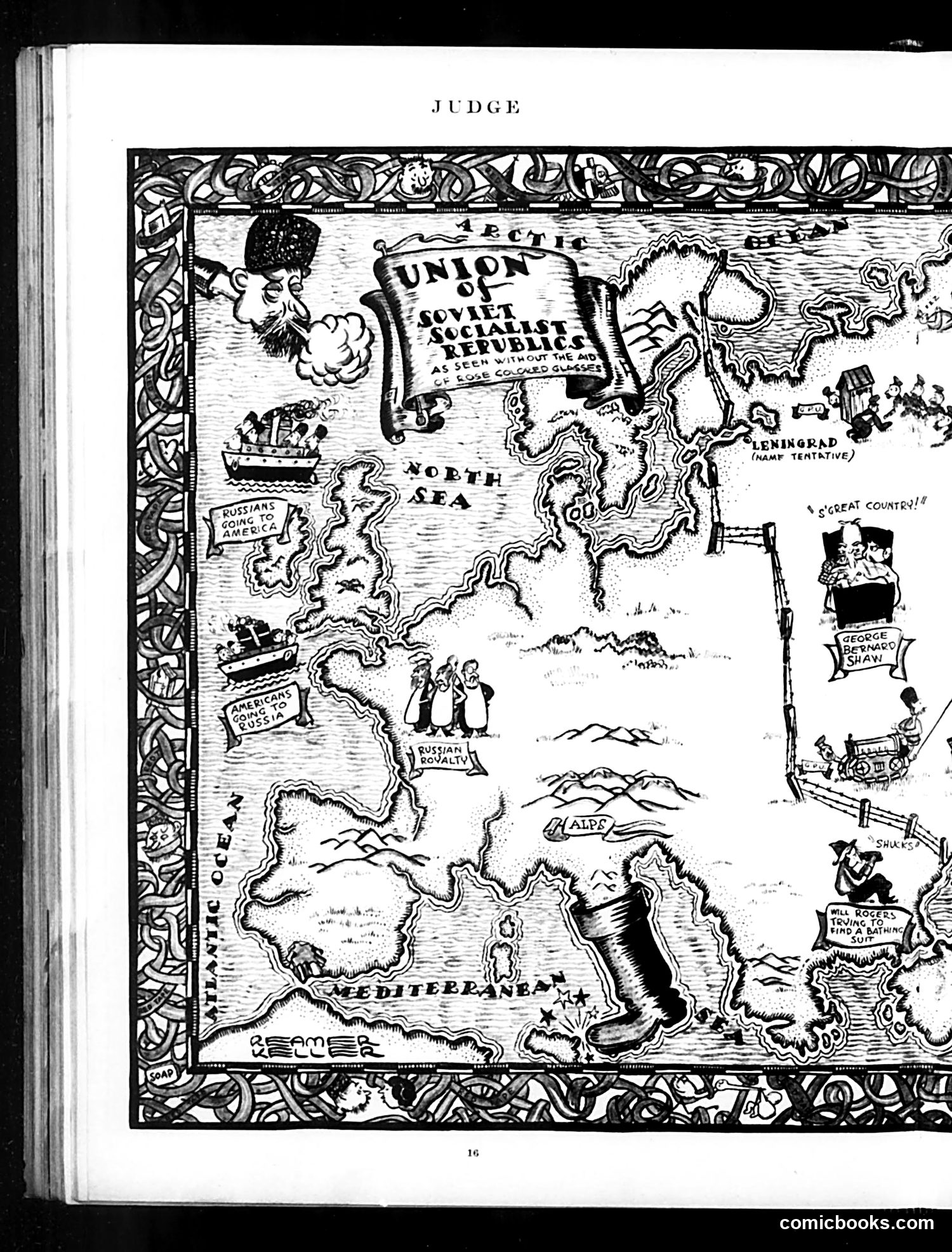
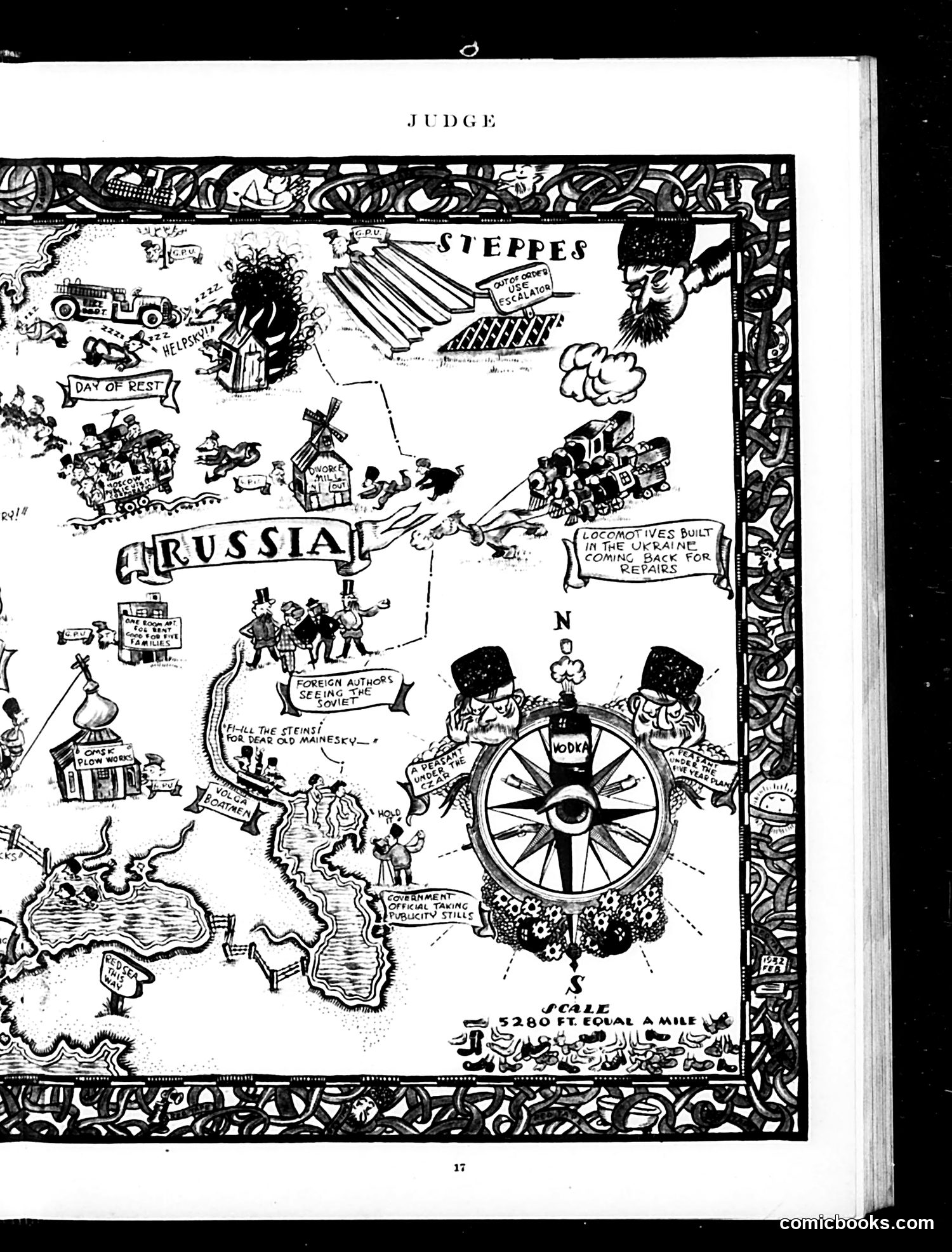
# Analysis of Judge Page This page satirizes the ideological conflict between capitalism and communism, likely from the 1920s-30s Red Scare era. **Top cartoons:** Two panels show a car labeled "Capitalism" (top) versus "Communism" (bottom), each carrying passengers toward different fates—suggesting both systems have dangerous consequences. **"Toss Up" section:** Text mocks various threats to American stability: Siberian wolves, communists infiltrating politics, dangerous exotic birds, movie ushers' power, and business corruption. The tone is deliberately absurd, treating all as equal dangers. **Bottom cartoon:** A man lies exhausted beside a horse, illustrating the text's point about telephone company dial adoption—framed as citizens being exploited by corporate fees. Overall, the page uses exaggeration and dark humor to dismiss communist ideology while simultaneously criticizing American capitalism's excesses.
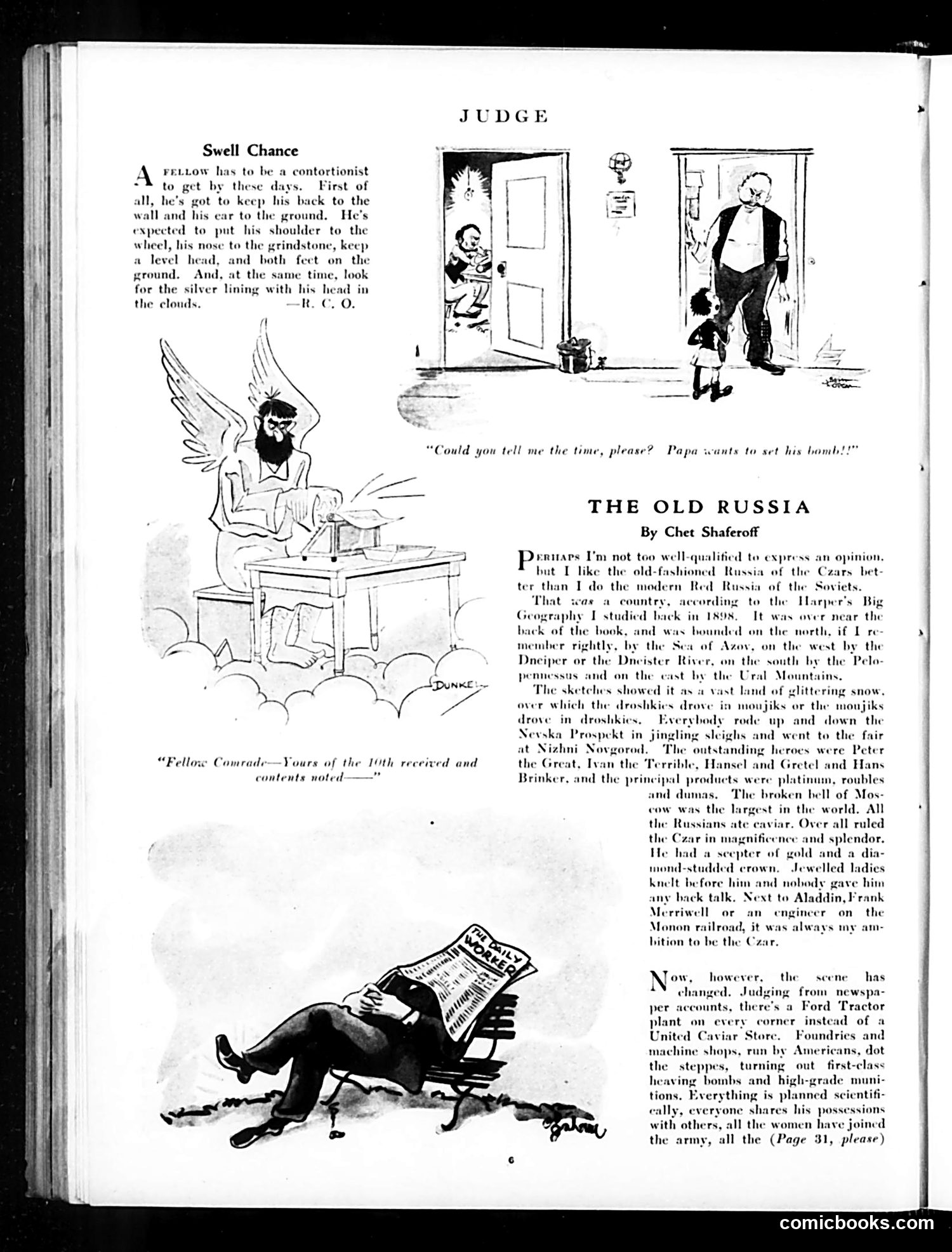
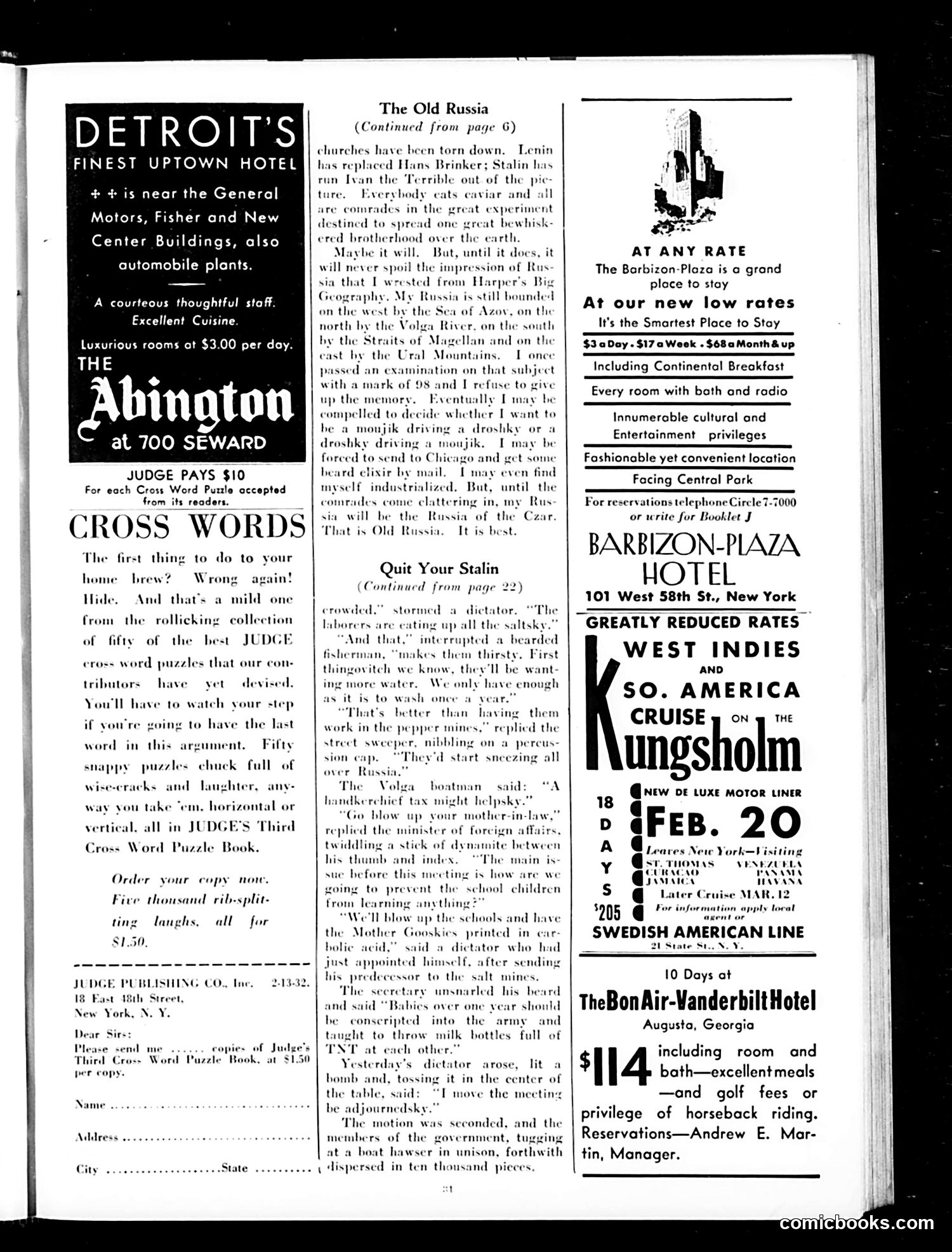
# Analysis of Judge Magazine Page **"Swell Chance" cartoon (top):** Depicts a contortionist attempting an impossible physical feat—bending backward to touch his head to a wheel while keeping feet grounded. The caption's reference to "silver lining" suggests this mocks someone pursuing an unrealistic goal or false hope. **"The Old Russia" article (by Chet Shaferoff):** Contrasts pre-Soviet Russia under the Czars with modern Soviet Russia. Shaferoff nostalgically describes imperial Russia's grandeur—the Czar's splendor, wealth, and hierarchical society—while lamenting modern Soviet industrialization (Ford Tractor plants, factories) where "everyone shares possessions" and "all the women have joined the army." The piece satirizes Soviet communalism as a loss of the romantic imperial past.
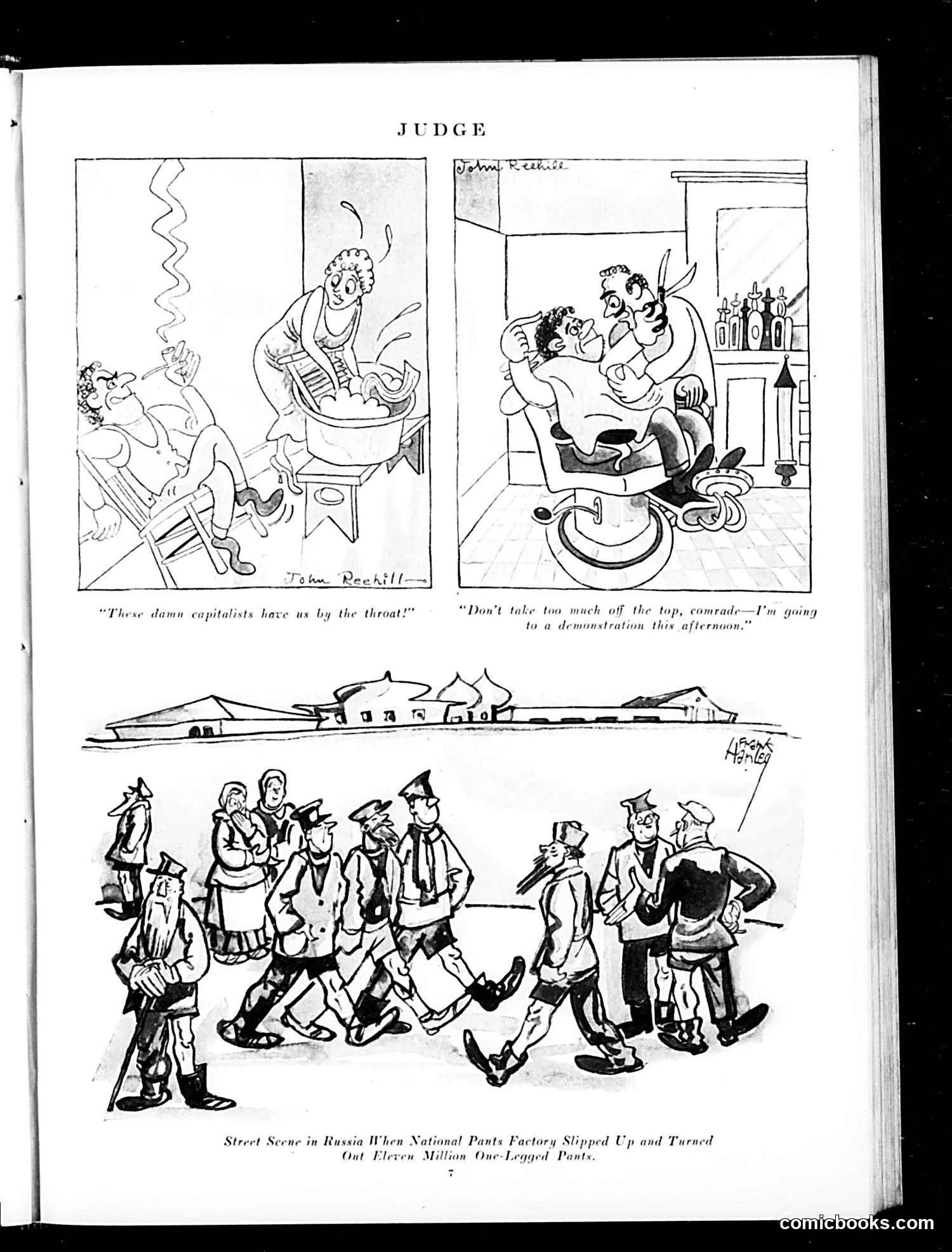
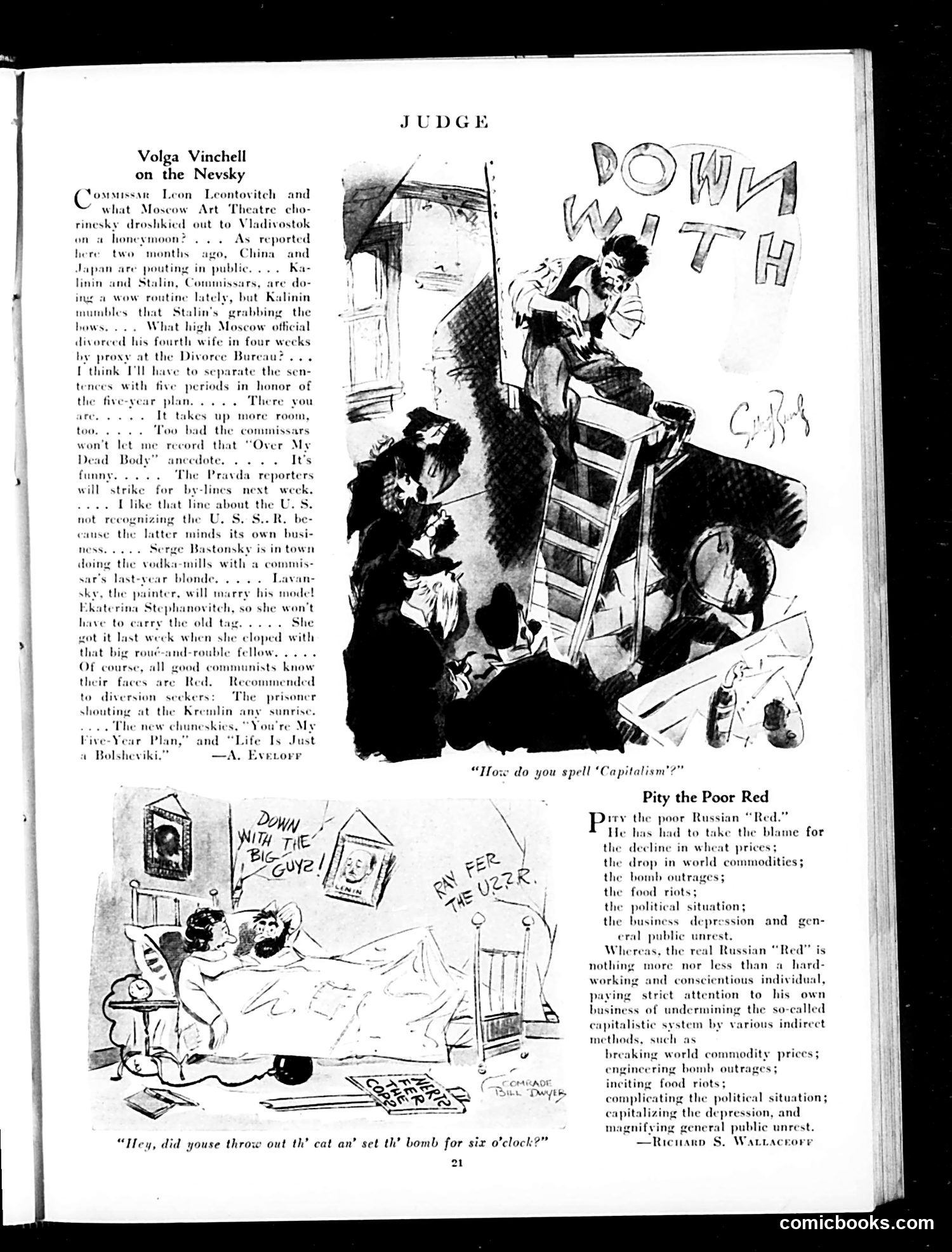
# Political Cartoon Analysis: Judge Magazine Page This page contains three satirical cartoons labeled "JUDGE." The top two cartoons appear to reference capitalist exploitation and political demonstrations, with captions about "damn capitalists" and attending "a demonstration this afternoon." The bottom cartoon, titled "Street Scene in Russia When National Pants Factory Slipped Up and Turned Out Eleven Million One-Legged Pants," satirizes Soviet industrial inefficiency and communist centralized planning. It depicts Russian civilians in chaotic confusion over a massive factory error—producing one-legged pants instead of proper clothing. This mocks both Soviet manufacturing failures and the absurdity of rigid communist bureaucracy where such enormous mistakes could occur without correction. The cartoon reflects American Cold War-era skepticism toward Soviet competence and communist economic systems.
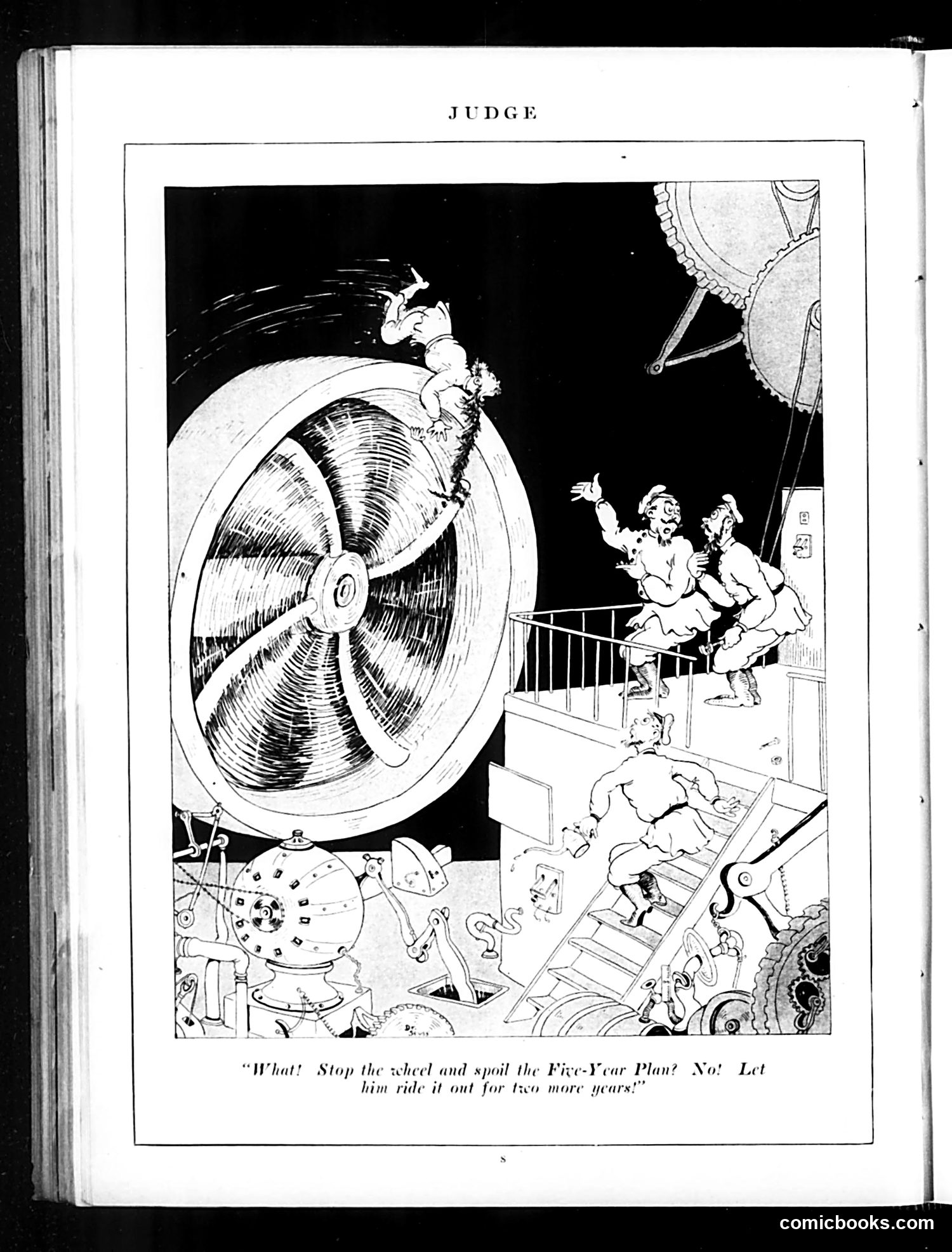
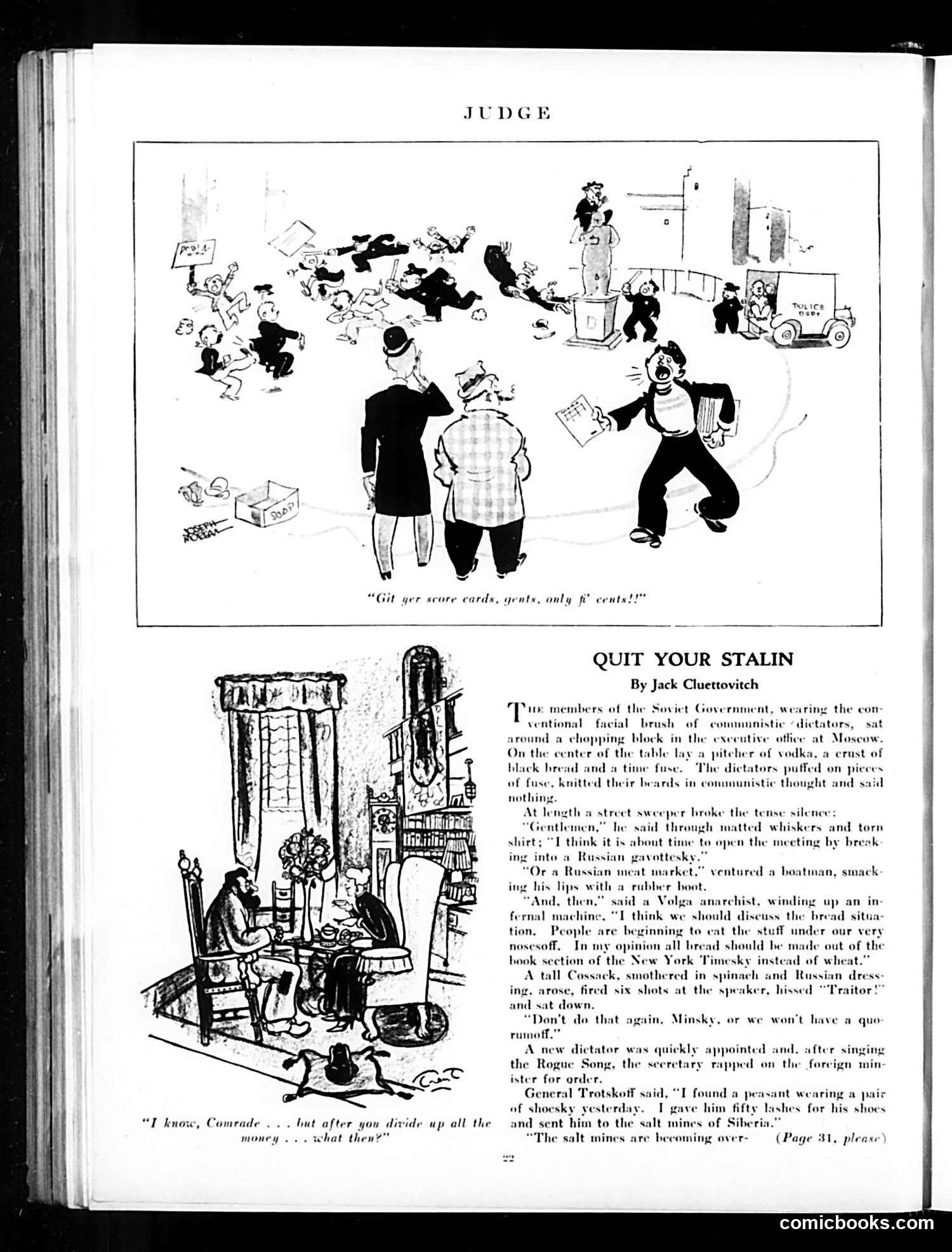
# Political Cartoon Analysis This Judge magazine cartoon satirizes Soviet leadership, likely from the early 1930s. The massive wheel represents Stalin's "Five-Year Plan"—the Soviet Union's ambitious industrial development program. The figures appear to be Communist leaders callously allowing a person to continue being ground by the wheel for two additional years rather than stopping it to save him. The satire attacks the Five-Year Plan's human cost and the leadership's indifference to suffering caused by their policies. The exaggerated mechanical imagery emphasizes how the plan treated people as disposable cogs. This reflects American anti-Communist sentiment and criticism of Stalin's brutal industrialization, which caused widespread famine and hardship among Soviet citizens during this period.
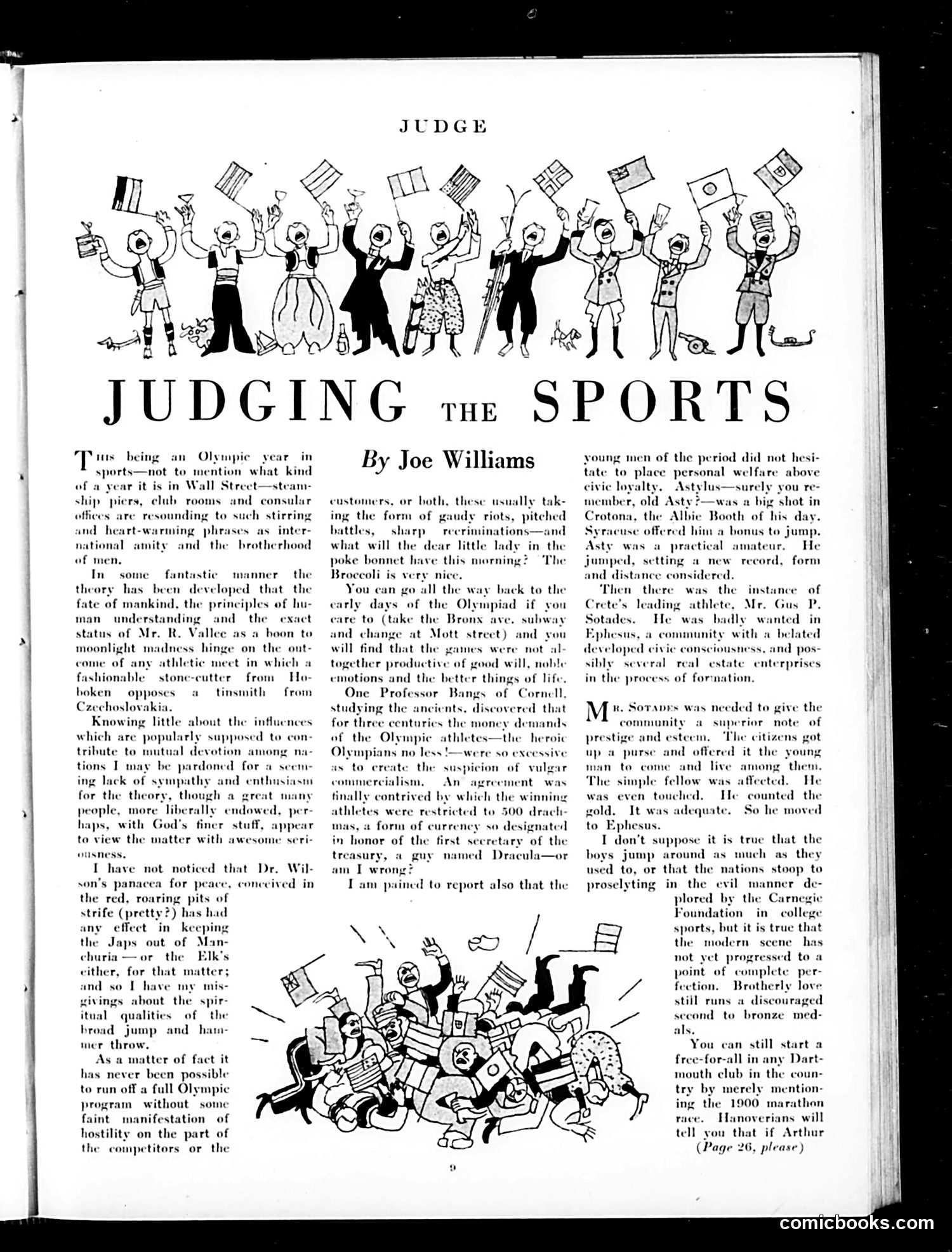
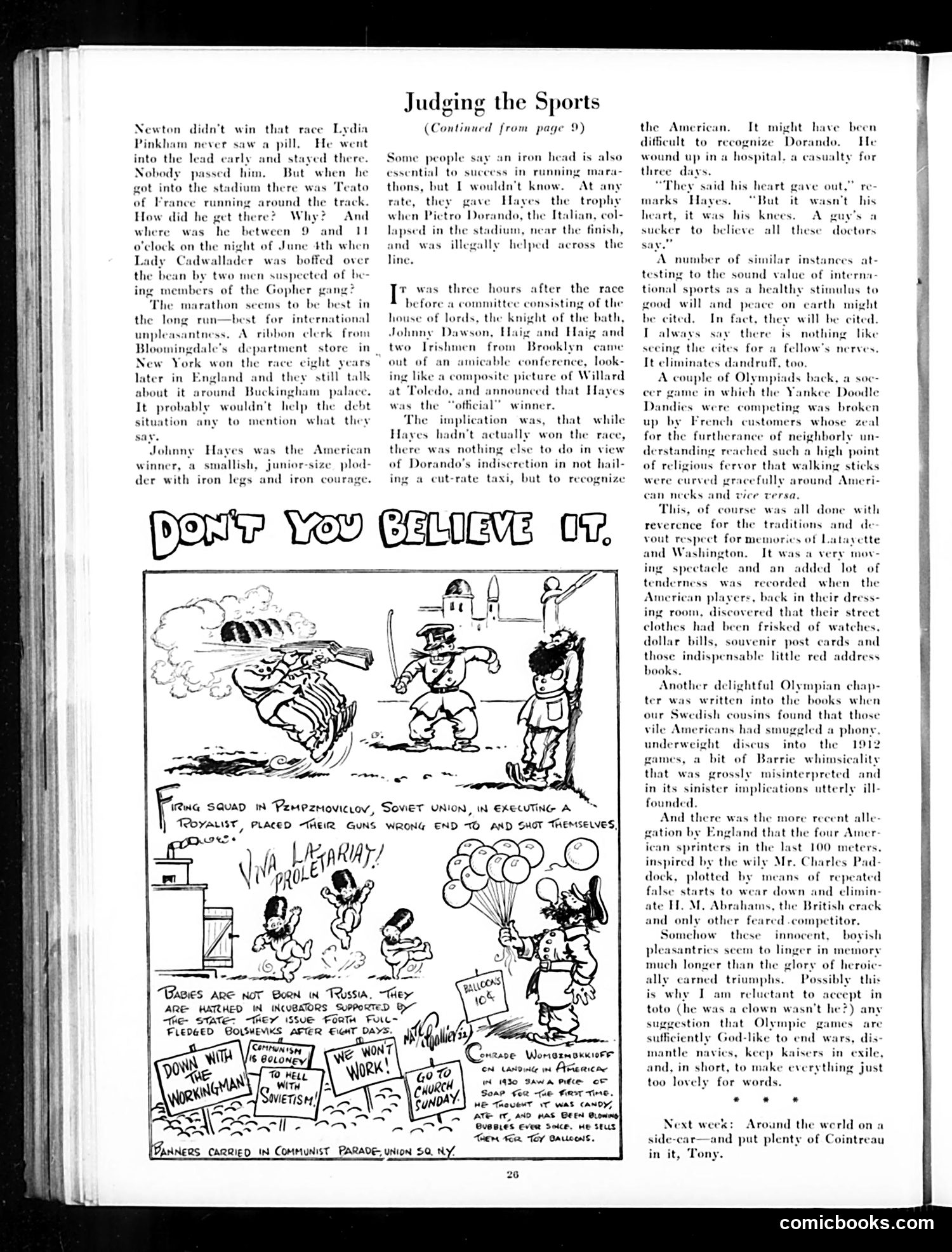
# Judging the Sports: What This 1928 Cartoon Means This is a satirical article by Joe Williams about the 1928 Olympics, illustrated with two cartoons showing jubilant athletes waving flags and, below, a chaotic pile of brawling competitors. **The satire:** Williams mocks the widespread belief that Olympic competition promotes "international amity and the brotherhood of men." He argues this is naive—the ancient Olympics were equally commercialized and contentious. He cites "Professor Bangs of Cornell" discovering that ancient Olympic athletes demanded excessive prize money (500 drachmas), and communities bribed athletes with bonuses to compete for them (citing a fictional "Dracula" as treasury secretary and an athlete named "Asty"). **The point:** Modern nations haven't truly "progressed" morally through sports—athletes remain mercenary, communities still compete for prestige through athletic recruitment, and hostility persists. The cartoons visually reinforce that Olympic competition produces chaos, not unity. Williams suggests linking national virtue to athletic prowess is foolish. This reflects 1920s skepticism about sports' redemptive claims and competitive nationalism.
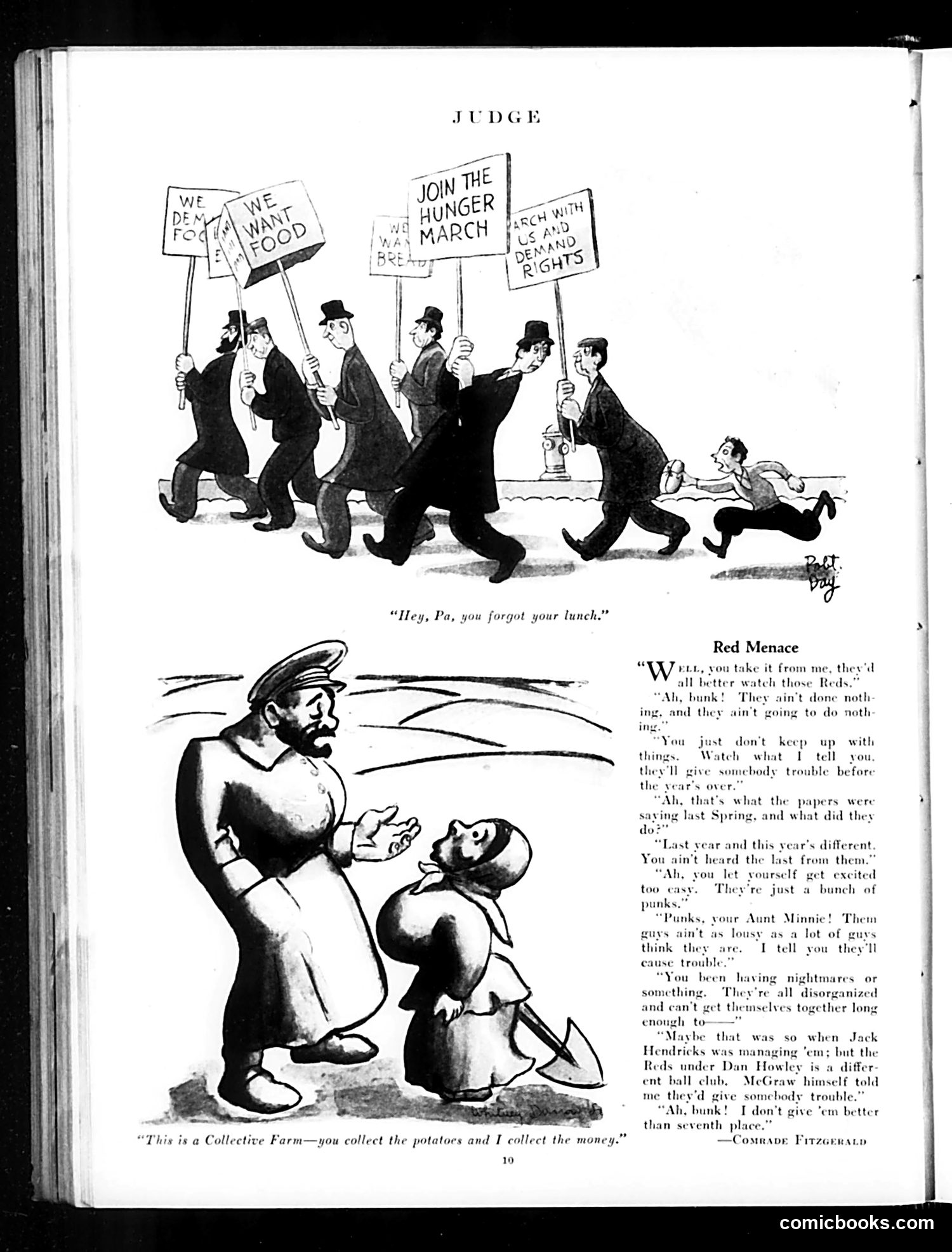
# Political Cartoon Analysis: "Red Menace" This page contains two distinct pieces of satire: **Top cartoon**: Depicts men in formal dress carrying protest signs ("We Demand Food," "Join the Hunger March," "Teach Land and Rights") while marching past a judge. One small figure has apparently forgotten his lunch. The satire mocks radical political movements and protesters, suggesting their grievances are trivial or hypocritical. **Bottom section**: A dialogue between two figures debating the Cincinnati Reds baseball team's prospects under manager Dan Howley, contrasting them unfavorably to when Jack Hendricks managed the team. One character dismissively predicts "seventh place." The page's title, "Red Menace," creates intentional wordplay—conflating the baseball "Reds" with Communist "Reds" (the Soviet threat preoccupying America in this era). This satirizes both contemporary anti-Communist anxiety and sports fandom as equally overwrought concerns. The humor lies in treating baseball predictions with the same dramatic urgency as political fears.