
Judge, 1932-02-13 · page 20 of 36
Judge — February 13, 1932 — page 20: what you’re looking at
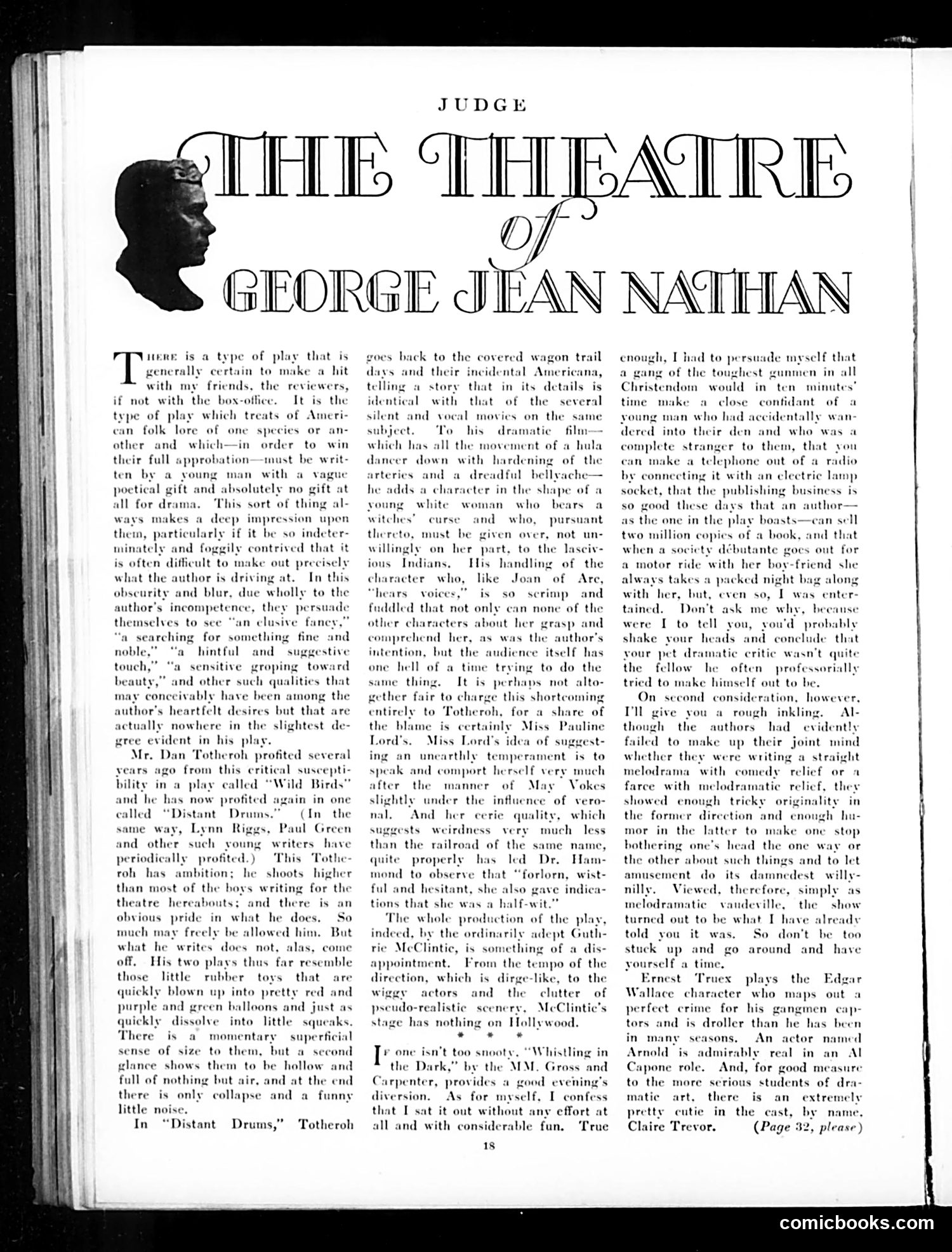
A restored page from Judge, 1932-02-13. Page through the whole issue in the reader above.
📄 Transcribed text from this page (OCR, searchable)
Machine-transcribed from the original scan — historical spelling and the odd misread are preserved.
f tiene is a type of play that is T enerally certain to make a hit with my friends, the reviewers, if not with the box-otf It is the type of play which treats of Ameri- can folk lore of one species or an- other and which—in order to win their full ten a r—must be writ- yay man with a vague poetical gift and absolutely no gift at all for drar This sort of thing al- ways makes a deep impression upon them, particularly if it be so indeter- minately and foggily contrived that it is often difficult to make out precisely what the author is driving at. In this obscurity and blur, due wholly to the author's incompetence, they persuade themselves to see “an clusive fancy.” 1 searching for something fine and hintful) and su sensitive groping toward nd other such qualities that may conceivably have been among the author's heartfelt desires but that are actually nowhere in the slightest de- gree evident in his play. Mr. Dan Totheroh profited several years ago from this critical suscept bility in a play called “Wild Birds and he has now profited again in one called “Distant Drums.” (In the same way, Lynn Riggs, Paul Green and other such young writers have periodically profited.) This Tothe- roh has ambition; he shoots higher than most of the b theatre here stive beauty,” vs writing for the bouts; and there is an obvious pride in what he much may freely be allowed him. But what he writes does not, alas, come off, His two plays thus far resemble those little rubber toys that are quickly blown up into pretty red and purple and green balloons and just as quickly dissolve into little squeaks. There is es. So momentary superficial to them, but a second glance shows them to be hollow and full of nothing but air, and at the end there is only collapse and a funny little noise. In “Distant sense of si Drums,” Totheroh AN NACTIGIAN es back to the overed wagon trail days and their incidental American telling a story that in its details is identical with that of the several silent and vocal movies on the same subject. ‘To his dramatic — film which has all the movement of a hula dancer down with hardening of the arteries and a dreadful bellyacho— he adds a character in the shape of a young white woman who bears a witches’ curse and) who, pursuant thereto, must be given over, not un- willingly on her part, to the laseiv- ious Indians. His handling of the character who, like Joan of Are, “hears voices,” is so scrimp and ddled that not only can none of the about her grasp and comprehend her, as was the author's intention, but the a f other characters idience itself has one hell of a time trying to do the same thing. It is perhaps not alto- gether fair to charge this shortcoming entirely to Totheroh, for a share of the blame is certainly Miss Pauline Lord's. Miss Lord's idea of s st ing an unearthly temperament is to speak and comport herself very much after the manner of May Vokes slightly under the influence of vero- nal, And her eerie quality, which sugg sts. weirdness very much less than the railroad of the same name, quite. properly has led Dr. Ham- mond to observe that “forlorn, wist- e indic If-wit.” The whole production of the play, indeed, by the ordinarily adept Guth- rie McClintic, is something of a dis- appointment. From the tempo of the direction, which is dirge-like, to the wiggy actors and the clutter of pseudo-realistie scenery, McClintic’s stage has nothing on Hollywood. eos 6 at she was a iG one isn't too snooty, “Whistling in the Dark,” by the MM. Gross and Carpenter, provides « diversion. 1 evening’ As for myself, I confess that I sat it out without any effort at all and with considerable fun. True 18 enough, T had to persuade myself that a gang of the toughest gunmen in all Christendom would in’ ten minutes’ time make dant of a young man who had accidentally wan a close co dered into their den and who was a complete stranger to them, that you can make a telephone out of a rac by conneeting it with an cleetric lamp socket, that the publishing business is so good these days that an author— as the one in the play boasts—can sell two million copies of a book, and that when a society débutante goes out for a motor ride with her boy-friend she always takes a packed night bag along with her, but, even so, I was enter- tained. Don't ask me why, beeanse were I to tell you, you'd pr e your he vably 1s and conelude that your pet dramatic critic wasn't quite the fellow he often professorially tried to make himself out to be. On second y onsideration, however, I'll give you a rough inkling. Al- though the authors 1 evidently failed to make up their joint mind whether they were writing a straight melodrama with comedy relief or a farce with melodramatic showed enough tricky originality in the former direction and enough hu- mor in the latter to ud the one way or the other about such things and to let amusement do its damnedest willy- nilly. Viewed, therefore, simply as melodramatic vaudeville, the show turned out to be what [he already told you it was. So don't be too stuck up and yourself a tim Ernest. Truex plays the Edgar Mace character who maps out a lief, they one stop bothering one’s h o around and have Ws perfect crime for his gangmen cap- nd is droller than he has been many seasons, An actor named Arnold is admirably real in an Al yone role. And, for good measure to the more serious students of dra- matic art, there is an extremely pretty cutie in’ the cast, by name. Claire Trevor. (Page 32, please) ft comicbooks.com