
Judge, 1932-02-13 · page 26 of 36
Judge — February 13, 1932 — page 26: what you’re looking at
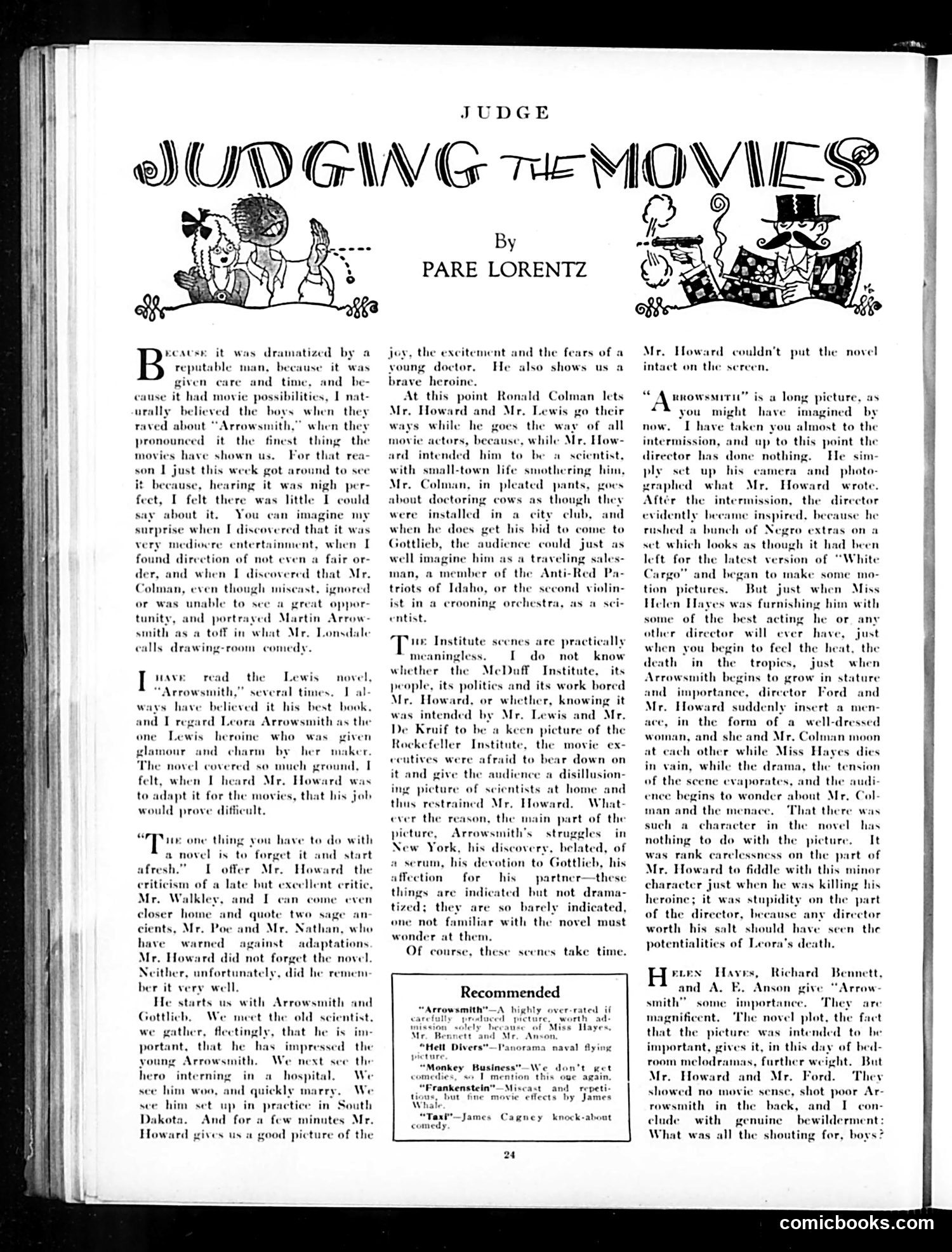
A restored page from Judge, 1932-02-13. Page through the whole issue in the reader above.
📄 Transcribed text from this page (OCR, searchable)
Machine-transcribed from the original scan — historical spelling and the odd misread are preserved.
| J | | | } 1 | | keause it was dramatized by a reputable man, because it was given care and time, and be- ause it had movie possibilities, I nat- Hy believed the boys when they ed about “Arrowsmith,” when they pronounced it the finest thing the movies have shown us. For that rea- mn I just this week got around to s because, hearing it was nigh per- feet, I felt there was little 1 could y about it, You can imagine my surprise when I discovered that it was very medivere entertainment, when I found direction of not a fair or- der, and when [ discovered that Mr. Colman, even though miseast, ignored or was unable to see a great oppor- tunity, and portrayed Martin Arrow- smith as a tof in what Mr. cally drawing-room comedy. I Have read the Lewis novel, “Arrowsmith,” several times. 1 al ieved it his best book. and I regard Leora Arrowsmith as the Lewis heroine who given ur and moby her maker. novel covered so much ground, I » When IT heard Mr. Howard was pt it for the movies, that his job would prove difficult. Lonsdale ways have be was 4 ue one thir on have te do with a novel is to forget it and start afresh.” [offer Mr. Howard the criticism of a late but excellent critic. Mr. Walkle: nd Iocan come pser home and quote two s: ents, Mr. Poe and Mr. Nath: have ward did . unfortur ber it very well. He starts us with Arrowsmith and Gottlich, We meet the old sei we her, fleetin that he is’ im- portant, that he impressed the young Arrowsmith. We next sce the hero interning in a hospital. We sce him woo, and quickly marry. We see him set up in practice in’ South Dakota. And for a few minutes Mr. Howard gives us a good picture of the JUDGE UDG MG THE™! By PARE LORENTZ joy, the excitement and the fears of a young doctor. brave heroine. At this point Ronald Colman. lets Mr. Howard and Mr. Lewis go their ways while he of all movie actors, | Mr. How- ard intended him to be a se with small-town life smothering him, Mr. Colman, in pleated pants, goes about doctoring cows as though they were installed in a city club, and when he does get his bid to come to Gottlieb, the audience could just as well imagine him as a traveling sales- man, a member of the Anti-Red Pa- triots of Idaho, or the second violin- ist ii entist. He also shows us a oes the w ause, While ist. a crooning orchestra, as a. sei- ur Institute scenes are practically meaningless. [I do not know whether the McDuff Institute, its people, its politics and its work bored Mr. Howard, or whether, knowing it was intended by Mr. Lewis and Mr, De Kruif to be a keen picture of the Rockefeller Institut: vcutives were afraid to bear down on it and give the audience a disillusion- ing picture of scienti the movie ex- home and rd, What- ever the reason, the main part of the picture, Arrowsmith’s struggles in New York, his discovery. belated, of a serum, his devotion to Gottlieb, his affection for his partner—thesc things are cated but not drama- tized; they one not fam thus rest are \ r with the novel must wonder at them. OF course, these scenes take time. Bens Hell Divers” picture Monkey Business” Hi T menti Frankenstein’ ast and repel jects by James Taxt"—James Cagney knock-about 24 OV IS \A Mr. Howard couldn't put the novel intact on the sereen, “A mnowsstrrn” isa long picture, as you might have imagined by I have taken you almost to the intermission, and up to this point the director has done nothing. He sim- ply set up. his and pho! graphed what Mr. Howard After the intermission, the director evidently became inspired, beeause he rushed a bunch of Negro extras ona set which looks as though it had been left for the latest version of “White Cargo” and began to make some mo- tion pictures. But just when Miss Helen Hayes was furnishing him with some of the best acting he or any how, ne wrote, other director will ever have, just when you begin to feel the heat, the death in’ the tropies, just. when Arrowsmith begins to grow in stature and importance, director Ford and Mr. Howard suddenly insert at form of a and she \r h other while Miss Hayes die: in vain, while the draw of the sce ence begins to wonder about Mr. Col- man and the me That there was such a character in’ the novel nothing to do with the picture. It was rank carelessness on the part of Mr. Howard to fiddle with this minor aracter just when he was killing his heroine; it was stupidity on the part of the director, because any di worth his salt should seen the potentialities of Leora’s death, Hs Haves, Richard and A. EB. Anson give “Arrow- h” some importance. ‘They are ificent. The novel plot, the fact the picture was intended to be important, 4 of bed- room melodr: . further weight. But n> ace, in’ the well-dressed has tor Bennett, Mr. Howard and Mr. Ford. Thev showed no movie sense, shot poor Ar- 1 in the back, and I with genuine bewilderment: was all the shouting for, bos comicbooks.com