A complete issue · 36 pages · 1931
Judge — November 21, 1931
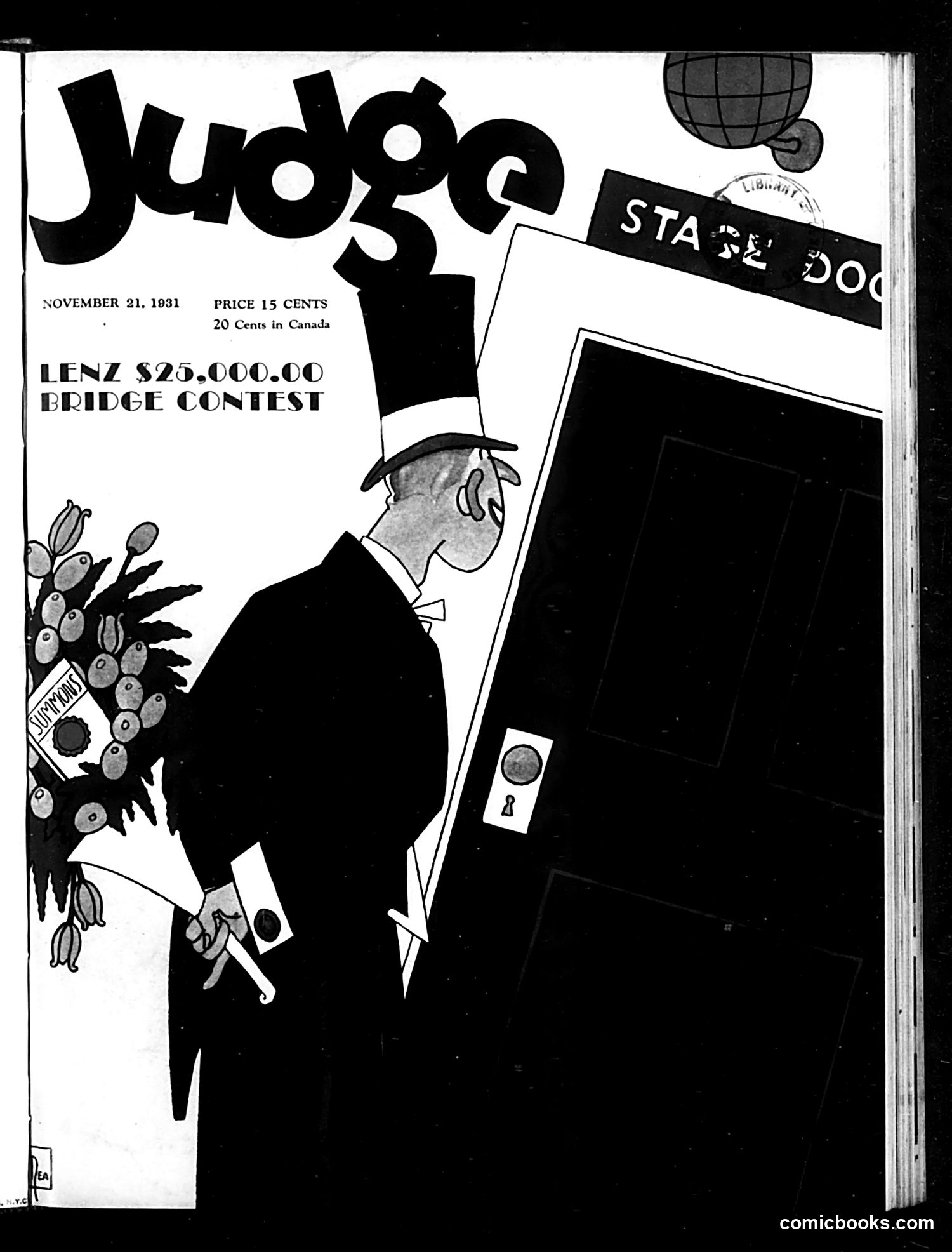
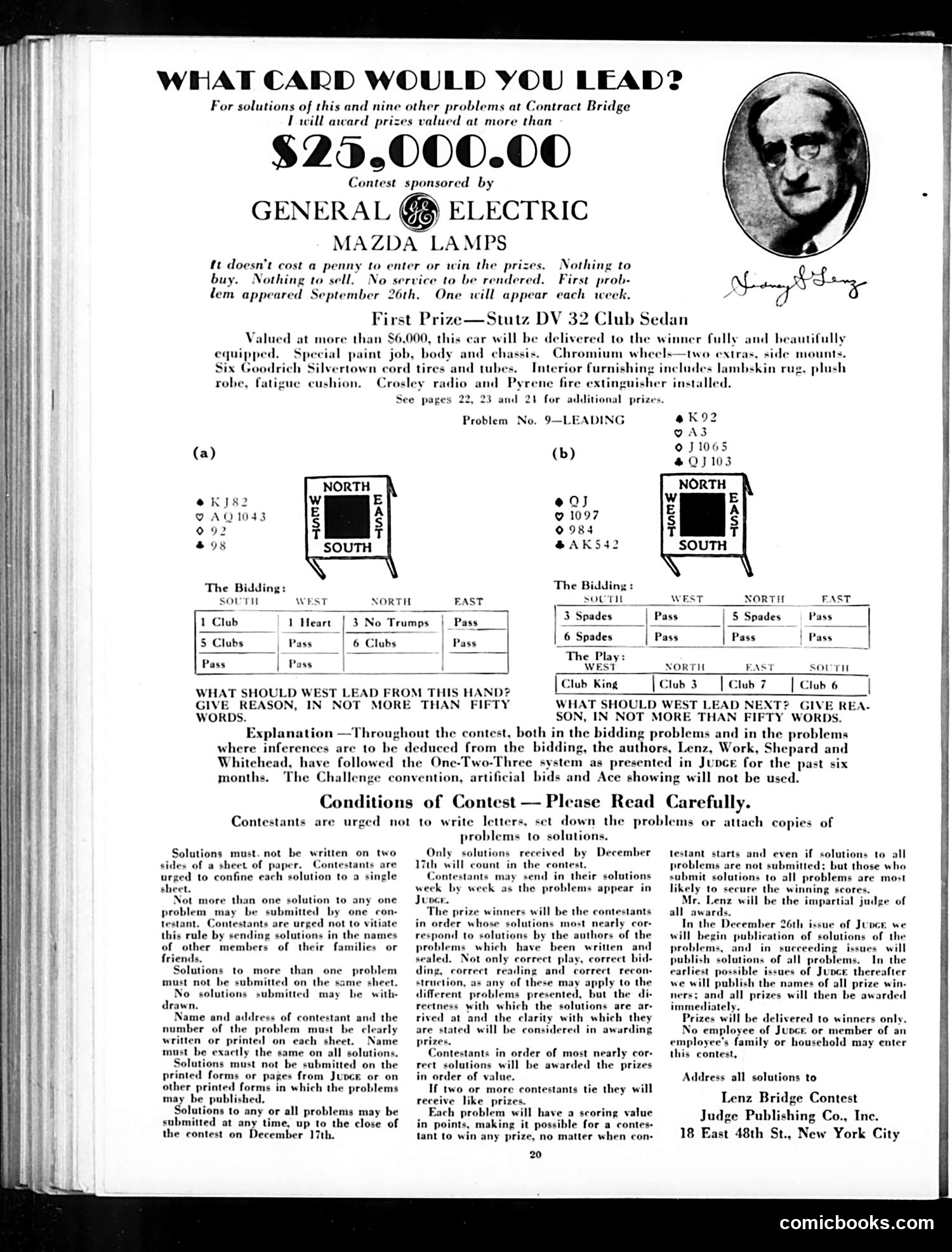
# Judge Magazine Cover Analysis - November 21, 1931 This cover advertises a **Lenz $25,000 Bridge Contest**, referencing what appears to be a prominent bridge-building or engineering competition of that era. The illustration shows a well-dressed man in formal attire holding flowers, standing before a large door marked "State Door" (or similar). The art style and composition suggest romantic or comedic anticipation—the man appears to be about to enter or propose something significant. The satire likely plays on the contrast between the substantial prize money ($25,000 during the Depression) and either the difficulty of winning it or the absurdity of the contest's requirements. Without additional context about the specific Lenz competition, the exact target of ridicule remains unclear, though the formal dress and flowers suggest mock-gallant behavior toward what may be a bureaucratic or challenging endeavor.
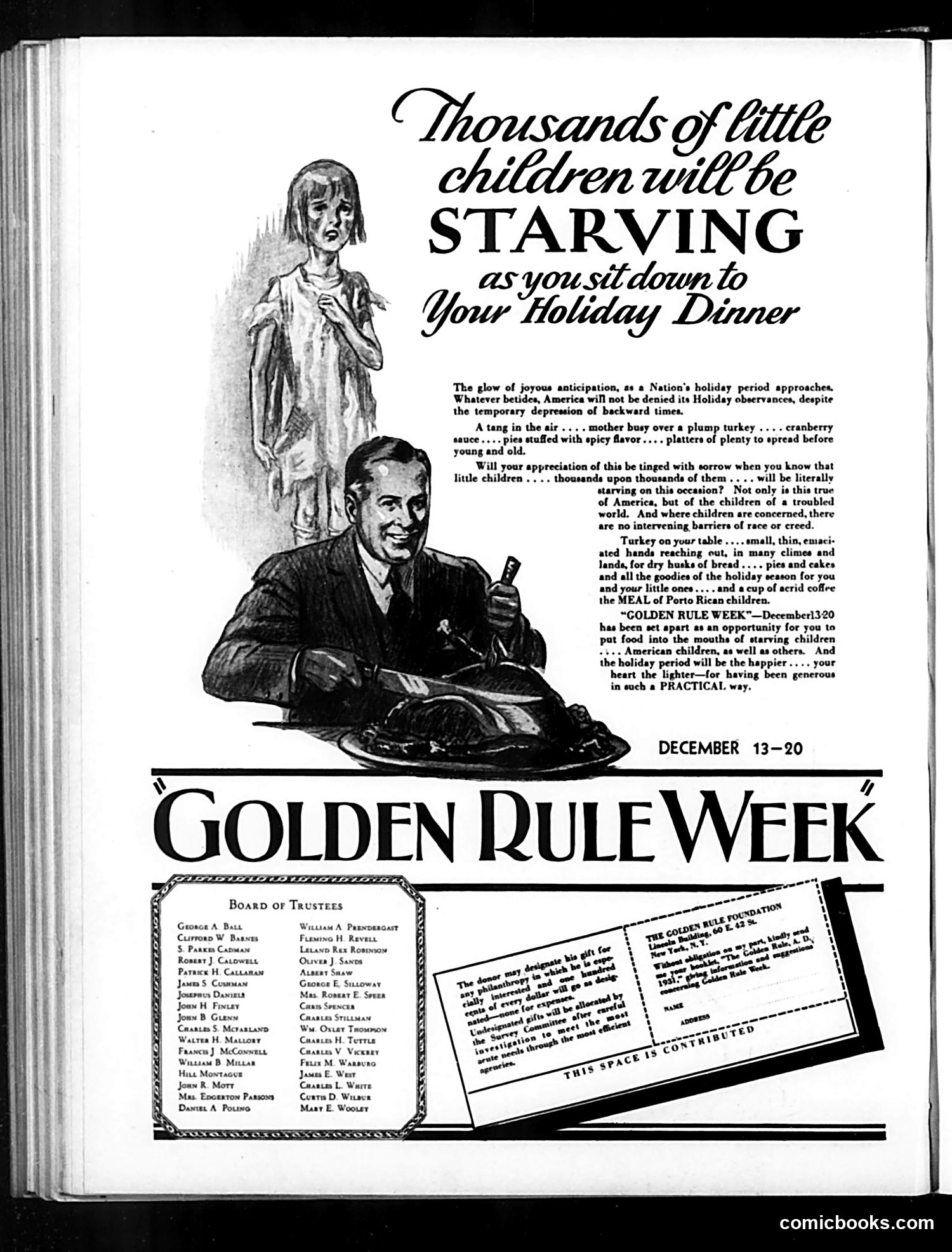
# "Golden Rule Week" Charity Appeal (Judge Magazine) This is a charity advertisement for "Golden Rule Week" (December 13-20), not political satire. The imagery deploys emotional persuasion: a starving child gazes at a well-dressed man enjoying a holiday dinner, juxtaposing wealth and deprivation. The appeal asks affluent readers to donate food to impoverished children during the holiday season, specifically mentioning "Porto Rican children" and "American children" in need. The "Golden Rule" reference invokes Christian charity ethics. The "Board of Trustees" lists prominent citizens, suggesting this is a legitimate civic organization. Rather than mocking anyone, the advertisement shames wealthy readers into charitable action by contrasting their plenty with others' hunger—a common philanthropic strategy of that era.
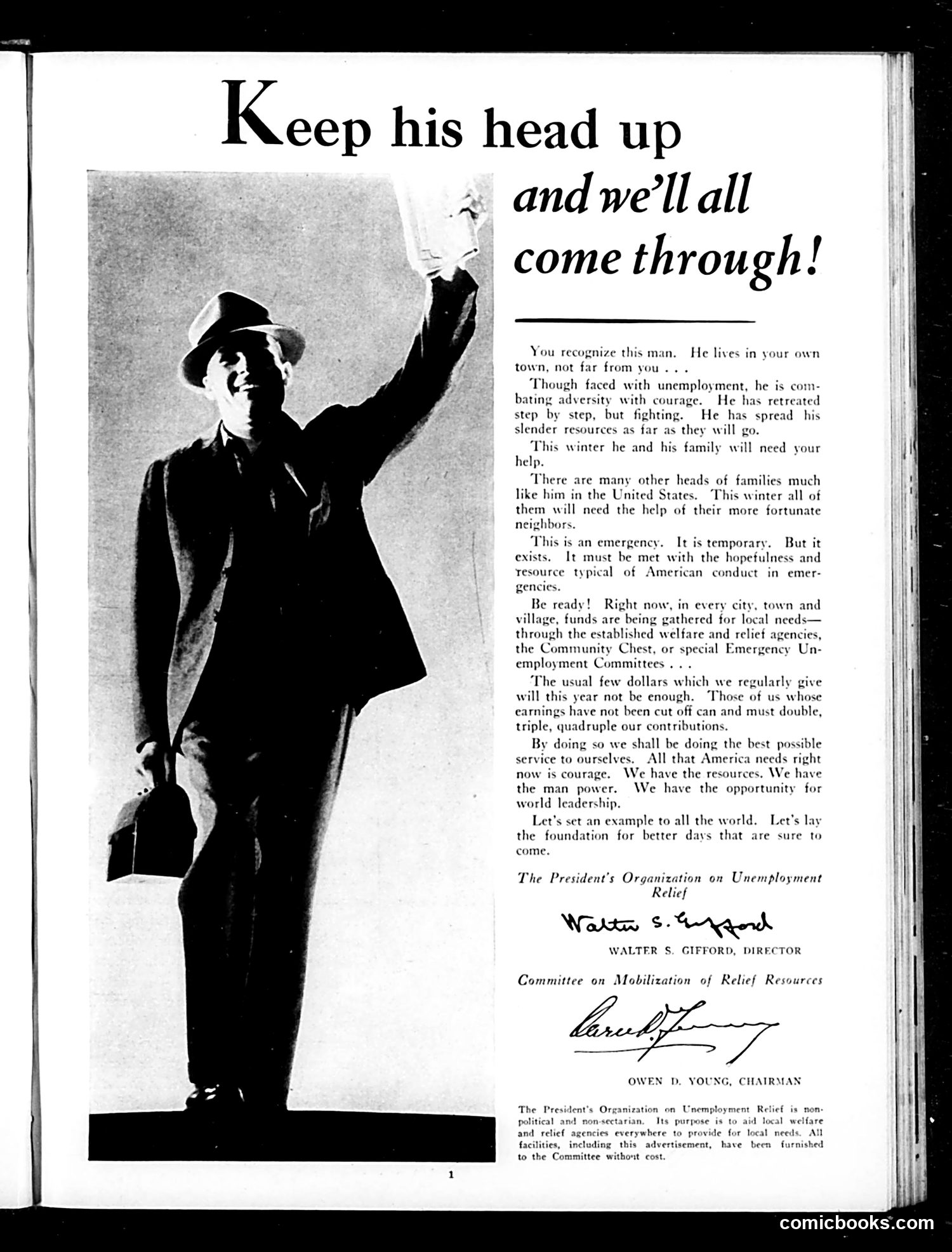
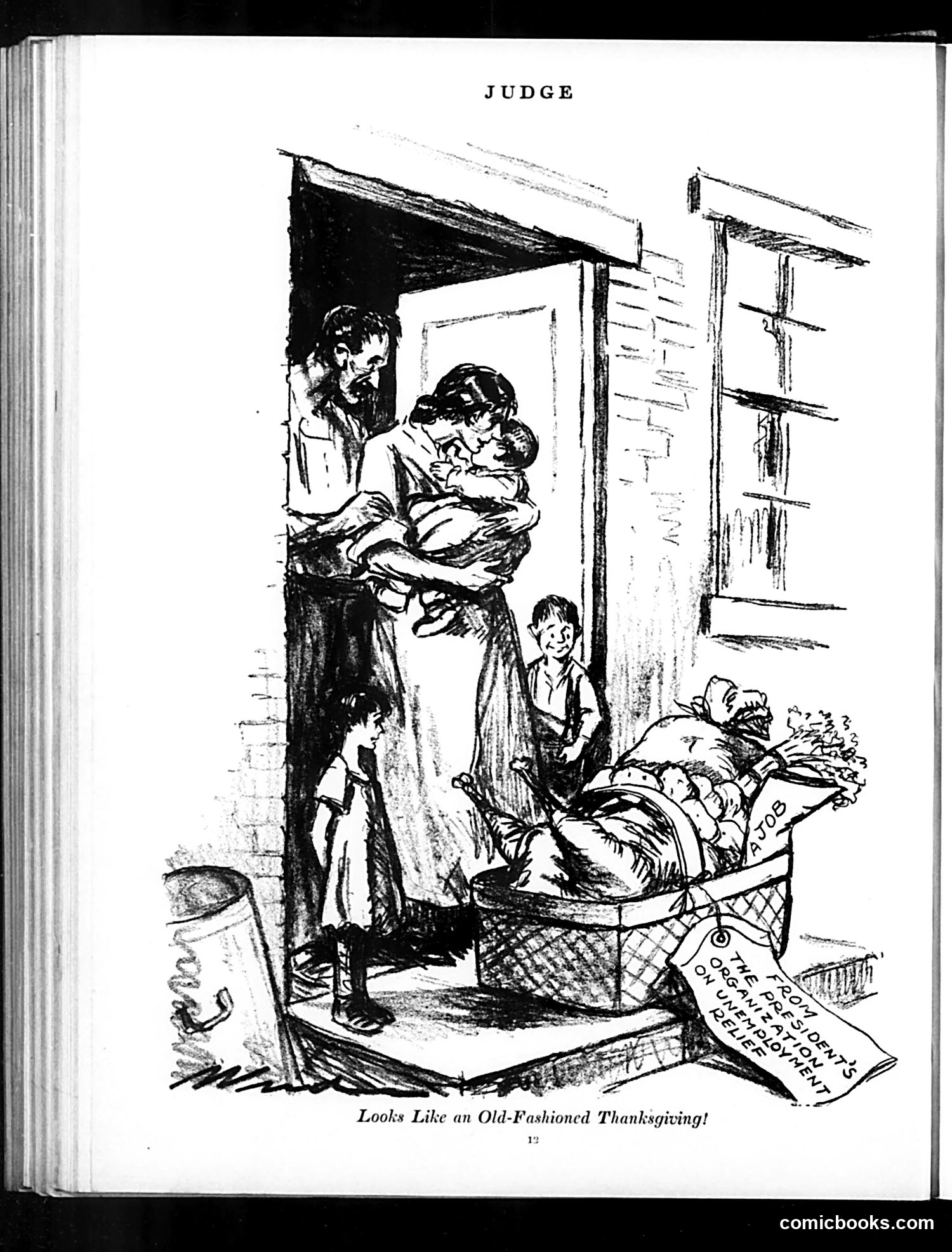
# Analysis This is not satire but rather a **sincere public service appeal**—unusual for Judge magazine, which typically featured political cartoons and humor. The page promotes **The President's Organization on Unemployment Relief**, signed by Walter S. Gifford (Director) and Owen D. Young (Chairman). It urges Americans to contribute money to help unemployed families during what appears to be the **Great Depression era**. The illustration shows an everyman figure with fist raised in determination—"Keep his head up and we'll all come through!" The text appeals to donors' sense of civic duty and American resilience, asking citizens to double or triple their usual charitable contributions for emergency local relief efforts. This represents Depression-era mobilization of private charitable giving before extensive federal welfare programs.
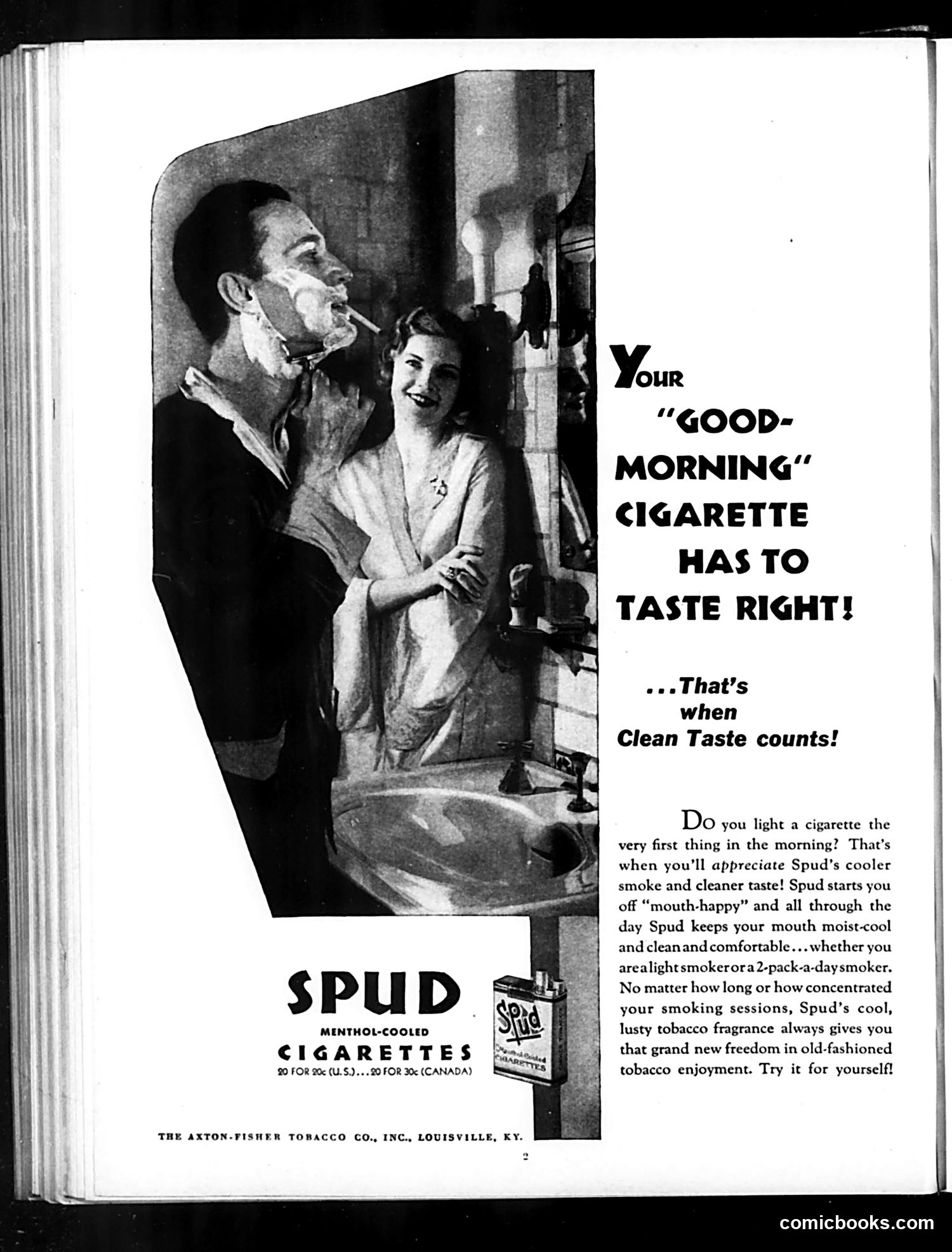
# Spud Cigarettes Advertisement This is a **straightforward cigarette advertisement**, not political satire or editorial content. It's from Judge magazine but functions as a paid commercial for Spud menthol-cooled cigarettes by Axton-Fisher Tobacco Co. (Louisville, Kentucky). The ad features a domestic morning scene—a man smoking while a woman smiles approvingly—to market cigarettes as a pleasant daily habit. The copywriting emphasizes "clean taste" and mouth freshness as selling points, claiming menthol provides "cooler smoke." By modern standards, this is striking primarily for its **casual normalization of morning smoking** and the gendered domestic framing that presents cigarettes as enhancing everyday life. The health claims ("clean," "comfortable") reflect pre-warning-label advertising standards, before cigarettes' serious health risks became public knowledge.
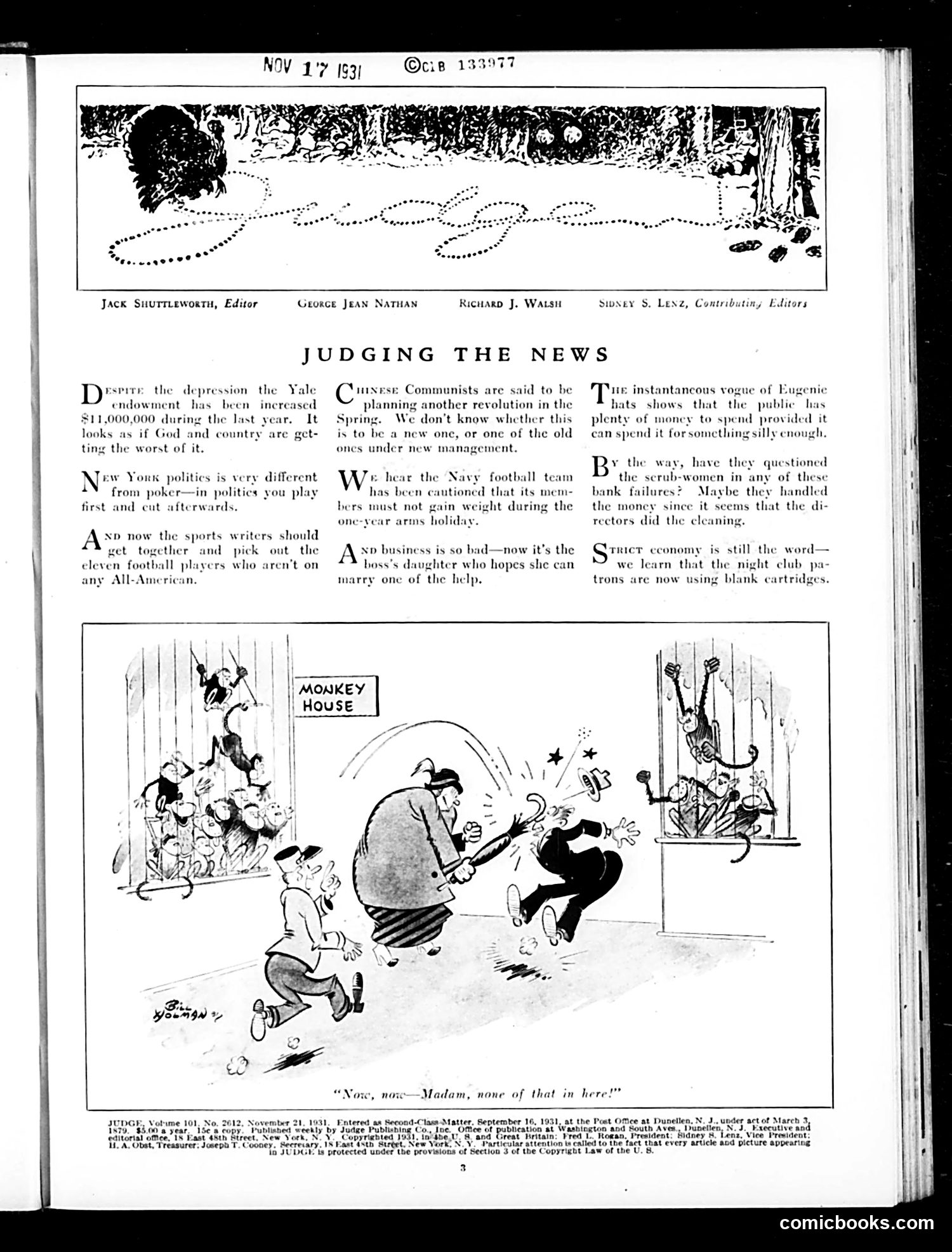
# "Judging the News" - November 17, 1931 This page satirizes current events through brief editorial commentary paired with a cartoon. The main cartoon depicts a "Monkey House" scene where a large man (representing authority/management) attempts to control chaos—monkeys swinging from windows and fixtures while a figure in black (likely representing labor or the working class) confronts him with a club. The caption reads, "Now, now—Madam, none of that in here!" The satire appears to reference labor unrest and economic turmoil during the Great Depression (1931). The monkey imagery suggests the chaos of workers' protests or strikes, while the authority figure's attempt at control represents management or government efforts to suppress dissent. The humor lies in portraying labor disputes as absurd "monkey" antics rather than legitimate grievances.
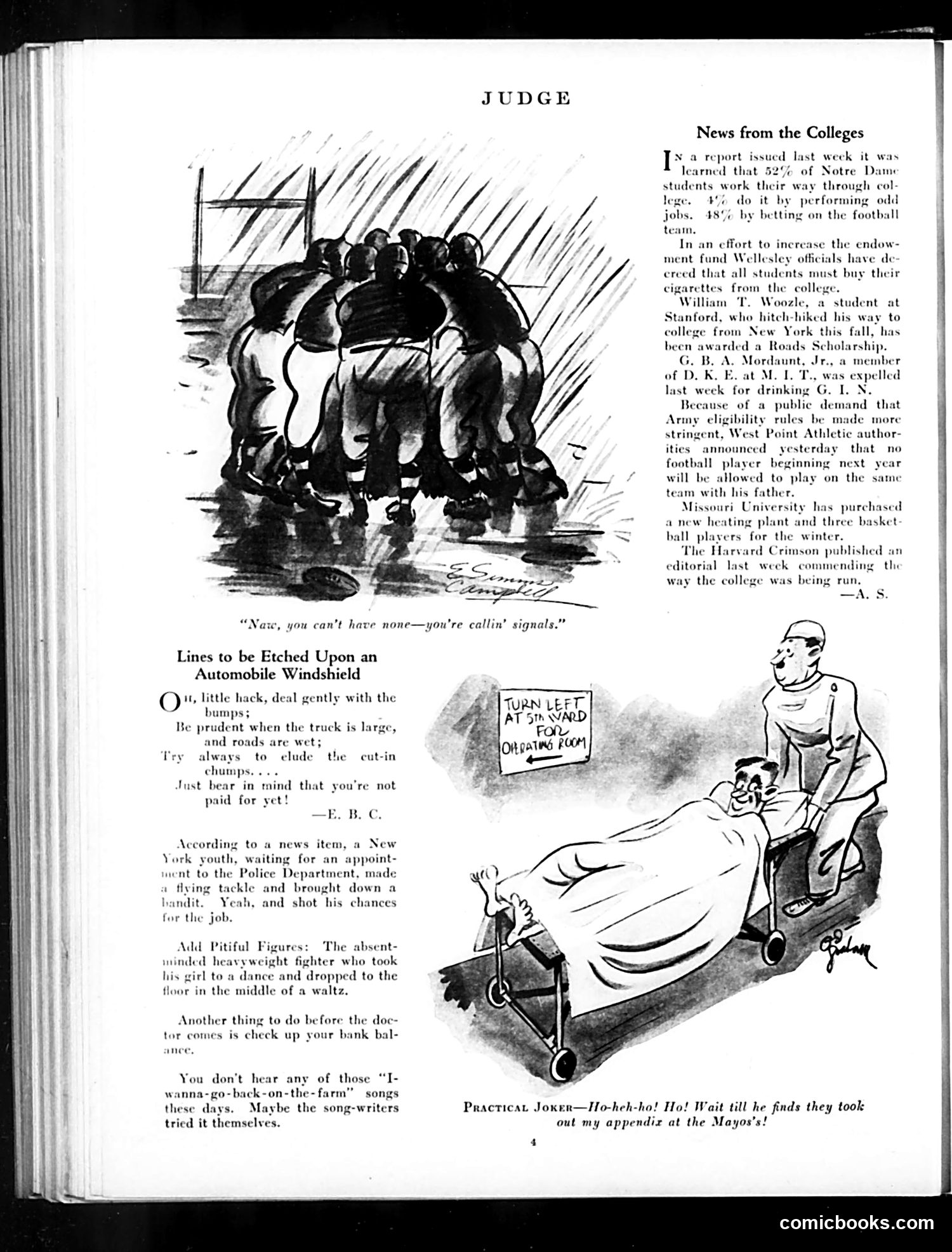
# Analysis of Judge Magazine Page The top cartoon depicts a football huddle with the caption "Now, you can't have none—you're callin' signals," satirizing college football's recruiting practices. The accompanying "News from the Colleges" section mentions Notre Dame students working their way through college, a Stanford hitch-hiker receiving a Roads Scholarship, and West Point enforcing rules against players having family on the same team—suggesting concerns about nepotism and commercialization in collegiate athletics. The lower cartoon, titled "Practical Joker," shows someone being transported on a wheeled stretcher with a sign reading "Turn left at 5th and Fox for operating room," mocking someone's misfortune as a cruel prank. The humor relies on the victim's confusion and delayed realization of the joke's severity.
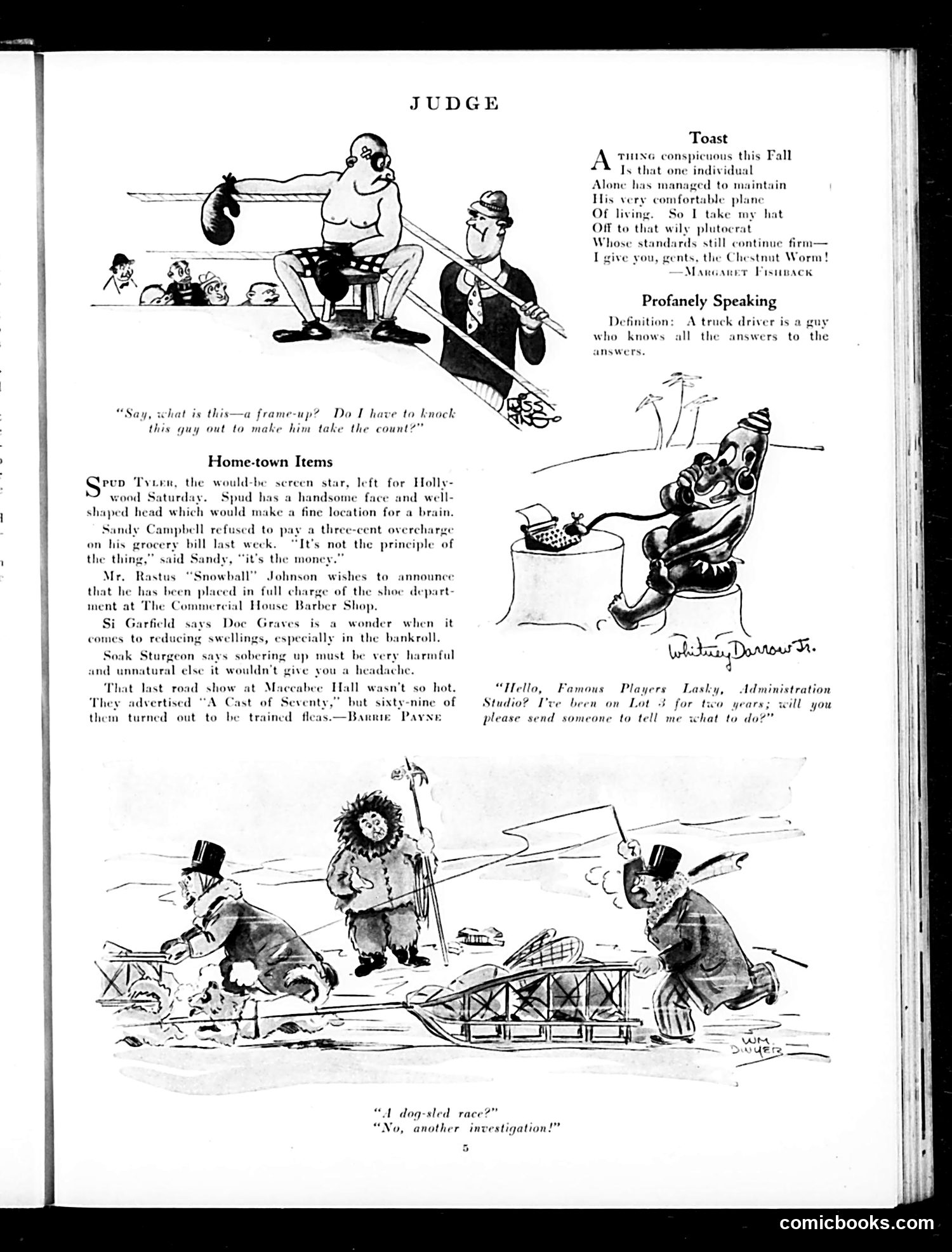
# Analysis This page from *Judge* magazine contains several satirical items and cartoons: **Top cartoon**: A corpulent judge sits between a small man and woman, with the caption asking about a "frame-up" and whether knocking someone out is necessary for court. This appears to be satire about judicial corruption or questionable legal proceedings. **"Home-town Items"**: Brief gossip about local figures—a would-be screen star, a grocer's overcharge dispute, a shoe department announcement, and claims about reducing swellings. These mock small-town scandals and advertising pretensions. **"Profanely Speaking"**: A humorous definition equating truck drivers with omniscience. **Bottom cartoon**: Three men in top hats investigate something, captioning a "dog-sled race" as "another investigation"—likely satirizing government investigations or inquiries of the era. The overall tone mocks small-town life, legal absurdity, and bureaucratic investigations.
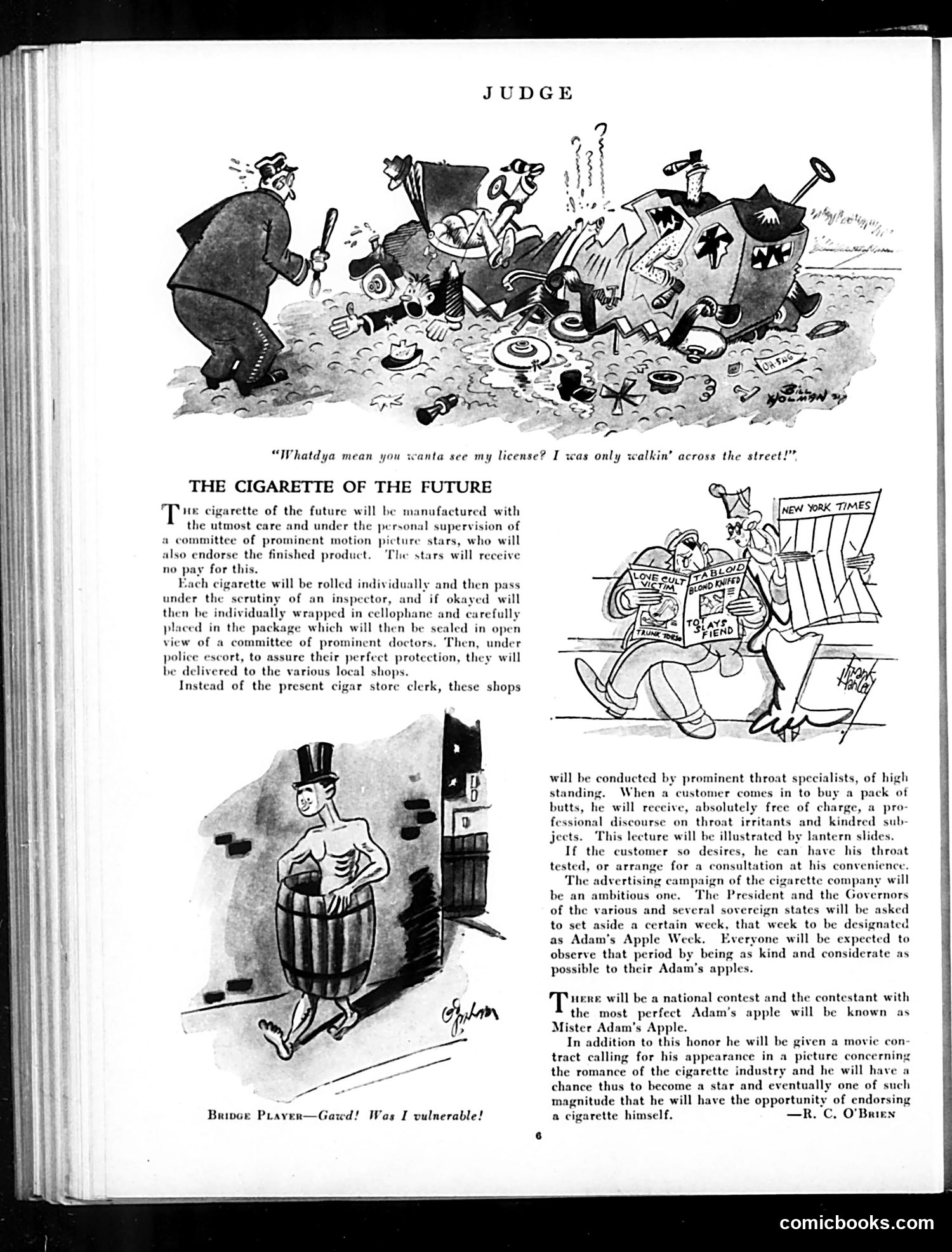
# Analysis This satirical piece titled "The Cigarette of the Future" mocks early 20th-century regulatory impulses and celebrity culture. The top cartoon shows a judge confronting what appears to be a chaotic street scene, with the caption "What d'ya mean you wanta see my license? I was only walkin' across the street!"—satirizing excessive bureaucratic licensing requirements. The main article parodies a proposed future where cigarette manufacturing would be overseen by prominent motion picture stars and throat specialists, with elaborate inspections and "Adam's Apple Week" promotions. The illustrations show exaggerated medical supervision and celebrity endorsement culture. The satire targets both progressive-era regulation (seen as absurdly intrusive) and the emerging celebrity endorsement industry, suggesting these "improvements" would become ridiculous when applied to everyday commerce.
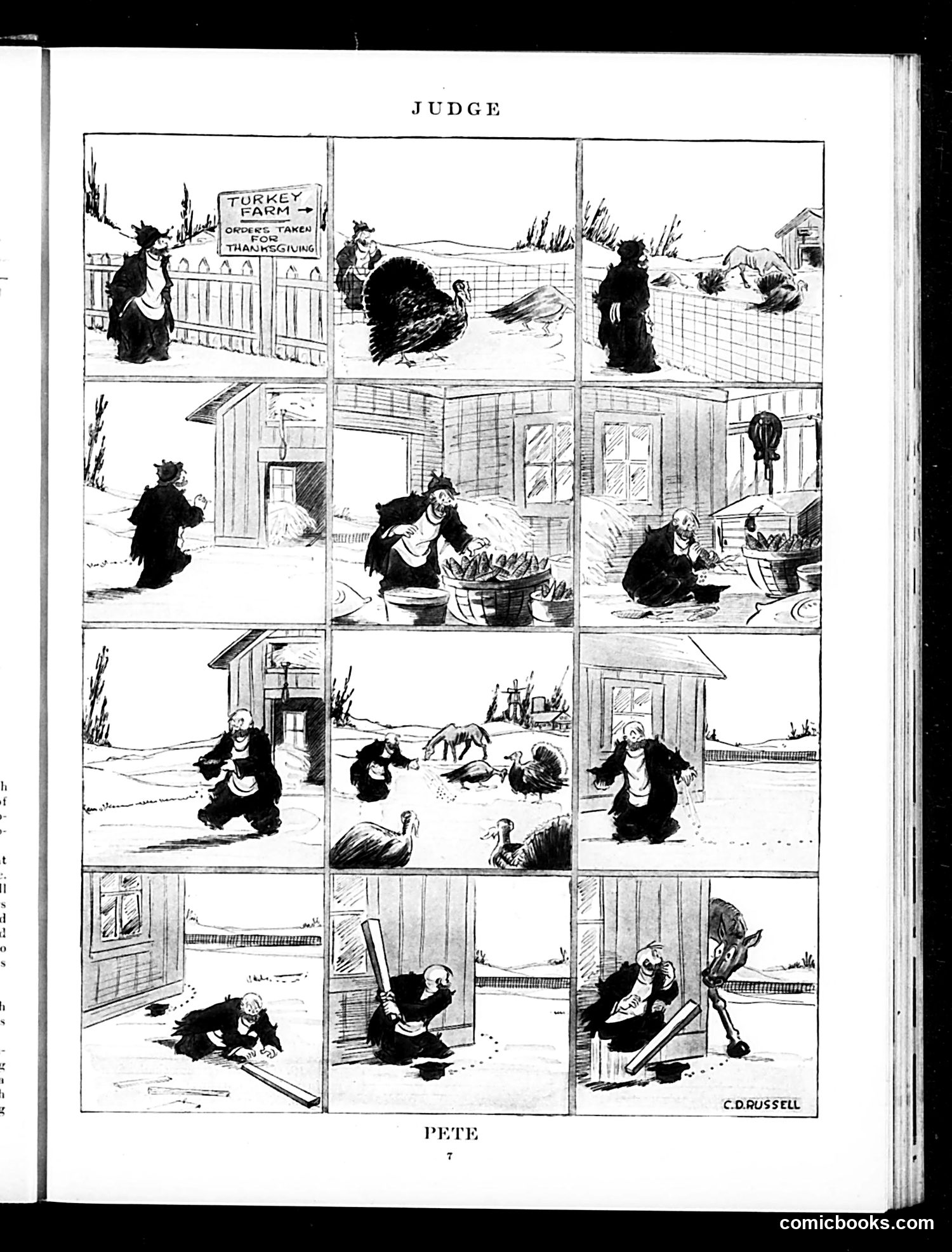
# "Judge Pete" Comic Strip Analysis This two-panel comic strip by C.D. Russell depicts a darkly humorous sequence at a turkey farm. The top panels show a figure in formal attire ("JUDGE") inspecting the farm and its operations. The lower panels show "PETE," apparently a farm worker, engaging in increasingly violent and chaotic interactions with the turkeys—chasing, striking at, and wrestling with them. The satire appears to mock judicial authority or a specific judge character ("Judge Pete"), suggesting corruption, incompetence, or hypocrisy through slapstick misadventure. The turkey farm setting and the contrast between the judge's formal position and Pete's crude farmyard chaos likely comment on social pretension or abuse of power. Without additional context about contemporary figures, the specific target remains unclear.
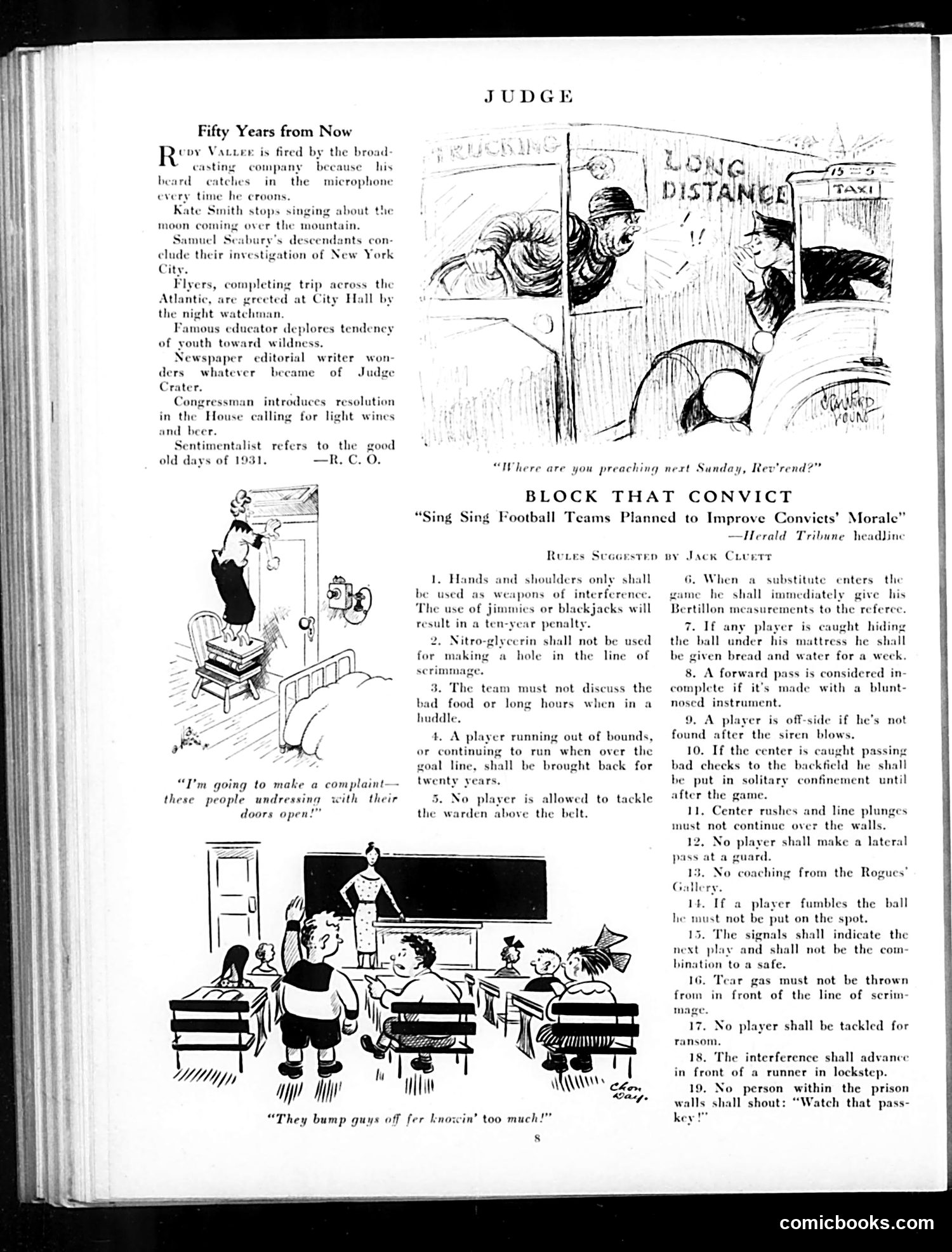
# "Block That Convict" — Judge Magazine Satire This page satirizes a 1930s Herald Tribune headline about Sing Sing prison organizing football to improve inmates' morale. The satire presents mock "rules" that blur prison discipline with football regulations, exposing the absurdity of the scheme. The humor lies in rules that reference prison realities: players "hiding the ball under mattresses," "passing bad checks," being "put on the spot," or tackled "for ransom." References to "tear gas," "lockstep," and the "warden above the belt" treat convicts as both players and prisoners simultaneously. The cartoons above mock broader 1931 topics: Ruby Vallee's microphone feedback, Kate Smith's famous song, Judge Crater's unsolved 1930 disappearance, and youth delinquency. The "Fifty Years from Now" conceit satirizes contemporary trends by imagining their ridiculous future consequences—typical Judge editorial humor combining social commentary with absurdist comedy.
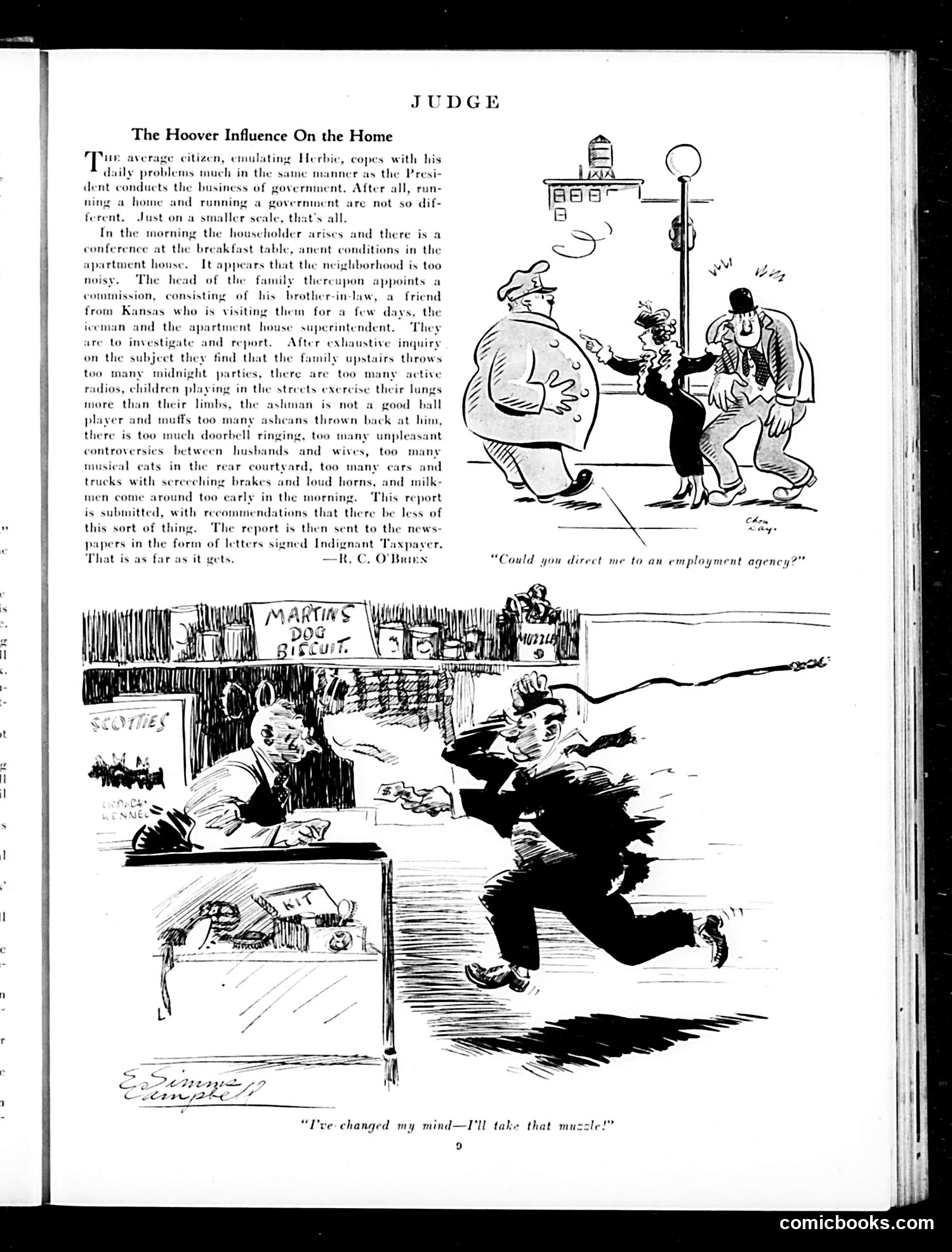
# Analysis of Judge Magazine Page This page satirizes President Herbert Hoover's administrative style applied to household management. The article's conceit compares running a home to running government "on a smaller scale." **The satire:** The head of household creates a commission (mimicking Hoover's preference for committees and commissions) to investigate neighborhood noise. After exhaustive inquiry, they produce a detailed report listing grievances—loud parties, radios, children, ashmen, doorbells, cats, cars, milkmen. The punchline: "That is as far as it gets"—the report goes nowhere, merely submitted to newspapers as signed letters from "Indignant Taxpayer." **The political point:** This mocks Hoover's ineffectual approach to governance through commissions that investigate and recommend but lack enforcement power. The implication is that his administration produces endless reports while problems remain unsolved. **The cartoons** (illustrating the concept) show a man being directed to an employment agency, and another fleeing with a muzzle he's changed his mind about buying—visual jokes about solving domestic problems.
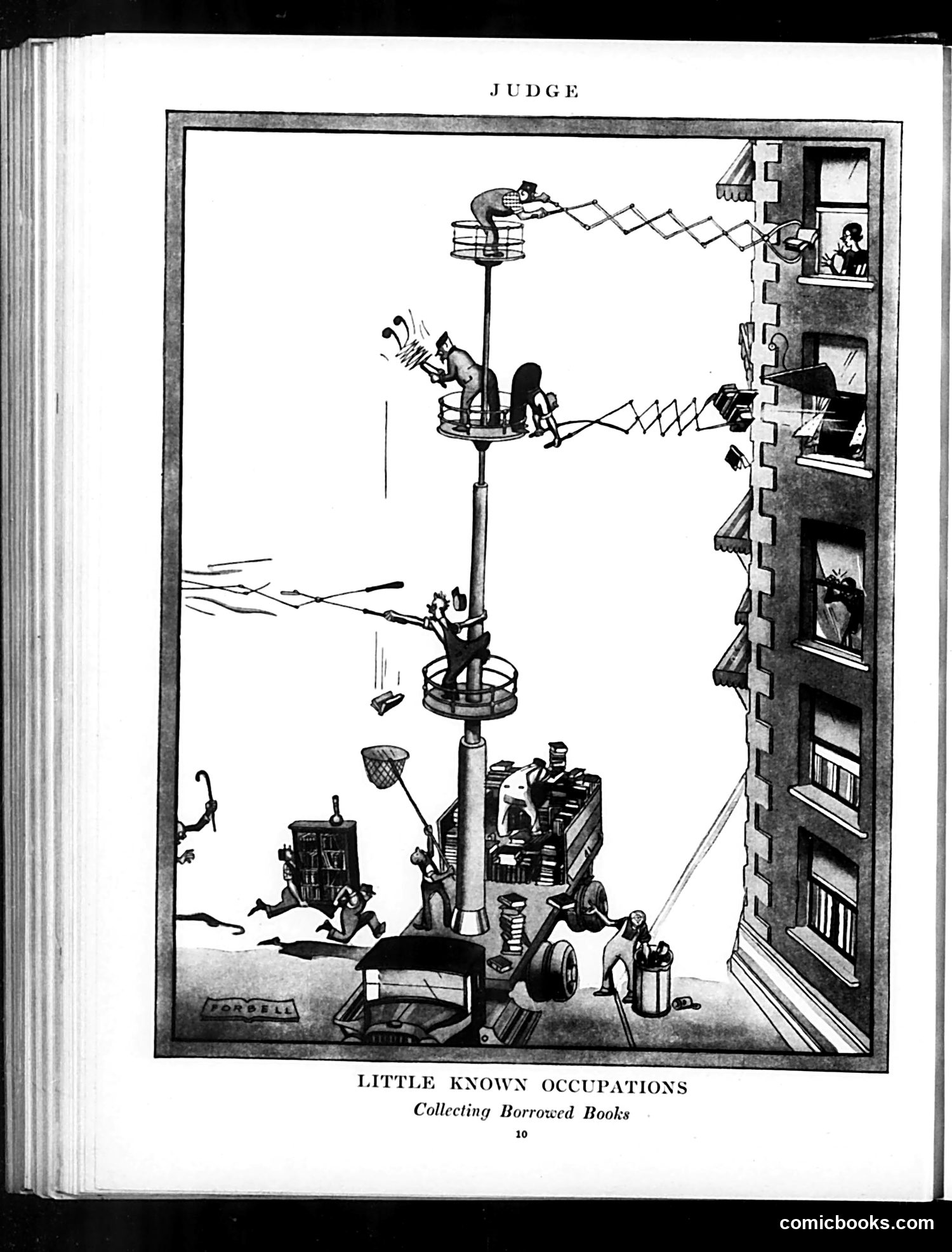
# "Judge" Cartoon Analysis: "Little Known Occupations - Collecting Borrowed Books" This satirical cartoon depicts the humorous "occupation" of retrieving loaned books from neighbors. The central pole serves as a mechanical contraption with figures at various heights operating pulleys and nets to capture books from a multi-story apartment building on the right. The joke satirizes the common social frustration of never getting borrowed books returned. Rather than asking politely, the cartoon imagines an elaborate, industrial-scale apparatus—complete with vehicles, operators, and mechanical systems—as the only effective method to recover borrowed volumes. The cartoon comments on both human nature (people's reluctance to return borrowed items) and the absurdity of treating a minor domestic annoyance as worthy of serious mechanical engineering. The "little known occupation" framing humorously suggests book-collecting might warrant professional status given how difficult the task appears.