
Judge, 1931-11-21 · page 20 of 36
Judge — November 21, 1931 — page 20: what you’re looking at
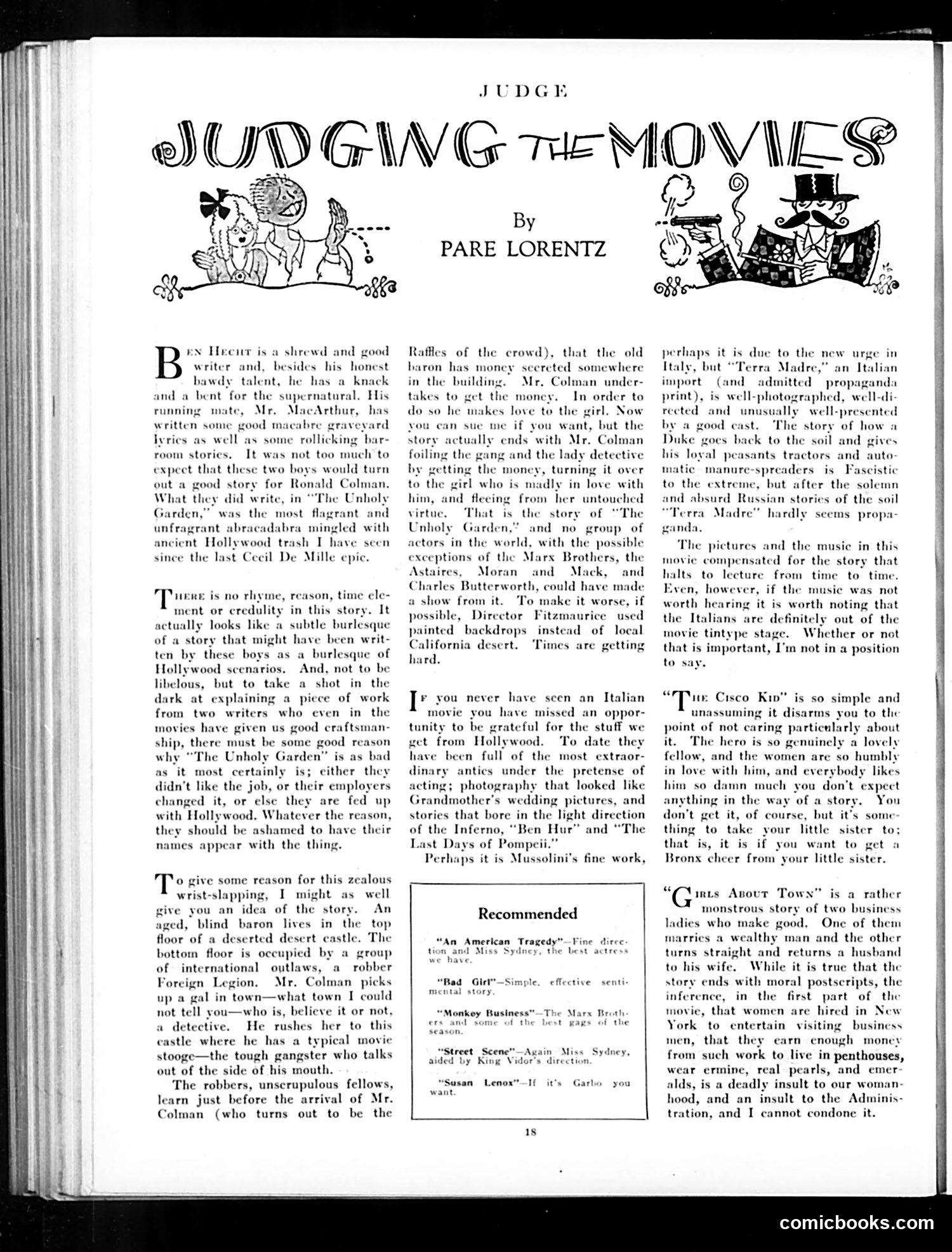
A restored page from Judge, 1931-11-21. Page through the whole issue in the reader above.
📄 Transcribed text from this page (OCR, searchable)
Machine-transcribed from the original scan — historical spelling and the odd misread are preserved.
e&N Heer is a shrewd and good B writer and, besides his honest bawdy talent, he has a knack ind a bent for the supernatural. His running mate, Mr. MacArthur, has bre graveyard lyrics as well as some rollicking bar- written some good mz room stories. It was not too much to expect that these two boys would turn out a good story for Ronald Colman, What they did write, in “The Unholy Garden,” was the most flagrant and unfragrant abracadabra mingled with ancient Hollywood trash I have seen since the last Ceeil De Mille epic. TT ke is no rhyme, reason, time ele- ment or credulity in this story. It actually looks like a subtle burlesque of a story that might have been writ- ten by these boys as a burlesque of Hollywood scenarios, And, not to be libelous, but to take a shot in’ the dark at explaining a piece of work from two writers who even in the movies have given us good craftsman- ship, there must be some good reason why “The Unholy Garden” is as bad as it most certainly is; either they didn’t like the job, or their employers changed it, or else they are fed up with Hollywood. Whatever the reason, they should be ashamed to have their names appear with the thing. Te give some reason for this zealous wrist-slapping, I might as well give you an idea of the story. An aged, blind baron lives in the top floor of a deserted desert castle. The bottom floor is occupied by a group of international outlaws, a robber Foreign Legion. Mr. Colman picks up a gal in town—what town I could not tell you—who is, believe it or not, a detective. He rushes her to this castle where he has a typical movie stooge—the tough gangster who talks out of the side of his mouth. The robbers, unscrupulous fellows, learn just before the arrival of Mr. Colman (who turns out to be the JUDGE JIUVGIWG TEM By PARE LORENTZ Raffles of the crowd), that the old baron has money secreted somewhere in the buildin: Mr, Colman under- takes to get the money. In order to do so he makes love to the girl, Now you can sue me if you want, but the Story actually ends with Mr. Colman foiling the gang and the lady detective by getting the money, turning it over to the girl who is madly in love with him, and fleeing from her untouched virtue, That is the story of “The Unholy Garden,” and no group. of actors in the world, with the possible exceptions of the Marx Brothers, the Astaires, Moran and Mack, and Charles Butterworth, could have made a show from it. To make it worse, if possible, Director Fitzmaurice used painted backdrops instead of local California desert. ‘Times are getting hard. [ou never have seen an Italian novie you have missed an oppor- tunity to be grateful for the stuff we get from Hollywood. To date they have been full of the most extraor- dinary antics under the pretense of acting; photography that looked like Grandmother's wedding pictures, and stories that bore in the light dire: of the Inferno, “Ben Hur” and Last Days of Pompe Perhaps it is Mussolini’s fine work, Recommended “An American Tragedy" Fine direc tion and Miss Sydney, the best actress “Bad Girt"—Simple, effective senti- mental story “Monkey Business"—The Marx Broth Street Scene" —Ay aided by King Vidor's d “Susan Lenox”—If it's Garbo you want ov [LY perhaps it is due to the new urge in Italy, but “Terra Madre,” an Italian import (and admitted propaganda print), is well-photographed, well-di- rected and unusually well-presented by a good cast. The story of how a Duke goes back to the soil and gives his loyal peasants tractors and auto matic manure-spreaders is Fascistic to the extreme, but after the solemn and absurd Russian stories of the soil “Terra Madre” hardly seems propa- ganda. The pictures and the music in this movie compensated for the story that halts to lecture from time to time. Even, however, if the music was not worth hearing it is worth noting that the Italians are definitely out of the movie tintype stage. Whether or not that is important, I’m not in a position to say. “Die Cisco Kin" is so simple and unassuming it disarms you to the point of not caring particularly about it. The hero is so genuinely a lovely fellow, and the women are so humbly in love with him, and everybody likes him so damn much you don’t expect anything in the way of a story. You don’t get it, of course, but it’s some to take your little sister to; it is if you want to get a that Bronx cheer from’ your little sister. “C’ints Anovr Town” is a rather monstrous story of two business ladies who make good. One of them marries a wealthy man and the other turns straight and returns a husband to his wife. While it is true that the story ends with moral postscripts, the inf . in the first part of the movie, that women are hired in New York to enter! visiting business men, that they earn cnough money from such work to live in penthouses, wear ermine, real pearls, and emer alds, is a deadly insult to our woman- hood, and an insult to the Adw tration, and I cannot condone it. comicbooks.com