
Judge, 1931-11-21 · page 15 of 36
Judge — November 21, 1931 — page 15: what you’re looking at
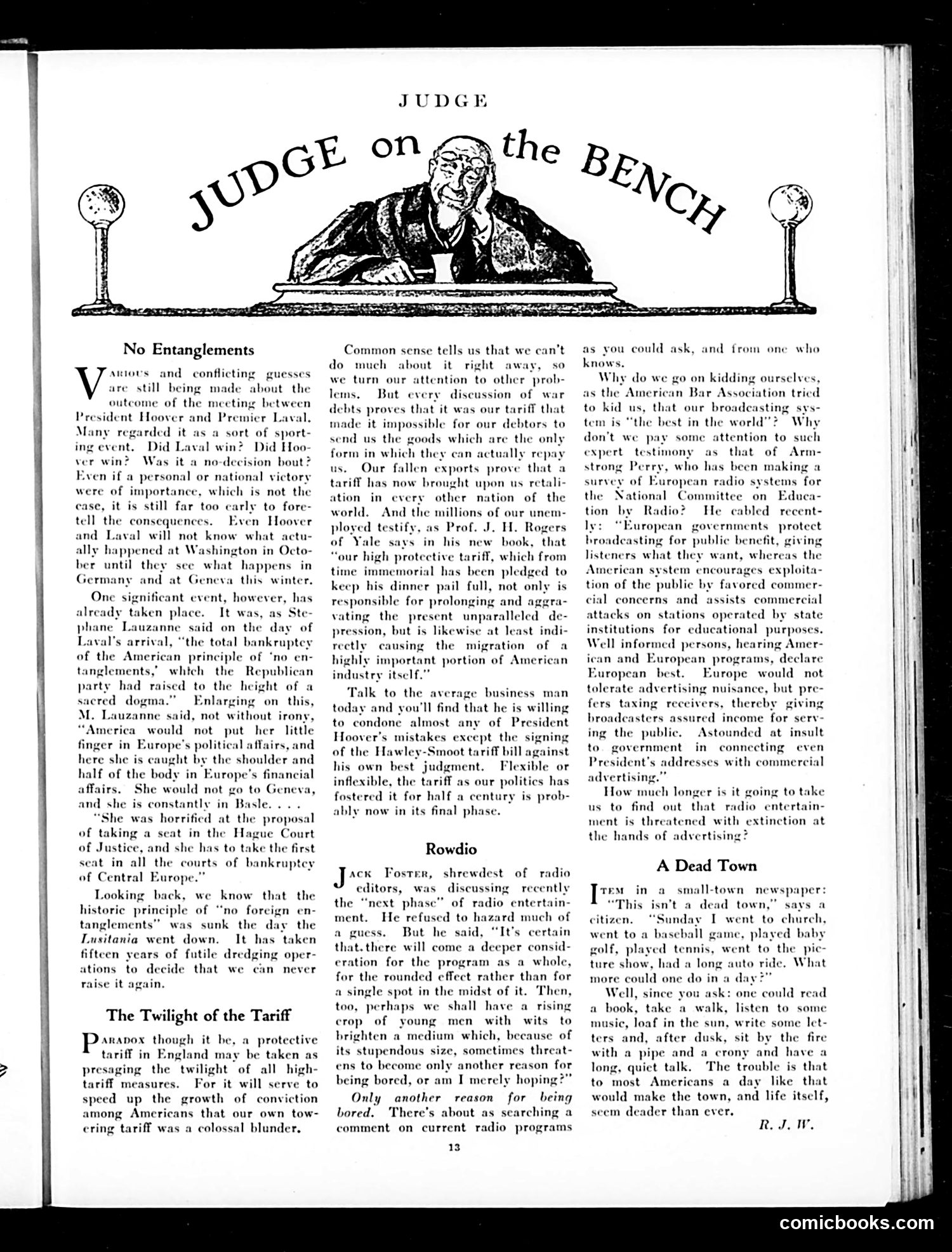
A restored page from Judge, 1931-11-21. Page through the whole issue in the reader above.
📄 Transcribed text from this page (OCR, searchable)
Machine-transcribed from the original scan — historical spelling and the odd misread are preserved.
Ww No Entanglements anious and conflicting guesses are still being made about the outcome of the meeting between President Hoover and Premier Laval. Many regarded it as a sort of sport- ing event. Did Laval win? Did Hoo- ver win? Was it a no-decision bout? Even if a personal or national victory were of importance, which is not the case, it is still far too carly to fore- tell the consequences. Even Hoover and Laval will not know what actu- ally happened at Washington in Octo- ber until they sec Germany what happens in and at Geneva this winter. tificant event, however, has Laval’s arrival, “the total bankruptey of the American principle of ‘no en- tanglements,’ whitch the Republic party had raised to the height of a cred dog —_ on this, argin; + not without irony, her little merica would not put finger in Europe's political « here she is caught by the shoulder and half of the body in Europe's f affairs. She would not go to and she is constantly in Basle... . “She was horrified at the proposal of taking a seat in the H of Justice, and she has to seat in all the courts of bankrupte of Central Europe.” Looking back, we know that the historic principle of “no foreign en- tanglements” was sunk the day the Lusitania went down. It has taken fiftcen years of futile dredging oper- ations to decide that we can never raise it again. rue Court The Twilight of the Tariff Pamvox though it he, a protective tariff in England may be taken as presaging the twilight of all high- tariff measures. For it will serve to speed up the growth of conviction among Americans that our own tow- cring tariff was a colossal blunder. JUDGE Common sense tells us that we can’t do much about it right away, so we turn our attention to other prob- lems, But every discussion of war debts proves that it was our tariff that made it impossible for our debtors to send us the goods which are the only form in which they can actually rep us. Our fallen exports prove that tariff has now brought upon us retali- ation in other nation of the world. And the millions of our unem- ployed testify, as Prof. J. H. Rogers of Yale book, that “our high protective tariff, which from time immemorial has been pledged to keep his dinner pail full, not only responsible for prolonging and aggra- vating the present unparalleled de- pression, but is likewise at least indi- rectly causing the migration of a highiy important portion of American industry itself.” every s in his new Talk to the average business man today and you'll find that he is willing to condone almost any of President Hoover's mistakes except the sig of the Hawley his own best judgme Flexible or inflexible, the tariff as our politics has fostered it for half a centu ably now in its final phase. is prob- Rowdio J* Foster, shrewdest of radio editors, was discussing recently the “next phase” of radio entertain- ment. He refused to hazard much of a guess. But he said, “It's certain that.there will come a deeper consid- eration for the program as a whole, for the rounded effect rather than for a single spot in the midst of it. Then, too, perhaps we shall have a_risir crop of young men with wits to brighten a medium which, because of its stupendous size, sometimes threat- ens to become only another reason for being bored, or am I merely hoping? Only another reason for being bored. There’s about as searching a comment on current radio programs 13 as you could ask, and from one who knows. Why do we go on kidding ourselves, as the American Bar Association tried to kid us, that our broadcasting sys- tem is “the best in the world’? Why don't we pay some attention to such expert testimony as that of Arm- strong Perry, who has been making a survey of European radio systems for the National Committee on Educa- tion by Radio? He cabled recent- ly: ‘uropean governinents protect broadcasting for public benefit, giving listeners what they want, whereas the Anerican system encou ges exploita- tion of the public by favored commer- cial concerns and assists commercial attacks on stations operated by state institutions for educational purposes. Well informed persons, hearing Amer- ican and European programs, declare European best. Europe would not tolerate advertising nuisance, but pre- fers taxing receivers, thereby giving broadcasters assured income for serv- ing the public. Astounded at insult to. government in’ connecting even President's addresses with commercial advertising. How much longer is it going to take us to find out that radio entertain- ment is threatened with extinction at the hands of advertisin A Dead Town tem in a small-town “This isn't ad town,” says a “Sunday I went to church, went to a baseball game, played baby golf, played tennis, went to the pic- ture show, had a long auto ride. What more could one do in a day Well, since you ask: one could read a book, take a walk, listen to some music, loaf in the sun, write some let- ters and, after dusk, sit by the fire with a pipe and a crony and have a long, quict talk, The trouble is that to most Americans a day like that would make the town, and life itself, seem deader than ever, newspaper: citizen. R. Ww, comicbooks.com