
Judge, 1931-11-21 · page 26 of 36
Judge — November 21, 1931 — page 26: what you’re looking at
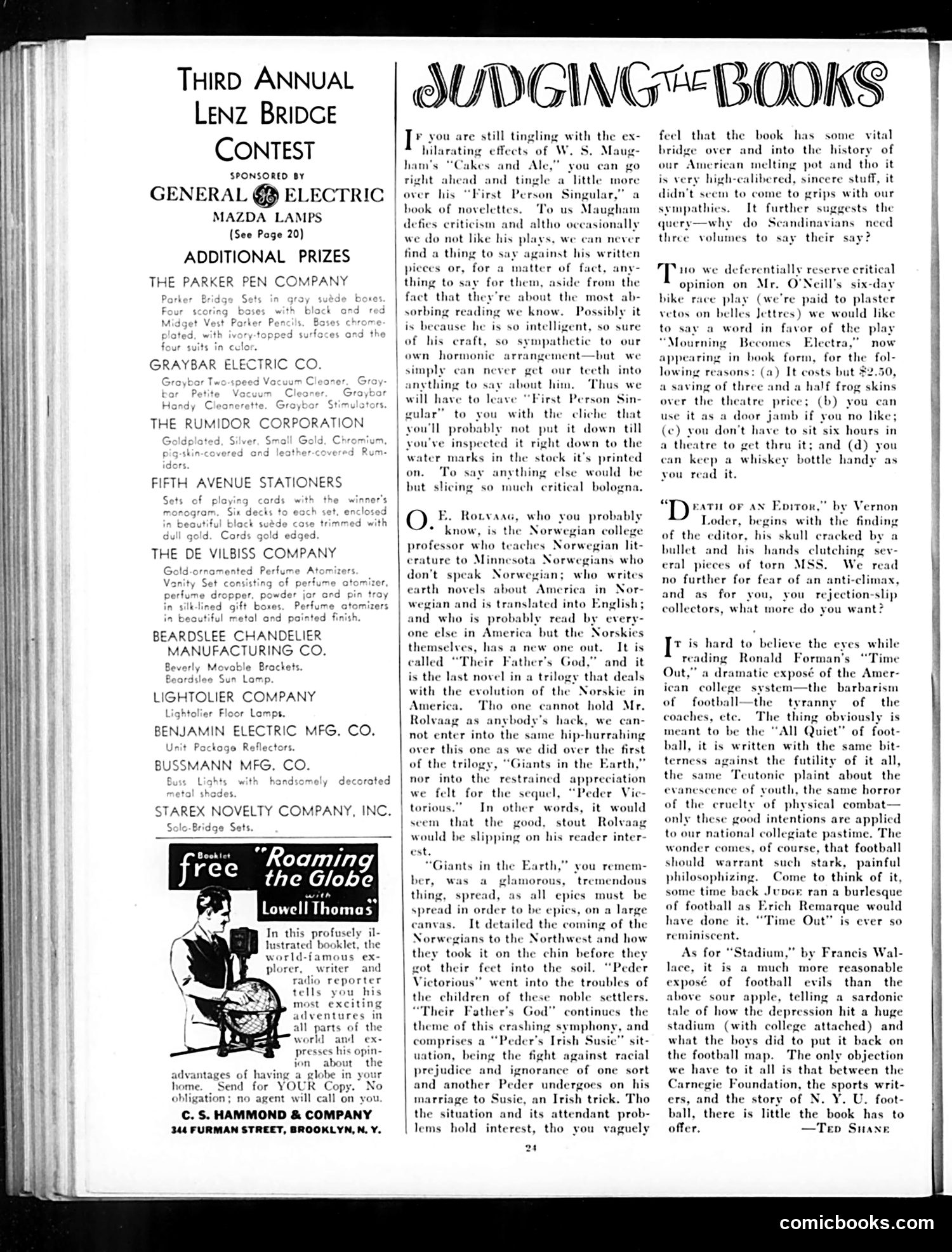
A restored page from Judge, 1931-11-21. Page through the whole issue in the reader above.
📄 Transcribed text from this page (OCR, searchable)
Machine-transcribed from the original scan — historical spelling and the odd misread are preserved.
THIRD ANNUAL LENZ BRIDGE CONTEST SPONSORED BY GENERAL @ ELECTRIC MAZDA LAMPS (See Page 20) ADDITIONAL PRIZES THE PARKER PEN COMPANY in beautiful metal and po BEARDSLEE CHANDELIER MANUFACTURING CO. 8. Movable Bracke Sun Lomp LIGHTOLIER COMPANY Lightolier Floor Lamps. BENJAMIN ELECTRIC MFG. CO. Unit Pockoge Reflectors. BUSSMANN MFG. Co. STAREX NOVELTY COMPANY, INC. Solo-Bridge Sets. “Roaming the Globe Lowell Thomas’ In this profusely il- lustrated booklet, the world-famous e plorer, writer and radio reporter tells you his most exciting adventures in all parts of the world and ex- presses his opin- ion about the advantages of having a globe in you ; no agent will call on you Cc. S. HAMMOND & COMPANY 344 FURMAN STREET, BROOKLYN, Nv. Y. | torious.” AUDGING“ BOOKS I’ you are still tingling with the ex- hilarating effects of W. S. Ma ham’s “Cakes and Ale,” you can go right ahead and tingle a little more over his “First Person Singular,” a book of novelettes. To us Maugham defies criticism and altho occasionally we do not like his plays, we ean never find a thing to say against his written pieces or, for a matter of fact, any- thing to say for them, aside from the fact that they're about the most ab- sorbing reading we know. Possibly it is because he is so intelligent, of his craft, own hormonic so sure to our ment—but we simply can never get our teeth into inything to say about him. will I to leave gular” to ye you'll: probably so sympathetic arrany Thus we “First: Person Sin- with the cliche that not put it down till | you've inspected it right down to the water marks in the stock it's printed To say anything clse but slicing so much critical bole O FE. Rotvaag, know, is the professor who teaches Norwegian lit- erature to Minnesota Norwegians who don’t speak Norwegian; who writes earth novels a . wegian and is translated into English; and who is probably read by every- one else in America but the Norskies themselves, has a new one out. It is called “Their Father's God,” and it is the last novel in a trilogy that deals with the evolution of the Norskie in Amer Tho one cannot hold Mr. Rolvaag as anybody's hack, we can- not enter into the same hip-hurrahing over this one as we did over the first of the trilogy, “Giants in the Earth,” nor into the restrained appreciati we felt for the sequel, “Peder Vie- In other words, it would that the stout Rolv would be slipping on his reader inter- est. “Giants in the was a who seem good, Earth,” glamorous, spread, as you remem- tremendous all epics must. be d in order to be epics, on a large canvas. It detailed the coming of the Norwegians to the Northwest and how they took it on the chin before they got their feet into the soil. “Peder Victorious” went into the troubles of the children of these noble settlers. “Their Father's God" continues the theme of this crashing symphony, and comprises a “Peder’s Irish Susie” sit- being the fight against racial prejudice and ignorance of one sort and another Peder undergoes on his marriage to Susie, an Irish trick. Tho the situation and its attendant prob- lems hold interest, tho you vaguely feel that the book has vital bridge over and into the history of our American melting pot and tho it is very high some alibered, sincere stuff, it didn’t seem to come to grips with our sympathies. It further suggests the query—why do Scandinavians need three volumes to say their say? T te we deferentially reserve eritical opinion on Mr. O'Neill's six-day bike race play (we're paid to plaster vetos on belles Jettres) we would like to say a word in favor of play “Mourning Electra,” now appearing in book form, for the fol- lowing reasons: (a) It costs but a saving of three and a half frog s over the theatre price; (b) you use it as a door jamb if you no 1 (ce) you don’t have to sit six hours in a theatre to get thru it; and (d) you can keep a whiskey bottle handy as you read it. “‘D EATH OF AN Eprror,”” by Vernon Loder, begins with the finding of the editor, his skull cracked by bullet and his hands clutehin eral pieces of torn MSS. We no further for fear of an anti-clir and as for you, you rejection-slip collectors, what more do you want? Becomes t is hard to believe the eyes while reading Ronald Forman’s “Time Out,” a dramatic exposé of the Amer- ican colle system—the barbarism of football—the tyranny of — the coaches, ete. The thing obviously is meant to be the “All Quiet” of foot- ball, it is written with the same bit- terness against the futility of it all, utonic plaint about the evanescence of youth, the same horror of the cruelty of physical combat— only these good intentions are applied to our national collegiate pastime. The wonder comes, of course, that football should warrant such stark, painful philosophizin Come to think of it, some time back Juper ran a burlesque of football as Erich Remarque would have done it. “Time Out” is ever so reminiscent. As for “Stadium,” by Francis Wal- lace, it is a much more reasonable exposé of football evils than the above sour apple, telling a sardonic tale of how the depression hit a huge stadium (with college attached) and what the boys did to put it back on the football map. The only objection we have to it all is that between the Carnegie Foundation, the sports writ- ers, and the story of N. Y. U. foot- ball, there is little the book has to offer. —Tep Suaxr the same ‘ comicbooks.com