
Judge, 1931-11-21 · page 18 of 36
Judge — November 21, 1931 — page 18: what you’re looking at
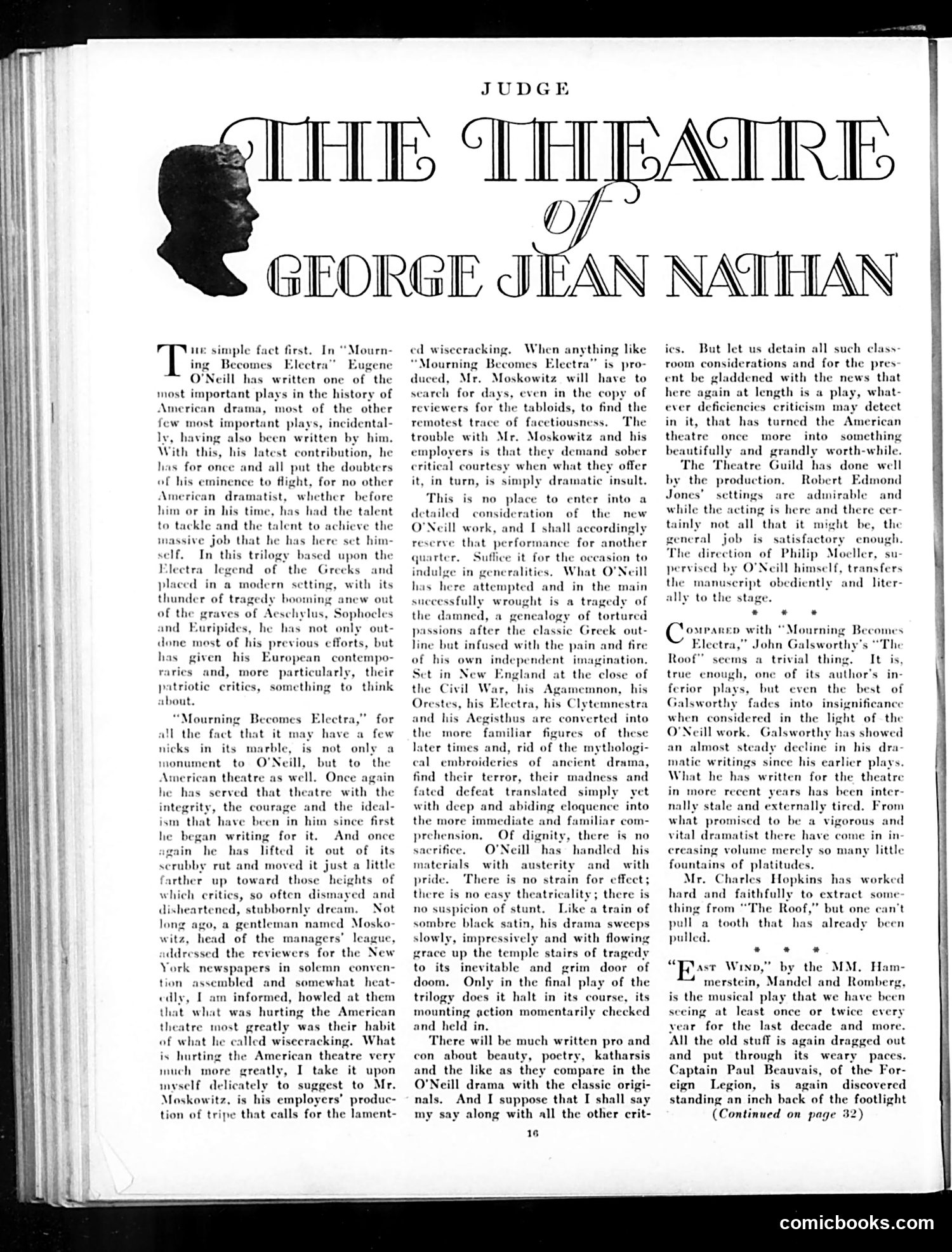
A restored page from Judge, 1931-11-21. Page through the whole issue in the reader above.
📄 Transcribed text from this page (OCR, searchable)
Machine-transcribed from the original scan — historical spelling and the odd misread are preserved.
JUDGE a THEATRE GEORGE FA NACHIAIAN ur simple fact first. In “Mourn- T Becomes Electra” Eugene O'Neill has written one of the most important plays in the history of American drama, most of the other few most important plays, incidental- ly, having also been written by him. With this, his latest contribution, he has for once and all put the doubters of his eminence to flight, for no other Ameri dramatist, whether before him or in his time, has had the ent to tackle and the talent to achieve the massive job that he has here set him- self. In this trilogy based upon the Electra legend of the Greeks and placed in a modern. setting, with its thunder of tragedy booming anew out of the graves of Aeschylus, Sophocles and Euripides, he has not only out- done most of his previous efforts, but has given his European contempo- raries and, more particularly, their patriotic critics, something to think about. Mourning Becomes Electra,” for wl the fact that it may have a few nicks in its marble, is not only monument to O'Neill, but to the American theatre as well. Once again he has served that theatre with the integrity, the courage and the ide ism that have been him since he began writing for it. And once t n he has lifted it out of its scrubby rut and moved it just a little farther up toward those heights of which critics, so often dismayed and disheartened, stubbornly dream. Not a gentleman named Mosko- e m: ers’ | 1 the reviewers for the York newspapers in solemn conven- tion assembled and somewhat heat- edly, [am informed, howled at them that what was hurting the American theatre most greatly was their habit of what he called wisecracking. What is hurting the American theatre very much more greatly, I take it upon myself delicately to suggest to Mr. Moskowitz, is his employers’ produc- tion of tripe that calls for the lament- ed wisecracking. When anything like “Mourning Becomes Electra” is pro- duced, Mr. Moskowitz will have to search for days, even in the copy of reviewers for the tabloids, to find the remotest trace of facetiousness. The trouble with Mr. Moskowitz and his employers is that they demand sober critical courtesy when what they offer it, in turn, is simply dramatic insult. This is no place to enter into a detailed consideration of the O'Neill work, and I shall a reserve that performance for quarter, Suflice it for the oce: indulge in generalities. What O° has here attempted and in the main successfully wrought is a tragedy of the damned, a genealogy of tortured passions after the classic Greek out- line but infused with the n and fire of his own independent it ation, Set in New England at the close of the Civil War, his Agamemnon, his Orestes, his Electra, his Clytemnestra and his Aegisthus are converted into the more familiar figures of these later times and, rid of the mythologi cal embroideries of ancient drama, find their terror, their madness and fated defeat translated simply yet with deep and abiding eloquence into the more immediate and familiar com- prehension, Of dignity, there is no sacrifice. O'Neill has handled his materials with austerity and with pride. There is no strain for effect; there is no easy theatricality; there is no suspicion of stunt. Like a train of sombre black satin, hi slowly, impressivel grace up the temple s' to its inevitable and grim door of doom. Only in the final play of the trilogy does it halt in its course, its mounting action momentarily checked and held in. There will be much written pro and con about beauty, poctry, katharsis the like as they compare in the O'Neill drama with the classic origi nals. And I suppose that I shall say my say along with all the other crit- 16 new But let us detain all such class- room considerations and for the pres ent be gladdened with the news that here again at length is a play, what- ever deficiencies criticism may detect in it, that has turned the American theatre once more into something itifully and grandly worth-while. The Theatre Guild has done well by the production. Robert Edmond Jones’ are admirable and while the acting is here and there cer- tainly not all that it might be, the general job is satisfactory enough. The direction of Philip Moeller, su- pervised by O'Neill himself, transfers the manuscript obediently and. liter- ally to the stage. ics. settings ompanep with “Mourn ra,” John Galsworthy’s “T! seems a trivial thing. It nough, one of its author's in- ferior plays, but even the best of Galsworthy fades into insignificance when considered in the light of the O'Neill work. Galsworthy has showed an almost steady decline in his dra- matic writings since his earlier plays. What he has written for the theatre in more recent years has been inter- nally stale and externally tired. From what promised to be a vigorous and vital dramatist there have come in in creasing volume merely so many little fountains of platitudes. Mr. Charles Hopkins has worked hard and faithfully to extract some thing from “The Roof,” but one can't pull a tooth that has already been pulled. “8 # the MM. Ham- merstcin, Mandel and Romberg, is the musical play that we have been seeing at least once or twic year for the last decade and more. All the old stuff is again dragged out and put through its weary paces. Captain Paul Beauvais, of the For- eign Legion, is again discovered standing an inch back of the footlight (Continued on page 32) “Biast Wino,” by every comicbooks.com