A complete issue · 36 pages · 1931
Judge — November 14, 1931
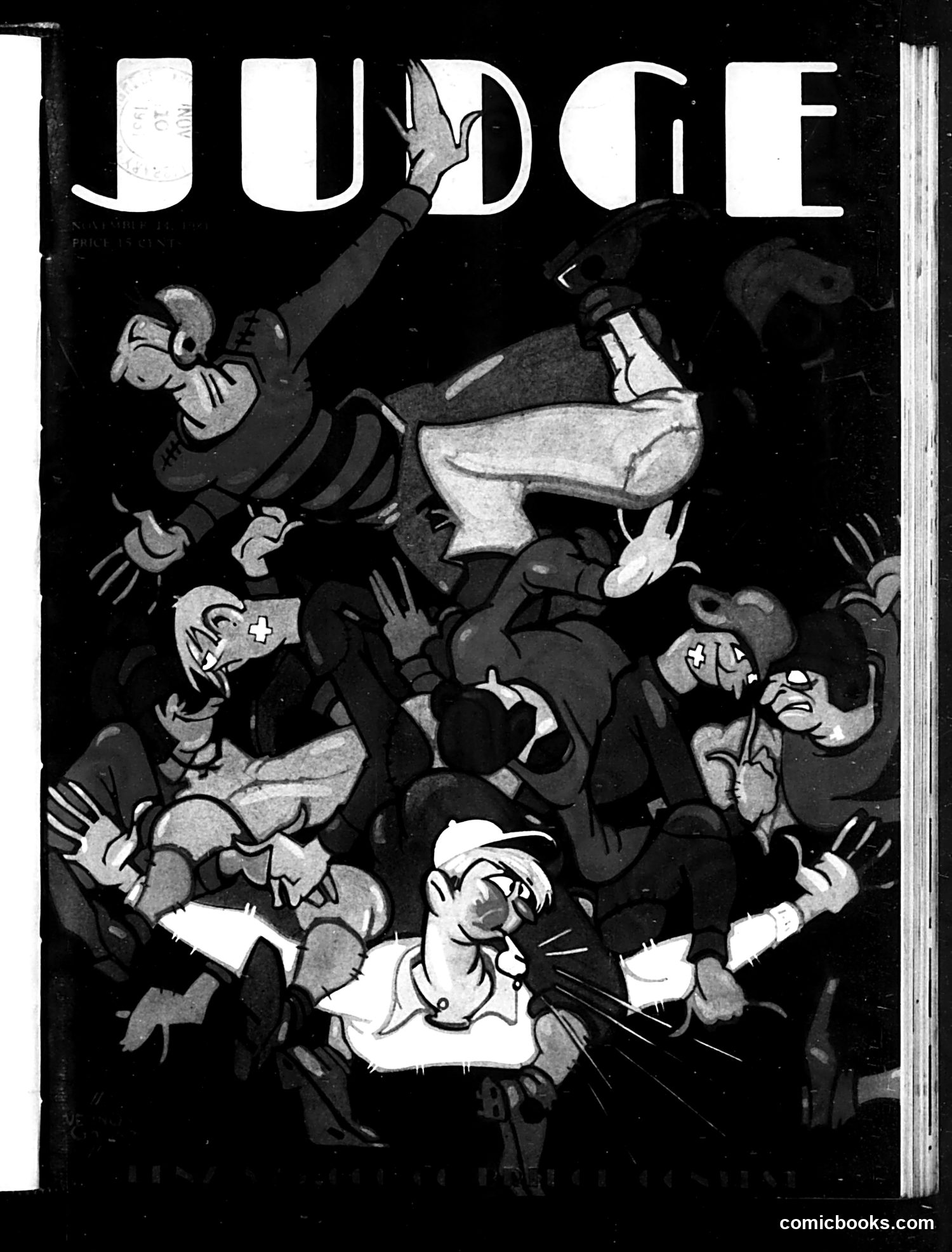
# Judge Magazine Cartoon Analysis This appears to be a Judge magazine cover depicting a courtroom scene with anthropomorphic animals as judges and defendants. The central figure—a large animal in judicial robes—presides over what seems to be a trial or hearing involving smaller animal characters. Without additional OCR text or clearer identifying marks, I cannot definitively name the specific political figures or events being satirized. The cartoon likely comments on a contemporary legal proceeding or judicial decision from Judge's publication period (likely early-to-mid 20th century), using animal caricatures as a common satirical device. The composition suggests critique of court proceedings, possibly highlighting corruption, absurdity, or partisan justice—typical targets of Judge's political satire. The energetic staging and exaggerated expressions emphasize the magazine's humorous intent, though the specific reference remains unclear without additional context.
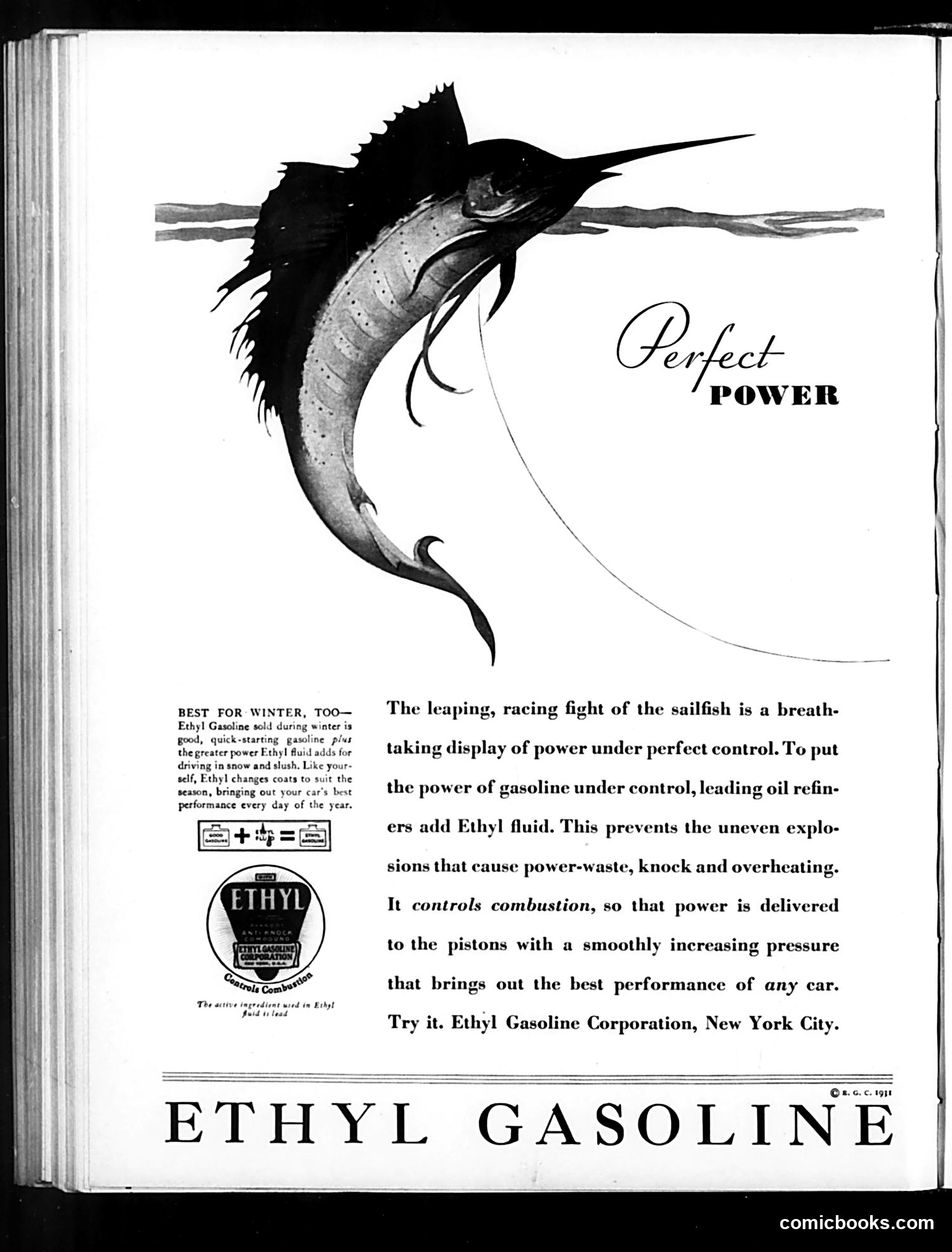
This page is primarily **advertising, not satire**. It's a full-page ad for Ethyl Gasoline from the Ethyl Gasoline Corporation (New York City), likely from around 1931 based on the copyright mark visible. The centerpiece is an illustration of a **sailfish leaping dramatically**, used as a metaphor for power and control. The ad copy compares the "perfect power" of a sailfish's controlled leap to gasoline enhanced with Ethyl fluid additive, which supposedly prevents engine knock, overheating, and uneven combustion. The small left sidebar references winter driving conditions, suggesting this ran during colder months. The Ethyl logo and circular badge appear as branding elements. This represents early automotive advertising using nature imagery to market fuel additives as performance enhancers.
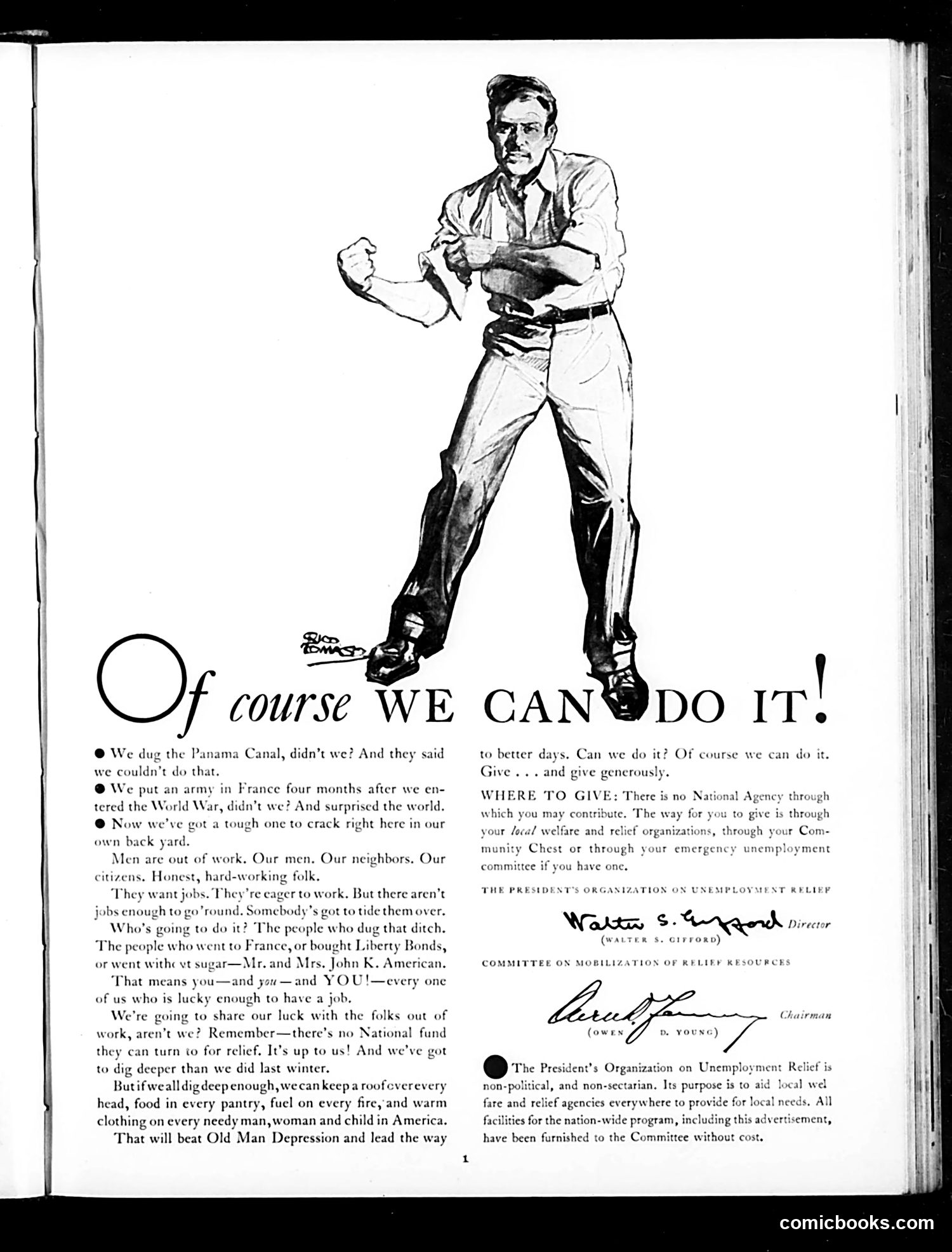
# "Of Course We Can Do It!" - Public Works Relief Advertisement This is a Depression-era public service announcement, not satire. The illustration shows a confident working man in fighting stance, accompanying text that appeals to American optimism and shared sacrifice to address unemployment. The message references past national achievements (Panama Canal, WWI mobilization) to argue Americans can solve current joblessness through collective effort. It emphasizes that ordinary citizens—"honest, hard-working folk"—need employment and deserve government support. The ad directs people to contribute through welfare and relief organizations, and notes the President's Organization on Unemployment Relief coordinates the effort. Signed by what appears to be leadership, this represents Depression-era messaging promoting both civic responsibility and government relief programs as patriotic duty.
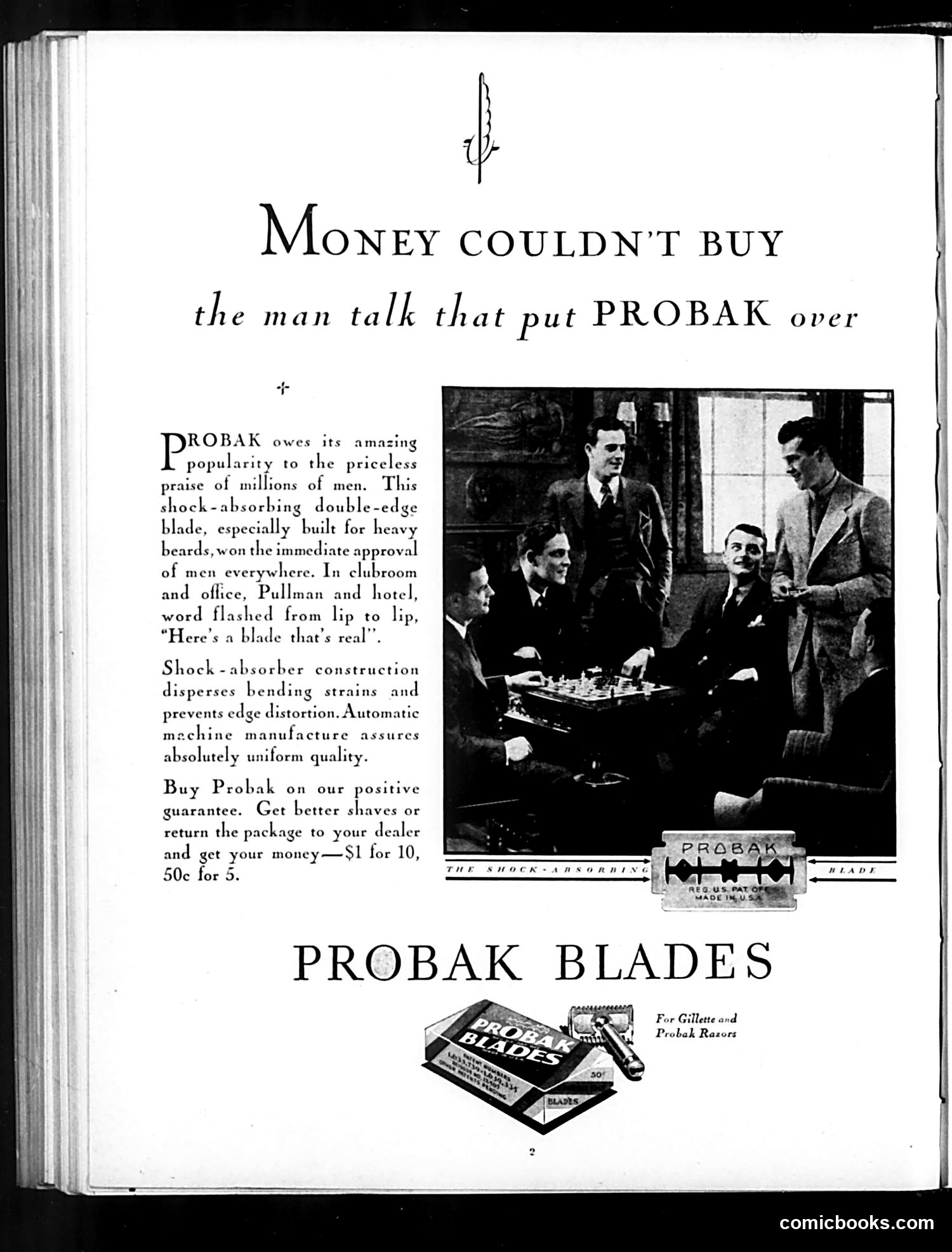
# Analysis This page is primarily a **Probak razor blade advertisement**, not political satire. The headline "Money couldn't buy the man talk that put Probak over" uses a common advertising trope: claiming a product's popularity stems from word-of-mouth praise rather than paid promotion. The photograph shows men in an office or clubroom discussing the razor blade—a staged scene meant to suggest authentic masculine endorsement. The text emphasizes the blade's "shock-absorbing" double-edge design and "uniform quality" from automatic manufacturing. The ad concludes with pricing ($1 for 10 blades, 50¢ for 5) and a money-back guarantee. This is straightforward commercial content typical of Judge magazine, which carried substantial advertising alongside satirical editorial material. There is no political cartoon or social satire present on this page.
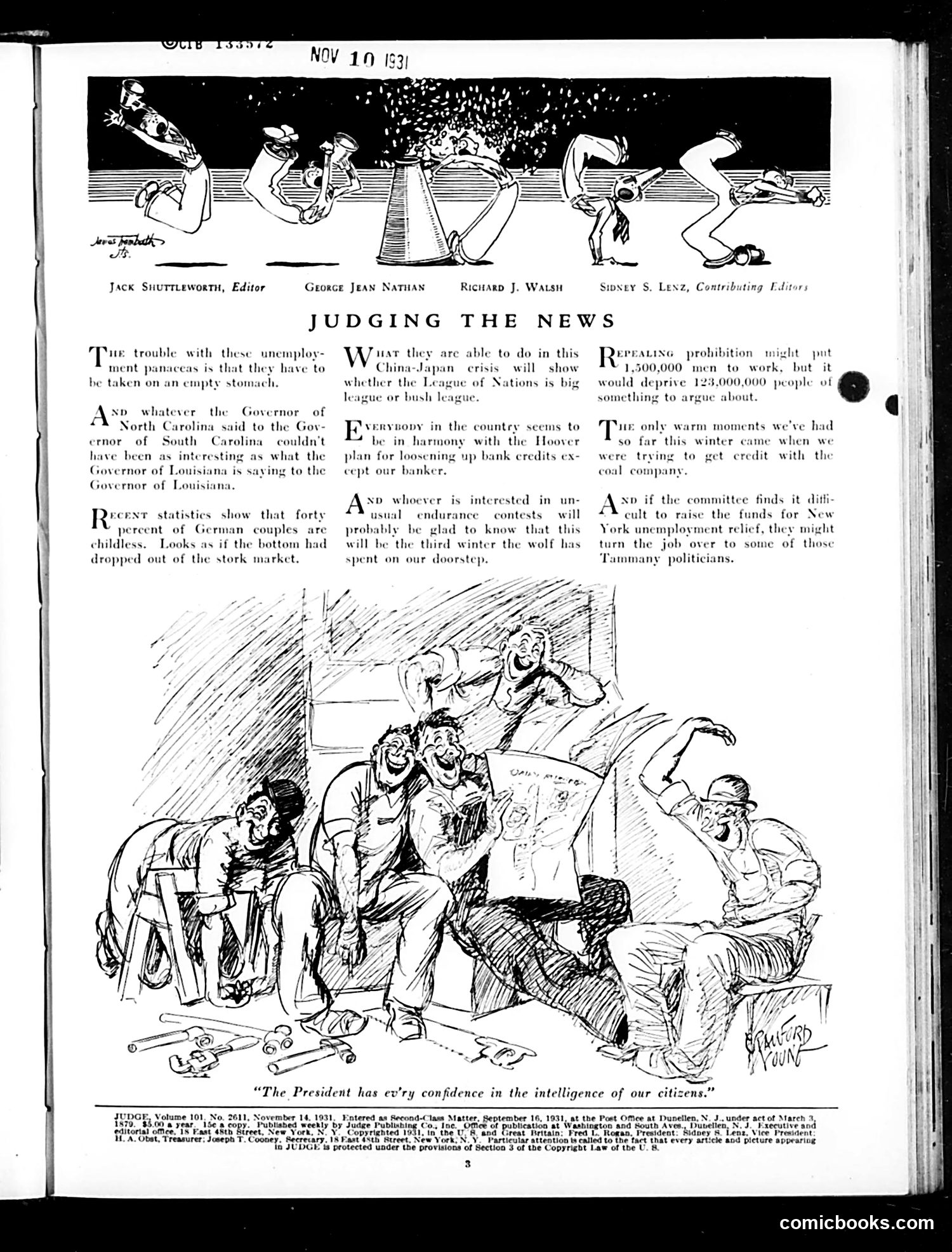
# "Judging the News" - November 10, 1933 This page from Judge magazine satirizes early 1930s Depression-era politics and policy debates. The main cartoon depicts citizens in apparent poverty or hardship, with the caption "The President has every confidence in the intelligence of our citizens." The satire appears to mock President Franklin D. Roosevelt's optimistic rhetoric about public intelligence during the economic crisis, contrasting his confidence with the visible suffering shown in the illustration. The page's editorial snippets discuss unemployment relief, the League of Nations, banking credits, and prohibition repeal—all major Depression-era issues. The cartoon suggests cynicism about whether the public truly understood or could solve the economic problems they faced, despite presidential assurances.
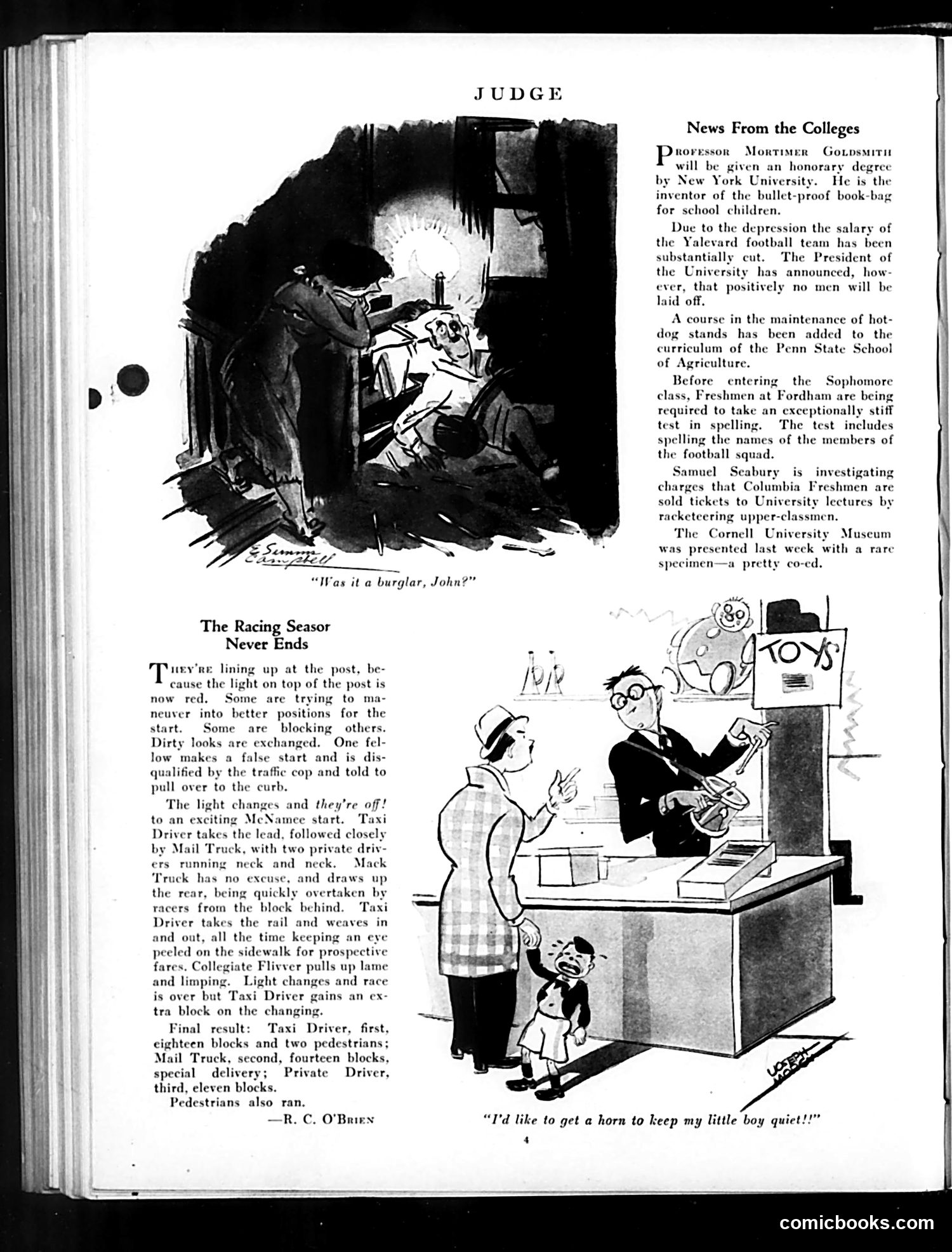
# Analysis of Judge Magazine Page **Top Cartoon ("Was it a burglar, John?")**: A humorous domestic scene showing a woman discovering her husband at night. The joke relies on the ambiguous situation—she's asking if an intruder is present, but the actual scenario appears to be a marital misunderstanding, likely playing on period anxieties about home security and spousal awkwardness. **"The Racing Sensor Never Ends"**: A satirical piece by R.C. O'Brien critiquing traffic management at what appears to be a horse race or sporting event. It mocks various drivers (taxi, mail truck, private driver) and pedestrians attempting to navigate through a race with changing traffic lights, highlighting the chaos and poor coordination of urban transportation during this era. **Right Cartoon**: A toy store scene depicting a father attempting to purchase a horn to quiet his child, satirizing parenting frustrations and consumer culture.
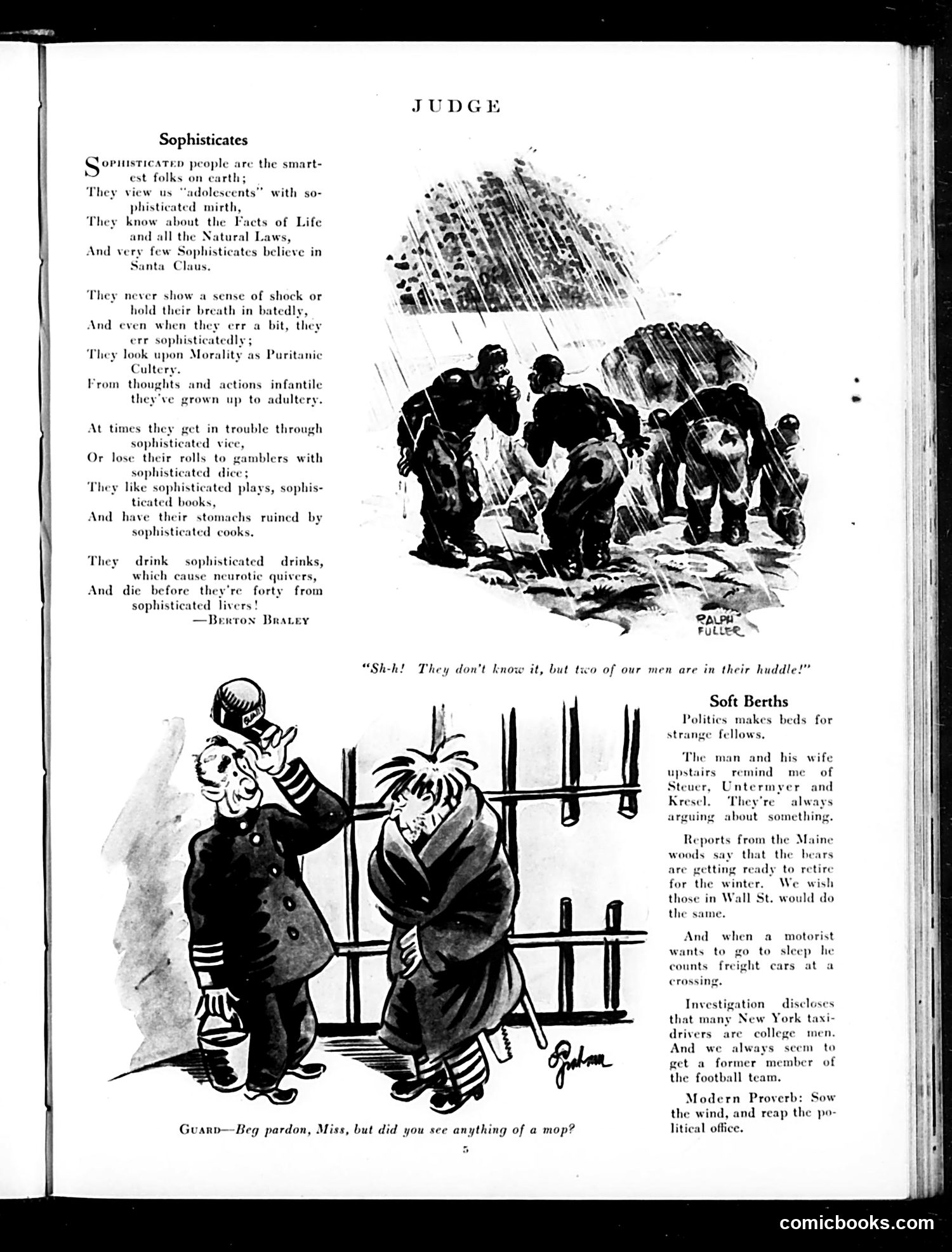
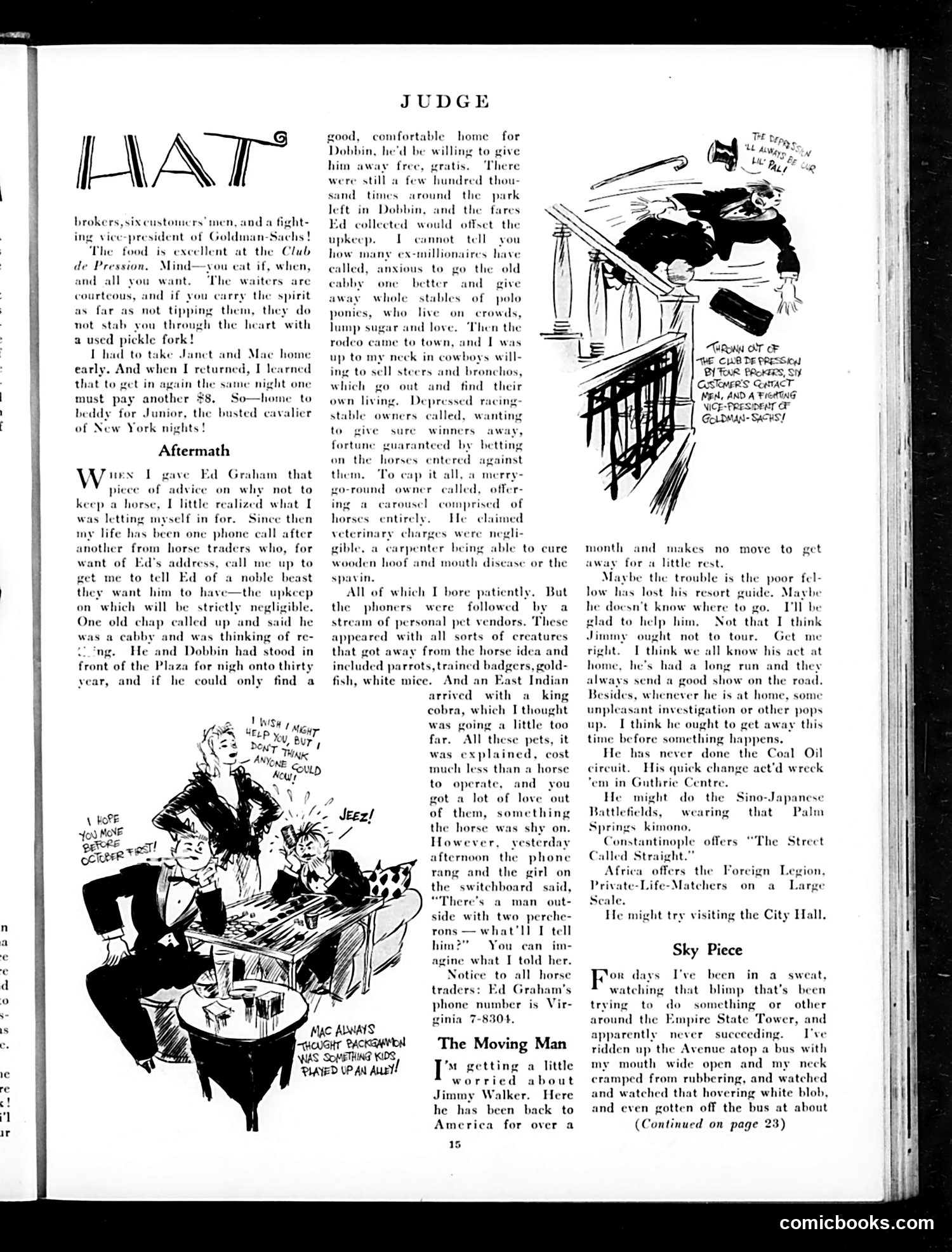
# Analysis of Judge Magazine Page **"Sophisticates" poem** (top left): Satirizes wealthy, educated people who reject traditional values like Santa Claus and morality. The poem, attributed to Burton Braley, mocks their pretentiousness—their sophisticated drinks, books, and cynicism—suggesting this lifestyle leads to early death and ruin. **Top illustration**: Shows people huddled in rain, with the caption "Sh-h! They don't know it, but two of our men are in their huddle!" This appears to mock either political spies or undercover operatives infiltrating a group. **Bottom cartoon**: A guard questions a woman about a mop, captioned "Guard—Beg pardon, Miss, but did you see anything of a mop?" The joke's specific reference is unclear without additional context. **"Soft Berths" column** (right): Brief social commentary on politicians' cushy jobs and various amusing observations about bears, motorists, and taxi drivers.
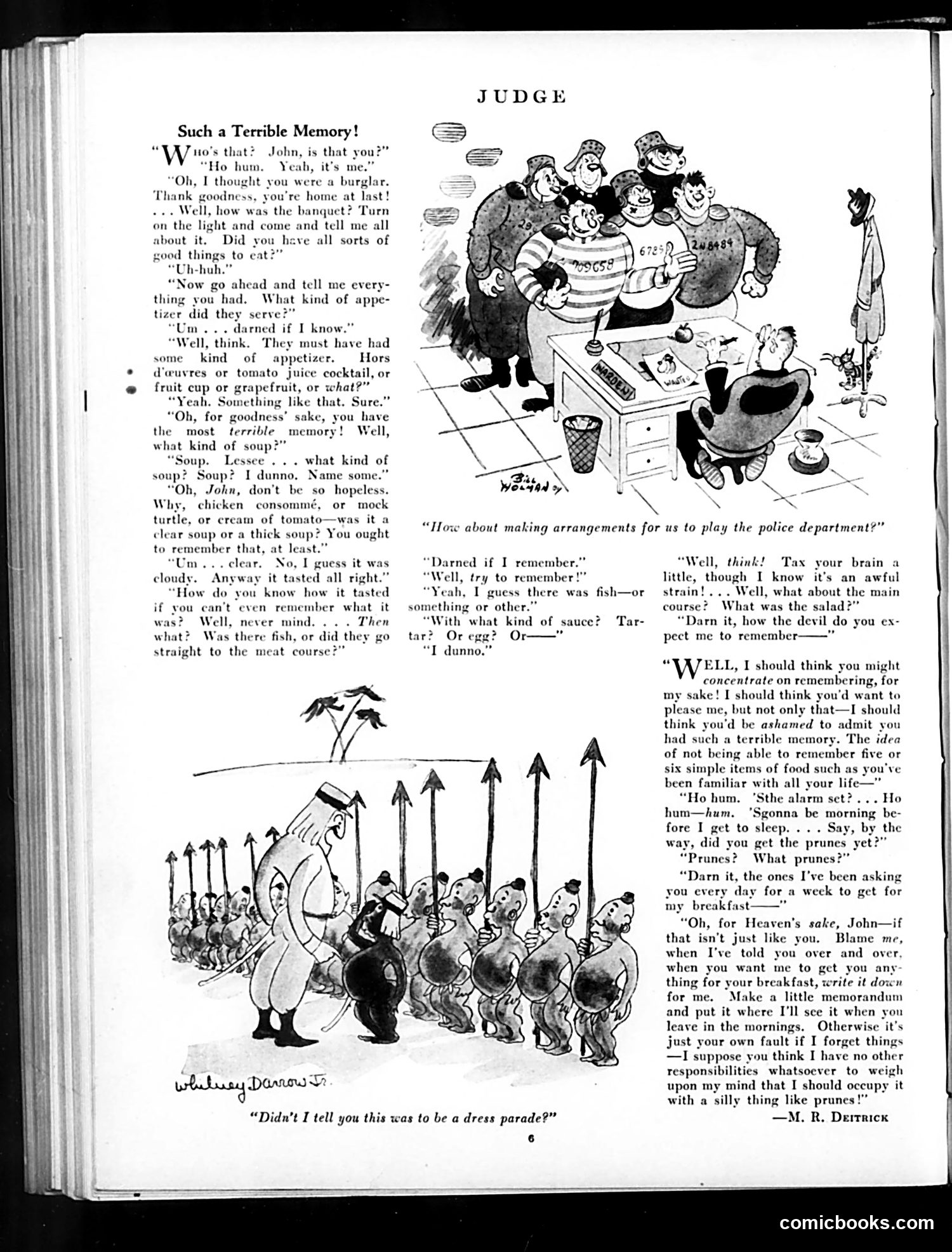
# "Such a Terrible Memory!" - Judge Magazine Cartoon This page satirizes a wife's frustration with her husband John's poor memory. The dialogue shows her attempting to extract details about a fancy dinner he attended, but he can barely recall what he ate—vaguely remembering "soup" and "fish" without specifics. The cartoon's humor targets the stereotypical absent-minded husband, while the wife's escalating exasperation is played for comedy. The bottom cartoon, titled "Didn't I tell you this was to be a dress parade?" appears to reference confusion over social expectations or formality. The satire gently mocks domestic life and gender dynamics of the era, where wives expected husbands to remember social details while men were portrayed as comically forgetful about domestic matters.
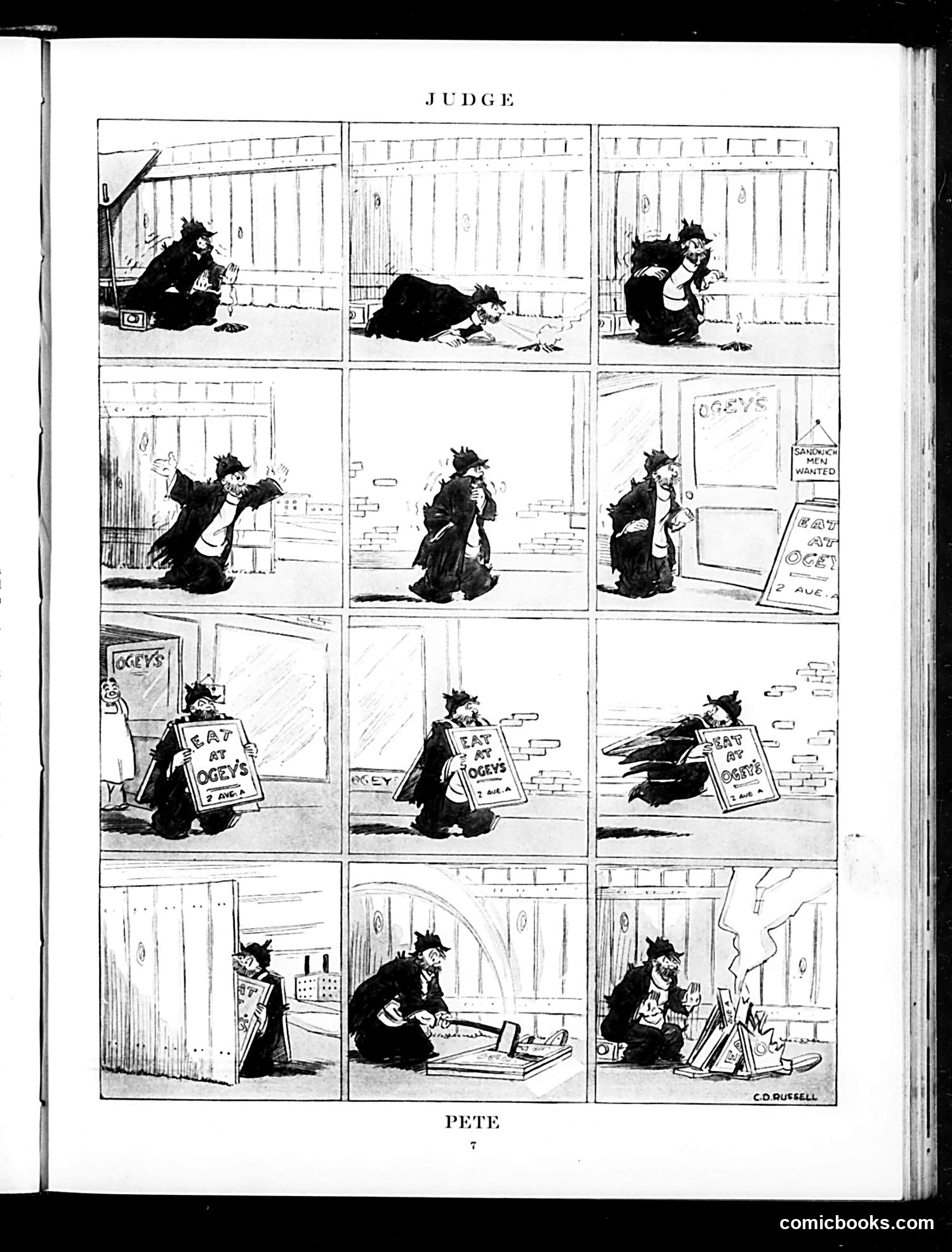
# "Judge" - "Judge Pete" Comic Strip This is a multi-panel comic strip by C.D. Russell titled "Judge Pete." The protagonist appears to be a judge or authority figure in dark robes who encounters various street situations. The narrative follows Pete as he confronts what looks like vagrants or street people advertising "Eat at Ogey's" (possibly a cheap restaurant). In subsequent panels, Pete becomes increasingly frustrated with the advertisements and street hustlers, eventually escalating to physical confrontation and destruction of the signs. The satire likely mocks either overzealous municipal enforcement against street vendors, or conversely, Pete's disproportionate judicial/authoritarian response to minor street commerce. Without knowing Judge magazine's specific political stance or the publication date, the exact target of ridicule—whether Pete or the street vendors—remains somewhat unclear.
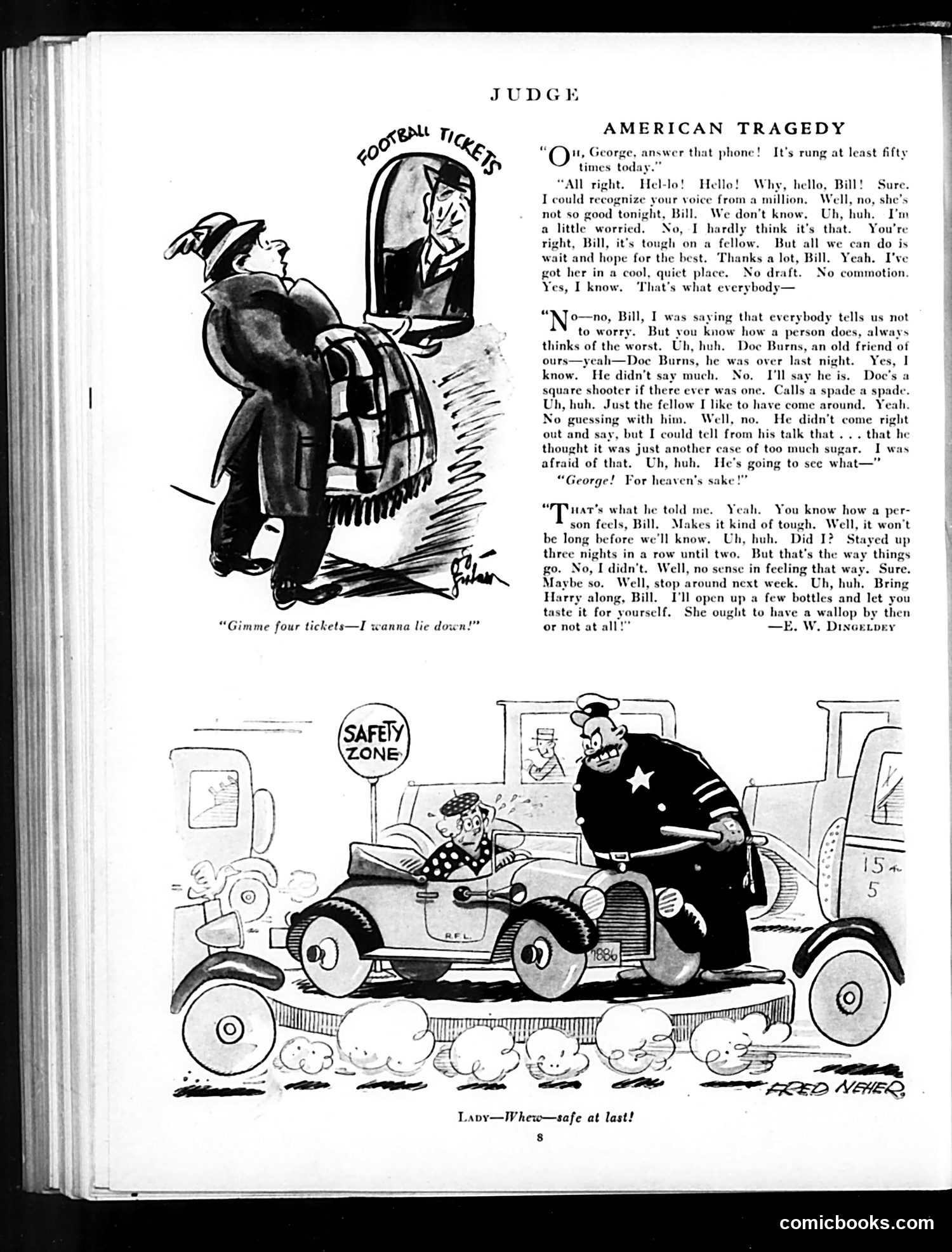
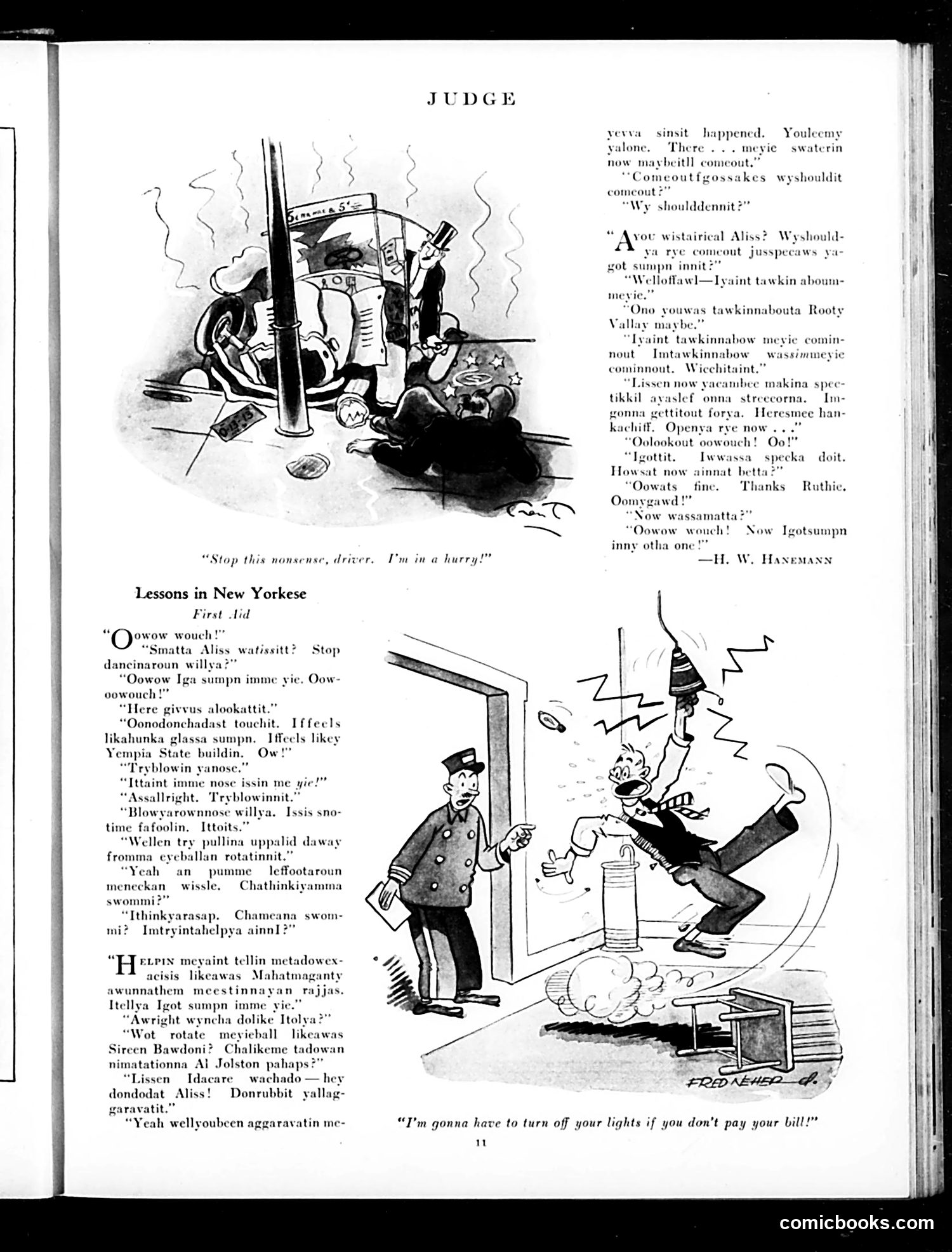
# "American Tragedy" - Judge Magazine This page satirizes American anxious domesticity during what appears to be the early 20th century. The top cartoon shows a man fielding repeated phone calls about an unnamed crisis—his dialogue reveals worry, superstition ("too much sugar"), and dependence on male friends' reassurance. The cryptic conversation suggests illness or injury in the household, likely a child or spouse, generating the frantic phone activity. The bottom cartoon by Fred Neher shows a traffic-safety message: Uncle Sam stands guard in a "Safety Zone," protecting a child in a toy car from oncoming traffic. The caption "Lady—Where—safe at last!" ironically comments on urban dangers. Together, the page contrasts private domestic anxiety with public safety concerns, suggesting American life's precarious nature. The wealthy gentleman's nervous reliance on social networks mirrors the era's growing middle-class dependency on expert advice and community reassurance during medical or safety crises.
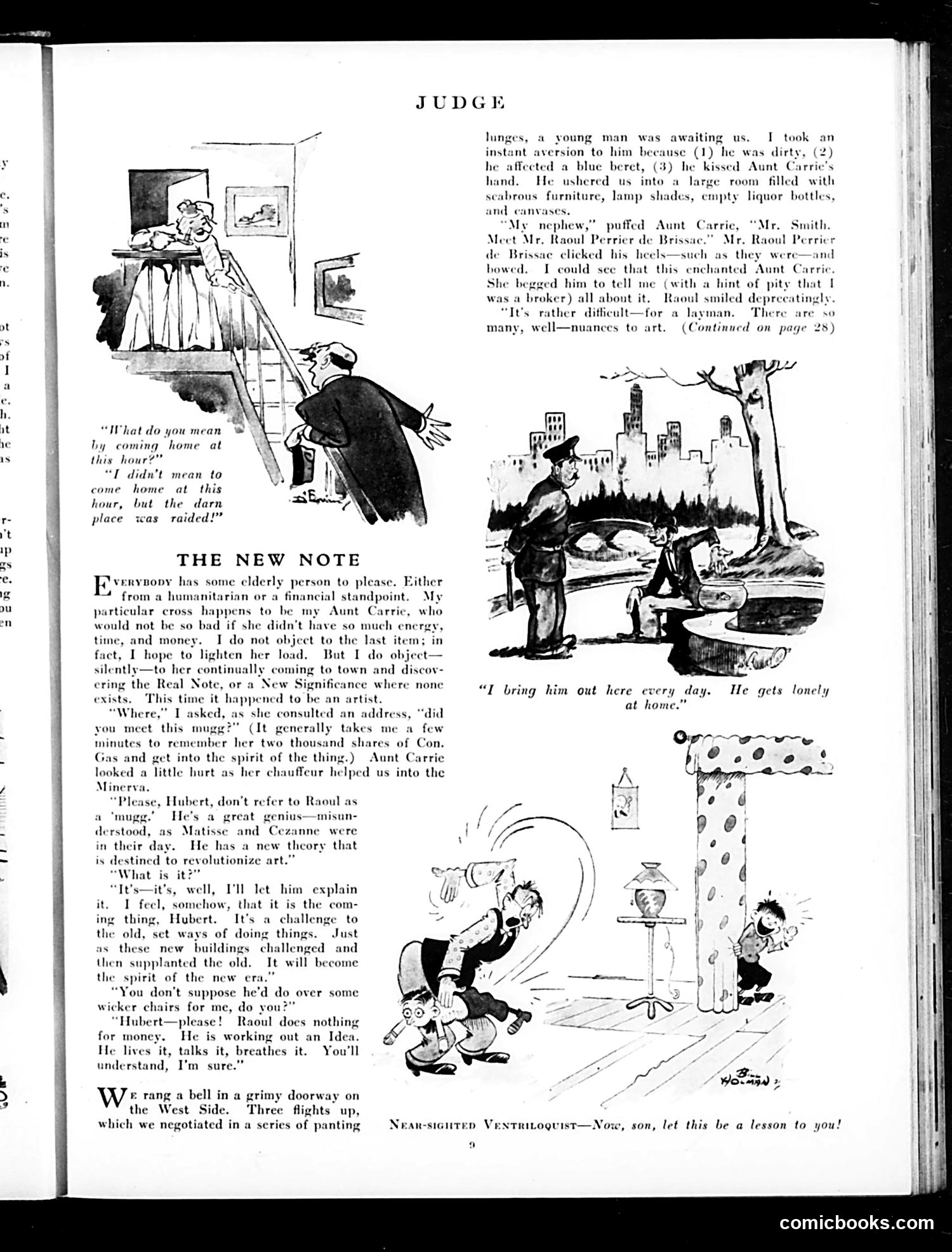
# Judge Magazine Satire Analysis This page satirizes wealthy Americans' fashionable embrace of modern art and bohemian artists during the early 20th century. The main story mocks Aunt Carrie, a wealthy woman patronizing "Raoul Perrier de Brissac," a pretentious artist living in squalid conditions on the West Side. The satire targets how wealthy dilettantes romanticize struggling artists as geniuses while the artists exploit this admiration. Raoul affects the stereotypical "artiste" pose—beret, hand-kissing, pseudo-intellectual talk about "nuances"—while living in poverty surrounded by "scabrous furniture" and empty liquor bottles. The narrator (Hubert), presented as sensible, finds the whole enterprise absurd, particularly Aunt Carrie's need to discover "the Real Note" or latest artistic trend. The bottom cartoon about a "Near-sighted Ventriloquist" appears unrelated social commentary, likely mocking misguided authority figures. The joke: wealthy patrons' gullible enthusiasm for avant-garde art and bohemian lifestyle is ridiculous posturing that primarily serves artists' financial interests, not genuine artistic revolution.
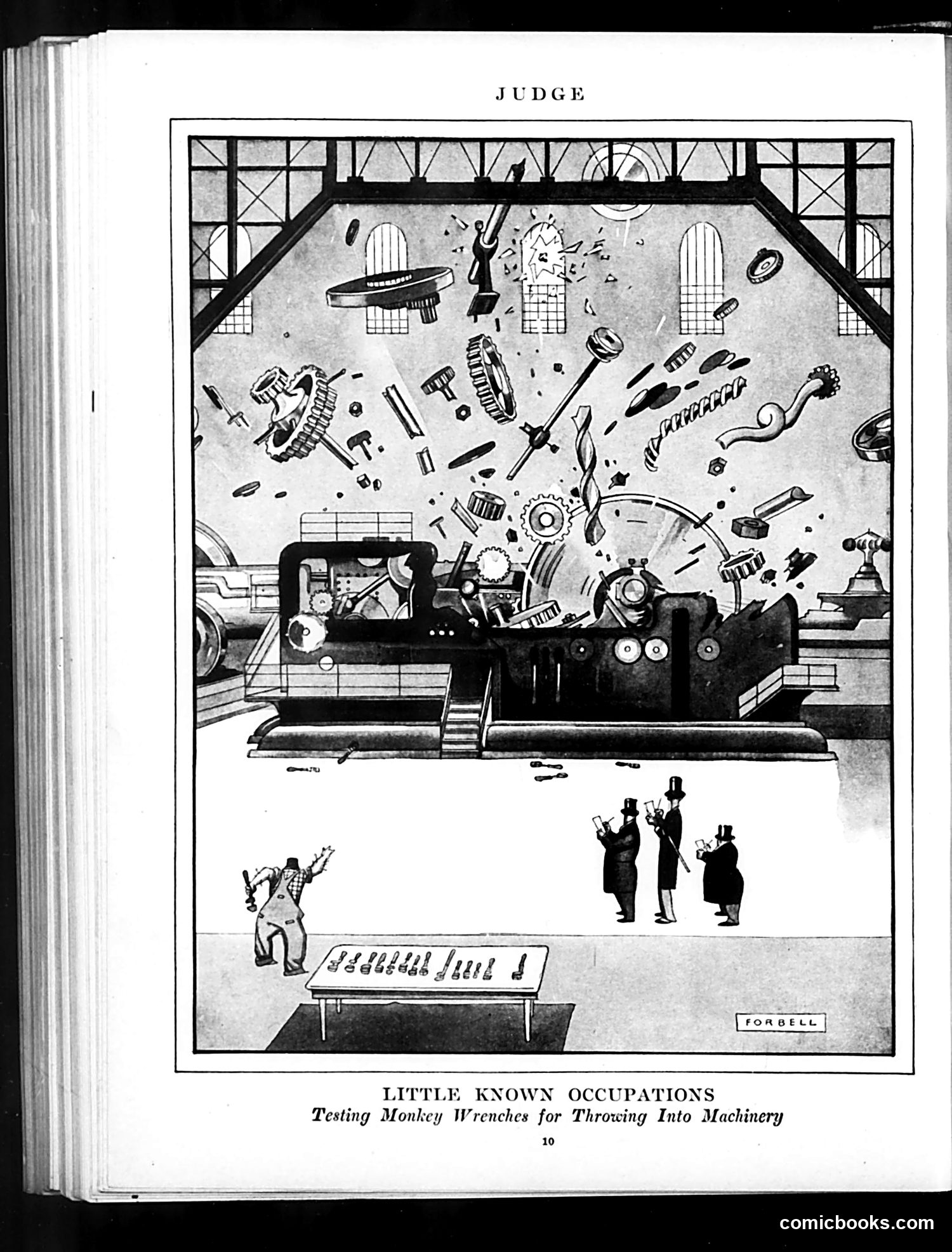
# "Testing Monkey Wrenches for Throwing Into Machinery" This cartoon satirizes labor sabotage and industrial unrest. The "little known occupation" is a monkey wrench tester—a darkly humorous reference to "throwing a monkey wrench into the works," a phrase meaning to deliberately disrupt operations. The image shows factory workers in the foreground observing a chaotic scene above: machinery exploding with parts flying everywhere, while figures operate the destruction. This mocks the period's labor disputes and sabotage tactics employed during industrial conflicts. The satire targets both labor unrest and management's paranoia about worker sabotage—presenting saboteurs as having an actual job title and testing procedures, absurdly formalizing what was genuinely feared as workplace violence. Judge magazine, conservative and pro-business, used this to ridicule labor activism as destructive and organized.