
Judge, 1931-11-14 · page 11 of 36
Judge — November 14, 1931 — page 11: what you’re looking at
What you’re looking at
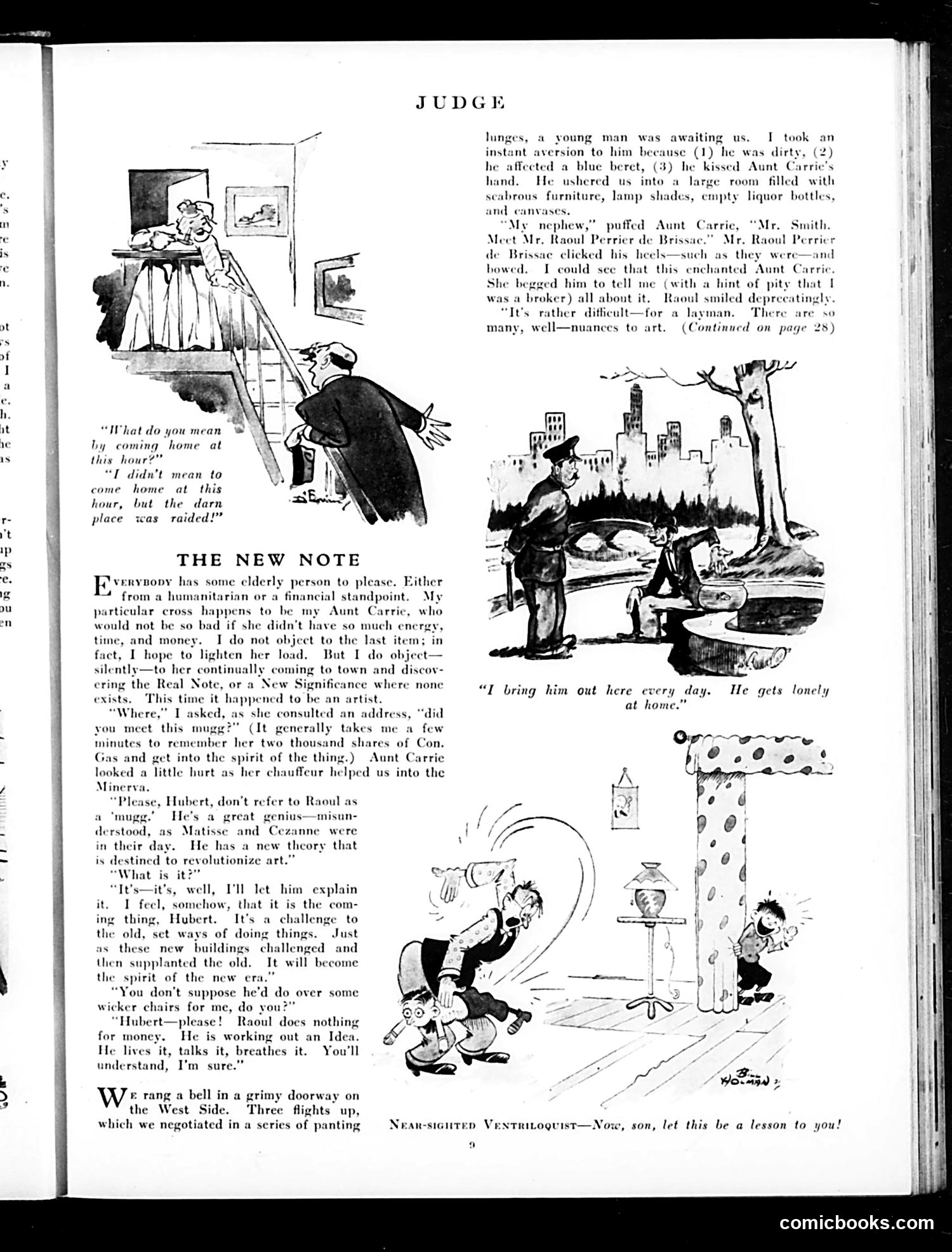
# Judge Magazine Satire Analysis This page satirizes wealthy Americans' fashionable embrace of modern art and bohemian artists during the early 20th century. The main story mocks Aunt Carrie, a wealthy woman patronizing "Raoul Perrier de Brissac," a pretentious artist living in squalid conditions on the West Side. The satire targets how wealthy dilettantes romanticize struggling artists as geniuses while the artists exploit this admiration. Raoul affects the stereotypical "artiste" pose—beret, hand-kissing, pseudo-intellectual talk about "nuances"—while living in poverty surrounded by "scabrous furniture" and empty liquor bottles. The narrator (Hubert), presented as sensible, finds the whole enterprise absurd, particularly Aunt Carrie's need to discover "the Real Note" or latest artistic trend. The bottom cartoon about a "Near-sighted Ventriloquist" appears unrelated social commentary, likely mocking misguided authority figures. The joke: wealthy patrons' gullible enthusiasm for avant-garde art and bohemian lifestyle is ridiculous posturing that primarily serves artists' financial interests, not genuine artistic revolution.
📄 Transcribed text from this page (OCR, searchable)
Machine-transcribed from the original scan — historical spelling and the odd misread are preserved.
ip a8 ou we ne | | | : JUDGE lunges, a young man was awaiting us. I took an instant aversion to him because (1) he was dirty, (2) he affected a blue beret, (3) he kissed Aunt Carrie's hand. He ushered us into a large room filled with scabrous furniture, lamp shades, empty liquor bottles, and canvases. “My nephew,” puffed Aunt Carrie, “Mr. Smith. Meet Mr, Raoul Perrier de Brissac.” Mr. Raoul Perrier de Brissac clicked his heelys—such as they were—and bowed. I could see that this enchanted Aunt Carric. She begged him to tell me (with a hint of pity that I was a broker) all about it. Raoul smiled depreeatin “It's rather difficult—for a layman. There are many, well—nuances to art. (Continued on page “What do you mean by coming home at this hour?” “T didn’t mean to come home at this hour, but the darn place was raided!” THE NEW NOTE Byvervzony has some elderly person to please. Either ~ from a humanitarian or a financial standpoint. My particular cross happens to be my Aunt Carrie, who would not be so bad if she didn’t have so much energy time, and money. I do not object to the last item; in fact, I hope to lighten her load, But I do object— silently—to her tinually comin town and discov- cring the Real Note, or a New nee where none exists. This time it happened to be an artist. “Where,” I asked, as she consulted an address, “did you meet this mugg?” (It generally takes me a few minutes to remember her two thousand shares of Con. Gas and get into the spirit of the thing.) Aunt Carrie looked a little hurt as her chauffeur helped us into the Minerva. “Please, Hubert, don’t refer to Raoul as a ‘mugg.’ He's a great genius—misun- derstood, as Matisse and Cezanne were in their ¢ He has a new theory that is destined to revolutionize art.” “Ww is it?” “It’s—it’s, well, I'M let him explain it. I feel, somehow, that it is the com- ing thing, Hubert. It’s a challenge to the old, set ways of doing things. Just as these new buildings challenged and then supplanted the old. It will become the spirit of the new era.” “You don't suppose he’d do over some wicker chairs for me, do you?” “Hubert—please! Raoul does nothing for money. He is working out an Idea. He lives it, talks it, breathes it. You'll understand, I’m sure.” “I bring him out here every day. He gets lonely at home.” Woemge) » W rf rang a bell in a grimy doorway on the West Side. Three flights up, which we negotiated in a series of panting Nean-siguten Ventriroguist—Now, son, let this be a lesson to you! comicbooks.com