
Judge, 1931-11-14 · page 15 of 36
Judge — November 14, 1931 — page 15: what you’re looking at
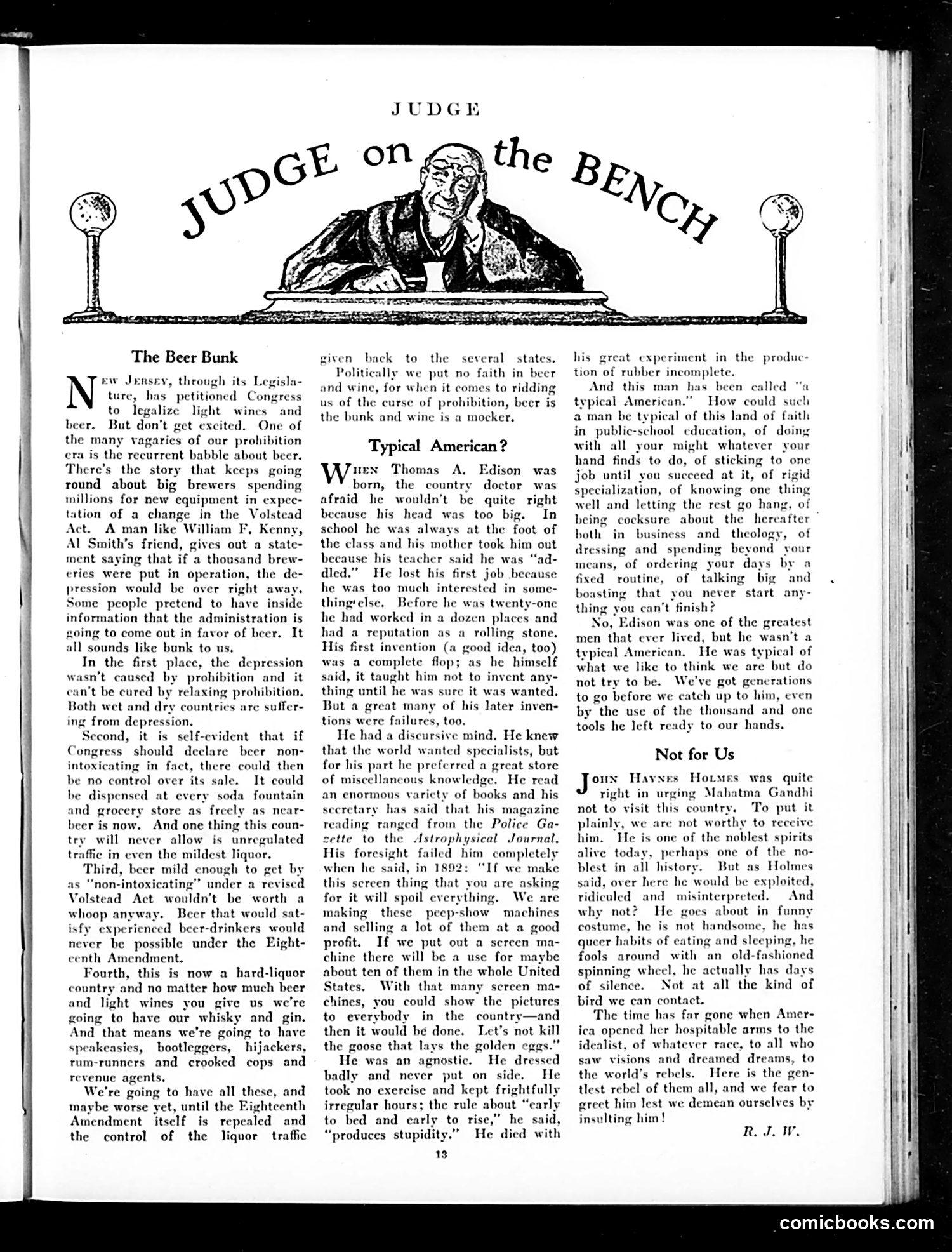
A restored page from Judge, 1931-11-14. Page through the whole issue in the reader above.
📄 Transcribed text from this page (OCR, searchable)
Machine-transcribed from the original scan — historical spelling and the odd misread are preserved.
The Beer Bunk rw Jensey, through its Legisla- N ture, has petitioned Congress to legalize light wines and beer. But don’t get excited. One of the many vagaries of our prohibition cra is the recurrent babble about beer. There's the story that keeps going round about big brewers spending millions for new equipment in expec- tation of a change in the Volstead Act. A man like William F, Kenny, Al Smith’s friend, gives out a state- ment saying that if a thousand brew- s were put in operation, the de: pression would be over right away. Some people pretend to have inside information that the administration is roing to come out in favor of beer. It all sounds like bunk to us. In the first place, the depression wasn’t caused by prohibition and it can't be cured by relaxing prohibition. Both wet and dry countries are suffer- ing from depression. Second, it is self-evident that if Congress should declare beer non- intoxicating in there could then be no control over its sale. It could be dispensed at every soda fountain and grocery store as freely as near- beer is now. And one thing this coun- try will never allow is unregulated traffic in even the mildest liquor. Third, beer mild enough to get by as ‘“non-intoxicating” under a revised Volstead Act wouldn't be worth a whoop anyway. Beer that would sat- isfy experienced beer-drinkers would never be possible under the Eight- centh Amendment. Fourth, this is now a hard-liquor country and no matter how much beer and light wines you give us we're going to have our whisky and gin. And that means we're going to have speakeasies, bootleggers, hijackers, rum-runners and crooked cops and revenue agents. We're going to have all these, and maybe worse yet, until the Eightcenth Amendment itself is repealed and the control of the liquor traffic JUDGE given back to the several states. Politically we put no faith in beer and wine, for when it comes to ridding us of the curse of prohibition, beer is the bunk and wine is a mocker. Typical American? mex Thomas A, born, the country doctor was afraid he wouldn't be quite right because his head was too big. In school he was always at the foot of the class and his mother took him out because his teacher said he was “ad- dled.” He lost his first job because he was too much interested in some- thingrelse. Before he was twenty-one Edison was he had worked in a dozen places and 1 a reputation as a rolling stone. first invention (a good idea, too) was a complete flop; as he himself said, it taught him not to invent any- thing until he was sure it was wanted. But a great many of his later inven- tions were failures, too. He had a discursive mind. He knew that the world wanted specialists, but for his part he preferred a great store of miscellancous knowledge. He read an enormous variety of books and his secretary has said that his ma reading ranged from the Police Ga- tte to the Astrophysical Journal. His foresight failed him completely when he said, in 18 “If we make this sercen thing th are asking for it will spoil every We are making these peep-show machines and selling a lot of them at a good profit. If we put out a screen ma- chine there will be a use for maybe about ten of them in the whole United States. With that many screen ma- chines, you could show the pictures to everybody in the country—and then it would be done. Let's not kill the goose that lays the golden eggs.” He was an agnostic. He dressed badly and never put on side. He took no exercise and kept frigl tfully irregular hours; the rule about to bed and early to rise,” he “produces stupidity.” He died with 13 his great experiment in the produc tion of rubber incomplete. And this man has been called “a typical American.” How could such a man be typical of this land of faith in public-school education, of doing with all your might whatever your hand finds to do, of sticking to job until you succeed at it, of ri specialization, of knowing one thing well and letting the rest go hang, of being cocksure about the hereafter both in business and theology, of dressing and spending beyond your means, of ordering your days by a fixed routine, of big ‘and boastin, never start any- thing y No, Edison was one of the greatest men that ever lived, but he wasn’t a typical American. He was typical of what we like to think we are but do not try to be. We've got generations to go before we catch up to him, even by the use of the thousand and one tools he left ready to our hands. Not for Us oun Haynes Hotmes was quite right in urging Mahatma Gandhi not to visit this count To put it plainly, we are not worthy to receive him. He is one of the noblest spirits alive today, perhaps one of the no- Dlest in all history. But as Holmes said, over here he would be exploited, ridiculed and misinterpreted. And why not? He about in funny costume, he is not handsome, he has queer habits of eating and sleeping, he fools around with an old-fashioned spinning wheel, he actually has days of silence. Not at all the kind of bird we can contact. The time has far gone when Amer- ica opened her hospitable arms to the idealist, of whatever race, to all who saw visions and dreamed dreams, to the world’s rebels. Here is the gen- tlest rebel of them all, and we fear to greet him lest we demean ourselves by insulting him! you goes RJILW. comicbooks.com