
Judge, 1931-11-14 · page 20 of 36
Judge — November 14, 1931 — page 20: what you’re looking at
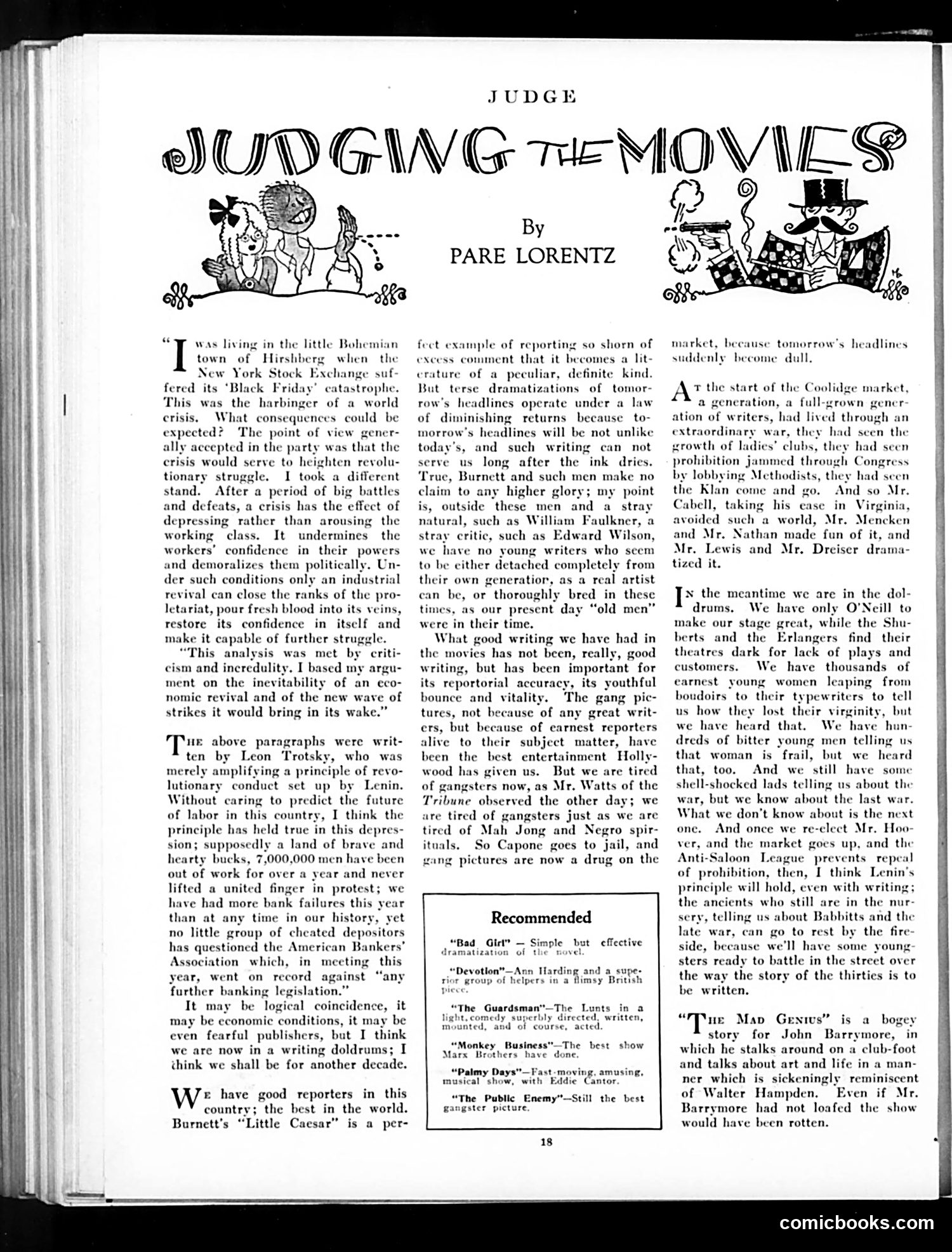
A restored page from Judge, 1931-11-14. Page through the whole issue in the reader above.
📄 Transcribed text from this page (OCR, searchable)
Machine-transcribed from the original scan — historical spelling and the odd misread are preserved.
UVGWG Te) was living in the little Bohemian town of Hirshberg when the ‘ew York Stock Exchange suf- fered its ‘Black Friday’ catastrophe. This was the harbinger of a world crisis, What consequences could be expected? The point of view gener- ally accepted in the party was that the crisis would serve to heighten revolu- tionary strugg' 1 took a different stand. After a period of big battles and defeats, a crisis has the effect of depressing rather than arousing the working class. It undermines the workers’ confidence in their powers and demoralizes them politically. Un- der such conditions only an industrial ival can close the ranks of the pro- iat, pour fresh blood into its veins, restore its confidence in itself and make it capable of further struggle. “This analysis was met by criti- cism and incredulity. I based my argu- ment on the inevitability of an eco- nomic revival and of the new wave of strikes it would bring in its wake.” ie above paragraphs were writ- ten by Leon Trotsky, who was merely amplifying a principle of revo- lutionary conduct set up by Lenin. Without caring to predict the future of labor in this country, I think the principle has held true in this depres- sion; supposedly a land of brave and hearty bucks, 7,000,000 men have been out of work for over a year and never lifted a united finger in protest; we have had more bank failures this year than at any time in our history, yet no little group of cheated depositors has questioned the American Bankers’ Association which, in meeting this year, went on record against “any further banking legislation.” It may be logical coincidence, it may be economic conditions, it may be even fearful publishers, but I think we are now in a writing doldrums; I think we shall be for another decade. W: have good reporters in this country; the best in the world. Burnett's ittle Caesar” is a per- JUDGE By PARE LORENTZ fect example of reporting so shorn of nent that it becomes a lit- erature of a peculiar, definite kind. But terse dramatizations of tomor- row’s headlines operate under a law of diminishing returns because to- morrow’s headlines will be not unlike today’s, and such writing can not serve us long after the ink dries. True, Burnett and such men make no claim to any higher glory; my point is, outside these men and a_ stray natu Faulkner, a stray cr! such as Edward Wilson, we have no young writers who seem to be either detached completely from their own generatior, as a real artist can be, or thoroughly bred in these s our present day “old men” were in their time. What good writing we have had in the movies has not been, really, good writing, but has been important for its reportorial accuracy, its youthful bounce and vitality. The gang pic- tures, not because of any great writ- ers, but because of earnest reporters ve to their subject matter, have been the best entertainment Holly- wood has given us. But we are tired of gangsters now, as Mr. Watts of the Tribune observed the other day; we are tired of gangsters just as we are tired of Mah Jong and Negro spir- ituals, So Capone goes to jail, and gang pictures are now a drug on the eXCESS COL Recommended “Bad Girt” — Simple but effective dramatization he nove “Devotlon”—Ann Harding and a supe- rior group of helpers in a flimsy British “The Guardsman"—The Lunts in a ne 1 omedy superbly cted, written, J of cou! ted. “Monkey Business"——The best Marx Brothers have done. almy Days” musical show, show Fast-moving, amusing, with Eddie Cantor. “The Public Enemy—Still the best gangster picture. market, because tomorrow's headlines suddenly become dull. tT the start of the Coolidge market, a generation, ation of writers, | extraordir growth of | full-grown. gener d lived through an war, they had seen the es’ clubs, they had seen prohibition jammed through Cor by lobbying’ Methodists, they had seen the Klan come and go. And so Mr. Cabell, taking his ease in Virgin avoided such a world, Mr. ™ and Mr. Nathan made fun of it, and Mr. Lewis and Mr. Dreiser drama- tized it. I ‘ the meantime we are in the dol- drums. We have only O'Neill to make our s great, while the Shu- berts and the Erlangers find their theatres dark for lack of plays and customers. We have thousands of earnest young women leaping from boudoirs to their typewriters to tell us how they lost their virginity, but we have heard that. We have hun- dreds of bitter young men telling us that woman is frail, but we heard that, too. And we still have some shell-shocked lads telling us about the war, but we know about the last war. What we don’t know about is the next one. And once we re-elect Mr. Hoo- ver, and the market goes up, and the Anti-Saloon League prevents repeal of prohibition, then, I think Lenin's principle will hold, even with writing the ancients who still n the nur- sery, telling us about Babbitts and the late war, can go to rest by the fire- side, because we'll have some young: sters ready to battle in the street over the way the story of the thirties is to be written. “Mune Mav Genius” is a_ bog story for John Barrymore, in which he stalks around on a club-foot and talks about art and life in a man- ner which is sickeningly reminiscent of Walter Hampden. Even if Mr. Barrymore had not loafed the show would have been rotten. comicbooks.com