
Judge, 1931-11-14 · page 18 of 36
Judge — November 14, 1931 — page 18: what you’re looking at
A restored page from Judge, 1931-11-14. Page through the whole issue in the reader above.
📄 Transcribed text from this page (OCR, searchable)
Machine-transcribed from the original scan — historical spelling and the odd misread are preserved.
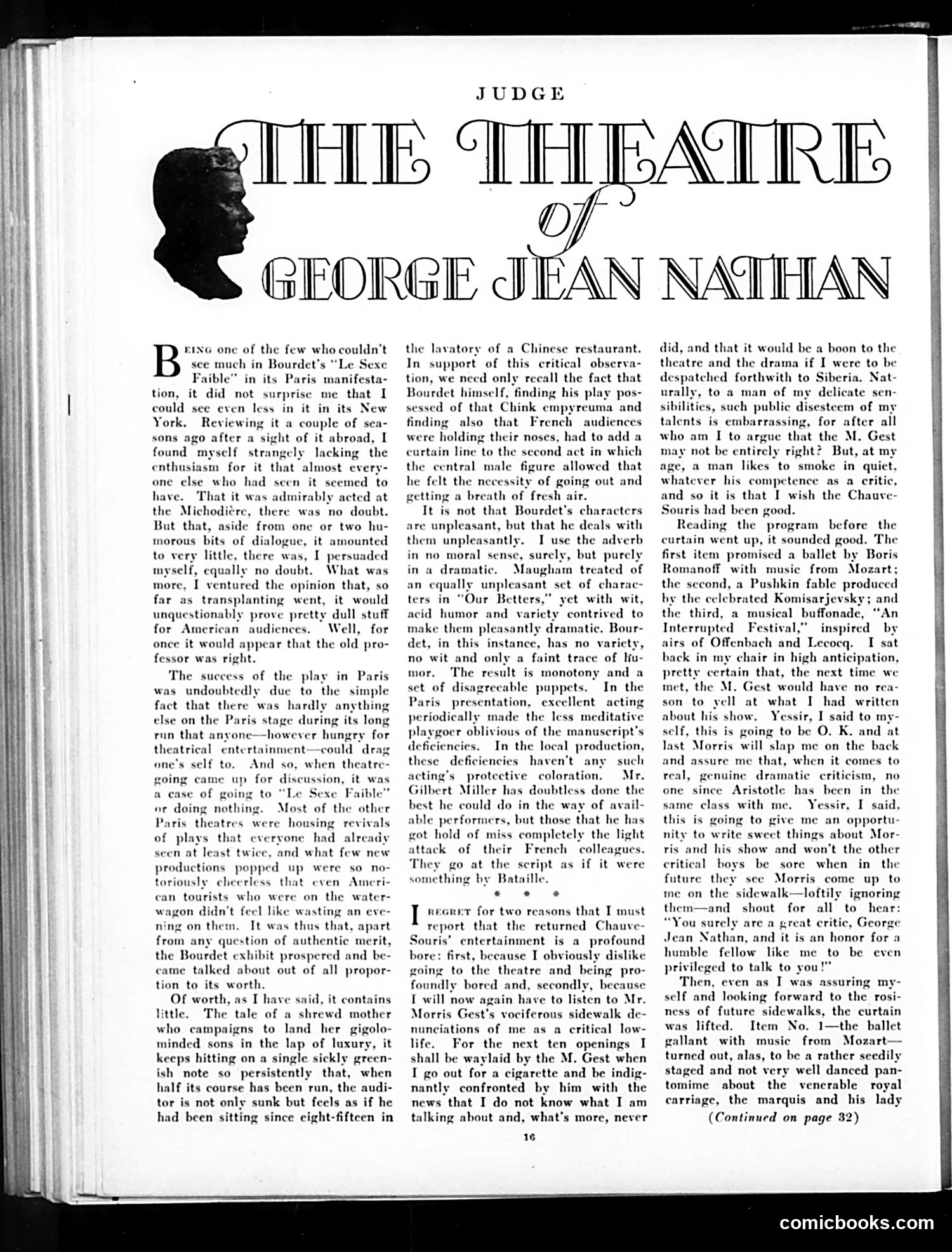
| | | | LEAR LA IAL | sascha TITS IID FING one of the few who couldn't B see much in Bourdet’s * Sexe aible” in its Paris manifesta- tion, it did not surprise me that I could see even less in it in its New York. Reviewing it a couple of sea- sons ago after a sight of it abroad, I found myself. str: lacking the enthusiasm for it that almost every- one else who had seen it seemed to have. That it was admirably acted at the Michodiére, there was no doubt. But that, aside from one or two hu- morous bits of dialogue, it amounted to very little, there was, I persuaded myself, equally no doubt. What was more, I ventured the opinion that, so far as transplanting went, it would unquestionably prove pretty dull stuff for American audiences. Well, for once it would appear that the old pro- fessor was right. The success of the play in Paris was undoubtedly due to the simple fact that there was hardly anything else on the Paris stage during its long run that anyone—however hungry for theatrical entertainment—could drag s self to. And so, when theatre- came up for discussion, it was a case of going to “Le Sexe Faible” or doing nothi Most of the other Paris theatres were housing revivals of plays that everyone had already seen at least twice, and what few new productions popped up were so no- toriously cheerless that even Ameri- can tourists who were on the water- wagon didn’t feel like wasting an eve- on them. It was thus that, apart from any question of authentic merit, the Bourdet exhibit prospered and be- came talked about out of all propor- tion to its worth. Of worth, as I have said, it contains little. The tale of a shrewd mother who campaigns to land her gigolo- minded sons in the lap of luxury keeps hitting on a single sickly green- ish note so persistently that, when half its course has been run, the audi- tor is not only sunk but feels as if he had been sitting since ecight-fifteen in JUDGE the lavatory of a Chinese restaurant. In support of this critical observa- tion, we need only recall the fact that Bourdet himself, finding his 7 sessed of that Chink empyreuma and finding also that French audiences were holding their noses, had to add a curtain line to the second act in which the central male figure allowed that he felt the necessity of going out and getting a breath of fresh air. It is not that Bourdet's characters are unpleasant, but that he deals with them unpleasantly. I use the adverb in no moral sense, surely, but purely in a dramatic. Maugham treated of an equally unpleasant set of charac- ters in “Our Betters,” yet h wit, acid humor and variety contrived to make them pleasantly dramatic. Bour- det, in this instance, has no variety, no wit and only a faint trace of Itu- mor. The result is monotony and a set of disagreeable puppets. In the Paris presentation, excellent acting periodically made the less meditative playgoer oblivious of the manuscripts deficiencies. In the local production, these deficiencies haven't any such acting’s protective coloration. © Mr. Gilbert Miller has doubtless done the best he could do in the way of able performers, but those that he I got hold of miss completely the light attack of their French colleagues. They go at the script as if it were something by Bataille. eee « I reoret for two reasons that I must report that the returned Chauve- Souris’ entertainment is a profound bore: first, because I obviously dislike going to the theatre and being pro- foundly bored and, secondly, because I will now again have to listen to Mr. Morris Gest’s vociferous sidewalk de- nunciations of me as a critical low- life. For the next ten openings I shall be waylaid by the M. Gest when I go out for a cigarette and be indig- nantly confronted by him with the news that I do not know what I am talking about and, what’s more, never 16 gre Tpare GEOKGE RA NATHAN did, and that it would be a boon to the theatre and the drama if I were to be despatched forthwith to Siberia. Nat- to a man of my delicate sen- ics, such public disesteem of my talents is embarrassing, for after all who am I to argue that the M. Gest ot be entirely right? But, at my a man likes to smoke in quiet, shatever his competence as a critic, and so it is that I wish the Chauve- Souris had been good. Reading the program before the curtain went up, it sounded good. The first item promised a ballet by Boris Romanoff with music from Mozart; the second, a Pushkin fable produced by the celebrated Komisarjevsky; and the third, a musical buffonade, “An Interrupted Festival,” inspired by airs of Offenbach and Lecoc I sat back in my chair in high anticipation, pretty certain that, the next time we met, the M. Gest would have no rea- son to yell at what I had written about his show. Yessir, I said to my- self, this is going to be O. K. and at last Morris will slap me on the back and assure me that, when it comes to real, genuine dramatic criticism, no one since Aristotle has been in the same class with me. Yessir, I said. this is going to give me an opportu- nity to write sweet things about Mor- ris and his show and won't the other critical boys be sore when in the future they see Morris come up to me on the sidewalk—loftily ignoring them—and shout for all to “You surely are a great critic, Geo Jean Nathan, and it is an honor for a humble fellow like me to be even privileged to talk to you!” Then, even as I was assuring my- self and looking forward to the ros’ ness of future sidewalks, the curtain was lifte Item No. 1—the ballet gallant with music from Mozart— turned out, alas, to be a rather seedily staged and not very well danced pan- tomime about the venerable royal carriage, the marquis and his lady (Continued on page 82) comicbooks.com —— er —.